Road, Movie (2009), written and directed by Dev Benegal, follows Vishnu (played by middle cinema darling Abhay Deol), the son of a small time hair oil seller, who borrows an ancient Chevrolet truck from his neighbour and hits the road on the pretext of selling his father’s stock and delivering the truck to its proper destination. Little does he care that the truck doubles as mobile cinema. On his way, he encounters a village in dire need of water where a dacoit group has been terrorizing the villagers, appropriating the available water, bottling it and selling it back to them. A paean to popular cinema of yesteryear, specifically to those times when films used to be a collective social experience that transcended class, race, gender and other disparities, Road, Movie views (and literalizes, as in the carnival segment) cinema, in the Bazinian sense, as a collective dream that acts as a fulfillment ground for our real life desires. Consequently, it laments the death of that collective experience due to corporatization of film production and segmentation of potential markets*. Through plot details, bizarrely enough, it equates cinema to both water (suggesting that both are essentially public commodities unjustly being appropriated for the benefit of a few) and oil (in that both are ultimate stress-busters and great social levelers, as is pointed out in the recurring song borrowed from Guru Dutt’s Pyaasa (1957)). Road, Movie is also self-consciously generic, as its title points out, likening the journey on a road to the trajectory and experience of a movie. True to the conventions of its genre, the individualistic, petit bourgeois protagonist realizes the meaning and importance of living in a community and, among other bromides, that the journey is more important than destination. But then, Benegal also keeps deviating from the genre in that he avoids conjuring up a revolutionary hero out of Vishnu. He may mean good, he might have learned a few important lessons, but he’s as helpless in front of these social forces as he was at the beginning. He can do nothing but go back to his dreary middle class existence. Oh well, at least there’s Tel Malish.
[*See Jonathan Rosenbaum’s review of Sleepless in Seattle (1993) for a detailed examination of the phenomenon]
Anand Patwardhan has been making political documentaries for nearly three decades pursuing diverse and controversial issues that are at the crux of social and political life in India. Many of his films were at one time or another banned by state television channels in India and became the subject of litigation by Patwardhan who successfully challenged the censorship rulings in court. Patwardhan received a B.A. in English Literature from Bombay University in 1970, won a scholarship to get another B.A. in Sociology from Brandeis University in 1972 and earned a Master’s degree in Communications from McGill University in 1982. Patwardhan has been an activist ever since he was a student — having participated in the anti-Vietnam War movement; being a volunteer in Caesar Chavez’s United Farm Worker’s Union; working in Kishore Bharati, a rural development and education project in central India; and participating in the Bihar anti-corruption movement in 1974-75 and in the civil liberties and democratic rights movement during and after the 1975-77 Emergency. Since then he has been active in movements for housing rights of the urban poor, for communal harmony and participated in movements against unjust, unsustainable development, miltarism and nuclear nationalism. [Image Courtesy: Icarus Films, Bio Courtesy: Official Site]
The most acclaimed Indian documentary filmmaker, Anand Patwardhan has been called the Michael Moore of India, although the latter started his career much later than Patwardhan did. The comparison is not entirely unwarranted though. For one, Patwardhan’s political inclination is very similar to that of the Canadian-American. He even admires Moore’s works to a large extent. But of more interest is the commonality between their styles. Like in the films of Moore, the image and the sound counterpoint each other at the most critical junctures. But, unlike in Moore where it’s almost exclusively played out for laughs, this friction is also used to provide highly affecting social ironies or even serve as penetrating summations. Same is true of the dialectical imagery – arrived at though Eisensteinian cutting or, more frequently, within the same shot – in his films. This might sound too crude and simplistic, but Patwardhan’s curious, clear-sighted camera and editing never once call attention to themselves or invite us to marvel their artistry. It is almost as if the sound and the image have independent existence since each of them has its own emotional weight and rumination quotient. At times, the image and sound are linked together by folk (generally recorded directly) or pop songs (official versions), which serve as catharsis for the pent up resentment and tension. Moreover, these folk songs also help illustrate how a community uses its art forms to make a record of its problems and struggles and to develop a sense of clanship among its members to help them go on.
Another singular aspect of Patwardhan’s cinema is his attention to dialects, language and speech patterns. Although there must have been considerable amount of luck in making many of these observations, the amazing consistency with which these nuggets steal the speeches they appear in makes this an ostensible trademark of the director. A chief nuclear scientist believes, albeit with a modicum of humour, that the numerous berserk cows did not spoil the nuclear test because they are sacred. A well-off, educated urban businessman, who has, along with his wife, resorted to religious methods for having a child, tells us (among other atrocities) that Hinduism is extremely liberal and broad minded in comparison to Islam and that “women cannot be divorced very easily”. An atheist (or secular) speaker of the Left uses the term “Lakshman Rekha” to denote the poverty line. This scrupulous attention to representation extends also to the visual language. Mass media, especially mainstream cinema and popular television (shows and news – rather interchangeable really), make regular appearances in Patwardhan’s films and are used to highlight their regressive influence. Although the working methods that he has developed over time bear an unmistakable authorial stamp (save for two rather ordinary short films), Patwardhan claims that he does not believe in deliberate stylization and that there is no conscious aesthetic in his films. In fact, the only cinematic influence that he mentions in interviews is that of Imperfect Cinema (Patwardhan’s films are certainly works of Third Cinema and his essay on The Battle of Chile (1977) is an illuminating read). So it should of little doubt that his politics is what informs his aesthetics.
In a way, Anand Patwardhan could be called the child of Karl Marx and Karamchand Gandhi. If there is one vein that runs throughout Patwardhan’s filmography, it is the attempt to suitably wed class consciousness with nonviolent methods of problem solving. In that respect, all his films could be seen as efforts to demonstrate that this marriage is not just chimerical utopianism, but a practical possibility. He has been criticized for taking sides, for not presenting facts with objectivity and, plainly, for not giving the ‘other’ side a fair hearing. Surely, there can be few qualities more repulsive than non-committedness, neutrality and pseudo-objectivity in a political documentary for you can’t be neutral on a moving train. But then that doesn’t mean films such as Patwardhan’s are propagandistic or, worse, merely personal preferences, worldviews and opinions. His filmmaking is defined by curiosity and compassion rather than didacticism and judgment. Patwardhan’s allegiance is not to any geography, religion, ideology, language or class, but only to humanitarianism (for the lack of a better term), although, ironically, that stance dictates much of his politics. Through the films, it becomes evident that it is not an hatred towards the ruling class, but a genuine concern for the underprivileged that characterizes his cinema. Witness to this attitude is the fact his central interest remains – and this has given birth to the best sections he’s ever done – in the struggles of the oppressed than the acts of the powerful. All his films, in one way or the other, are celebrations of (or pleas for) nonviolent forms of resistance. (He places Mohandas Gandhi, Martin Luther King, B. R. Ambedkar and Salvador Allende on the same pedestal.) It is as if, for him, the struggle itself is more important than the end result. These films testify to the filmmaker’s belief that a struggle for human rights need not necessarily entail dehumanization of oneself, that, to borrow Gandhi’s oft-used quote, “an eye for an eye makes the whole world blind”.
(NOTE: As usual, there are gaping holes here which will be filled once I see those missing films)
Zameer Ke Bandi (Prisoners Of Conscience, 1978)
Shot on grainy 16mm stock that embodies the spirit and theory of Imperfect Cinema that Patwardhan so cherishes, Prisoners of Conscience (1978) captures a particular facet of the tumultuous years following the declaration of emergency by Prime Minister Indira Gandhi in June, 1975: political imprisonment. Through first hand accounts, the director presents details of the appalling brutality of prison procedures and the classism that permeates them. Patwardhan’s major lament is not against Indira’s policies per se, but the very act of holding political prisoners without trial (That the film clearly points out that the situation did not improve much even after Janata Dal came to power testifies to its “nonpartisan” quality). What was unique about the widespread resistance to this political ploy of Indira Gandhi was that it was highly democratic in nature, with participation by both the secular Left and the Hindu-based RSS (a marriage quite unimaginable now), both workers and students, both citizens and immigrants and both radical Maoists and nonviolent Gandhians. Using the various interviews of people from each of these groups, Patwardhan attempts to examine and evaluate his own political leaning by trying to uncover socialist strains in Gandhian philosophy and the possibility of having a nonviolent base for Marxist thought. In additional to his ideology, it is also Patwardhan’s directorial style that seems to have (more or less) found its bearings in Prisoners as is evident in the therapeutic use of folk songs, the ironic cross cutting between Republic Day celebrations and prison proceedings and the general hesitation to be overly acerbic or coldly academic.
Hamara Shahar (Bombay, Our City, 1985)
Bombay, Our City (1985) is a devastating account of the slum clearance operations of the Bombay Municipal Corporation in 1984, in which encroachments by rural immigrants were systematically removed to make way for skyscrapers and to prettify the city. Patwardhan interviews residents of the slums, industrialists in the city, officials at the municipality office and middle class citizens of the city, all of whose words provide a unique insight into the issue. Occasionally, the film falls prey to an unrefined Marxist impulse wherein the director includes images of bourgeois tea parties and yacht races for no reason other than to provide contrast. But then, this sudden shift of gears also seems justified when we witness a group of upper-class folks – the city’s police commissioner included – discussing how to fight this “evil” of encroachments through martial training of youths. What is really extraordinary about the segments involving the slum residents is how remarkably aware these people are of their surroundings and of the numerous forces that bind them. A terrific song compiled by the local theatre group, which forms the spiritual backbone of the film, details the government’s injustices with great humour and pathos. Equally piercing are the testaments of the evicted (One of them says “Instead of removing poverty, they’re removing the poor”, alluding to Indira (and Rajiv) Gandhi’s populist slogan for eradicating poverty). Finally, Bombay, Our City also presents Patwardhan finding his own place as a filmmaker and an activist. One of the slum dwellers accuses Patwardhan of exploiting their misery for artistic gains while the Right accuses him of romanticizing the working class. The director, however, remains the humble inquisitor.
Una Mitran Di Yaad Pyaari (In Memory Of Friends, 1990)
In Memory of Friends (1990) finds Patwardhan in Punjab covering communal clashes between Sikh and Hindu fundamentalists during the Khalistan Movement and the subsequent endeavours of secular parties with Marxist associations in reinstating peace in the state. The subject of In Memory is both philosophically and politically complex (primarily due to different parties holding power at the state and central levels), for the demand for a separate state based on religion is, as Patwardhan remarks, both purely democratic and against democracy. At the focal point of the film is the figure of Bhagat Singh, freedom fighter and revolutionary whose image has been appropriated and manipulated by each political group to suit to its own ideological agenda. The Sikh separatists claim Bhagat Singh was a religious man whereas the right wing extols his nationalism. Even those who remain neutral about him seem to consider him as some sort of an antithesis to the nonviolent Gandhi. This starling rupture between the past and the present – the reality and its image – informs the central structuring device of In Memory. Interleaved with footage of interviews with the secularists, the separatists and the relatives of Bhagat Singh are passages in which Bhagat Singh’s posthumously published jail writings are recited by a narrator (Naseeruddin Shah) which clearly indicate that he was not only a staunch socialist and an atheist who believed that widespread class consciousness was the only way out of communal wars, but also that he deeply admired non-violence. Like all the secular teachings of Sikhism, Bhagat Singh’s beliefs, too, seem to have vanished into the past.
Ram Ke Naam (In The Name Of God, 1992)
In the Name of God (1992) chronicles the immediate and historical events leading up to the demolition of the Babri Mosque in Ayodhya, Uttar Pradesh on 6 December 1992, when thousands of Hindu fundamentalists barged into the mosque premises and started bringing down the structure. Characteristically witty with a very keen eye for tragicomic ironies (The camera casually photographs an eatery named “Shriram Fast Food” as we hear public speakers, mounted on hired trucks, advertising the divinity of Lord Ram), Patwardhan examines the classism that exists within these communal forces (in the form of castes) and charts both the strategies of the then-oppositional Hindu groups, one of whose leaders had undertaken a nationwide propagandist tour, and the efforts of the secular Left in mitigating the communal agitation that seemed to have gripped the country like a plague. Unlike most rationalists, he chooses to view religion not as an entity fascist in its very conception, but as one which is molded by the ideology that propagates it. This is reinforced by the numerous segments featuring with Pujari Laldas, the official priest at the temple inside the mosque premise and a Hindu liberation theologian, the honesty and conviction of whose words suffuse the film with an earnestness and compassion so crucial to sociological filmmaking. But perhaps more than anything, In the Name of God is an elegy for the city of Ayodhya – a city caught unawares by external polarizing forces, its identity erased and reconstituted and its people made to live in perpetual fear.
Pitra, Putra Aur Dharmayuddha (Father, Son And Holy War, 1994)
A twin to In the Name of God, Father, Son and Holy War (1994) is less topical and more contemplative a film than its predecessor in that it attempts to study primeval and deep-rooted social issues with the bloody aftermath of the Babri Mosque demolition as only the backdrop. The central thesis of the film contends that religion and mythology – whatever be their flavour – construct and propagate a skewed sense of masculinity and bravery that is predicated on violence and hatred, which deems non-violence as an impotent principle and which is only exacerbated by most of modern consumerist advertising and certain sections of the mass media. Furthermore, Patwardhan suggests, it is the same texts and practices that define femininity as whatever masculinity isn’t, with passive acceptance, chastity and servility being its prime virtues. The film argues, presenting archaeological evidence, that this was not always the case and that, at the danger of sounding too simplistic, this worship of violence and destruction – in place of fertility and proliferation – started when man learned to domesticate and own animals and settle down. Equally sweeping are its other assertions that attempt to cover of number of social phenomena (including the popularity of WWF and on-screen violence, in general), which runs the risk of decontextualizing the key argument of the film. True, that all these facets are only deeply intertwined, but the film is so ambitious and loosely structured that it almost ends up proving otherwise. These observations would find greater strength and coherence in the director’s decidedly superior work, War and Peace.
A Narmada Diary (1995)
A very pertinent film about the social conditions in the third world – especially after the advent of globalization – A Narmada Diary (1995) sits well alongside works such as West of the Tracks (2003) and Up the Yangtze (2007) in the sense that it chooses to document on film – for us and for posterity – what would otherwise be relegated to the footnotes of most mass media. Co-directed with activist Simantini Dhuru, the film tracks the struggle of an indigenous population (Narmada Bachao Andolan/Save Narmada Movement) living on the banks of river Narmada against the Sardar Sarovar Dam project, which would result in their displacement and massive land submergence. There is a sense of watching history in the making as the group congregates for planning, organizes non-violent protests, confronts key officials responsible for the construction of the dam and exhibits a singular integrity of purpose, further evidencing Patwardhan’s heartfelt admiration for Patricio Guzmán’s masterpiece. Although the Save Narmada Movement is generally known to be led by Medha Patkar, Patwardhan and Dhuru avoid the pitfall of making a hero out of her and building a film around an exceptional individual’s actions. Instead, true to the spirit of this struggle, the directors present her as a key player in a movement organized and executed by the local populace en masse. Additionally, A Narmada Diary is also a personal struggle for Patwardhan as a filmmaker. Like the rebellion, his work stands as the direct antithesis to the pro-dam government propaganda films that make their appearance throughout the picture.
Jang Aur Aman (War And Peace, 2001)
War and Peace (2001) could well have been titled War and Peace: Or How I Learned to Forget Gandhi and Worship the Bomb, for the major theme that runs through the film is the disjunction that exists between the past and the present and a nation’s collective (and selective) cultural amnesia with respect to its own past. Shot in four countries – India, Pakistan, Japan and the USA – and over a period of four years following the 5 nuclear tests done by India in 1998, Patwardhan’s film was slammed by Pakistan for being anti-Pakistani and by India for being anti-Indian, while the film’s barrel was always pointed elsewhere. Tracing out the country’s appalling shift from Gandhianism to Nuclear Nationalism and Pakistan’s follow-up to India’s nuclear tests, Patwardhan examines the role of the two countries as both perpetrators and victims of a major mishap that is now imminent, taking the Hiroshima-Nagasaki incident as a potent example to illustrate why nuclear armament is not merely a potentially hazardous move, but a wholly unethical one. War and Peace is a film that should exist, even if amounts to only the ticking of a radiometer amidst atomic explosions, for it calls for a realization that there can be neither a victor nor a finish point in this internecine race. It is, without doubt, Anand Patwardhan’s masterpiece. [Read full review]
[To The Children Of Swat, From The Children Of Mandala (2009)]
Kanasembo Kudureyaneri(2010) (Riding The Stallion Of A Dream)
Girish Kasaravalli
Kannada
Girish Kasaravalli’s Riding the Stallion of a Dream (2010) is something of a blast from the past, specifically from the Indian parallel cinema of the 1970s of which Kasaravalli himself was a part (This regression in time might just be the point of the film). Like most films of that period, Riding has a keen sense of class politics at work in the hinterlands of the country (There is nothing very specifically 21st century about the script, except for the mention of factories buying farmlands). Furthermore, it embraces the typical aesthetic characteristics of the movement with its use of a traditional, downbeat soundtrack, its penchant for naturalism and, particularly, darkness and its employment of dubbed sound. But more importantly, it retains the optimistic belief of the age that change is indeed possible (even though Kasaravalli’s proposed means of change is much less romantic and much more grounded). However, unlike its predecessors, Kasaravalli’s film is unwilling to overlook the human elements comprising the class struggle. Indeed, this is where the script’s Arriaga-like structure is really put into good use. The film is essentially divided into four segments which alternately present reality as seen by Irya the village gravedigger and his wife Rudri and reality as seen by the son Shivanna and the daughter-in-law Hema of the recently deceased village elder (among other elites). Predictably for a film that deals with multiple classes, Riding is full of ironies small and big. The pristine corridors of the elder’s house are contrasted with the dilapidated interiors and streets of Irya’s home and neighbourhood. Shivanna and Hema are almost always seen trapped inside the claustrophobic villa, which is suffused with the stench of the rotting corpse of the village elder that reflects their moral decay, while the gravedigger and his wife are seen in glorious long shots traversing the wide open spaces and flower farms of the village. The death of the patriarch (whose body has to be forced to a sitting position and whom his son will be taking over from) spells doom for Shivanna and co. while it’s Rudri (there’s even a direct reference to her as Irya’s surrogate mother) who takes to herself to reconstruct her husband’s life. Revealing the old man’s death helps affirm Irya’s dream while it would shatter Shivanna’s and contrariwise. In both camps, it is a blind faith in God and religion that serves to preserve status quo. There is considerable tweaking of the mise en scène – especially in the lighting and actor blocking – as well that aids to emphasize this tug of war. Kasaravalli provides us almost exactly one half of the truth in each segment, leaving it to the subsequent or preceding segment to complement it. A simple shot from a particular segment finds its corresponding reverse shot in only the next segment and vice versa. Each of these couples in the story wants to lead a better, more dignified life, as defined by their social classes. Like the audience, these couples are unable to see what lies on the other side of the hedge and how their seemingly independent plans might affect the other. There is no moral dilemma that they see in their actions. This way, Kasaravalli calls into question the perceptibility of the class structure itself and, subsequently, uses his art to provide us that critical distance from reality which is required to understand it in totality. As a result, the characters in Kasaravalli’s film are not (save for a touch of contempt and sympathy the upper and lower class characters respectively receive from the director – a possible residue of the parallel cinema of yesteryear) class abstractions or oversimplified monsters and victims. They are both individuals with choice and products of their classes (Irya blows his money on alcohol and loafs about regularly, Rudri is a casual thief and some of the landowners in the village do genuinely care about Irya’s condition). Only that each of the couple wants to ride off on its own dream horse and in a direction that it wants. But what both don’t realize is that the horses are tied to the same chariot.
Peepli [Live](2010)
Anusha Rizvi, Mahmood Farooqui
Hindi
A haggard, thirty-ish dimwit cum farmer Nathu (Omkar Das) lies in his house staring at a brand new – decidedly useless – hand pump presented to him after having almost inadvertently announced his suicide. Debutant writer-director Anusha Rizvi weaves a modest satire on mass media and electoral politics around this devastating existential premise that attempts to chastise the two entities for their opportunistic and exploitative response to the wave of farmer suicides in the country. What the film does not pay attention to is the fact that it is the same kind of corporations running these media outlets that are almost entirely responsible for the suicide wave across the nation as well. Not that the film is ignorant of the connection. It only knows the dynamics underpinning the phenomenon too well, as it indicates throughout with a hit-and-run approach, and chooses to concentrate on the effects rather than the causes. The result is a safe and rather neatly performed flogging of the dead horses known as media sensationalism and political hypocrisy that, predictably, detaches its target from the larger political fabric. Backed by some clever compositions and a noteworthy production design that provides an unsettling contrast between the part-godforsaken, part-heavenly hinterland and the sanitized, air-conditioned coldness of the studio interiors, the film is generally unmarred by its advertisement and photography-driven aesthetics and the sporadically sloppy direction. The film attains formidable density in the first half hour, where it starts exploring the imperceptibility of the moral gravity of one’s professional choices in the corporate ladder, and gets an easy and firm grasp of the bubbling up and trickling down processes of information and knowledge. It’s only when the film aims for the occasional dollop of profundity that it strains.
Udaan, one of this year’s entries at Cannes in the Un Certain Regard section, is a coming-of-age tale set in the heartland of India and tells the story of seventeen year old Rohan Singh (Rajat Barmecha) who is expelled from his boarding school in Shimla, along with three of his friends, and is forced to return to his hometown of Jamshedpur to his estranged father, Bhairav Singh (Ronit Roy). He discovers that he has to put up with not only the tyrannical ways of his father but also with his six year old step brother Arjun (Aayan Boradia) who is treated no better than Rohan by their father. Bhairav makes Rohan work out every day. He gets him admitted to an engineering college and instructs him to work in his steel factory. It is clear that it is not just the steel he wants to temper. Rohan regretfully abides, wearing the bland white jacket over his snarky one-liner T-shirts. More interested in the ambiguity of poetry than the precision of engineering drawing, Rohan starts bunking classes, winding up at the river bank to write. Naturally, writing becomes the tool for him to express himself, apart from other methods like shouting into a deserted basement at the dam and reciting largely improvised stories to patients and staff at the local hospital, where his brother is admitted for a few days.
Rohan is portrayed by debutant Rajat Barmecha. Barmecha plays Rohan straight, without the usual film vocabulary actors succumb to, and he is the greatest success for the film. With their long lashes, his eyes suggest everything from desire to rebellion. As Rohan, he appears to be the kind of person who seems to be willing to listen to your problems and the kind of person who hopes that you listen to his. With his “feminine” countenance (a feature that his father derides heavily in the film and the reason I predict that he won’t make it big in Bollywood), he’s also the person you believe won’t be parading his chutzpah or doing something alarmingly foolish. In short, he appears to be a person whom everyone will trust. Ironically, he lies to his father whenever he is in potential trouble (In a well realized arc, he later chooses to tell the truth to his father, not out of guilt, but because he knows that he knows his father well enough and that he can handle the consequences). He would probably have gotten away from his father and his rigid laws if it wasn’t for Arjun, whom he seems to view as a younger, not-yet-scathed version of himself. Predictably, he becomes Arjun’s surrogate father (and mother too, if we are to consider his oft mentioned femininity in the film). Meanwhile, Bhairav’s brother Jimmy (Ram Kapoor), who does not have children of his own, becomes Rohan’s surrogate father and the latter, his surrogate son. Each of the three otherwise unrelated characters is connected to the others via the beastly persona of Bhairav. These are all familiar writing tricks, of course, but first-time director Motwane treats the text with skillfulness of a semi-veteran.
You know that a coming-of-age film is on the right track when it starts with the protagonist jumping over the walls of his hostel into the city streets. In fact, Udaan strictly adheres to the path laid out by the genre, carefully working out culture-specific variations and steering clear of conventional pitfalls of the nation’s industrial cinema. The latter was possible perhaps because the film draws inspiration more from the west’s treatment of the genre than from the melodramatic traditions of Bollywood (more on this later). There seems to be an influence of virtually every landmark coming-of-age film in Udaan. Rohan and his college friends, high on booze, deliberately pick on a group of mooks at a pool hall – a scene that seems directly out of Scorsese’s Mean Streets (1973, the appropriation doesn’t seem like homage or pastiche for it is employed in a very similar fashion for very similar effects. One might also recall that Anurag Kashyap, who has co-written and produced this film, had already harnessed Keitel’s LSD trip in his reworking of Devdas, which Motwane co-wrote). Rohan’s and younger brother Arjun’s having to put up with an authoritarian father they barely know has echoes of The Return (2003), but where, in the latter film, the father is a mythical, metaphorical figure looming over the kids like a phantom, Bhairav is an everyman grounded in reality (One of Rohan’s friends tells that every father in the city is like Bhairav). The teenagers driving like crazy through the city streets at night, too, might have been from Nick Ray. But it is The 400 Blows (1959) that Udaan seems to want to emulate the most. Right from Rohan’s breakout from the regressive boarding school, to the motif of running and up to the final freeze frame on his face (albeit on a less ambivalent note), Udaan smells of Truffaut’s masterpiece (There’s a fleeting, pretty stunning image of Rohan’s face, framed head on with harsh light from above, which recalls young Doinel’s). And that’s besides the fact that this is Vikramaditya Motwane’s debut film and might be highly autobiographical.
Udaan’s embracing of these films, especially The 400 Blows, and the tropes of the genre as treated by the west is of note because it is what defines the interesting politics of the film. Udaan is, at its centre, a war against tradition in all its shapes and sizes. Bhairav is the symbol of tradition and conservatism in the film. He acts like his father did and metes out the same kind of punishment to his kids as his father had to him. With his dark glasses, trimmed moustache and perpetually disgruntled look, he is the quintessential patriarch guarding the passage between tradition and modernity. He has married thrice, works out extensively everyday, drinks every night, smokes throughout, doesn’t hesitate to use his belt on his six year old, ridicules his first son’s feminine looks and is probably also proud of this skewed sense of masculinity of his. He admires the famed industrialists and other icons of Jamshedpur and literally prostrates before them. He calls his brother Chotu (“little one”, which he sure isn’t) and insists that the kids address him as “sir”. His brother Jimmy is the counterbalancing force to Bhairav in the film. He is a man who had chosen the road less traveled (and supposedly failed). He is a progressive man who believes that Rohan should do what he wants to. It is Jimmy who paid any heed to what Rohan’s mother felt her son should become. Bhairav, on the other hand, is disgusted by Jimmy’s impotence and obesity (he would have anyway called Jimmy impotent, given his definition of what being masculine is). The two vastly different father figures, resulting from a schism within the family, are the choices provided to Rohan, who similarly has to choose between industrial work and poetry. Obviously, he chooses to emulate Jimmy, and in a predictably rebellious manner.
[Udaan (2010) Trailer]
Along the film, Rohan repudiates everything that is traditional and everything that binds him to his biological father. He shatters the rickety old car of his father with a crowbar, he discards the familial watch that Bhairav gives him on his eighteenth birthday (a familiar cliché in Indian cinema) and he even punches his father right on the face. Towards the end, he manages to make his father chase him unsuccessfully, once and for all, after having run behind him everyday. He will perhaps become everything his father isn’t (which is exactly what the latter tries to prevent). There is also a conspicuous absence of women in the film. Motwane and Kashyap avoid the pitfall of succumbing to the view that all women are victims of tradition. There are two women who are alluded to in the film – Rohan’s deceased mother who wanted her son to be a writer and his friend’s mother who chastises her son for having thrown out his abusive father out of the house – who, too, reflect the dichotomy between modernity and tradition that Jimmy and Bhairav respectively represent. Moreover, Rohan being a very liberal person like his mother (whom he seems to have a lot of love for) and his wanting to break away from Bhairav’s patriarchy puts the film onto an oedipal course as well, which is not very alien to the narrative at hand. One reason why Udaan is one of the few truly liberal films out there is because it carefully avoids, through its script choices, subscribing to that awful pseudo-liberal axiom that you can follow your dream no matter who you are. By locating the protagonist in a regressive middle class setup (which is beset by the problems caused by the recession) and eventually shifting him into a more progressive, flexible middle class, Udaan comes across as an honest, non-exploitative bourgeois film. Of course, it does not mobilize this trajectory for more overtly political purposes (Rohan father is a steel industrialist in Jamshedpur while his friend’s parents live in Singur. This tempting premise is left unexplored), but that’s probably because the film chooses to work completely within the genre.
This liberal support of the individual, free of all traditional baggage, is what makes Udaan a very “western” film (“western” in the same way Kurosawa was) and it is perhaps what makes the film very offbeat with respect to Bollywood cinema as well. Where the typical film would have portrayed Bhairav as an ogre on the outside and a child within (he would probably have confessed his love for his son to a friend or would have spread a blanket over Rohan while he’s asleep!), Udaan retains him as a threatening force. There’s no gentle giant act that Bhairav is made to undergo. But that does not mean that he is merely a concept or a one-dimensional monster. What makes him very human is the fact that he seems to know that he’s acting it all out. He’s a man blinded by tradition no doubt, but seems to be aware of that limitation. He tells Rohan that he didn’t have much to say to him when he visited his school. Even when he apologizes to his kids (before he distracts them from reflection), he does so within the limits of dignity allowed by his “character”. The triumph of writing lies in its belief that it need not “prove” that Bhairav is a human being. He just is and Ronit Roy plays him with the same kind of conviction. This consciousness of one’s limitations and the choice to be what one is also goes down well with the basic libertarian idea, which the film espouses, of a man making up his own destiny (which is very frequently mutated to condemn crimes of all kinds).
Udaan’s one more connection to The 400 Blows must be noted. While Truffaut’s work tried to break away from a tradition and the moral squalor that it seems to have brought, it simultaneously represented a move away from the traditions of cinema, with its technical radicalism and its inclination to make cinema author-centric. It was a battle being fought against the tradition (of quality) on multiple levels, virtually kicking off the New Wave. Udaan, on the other hand, has its feet planted firmly on the genre. Motwane is not a strict modernist like Truffaut was. Even if he is opposed to tradition and might be using cinema as a medium of personal expression, he does not go to the extent of taking up genre-blending or self-reflexivity. Sure, it does break away from the conventional story telling methods of the national cinema, but it does so only to adopt conventions of a different cinema. The aesthetics of the film – sunrays scattered by tree leaves piercing the camera lens, faces gazing towards infinity from the edge of the frame, cute symbolism, characters dragged softly into and out of the shallow focus and guitar riffs trying to create the blues – virtually cry out “Sundance!”. Some of the lines feel very scripted (a shortcoming that is commented on within the film and nearly overcome by making the protagonist a writer). But there are stretches in Udaan that are also directed with considerable finesse. There is much restraint in the score. Where a lesser film would have tried to cover up the silence with piano pieces, Udaan dares to leave it as it is. In the film’s most striking moment, Rohan relaxes on a cot after having dragged his heavy trunk upstairs. There’s no music. Almost no sound. Just the anxious face of a teenager back from an arduous journey and ready to embark on a longer and more important one. The shot lasts a few seconds. You wish it went on – the shot and the journey.
Director Priyanandan’s National Award winning Pulijanmam (2006) charts the efforts of a middle-aged, true-blue communist playwright Prakash (the recently deceased Murali Nair) who is about to stage a play based on a folk legend about a highly-skilled man, Kari, of the lower caste who defies god and enters the dark woods, assuming a tiger incarnation, to bring back tiger mane in order to cure the madness of the ruler. “Every generation takes what it wants from a story” says Prakash early on. For one, he sees himself as a reincarnation of Kari and the play as some sort of a self-portrait. History and mythology merge as Prakash finds his campaign against religion and against the ruling communist party’s decision to allow corporations to build resorts over farm lands to be increasingly similar to Kari’s inhuman crusade. Writers N. Prabhakaran’s and N. Sasidharan’s ambition to chronicle the fall of communism in one of the nation’s two most left-leaning states is palpable, but Priyanandan’s methods hurt the film beyond recovery. The director resorts to too much cross cutting, trying to thrust the parallel between the two stories down our throats and destroying the intrigue built up by the film’s first half-hour. The cinematography and composition is purely functional, with some flashes of brilliance to hold attention. Then there’s also the script’s tendency to cover too much ground and make a few social observations too many that stick out like a sore thumb. I must say it’s a tad disappointing to see this film being given the Indian National Award for best film over Goutam Ghose’s ideologically kindred and infinitely superior Yatra (2006).
“Your brother’s going away hasn’t changed him a bit. Such pride! Even your leaving will not shame him. He is as he was.”
Kumar Shahani remains one of the directors in that rarely seen and even more rarely discussed group of filmmakers that includes names such as Mani Kaul and M. S. Sathyu. Unfortunately, neither are there home video releases for most of their works nor are there widespread public screenings or film fest retrospectives within the country to generate interest. Heck, they don’t even make their way into the world of file sharing and peer to peer networks. We are now at a point where even the original negatives of the films face the risk of extinction. One can only hope that institutions like the World Cinema Foundation will do something about it. Kumar Shahani’s Maya Darpan (1972) is a seminal work in Indian Parallel Cinema not just because it canvasses critical social issues (a facet that, more or less, in hindsight, has become a characteristic of the movement) but also because it attempts to seek out a new aesthetic, which does not try to straddle mainstream cinema and art cinema, to do that. The very title, Maya Darpan (literally “Illusory Mirror”), aptly sums up both the film’s social (imprisonment by one’s own “image”, as defined by the class system) and formal (Maya Darpan could well be a sobriquet for cinema itself, encompassing both its illusive and realistic properties at once) concerns at once.
Shahani’s film is set in a provincial town in Northern India, at a time following the nation’s independence in 1947 (The film could well have been set in 1972, just after the worldwide leftist revolution had been put down, and there wouldn’t be much change to the script) when India was yet to be completely integrated as a political entity and when Nehruvian socialism was about to take on the existing feudal hierarchy. Taran (Aditi) is the daughter of a wealthy landlord (Anil Pandya) and lives with her father and her widowed aunt (Kanta Vyas) in their ancestral mansion (which goes on to represent the whole of upper class in the film). The town is witnessing protests by newly formed labour unions which are partly being politically educated by the local railroad engineer (Iqbalnath Kaul), who seems to have an unspoken romantic relationship with Taran. Taran’s unseen brother, who had, to the chagrin of their father, renounced his class privileges and gone off to an Assamese tea estate, asks Taran to join him. Stuck in a stifling patriarchal order, with pressure to get married to an upper class groom mounting, Taran decides to talk to her father about her plans. Actually, much less goes on in the film than what I’ve described and the film is more interested in assessing the formal possibilities of the medium than in following a seamless opportunity-conflict-resolution trajectory. Taran’s character does not arc in the traditional manner (she seems to have already entered the third act) although she eventually manages to switch roles with her lover.
Maya Darpan is a film about transition and transformation – from the bondage of regressive social structures to a progressive state of liberty and equality, from a setup where people have to assume rigid roles irrespective of free will to one where a individual can free himself of inherited roles and think for himself/herself (Taran recites a poem – “I’m called to birth again” – that recalls the legend of the phoenix, as she washes her hands). In other words, it is about the process of breaking the cycle of repression and exploitation into a zone of freedom (Shahani even inserts newsreels depicting World War 2 battle sequences and Gandhian protests during the British rule of India, perhaps to suggest all forms of oppression and subjugation). Shahani finds the cinematic idiom to express this cycle in the form of duplicated shots, redundant compositions and repeated actions and dialog. There are many shots that depict characters moving from the right edge of the screen to the left that are so schematic and mundane to the point of being humorous and self-parodying (One of Taran’s daily routines is to dust the set of chairs – presumably the symbols of power and authority in the film – that her father and other landlords use during their teatime. Fittingly, they are left scattered and disowned by her towards the end of the film). This transgression of social boundaries is also depicted by having characters cut through boundaries and cross railway tracks regularly. Consequently, Maya Darpan plays out like a piece of complex musical composition with many minute variations on a few primary motifs (The film’s unexpected coda itself is a set of classically choreographed tableaus that, I believe, presents the class conflict in dance/martial art form).
Shahani apparently assisted Robert Bresson on A Gentle Woman (1969) and the influence of the French director on Shahani’s style is obvious (especially the extraordinary opening sequence of that particular film, which is echoed at multiple places in Maya Darpan). Like Bresson, Shahani’s shot division has a tendency to break down sequences into their most basic components. Images of hands and feet, isolated in action, often punctuate the narrative. Also Bressonian is the use of sound in the film. Shahani employs tremendous amount of off-screen noise to complement the imagery rather than reinforce it (This divorce between image and sound is alluded to in the very first scene of the film – the nomadic camera, at first, seems to be searching for the voice on the soundtrack and eventually settles down near a sleeping character. The voice turns out to be non-diegetic). The presence of trains, automobiles, oxcarts and taps are all established by the soundtrack. In fact, the camera is never made privy to any sensational action. These actions are either relegated to the space off-screen or they are only provided to us through words. But the influence of Bresson is most palpable in Shahani’s use of his actors. He asks the actors, all non-professionals, to have no expression whatsoever on their faces when spouting their lines monotonically, without any modulation. The effect is all the more unsettling given how vehemently it goes against the natural speech pattern of the country.
As a result, Maya Darpan could be described as a film in which the sociopolitical concerns of Shyam Benegal and John Abraham are distilled through the minimalist aesthetics of Bresson (with a dollop of Resnais, Antonioni and Pasolini to boot). However, it should not be assumed that Shahani’s style is entirely derivative. Shahani’s Bresson influence is just the base upon which he works out his own ways. For instance, in Bresson’s films, conflicts would largely be kept internal and would very occasionally manifest in the characters’ physical actions. In either case, Bresson thoroughly remains a realist of space and time. Shahani, on the other hand, doesn’t hesitate to slip in the borderline-surreal elements. Large stretches of poetry and prose are recited by the characters on the soundtrack, which touch upon their psychology but abstain from analysis, while we see them wandering the barren, debris-filled streets of the town. Furthermore, Bresson’s characters have to go through a process of suffering before they can attain deterministic grace and happiness whereas Shahani’s protagonist is an active entity who chooses to change her life through conscious effort. Even the handful of comments online about the film mentions its innovative use of colour, which I find to be the least important aspect of the work. Shahani does this through the costume and production design of the film, which doesn’t exactly seem to succeed throughout.
Satyajit Ray once commented about Maya Darpan, along with other acclaimed works of the period (almost all of which he was critical of!), in his collection of essays Our Films, Their Films. I’ll type it down here:
Shahani’s other allegiance [in addition to Ritwik Ghatak] is to Bresson with whom he had worked on a film. The legacy of that lesson is to be seen in the girl in the centre of Mayadarpan [sic]. She, too, like Mouchette, suffers inwardly and wordlessly. No quarrel with that. But we are concerned with what happens outwardly. And here, I am afraid, Bresson evaporates. Does Shahani seriously believe that the major outward manifestation of such suffering is a slow, rigid ambulation up and down verandas repeated every five minutes or so throughout the film? Film language would be threatened with extinction if this were really so. To me Mayadarpan seems a combination of poor psychology and poorer stylization. Even the sophisticated response to colour goes for nothing in a film that is so gauche in its handling of the human element. Even more than [Mani] Kaul, Shahani seems to forget that when one imposes a rigid style on the actor without a thorough working out of its expressive possibilities, it becomes indistinguishable from bad acting. The method becomes, extremely risky in a story with an urban background, where the nature of life and work severely limits the expressive gestures. The only possible approach here is the psychological one, for which Shahani seems to have no use.
While I would not be so harsh and unforgiving about Shahani’s film, I do believe Ray makes some fine points there. Shahani sure does seem to be on an experimental ground, trying to figure out the most effective means to get his points across. Not all his flourishes work and there are a number of rough edges to the film. Some shots seem o serve no purpose except perhaps to further disengage us from the already alien narrative. But it would be a tad unfair to say that Shahani eschews psychological exploration altogether. True that he does not work towards psychological realism through the conventional means of writing, acting and scoring. His psychological examination is, akin to Michelangelo Antonioni, carried out through actor choreography, his compositions and his mise en scène (and, to a minor extent, through the poetry-driven non-sequiturs that brace the narrative). Taran is almost always composed against the mansion’s walls and amidst the imposing interiors of the building. She is arrested and suffocated by the endless amount of doorways and pillars in the mansion. During the course of the film, it’s as if the monstrous structure assumes a life of its own, consuming Taran into the void within. This is starkly contrasted with the lush and open spaces of Assam and of the working class section of the village. The bottom line is that, if not anything else, films such as Maya Darpan are of considerable interest to the native viewer since they repudiate accepted norms of psychological realism in a country whose cinema has always thrived on those norms.
Through The Rear Window (Image courtesy: BigOye.com)
Let’s not make wrong assumptions. Dibakar Banerjee’s Love, Sex Aur Dhokha (2010) is not an experimental film, although it is considerably avant-garde in comparison to the existing norms of Bollywood, with its premise, non-professional casting, sound design and somewhat non-conformist grammar. The promos may have given one the idea that it is a film that works in ultra-Brechtian mode. Far from that, the film doesn’t ever breach the fourth wall, thanks to its choice of making the film appear entirely subjective (It actually isn’t as is revealed by certain shots). Another misconception the promotional ads might have given birth to is that Banerjee’s film is highly agenda-driven. This was my biggest fear too, that Banerjee might be presenting an extended, dressed-up message pertaining to mass media and reality TV. Thankfully, not considering its minor flights into Madhur Bhandarkar-ness, the film eschews making any overt statement and lets the implication of its choices speak for itself. Banerjee uses a number of clever and not-so-clever tricks to make the film straddle the zones of populist and experimental cinema, the brilliant and the banal and art and entertainment. But, perhaps, the best part about the whole venture is that it stands witness to the fact that it isn’t just because of the star or studio system that our cinema is in such a poor shape. And that good cinema can well be produced under shoestring budgets.
Love, Sex Aur Dhokha presents three stories, running for about 40 minutes each, each of which is introduced by an apt B-movie title, suggesting the highly fictional and staged nature of the segments to follow. Indeed, each of the three stories amounts to some form of performance or the other. The first segment gives us a student filmmaker, Rahul (Anshuman Jha), who idolizes Aditya Chopra and is trying to complete his diploma film that takes off from his mentor’s much loved Dilwale Dulhaniya Le Jayenge (1995). The second part tells the story of a retail store manager, ironically named Adarsh (Raj Kumar Yadav), who is terribly pressed for money and plans to break through, not without much hesitation, by rigging up a sex scandal. And the third section gives us a television reporter, Prabhat (Amit Sial), and his aide, whom he saves from suicide, trying to blow the cover of a vulgar pop-star by setting up a sting operation. Banerjee uses the oldest trick of the new millennium to tie the three disparate stories together, using overlapping narratives and intersecting references and conversations, whose artificiality shows up at a few places, but not so much as to make the choice seem completely inorganic. In all three segments, there is at least one diegetic camera recording all the events – of Rahul’s professional camera, the CCTC cameras and Prabhat’s spy-cam – whose footage Banerjee splices and slices to form a seamless narrative.
The first segment, at first glance, seems cut off thematically from the other two. However, gradually, it reveals itself as a gateway to the other two segments, which starkly diverge from the idea the first one presents. Rahul, like the bumbling duo of Ishqiya(2010), does not understand the difference between life and art. He believes that life can proceed the same way as one of his mentor’s movies. He tries to port Bollywood culture on to his life – scribbling his beloved’s name on trees, eloping with friends’ help a la Saathiya (2002) and making late night phone calls to surprise his sweetheart. One even wonders if his real name is Rahul or if it is another one of his lame attempts at merging life with pop art. In other words, he does not realize that his life is the exact negation of the film he is making. A cut from the smiling face of Shruti within the film gives way to the image of her crying in reality. A scene in Rahul’s film is interrupted by a similar incident happening in real life. Shruti’s father turns out to be far from the generous father in his film. Rahul films his life 24×7, in order to send it to his idol some day, with a belief that it is as fairytale-like as the films he likes (there is even a kiss scene in this section that is severed from the frame in a manner characteristic of Bollywood). Rahul, eventually, pays the price for not understanding the vast chasm that exists between reality and its popular representation, an instance of which he is creating as his diploma project (I don’t understand why Banerjee feels the need to exaggerate the film within the film so much to emphasize this dichotomy. Comic relief, maybe).
[LSD Trailer]
Having established the disjunction between truth and its representation, Banerjee’s film attempts to explore the ethics of representation in the second segment of the film. Banerjee bases this part of the film fittingly in a supermarket – the temple of commodification and commerce. Characters, especially the two women in this segment, are almost always filmed standing amidst aisles filled with FMCG products, wearing clothing that is as colourful as the products themselves. One person in the mall tells us how commercially profitable the CCTV is, citing the hefty amount of money that the footage of a shootout brought. Welcome to the world of consumer capitalism, where violence and sex are commodities to be proliferated, packaged, advertised and sold. The moral conflict that Adarsh is presented with, when he has the option of switching off the CCTV system, is the quintessential moral question underlying capitalism – just how far will you go? In fact, the target is capitalism in all three segments of the film. Only that it is indicted through its powerful agents – mass media and Bollywood. Adarsh himself is a more polished and less addicted version of Rahul in the way he is unable to comprehend the difference between reality and its representation (and, hence perhaps, the gravity and possible consequences of his moral choice). In a cheeky homage to Jean-Luc Godard’s Band of Outsiders (1964), Adarsh gloriously “performs”, in true Bollywood fashion, a fake death stunt while he frets when an actual shootout follows. The sex scene itself is filmed head on and plays out between the storeroom shelf and a curtain suggestive of a theatrical performance.
Following this segment on the ethics of representation, Banerjee takes up the tautological (and Godardian) question of representation of ethics. This third section of the film, which deals with a sting operation performed by a private news network, is, on paper, the richest segment of the film for it’s the most morally ambiguous of the three. Morally ambiguous because, unlike the other two segments, we just aren’t able to embrace any particular side or character here. The pop-star’s activities may be highly questionable and even downright immoral, but so are the methods of the news network. Each character in this segment is prostituting himself/herself in one way or the other (Of course, here too, the punching bag is capitalism). Only that the news network, the self-proclaimed keeper of truth and justice, seems licensed to do it. More than acting as a medium of announcement, this news network, as in reality, likes to work as a moral police, telling its people what is ethically right, what is wrong, when to be enraged at someone and when to cheer for some lame event. There is apparently no difference between what the news network editor does and what Adarsh does. However, there is a ray of hope that is presented in this segment in the form of (again, the aptly named) Prabhat, the least unethical person in the film and the alter ego of the director himself perhaps, who refuses to hand over any of the footage that he has shot, sacrificing fame and money for integrity.
Of course, Banerjee’s film isn’t as consistent and ambitious in presenting us with such moral ambiguity. The characters in the first two segments are mostly black and white and we are told beforehand whom to root for and whom to curse. But as such, the film has a set of ethics (evident from its editing pattern), close to that of Prabhat’s, which it staunchly adheres to, even to the point of flaunting it. The possibly sensational sex scene is dimly lit and choreographed at a considerable distance from the camera that it is completely de-eroticized. So is the case with the murder in the first segment. In all three segments, reality is manipulated to a large extent for the sake of representation – Rahul’s film, the MMS clip and the sting operation footage – with a profit motive. Although the titular love, sex and betrayal form the prime motifs in the first, second and third segments respectively, it is clear that all three elements run though all the three sections of the film in a manner that betrays much cynicism about cinema. This cynicism towards such an important medium by a filmmaker is certainly off-putting until Banerjee presents the warm epilogue to the film, where a young girl wields the camera and charmingly interviews the various characters of the film. Yes, Banerjee does seem to recognize the power of cinema in preserving life’s most precious and fleeting moments, to convert them into art and preserve them for eternity.
Jang Aur Aman (2001) (aka War And Peace)
Anand Patwardhan
Hindi/English/Urdu/Japanese
“In India, the ideology that killed Gandhiji was once more legitimate. Nuclear nationalism was in the air. The memory of one who opposed the bomb on moral grounds alone had begun to fade.”
Documentary filmmaker Anand Patwardhan’s controversial War and Peace (2001) could well have been titled War and Peace: Or How I Learned to Forget Gandhi and Worship the Bomb, for the major theme that runs through the film is the disjunction that exists between the past and the present and a nation’s collective (and selective) cultural amnesia with respect to its own past. Shot in four countries – India, Pakistan, Japan and the USA – and over a period of four years following the 5 nuclear tests done by India in 1998, Patwardhan’s film was slammed by Pakistan for being anti-Pakistani and by India for being anti-Indian, while the film’s barrel was pointed elsewhere. Tracing out the country’s appalling shift from Gandhian-ism to Nuclear Nationalism and Pakistan’s follow-up to India’s nuclear tests, Patwardhan examines the role of the countries as both the perpetrators and the victims of a major mishap that is now imminent, taking the Hiroshima-Nagasaki incident as a potent example to illustrate why nuclear armament is not merely a potentially hazardous move, but a wholly unethical one. War and Peace is a film that should exist, even if amounts to only the ticking of a radiometer amidst nuclear explosions, for it calls for a realization that there can be neither a victor nor a finish point in this internecine nuclear race.
Minutes into the film, it becomes evident that Patwardhan’s stance is far from neutral. War and Peace is not a documentary which sets up the dialectics, leaving it to us to resolve the contradictions and come to an ideological stance. It is, clearly, anti-nuclear in its politics. Patwardhan’s editing is deterministic and it pointedly juxtaposes shots of unabashed right wing celebration of the success of the nuclear tests with those of the anti-nuclear protests being squashed by police force. The cross section of people Patwadhan takes for the pro-nuclear arguments consists almost entirely of common folk, far removed from any knowledge of the bigger picture, and the sample he gathers for the film’s anti-nuclear arguments is made up of activists, scientists and cultural icons whose opinions, naturally, seem far more logical than the former group’s. However, even amidst the one-sidedness of Patwardhan’s intent and approach and the near simplification of issues, War and Peace provides a lot for the audience to work with. Part of the pleasure in watching War and Peace comes from the cat and mouse game between the audience trying to pin down the filmmaker to a particular ideology, political side, a nationality or a religion and the director invalidating every such categorization, one after the other.
Eventually, beyond the seemingly-leftist tone of the first chapter, Patwardhan turns out to be an absolute centrist, with humanitarianism (and hence complete nuclear disarmament) being the only ideology he seems to support. One by one, he strips down every artificial façade people have been made to wear, to elevate the movie to a purely human level. In a moving scene, the friend of a Kargil-war martyr, a Pathan himself, tells us that he feels guilty because it was another Pathan who shot his friend. In another, two former generals – one from India and one from Pakistan – recall how futile the previous war was, both politically and personally. Likewise, Patwardhan nullifies every classification based on class, religion, nationality and political leaning in order to recognize people just as people and to acknowledge the existence of each one of them. But, despite the film critical and sometimes cynical attitude, never does Patwardhan assume a stance superior to the people he deals with. War and Peace is as much a personal film as it is political. From the film’s very first lines, Patwardhan ties his story to the history of the country. He goes on to tell us in a somber, disinterested tone, which will stay for the rest of the film: “That our family, like Nathu Ram Godse and his co-assassins, were upper caste Hindus cured me for ever, of any narrow understanding of nation and any vestige of pride in the accident of birth”. With the significance of his own caste questioned, Patwardhan merely goes on to explore if there is any worth in associating one’s name to these man-made trappings at all.
When Mao Zedong told the Dalai Lama that religion was poison, he was, in fact, nurturing another poison called patriotism. Of course, in India, it is undeniable that both religion and jingoism work in union to charge the people up with faux ideologies, no matter which party forms the government. War and Peace investigates this strong synergy within the context of the nuclear race between India and Pakistan. Both ultra-nationalism, with its distorted, larger-than-life definitions of “bravery”, “martyrdom” and “sacrifice”, and religion, which perpetuates a misplaced sense of masculinity with its belligerent iconography and literature, as is elucidated by Patwardhan’s film, seem to operate in conjunction with the free market system to create an environment where might is indeed right. And this explosive mixture of religion, politics and capitalism, as Patwardhan highlights briefly, doesn’t exactly seem unique to India or Pakistan. “For God and Country” reads the American motto on its Air Force Association headquarters. In this regard, War and Peace shares a lot with Kubrick’s Dr. Strangelove (1964, alluded to in the film’s first few minutes), where, too, the nuclear superiority was equated with masculinity. In fact, in a panel discussion about Patwardhan’s film, former director-general of Pakistan’s intelligence agency, Lt. Gen. Asad Durrani tells us that the only fear Pakistan has about the nuclear bomb, thanks to the ease of access to it, is that it might go off accidentally!
Patwardhan emphasizes this effacement of the individual to serve national and religious ideologies continuously in the film. People are often photographed, in long shots, as being overshadowed by huge banners of political leaders, by paintings of gods, by commercials of consumer products and, sometimes, by the nuclear bomb itself – both in India and Pakistan (Even during his stay in America, Patwardhan manages to photograph a couple of security guards being dwarfed by a triumphant image of Neil Armstrong holding the American flag on the moon). There is a constant battle between individual conscience and populist opinion throughout Patwardhan’s film (In a noteworthy composition, Patwardhan photographs Raja Ramanna, father of India’s first nuclear program, through a ventilation in the piano that gives us a wheel like figure – the symbol on the Indian flag – imprisoning the man). In a cracking sequence, during a debate on nuclear testing, in a high school in Pakistan, Patwardhan finds a girl, who had just now spoken onstage ‘for’ the bomb, speaking against it. Upon inquiry about this discrepancy, she tells us that she chose a side that would give her more points to speak about and one that would be received well by the majority. It is a remarkable scene, with the politics of both the countries being boiled down into a single classroom, which strikingly underlines the tendency of common folk to conform to the majority in an unstable political climate.
But the real catalyst in this destructive process seems to be the free market system whose agents leave no stones unturned to create and exploit emotional imbalance among people. War and Peace examines how privatized media networks, instead of reassuring people, “brought [Kargil] war into the living rooms” by sensationalizing images of war and selectively filtering truth to evoke a vengeance-driven feeling of nationalism. The FMCG brands promptly followed up with slogans and graphics on their packages so as to reinforce the ruling party’s justification of the war. Even after the war, these firms did not forget to cash in on the remains of the war. “Cadbury’s salutes the heroes of the war”, “Hero Honda presents the 50th day commemoration” and other such commercials flood the Indian TV screen following the war. Extrapolating this set of arguments, in the final chapter titled “Song of India, Song of America”, and taking into consideration the infamous Tehelka scam that exposed the corruption of the Indian defense ministry, Patwardhan raises the question about the consequences of privatizing the defense industry, as it has been done in America. The point that Patwardhan seems to be making with this fabric of arguments seems to be that, in an attempt to ape the west, both India and Pakistan seem to have forgotten their basic necessities while going after a luxury called nuclear empowerment, which turns out to be only detrimental to the development of both countries.
The most unfortunate part about this kind of a system of governance, so the film points out, is that it makes science a culprit to the decisions made on religious and nationalist bases. The fundamentalists, both in India and Pakistan, believe that the A-bomb is a “gift from God” (Hindus and Muslims are seen, literally, worshiping the bomb). Science is transmogrified to serve the cause of religion and the fanatic nuclear race. Every decision is justified using science and mathematics and people, as a result, are reduced to mere numbers. One scientist tells us the casualty due to nuclear radiation is just one in a million. Another one talks about making tradeoffs for a greater cause. Probability theory is exploited to uphold morality and deaths are quantized and neglected in comparison to the superpower status a nuclear bomb might give the nation. General Leslie Groves, the director of the Manhattan project, as is revealed by historians in the film, decided to use two nuclear bombs in place of one (even when Japan had virtually lost the war) just in order to compare the effectiveness of uranium and plutonium based bombs. By the time this factoid is revealed, Patwardhan’s observation that the minorities – ethnic, social, political and religious – are the ones who end up at the receiving end becomes a universal truism.
Patwardhan’s film is full of humorous moments brimming with great irony. These blink-and-you-miss moments often arrive as establishment shots, cleverly setting up the attitude of the filmmaker in the sequence to follow. Be it of a man cleaning the garden of Raja Ramanna, who is sedately playing the piano inside his house, a miniature cannon placed in his house besides a sculpture based on the Mahabharata war, a set of Nancy Drew books arranged alongside books on Islam in the girls’ high school in Pakistan, a destitute woman sitting indifferently besides the hordes of laymen celebrating the nuclear success or a bunch of puppies and kitten playing in the Gandhi ashram, Patwardhan’s ever-curious camera, even during the most serious of conversations, never hesitates to wander off to make a point of its own. But the remarkable part in all of this is that Patwardhan derives his assertions from reality – from actual objects present in the scene of discussion. Instead of cutting forcefully from one image to another to make an Eisensteinian statement, Patwardhan merely reframes using a gentle tilt or a pan, often with a socialist eye for detail, to highlight the various opposing forces acting on people.
War and Peace could well serve as a fitting documentary counterpart to Haasan’s Hey Ram (2000) – my pick for the best Indian film of last decade. Both are decidedly Gandhian films that examine the deadly confluence of politics and religion (one character in Haasan’s film equates this combination to “sex and violence” in cinema). Where Haasan’s film ends with the murder of Gandhi, War and Peace begins with that incident. While Hey Ram had the present in black and white and the past in colour to reflect the collective loss of memory that the nation seems to be suffering from, Patwardhan’s film presents us the past entirely using monochrome newsreels – both archival and reconstructed – and the present in colour, as if quarantining the past as a work of fiction (complete with a introductory countdown and a projector hum). Both explore the country’s selective renouncement of its own past whereby all the ills of the past are willfully retained and rewarded while the ideology that called for a non-violent and symbiotic way of life is as consigned as foolish romanticism. “This thing skips a generation”, notes one of the residents of Hiroshima, in War and Peace, referring to the effects of the A-bomb toxins on the new-born. This, in another sense, is indeed what both these films hope for – that the younger generation will open up to a past that their elders refuse to acknowledge.
In some ways, Priyadarshan’s Kanchivaram (A Communist Confession, 2008) reminds of another film that released the same year – the Oscar winning Departures. Not only because these films are two of the best melodramas of recent times, but the fact that both these directors had been making pornographies, real or figurative, for quite some time. A while ago, looking at Priyadarshan’s series of inane films, one could almost joke that Priyadarshan is distracting us while he is laying the groundwork for some sinister master plan. Only that it has come true. In Kanchivaram, he creates a film of high cinematic and dramatic values that I wouldn’t think much about calling it ‘the’ movie Indian cinema has been waiting for. Having witnessed, now, that Priyadarshan’s film can lick Departures any day, it is only saddening to recollect that they sent that educational video about dyslexia for the Oscars. Not because the Oscars are the greatest recognition for movies or that the Academy would have easily nominated Kanchivaram (which is actually unlikely), but the fact that we should be careful about the quality of films that we choose to give a boost to.
Priyadarshan’s script, quite simply, follows the life of Vengadam (Prakash Raj), a silk weaver in Kanchivaram, Tamil Nadu during the pre-independence era. Vengadam is one of the best weavers in that region and has just got married to Annam (Shreya Reddy). The screenplay gradually adds detail to Vengadam’s every day life until Vengadam and Annam have a daughter Thamarai (Shammu). At Thamarai’s naming ceremony, Vengadam, as per customs, avows that he will adorn her in a silk sari during her marriage. And this event becomes the focal point of the story, the object of desire for our protagonist and the fodder for some neat writing by Priyadarshan. The narrative starts two days after the assassination of Mahatma Gandhi and we see Vengadam, now in the police custody, being taken somewhere. The film shuttles between, ironically, the pre-independence era and the newly independent nation as Vengadam recollects his past during a bus journey. This is one of the most worn out devices in cinema but, surprisingly, it works for Kanchivaram because it tells us beforehand of Vengadam’s fate and in essence, removes the unnecessary element of suspense from, what would turn out to be, a character-driven movie.
Evidently, the facet that stands at the podium is Priyadarshan’s script, which perhaps is the kind Indian cinema has been having a go at, unsuccessfully, for years now. Stringing together a chain of massive ironies, honest observations and relevant details, Priyadarshan concocts a script that doesn’t merely derive its characters like many a potboiler, but lets them evolve. That is to say that it doesn’t just take its characters through preordained dramatic checkpoints, but allows them open up at their own pace. Save for the two inevitable turning points that are required to stitch up the three acts, never does Priyadarshan feel the unwarranted need to see the story through to a climax just for the sake of it. Rather, he relies on accumulation of detail to unravel Vengadam’s world. Consider the scene when Vengadam presents the worker’s petitions to his “boss”. Or the scene where he declares the protest. Or even the scene where he and his daughter get caught throwing pebbles at a bystander. One would otherwise have expected a spat of sorts in each one of these petty situations. Instead, Priyadarshan squelches every possible avenue of exaggeration and manipulation.
That is not to say that Kanchivaram is not a melodrama. On the contrary, I believe, it is precisely how a melodrama should be. The word “melodrama” has been used very loosely and often as a derogatory remark. Most of our mainstream movies have been put down because of the same reason, and rightly so. Where these ordinary films tried to exaggerate emotions through copious amounts of words, leaving no margin for discovery or imagination, Kanchivaram lets cinema do that for it. Its exaggeration is not the weak over-emphasis of words, but the subconscious amplification by images. Priyadarshan realizes that subtlety is the essence of art and places immense trust on his audience, yet never lets the movie lurk near ambiguity. His melodrama is not made of music cues or slow motion shots, but of cinematic compositions. Consider the final scene where Thamarai, who had earlier taken over the responsibility of taking care of her father from her mother, breathes her last. Vengadam takes her in his arms to show the sari he has been weaving for her. Earlier in the film, Vengadam had does exactly the same thing when his wife is in her death bed. Instead of having Vengadam break down, and cry out aloud the unfairness of it all, Priyadarshan merely uses the same camera angle – looking at the pair of actors through the weaving machine – to nudge our memory, make us work and only then earn the tragedy of the moment.
But what is most striking about the script, which treads a very risky and usually avoided territory in mainstream cinema, is the way it examines what politics means to common man. Even though the novel idea of communism aids Vengadam to realize that he is being exploited, in summary, it amounts to nothing. Personal, emotionally charged motivations overwhelm conscious political ideologies. Importing an alien political system without any concern for existing social structure has resulted in more harm than good. In fact, reminiscent of what fellow Keralite John Abraham did three decades ago in Agraharathil Kazhuthai (1978), Priyadarshan explores the implications of porting any foreign system to suit a completely different environment. The caste system, which was initially used to classify professions, has mutated into an organized system for exploitation, which is passively accepted by both the oppressors and the oppressed. There is even a subplot in the film, which acts as comic relief and satire at the same time, where a policeman, who is to take charge of the convicted Vengadam, finds the official emblem dislodged from his hat and panics at the thought of losing his job just because of that.
Although attention-craving at places, Priyadarshan’s direction shows the signature of a mature director who knows his craft. He seems to know where exactly to use expressionist lighting and where to focus deeply. Speaking about cinematography, Kanchivaram would not be what it is without the contribution of three fine pieces of work. The first is Sabu Cyril’s production design. Though aided considerably by what looks like post-production processing, Cyril nevertheless does a terrific job in creating a uniform earthy tone to the film which eventually blends into the red of communism that later becomes the central point of the film. All the people in the film – the leads and the junior actors – look straight out of grandpa’s albums, with clearly defined facial features. The second is Thiru’s cinematography, which speaks for itself. This veteran cameraman had already proved his worth in Hey Ram (2000), Kanchivaram is just second witness. And equally noteworthy is M. G. Sreekumar’s soundtrack, which is befitting of the period and shuttles between classic Carnatic, which was at one time everyman’s art, and emphatic choral, going hand in hand with the communist theme of the movie. But needless to say, the greater credit goes to the director for retaining the necessary and weeding out the superfluous.
The performances are all fine (except for Prakash Raj’s diction, which sometimes betrays his roots) and would be the first things to amass praise. But I find it kind of funny that a Malayalam film director casts a Kannada actor and a Telugu actress as the lead in a Tamil film! Talking about languages, it is also interesting that Priyadarshan sets his film in Tamil Nadu and not Kerala, given that communism is central to the plot of the film. And one more thing, I would definitely have loved see more of the actual weaving process, the machines and the graceful movements of the workers who churn out such world-class products, just in order to sink into the world of Kanchivaram. Priyadarshan does show these images early on, but cut away too early to have any effect. Furthermore, with clever use, these gestures could have well increased the vitality of Vengadam’s character manifold. Well, let’s just stick to what is present in the movie, which itself is pretty darn awesome. I may be slightly overrating this movie, but what the heck! We are not going to see such an uncompromising Indian film for a long time to come. No, not from Priyadarshan at least. De Dhana Dhan is slated for a 2009 release.
Verdict:
P.S:Here is a hilarious article by an American about his experience of working as an extra in a Priyadarshan comedy.
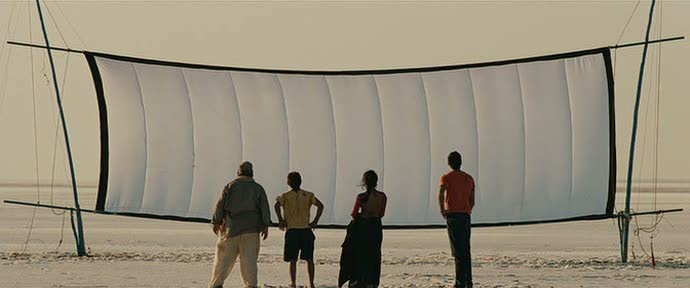 Road, Movie (2009), written and directed by Dev Benegal, follows Vishnu (played by middle cinema darling Abhay Deol), the son of a small time hair oil seller, who borrows an ancient Chevrolet truck from his neighbour and hits the road on the pretext of selling his father’s stock and delivering the truck to its proper destination. Little does he care that the truck doubles as mobile cinema. On his way, he encounters a village in dire need of water where a dacoit group has been terrorizing the villagers, appropriating the available water, bottling it and selling it back to them. A paean to popular cinema of yesteryear, specifically to those times when films used to be a collective social experience that transcended class, race, gender and other disparities, Road, Movie views (and literalizes, as in the carnival segment) cinema, in the Bazinian sense, as a collective dream that acts as a fulfillment ground for our real life desires. Consequently, it laments the death of that collective experience due to corporatization of film production and segmentation of potential markets*. Through plot details, bizarrely enough, it equates cinema to both water (suggesting that both are essentially public commodities unjustly being appropriated for the benefit of a few) and oil (in that both are ultimate stress-busters and great social levelers, as is pointed out in the recurring song borrowed from Guru Dutt’s Pyaasa (1957)). Road, Movie is also self-consciously generic, as its title points out, likening the journey on a road to the trajectory and experience of a movie. True to the conventions of its genre, the individualistic, petit bourgeois protagonist realizes the meaning and importance of living in a community and, among other bromides, that the journey is more important than destination. But then, Benegal also keeps deviating from the genre in that he avoids conjuring up a revolutionary hero out of Vishnu. He may mean good, he might have learned a few important lessons, but he’s as helpless in front of these social forces as he was at the beginning. He can do nothing but go back to his dreary middle class existence. Oh well, at least there’s Tel Malish.





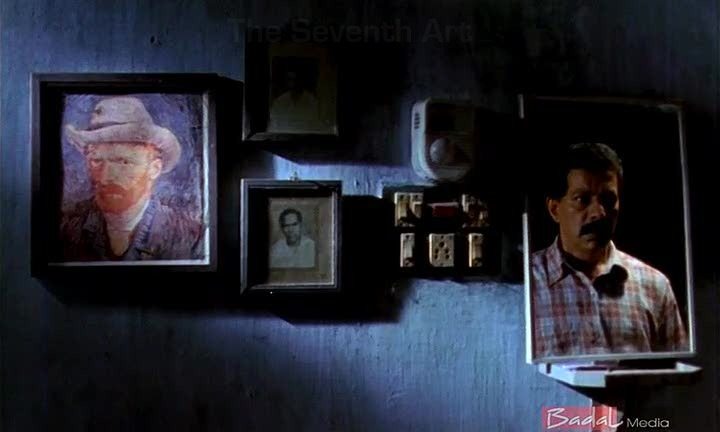

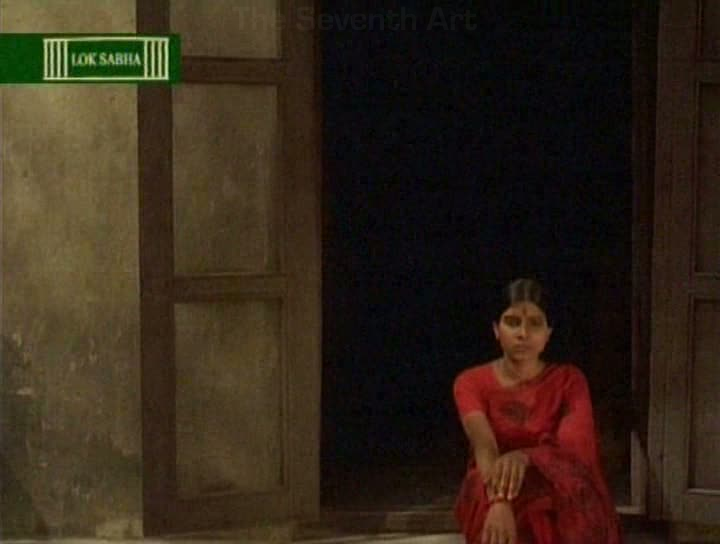


 That is not to say that Kanchivaram is not a melodrama. On the contrary, I believe, it is precisely how a melodrama should be. The word “melodrama” has been used very loosely and often as a derogatory remark. Most of our mainstream movies have been put down because of the same reason, and rightly so. Where these ordinary films tried to exaggerate emotions through copious amounts of words, leaving no margin for discovery or imagination, Kanchivaram lets cinema do that for it. Its exaggeration is not the weak over-emphasis of words, but the subconscious amplification by images. Priyadarshan realizes that subtlety is the essence of art and places immense trust on his audience, yet never lets the movie lurk near ambiguity. His melodrama is not made of music cues or slow motion shots, but of cinematic compositions. Consider the final scene where Thamarai, who had earlier taken over the responsibility of taking care of her father from her mother, breathes her last. Vengadam takes her in his arms to show the sari he has been weaving for her. Earlier in the film, Vengadam had does exactly the same thing when his wife is in her death bed. Instead of having Vengadam break down, and cry out aloud the unfairness of it all, Priyadarshan merely uses the same camera angle – looking at the pair of actors through the weaving machine – to nudge our memory, make us work and only then earn the tragedy of the moment.
 Although attention-craving at places, Priyadarshan’s direction shows the signature of a mature director who knows his craft. He seems to know where exactly to use expressionist lighting and where to focus deeply. Speaking about cinematography, Kanchivaram would not be what it is without the contribution of three fine pieces of work. The first is Sabu Cyril’s production design. Though aided considerably by what looks like post-production processing, Cyril nevertheless does a terrific job in creating a uniform earthy tone to the film which eventually blends into the red of communism that later becomes the central point of the film. All the people in the film – the leads and the junior actors – look straight out of grandpa’s albums, with clearly defined facial features. The second is Thiru’s cinematography, which speaks for itself. This veteran cameraman had already proved his worth in
 The Seventh Art