Cinema of Japan


Jia Zhang-Ke

Jia Zhang-Ke 
(1970-)

Born in 1970 (Fengyang, Shanxi Province), Jia Zhangke studied painting, developed an interest in fiction, and in 1995 founded the Youth Experimental Film Group, for which he directed two award-winning videos. He graduated in 1997 from the Beijing Film Academy, and his first feature, Xiao Wu (1998) was very successful at the Berlin, Nantes and Vancouver festivals. The following films Zhantai (Platform, 2000), and Ren xiao yao (Unknown Pleasures, 2002) were selected in competition respectively at Venice and Cannes. He established Xstream Pictures in 2003 in order to promote young talented directors from all over China. He directed Shijie (The World) in 2004 and his latest film Sanxia haoren (Still Life) received the Golden Lion Award at the Venice Film Festival 2006. (Bio Courtesy: Cannes Festival, Image courtesy: Glamour Vanity)


“Juxtaposing a person with an environment that is boundless, collating him with a countless number of people passing by close to him and far away, relating a person to the whole world, that is the meaning of cinema.”

– Andrei Tarkovsky


If the filmography of Jia Zhang-Ke is to be summed up in a single line, it has to be the above statement. Along with Apichatpong Weerasethakul, Jia appears to be the pick of the past decade and has made his way into almost every best-of-the-decade list out there. With a body of work that spans only a decade and a half, the Chinese has already authored at least four great works that clearly illustrate the director’s consistency of vision and his command of the filmic medium. What sets Jia apart from his contemporaries like Tsai Ming-Liang and Hou Hsiao-Hsien is the narrative and thematic specificity that pervades the whole body of his work. While the latter directors have sometimes de-contextualized their narratives and resorted to broad strokes in order to, perhaps, deliberately universalize the issues they are dealing with, Jia almost always particularizes. It is true that, like the other two senior directors, Jia keeps coming back to the same set of motifs and questions, but there is always a thread that runs through his films alongside these investigations that examines his own role and responsibility as a Chinese, as a filmmaker and as a Chinese filmmaker.

Jia seems to have established his signature aesthetic very early on in his career. Even in an early and relatively minor work like Pickpocket (1997), one can see that Jia, like Tsai and Hou, favours long shots, filmed from at a distance, and uses direct sound to wondrous effect. Then there is the trademark pan shot, which Jia treats like a brush running over a very wide canvas woven in time, whose use only proliferates with the years. Jia employs this pan shot to often depict people separated by space and time and the relationship they bear with the environment they live in. This unhurried, evocative shot directly ties Jia’s cinema to those of Tarr, Wenders, Polanski, Tarkovsky and Angelopoulos, the last of whom is the filmmaker Jia seems to closest to, thematically and formally. His actors are regularly seen squatting – a primal and distinctly human gesture that distinguishes man from the artificial, industrial universe around him. Most times, his scenes unfold in the master shot itself, as Platform (2000) and The World (2004) clearly testify. When the scenes are not shot in natural light – night scenes, for instance – they are, more often than not, lit by a single light source that is present in the diegesis itself.

From In Public (2001) onwards, Jia seems to have taken a liking for the HD digital format (shot masterfully by Yu Lik Wai) that seems to impart an extra layer of realism and intimacy to the films. Additionally, the director does not hesitate to shift the tone within his films abruptly – a playful tendency that is also palpable in Weerasethakul’s films. One moment you witness a solemn, moving conversation and in the next, you see characters floating about in animated spaces or buildings lifting off the ground like rockets. Apart from this, Jia’s vertically unsymmetrical framing is redolent of Godard’s early political features and he similarly embeds his characters within images of reconstruction and modernization of the place they live in. Also Godardian is the fact that there are hardly any “empty shots” (Godard’s terminology) in Jia’s films. He never depicts an action just for the sake of carrying the story forward or supplying petty information. To borrow Godard’s example, if a man crosses a street in a Jia film, one can be sure that either the director is interested in the man’s gait and gesture or the details of the street he is walking on or, as is usually the case, the relationship between the two.


Xiao Wu (Pickpocket, 1997)

PickpocketThe only Jia film with a single protagonist that I’ve seen, Pickpocket (1997) is also the director’s most accessible film. With a script whose likes one would find in the neo-realist films of yesteryear, Pickpocket chronicles the life of the titular small-timer, Xiao Wu, played charmingly by Jia regular-to-be Wang Hong Wei, as he loiters about doing his work in the streets of Fengyang, the director’s hometown. The questions of identity and cultural dislocation, which would intensify in the filmmaker’s subsequent works, already register a strong presence in this film. Jia employs direct sound to capture ambient and stray noises of the town that suit the film perfectly. Often, Xiao Wu’s voice is overpowered by the noise from the town streets or by the blaring pop songs that flood the soundtrack, which also particularize the film’s time line, suggesting the beginning of China’s globalization process. The soundtrack is complemented by the seeming omnipresence of the local television network that seems to either intrude into people’s private affairs or feed people with more dollops of pop culture. Xiao Wu is the quintessential Jia character, a flawed individual who has failed to catch up with the changing times (while all his colleagues have successfully boarded the train) and, as a result, pays the price. It is only after he (literally) sheds his old attire and learns to sing pop songs that he somewhat feels he is a part of his surroundings. As he sits arrested to an electric pole at the end, with the townsfolk staring at him curiously, one only thinks of the inevitability of this outcome. Forget the train, Xiao Wu hadn’t even got on to the platform.

Zhantai (Platform, 2000)

PlatformPlatfrom (2000), widely regarded as the director’s finest film, opens with a theatre performance that extols Mao’s communist revolution, setting up the theatre motif that permeates the entire film. Set at a time when China’s globalization measures were put into action, Platform is an epic film that actually gives the viewer the feeling of being there and drifting along with this endearing team of travelling players that stands for a whole generation – that of Jia’s – struggling to cope up with the drastic cultural transition that the measures have induced. That Jia sets the film in his hometown of Fengyang is of much importance because, according to Jia himself, it is one of China’s many towns that is far removed from the decision making machinery at Beijing and merely rolls along with the impetus given by the culture shock. Jia builds his film accumulating one insightful observation upon another, taking his characters through various signposts, such as screening of foreign films, permission for pop songs and private owned apparel shops, which indicate the direction the revolution is taking the country in. Characters go into sudden flights of fantasy, as they would in later films too, and step into improvised dance sequences and on-stage performances in an attempt to transcend the stalemate they are presently in. Jia’s film is a finely balanced mixture of nostalgia, elegy, cynicism, and hope, but never does it criticize its characters for their acts. It recognizes shares their surprise and alienation, recognizing and embracing them as flawed individuals who are yet to get onto the speeding train of progress and off the platform of cultural disjunction.

Gong Gong Chang Su (In Public, 2001)

In PublicIn Public (2001), made when Zhang-Ke was scouting locations for his next film, is the most abstract of all the director’s works for it completely sacrifices a narrative for something more expressive. Running for just over half an hour, In Public is the first film by the director to be shot in digital and presents vignettes from various public places, including a railway station, a bus stop, a bus, a pool hall and a discotheque, whose images inherently bear what Jia explored in his previous two fictional features. The key sequences come towards the end, in which we see people enthusiastically participating in activities at the pool hall and at the karaoke, where the effect of China’s modernization on a remote town’s populace is most evident. Even amidst the interesting impromptu dancing lessons that are taking place in the room, Jia’s ever-curious camera (often easily spotted by the people it shoots, helmed by regular collaborator Yu Lik Wai) keeps going back to a bald man sitting on a wheel chair at one end of the room. As the camera tilts down to the chair, we see a portrait of Mao Zedong hanging from the down. If not anything else, In Public serves as a distillation of the director’s techniques with its long and medium length shots, slow pans and his discerning eye for industrial landscapes. Jia’s attention is as much on the public places as it is on the people who inhabit them. He takes equal pleasure in dwelling on an arbitrary face that attracts him and in filming people from a distance, studying their behaviour in these public spaces.

Ren Xiao Yao (Unknown Pleasures, 2002)

Unknown PleasuresIf Platform was Jia traveling along with the touring theatre and sharing their culture shock, Unknown Pleasures is the director stepping back and looking at his counterparts of the next generation. The fact is underscored with the help of Wang Hong Wei who, as usual, remains the director’s alter ego and makes a cameo appearance, playing a variant of Xiao Wu. Slightly more cynical than all other Jia films, Unknown Pleasures is also the most light-hearted of them all, betraying a love and sympathy that the director has for his characters. A couple of middle class teenagers – Bin Bin (Zhao Wei Wei) and Xiao Ji (Wu Qiong) – knock about the town without any apparent motive when one of them falls in love with the mistress, Qiao Qiao (Zhao Tao, modeled after Mia Wallace), of a local gangster. In one scene, Xiao Ji, a parody of himself, talks to her about the bank robbery in Pulp Fiction (1994). In fact, the whole film borrows much from the Tarantino film. Xiao Ji dances at the local disco with Qiao Qiao, only to get repeatedly beaten up by the gangster. He decides to rob a bank which turns out to be only marginally less funny than a Woody Allen sketch. Jia’s film apparently has China’s “single-child” policy for population control as its backdrop and Jia might just be pointing out how this has resulted in an entire generation feeding and growing up on ideas and attitudes proposed by pop culture. But, keeping in mind the director’s previous couple of works, one may conclude that Jia’s primary intention is to portray the aftermaths of a cultural shift that is just too drastic for its participants to cope up with.
 

(To Be Continued…)

(Continued from part 1/2)

Hao Nan Hao Nu (Good Men, Good Women, 1995)

Good Men, Good WomenGood Men, Good Women (1995), the final part in Hou’s trilogy on Taiwanese history, could well be considered as the first in a series of highly experimental films by Hou Hsiao-hsien. Dividing the film into two time lines – one set in the Chiang Kai-Shek era of White Terror and the other in contemporary Taiwan – Hou investigates both the unifying spirit and the chasms that exist between the nation’s past, present and future. A lonesome actress Liang Ching (Annie Shizuka Inoh) is to play the role of Chiang Bi-Yu, a Taiwanese resistance fighter from the 1940’s. Ching’s confrontation with the painful history of her nation coincides with a confrontation with her own dark past, where we learn about her stint as a bar host and her affair with a man named Ah-Wei (Jack Kao), whose murder she becomes an accomplice to, for three million bucks. The betrayal of a group of loyal partisans by the very side it wished to fight for serves as an agonizing reminder of her betrayal of a man who loved and trusted her. Hou’s highly stylized direction cuts back and forth between the scenes from the past that use soft, black and white footage and those from the present, shot in a bland colour stock, both of which mingle at one point, pointedly suggesting the marriage of collective and personal histories that gives a not-so-rosy picture of the future. Good Men, Good Women is a transitional film for Hou in the way it acts as a bridge between the idea of inseparability of past and present indicated by The Puppetmaster (1993) and that of absolute isolation of the two from each other that characterizes Goodbye South, Goodbye (1996).

Nan Guo Zai Jian, Nan Guo (Goodbye South, Goodbye, 1996)

Goodbye South, GoodbyeWith Goodbye South, Goodbye (1996), Hou seems to have bid farewell to narrative cinema for good. It is safe to declare that absolutely nothing happens in the film, for right from the first shot of the film, where we witness a bunch of blasé youngsters sitting in a train and one of them losing signal on his cellular phone, to the last one where a car carrying those people crashes to a standstill, there is simply no indication that the vicious circle that the characters are treading on will break some day. Neither their choices nor their actions seem to make any difference to the drug-addicted, gamble-driven, aimless and nihilistic lives they seem to be leading. They live for the moment, without a shred of consideration for the consequences or causes of their present actions (They open a restaurant where they end up telling the customers what they should eat!). With an absurdly exaggerated colour scheme, consisting mostly of primary colours, Hou builds the film as a string of moments, each rife with dark, brutal humour (“Did she slit her wrists again?”), that gradually reveal how a whole generation is living with neither an apparent memory of the past nor a hope for the future. Alternating between scenes of motion – trains, motorbikes and automobiles – and transit, whose destination is never once clear, and utter motionlessness, shot in dimly lit, cramped interiors, Goodbye South, Goodbye is a stark and affecting portrait of a stalemated generation whose loss of identity seems to mirror that of the nation they are living in.

Hai Shang Hua (The Flowers Of Shanghai, 1998)

The Flowers of ShanghaiCould there be a more baffling and contrasting follow up to the apparent frivolity and irresponsibility of Goodbye South, Goodbye (1996) than The Flowers of Shanghai (1998), Hou’s only film to be set entirely in the pre-WW2 era? Slightly redolent of Zhang Yimou’s magnificent Raise the Red Lantern (1991), The Flowers of Shanghai, set during the turn of the nineteenth century in the brothels of Shanghai, presents us a series of seemingly endless conversations and bouts presided by men, presumably belonging to the officer class of the ruling government, who indulge themselves by patronizing the courtesans and playing drinking games on the table. Hou’s most relentless and most rigorous film till date, The Flowers of Shanghai is shot completely indoors, with carefully orchestrated actor choreography, consisting almost entirely of medium shots and with a intensely reddish lighting scheme throughout that evoke a high degree of claustrophobia and suffocation, which perhaps mirror the experience of the flower girls themselves (the exact feeling that is induced when one watches Ten (2002)). It is hard not to think of the film as a political allegory given the fact that the whole film plays out within a single, enclosed structure and the intricate way in which relationships are reduced to ideas of ownership, subscriptions and contracts. However, even if the case for political abstraction is dismissed, The Flowers of Shanghai still remains a scathing examination of power and freedom of a highly marginalized section of people living under a decidedly patriarchal structure – an exploration that remains as potent even in the most modern of times.

Qian Xi Man Po (Millennium Mambo, 2001)

Millennium MamboMillennium Mambo (2001) arrives, at the turn of the century, as a timely reboot to Hou’s Daughter of the Nile (1987). Like the protagonist of the latter film, Ah-Sang (Fan Yang), Vicky (Qi Shu) finds herself in a stalemate of sorts, with no relationship to really hold on to, and wishes to escape into the past as a means of overcoming the abyss called future. She seems haunted by the idea of beginning anew in a new place and a new time and is fascinated by the antiquity of Hokkaido, Japan, the old people who live there and the old cinema posters that adorn its slow-clad streets. However, unlike Ah-Sang, she seems numbed by her condition so as to not show any signs of desperation for escape. There are echoes of both Tsai Ming-Liang and Wong Kar Wai in this film in its existential overtones and (yet) brimming optimism. In stark contrast to the medium-shot rigor of his previous film, Hou’s aesthetics are freewheeling and he shoots in cinema vérité format, employing a mildly accentuated colour palette and a large number of loosely focused, handheld shots and close ups that was hitherto uncharacteristic of the director. Like some of his previous films, Hou seems to be interested more in capturing the rhythm of life during a specific time period in Taiwanese history than anything else. Consequently, Hou employs a highly evocative techno soundtrack and punctuating slow motion shots that gives one the affecting feeling that these are moments of utmost transience to be cherished for eternity, much like the evanescent face imprint that Vicky leaves on snow.

Kôhî Jikô (Café Lumiére, 2003)

Cafe LumiereCafé Lumiére (2003) is the kind of film that I would have expected from Jarmusch, given his preoccupation with Japan and, specifically, Ozu (No wonder he cites Hou as one of his idols). However, in retrospect, it looks like that no other director deserves making this film as much as Hou does. That is because Café Lumiére serves both as the updation of Ozu’s themes for the new century and as the next logical step in Hou’s body of work. Most minimal in terms of plot in all of Hou, Café Lumiére continues Hou’s exploration of the new generation that has been cut off from its past and that seemingly unbridgeable generation gap that exists between the members of two generations – a characteristic Ozu theme that had its cultural roots in Post-war Japan – in this post-globalization world. However, Hou examines this chasm from an outsider’s point of view, as and through a person straddling the cultures of Japan and Taiwan – a stance that permeates the whole film, tying what is quintessentially Hou to that which is quintessentially Ozu. Hou’s stylistics, too, become inseparable from the Japanese director’s as he concocts similar ground level compositions, with meticulous actor choreography filmed in long shots and  separated, at times, by major ellipses. Like Jarmusch’s latest, Hou’s film is also one about transition – one without any particular destination – and he adorns the film with images of trains and railway stations. In fact, Hou’s film is the cinematic equivalent of the painting that Hajime (Tadanobu Asano) creates in the film, indicating a generation that rests within the womb of a dense network of trains, slowly bleeding.

Zui Hao De Shi Guang (Three Times, 2005)

Three TimesHou Hsiao-hsien’s most acclaimed film, Three Times (2005), brings him back to overtly political filmmaking after a hiatus of, arguably, four films. Divided into three segments – set in 1911, 1966 and 2005 in Kaohsiung, Dadaocheng and Taipei respectively – Three Times seems like a distillation of three of the director’s earlier films. Hou’s aesthetics change with the time period the film deals with (in a highly cinematic sense too). He uses a green filter, a mixture of outdoor and indoor shots and a soundtrack composed of romantic songs for the first segment, a red filter, largely medium shots filmed indoors with a static camera and a classical soundtrack for the second and a blue tinge and fluid camerawork with a number of close-ups for the third, reflecting the spirit of each age. But Hou’s film is far from a simple comparison of lives in three distinct time periods. Hou is more interested in the underlying similarities and ironies more than the apparent and inevitable differences. Like many of the director’s previous films, Three Times is an exploration of the distance between individuals, the communication gap that separates them and the ways those distances and gaps are bridged. In the bittersweet, first segment, letters and boats serve the purpose of bringing people together, with words complementing when stretches of silence aren’t enough. In the second segment, voices are entirely muted as intertitles replace conversations. In the final one, despite the infinite means of communication and commutation available, characters don’t seem to be able to connect either with each other or with their past, as they ride off in their contraptions to nowhere.

Le Voyage Du Ballon Rouge (The Flight Of The Red Balloon, 2007)

The Flight of the Red BalloonThe Flight of the Red Balloon (2007) might just be Hou’s greatest accomplishment to date.  Hou’s second film on foreign soil is aptly set in Paris, France – the city of arts – and takes off from Lamorisse’s childlike short The Red Balloon (1956). The latter trivia is very important and provides thematic context to Hou’s film. The balloon in Lamorisse’s film becomes a symbol of beauty and of art, abandoning a cruel world that rejects it and embracing and protecting those who recognize beauty in the mundane. Likewise, in Hou’s film, Simon (Simon Iteanu) is surrounded by a number of art forms – music, literature, photography, puppetry, cinema and painting – and mother figures – his actual mother, his nanny, his piano teacher, his “pretend sister” and, of course, the all-mysterious red balloon. Hou, evidently inspired by the city, creates a fractal of art forms around these wonderful people in the film who seem to be striving to capture instantaneous reality and achieve peace and perfection through the art forms they practice. Hou uses semi-transparent, partially reflecting surfaces and has melodious music pieces accompany the most quotidian of images to underscore both the impossibility of life to attain the utopia of art and the presence of art in everyday life, all around us (The dense, final scene of the film employs Félix Vallotton’s painting, The Ball, to highlight how art is created out of the ordinary and how it embodies a desire to overcome the imperfection of reality). When Suzanne (Juliette Binoche) asks the blind tuner if he can tune the piano back to normal, she might well have been taking about her life.

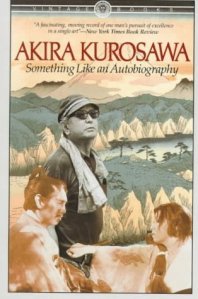
Something Like An Autobiography
Akira Kurosawa (Translated by Audie E. Bock)
Random House, 1983
 

“I am not a special person. I am not especially strong. I am not especially gifted. I simply do not like to show my weakness, and I hate to lose, so I am a person who tries hard. That’s all there is to me”

– Akira Kurosawa (Something Like An Autobiography,1983)


Something Like An AutobiographyThe artist is a typed individual. It is always comfortable for us to outcast him and envisage him as a hermetic loner, scribbling about in the wilderness. Why not? History testifies regularly that great artists often succumb to the battle between personal and professional lives. This preservation of the artist as an enigmatic figure also serves partly to assuage our need for heroes. Japanese director Akira Kurosawa, too, probably would have been the stuff of legends before the world got to know him through his intensely intimate book Something Like An Autobiography. Kurosawa was at the twilight of his career when he wrote the book and he was, clearly, a man with nothing to lose but his vanity. Kurosawa pains an immensely honest portrait of himself, trying as objective to be possible, sometimes even being overly harsh on himself.  Reading the book, one is only surprised that it was this very person who made those fierce Samurai movies!

Divided into many small chapters, Something Like An Autobiography follows Kurosawa’s life right from his birth (!), through his “crybaby” days, his rebellious phase and to his jumping into cinema. With enviable clarity and memory power, Kurosawa recalls even minor incidents that the normal minds do not register. His trips to the ladies toilet (yes, that’s right!), his first encounter with Sake, his friction with the sports teacher and his clash with the local gang of brats are all memories that the reader wishes he had had.  However, not all memories are as sweet. Kurosawa’s years following his decision to leave home and his life during tumultuous times of the second big war are but some of the most horrifying experiences a youth can experience. Kurosawa explains with utmost calm his harrowing period as an editor of an underground communist magazine and the exceeding financial crunch he experienced during that time.  But what takes the cake is his eternally burning rage against the Japanese board of film censor for whom he reserves the choicest of worlds in the book.

In fact, with only a little effort, Something Like An Autobiography could be easily turned into a dramatic film script. Kurosawa, the man he is, handles the whole book somewhat like a scriptwriter or a director would. Consider the passage where he is about to introduce his biggest influence – director Kajiro Yamamato. Kurosawa directly cuts to Yamamato’s deathbed where the latter asks how his assistant directors are behaving on the sets! This minimalist urge to drive home the point and put the audience immediately into the midst of the context clearly shows up in his films too (He mentions a similar incident that he did for the opening scene of Stray Dog (1949)). Special mention has to be made for the translation by Japanese film scholar Audie E. Bock who has successfully has managed to convey perhaps exactly what Kurosawa intended without resorting to verbose intertitles or unwarranted western phrases.

The most evidently surprising thing about the book, written in 1983, is the timeline it covers in Kurosawa’s life. The book proceeds chronologically and ends with a chapter on Kurosawa’s first international success, Rashomon (1950). The post-Rashomon period is completely missing, not even superficially present.  One can perhaps say that the rest was history. But the bigger Kurosawa mystery still persists. What was his state of mind during those troublesome years following the debacle of Red Beard (1965)? Why did he part ways with his favorite actor Toshiro Mifune? Why did he seek out foreign aid for his later films? Kurosawa’s not even willing to bring those questions into picture. You can’t blame him though. He clearly states early on that this book is only something that resembles an autobiography, not an account of what all happened. It would perhaps be fitting to call it a self-portrait than an autobiography – one where the author chooses to illustrate what defines him (and not what is defined by him) with equal measure of subjectivity and objectivity.

But on the other hand, his childhood days are allotted significant amount of space. Kurosawa mentions in the preface that if he had to write a book about himself, it would turn out to be nothing more than a talk about movies. But Something Like An Autobiography is far from that. With the exception of one chapter, there is almost no mention of films that he adored or influenced him.  Instead, Kurosawa basks in his reverence for his elder brother Heigo, his teacher Seiji Tachikawa, his mentor Kajiro Yamamato and his lifelong friend Keinosuke Uekusa. He spends a lot of time reminiscing his pre-cinema times, his trips to the country side, his memories of the Great Kanto Earthquate that shattered Tokyo and his stint at the Keika Middle School. But it is in these apparently casual escapades that we get to know Kurosawa’s inspiration as a filmmaker. In hindsight, one can see why there are almost no parents or kids in his films, why his scripts have always had a patriarchal tendency, why the female figure is regularly absent and why his heroes have mostly been angry and lonesome youth. Perhaps, Dreams (1990) is the cinematic equivalent of Something Like An Autobiography.

Kurosawa emphasizes that everything that is to know about him is there is his films. Interestingly, everything that is to his movies is also present in this book. Brimming with humour (including the laugh-out-loud kind) and pathos, Something Like An Autobiography takes you through a quintessentially Kurosawa emotion ride. It would not be a mere coincidence if you envisage Kurosawa as Mifune while bumbling with cold and hot water at a bathhouse or find Kurosawa meeting Tachikawa after 25 years as moving as Shimura sitting in the snow on that swing. He describes his fond acquaintances with as much love and enthusiasm as for his characters. One does feel at the end of the book that he/she has known Uekusa, Heigo and even Yamamato for years. But most importantly, it becomes clear how Kurosawa and, perhaps, many such stalwarts are as tied to this very world as we are. However, not one ounce of respect is lost as Kurosawa disarms himself to reveal what he really is. On the contrary, one only reveres him more as he passes through the purgatorial gate of Rashomon.


Verdict:

Sanshô Dayû (1954) (aka Sansho The Bailiff)
Kenji Mizoguchi
Japanese

“Without mercy, man is like a beast. Even if you are hard on yourself, be merciful to others. Men are created equal. Everyone is entitled to their happiness. “


Gilbert Adair’s legendary quote about Kenji Mizoguchi’s Sansho the Bailiff (1954) runs thus: “Sansho the Bailiff is one of those films for whose sake the cinema exists…”. Nor just Mr. Adair, but the whole world unanimously hails the film as the director’s masterpiece and a landmark film in cinema history. Having missed the retrospective of the director at Bangalore International Film Festival (BIFFES) early last year and having been swept away by Ugetsu (1953), I was indeed eager to see Sansho.  Although not as subconsciously affecting and mentally agitating as Ugetsu, Sansho is a film that nevertheless grows with time.

sansho_the_bailiff_2Sansho the Bailiff cuts back to the last millennium to tell the tale of Zushio and Anju, children of a deposed governor whose only mistake was compassion towards his subjects. With the governor forced into exile, the children and their mother have to make their way into the neighbouring country, along with their faithful maid. But it is fate that decides their course and they find themselves separated into and by islands in no time. Mother is traded as a courtesan and the children sold as slaves to a rich man named Sansho. Years pass by as the kids assume a new identity. Zushio seems be moving closer to Sansho’s principles than his fathers’, mirroring Sansho’s son who refuses to take up his father’s job and becomes a monk. The only hope for his redemption lies in his sister’s faith in better times and in his own memory of the past.

Mizoguchi weaves his tale on a hypothesis about political power –an over-simplified statement that people in power can not possibly show compassion and those who do, would not remain in power any more. Sansho the Bailiff thrives on its characters’ answerability in to the political hierarchy.  Mizoguchi plays around with the permutations offered by power, compassion and responsibility to system and to self. Zushio’s father had the political power and the will to show mercy. He goes against the rules and hence gets deposed. The merciless Sansho, his mirror image, has the power and sticks to the rules. Sansho’s son Taro, on the other hand, is a compassionate individual who refuses to follow the rules and be the successor to his father. Zushio eventually assumes power in order to succeed his father (as foreseen by Mizoguchi’s mise en scène) and deliberately do good. The slaves have the compassion but not the power. Zushio’s father’s lesson about mercy passes from one person to another – From him, to Zushio, to Taro, to Anju, and back to Zushio – like a relay baton, but seems to get lost amidst the drunken revelry of the freed slaves.

Watching Sansho the Bailiff, I was continually reminded of Stanley Kubrick’s wonderful Barry Lyndon (1975). When Kubrick chose, or rather had manufactured, the extremely wide angle lens for his film, what he had obtained wasn’t just a solution to a technical constraint but a conscious stylistic decision. Kubrick apparently wanted to shoot a lot of scenes under exceedingly low lighting conditions for which he supposedly ordered the f/0.7 Zeiss lens. The drawbacks (or were they?!) were that the focus was too shallow and the camera movement terribly limited. But it is highly unlikely that Kubrick, the perfectionist director and the professional photographer that he was, had not foreseen the limitations or thought about the possibilities. Kubrick converts what could have been an ambitious failure into yet another exploration of the filmic medium using these very “restrictions”.

Barry Lyndon is completely devoid of those “satanic” tracking shots that Kubrick is so fond of. In fact, there is hardly any camera movement, apart from the three trademark scenes of “suspended Kubrickian madness” – the hand held shots. This “decision” of Kubrick effectively locks Barry on to the screen.  He is robbed of lateral motion or that metaphorical freedom, if you please. Moreover, the shallow focus that the lens provides gives these candlelit images a painting like two-dimensionality, further restricting lateral and perpendicular movement and sealing Barry’s fate (and refusing emotional depth for the audience). For a film that is all about fate, chance and free will, Kubrick’s decision is remarkable. He narrates the whole film in the past tense, in a way that determines Barry’s destiny with prior knowledge of the denouement of his life. In essence, what Kubrick conjures up is a dateless fable, purely cinematic, that would not transform whatsoever with the passage of time.

sansho_the_bailiff_1Mizoguchi, technically handicapped in comparison to Kubrick, gloriously achieves the same effect and, more importantly, in a decidedly “Japanese” fashion. As clarified in the opening quote (“This tale is set during the late Heian period an era when mankind had not yet awakened as human beings. It has been retold by the people for centuries and it is treasured today as one of the world’s great folk tales, full of grief.”), Mizoguchi, too, proclaims that the story is of the past – over and done with, its outcome fixed. Again, within the film he furnishes detail using direct flashbacks or visual fragments from the past. Contrary to Kubrick’s motionlessness, Mizoguchi’s camera tracks, pans and rises in a spectacular fashion (the shot in the manor after the slaves over is strangely reminiscent of The Killing (1956)). Watching Sansho the Bailiff is like reading an ancient scroll – both visually and conceptually – which is as much native as Barry Lyndon is, with all its mythical, cultural and historical elements intact.

In resonance with the above practice, Mizoguchi compiles his mise-en-scene such that it constantly points to the inevitability of fate and carries a sense of foresight within itself. Like the “planar preordination” of Lyndon, Mizoguchi frames his characters regularly between parallel wooden structures – fences, trees and pillars – and essentially, “defines” their state.  As if forcing his characters into the vicious circle that comes ready with slave trade, Mizoguchi seldom allows them latitude. Throughout the film, Mizoguchi seems to determine as to where the characters will end up, with one notable exception. The scene where the kids are separated from their mother is a powerhouse no matter how often you watch it. As we witness the boat drift away, we can clearly notice the absence of a horizon, – as in Ugetsu – perhaps the only time where the future of a character is left open by the director, albeit for a short time.

For most part, Sansho is a cruel film. The very title of the film is based on the name of the villain and not Zushio. It presents hope neither for its characters nor its audience. In the poignant final scene, as mother and son reunite, Mizoguchi’s camera pulls away dwarfing them in comparison to the landscape that is as serene and pacific as it was during the beginning of the entire ordeal. It is as if this majestic nature is completely indifferent to the ephemeral travails and triumphs of human beings. What takes a lifetime for the ant-like characters is nothing more than a fleeting instant for nature, which continues to concoct its own tragedies. Often, we see barren and crooked trees taking over the characters in the frame almost in an expressionistic manner. True that nature regularly comments upon their situation but it never does anything to alter it (“Even children as young as you are sold and bought, treated like animals and nobody questions it”, says a character).

sansho_the_bailiff_3The only hope that Mizoguchi presents in the film is by situating the tale in the past – by providing an apparent relief that all the pain and suffering is over and humanity has been discovered (“…an era when mankind had not yet awakened as human beings.”). But reading the opening quote once more, one can feel a strong vein of sarcasm running through. Is Mizoguchi decidedly making it a period drama? Or is there something more “present” to the tale? To clarify my doubts, I looked up the internet about the situation in post-war Japan. Not very surprisingly, I discovered that there indeed were atrocities committed by the occupying forces in the country during the post-war period and also a foundation known as  Recreation and Amusement Association that isn’t much different from the Geisha-slave system that Sansho talks about, which. Of course, I can’t say with conviction that Mizoguchi had contemporary politics of Japan in mind while making this film, but similarities are glaring. As the lady at the weaving mill quotes, “l can’t rest unless I die. What a horrible world! We’re not human beings. Why does the rest of the world turn its back on us?”. Sansho’s is indeed a cold world.

Rise Of The Landing Sun

Rise Of The Landing Sun

When one thinks of people like Steve Irwin (“The Croc Hunter“) and Timothy Treadwell (immortalized in Grizzly Man (2005)), it is invariably about the way they died. Some say they saw it coming all the time while some coldly label them romantic fools. But coming to think of it, they perhaps are the happiest kind of people – dying doing what they wanted all their life.  And the same goes for the little octopus in Okuribito (2008) that struggles to survive on land and dies serenely when discharged into its habitat. Hijacking the Oscar from strongly tipped films Waltz with Bashir (2008, Golden Globe winner) and The Class (2008, Palm D’Or winner), Departures has attempted to turn the eyes of the world from the age old issue of wars into something perhaps equally alarming.

Kicking off from the buzzing city of Tokyo, the film tells us of Daigo Kobayashi (a very physical, Ben Stiller-ish Masahiro Motoki), a cellist who finds himself out of job, his wife Mika (Ryoko Hirosue) who seems to be tolerant to all his bluffs and goof-ups and their life following their decision to move to the countryside. By twist of fate, Daigo lands up as a mortician and what follows is a series of impressive and often funny encounters that he has in his profession. After the first gruesome “project”, he takes bath vigorously to get rid of the stench having done the same to the deceased! However, he still desires to play the cello at defining moments that either shake him up or have him exhilarated, perhaps the only times he truly feels alive.

Although Departures is not entirely a character-driven film, the people in the film exist not because they are entities that shape the plot but because they signify something that is not forced upon them. Director Takita neither shapes his characters to conform to the mechanics of a plot nor does he let them take over the unraveling of the film. He merely chooses or avoids them. He reveals them to highlight disparities, change in attitudes and at times the national mentality. All of them (most importantly) have a past that runs parallel the country’s itself. They all are aware of their destination – both collective and individual. I do hope Mr. Takita makes a film that is set 25 years hence. That would clearly justify the ominous atmosphere that the characters carry with them.

Death doesn’t mean the end, but leaving the present, heading for the next stage. Truly a gateway” says the old man at the funeral house. “Journeys” they are called. Takita punctuates episodes in the film with shots of landscape in motion – trams, cars, rivers and birds – illustrating the significance of commutations, movements and relocations in our lifetime and beyond. These journeys are initiated by the morticians with a grace and precision comparable to a wedding or religious ceremony. I guess humans have a paradoxical tendency towards death – possessing inherent self-destructive properties to move towards it yet a grotesque desire to reanimate the dead and to infuse life into the non-living. Daigo embellishes the corpses, endowing them with elegance never seen during their living days, which almost consoles one with the fact that they have had such a beautiful death despite their ugly lives. In essence, a death that unites everyone – the expired and the living. Takita presents a number of such references to the living, the dead and the living dead throughout Departures.

Like Scorsese’s comic book wonder Bringing Out The Dead (1999), Okuribito is a film of great ironies – ironies that come packaged with the biggest taboo of them all called Death. A destitute gets all the respect and care he never had when he lived. A misanthrope would be called a gentle giant the minute he stops breathing. Okuribito explores all these weirdly funny facets of life (and its absence) through the prism contemporary Japanese culture and the paradigm shift that it is currently experiencing. Take the hilarious scene where Daigo “discovers” that the dead girl is actually a transvestite. When asked what kind of make-up – men’s or women’s – would the parents like their child to have, they ask Daigo to use the female make-up – which they perhaps would never have allowed their son to use. One excavates a host of such observations and Herzogian contradictions which will only be ruined by verbalization.

I was tempted to compare the film with Ozu’s masterwork Tokyo Story (1953) until I realized how unfair and often foolish this comparison would be. There is nothing Ozuvian about the form that Takita employs (the first few shots of the film would confirm that). The film is as removed from Tokyo Story, albeit the striking similarity of content, as modern Japan is from the culture the west associates it with. Unlike Ozu’s films that suggest a larger youth population, Okuribito provides us with sketches of Yamagata that are filled largely with old people and a few “Macdonalized” young ones. Yet, both seem so true to the contemporary state of affairs in the country. This just goes to show how the country itself has transformed through the years and that a comparison of films can be made only from a historical perspective and not a cinematic one.

Japan is standing on the brink of a historical moment now. With a large fraction of its citizens moving out of the income graph and a minuscule youth population struggling to stabilize the pyramid, the country’s economy seems to be in for a major crisis – a crisis that every country has to go through some day. Okuribito’s almost allegorical take on this transmutation of the country’s demography and culture is probably what makes it uniquely Japanese (and perhaps the only reason it is fir for comparison with the “Japanese” Ozu). The film’s excessively melodramatic flavour may turn off purists but why I feel that it succeeds despite (and sometimes because of) its flaws is that Departures plays out as an elegy. A requiem for the death, or rather the departure, of its senior population and the social, cultural and economic norms that are soon to go down with it.

 
Verdict:

Five Dedicated To Ozu (2003) (aka Five)
Abbas Kiarostami
Silent

“…”

Five

Unquestionably, Kiarostami’s films are unlike any film ever seen, leave alone Iranian ones.  But one film that is extreme and decidedly avant-garde even by Kiarostami’s standards – Five: Five long takes dedicated to Yasujiro Ozu (2003) – has turned out to be one of his finest works. In what can be described as a super-slow version of Koyaanisqatsi(1982), Kiarostami presents us five shots of the sea, filmed during various times of the day, at various distances and of varying lengths. Kiarostami quietly integrates the five elements of nature to create a film that is as warm as Ozu’s and as puzzling as his own, in a way, forming a singular connection between them.

The first shot shows us a piece of log lying on the beach as the incoming waves unsuccessfully try to pull it in. There is instant engagement here. I do not know about others, but I have spent hours watching such insignificant dramas of nature – the wind trying to knock off a fruit of a tree, a crow trying to pull out a twig that is stuck and the waves trying to sweep my feet at the beach. There is complete focus on the log and the incoming waves here. These are the only two components of the frame and these alone form the foreground of the image. Interestingly, this is the only segment where the camera actually moves in order to accommodate the object under consideration. Kiarostami shows us a very ordinary piece of event, but our mind conjures up a narrative of sorts – with its own formulation of safe-space and danger zones of the “narrative”.  And things become complicated as the log breaks off and the larger part is swept off into the sea. Though completely unrigged, this “turning point” makes our attention shuttle between the drifting piece in the water and the struggling one on the beach. Is Kiarostami alluding to Floating Weeds?!

In the second one, we are shown the image of the sea as seen from an embankment on the beach. We are drawn into the horizontal waves that decorate the widescreen in the form of broad white lines. Gradually, we have people walking across in front of us pushing the sea into the background. People of all ages flood the screen in many amusing ways, regularly diverting our attention from the sea. There are even critters that wallow into the frame and easily gather focus. There is a feeling of watching a Béla Tarr film – but only in a sense. That is, in Tarr’s films, the dynamics of the foreground, though initially attractive, feel like clockwork after a while. Slowly, we sense the background – the still life – gathering a presence of its own and even imposing itself upon us. There is a feeling of intimidation and ill-omen whereas here, it works the other way round. The patterned backdrop is quite fascinating to start with, but as the humans start coming in the foreground, our attention is naturally devoted to them. We start studying them and even start expecting some new ones (I was hunting Jafar Panahi’s cameo). This segment ends the way it started – the sea alone occupying the stage.

The next shot presents us the sea sandwiched between the sky and land. This is shot from considerable distance and looks like a painting. It is early morning and there are dogs lying on the beach. Almost nil action takes place notwithstanding the stray movements made by the canines. Everything is in the background here as opposed to the previous two shots. Gradually, the contrast of the image starts reducing and after one point we are unable to differentiate between the sky and the sea. The shot fades to white after all the three elements of nature dissolve into one another.

The fourth shot is perhaps the most “interesting” of all. In a direct homage to Ozu’s style, Kiarostami places the camera at knee level and in close proximity to the sea. Soon, the screen is infested by ducks of various sizes, colours and gaits. This is the as close to comedy as the film gets. The ducks move at almost a fixed speed and their footwork seems like a musical rhythm.  Suddenly, all the ducks that have gone past retreat as a bunch as if in a panic. The concentration is completely on the foreground here and the sea becomes no more than a comfortable backdrop.

The final shot lasts about half an hour and is the boldest of them all. It is night time and we can hear the loud croaking of frogs and barking of dogs. And it is only after a while we come to know that we are staring at the still sea. The reflection of the moon appears in a distorted way on the dirty surface of the water. Once more we desire the reflection to settle down to form the perfect circle. The notions of foreground and background are completely eliminated as the pulsating moon appears like a milk drop that falls into abysmal vacuum. And just when everything seems unperturbed, rain comes. The annoying frogs disappear and so does the reflection. Kiarostami has probably shot this in time lapse as the rain stops suddenly to restore the noisy atmosphere. The moon “settles down” and soon disappears behind the clouds. It is interesting to see that all the dynamics of the scene here is off-screen and their presence indicated only by the sounds they produce. We stare at nothing but dark blank space for most of the time but never once lose hold of what is happening in the film’s environment. A little later, we hear the rooster’s call and sure enough, bright sunlight strikes the image to reveal the clear blue water. This part is truly a revelation as one feels a fresh lease of life in the hitherto mundane and contemplative frame.

There is naturally a problem with a film that is as provocative as “Five”. How much of the content we derive out of the film is intentional? Was there a set of objectives for the director while filming the footage? Was every element in the mise-en-scene completely controlled by the filmmaker? Would the film have been different if each shot was prolonged or shortened?  Here lies the classic tale of the emperor and his clothes. With a name as great as Kiarostami’s in the title cards, one directly gets ready to attach significance to the images, however banal they are. At the same time, it is but natural to feel awkward while watching such material. There is that absurd feeling of watching a Stan Brakhage film (I’ve seen over two dozen of his films and I must admit I can’t recognize most of them!) to the point of laughing at yourself. You get the feeling that Kiarostami is probably toying with his audience after all.

But surely, this isn’t anything like what Warhol did. Here is a filmmaker who understands what Ozu stood for and how big a responsibility the title of the film places on him. A filmmaker in the tradition of Ozu himself, Kiarostami does not go for cheap attention using complicated mise-en-scene and steady-cam shots. He doesn’t just see the world but observes it. He studies the relation between the various planes of the image. He experiments with the distance of observation and the range of emotions they evoke. In essence, he analyzes the subjective and objective components of the cinematic image never once losing the most important ingredient of his entire body of work – humanity. And that is why “Five”stands as a fitting tribute to one of cinema’s greatest humanists, by another.

Four Faces of King Lear

Four Faces of King Lear

Shakespeare’s plays have become an endless pool of resource for the filmmakers of the world. Their universality of themes and emotions has intrigued a range of directors and has prompted so many adaptations and retellings. One of them, King Lear, distinctly stands out. Romeo and Juliet may have become one for the classrooms and Macbeth may still be classified as a terrifying legend, but King Lear seems to grow with age and feels immensely relevant and profound now more than ever. The themes handled by the epic resonate and typify the post-modern era as if the book was written a few years ago. Of course, it is difficult to make a film that is both true to the literature and retains its cinematic qualities without the influence of theatre. But some of these projects have done this well, to say the least. Here are four of the cinematic versions that were but inevitable to come. 

King Lear – Jonathan Miller (1982), The United Kingdom

A film from the home country to begin with. Miller’s King Lear is my substitute for the impossible-to-find Peter Brook version. Made as a part of a massive project undertaken by the BBC in 1982 to film Shakespeare’s works, this version has been remembered almost solely for the monumental performances of all the actors. And in harmony with the intention of the production, the film remains thoroughly faithful to the classic. It attempts to take into it everything that Shakespeare put forth in his narrative.

I must admit that I was quite skeptical when I started watching the film. Shot in 4:3 and under an objective of just filming Shakespeare’s work, I expected the film to be too theatrical and plainly, an extended soap-opera. But the film is far from that. It almost completely does not use expressionist zooms, shot-reverse shots and even a background score for that matter. Yes, it is excessively lit and has got a soap-like visual quality, but it sure does possess cinematic values of its own. Its cinematography, particularly, uses room space well and with surprisingly long shots, achieves a quiet brilliance of its own. The camera is almost static but it conveys much even with that restriction. Interestingly, it almost always films Lear from a downward angle perhaps mirroring Lear’s own infallible pride.

Hordern’s performance as Lear is evidently great and at times, even imposes on the other actors’. Edmund’s character, played by Michael Kitchen, serves as the comic relief and regularly breaches the fourth wall to glorify his vileness. However, the production design of the film leaves a lot to be desired. Shot almost completely indoors, the film uses a bland colour palette that is neither as expressive as Kurosawa’s version nor as meticulously controlled as Kozinstev’s. But the 185 minutes of inspired performances more than make up for that and eventually deem it a very worthwhile effort.

Korol Lir – Gregori Kozinstev (1971), The USSR

Kozinstev’s least talked about adaptation is ironically a fantastic one. Shot arrestingly in widescreen, the film reminds us of the Tarkovsky classic Andrei Rublev (1966) with its measured pace and absorbing imagery. The extraordinary cinematography uses the widescreen judiciously as it uses track shots to cover the vast stretches of barren and decaying landscape that reflect the very nature of Lear’s mind. Kozinstev’s employment of largely empty rooms and lifeless locales coupled with the recurrent images of wild beasts that highlight the torment that Lear is going through provides the perfect ominous atmosphere for the tragic showdown.

Where the BBC version was elaborate and expressive for the sake of the text, Korol Lir is less verbose and more cinematic. The images take the driver’s seat and the emotions are kept suppressed. This quietness of the images adds to the menacing atmosphere that builds up. Kozinstev utilizes the black and white costumes effectively to convey meaning rather than verbalizing it. Yuri Yarvet shines as the (completely shaven!) foolish king and carries naturally with himself an air of madness.

Kozinstev remains mostly faithful to the text and retains most of the characters and elements as they are. However, his handling of Lear and The Fool are interesting. After the first part of the film, Lear is almost constantly shot downwards. At times, the camera neglects him and shuns him oblivion and others, it completely homogenizes him with the helpless mass. Kozinstev places Lear as an insignificant part in the huge fabric of nature. This stark contrast in his position before and after the partition evokes a sense of sympathy for Lear even though his plight is a result of his own decisions. Additionally, Kozinstev ties Lear’s fate to that of his kingdom itself. As Lear deteriorates, we see images of mass exodus looking as if headed towards doom.

And more fascinating is the character of The Fool. Kozinstev does use The Fool as the pivotal character but where Shakespeare killed off the character towards the end, Kozinstev retains him even after Lear’s death. An interesting proposition – The Fool without The King – considering that The Fool is but a manifestation of Lear’s mental self. The soul without the body, the shadow without the object.

Ran – Akira Kurosawa (1985), Japan

Moving farthest from the country of origin, we arrive at my favorite version of the tragedy. Akira Kurosawa’s Ran is a revelation and a slap for those who considered him defeated after such frustrating years. Kurosawa gives a complete reboot to the book and revamps it perfectly to suit the backdrop. He had already sizzled in the multi-layered feudal drama Kagemusha (1980) and in Ran he retains the backdrop to carve out a shattering masterpiece that is much more cinematic, much more harrowing and much more human than its counterparts.  As much cold at surface as it is with its gut-wrenching violence, Ran at heart it is an elegy, a requiem for the helpless decline of humanity.

Kurosawa makes remarkable changes in the text as he replaces the daughter trio with three sons. He completely eliminates the Gloucester subplot and the theme of lust from the picture. The central focus of Kurosawa remains the idea how man’s past catches up with him no matter what he does. Hidetora (The Lear character) suffers progressively as every one of his action turns back on him one by one. He shelters in a ruined fort that was destroyed by him. He then is protected by Tsurumaru who was blinded during one of his raids. And both his daughters-in-law have been affected by his wars in one way or the other. Hidetora has cast the boomerang, now he has to collect it.

Kurosawa was an excellent painter and it shows. With remarkable use of almost all colours, Kurosawa takes us the filmic medium as his canvas and strikingly brings out the brewing savagery and insanity of all his characters (“Ran” incidentally means Chaos).

Watching Ran even after 20 years of its production, a shiver runs down the body, for the images are of such power. The threatening clouds that preface each scene, the opening hunt, Lady Kaede’s vengeance and its termination and the final image of the blind Tsurumaru dropping the scroll of Buddha – more than an adaptation. Poetry of war.

King Lear – Jean-Luc Godard (1987), France

It actually isn’t fair to call this one a French adaptation. It is Godard’s adaptation, period.

And it isn’t fair to even call it an adaptation of King Lear; it is a film that tells about an adaptation. I might just be giving the article away, but there are some traces of the Shakespearean work to classify it with the other three films. It follows a man who calls himself Shakespeare Junior the fifth just after the Chernobyl incident as he tries to re-create Shakespeare’s (lost) work. And as usual, Godard uses this loose structure to weave his tangled web of ideas and reflections.

What Godard has done here is commendable because he takes Lear from one form of literature to another. All the Lears hitherto have been narrative oriented whereas Godard presents him inside an essay – an essay on art, its preservation and reproduction. He discusses how images are unique and how it is inimitable. Additionally, he places the audience directly in King Lear’s shoes. Lear wanted to believe everything he heard from his daughters and similarly, the audience is “led” to believe that the film has ended much before the actual finish (many times!). And through this mockery, Godard calls for a desertion of belief on the images we see. He emphasizes time and again that “seeing isn’t believing”.

The film regularly tells us that it is 3 journeys into King Lear. Godard grazes the book, which is essentially a tale of struggle of virtue amidst domination, power and betrayal, and extends its possibilities to ponder upon the nature of the cinematic medium. He explores three kinds of domination – domination of commercialism over art, domination of power of image over that of words and the domination of existing forms of cinema over the new ones. And surprisingly, the final tragic image of Lear (Don Learo here) doesn’t show him crying with Cordelia in his arms. Instead, his back is turned as Cordelia remains dead behind him. He continues to be blind.

As such King Lear is all about decadence. Everyone in the story is blind. Lear is blinded by his pride and the fear of hatred, Gloucester by mere belief and later physically, Edmund the sisters by their lust for power and even Kent by his loyalty. The only person unaffected by this “disease” is Cordelia (and perhaps The Fool who is but half a man) whose is the only symbol of virtue and righteousness in the story. And Shakespeare’s work is a tragedy only because of her death that apparently leaves us without a channel of hope.  However, Kent’s eventual awakening after Lear’s death is a possible conduit to sustenance of humanity.

To see how various filmmakers have been obsessed with the representation of power over virtue and vice versa, death and survival of good and vagaries of the human mind is as enlightening as it entertaining. One realizes that even after so many interpretations and analyses, the book remains a constant supplier of thought and remains open to so many adaptations. I, for one, would like to see at least two good Indian adaptations of the book. One, a neorealistic version set in the cities of modern India where struggle for survival is at its peak – something like what would evolve if Wong Kar Wai made it. And the other, a Ran meets Tokyo Story kind of adaptation rooted in the most rural of India’s villages where, also, the feud over familial property remains a fiery issue.

Kakukshi-Toride No San-Akunin (1958) (aka The Hidden Fortress)
Japanese
Akira Kurosawa

“Get away from me! You stink of dead bodies!”
 

Hidden FortressJapanese cinematic master Akira Kurosawa has always been a source of inspiration for both contemporary and future film makers. Right from Sergio Leone to Kamal Haasan, every one who has come across his films have been entranced by it. Kakukshi-Toride No San-Akunin (1958), which is considered one of Kurosawa’s finest, apparently inspired George Lucas to script the characters and the narration in the Star Wars franchise based on the two slaves of the film.

Tahei and Matakishi are two slaves who dream of making big business during the war time. They are always fighting and trying to pull each others’ leg. They escape from a concentration camp and stumble upon some pieces of gold and discover that there is more where that came from. They are led by Rokurota Makabe who seems to have all the gold hidden at a secret place. They strike a deal with him wherein they get a share of the gold if they help him smuggle the gold across the heavily guarded border into another country. The gang go through a variety of dangerous situations, every time being saved by Rokurota Makabe. Gradually, they learn that Rokurota Makabe is not a lay man but he is the general of the Akizuki country and is in charge of getting Akizuki’s national treasure and its princess to the right place. The journey not only enlightens the princess about the plight of her subjects but also acts as a medium of settling the differences between the bickering duo.

“Unconventional” doesn’t start to describe this film that refuses to go traditional. Right from the starting conversation that is introduced without an establishing shot (that is reminiscent of the Tarantino age) to the style of narration of the story as viewed my the minor characters of the plot instead of the protagonists, the film breaks the canons of film making one by one with the action and thrill kept intact. Toshiro Mifune is majestic as ever with the right blend of the arrogance and humour. The film was the recipient of the FIPRESCI award at the Berlin International Film Festival in 1959.

Kaidan (1964) (aka Kwaidan)
Japanese
Masaki Kobayashi

“We forgot to write the holy text on his ears”
 

KwaidanVery few films have come out that are based on mythology of their country of origin. Except for the slew of animations films, there are no mainstream mythological films from India, a country with the richest mythology. Japan, on the other hand is conscious of its heritage and has adapted the same in various forms. Masaki Kobayashi’s Kaidan (1964) is based on a compilation of ghost stories from Japan and consists of four segments.

The first segment “Black Hair” follows a jobless samurai who has divorced his wife in exchange for a prestigious social position. He repents his decision and decides to return to his wife only to discover that she is dead. The second sequence titled “The Woman Of The Snow” has a young woodcutter witnessing a beautiful female ghost in a snowstorm and is haunted by the vision. Years later he comes to know that his young wife is a human form of the spectre he had seen. The third story “Hoichi, The Earless” tells about the mysterious disappearance at nights of the title character who is a blind monk living in a temple. When the senior monks conclude that it is a work of the spirits of the Heike army which perished near the temples years ago and tries to clear the situation. Things become worse when the discussed plan is not implemented perfectly resulting in the loss of ears of Hoichi. The final segment called “In A Cup Of Tea” involves a samurai who consumes a soul residing in a cup of tea, refuses to respect it and faces the consequences. The film ends in a rounded manner that reflects the structure of the final story.

The film does not frighten the viewer nor is it its intention. Amazing production design reflect the quality of investment of this multi-million project. Almost the whole of the first three stories is shot indoors in fabulous sets that set up the required eerie environment. For its rich visuals and exquisite cinematography in the widescreen, the film won the special jury prises at the Cannes Film Festival in 1965

Yume (1990) (aka Dreams)
Japanese
Akira Kurosawa

“Yesterday I was trying to complete a self portrait. I just couldn’t get the ear right, so I… cut it off and threw it away.”
 

YumeThe first thing that strikes everyone about Japanese cinema is the Samurai culture. And the first thing that strikes about Samurai films is Akira Kurosawa. Akira Kurosawa’s later films, however, were not received well even though they were offbeat works such as Dodes’ka-den (1970), Dersu Uzala (1975) and Yume (1990). Yume presents itself as a episodic collection of eight vignettes apparently based on the director’s dreams.

The first dream “Sunshine Through The Rain” presents a kid witnessing the wedding procession of foxes against his mother’s warnings and his subsequent punishment. In the second segment “The Peach Orchard” has a boy witnessing her sister’s dolls (which represent peach orchards) performing a dance and later scolding him for cutting down peach orchards. The next dream “The Blizzard” portrays a few mountaineers trying to scale a peak against all odds posed by the harsh nature. “The Tunnel” sequence is a chilling account of a Japanese army official who meets a dead soldier from his squad who refuses to believe that he is dead. In the “Crows” dream where Martin Scorsese plays Vincent Van Gogh, we are given a tour through the works of Van Gogh. The “Mount Fuji In Red” segment shows a nightmare portrayal of Nuclear explosion. In the seventh dream “The Weeping Demon”, a man meets a demon who explains that a large scale mutation took place that resulted men such as him. In the final dream “Village Of The Watermills”, a man looks at a village that abandoned the use of modern technology and has decided to live in a clean and peaceful environment.

Spectacular imagery and and amazing production design spells class all over. The film, without doubt, provokes mixed reactions from the audience. But it is indisputably, a daring work of art by all measures. Let’s face it. Which other director has the guts to make a picture based on their dream! The film was nominated for the Golden Globe for best foreign film in 1991.

« Previous PageNext Page »