The Dark Knight Rises (2012)
Christopher Nolan
English
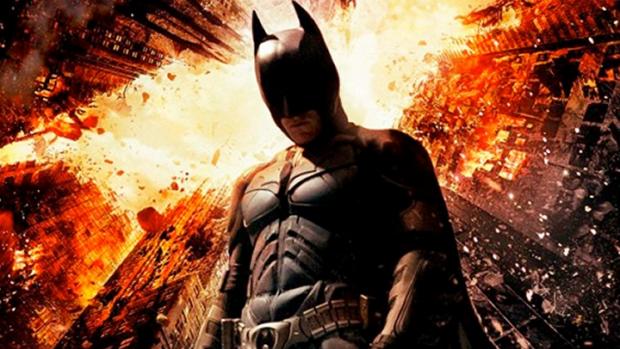 For a large part of its long runtime, Christopher Nolan’s The Dark Knight Rises is riveting and conjures up messy themes and moral paradoxes that question the assumptions of the genre the film belongs to. The canvas is bigger than ever in the trilogy, the narrative knottier and the possibilities richer. The film is marked by a preponderance of vertical movements – Bane’s ascent from the sewers, Wayne’s escape from the pit, the Batman’s flight from the cops – and I guess one could tenuously map this to the notion of a Freudian return of the politically (Gotham’s seemingly huge underclass) and psychologically repressed (Wayne’s childhood trauma). But The Dark Knight Rises pursues no such apple-cart-upsetting ideas to completion and instead chooses to couch itself in the rarefied realm of Batman mythos, where the stakes for the non-fan are nearly non-existent. Nolan’s film channels everything from the Old Testament (Gotham as Sodom, Blake as Noah, the plagues, the Great Deluge), through the French and the October revolutions (the storming of Bastille, the twilight of the tsars), to the recent Occupy movements in America in a way that only politically non-committed studio products can afford to. That does not, however, mean that the film has no political viewpoint. Vehemently reactionary, The Dark Knight Rises nearly reduces every issue to a question of bad parenting. The film is rife with appeals for the need of responsible fathers and father figures, with the incurably paternal Batman being something of a godfather overlooking his hapless Gothamite children. (There’s a chuckle to be found when you see Gordon unveiling a statue of the Batman). And yet, I’ve not seen a film as classically solemn and tonally consistent all this year, with all other movies coming across as glorified sitcoms in comparison.

 Satoshi Kon’s remarkable debut feature Perfect Blue (1997) begins with an action scene from a television episode of Power Rangers, revealed only shortly later to be a live performance by the actors in a public auditorium. As the resoundingly unsuccessful show winds down, we hear some young audience members sourly point out that it was nothing like the television version. This idea of the virtual, the illusionary coming across as more real than the real drives the central conflict of Perfect Blue, in which an erstwhile pop idol, Mima, finds herself becoming the prisoner of her own fabricated personality. A good ten years ahead of its time, Satoshi Kon’s film frighteningly presages the progressive virtualization and publicization of our personalities. Mima loses out to one of her fans who does a better job of impersonating her than herself and develops a persona for Mima that’s truer than reality. Perfect Blue doesn’t merely subordinate reality to illusion and personality to identity, but thoroughly undermines the possibility of constructing such dichotomies, as reality and illusion bleed so thoroughly into each other that it is not just impossible, but also immaterial that they be separated. Even with its deceptively assuring closure, a la Shutter Island (2010), the film pulls the rug of reality from under our feet and leaves us hanging like Scottie Ferguson. Very much like Mima, the audience struggles with the instability of the movie’s construction and attempts (perhaps in vain) to hold on to a solid ground from which to view things, to secure its own sanity. Directed with an extremist’s taste for visceral shock and a modernist’s eye for reflective surfaces, Perfect Blue challenges the psychological seriousness of many similar live-action features, while benefiting from its choice of the medium.



 The Seventh Art