Ellipsis


Tangshan Dadizhen (2010) (Aftershock)
Xiaogang Feng
Mandarin
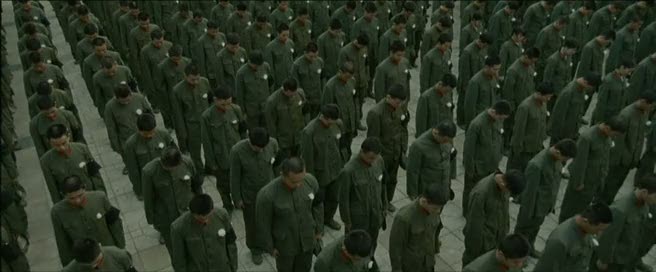
 

AftershockThere’s a problem with state-sponsored filmmaking: No matter how brilliant an artist you are, your works will eventually be evaluated based on your government’s activities – past, present and future. Xiaogang Feng’s Aftershock (2010), the Chinese entry for the Oscars, is a fine melodrama, with lots of empathy for its characters, but, despite its ambitions, it can’t help but spell the state agenda. It is rather interesting that the focal point the film – a work that so doggedly deals with family drama – is the death of Mao Zedong. In the film’s triggering event, the massive Tangshan earthquake of 1976 (an awfully done segment that tries in vain, like Lu’s work last year, to match Hollywood), a woman (Fan Xu) is given the choice of having either her daughter or her son rescued. The choice, actually, is of sacrificing either one. Devastated, she chooses her son, and doesn’t get to know that her daughter is, in fact, alive. Mao passed away months after the quake. Feng establishes a parallel between the two mishaps and treats them as kindred events that shape the microcosm and macrocosm of the story. The quake splits the twins into son and daughter of two different families. Mao’s death bifurcates Chinese history and ideology into one that is stuck with the nation’s past and one which thrusts forward, trying to catch up with the rest of the world. (That the two earthquakes which bracket  Aftershock‘s proceedings occur on either side of the Soviet dissolution is significant). Feng sketches the son’s family as being problematically patriarchal and the other family as somewhat liberal and progressive. Through the familial trajectory (the daughter marries a Canadian and returns home just after the 2008 Sichuan quake), the film seems to appeal for reconciliation between the two histories and to point out that that they were, after all, children of the same parents. I’m not sure if this nationalist sensibility is really that reproachable, but Feng portrayal of the Chinese army as all do-gooders and the current government as highly people-friendly distracts us from the finer aspects of this work.
Road, Movie (2009)
Dev Benegal
Hindi


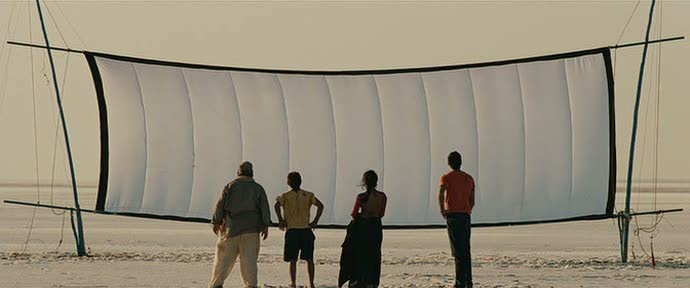
Road, MovieRoad, Movie (2009), written and directed by Dev Benegal, follows Vishnu (played by middle cinema darling Abhay Deol), the son of a small time hair oil seller, who borrows an ancient Chevrolet truck from his neighbour and hits the road on the pretext of selling his father’s stock and delivering the truck to its proper destination. Little does he care that the truck doubles as mobile cinema. On his way, he encounters a village in dire need of water where a dacoit group has been terrorizing the villagers, appropriating the available water, bottling it and selling it back to them. A paean to popular cinema of yesteryear, specifically to those times when films used to be a collective social experience that transcended class, race, gender and other disparities, Road, Movie views (and literalizes, as in the carnival segment) cinema, in the Bazinian sense, as a collective dream that acts as a fulfillment ground for our real life desires. Consequently, it laments the death of that collective experience due to corporatization of film production and segmentation of potential markets*. Through plot details, bizarrely enough, it equates cinema to both water (suggesting that both are essentially public commodities unjustly being appropriated for the benefit of a few) and oil (in that both are ultimate stress-busters and great social levelers, as is pointed out in the recurring song borrowed from Guru Dutt’s Pyaasa (1957)). Road, Movie is also self-consciously generic, as its title points out, likening the journey on a road to the trajectory and experience of a movie. True to the conventions of its genre, the individualistic, petit bourgeois protagonist realizes the meaning and importance of living in a community and, among other bromides, that the journey is more important than destination. But then, Benegal also keeps deviating from the genre in that he avoids conjuring up a revolutionary hero out of Vishnu. He may mean good, he might have learned a few important lessons, but he’s as helpless in front of these social forces as he was at the beginning. He can do nothing but go back to his dreary middle class existence. Oh well, at least there’s Tel Malish.


[*See Jonathan Rosenbaum’s review of Sleepless in Seattle (1993) for a detailed examination of the phenomenon]

Nandalala (2010)
Myshkin
Tamil


NandalalaTamil auteur Myshkin’s third venture Nandalala (2010) has its opening credits rolling over an image that seems straight out of Solaris (1972): two weeds gently swayed by the water flowing over them. Likewise, in the film, Bhaskar (Myshkin) and Agilesh (Ashwath Ram) are two kindred fishes flowing upstream, possibly trying to undo their births into this brutal world, in search of their origin: their respective mothers. As is made explicit in a near-surreal night scene at the beginning, the fear of being abandoned – by mother, by the state and by God – forms the backbone of Myshkin’s film. Walking along the margin of the highway like those reptilian critters we see, the duo comes across and strikes a rapport with a number of people almost all of whom live on the fringes of society. Bhaskar and Agilesh, themselves, are misfits who’ve broken away from the establishment – the asylum and the school. Those in the mainstream, on the other hand, are seen in the safety of their houses and cars. Paranoid, hateful, hypocritical and downright barbaric, they seem distrustful of everything that might distract them from their well laid plans. (That Myshkin casts himself in a starless film that he had to struggle to get funds for makes this a story of a marginalized filmmaker struggling with the industry as well). Social integration, however, is not what Nandalala aims for. For Myshkin, as is represented in the opening shot, it is the society that is constant flux around these central characters who find meaning in their relationship with each other rather than their position in the society. (The last scene is probably a little more cynical than it appears to be). Punctuated by Fordian skylines and generally jarring bird’s eye view shots that desert the characters, Nandalala, over-scored, overacted, imprudently written and characteristically over-directed at times, nevertheless continues to refine and fortify Myshkin’s cinema of physicality with its long shot filmmaking, chopped framing, brittle cutting and Mifune-esque performances.


(Image Courtesy: Tamil Torrents)

The Oath (2010)
Laura Poitras
English


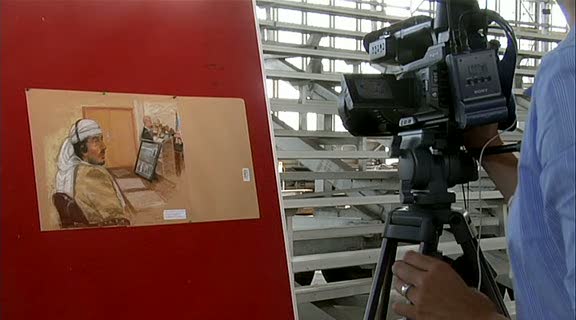
The OathThe approach of Laura Poitras’ documentary The Oath (2010) is akin to having your cake and eating it too. And your neighbour’s. And the next one as well. Split between two geographies and worlds – Yemen, where Abu Jandal – erstwhile Al Qaeda member and Bin Laden’s bodyguard – drives the streets for a living, and Guantanamo Bay, where Salim Hamdan – Jandal’s brother-in-law and a driver in the same organization – is imprisoned by the US government on charges of “supporting terrorism materially” – The Oath attempts to indirectly examine both the alleged indoctrination of young Jihadis for the purpose of suicide bombing and the Bush regime’s seemingly opaque and opportunistic justice system. Cutting back and forth between conversations with the loquacious, confident and charming Jandal and the uninhabited, melancholy premises of the detainment facility where Hamdan is held, Poitras establishes a parallel between the two men: both are prisoners over whom the possibility of death looms every instant and who, paradoxically, find safety in the very jails that hold them. (Jandal, placed high on Al Qaeda’s hit list, seeks refuge in the prison of TV images while Hamdan ghettoizes himself out of fear after he returns). “I’m a soldier, I’m not a martyr”, says a hypocritical Carlos in Assayas’ latest work. Jandal maintains the same, even though he sees no wrong in blowing up passenger planes. Poitras does enough to build on Jandal’s self-contradictions to paint a portrait of him as a conflicted buffoon whose only oath of loyalty is to life – not God, religion or political cause. But then, the film’s agenda doesn’t stop there. Poitras is liberal enough to dispel the conservative notion of Jihadis as mean killing machines and to label all her subjects as being “merely human”, but she’s also selectively neocon in that she develops a Freudian sketch of Islam and Jihad which does nothing to challenge the equally-distorted western perception of these larger institutions. This self-serving worldview notwithstanding, The Oath makes for an intriguing watch in the way it keeps stressing the gargantuan role that the visual media has come to play in our daily lives and administrative systems where the presence of a camera is the sole screen that separates memory and forgetfulness, justice and tyranny and life and death.

Kak Ya Provyol Etim Letom (2010) (How I Ended This Summer)
Aleksei Popogrebsky
Russian


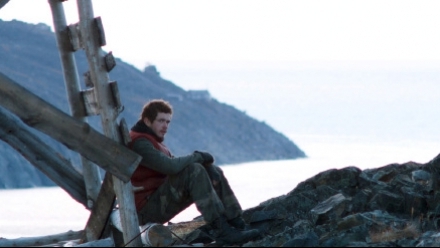
How I Ended This SummerAleksei Popogrebski’s How I Ended This Summer (2010) chronicles an unspecified number of days in the life of Sergei (Sergei Puskepalis), the sole operator of a meteorological survey unit on a remote island in the Arctic Ocean, and the younger, hipper Pavel (Grigoriy Dobrigin), an intern at the station. Popogrebski embellishes his widescreen canvas with breathtaking images of Chukotka, Russia, which appears as though it is the very edge of the earth. For Sergei, however, it is the very edge of his life, for confronting this seemingly limitless stretch of unpopulated, hostile and godforsaken terrain is like confronting the human condition itself. Faced with this predicament, Sergei holds-on to illusions that comfort him the most: work (however mechanized and pointless it may be) and family (both his real family that lives on the mainland and his newfound ‘son’ Pavel). Communication, or rather the inability to establish it, forms the prime motif of Popogrebski’s film. Be it between the island and the mainland or between two individuals in the same room (and, since we are in that realm, between man and God), meaningful communication seems to be a luxury. (The film abounds with radioactive emissions, short waves and SMS smileys while there are  only a few shots shots where we see two people together in the frame). Taking the idea of the lack of communication to a more tangible domain, How I Ended This Summer could be seen as a quasi Cold War allegory – a reading that’s quite plausible given that residual nuclear deposit on the island is what drives the plot – where an utter lack of understanding and introspection on the part of both the superpowers not only proved internecine, but has also left an indelible mark on generations to come. Popogrebski, of course, can’t propose a retroactive solution. He can, and does, only look forward to a renewed future, even if it means starting with a simple hug.

(Image Courtesy: BFI )

Hahaha (2010)
Hong Sang-soo
Korean


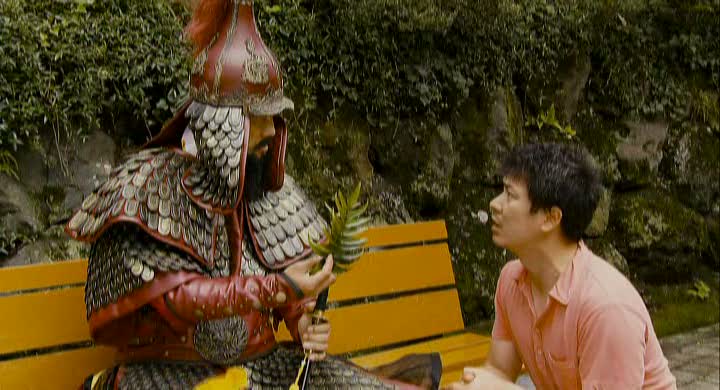
HahahaHong Sang-soo’s easy-to-type Hahaha (2010) is the kind of picture that critics comfortably dismiss as light and frivolous. That’s because Hahaha is light and frivolous. And consciously so. The film presents two young friends who accidentally meet and decide to hang out in a pub nearby. During their bout, they take turns to recite their experiences during last summer in a sea-side town. As the two mildly amusing stories unfold, we realize that they are not all exclusive as both tellers believe. We see characters and events that span the two stories, time-line of one story flowing into the other and the characters’ paths intersecting in bizarre and not-so-bizarre ways. Perhaps these two men are drunk enough (or dumb enough) to not realize that their stories share a single universe. Or it may be that one of them is only playing along and making his story up. Or maybe both of them are playing a game of Exquisite Corpse. It is also equally possible that both of them are sincere and it is Hong who is pulling their legs by actually making a film out of their stories wherein he fuses and confuses separate characters. The two stories are contaminated by regularly occurring zoom shots that lend the film the look of a bad sitcom or, more accurately, an amateur video made on the sets of Hahaha which reveal the artifice of it all. Existentialist in approach, Hong’s film argues, as does Allen’s Melinda and Melinda (2004), that one’s life is how one interprets it to be and that value of things resides only in one’s perception of those things. Consequently, like Allen’s film, one of the stories is high on marital drama and the other, on romantic comedy. (Actually, the former ends up being hysterical while the latter is pretty bland). But the film is also a testament to the power of stories in embodying our desires and overcoming our fears and a lighthearted appeal for the existence of personal, eccentric histories – personal and national – as opposed to the unquestionable, unfruitful facts handed down by text books.

The Social Network (2010)
David Fincher
English


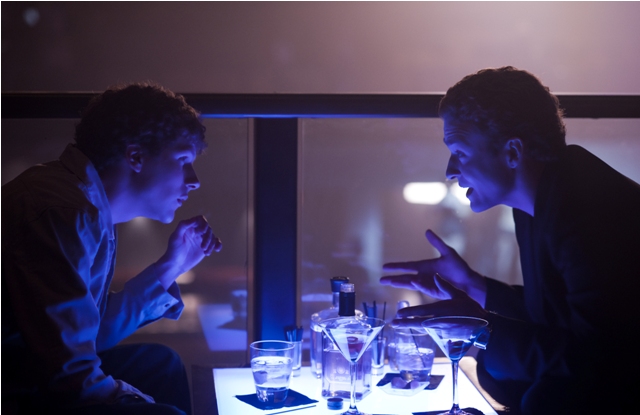
The Social NetworkGod created man in his own image. Aaron Sorkin’s Mark Zuckerberg (Jesse Eisenberg), it appears, created the 21st century man in his own image: a two-dimensional, unchanging prisoner of a projected persona. This threatening, ever-endangered entity called the “image” – social and cinematic – is what both Mark Zuckerberg and director David Fincher are respectively after in The Social Network (2010), the one picture of recent times that has given birth to the finest of film criticism*. The closest the trajectories of these two figures ever come in the film is the surprising moment when Zuckerberg wields a digital camera to photograph his friends diving into the pool. Clearly, Fincher’s romanticizing of Zuckerberg’s dream run attempts to equate the latter with a film director – to possibly Fincher himself, although it is a bit difficult to imagine David Fincher as anything but the establishment – in the way both of these misfits vainly put up with the bureaucratic minutiae of the head honchos and thrust their vision – the images – forward even if it means compromise on personal fronts. Both of them overcome the schemes and vagaries of the real world – emotions, accidents and flaws – using the surety of binary numbers: Zuckerberg with his codes, Fincher with his Red One. Zuckerberg, however, belongs to both film noir and fantasy. He is both Jake Gittes who learns to give up hope the hard way and David who defeats the Goliaths of Harvard, both Mario who tries to win back his princess and the dragon that tries to imprison her in a digital jungle, both Faust and the Devil, a crusader who makes a million enemies to regain a friend. What makes The Social Network particularly rich is its beneficial (and sort of natural) ambivalence towards copyright, Web 2.0 and, in general, capitalism. In fact, Sorkin and Fincher seem to view Web 2.0 as being simultaneously socialistic and capitalistic, democratic and Darwinian, a refined laissez-faire system where the individual decides, drives and controls and a great leveler that brings down established social hierarchies in a matter of hours and a few keystrokes. These are exactly its pitfalls as well.

[*There have been numerous remarkable examinations of the film already. Here are my favorite five among the two dozen or so that I read: Adam Nayman, Ignatiy Vishnevetsky, Jim Emerson, Manohla Dargis and Tom Hall]

(Image Courtesy: Hollywood Chicago)

Copie Conforme (2010) (Certified Copy)
Abbas Kiarostami
French/Italian/English


Certified CopyA possible manifesto for postmodernism, Abbas Kiarostami’s Certified Copy (2010) reminds one of a million other pictures – from the director’s own early films, through Godard, Rossellini, and Hitchcock, to Scorsese, Hou and Jarmusch – in both its major and minor strokes. This actually goes well with the film’s central argument of there being no originals in art as well as life. It asserts, as does Jarmusch’s latest, that meaning and authenticity exist in one’s gaze of objects rather than the objects themselves (Like the director’s previous film, this one reverses the artist-audience relationship and suggests that the viewer is the original author of works of art), that the question of authenticity is obviated if a (relative) truth could be arrived at through artifice, that no art can be inherently original given that it is feeds on and reshapes reality and that all aspects of human existence – appearance, language, behaviour, relationships and gestures – are reproductions of existing templates. Building upon the latter argument, the film examines the importance and inevitability of role-playing in our lives through the lead characters/actors (Juliette Binoche and William Shimmel), who bear an original-copy relationship themselves. Through them, the film proposes that there is no absolute ‘self’ and that it is only within context and within a relationship that each ‘role’ we play obtains a meaning. It is not that these two characters are faking it during one half of the film, but just that – like Sartre’s waiter – these inauthentic people segue from one level of role-playing to another (On one level, Certified Copy is a film where actors play characters playing characters playing characters). Akin to Shutter Island (2010), Certified Copy is divided into two realities, with the verity of each half being valid only in relation to that of the other. However, there’s much more to Kiarostami’s film than such straightforward illustration of philosophical ideas. (Like Scorsese’s movie, this one wears its themes on its sleeve, thereby undermining them.) Throughout, it probes where the essence and authenticity of a film rests: in its grand, ethereal ideas or in its banal, concrete physicality. Does the spirit of Certified Copy lie in its precise, recursive structure and its intricate mise en scène or is it in the minute, magical gestures of Binoche’s visage and the gentle eroticism of her loose-fitting gown?

Endhiran (2010) (Robot)
Shankar Shanmugam
Tamil


EndhiranShankar’s Endhiran (2010) is the sort of material that would have proven gold in the hands of a director like Bertolucci or Hitchcock. It has been over a decade and a half since ‘Superstar’ Rajinikanth started playing himself in his movies, maintaining a Brechtian relationship with his audience wherein the actor would slip in and out of the context of the films on whim. And Endhiran only seems like a logical consequence of that choice. Watching the film, it would be useful to remember that the Tamil film and television industry fetishizes the Rajini image to such an extent that all spin-offs from it – spoofs, impersonations, derivatives and pastiches – are celebrated endlessly. New age actors imitate and try to emulate him all the time, with some of them even proclaiming that they’re the next ‘Superstar’. It has, more or less, come to a point where the Rajini image has assumed an immortal life of its own while the man responsible for it has been deemed a faint echo. Given this postmodern, post-Rajinikanth situation the industry is in, much of the premise of Endhiran – a grouchy, ageing, eventually-envious scientist builds a nearly-invulnerable android modeled on his younger self, which goes berserk and multiplies itself to the point where the original (copy) loses its value – feels faintly autobiographical. An affront in every which way to the generally revered tenets of Hollywood storytelling (and science) predicated on plausibility, causality and relevance – as if the writer-director has taken all those Chuck Norris-based Rajinikanth jokes to heart –  Endhiran might just be the harbinger of something that was always within the reach of this industry: Tamil camp!


(Image Courtesy: SouthDreamz)

Exit Through The Gift Shop (2010)
Banksy
English


Exit through the Gift ShopNoted British street artist Banksy’s Exit through the Gift Shop (2010) is a confounding beast in that it purports to be a documentary by Banksy on a man called Thierry Guetta who attempts to make a documentary on Banksy (along with other street artists). The first section of the film brings us the essence of street art, its intention to democratize art by bringing it out of arthouses and into the streets. (One of Banksy’s “guerilla installation” works depicts a lady wearing a gas mask). Gradually, the film’s focus shifts to Guetta himself. He is presented as an inarticulate, passionate camera buff fetishizing the recorded image (presaging his unrestrained fetishizing of pop culture later on), as a romantic who believes that recording every moment of one’s life increases the value of one’s gaze and, in a sense, as a Banksy-like artist working on the streets of life. Along the way, it takes a lot of potshots at the reception of avant-garde art centered on the grand debut of Guetta. The interesting thing here is that it doesn’t judge Guetta’s works till the very end, thereby toying with our perception of these works as well (some of them indeed seem praiseworthy and were probably made by Banksy himself). But then, Exit does have an agenda of its own. It evidently stands against celebrity culture and the commodification of street art. It seems to propose that street art has to be a physical endeavour more than a conceptual one and that the physical presence of the artist during creation is of utmost importance. Ironical it is that Banksy himself has held a number of exhibitions and is a revered name in art circles. This is perhaps the whole point of the film. Exit could be read – if not as a self-serving promotional campaign – as Banksy’s attempt to come to terms with his failed anonymity, as an effort to resolve the contradictions associated with his name (through the figure of Guetta) and as a form of self-criticism which recognizes that he has become a brand despite himself.

« Previous PageNext Page »