Flashback


Maya Darpan (1972)
Kumar Shahani
Hindi

Your brother’s going away hasn’t changed him a bit. Such pride! Even your leaving will not shame him. He is as he was.


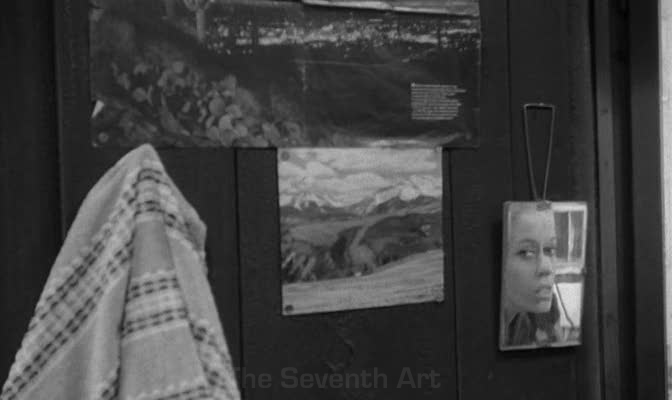
Maya DarpanKumar Shahani remains one of the directors in that rarely seen and even more rarely discussed group of filmmakers that includes names such as Mani Kaul and M. S. Sathyu. Unfortunately, neither are there home video releases for most of their works nor are there widespread public screenings or film fest retrospectives within the country to generate interest. Heck, they don’t even make their way into the world of file sharing and peer to peer networks. We are now at a point where even the original negatives of the films face the risk of extinction. One can only hope that institutions like the World Cinema Foundation will do something about it. Kumar Shahani’s Maya Darpan (1972) is a seminal work in Indian Parallel Cinema not just because it canvasses critical social issues (a facet that, more or less, in hindsight, has become a characteristic of the movement) but also because it attempts to seek out a new aesthetic, which does not try to straddle mainstream cinema and art cinema, to do that. The very title, Maya Darpan (literally “Illusory Mirror”), aptly sums up both the film’s social (imprisonment by one’s own “image”, as defined by the class system) and formal (Maya Darpan could well be a sobriquet for cinema itself, encompassing both its illusive and realistic properties at once) concerns at once.

Shahani’s film is set in a provincial town in Northern India, at a time following the nation’s independence in 1947 (The film could well have been set in 1972, just after the worldwide leftist revolution had been put down, and there wouldn’t be much change to the script) when India was yet to be completely integrated as a political entity and when Nehruvian socialism was about to take on the existing feudal hierarchy. Taran (Aditi) is the daughter of a wealthy landlord (Anil Pandya) and lives with her father and her widowed aunt (Kanta Vyas) in their ancestral mansion (which goes on to represent the whole of upper class in the film). The town is witnessing protests by newly formed labour unions which are partly being politically educated by the local railroad engineer (Iqbalnath Kaul), who seems to have an unspoken romantic relationship with Taran. Taran’s unseen brother, who had, to the chagrin of their father, renounced his class privileges and gone off to an Assamese tea estate, asks Taran to join him. Stuck in a stifling patriarchal order, with pressure to get married to an upper class groom mounting, Taran decides to talk to her father about her plans. Actually, much less goes on in the film than what I’ve described and the film is more interested in assessing the formal possibilities of the medium than in following a seamless opportunity-conflict-resolution trajectory. Taran’s character does not arc in the traditional manner (she seems to have already entered the third act) although she eventually manages to switch roles with her lover.

Maya Darpan is a film about transition and transformation – from the bondage of regressive social structures to a progressive state of liberty and equality, from a setup where people have to assume rigid roles irrespective of free will to one where a individual can free himself of inherited roles and think for himself/herself (Taran recites a poem – “I’m called to birth again” – that recalls the legend of the phoenix, as she washes her hands). In other words, it is about the process of breaking the cycle of repression and exploitation into a zone of freedom (Shahani even inserts newsreels depicting World War 2 battle sequences and Gandhian protests during the British rule of India, perhaps to suggest all forms of oppression and subjugation). Shahani finds the cinematic idiom to express this cycle in the form of duplicated shots, redundant compositions and repeated actions and dialog. There are many shots that depict characters moving from the right edge of the screen to the left that are so schematic and mundane to the point of being humorous and self-parodying (One of Taran’s daily routines is to dust the set of chairs – presumably the symbols of power and authority in the film – that her father and other landlords use during their teatime. Fittingly, they are left scattered and disowned by her towards the end of the film). This transgression of social boundaries is also depicted by having characters cut through boundaries and cross railway tracks regularly. Consequently, Maya Darpan plays out like a piece of complex musical composition with many minute variations on a few primary motifs (The film’s unexpected coda itself is a set of classically choreographed tableaus that, I believe, presents the class conflict in dance/martial art form).
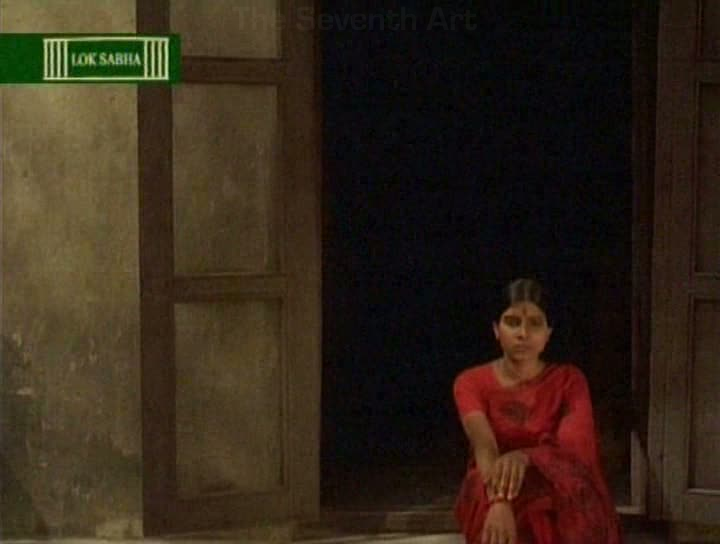
Maya DarpanShahani apparently assisted Robert Bresson on A Gentle Woman (1969) and the influence of the French director on Shahani’s style is obvious (especially the extraordinary opening sequence of that particular film, which is echoed at multiple places in Maya Darpan). Like Bresson, Shahani’s shot division has a tendency to break down sequences into their most basic components. Images of hands and feet, isolated in action, often punctuate the narrative. Also Bressonian is the use of sound in the film. Shahani employs tremendous amount of off-screen noise to complement the imagery rather than reinforce it (This divorce between image and sound is alluded to in the very first scene of the film – the nomadic camera, at first, seems to be searching for the voice on the soundtrack and eventually settles down near a sleeping character. The voice turns out to be non-diegetic). The presence of trains, automobiles, oxcarts and taps are all established by the soundtrack. In fact, the camera is never made privy to any sensational action. These actions are either relegated to the space off-screen or they are only provided to us through words. But the influence of Bresson is most palpable in Shahani’s use of his actors. He asks the actors, all non-professionals, to have no expression whatsoever on their faces when spouting their lines monotonically, without any modulation. The effect is all the more unsettling given how vehemently it goes against the natural speech pattern of the country.

As a result, Maya Darpan could be described as a film in which the sociopolitical concerns of Shyam Benegal and John Abraham are distilled through the minimalist aesthetics of Bresson (with a dollop of Resnais, Antonioni and Pasolini to boot). However, it should not be assumed that Shahani’s style is entirely derivative. Shahani’s Bresson influence is just the base upon which he works out his own ways. For instance, in Bresson’s films, conflicts would largely be kept internal and would very occasionally manifest in the characters’ physical actions. In either case, Bresson thoroughly remains a realist of space and time. Shahani, on the other hand, doesn’t hesitate to slip in the borderline-surreal elements. Large stretches of poetry and prose are recited by the characters on the soundtrack, which touch upon their psychology but abstain from analysis, while we see them wandering the barren, debris-filled streets of the town. Furthermore, Bresson’s characters have to go through a process of suffering before they can attain deterministic grace and happiness whereas Shahani’s protagonist is an active entity who chooses to change her life through conscious effort. Even the handful of comments online about the film mentions its innovative use of colour, which I find to be the least important aspect of the work. Shahani does this through the costume and production design of the film, which doesn’t exactly seem to succeed throughout.

Satyajit Ray once commented about Maya Darpan, along with other acclaimed works of the period (almost all of which he was critical of!), in his collection of essays Our Films, Their Films. I’ll type it down here:

Shahani’s other allegiance [in addition to Ritwik Ghatak] is to Bresson with whom he had worked on a film. The legacy of that lesson is to be seen in the girl in the centre of Mayadarpan [sic]. She, too, like Mouchette, suffers inwardly and wordlessly. No quarrel with that. But we are concerned with what happens outwardly. And here, I am afraid, Bresson evaporates. Does Shahani seriously believe that the major outward manifestation of such suffering is a slow, rigid ambulation up and down verandas repeated every five  minutes or so throughout the film? Film language would be threatened with extinction if this were really so. To me Mayadarpan seems a combination of poor psychology and poorer stylization. Even the sophisticated response to colour goes for nothing in a film that is so gauche in its handling of the human element. Even more than [Mani] Kaul, Shahani seems to forget that when one imposes a rigid style on the actor without a thorough working out of its expressive possibilities, it becomes indistinguishable from bad acting. The method becomes, extremely risky in a story with an urban background, where the nature of life and work severely limits the expressive gestures. The only possible approach here is the psychological one, for which Shahani seems to have no use.

While I would not be so harsh and unforgiving about Shahani’s film, I do believe Ray makes some fine points there. Shahani sure does seem to be on an experimental ground, trying to figure out the most effective means to get his points across. Not all his flourishes work and there are a number of rough edges to the film. Some shots seem o serve no purpose except perhaps to further disengage us from the already alien narrative. But it would be a tad unfair to say that Shahani eschews psychological exploration altogether. True that he does not work towards psychological realism through the conventional means of writing, acting and scoring. His psychological examination is, akin to Michelangelo Antonioni, carried out through actor choreography, his compositions and his mise en scène (and, to a minor extent, through the poetry-driven non-sequiturs that brace the narrative). Taran is almost always composed against the mansion’s walls and amidst the imposing interiors of the building. She is arrested and suffocated by the endless amount of doorways and pillars in the mansion. During the course of the film, it’s as if the monstrous structure assumes a life of its own, consuming Taran into the void within. This is starkly contrasted with the lush and open spaces of Assam and of the working class section of the village. The bottom line is that, if not anything else, films such as Maya Darpan are of considerable interest to the native viewer since they repudiate accepted norms of psychological realism in a country whose cinema has always thrived on those norms.

Los Angeles Plays Itself (2003)
Thom Andersen
English

Los Angeles is where the relation between reality and representation gets muddled.


Los Angeles Plays ItselfThom Andersen’s exceedingly engaging Los Angeles Plays Itself (2003) apparently began as a project to illustrate the representation of the city of Los Angeles in Hollywood cinema to the director’s students. But, luckily for us, it went on to become this 168 minutes of unadulterated, deceptively simple, video store joy that presents us with multiple levels of cinematic and sociopolitical discourse. Accumulating an enormous amount of footage from over two hundred films (the director himself is credited for the research), ranging from rare silent films to direct-to-video duds, splicing them with a high degree of meticulousness (Editor Yoo Seung-Hyun is the first technician to be credited on screen) and providing a deliberate, hilarious and nearly atonal voiceover by Encke King (simply brilliant), Andersen, armed with an formidable knowledge of the city’s history, geography, architecture and cinema, writes a dense and trenchant video essay on filmmakers’ perception of Los Angeles, audience’s perception of cinema and Los Angeles’ perception of itself. Los Angeles Plays Itself has to be one of the most entertaining films of last decade. Not only does it serve as a throwback to the very many noir, crime and action films of yesteryear, but it almost always points out the things that we have missed or overlooked in those films.

Los Angeles Plays Itself is divided into three parts that examine, in order, the way the city has been used as a backdrop for the plot, as a character in it and as the subject itself. Before that, Andersen establishes the reasons why he feels this study is justified and his criticism valid. Following this, he also gives a brief synopsis of present day Los Angeles, where permanent structures have become exclusive movie sets and makeshift film sets have become public offices. In the first part, Andersen presents numerous films that have tried to pass off Los Angeles as other American cities (two films even use it as China and Switzerland!), thanks to its seemingly malleable geography. Andersen discusses how action scenes eschew realistic continuity and cut from one place to another separated by tens of miles in actuality. Gone in 60 Seconds (1974) is probably the only film that emerges unscathed here (Andersen sees the film as a materialization of Dziga Vertov’s vision of a cinema that is purely made of mechanical objects). This section certainly throws one off balance with its complaints and it is here that the film comes close, if at all it does, to whining (Andersen openly declares that he dislikes geographic license, that the abbreviation, LA, is derisive and that artistic license is only a euphemism for laziness!).

However, there is another thread in this first part of the film that examines the use of the Los Angeles’ architecture in films. Andersen exemplifies that the modernist office and residential buildings, which were built as platforms for a healthier way of living, have almost always been used as the lairs of the villains and of madmen. The sleek, predominantly glassy, well-ventilated structures have somehow been associated with insidiousness and inhumanity. Perhaps this is a modern way of representing Transylvanian castles and haunted mansions. Andersen calls this “Hollywood’s war with modernist architecture”. In this section, he makes it almost seem like there’s an identity crisis experienced by his city. The second part of the Los Angeles Plays Itself explores films that have used Los Angeles as a character, as an integral part of the proceedings. It is here that he makes a distinction between “low-tourist” filmmakers (Hitchcock, for instance) and “high-tourist” ones (the avant-garde directors). Quite a few films are shown in a positive light here, most notable of them being Wilder’s Double Indemnity (1944), Aldrich’s Kiss Me Deadly (1955) and MacKenzie’s The Exiles (1961). The third and final part deals with films that have used Los Angeles as the subject itself. These are films that have confronted the darker passages of the city’s history head on. Andersen’s film is at its most “serious” here and talks about how films starting from Chinatown (1974) have increasingly been searching for scandalous events and eccentric public figures to tweak the rosy image of Los Angeles and create new ones that are equally flawed.

Los Angeles Plays ItselfPerhaps the best thing about Andersen’s film is that it hints at new ways of watching and reading cinema. By ‘new ways’, I do not mean a radical realignment of our visual sense as Brakhage called for, but a more benign change in the way we receive and assimilate the cinematic image. In a typically Bazinian way, he says: “Movies bury their traces, choosing for us what to watch and moving on to something else. They do the work of our voluntary attention. So we must suppress that faculty as we watch. Our involuntary attention must come to the fore”. This may sound pretty intuitive, but it only goes on to show how submissive we have become to the totalitarianism of the pop-film image. Los Angeles Plays Itself strikingly and consistently segregates various planes of the film image for analysis and indirectly reveals how complacent we have become when it comes to observing an image. Almost always in Andersen’s film, our focus is made to shift from the plane of principal action – usually the foreground – towards the setting and backdrop of the action – the architecture for indoor scenes and geography for the ones shot outdoor. Moreover, Andersen presents us shot footage of the actual buildings and locations before unraveling their presence in older films. As a result, one feels a strange intimacy with these structures that enables one to identify as much with the film space as with the characters. The effect is noteworthy. By separating the foreground and the background of the shot and familiarizing us with the latter beforehand, Andersen’s film makes us notice the artifice underlying the shot’s construction and the sleight of hand behind its execution.

In many ways, as Jonathan Rosenbaum mentions too, Los Angeles Plays Itself is an extended piece of film criticism written in film form. Andersen stacks one insightful observation upon another, almost each of which transcends the particular context it is defined in and evolves into a starting point for discussion about cinema at large. Take the passage where he tangentially talks about the cinema of Robert Altman: “How can I say this politely? It’s hard to make a personal film based on your own experience when you’re absurdly over-privileged. You tend not to notice the less fortunate, and that’s almost everybody. If you ridicule your circle of friends, your film will seem sour and petty. If you turn their problems into melodrama, your film will seem pathetic and self-pitying”. What was made as an offhand comment about Altman’s films makes so much sense with respect to the works of many other filmmakers too. Lines such as these might give an impression that Andersen hates cinema. But a second look reveals that he makes these statements only in a descriptive sense and not a judgmental one (His qualms with Chinatown is more with its legend and its denouement than the quality of film itself). His stance is liberal (even socialist, one might say) and he seems to be championing films that reflect the realities of working-class lives in Los Angeles over ones that speculate about alternate histories and criminal underbellies.

The three parts of the film are not only arranged in an increasing order of importance given to the city by Hollywood cinema, but also in the decreasing order of attention the latter has given to the reality that makes up Los Angeles. By the time Andersen ends his film with a discussion of the UCLA gang of African-American filmmakers, the director’s resentment about the representation of his city in popular films becomes alarmingly clear. Not only have these films stripped the city of its identity to make way for a ‘vanilla city’, but they’ve also managed to overwrite its culture and history with a sensationalist view of the city that is far from the truth. Furthermore, as indicated by Andersen’s choice of closing his film with excerpts from the works of these African-American directors, this tendency has also sidelined personal, political, independent and honest cinema that genuinely cares for its subjects and the city. Hipster cynicism and conspiracy theories have replaced optimistic political discussions and concrete reality. It is only during these glorious final minutes of Los Angeles Plays Itself that it becomes evident that it is, first and foremost, an elegy for a lost world. Like Tsai’s Goodbye, Dragon Inn that released the same year, Andersen’s film is an elegy for the real people, the real buildings, the real locales and the real cinema of his city that have been virtually rendered nonextant by the tyranny of dominant forms of expression.

Frantic (1988)
Roman Polanski
English

There is always someone who’ll do you one better
 

FranticThe more one learns about the life and works of Alfred Hitchcock, the more one sees how influential he has been on the generation of filmmakers that followed. More than the techniques and cinematic devices that Hitchcock had helped shape and the themes that he consistently dealt with, it is his very methodology of working – the now-legendary precision of his craft, the authorial domination that he seems to have exhibited (Godard had once equated him to tyrants and dictators) and the relentlessness of his approach – that seem to intrigue many. Interestingly, it is these very elements that elevate the films of Hitchcock into the realm of personal cinema wherein the director seems to have exerted a ruthless control over his films’ world in response to the unruliness of the real world. Although many filmmakers, such as Martin Scorsese and Quentin Tarantino, have forayed into the distinctive universe of Hitchcock, few filmmakers seem to be completely obsessed with his art. Directors such as David Lynch, Brian De Palma and Roman Polanski, each in their own unique way, have been carrying on the legacy of the master filmmaker with spectacular results. The filmography of the latter, especially, betrays such an obsession with that of Alfred Hitchcock that one can almost predict the next logical step for the director.

The major theme that pervades the entire body of work of Roman Polanski is that of the fickleness of the boundary between Good and Evil – the ease of induction of the former into the latter and the (in)ability of Good to recover from this demonic metamorphosis. For Polanski, like Hitchcock, Evil is an undeniable fact that lurks and simmers just beneath a veneer of order, propriety and Goodness. Most of his protagonists transition from a world of safety and predictability into a chaotic netherworld – from superego to id, if you will – where all their cherished beliefs go for a toss. The Bates Motel is just a turn away from the main road. Even when he adapts from existing works of literature, as in The Tragedy of Macbeth (1971), Tess (1979) and Oliver Twist (2005), his interest has always been on what motivates men to cross over to the other side. This theme relates directly in Polanski’s films to the question of commonplaceness of Evil and the existence of fascist tendencies within each one of us. A Freudian might connect this to Polanski’s traumatic childhood in the Jewish ghettos. Furthermore, this abstract theme also forms the template for a more personal examination of the male psyche, its fears and its insecurities. Evidently, these facets are also hallmarks of Hitchcock’s films and Polanski’s triumph lies in appropriating these elements and imparting his own artistic vision and personal dimension to them.

Even a cursory glance at Polanski’s early films illustrates both the presence of this motif and Polanski’s preoccupation with Hitchcock. Knife in the Water (1962) and Cul-de-sac (1966) are clinical, minimalist studies of the male psyche, reminding us of films such as Lifeboat (1944), and are direct predecessors of the film under consideration. Repulsion (1965) is, in some ways, a companion piece to Psycho (1960) and presents a pretty, young woman Carol (Catherine Deneuve) struggling against the fear of sexual conformism and ultimately breaking down in an alien land. Chinatown (1974) gives us Jake Gittes (Jack Nicholson) driving around Los Angeles with a wounded nose (that reminds one of the impotent, plastered leg of L. B. Jeffries in Rear Window (1954)) trying to get to the bottom of the supposed conspiracy around him, a la Scottie Ferguson, and eventually getting sucked into the inevitable spiral of impotence and death. Unlike what Hitchcock does in Vertigo (1958), Polanski does not severe our identification with the protagonist and makes us share his delirium throughout. The Tenant (1976), Polanski’s greatest film, is a glorious melting pot of Polanski’s Hitchcock influences, specifically Psycho, Rear Window and Vertigo, the essence of all his previous films and his Napoleon complex. Despite its flamboyance and non-committal nature, the two mirroring halves of What? (1972) are redolent of Vertigo.

North By Northwest

Frantic

Frantic (1988) is no different, although one could argue that Polanski’s disillusionment with the American ideals, especially that of Liberty (Interestingly, he was rallying for the same against the communist regime of Poland in his short films), adds an extra layer to the proceedings. The very economy of the title – Frantic – recalls the directness of the titles of Hitchcock’s films. Written by Polanski and regular collaborator Gerard Brach, Frantic is a thriller in the vein of Hitchcock’s espionage films and follows Dr. Richard Walker (Harrison Ford) scouring the sunlit streets and dark underbelly of Paris in search of his wife Sondra (Betty Buckley). The film opens with the POV shot of a car travelling on the highway as if to suggest the imminent journey of the protagonist deep into his own psyche. In the car are Mr. and Mrs. Walker reminiscing about the city of Paris, where they had their honeymoon two decades ago. “It’s changed too much” remarks Richard. He might very well have been talking about their matrimony. The cab breaks down. The replacement tyre is also flat. Perhaps that’s how the Walker couple is too. The Walkers find another taxi to arrive at Le Grand Hotel and check in to Room 402 where a strikingly directed, 10-minute set piece unfolds.

As the couple indulges in amusing romantic talk that rarely shows signs of a crumbling relationship, we get occasional glimpses of Richard’s possessiveness about Sondra and a tinge of dissatisfaction on her part towards him (“Promises, promises”). Although there is no specific set of devices that Polanski employs for identification with a character (The first human POV shot comes only after the half-hour mark), thanks to his star persona, we immediately identify (in a positive manner) with Ford. We still see him as a charismatic, flawless, blue collar version of Indiana Jones. Richard takes a nap after a shower and finds his wife missing when he wakes up. Of course, one could resort to the old solution of labeling whatever happens after this as merely a bad dream that Richard has and that interpretation does have some validity. But whether it happens really or in his mind is really irrelevant for what is important is the profound change that Richard’s personality undergoes. It is after this incident that Richard leaves the safe and orderly world of conferences and hotel room formalities into a chaotic underworld of smuggling, murder, double dealing and racial politics. And it is in this precarious world in which Richard’s presumptuousness and superiority is revealed and regularly punished.

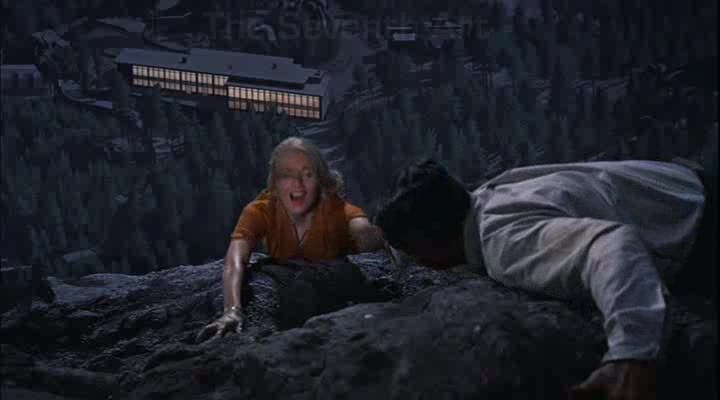
Paris is no more the city of love that he had seen twenty years ago. It is as “dangerous” and “dark” as the notorious alleys back home. In this unpromising climate, Richard embarks on a detective mission on his own, like Roger Thornhill, in order to “bring back” his wife, now that he has lost confidence in both the Parisian police and the American embassy there. He tries to make his way through his obstacles using the seemingly limitless amount of money he has got and, to an extent, succeeds. But eventually, money proves to be too weak a weapon to control and shape the unruly and the near-bureaucratic world around him. The world around him continuously reveals how powerless and unimportant he is. Ford is no more the omnipotent, omnipresent and the omniscient adventurer who could get an autograph from Hitler, escape from South American tribes and permeate the deepest of Indian caves with ease.  He has aged and is, truly, away from Hollywood. The medicine man becomes a drug user. The revered VIP is seen roaming around barefoot with a junkie. His sense of security and identity is dislodged piece by piece to the point that he indulges in fistfights with random strangers in a random apartment without a shred of dress to cover him. The hotel’s security officer suggests that perhaps Sondra is with “someone she has been thinking about” to which Richard reacts with amazement and denial. This is perhaps his biggest fear for Richard – of losing his wife and of her finding a better man (“There is always someone who’ll do you one better” he says, albeit in some other context). The possibility of that happening seems very high, given the status of their relationship. And this way, Polanski takes apart the myth of the American Hero – a man who simply has to be the best, there’s no two ways about it.

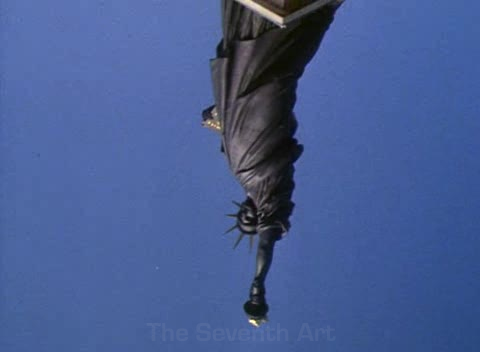
FranticOf course, the last half-hour of Frantic is a significant failure. For one, it contradicts the themes set up so far in the film. While, till now, Walker’s pride and smugness was stripped off layer by layer and his own powerlessness pointed out to him endlessly, the last half an hour restores his original status as an American Hero who can penetrate any setup and rescue anyone. What had been a nightmare till now (Ennio Morricone’s surreal score deserves applause) turns into a dream where every move of Walker’s turns out right and with expected consequences. There might be a reason to this incoherence. Polanski was apparently forced to cut 15 minutes of the film and change the ending (note that Polanski was considered washed out by now). I hear, from a not-so-reliable source, that in the original ending that Polanski wrote, Sondra turns out to be a double agent herself. This twist ending would have served two purposes. First, it would have made a political statement, although superficial, about America’s involvement in the Israel-Palestine conflict (The nuclear detonator is concealed inside the miniature Statue of Liberty; the film was made during the Reagan era). Also, it would have been the final blow to Walker’s ego. His worst fear – that his wife is with someone else and that he is not competent enough for her fantasies – would have come true.

The studio’s intervention is telling. By having Richard plan and win the climactic showdown and save his wife heroically, the studio’s move only reinforces the glory of American conservatism that the film had hitherto satirized (Surely, the Walkers are conservatives.  The Statue of Liberty a visual motif in the film. Richard mentions that they don’t vote anymore. Polanski and Brach don’t even give them token liberal statements to make). The Statue of Liberty which had till now been tossed around stands upright as the Walkers reunite. Additionally, the studio’s cut reestablishes the patriarchal structure of the Walker family that was threatened by the situation (It is only Richard who gets to give orders to his children). The whole point of the film is potentially undermined by the studio’s decision. Polanski would make amends for this blunder with his next film, Bitter Moon (1992), where too a couple plans to travel to the exotic east and rekindle their lost love. If the quintessential hero figure of Harrison Ford was the equivalent of Hitchcock’s Cary Grant, the stammering, insecure Hugh Grant would be that of James Stewart. In Bitter Moon, Nigel (Hugh Grant) ventures away from the boredom of his marriage and into his own erotic fantasy without a clue that he is still far from his wife’s. Polanski both brings down the last shred of esteem in the male character and the patriarchy that he embodies with the twist at the end (which is the kind of device that he seems to have had in mind for Frantic). Polanski, cleverly, even throws in gratuitous amounts of nudity, possibly, to appease the studio.

Interestingly, there is another film that achieves what Polanski’s film unfortunately doesn’t. Of course, Alfred Hitchcock’s Vertigo serves as the inspiration for Frantic, with the male fantasy being destroyed and chastised by the mysterious woman he seeks. And perhaps David Lynch’s Lost Highway (1997), which I’ve not seen, deals with the same thing too. But Frantic is remarkably similar to Kubrick’s final film, Eyes Wide Shut (1999). Kubrick’s film has often been compared to Polanski’s The Ninth Gate (1999) because both films deal with secret societies and strange rituals. Kubrick’s film is, in fact, closer to Frantic than The Ninth Gate, in which Polanski was eyeing something else altogether. In Eyes Wide Shut, Tom Cruise plays Dr. Bill Harford (Richard Walker in Frantic is also a doctor and Harford is an acronym for Harrison Ford!) who is nudged into a cat and mouse game of pursuing his wife’s fantasies and trying to build his own. Tom Cruise is the direct successor, in some ways, to Harrison Ford. Both are the icons of the confident, self-assured man in Hollywood. No one would imagine the existence of a weak, possessive and insecure person beneath their flawless exteriors. Had Polanski made his film a decade later, my guess is that he would have most definitely cast Tom Cruise in the lead role. While Polanski’s planned ending stops at the male’s disillusionment, the destruction of his dream and his subsequent return to harsh reality, Kubrick goes one step further and proposes what might be done for reconciliation.

Sulanga Enu Pinisa (2005) (aka The Forsaken Land)
Vimukthi Jayasundara
Sinhala

“I committed no sin. I’ve always wanted to earn paradise. But I won’t die in this desert without a holy place. If you die here, you’ll be reborn as a toad or a snake.


The Forsaken LandSri Lankan filmmaker Vimukthi Jayasundara’s debut and only film to date, The Forsaken Land (2005), opens at dusk with the shot of an armed man carefully surveying a vast stretch of land, walking over it in a zigzag pattern and pausing occasionally to observe specific points on it. Following this, we see a montage of seemingly unrelated images – a hand running over a tube light, a rigid arm jutting out of a stream of water and a couple sleeping, filmed head on – that recall Weerasethakul’s films for some reason and announce the otherworldly nature of this land where the story is to unfold. The Forsaken Land embodies the quintessence of the radical, new age aesthetic known as Contemporary Contemplative Cinema with its penchant for protracted, long shots and accentuated, hyper-real direct sound (particularly the sounds of elements of nature), its keen eye for landscapes and its tendency to favour the documentation of rhythm of life and gradual changes in human behavioral patterns over construction of intricate plots and dense theoretical analyses and announces (as do most of the films employing this aesthetic) that the time for action is over and the time for reflection has indeed begun. Having been slammed by the right wing for being anti-war and, indirectly, pro-terrorist, and received threats from the ruling majority, Jayasundara hasn’t made a film since.

The Forsaken Land is set at a time when war between the Sri Lankan government and the Liberation Tigers of the Tamil Ealam (LTTE) has reached a deadlock and is at a point where either side can trigger the next phase of battles. But it becomes clear, as the film unfolds, that this abeyance of war is just an illusion of peace that will be disrupted anytime, as indicated by the threatening presence of tanks, trucks and jeeps everywhere.  The film charts the lives of six individuals living in a remote area in southern part of the country – Anura (Mahendra Perera), the lone guard at the local military outpost who goes to duty everyday to protect it from a nonextant enemy, his wife Lata (Nilupli Jeyawardena) who stays home, spending her time observing the world around her, his sister Soma (Kaushalya Fernando) who goes to work in the town nearby and who is either unmarried or has lost her spouse, his colleague, the old man Piyasiri (Hemasiri Liyanage), who seems to have a strange affinity towards the little girl Batti (Pamudika Sapurni Peiris), who may or may not be the daughter of Soma and a soldier Palitha (Saumya Liyanage), who has an affair with Lata. Not only is none of these relationships made clear, but they are also rendered irrelevant. Information is aptly given in extremely small amounts with only barebones of a story to support it.

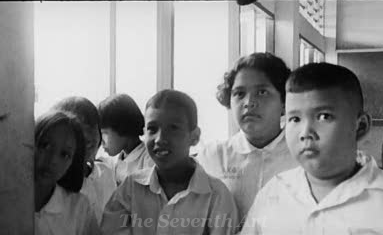
The Forsaken LandThe first thing that one notices in the film is how sparse the locales are. There are hardly any people seen. There is no connection of the village to the world around it save for the occasional bus that takes Batti to her school and Soma to her workplace. There are no TVs, no radios or even newspapers that are seen in the film (till Soma decides to buy a radio from her salary). Anura’s house, itself, stands as the lone man-made structure in this seemingly limitless plain. Additionally, the film does not particularize the location and hence it can be assumed that Jayasundara is universalizing the conditions of his central characters. It is not only a geographical vacuum that these characters seem to be living in, but also in political, moral and cinematic vacuums, Clearly, these characters are suspended in the hiatus between two brutal civil wars, unable to settle down into a permanent life style. They amuse themselves with petty sexual games and illicit affairs while murder is not an uncommon act around here. Somehow, all the characters in the film seem to have landed smack dab in the amoral middle of the moral spectrum (Only Anura turns out to be residing in a void within this void, with a shade of positive morality within, as indicated by the final minutes of the film). Moreover, in the indoor scenes of the film (there aren’t many), Jayasundara and cinematographer Channa Deshapriya light and film these characters in such a way that they seem to live inside a black void, unable to get out and soon to be annihilated by it.

But these people also harbour a hope, in vain, of escaping this limbo. Palitha wishes that he can go north and fly a helicopter, Soma decides to move out and teach at schools in other villages and Anura criticizes Palitha for blaspheming, betraying his belief that there is a higher power that will carry him through. They even speak about reincarnations in these lands forsaken by god. But, of course, they are sucked back by the void and dragged back into the vicious circle. It’s a circle alright. Piyasiri tells Batti a story about a dwarf girl and a hunchback. Like the hunchback who destroys his own house (and later himself) to protect his vanity and keeps doing the same mistake ad infinitum, all these characters seem be going in the same enclosed path (This seems to be the very case with the civil war, in fact, where for some arbitrary ideologies, people seem to be killing each other). Like the eternal repercussions of the hunchback’s deeds, the mistakes of the past – both personal and national – seem to bear upon each of the adults in the film. Only Batti, the icon of future and posterity in the film, with her innocence and untainted morality, free of any scar from the past, offers some hope when she boards the bus out of this blasted village as the film fades to black.

The Forsaken LandAnura guarding the outpost that is far from being under threat is reminiscent of Herzog’s Signs of Life (1968), where, too, the very purpose of existence of the characters was questioned. But unlike Herzog’s protagonist who attempts to induce aggression onto the ruined, dead and harmless surroundings, the characters in Jayasundara’s film succumb to it. The sudden passivity that follows an intense period of violence seems to have thrown them out of control. But, rather than Herzog, Jayasundara’s use of landscapes to underscore the moral depravity and pointlessness of the character’s lives suggests Rossellini and Antonioni. The house the characters live in is breaking down; there are hints of death around them regularly; the characters are ironically cleansing themselves now and then as if to rid themselves of this stagnation. Why, the building that unites all the characters and is placed physically on the highest ground, as if it is a sacred monument, is, of all things, a toilet. There is an image in the film early on of Anura sitting naked, stripped of his uniform and hence his identity, within bushes holding on to his gun. This could well represent the whole idea that the film presents. What’s the use of a weapon when you are dying out there, stark naked? What’s the use of boosting your defense systems when your people are dying of hunger and cold? However, Jayasundara’s film, although a maiden work, rarely lends itself to such propagandistic statements and, instead, lets us discover what it is like to be out there.

Godard once remarked that the best film on Auschwitz is one that unfolds in the house of one of the prison guards. Jayasundara’s film comes very close to that. It is more interested in what the war has done than the war itself. The focus of the film is the indelible scars a war leaves on its land and its people. The people in The Forsaken Land are those who have not been able to get rid of the inertia of fear and instability triggered by the war. They have resorted to nihilism, indulging themselves in superficial relationships and casual sex, perhaps in a belief that this state of peace is only transitory and there is no escape from the war. Like the fortunate turtle, which Batti finds, that escapes the claws of the vulture for a brief period of time, like that fish out of water waiting for the rain to pull it back into its routine, these people are merely waiting for fate to sweep them along and out of this limbo. And Jayasundara’s film proficiently shows us how such a precarious situation can prompt a human being to shed all the values he/she holds dear. By actually presenting the insanity that happens during a period of ceasefire, in the form of tortures and custody killings, as grotesque, brutal and indigestible, Jayasundara’s film indirectly questions the absurdity of justifying the very same routines during the war as acts of glory and honour.

Ljubavni Slucaj Ili Tragedija Sluzbenice P.T.T. (1967) (aka Love Affair, Or The Case Of The Missing Switchboard Operator)
Dušan Makavejev
Serbo-Croatian

“The threat posed to man by rats has still not been fully grasped here. Rats devour enormous quantities of food and other goods. They eat winter coats, entire libraries of books, corpses in autopsy rooms, even film stock.”


Love AffairAlthough such hybrids tend to be heavily reductive, considering Yugoslavian filmmaker Dušan Makavejev’s early features as (stay with me) Godard meets Bertolucci meets Anger meets Buñuel meets Waters proves to be a fairly useful starting point for exploration. Bringing to mind Godard’s self-reflexive examination of cinematic medium, Bertolucci’s Reich influenced analytical fiction, Buñuel’s hyper-surreal interjections, Anger’s extravagant imagery and Waters’ camp outings, Makavejev’s films seem to be completely in line with the French New Wave’s iconoclastic sensibilities, which seem to have remarkably captured the revolutionary spirit of the sixties. Blending news reels, pseudo-documentaries and on-location fictional footage shot in cinema-vérité fashion, Makavejev’s features remain an essential voice of (cinematic and sociopolitical) dissent, analysis and critique of the Tito regime. Like Godard, the primary hurdle for Makavejev in this direction seems to have been the problem of cinematic representation and the consequent need for returning to zero.

His second feature, following Man Is Not A Bird (1965), Love Affair presents us the titular love affair between an Hungarian immigrant Izabela (Eva Ras, who also appears in the director’s previous film), the titular switchboard operator, and Ahmed (Slobadan Aligrudic), a Turkish immigrant, who has served in the army for a considerable amount of time, is a party worker and is currently working as a sanitation officer for the government. Punctuating the affair are instructive documentary sequences where a sexologist and a criminologist go about explaining historical and cultural aspects of sex and homicide respectively. Then there are sequences from the local morgue where a dead body is being examined for cause of death. There are also sequences of extended conversations between Izabela and her friend Ruska (Ruzika Sokic) about the various affairs they have had. To top off this seemingly immiscible collage work is a documentary track that informs us about the history and consequences of rat infestation in Yugoslavia, including a scene where an on-screen text reads an absurd poetry about rodents.

Makavejev uses an interesting flashforward-flashback structure that regularly announces the outcome of the love affair, in effect squelching the tension that could have been generated if the film had gone conventional. During the post-mortem, we see the necklace and the undergarments of the victim presented as exhibits. Makavejev immediately cuts to Izabela wearing the same. A three month old fetus is found inside the victim, following which we see Izabela going to the hospital for a pregnancy test. It is only after Ahmed is identified as the murderer that Makavejev cuts to the actual event. A Godardian bedroom scene where Ahmed admires Izabela gives way to a cold, scientific and disturbing description of her dead body. Makavejev’s intention behind employing this structure may have been mere playfulness. Or it may have been an attempt to shift our attention from specifics of the plot to the nature of the relationship between Ahmed and Izabela. But it is more likely that Makavejev employs this device to denote the Vertigo-esque inevitability of a tragic ending to this doomed love affair (The “murder” itself is visually and thematically reminiscent of the one in Hitchcock’s film).

Love AffairMakavejev’s stance in this film, as in his other features of this period, seems to be that of William Reich, who was against pornography in sex and politics – a position that takes off from his ideology of free love and free-thinking. This pornography of the cinematic image is what Makavejev seems to be fighting against. His early films present themselves as attempts to work against the representation of workers and women in mass media by both (the then-popular) social realist films (in agreement with the maxim that realism does not mean reproducing reality faithfully but in showing how things really are) and Stalinist propaganda. The influence of propaganda art is visible everywhere in the film – through giant size posters of Lenin, Communist gramophone records and laudatory news reels and post card pictures – acting as a counterpoint to actuality. In Love Affair, like he did in his first feature, Makavejev continues to explore this chasm between the popular image of the worker and the truth about him (Here is an excellent essay that discusses Makavejev’s representation of the worker in Man Is Not A Bird).

One particular sequence exemplifies Makavejev’s discrediting of right-wing propaganda as nothing more than political porn. Izabela and Ahmed, after their first formal meeting, sit in her bedroom. She tells him that there is something good on television. Sipping coffee, they look towards the camera. Eschewing conventional eye-line match cut to a TV, Makavejev inserts news reels showing the Communist party destroying churches. She tells him that it is more intimate this way. They loosen up a bit. Ahmed calls Izabela a good homemaker. She places her head on his shoulders. The news reels again. A moment later they are in bed. Apart from this rendering of such Stalinist art as objects of arousal, Makavejev establishes the discrepancy between represented reality and the actual reality through his mise en scène by contrasting the joyous, dynamic, open spaces of the news reels with the empty, static and cramped apartment Ahmed and Izabela reside in. The two girls are often lost visually and aurally amidst the crowd and noise of the city. Even in the final scene, full of pathos, where Ahmed is arrested, Makavejev underscores this effacement of the individual for a faux nationalistic ideology by having exuberant Communist songs overpower Ahmed’s voice.

It seems to me, that for Makavejev, politics is sex and sex is politics. No, not on a metaphorical level, but quite literally. His films seem to present a notion that every authoritarian regime is fuelled by a distinct vision of sexuality – a possible influence of Reich, once again – and that this chauvinism/insecurity consequently shows up as the subjugation of one sex by the other. In line with that thought process, Makavejev fittingly boils down the larger picture down to sexual politics between the lead characters (Izabela looks at the camera, as she does frequently in the film, and shouts: “I didn’t sign up to be your slave”, thus opening up multiple plausible interpretations. Is she, apart from being the “everywoman”, a representative of Yugoslavia? Of represented Yugoslavia? Of cinema itself? A case could be made for each). There are lots of threads in the movie that can be neatly tied up together, I guess, only if the exact context of this film with respect to New Wave Yugoslavian cinema (Novi film) and the intricacies of the Yugoslavian politics is known. For instance, there are a number of stray slices-of-life sequences in the film that seem to serve no other purpose than to provide respite and true warmth to the couple, shielding them from the horrors of the external world. May be Makavejev wanted to avoid the criticism his earlier film received – that it was dark and pessimistic.

Love AffairLove Affair begins with a quote: “Will there be a reform of man? Will the New Man retain certain old organs?” suggesting that the outward ideology of the nation may have changed, but underneath it amounts to one fascism replacing another, with one form of sexual oppression giving way to another (an idea that becomes more streamlined and incisive in WR: Mysteries of the Organism (1971) and Sweet Movie (1974)). In the narrative track about the history of gray rats, the narrator explains us that these pests were let into Europe in order to get rid of the deadly black rats and that the gray ones prevailed being “stronger, tougher, and more bloodthirsty”. And that this new rat turned out to be more resilient than man. The narrator wonders “It’s still unclear who will rule the Earth in 100 years: People or rats?”. The political mapping is only too clear here. But then, that does not render Makavejev as a pure leftist leaning towards capitalism. He remains a centrist in all these early films (He presents Yugoslavia herself as straddling two ideologies as his mise en scène portrays a country in transition, borrowing politics and cultures from both sides of the world), holding both traditional capitalism and tradition Communism at a cynical, if not downright contemptuous, distance and embracing only the “individual” and his right to live and love freely.

Shirin  (2008) (aka My Sweet Shirin)
Abbas Kiarostami
Persian

“I fear that this embrace may turn out to be a dream. Like all the dreams we had throughout the years which, on waking, would turn into horrible nightmares.


ShirinIt’s been long since Abbas Kiarostami started trying to eliminate the role of the director in making films. His works bear witness to the fact that, with him, the function of a director is closer to that of a concept artist than a logistic manager. His latest, Shirin (2008), is the next logical step in this process of progressive non-intervention of director. An extrapolation of his segment Where is My Romeo? (which seems like a experimental doodle in comparison) in To Each His Own Cinema (2007), Shirin presents us an audience in a movie theatre, made up mostly of women, played wonderfully by over a hundred professional actresses, watching a period melodrama based on the love triangle between king Khosrow, princess Shirin of Armenia and Farhad, the ace mathematician and sculptor. No, we do not get to watch one frame of the film that is playing in the theatre. Instead, what we get is a film whose imagery is constructed entirely using close-ups of the audience’s reaction to the movie they’re watching while the soundtrack is that of the movie being seen. Emotions run the gamut – empathy, sympathy and apathy – as Kiarostami’s mildly differential and subtly accentuated lighting lovingly captures each contour of these beautiful women’s faces.

One familiar with the works of Kiarostami would know how the director uses the film screen as a kind of mirror for introspection. Be the mirror pointed towards the society at large, as in Homework (1989) and Ten (2002), or towards cinema, like in Close-Up (1990) and Five (2003), or towards the director himself, as in The Wind Will Carry Us (1999) and Life, And Nothing More… (1991), Kiarostami’s cinema has always flourished on this dialectic between reality and its reflection on screen. Here, in Shirin, he turns the mirror towards us – the viewers in the theatre – as we become our own audience. As a result, our reactions get tied to those of the audience on screen. We smile when they laugh and we are moved when they break down. We are surprised at every small twitch of their eyebrows, every casual gaze away from the screen, every mild shudder of theirs, and every tear that reaches their lips. Shirin make us privy not only to all our gestures and emotions which we are usually oblivious to, when sitting disarmed in the darkness of the cinema hall, but also to the taken-for-granted social experience shared by the collective of strangers wherein we all seem to concur emotionally and, yet, differ vastly in the vehemence of our responses.

ShirinShirin takes place in real time. The 90 minutes of the film coincide with the runtime of the film within the film. In some ways, I guess Shirin could be considered a companion film to Jafar Panahi’s Offside (2006), which took off from the fact that women, in Iran, are not allowed to enter football stadiums and which, too, unfolds in real time – 90 minutes again – alongside an international soccer match. While, in Panahi’s film, we are presented with a model of rebellion against existing norms, Shirin hints at conformism. Offside showed us an attempt to change existing reality whereas Kiarostami’s film presets to us a longing to enter an alternate one. There is a glint in all these women’s eyes that betrays their celebration of the film, which seems to perfectly acknowledge and express their own plight, and, consequently, a yearning to enter it forever. They seem to understand that this freedom is going to be short-lived and they would have to return to their oppressive lives soon (One woman has a plaster on her nose. We are tempted to ascribe it to domestic violence). Even though none of the men in the cinema hall get a close-up from Kiarostami, they do have a constant, ghostlike presence in the background. Whenever the scarves on their head slip off, the women snap back to reality to adjust it. One woman even winces when sunlight falls on her face as the door nearby is opened suddenly.

Of course, the first movie (not considering too much the hilarious opening scene of Ross Herbert’s Play It Again, Sam (1972), which too explored the possibility of life merging with art) that comes to mind watching Shirin is Godard’s My Life to Live (1962), in which Godard provides a close up of Nana (Anna Karina) weeping while watching Dreyer’s The Passion of Joan of Arc (1928) in a movie theatre. Like Godard, Kiarostami links the life of Shirin to that of the audience in the film by making the “story” of the film highly reflexive (Kiarostami might even be referring to Dreyer’s film, given the French connection of the film in the form of Juliette Binoche). Following Khosrow’s death, the princess asks her friends: “Are you shedding these tears for me, Shirin? or for the Shirin that hides in each one of you?”. This is as overt as Kiarostami’s film gets. The world in the film, too, is highly patriarchal, with the fate of Shirin being decided by power games played by men – kings, sons and lovers – alone (“Damn this game of men that we call love!”). By impartially cutting from one face to another, instead of dwelling on a single face, Kiarostami might just be making a statement of generalization and pinning the film down to the situation in present-day Iran. This notion becomes even more plausible given that the love triangle between Khosrow, Farhad and Shirin is essentially a contest between the government, an artist and a woman.

ShirinDespite its avant-garde and nonconformist nature, surprisingly, Shirin works well as an experiment in popular genre cinema – the one zone that the director has been reluctant to get into. Shirin proves, at least as far as modern day genre cinema is concerned, that sound is more important than the visuals if instant gratification is aimed for. It is certainly easier to keep track of and engage ourselves in a film when we look away from the screen than when we close our ears while watching the images. In Shirin, not once are we given visuals from the film within the film, but we are clearly able to understand its structure and chronology. There are flashbacks in the film that we never miss. Action scenes play out in our minds vividly (with reduced ASL, of course!) and voices are immediately matched with stereotypes that have been given to us through the ages. In a humourous moment, we see a mildly tearful woman break down completely when the orchestral music swells. This is genre cinema being taken apart to reveal its manipulation, folks. Kiarostami removes the redundant video track, so to speak, and adds a new one to counterpoint the soundtrack instead of reinforcing it. So, in a sense, Kiarostami moves both towards and away from genre cinema simultaneously. In the director’s own words: “It is a combination of both freedom and restriction.

Kiarostami once said the following in an interview which sums up so effectively his whole body of work and especially Shirin:

“A filmmaker has to be conscious about his responsibility. I always wish to remind the audience that they are watching a film. You see, it is very dangerous to make the audience more emotionally engaged than they need to be. In the darkness of the cinema, people are so innocent. It makes them feel that everything is closer and stronger. That is why we should not make them even more emotional: People need to think when they watch films, not to be robbed of their reason… I make half movies. The rest is up to the audience to create for themselves“

Kiarostami’s idea of cinema is one that requires the physical presence of an audience for the completion of the enterprise that the filmmaker has set off (“There is no such thing as a movie before the projector is switched on and after the theatre’s lights are turned off.” he says in another interview). Shirin is yet another half movie in the director’s filmography not only in the sense that it provides us with only one half of the melodrama – the soundtrack – being played, but also because it leaves it to us to decide the connotations of this bizarre marriage between an expressionistic soundtrack and a realistic imagery. In fact, Shirin is made of numerous such interactions between the prime elements of Kiarostami’s cinema. Throughout the film, there are rich conversations between sound and image (by direct opposition between generic and non-generic forms), the past and the present (The women seem to be able to identify themselves with a fictional character living in a distant past), fiction and reality (As always with Kiarostami, one isn’t able to separate what was scripted and what was spontaneous), the women and the film they are watching and Kiarostami’s film and us. And that is one of the reasons why Shirin is best watched in a theatre (It’s kind of like watching the last chapter of that Tarantino movie!), where, for once, we would be tempted to take a look around.

[Where is My Romeo (2007)]

Jang Aur Aman (2001) (aka War And Peace)
Anand Patwardhan
Hindi/English/Urdu/Japanese

“In India, the ideology that killed Gandhiji was once more legitimate. Nuclear nationalism was in the air. The memory of one who opposed the bomb on moral grounds alone had begun to fade.


War and PeaceDocumentary filmmaker Anand Patwardhan’s controversial War and Peace (2001) could well have been titled War and Peace: Or How I Learned to Forget Gandhi and Worship the Bomb, for the major theme that runs through the film is the disjunction that exists between the past and the present and a nation’s collective (and selective) cultural amnesia with respect to its own past. Shot in four countries – India, Pakistan, Japan and the USA – and over a period of four years following the 5 nuclear tests done by India in 1998, Patwardhan’s film was slammed by Pakistan for being anti-Pakistani and by India for being anti-Indian, while the film’s barrel was pointed elsewhere. Tracing out the country’s appalling shift from Gandhian-ism to Nuclear Nationalism and Pakistan’s follow-up to India’s nuclear tests, Patwardhan examines the role of the countries as both the perpetrators and the victims of a major mishap that is now imminent, taking the Hiroshima-Nagasaki incident as a potent example to illustrate why nuclear armament is not merely a potentially hazardous move, but a wholly unethical one. War and Peace is a film that should exist, even if amounts to only the ticking of a radiometer amidst nuclear explosions, for it calls for a realization that there can be neither a victor nor a finish point in this internecine nuclear race.

Minutes into the film, it becomes evident that Patwardhan’s stance is far from neutral. War and Peace is not a documentary which sets up the dialectics, leaving it to us to resolve the contradictions and come to an ideological stance. It is, clearly, anti-nuclear in its politics. Patwardhan’s editing is deterministic and it pointedly juxtaposes shots of unabashed right wing celebration of the success of the nuclear tests with those of the anti-nuclear protests being squashed by police force. The cross section of people Patwadhan takes for the pro-nuclear arguments consists almost entirely of common folk, far removed from any knowledge of the bigger picture, and the sample he gathers for the film’s anti-nuclear arguments is made up of activists, scientists and cultural icons whose opinions, naturally, seem far more logical than the former group’s. However, even amidst the one-sidedness of Patwardhan’s intent and approach and the near simplification of issues, War and Peace provides a lot for the audience to work with. Part of the pleasure in watching War and Peace comes from the cat and mouse game between the audience trying to pin down the filmmaker to a particular ideology, political side, a nationality or a religion and the director invalidating every such categorization, one after the other.

Eventually, beyond the seemingly-leftist tone of the first chapter, Patwardhan turns out to be an absolute centrist, with humanitarianism (and hence complete nuclear disarmament) being the only ideology he seems to support. One by one, he strips down every artificial façade people have been made to wear, to elevate the movie to a purely human level. In a moving scene, the friend of a Kargil-war martyr, a Pathan himself, tells us that he feels guilty because it was another Pathan who shot his friend. In another, two former generals – one from India and one from Pakistan – recall how futile the previous war was, both politically and personally. Likewise, Patwardhan nullifies every classification based on class, religion, nationality and political leaning in order to recognize people just as people and to acknowledge the existence of each one of them. But, despite the film critical and sometimes cynical attitude, never does Patwardhan assume a stance superior to the people he deals with. War and Peace is as much a personal film as it is political. From the film’s very first lines, Patwardhan ties his story to the history of the country. He goes on to tell us in a somber, disinterested tone, which will stay for the rest of the film: “That our family, like Nathu Ram Godse and his co-assassins, were upper caste Hindus cured me for ever, of any narrow understanding of nation and any vestige of pride in the accident of birth”. With the significance of his own caste questioned, Patwardhan merely goes on to explore if there is any worth in associating one’s name to these man-made trappings at all.

War and PeaceWhen Mao Zedong told the Dalai Lama that religion was poison, he was, in fact, nurturing another poison called patriotism. Of course, in India, it is undeniable that both religion and jingoism work in union to charge the people up with faux ideologies, no matter which party forms the government. War and Peace investigates this strong synergy within the context of the nuclear race between India and Pakistan. Both ultra-nationalism, with its distorted, larger-than-life definitions of “bravery”, “martyrdom” and “sacrifice”, and religion, which perpetuates a misplaced sense of masculinity with its belligerent iconography and literature, as is elucidated by Patwardhan’s film, seem to operate in conjunction with the free market system to create an environment where might is indeed right. And this explosive mixture of religion, politics and capitalism, as Patwardhan highlights briefly, doesn’t exactly seem unique to India or Pakistan. “For God and Country” reads the American motto on its Air Force Association headquarters. In this regard, War and Peace shares a lot with Kubrick’s Dr. Strangelove (1964, alluded to in the film’s first few minutes), where, too, the nuclear superiority was equated with masculinity. In fact, in a panel discussion about Patwardhan’s film, former director-general of Pakistan’s intelligence agency, Lt. Gen. Asad Durrani tells us that the only fear Pakistan has about the nuclear bomb, thanks to the ease of access to it, is that it might go off accidentally!

Patwardhan emphasizes this effacement of the individual to serve national and religious ideologies continuously in the film. People are often photographed, in long shots, as being overshadowed by huge banners of political leaders, by paintings of gods, by commercials of consumer products and, sometimes, by the nuclear bomb itself – both in India and Pakistan (Even during his stay in America, Patwardhan manages to photograph a couple of security guards being dwarfed by a triumphant image of Neil Armstrong holding the American flag on the moon). There is a constant battle between individual conscience and populist opinion throughout Patwardhan’s film (In a noteworthy composition, Patwardhan photographs Raja Ramanna, father of India’s first nuclear program, through a ventilation in the piano that gives us a wheel like figure – the symbol on the Indian flag – imprisoning the man). In a cracking sequence, during a debate on nuclear testing, in a high school in Pakistan, Patwardhan finds a girl, who had just now spoken onstage ‘for’ the bomb, speaking against it. Upon inquiry about this discrepancy, she tells us that she chose a side that would give her more points to speak about and one that would be received well by the majority. It is a remarkable scene, with the politics of both the countries being boiled down into a single classroom, which strikingly underlines the tendency of common folk to conform to the majority in an unstable political climate.

But the real catalyst in this destructive process seems to be the free market system whose agents leave no stones unturned to create and exploit emotional imbalance among people. War and Peace examines how privatized media networks, instead of reassuring people, “brought [Kargil] war into the living rooms” by sensationalizing images of war and selectively filtering truth to evoke a vengeance-driven feeling of nationalism. The FMCG brands promptly followed up with slogans and graphics on their packages so as to reinforce the ruling party’s justification of the war. Even after the war, these firms did not forget to cash in on the remains of the war. “Cadbury’s salutes the heroes of the war”, “Hero Honda presents the 50th day commemoration” and other such commercials flood the Indian TV screen following the war. Extrapolating this set of arguments, in the final chapter titled “Song of India, Song of America”, and taking into consideration the infamous Tehelka scam that exposed the corruption of the Indian defense ministry, Patwardhan raises the question about the consequences of privatizing the defense industry, as it has been done in America. The point that Patwardhan seems to be making with this fabric of arguments seems to be that, in an attempt to ape the west, both India and Pakistan seem to have forgotten their basic necessities while going after a luxury called nuclear empowerment, which turns out to be only detrimental to the development of both countries.

The most unfortunate part about this kind of a system of governance, so the film points out, is that it makes science a culprit to the decisions made on religious and nationalist bases. The fundamentalists, both in India and Pakistan, believe that the A-bomb is a “gift from God” (Hindus and Muslims are seen, literally, worshiping the bomb). Science is transmogrified to serve the cause of religion and the fanatic nuclear race. Every decision is justified using science and mathematics and people, as a result, are reduced to mere numbers. One scientist tells us the casualty due to nuclear radiation is just one in a million. Another one talks about making tradeoffs for a greater cause. Probability theory is exploited to uphold morality and deaths are quantized and neglected in comparison to the superpower status a nuclear bomb might give the nation. General Leslie Groves, the director of the Manhattan project, as is revealed by historians in the film, decided to use two nuclear bombs in place of one (even when Japan had virtually lost the war) just in order to compare the effectiveness of uranium and plutonium based bombs. By the time this factoid is revealed, Patwardhan’s observation that the minorities – ethnic, social, political and religious – are the ones who end up at the receiving end becomes a universal truism.

War and PeacePatwardhan’s film is full of humorous moments brimming with great irony. These blink-and-you-miss moments often arrive as establishment shots, cleverly setting up the attitude of the filmmaker in the sequence to follow. Be it of a man cleaning the garden of Raja Ramanna, who is sedately playing the piano inside his house, a miniature cannon placed in his house besides a sculpture based on the Mahabharata war, a set of Nancy Drew books arranged alongside books on Islam in the girls’ high school in Pakistan, a destitute woman sitting indifferently besides the hordes of laymen celebrating the nuclear success or a bunch of puppies and kitten playing in the Gandhi ashram, Patwardhan’s ever-curious camera, even during the most serious of conversations, never hesitates to wander off to make a point of its own. But the remarkable part in all of this is that Patwardhan derives his assertions from reality – from actual objects present in the scene of discussion. Instead of cutting forcefully from one image to another to make an Eisensteinian statement, Patwardhan merely reframes using a gentle tilt or a pan, often with a socialist eye for detail, to highlight the various opposing forces acting on people.

War and Peace could well serve as a fitting documentary counterpart to Haasan’s Hey Ram (2000) – my pick for the best Indian film of last decade. Both are decidedly Gandhian films that examine the deadly confluence of politics and religion (one character in Haasan’s film equates this combination to “sex and violence” in cinema). Where Haasan’s film ends with the murder of Gandhi, War and Peace begins with that incident. While Hey Ram had the present in black and white and the past in colour to reflect the collective loss of memory that the nation seems to be suffering from, Patwardhan’s film presents us the past entirely using monochrome newsreels – both archival and reconstructed – and the present in colour, as if quarantining the past as a work of fiction (complete with a introductory countdown and a projector hum). Both explore the country’s selective renouncement of its own past whereby all the ills of the past are willfully retained and rewarded while the ideology that called for a non-violent and symbiotic way of life is as consigned as foolish romanticism. “This thing skips a generation”, notes one of the residents of Hiroshima, in War and Peace, referring to the effects of the A-bomb toxins on the new-born. This, in another sense, is indeed what both these films hope for – that the younger generation will open up to a past that their elders refuse to acknowledge.

Landscape Suicide  (1986)
James Benning
English

“When I visited Plainfield, I couldn’t get a sense of the murder. But the feeling of a collective guilt still lingers.”


Landscape SuicideJames Benning’s Landscape Suicide (1986) begins with a three minute sequence of a tennis player (Eve Ellis) practicing serves. Benning shows us just the player, standing at the edge of the court, doing her routine in a near-mechanical fashion. We do not see where the serves land or if the balls are being collected by someone off screen. After these three minutes, Benning cuts to the view of the other side of the court. The turf is full of tennis balls lying in a random pattern. Though only expected, it is an enigmatic moment in the film, for it is the first change of setup in the movie. This banal sequence does two things. One, it habituates us to the rhythm and the mode of discourse of Benning’s film. It announces to us that the major events the film deals with and their consequences will largely be kept off-screen. Two, it acts as an abstract to one of the major questions of the film – Does the sum of human actions, however insignificant individually, have an effect on the environment they live in? We are products of our environments, naturally, but is our environment a product of our actions too? Following this prologue, Landscape Suicide presents itself in two parts, each one investigating a homicide, connected by an unseen narrator who, having heard of the incidents through newspapers and magazines, presents the movie from the perspective of an outsider.

The first half of the film revolves around the murder of a teenager by her classmate Bernadette Protti in 1984 and unfolds primarily through an extended interrogation sequence, as would the second half of the film, of the accused teenager. This long sequence is shot using a static camera, with no shot-reverse shot structure, that fixates itself on Protti’s face for the whole sequence. She is visibly shell-shocked and trying hard to muster up words to answer the questions. Apparently, Benning constructed the sequence based actual courtroom transcripts and had Rhonda Bell, who plays Protti, bring them to life. David Bordwell describes here how sometimes telling, and not showing, can be much more rewarding in film. That is exactly the case here. What Protti tells here isn’t as important as how she tells it. The whole sequence is more significant as a collection of gestures than as a document of confession. This is great delivery we are taking about here. It is a part which requires you to shed your vocabulary, be completely inarticulate (even more than The Dude!) and, yet, describe everything in fine detail and Bell does a remarkable job. Even with this barely coherent piece of monologue, it becomes clear how Protti’s image, perhaps characteristic of her age group during that period of time, amidst her peers is more important to her than any morality and how petty peer pressure and the rat race for celebrity status can cause even the most sane to lose balance.

The second interrogation sequence is that of the infamous Ed Gein, who, as we all know, has been the inspiration for characters like Norman Bates and his successors. This conversation, in complete contrast to the Protti interrogation, is completely formal and well worded. Gein, played to perfection by Elion Sacker, looks like a very reasonable man. He sticks to the question and answers then with utmost poise and a clear, flat, fearless voice. The painstakingly detailed and often hilarious session tries to pin down Gein based on his self-confessed aversion for blood, but, with machine like passivity and utter soberness, he parries tricky questions and stays impermeable. One might even end up labeling him innocent were one to assess him based on this interrogation alone. Both the interrogations come attached to two “set pieces” that seem tangential to them. Each interrogation is either followed or preceded by a montage of landscapes from the hometown of the central protagonist – Orinda, California for Protti and Plainfield, Wisconsin for Gein – and a vignette from the private life of a resident, possibly the victim, from that town at that period time.

Landscape SuicideAt first sight, the landscapes of these towns seem anything but indicative of the horrors that have taken place in them. The places we see, both Orinda and Plainfield, are as serene, unpolluted and quiet as towns and suburbs can ever be. But after a few minutes, the unanimous absence of people becomes a bit unnerving. It seems as if people are deliberately hiding from each other, trying to mind their own business and to distance themselves from anything that can potentially pop them out of their mundane routine. The narrator notes, strikingly, at one point: “When I visited Plainfield, I couldn’t get a sense of the murder. But the feeling of a collective guilt still lingers”. And there seems to lie the major weakness of most of our justice systems. These institutions have gotten used to “weed out” people such as Ed Gein and Bernadette Protti as anomalies in a flawless society, much like the way the narrator’s daughter tears out the pages describing the Protti murder from the Rolling Stones magazine in order to avoid reading depressing news, instead of tracing out and correcting the reasons behind the birth of all such Ed Geins and Bernadette Prottis. That is not to say that the reason behind the Gein murders and his penchant for “taxidermy” was only the animal violence he was exposed to everyday since childhood. But subjecting Bernadette Protti, who is clearly more a function of social status than of mental imbalance, to the same treatment as Ed Gein denotes nothing less than a complacent, if not irresponsible, justice system.

Landscape Suicide is a symmetric film. Between the five minute long prologue and epilogue, the last three “set pieces” of the film mirror the first three. While the Protti section is followed by the landscape montage and the household sequence, the Ed Gein section is preceded by them. In a way, Landscape Suicide also acts as an examination of the narrative property of cinema. We are first given Protti’s version of what happened verbally and then the images of the locations they took place in. One is thus able to situate the now-coherent account into its proper geographical location and conjure up, more concretely, the visual equivalent of Protti’s account. On the other hand, the locations of the incident are given before the oral account in the case of the Gein murder. In this case, one tries to reconstruct the incident by simulating the events being described within the locations already familiar. Benning resolves the “how” of the incident into “what” and “where” and asks us to put them back together to find out “why”. In essence, Benning divorces genre cinema from its exploitative nature by splitting up its action into words and locations. With some effort, one should be able to stitch up all the elements of Benning’s film to obtain a teen-slasher and a psychological thriller.

Additionally, Landscape Suicide is also about the act of remembering and reconstructing the past. It is an investigation about the possibility of retrieving the truth using every tool available. In both the interrogations, it becomes clear that the barrier to recovering one’s past is one’s own memory and, then, the language used to verbalize that sensory commodity. Throughout the Protti interrogation, there is a war between the sounds of her speech and the sounds of the typewriter that records her speech, with the latter seemingly trying to grab each one of her words and derive the literal meaning from it (this, somehow, reminds one of last year’s wonderful film Police, Adjective). Benning’s point may just be that our spoken and written media are incapable of translating actual experiences to words. It is evident that what Protti’s words mean are far from what she means. Throughout the two interrogations, Benning blacks out the screen regularly and adulterates the soundtrack with stray sounds, as if underscoring the incapability of the cinematic medium to capture or reproduce experiences and feelings in their entirety.

Landscape SuicideHowever, Benning does offer an alternative here. His use of a static camera throughout the courtroom scenes is noteworthy in this regard. Benning accustoms us to the space the camera stares at by eschewing conventional cinematic grammar for conversations and avoiding shuffling between setups anywhere in the film. At one point during the interrogation, Protti leaves for the bathroom. Instead of cutting to a new view point or providing an ellipsis, Benning lets the camera be as it was when Protti was there. It’s a moment that is reminiscent of the cut during the opening tennis sequence. The absence of a human figure before the camera is so unsettling that one can actually sense the change that the milieu before us has undergone. If history is indeed a study of changes through the ages, the only way to document it is to document the changes. In Benning’s film, this change is recorded in terms of changes in natural and man-made landscapes, which are also, perhaps, the closest in resembling the human memory in the sense that they, too, morph gradually over time owing to the cumulus of all human actions – both beneficial and detrimental. And it only follows logically that cinema should pay keen attention to landscapes and topographies if it ever wants to revive the past and reconstruct history as it was, free from corruption by conscious human intervention and oversimplification by the rigidity of our languages.

Dokfa Nai Meuman  (2000) (aka Mysterious Object At Noon)
Apichatpong Weerasethakul
Thai

“Now, do you have any other stories to tell us? It can be real or fiction.
 

Thai filmmaker Apichatpong Weerasethakul’s maiden feature Mysterious Object at Noon (2000) is an instant success. Loosely based on the game Exquisite Corpse, originally conceived by the surrealists, wherein the participants of the game take turns to advance a storyline, Weerasethakul’s film shows us the director and his crew traveling throughout rural and urban Thailand, picking people at random, presenting them with an audio tape that contains the narrative of a story as told by its previous bearers and asking them to further the tale in whatever way they like. The “story” in the film begins with a physically challenged kid, taught at home by a visiting teacher, who notices a strange, round object roll down from his teacher’s skirt one day, which later transforms into a mystic boy with superpowers! Wait till you see what this already bizarre setup mutates into. The “characters”, who narrate the story, almost run the gamut and include a sober tuna fish seller who, she believes, has been “sold” to her uncle, a talky old lady whose cheerfulness seems to conceal a tragedy, a gang of timid teenage mahouts who seem straight out of a Jarmusch movie, a troupe of exuberant traveling players, each of whom would have a quirk or two if probed, a bunch of TV show participants, two deaf and mute girls who seem to be the most excited of the lot and a bevy of primary school kids whose imagination would, literally, leave one speechless.

The original Thai title of the film, apparently, translates to “Heavenly Flower in Devils’ Hands”, evidently, calling attention to the film itself. It is undeniably true that what starts as a beautiful emotional drama is unfortunately mutilated and metamorphosed into a tale of fantasy, then, mystery, horror and romance. But, surely, this “heavenly flower” is not of much interest compared to the devils which hold it. Mysterious Object at Noon is, perhaps, closest in style and intent to Abbas Kiarostami’s Homework (1989), in which the director brings down a whole nation sitting in a stuffy room with a bunch of first graders (Actually, Weerasethakul’s whole body of work tempts one to equate him to Kiarostami, especially given his penchant for cars and roads!). Here, as in Homework, the initial objective of the filmmaker, eventually, turns out to be one big MacGuffin. The ultimate point of the movies is not to investigate whether the kids complete their homework promptly or if the story streamlines into a smooth narrative ready for Hollywood, but to draw out a portrait of a society derived from these first hand accounts. Weerasethakul’s movie may be a joke derived out of a simple afternoon game, but what it does, in effect, is to draw the cultural landscape of a country, not by taking a didactic top-down approach but by examining the most basic fears, desires, anxieties and interests of common folk who form its social structure.

Essentially, Mysterious Object at Noon examines the function and power of stories as cultural artifacts and explores how stories preserve and reflect the spirit of the age they originate in, much like every art form – major and minor. Additionally, Weerasethakul’s film acknowledges the tendency of these stories to undergo transformation through the years as they pass from one social class, age group, ethnicity and way of life to the other. These stories may get corrupt along the way, may absorb elements from real life and even end up losing their original meaning, but, in any case, they serve to perpetuate culture and build links between generations (One kid in the final segment recites a story about an uncle who recites to his nephew a story about an uncle and a nephew. Presumably, this story was told to him by his uncle). These stories may be passed on in the form of books, paintings, photographs, modern recording media (a la audio tapes, which are used in this film to record the story) and word-of-mouth, as Weerasethakul’s film indicates by turning on and off sounds, images and texts in an incoherent fashion. But, whatever the form, each version of these stories carries an imprint of the narrator’s sensibility and world view. With some effort, from each story, one should be able to reconstruct the realities of the world the narrator lives in and vice versa. Like the image of the railway tracks, which are parallel but seem to be converging at infinity, that punctuates the film, these stories, although appearing to be all over the place on the surface, have one point of convergence – they all help out in sketching the collective consciousness and the collective unconscious of a particular culture at a given point in time.

Moreover, by actually making a film out of the concocted story, Weerasethakul concludes that cinema, too, is one such medium that could well function as a sociological document and which the posterity can use to understand their own history from very many perspectives. By merely filming in black and white, Weerasethakul takes his film one step away from reality and makes it seem like an antiquated object that is being preserved for a long time. And like these stories that shape-shift with time, Weerasethakul, call it a running gag, makes certain folk tales and myths repeat themselves across his filmography, albeit in different avatars – another one of his many similarities to Kiarostami. The humourous father-daughter duo, who talk to the doctor about the old man’s hearing problem, reincarnate in the director’s next movie Blissfully Yours (2002). The story about the two greedy farmers and the young monk, which makes an appearance in the hypnotic Tropical Malady (2004), resurfaces with a more violent outcome in Syndromes and a Century (2006). And the tale about the shape-shifting “Witch Tiger” that the young boy begins to narrate at the end of Mysterious Object at Noon forms the entire second half of Tropical Malady, needless to say, in a completely transformed tone. For a writer-director who has consistently soaked his films in the themes of permanence of history and mythology, recycling of human memories and behaviour and the existence of a common binding spirit across generations, this gesture just can’t be considered as a mere prank.

Mysterious Object at Noon consistently reinforces and reminds of Weerasethakul’s preoccupation with juxtaposition of cultural extremes. Often in the director’s films, aptly highlighted by the “traveling shots” filmed from the car’s front and rear windows, we find ourselves wondering whether we are going forward in time or backwards. The very first shot of this film presents us everything that would become the director’s trademark in the following years. This single four minute point of view shot from inside a car presents us a host of extremes placed alongside each other. The car starts out on a broad highway, amidst tall buildings of the city, and takes a serpentine route to gradually arrive at a sparse and quieter suburban locale. The vehicle is that of an incense and tuna fish seller. He is broadcasting an advertisement using loudspeakers attached to the car, endorsing his brand of incense sticks, citing its virtues, and asking people to use only this brand while worshiping Buddha. This blatant lie on the soundtrack counterpoints the truth of the photographic image, which is also much more banal and undramatic compared to the fictional stories we hear on the car radio. Furthermore, by using an advertisement marked by scientific terminologies and latest capitalistic strategies to endorse a product used in a religious ritual, Weerasethakul brings total modernity and total antiquity – the future and the past – together to provide a broad outline of a country in transition (Tokens of American influence on contemporary Thai culture are abound in Weerasethakul’s films). Later, the director goes on to further explore the volatile boundary between reality and fiction and the object-mirror image relationship that they share with each other – using both the film within the film and its making-of. As it turns out in Panahi’s The Mirror (1997), reality deviates as significantly from fiction as it resembles it (The mystic kid seems, in actuality, far from being mystical and is more interested in KFC and comics).

Weerasethakul prefers to be called a conceptual artist rather than a film director (He cites Andy Warhol as a major inspiration). This tendency of his is most manifest in Mysterious Object at Noon, wherein he is content is merely triggering a chain of events and persevering to see what evolves. There is no manipulation of the mise en scène, the plasticity of the image is never harnessed and the camera is employed at a purely functional level. Weerasethakul does not even polish the gathered fragments and simply joins them, leaving all the interpretation to us. Shot in digital, cinéma vérité style, using handheld, and no with predetermined script, Mysterious Object at Noon oozes with documentary realism. Like he does in most of his films, Weerasethakul keeps exposing the tools of his trade in an attempt to disillusion us from the belief of watching an alternate reality and to reinforce the fact that this movie indeed takes place in our world. At one point in the film, the director himself enters the frame to adjust the lighting for the film within the film he is shooting. As a result, he lets us see both the creation and the creator – the image and the process behind its construction – much like he does with his script and its authors in Mysterious Object at Noon. However, Weerasethakul’s self-reflexive moves do not end here.

The film’s title should, appropriately, be cleaved into “Mysterious Object” and “At Noon”. Weerasethakul, after presenting us the major part of film dealing with the “mysterious object”, adds an epilogue titled “At Noon” shot in the director’s hometown of Panyi, whose quiet nighttime images we are already acquainted with thanks to the director’s earlier film Thirdworld (1998). This one is a completely freewheeling, heavenly segment in which we witness a group of boys playing soccer in the afternoon, kicking the ball into a nearby pond and taking a bath in the process of retrieving it. This is followed by vignettes of people having lunch and a bunch of younger kids, before being called by their mother for lunch, tying an empty tin can to a dog’s neck and watching the poor animal go berserk due to the noise the can produces. They say that the essence of life lies in boredom. Likewise, Weerasethakul seems to be of the opinion that the most interesting things in life arise out of these dead times in the afternoon (one needs to just look at the director’s next film for proof). And like these kids who seem conjure up fascinating things from the most commonplace of objects, Weerasethakul, too, realizes a movie completely out of the “dead time” of his characters’ lives, creating something magical that only cinema could have brought to life. In a way, Mysterious Object at Noon is an elegy for the stretches of time we’ve lost in planning ahead, the times we’ve cast off in the pursuit of “higher” goals and the dead times we’ve killed in order to move into lifeless ones.

Also published at Unspoken Cinema

Apichatpong Weerasethakul
Thai

Repulsion (1965)
Roman Polanski
English

“We must get this crack mended.


RepulsionRepulsion (1965), Roman Polanski’s second feature following Knife in the Water (1962) and the first one made in the UK is perhaps one of the few horror movies that have really aged well. The reason for that is probably because Polanski manages to avoid all the flashy temptations and pitfalls of the genre and the era and sticks to minimalism. Enchantingly shot in black and white, Repulsion presents to us the events that unfold in a span of two weeks in the life of Carol Ledoux (Catherine Deneuve), a foreigner who lives in London in an apartment with her sister Hélène (Yvonne Furneaux) and works at a local beauty parlour as a manicurist. Carol is aloof from her colleagues and seems to be living in her own world. Hélène has a boyfriend Michael (Ian Hendry) who appears to be eyeing Carol too and whose presence seems to infuriate Carol for no apparent reason at first. Meanwhile, a young man called Colin (John Fraser) tries to win Carol over in vain. Soon, we witness Carol descending into some form of a trance and then into a (self) destructive mode as she shuns herself from everyone. With a storyline that can’t be, by any measure, called meaty, Polanski weaves magic as he performs a quantum leap with his innovation and resourcefulness in translating the text to the screen.

Repulsion fittingly begins with a zoom out of Carol’s eye and ends with a zoom into it, preparing us for the purely subjective tale that takes place between these two shots (and also paying homage to the surreal masterpiece Un Chien Andalou (1929) which, too, slit the human eye to look beyond its retina). The movie is entirely seen through Carol’s eyes and faithful reproduction of reality is flushed down the drain. Anything is possible within these two goal posts. None of the events that we witness might have happened in reality, but they sure do in Carol’s mind. Her colleague even talks about the chicken scene in The Gold Rush (1925). Clearly, Repulsion stands as a direct manifestation of Polanski’s ideas about normalcy and abnormality. Right from the early short films, Polanski has always questioned the popular definitions of these two terms. With him, it isn’t easy to incriminate or vindicate any character for their acts. With him, one is never sure who is in the cage and who is out. One could say, in Repulsion, that the old lady next door was unethical when she listens to the conversation between Colin and Carol, but is it her mistake that the door is open to all? Same is the case with his very first film Toothy Smile (1957). In The Lamp (1959), we see broken toys separated from the new ones that are manufactured to perfection – perfection as defined by the society. In Repulsion, characters are presented to us as they appear to Carol. They conform to or deviate from what she sees as normal.

Repulsion also resonates with the most dominant Polanski theme of them all, which is that of violation of boundaries. Right from Toothy Smile, where a man stares at a naked woman through the open window that he notices by chance, the director has been preoccupied with characters who breach some form of limits that are imposed on them by the society. Although it is highly likely that this vision of Polanski, who had had to put up with a lot during his stay in communist Poland, was politically motivated it has trickled down into every kind of scenario, refining itself and exploring various manifestations of this notion of infringement of limits (Looking at the events that have transpired in Polanski’s life – the murder of Sharon Tate, his arrest in Switzerland recently and the weight of his celebrity status – one can only conclude that life has a morbid sense of humour). It is no mere coincidence that he chose the well known tale of Macbeth, where too the sacrosanct border between the ruler and the loyal warlord is breached with miserable consequences, to make a film. Be the violation interpersonal in nature, as in the case of voyeurism, break-ins and conquests, or individual, arriving in the form of agnosticism, impotence and alienation, it seems to be only detrimental to all its participants.

RepulsionMoreover, in this film, this motif of violation manifests itself in social, psychological, sexual and even religious terms. Carol is the symbol of complete purity in the film (Dressed in white, Deneuve is nothing short of a divine angel). She keeps warding off every kind of threat to that purity. A foreigner, now living in a completely alien city, she not only has to adapt to the new conventions, but also has to put up with every kind of oppression that the place may impose on her. There are enough indications in the film that Carol is homosexual (or, at least, unsure of her orientation). Now living in London, a city that must be far more conservative and, I daresay, homophobic than the place that she comes from, Carol is, clearly, far from freedom of choice (The anonymous phone call in which a female threatens Carol just goes to show how concrete this hostility is, as perceived by her, of course). It isn’t just sexual penetration that she is fighting against, but also those of conventions – political, social and religious– upheld strongly by the right wing. Carol is battling all the models presented by the society through its oppressive structures as the “right” way to live. But eventually, starting with the shaving knife – the first trace of a man in her apartment – that seems to have a disturbing presence, she is persuaded to give into all these forces.

Evidently, Polanski draws a lot of inspiration from Hitchcock, especially from Rear Window (1954) and Psycho (1960). Both Jeff (James Stewart) in Rear Window and Carol in Repulsion are alienated individuals living in an urban setting who look at their world through their skewed vision with a preconceived opinion about it. The only difference between them is that while Jeff becomes the aggressor, trying to find a deeper meaning to the world around him in order to add depth to his own life, Carol becomes the victim as she turns paranoid about her surroundings and pushes herself into a shell further away from the society. But the film is perhaps closest to Psycho, when it comes to genre elements, as it constructs a similar lonely, claustrophobic atmosphere where trespassers will be punished irrespective of their importance in the narrative thus far. My only gripe with Psycho is that it tries to explain Norman Bates’ (Anthony Perkins) behaviour scientifically till the last detail. By attributing his behaviour to a psychological disorder, it isolates him as a stray case and hence fails to aim higher and explore why each one of us is a potential Norman Bates (Hitch corrects this slip stylishly in The Birds (1963)). However, Polanski, like Akerman did in her Jeanne Dielman (1976), which, also, dealt with an alienated woman taking to violence, carefully keeps all the ambiguity generated in the film intact, thus providing ample space for discussion and interpretation.

Given the subjective and mostly surreal nature of the movie and the advantages of the genre, there is a lot of scope to employ warranted symbolism in the film and Polanski does just that. Phallic and penetration symbols galore, Repulsion is a gold mine for any student of Freud (The postcard showing the Leaning Tower of Pisa from Carol’s sister is the closest the film gets to being humourous). During the course of the movie, Carol’s apartment becomes the embodiment of her psyche and her virginity. What was initially well lit, neatly arranged, spacious and unblemished becomes, by the end of the film, a ruptured, dark, ramshackle mess overcrowded with neighbours, much like Carol herself. But, like it was done in Psycho, these symbols never become necessary elements for the film to be successful. They merely impart an additional layer to the film without ever having to reveal their presence. The object that she slams Colin with may be the symbol of the very thing she is hostile to, but, first of all, it is a weapon. The cracks on the wall may signify the cracking of her own psyche and resistance, but, primarily, they are elements of horror. The head of the rabbit in her handbag may allude to something deeper, but, again, it is first a shock factor. Furthermore, the film itself, notably, remains faithful to its genre instead of digressing into needless discourses or trying to be too clever for itself. It is, in the first place, a solid horror film and, only secondarily, a film that is a satire against the mores of our society and the baseless tenets that it proposes to everybody.

More so than the masterful Rosemary’s Baby (1968), which, too, spoke in subjective terms and satirized religion within the framework of a conventional horror movie, Repulsion is Polanski’s version of Lars Von Trier’s Antichrist (2009). When, in Antichrist, She (Charlotte Gainsbourg) does the unthinkable after knocking Him (William Dafoe) out, what she is actually doing is the exact opposite of what religion has taught us through the years – to be fruitful and to multiply. So does Carol as she slays – the icon of reproduction – a rabbit, destroys all the phallic symbols in the movie and, essentially, combats the obligation placed on everyone by religion to get a family and reproduce. Only that Trier isn’t content with just employing symbols for this purpose! Early on, Michael, upon observing a catholic procession, jokes that the church perhaps has wild parties at night. Soon, this notion of religion and sex being the two sides of the same coin takes shape in the movie as the soundtrack consistently replaces sounds of sexual moaning with those of the church bells. For Carol, who has been so far standing in opposition to this unfair responsibility of perpetuating the human race, this hypocrisy of organized religion is too just much to take and she, sadly, succumbs to it.

Repulsion

Repulsion

Even technically, despite being the director’s second feature, Repulsion reveals itself as an auteur’s work. One has to just look at a few of those early short films to see the consistency of directorial choices that Polanski makes. The pan shots that stray from the central object of attention, the ground-level deep focus shots and the spectacular interplay of light and darkness confirm the signature of Polanski. Furthermore, Polanski uses the camera (maneuvered magically by Gilbert Taylor) to provide contextual meaning using the pans and the zooms. His camera often starts out at the sunlit window and gradually makes its way to the darker interiors where Carol is sitting as if penetrating the resistive apartment. But what is truly the high point of Repulsion is the way it prunes down details to the most basics leaving the rest to our imagination – the most important factor as far as this particular genre is concerned, for horror never concerns itself with what’s out there, but with the uncertainty about something being out there at all. There is rarely a B-movie moment in the film that goes for cheap shock. For almost the whole movie, Polanski’s camera lingers entirely on Deneuve’s face. Every other information that we require is provided by the meticulously assembled soundtrack that not just evokes the creeps that it should, but also provides meaning to the visuals that we see.

One just can’t abstain from mentioning the role of Catherine Deneuve in the movie for Repulsion flourishes upon her very presence. More than her performance, which is indeed pretty commendable, it is her very image that provides depth to the film’s text. With looks that could puncture any man’s heart, Deneuve as Carol is the angel herself. In Repulsion, Polanski lets his probing script collide with the cherubic image of Deneuve and comments on what mass hysteria could do to even a goddess. Polanski gives feline mannerisms to Carol (cats being the cleanest of all animals), who is seen fiddling with her nose and purging herself like a cat now and then. After watching Repulsion, the casting of Deneuve as a bored urban housewife who takes to casual prostitution in Luis Buñuel’s Belle De Jour (1967), another superb film that examined the consequences of sexual conformism and oppression albeit in a hilarious fashion, looks all the more virtuoso since it absorbs the image of Deneuve distorted and updated by Polanski’s film and further subverts it in ways that only a master could have thought of. Employing Deneuve, Polanski, like Buñuel, has successfully turned the Cinderella story inside out (Michael calls Carol “Cinderella” early in the film), with escapism giving way to confinement, hope giving way to despair and fantasy giving way to paranoia.

« Previous PageNext Page »