Review


The Death of Stalin

Stalin jokes place the listener in a moral double bind. If there’s beauty in the capacity of humour to sublimate unspeakable horror and make life bearable, the idea of laughing at these jokes strikes us as ghastly precisely because it trivializes terror of the purges and the gulags. There’s no such dilemma about Hitler jokes, possibly because the kind of evil he stood for lives among us to date, whereas we are allowed to assimilate Stalin into history’s endless roster of multi-coloured dictators. Who, though, has the right to make Stalin jokes? The common people who lived under his rule, surely. But can today’s Russian citizens? Or the descendants of those who disappeared? Armando Iannucci, the writer-director of The Death of Stalin, certainly doesn’t think that’s a quandary, and chooses to treat Stalin as a collective civilizational inheritance like Jesus Christ or Julius Caesar. In Crimes and Misdemeanors, Alan Alda’s TV producer declares that comedy is tragedy plus time. It may be either too soon or too late to make a comedy on Stalin’s death. Iannucci, however, has decided that it’s just about time.

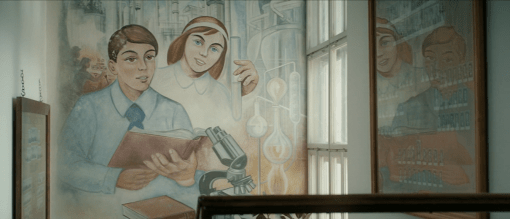
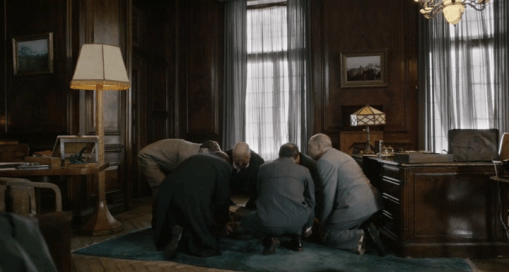
The film opens with its finest sequence, a brilliant, concentrated set-piece that blurs the boundary between comedy and horror, beauty and savagery, and terror and absurdity—just like the Stalin jokes. It’s 1953, a couple of hours before Stalin’s death, and Radio Moscow is having a live performance of a Mozart symphony. The Soviet premier calls the director of the station and asks him to ring back in seventeen minutes. The terrified director calls the premier back exactly in seventeen minutes just as the studio audience explodes in applause. Only then does he (and do we) realize that Stalin has timed the call to the end of the symphony. Stalin gives curt orders for the recording of the performance to be sent to him right away. The only problem: the concert wasn’t recorded. In panic, the director rushes to the orchestra, asking them to take their positions and replay the entire programme. To replace the part of the audience that left, the guards at the radio station go pick up random peasants from streets at gunpoint. Meanwhile, the police of the interior ministry, NKVD, is busy rounding up people on Stalin’s execution list. The film intercuts both these commotions, not making it clear which set of people are being picked up for what—an uncertainty reflective of the detainees’ own experience.

While the shell-shocked director prepares for the call, Stalin (Adrian McLoughlin) adds new names to his execution list, with Mozart playing on the radio. He hands over the list to Beria (Simon Russell Beale), whom he joins for a dinner alongside Khrushchev (Steve Buscemi), Molotov (Michael Palin) and Malenkov (Jeffrey Tambor). The men make bawdy jokes, force themselves to laugh at Stalin’s dumb repartees and sit through his movie screenings unwillingly. They will later note down the jokes that worked and the ones that didn’t so that they can improve their performance the next time around. It’s not the contrast between a decadent elite and a country in fear, but the necessity for maintaining an appearance at all levels of Russian social life that is suggested here. The symphony and the dinner are simulacra, like Stalin’s funeral pageantry later in the film, intended to hide less cheerful realities (The fear of punishment, Molotov’s imminent arrest, the internal hatred for Stalin). The remarkable set-piece lasts all of fifteen minutes and its astute plot-driven comedy is fleshed out by Iannucci’s customary, razor-sharp dialogue (“—He’s a great man with a great ear.” “—Two great ears.”), which is likely the film’s primary reason to exist.

The stellar opening sequence sets the rest of the film for a failure, which is understandably more mechanical and less inventive and funny. Divided into arbitrary chapters based on ridiculous protocol to be followed upon the premier’s demise (appropriately presented in an equally ridiculous Copperplate Gothic-like typeface), the plot follows the power struggle between Beria and Khrushchev, both of whom want to reshape the republic’s future per their own less-violent conceptions. Their real ideological differences are ignored by the film; this fight over non-existent differences is perhaps the point, just as its implication that Beria could have been any fall man, that Khrushchev could’ve just as well lost the war for history. The content of the Soviet politburo’s policies is of no concern to the film, it’s the form it has ideas on: Iannucci presents the politburo as a man-eat-man battleground for power, its meetings as verbal minefields where one wrong word could change the course of history. Upon Stalin’s death, something similar to democracy emerges within the chief committee, with all the contradictions of that system in place: in order to take control, Beria and Khrushchev find themselves having to influence the other members of the politburo by whatever means necessary, psychological or tactical. In outlining the surprisingly short roads between democracy and groupthink, the film boomerangs halfway back at its Western audience, whose own political climate of “saying the right thing” its satire resonates with.

Anglo-normative (“Beria-r”) without feeling the need to justify it, The Death of Stalin makes no pretence to realism or accuracy—a fact that attenuates its arguably offensive intentions. In fact, the film works off the incongruence of language and setting, treating Soviet Russia as mere costume and décor in a mostly-British sitcom (tea and buns for Stalin’s daughter) where Buscemi and Olga Kurylenko are guest performers with native accents. While the film goes through the motions in its second half, the jokes keep coming (—Malenkov after his inaugural speech: “Yes, ‘bread and peace’. I knew it would work. It was between ‘peace’ and ‘sausages’.” —Khrushchev: “Both good things, but you know where you are with a sausage.”). And it’s surprisingly inventive on the visual front. The tortures at Beria’s NKVD facility are relegated to the edge of the frame, making them perversely register with greater force and humour. A shot of Stalin’s son fighting with a guard over a pistol is milked for all its absurdity by contrasting it with the dignified pose of others in the shot. And I think the film might be unique in that it makes shots of people standing in a circle or a line talking (as in a bad TV drama) carry an ideological weight. Sophisticated, dialogue-driven comedy is a kind you don’t expect in English-language films anymore (it’s in the purview of television), so The Death of Stalin is a rarity. Your mileage may, however, vary.

Loveless

In The Student, Kirill Serebrennikov’s film from three years ago, a young man becomes a religious zealot and polices his classmates using quotes from the Bible. This shocks his progressive Jewish teacher, but the management shrugs its collective shoulder, considering him merely misunderstood. This return of suppressed superstition into current day Russian life is very much present as an undercurrent in Andrey Zvyagintsev’s new film, Loveless, but it’s only touched upon, not hammered down like in The Student. The director’s fifth feature, Loveless revolves around a husband and a wife who hate each other to the depths of their being. They are in the process of a divorce and neither wants to take custody of their taciturn twelve-year-old son Alyosha (Matvei Novikov), on whom their hatred spills over. Aloysha is not like the Antoine Doinel of The 400 Blows, who could just escape the domestic orbit into a premature adulthood. He is crushed by this everyday hell. There’s a heart-breaking shot of him hiding behind the bathroom door crying when he learns that his parents plan to pack him off to a boarding school.

The year is 2012 and speculations about the end of the world are in the air. The ‘family’ lives in the outskirts of Moscow in a high-rise apartment that they are selling off. Boris (Aleksey Rozin) the husband has a desk job and is worried that his boss, an orthodox Christian, would sack him were he to learnt of his divorce. Zhenya (Maryana Spivak) the wife works at a salon. Both of them are having an affair. Following their first, incredibly sordid fight, the film pursues their everyday routines separately: Boris at the office and later with his pregnant lover, Zhenya at the salon and then with her rich businessman lover. As the film loses sight of Aloysha, so does the couple; the boy vanishes from the house without a trace. Zhenya informs the police, but they wash their hands off, deeming the complaint too trivial and pointing her to a civil organization involved in such cases of lost children. Marshalling scores of volunteers, this group sets out to look for Aloysha with a concern and rigour that’s the only silver lining in this utterly despondent film.

Boris and Zhenya aren’t just horrible parents, but hideous people worried about Aloysha’s disappearance only because of its potential impact on them. Zhenya is presented as a shallow woman who spends her time instagramming, waxing herself and sleeping with her lover. Boris comes across only a notch better, but is just as despicable in his selfishness and cowardice. Thoroughly compromised early in the film, their declarations of genuine love and good faith to their lovers doesn’t fly at all. In a discomfiting scene that can find its home in a screwball comedy, Boris and Zhenya are forced to drive together to her mother’s house to look for Aloysha. She wants to smoke, he warns her not to. She asks him to raise the windows, he turns up the volume of the metal music. She screams at the top of her voice. Such unbound mutual hate calls for an act of violence to resolve it, but it never comes. It’s instead deflected onto Aloysha’s unknown fate. The question at the core of Loveless seems to be this: what does it mean for two completely broken, empty people incapable of giving love (outside of compensatory proclamations) to be responsible for a child?

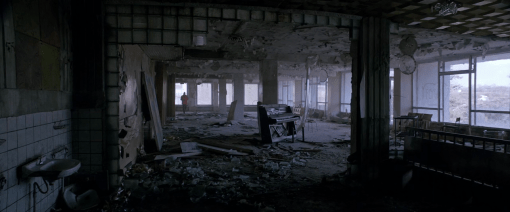
I don’t think Andrey Z’s interest is solely personal here and Loveless, like his earlier works, is obliquely political. In one of the first shots of the film, the camera is planted at the entrance of a building. Children storm out after a day’s school and walk past the camera. After a while, the camera follows a boy who happens to be Aloysha, but it could’ve been any of the other kids. Loveless presents his parents as merely a symptom of an extremely self-absorbed consumer society. The authority figures in the film—Boris and Zhenya, her paranoid mother, but also the police—just don’t care. The state having failed its subjects, it’s up to the civic bodies to fend for the people. The institution of loveless parents produces the machinery of lovelessness that is the volunteer group looking for Aloysha. They search for the boy high and low and end up in an abandoned facility in the woods—a dilapidated hotel with peeling walls, dripping roof and rotting furniture which combines with the winter landscape outside to produce a post-apocalyptic picture echoing Chernobyl. It may not take a village to raise a child, but it certainly takes a village to look for one. At the end of the film, Boris and Zhenya aren’t happy even with their lovers. He dumps his new toddler into a cradle to go watch the news on the Russian intervention in Ukraine. She walks away from her new husband watching the news to go exercise on a treadmill. Wearing the Russian Olympic jersey, she’s running but going nowhere—a blunt symbol to end a blunt film.

The SquareRuben Östlund’s The Square realizes that satirising contemporary art world is the easiest thing to do. So it makes up for it with a paralysing nuance that comes across as taking two steps forward and one backward. Östlund’s ambivalence towards his subject is apparent from the first scene. An uninitiated American journalist (Elizabeth Moss) asks the director of a contemporary art museum, Christian (Claes Bang), to explain a piece of curatorial text written in artspeak. He mumbles something about the context of exhibition, which the journalist accepts without question. The scene is supposed to be a sendup of the inscrutability of modern art, but the text the journalist reads out sounds legitimate, as does Christian’s response. This scene is followed by shots of the demolition of an old, imposing sculpture at the museum’s entrance whose place a modern work called The Square will take. This destruction is supposed to be read by us as sacrilege. But later in the film, Christian explains the meaning of The Square to his kids through family anecdote in a way that makes an authentic case for the work.
The artwork in question, The Square, I believe, is a genuinely interesting installation, and belongs to the family of contemporary sculptures that converts the hallowed halls of the art museum into a public space of confrontation. A four metre by four metre square of LED lights, it carries the following motto: “The Square is a sanctuary of trust and caring. Within it we all share equal rights and obligations.” Östlund follows up this on-screen statement with shots of the homeless in Stockholm. The blunt juxtaposition brings out the real problem with The Square and its utopian intentions: access to the museum itself is a question of social status and the mutual trust the work seeks to foster is in effect upper-class solidarity. On the other hand, Östlund refuses to see the museum or the art world as a monolith. The young marketing executives who come up with an awful, exploitative ad campaign for The Square are lampooned directly, but Christian is a well-rounded character shown to be capable of empathy and change.

Christian, though, is embedded in a power structure that he consciously makes use of. When a subordinate of his refuses to run a personal errand for him, he threatens the young man by turning it into a question of professional trust. He sleeps with the journalist well aware of the equations at play. He has preconceived notions about those living in low-income housing and doesn’t realize the implications of accusing everyone in an impoverished, immigrant-dominated apartment complex in order to zero in on one person who’s stolen his wallet and phone. At the same time, he comes out of his cocoon to own up to his mistakes and to trust others. When he loses his daughters at the mall, he entrusts his shopping bags to a homeless person. In a video-taped apology to an immigrant boy grounded at home because of his accusation, Christian displaces personal culpability into sociological abstractions, but finally takes his two daughters with him to meet the boy in person.

It would be more fruitful to see The Square not as a satire but a set of qualified observations about contemporary art and its institutions. The film understands museums as cultural establishments run like corporates needing to balance their role as proponents of progressive values and purveyors of artistic expression. When Christian is forced to give a press conference about the offensive promotional video, he’s taken apart by both socially-minded liberals and “defenders of free speech”. Christian’s existence is so sophisticated, so wrapped up in layers of irony and simulation that he becomes unable to tell the real from the artificial. He prepares his impromptu speeches in advance, even their improvisational bits. The gets taken for a ride by a con job at a public square, but is unfazed by the real violence taking place during a performance act. The Square’s single most important insight might be this: interpersonal trust in public spaces, all but killed by increased social inequality, can only resurface as parody in art museums for those with no need for it.

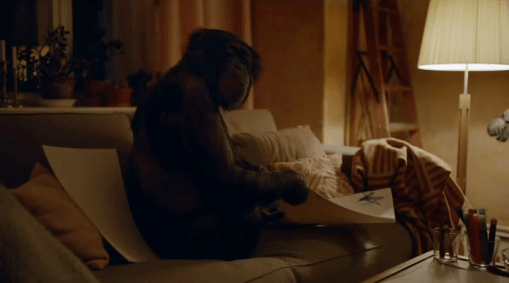
The most evident syndrome of this malady afflicting modern art establishments appears in a grand dinner scene in which a male performance artist (Terry Notary) wanders naked in imitation of a primate amidst tuxedoed patrons of the museum. At first amusing, his doubly-performative act turns out to be an escalation of hostilities culminating in a real attack on a woman. In this return of the repressed, the implicit social-behavioural contract of the museum space breaks down and the patrons are hard put to find an appropriate response to the aggression—a crisis paralleling the emotional violence the museum inflicts on the world around through its publicity campaign and the impossibility of the outside world to proportionally react to it.

The film’s cinematography is reminiscent of Lanthimos’ work in its unstable, dynamic compositions employing the architectural elements of the museum. Östlund’s chops as an entertaining filmmaker is apparent in the dinner scene and the thrilling sequence where Christian delivers the letters as his subordinate tries to protect their car from curious street hawks, passages pregnant with impending violence. But the film is also full of open threads and pointless sequences seemingly left loose for the purpose of ambiguity. The film maintains an air of mystery only because it constantly contradicts itself, afraid to look like a newspaper cartoon about modern art.

Western

In Western, Valeska Grisebach poses a series of interlocking power relations between characters and their communities that sets in conflict their individual selves and their group identities. Meinhard (Meinhard Neumann) is part of a German crew trying to setup a power plant in the woods of Bulgaria near the Greek frontier. The raw material for construction hasn’t arrived yet arrived at the site, so the crew spends its time lazing around on the river bank, knocking down beers, hitting on women of the nearby village, plucking fruit from private compounds and generally driving around at night. The men even plant a German flag to mark out their territory. Meinhard, in contrast, goes into village to get to know the residents. Over time, he makes friends even though he doesn’t speak Bulgarian. He helps them out with building wells in the village and, in turn, Adrian, one of the villagers, lets him use his horse and even has his nephew teach Meinhard to ride.

Supposedly an ex-legionnaire, Meinhard is a wanderer with no family or home. His reaching out to the villagers is an attempt at belonging to a place and a people. But what Western demonstrates is that, connect though he might with the residents, Meinhard will never be able to escape the larger identities circumscribing his individual, personal behaviour. The villagers refer to him as the German. They bond with him through positive clichés about Germans. One of them breaks ice with him using German military anecdotes. Meinhard, in turn, doesn’t realize that his symbolic gestures of belonging—giving his pocket knife to Adrian’s nephew, taking part in gambling, threatening a local lynchpin when he roughs up Adrian—align him along certain fault lines within the community. As an outsider, he can only see the village as a monolith to assimilate into, but doesn’t realize that his status as a higher-paid, well-travelled, working-class man from a developed country situates him in a complicated dynamic with the village residents; that the welcome the villagers extend him is precisely predicated on him being an outsider.

Meinhard’s relation with the crew, meanwhile, deteriorates just as he develops a rapport with the villagers. His German colleagues don’t like him hanging out late in town, pursuing women they’re after, or preventing them from using the village’s scanty water source. Like with the soldiers from Herzog’s Signs of Life—a work that Western alludes to—their worst instincts come out when they’re subject to boredom and lack of purpose in a foreign country. One of them justifies the flag-hoisting and points out that they’re the ones helping Bulgaria develop. After an untoward, selfish incident, Meinhard warns his crew chief Vincent (Reinhardt Wetrek) that he’d kill him if such things happen again. Meinhard’s severity alienates him from his own kind, but his self-effacing liberalism doesn’t exactly allow him to become one with the villagers. He’s left stranded at the end, dancing alone at a country festivity in a parody of communal participation, like many a tragic hero of arthouse cinema.

Grisebach constructs her film as a series of convivial scenes of groups of people conversing over drinks and food—this applies both to the Germans and the Bulgarians in the film, united in spirit in their desire to belong to a community. The passages of the film where Meinhard spends time with the villagers are tender in their imagination of the possibility of language not being a barrier in human relations. A film unfolding at a particular place and time, Western nevertheless functions as an encapsulation of larger political drifts (and, in this, it recalls the other recent, incisive film about the crisis of the EU, Toni Erdmann): the dubious promises of mobility offered by the European Union, the transition of Bulgaria from communism to a neoliberal order, the westward migration of its citizens for better prospects, and the living echoes of German-Bulgarian wartime relationship. The focus, as with many German films, is the weight of national history on individual consciousness.

Up

The ninth edition of the monumental Up series of documentaries aired in Britain and Australia this June. Produced by Granada television for the Britain’s ITV, the first edition of the series was telecast in 1964. The original producers set out with a quote from Ignatius Loyola as their hypothesis: “Give me the child until seven and I will show you the man.” Politically committed, they wanted to demonstrate in particular that the socioeconomic prospects of British citizens are foreordained at childhood. To this end, they selected fourteen seven-year-olds, of which four girls, from various income backgrounds from across Britain, and posed them questions related to money, school, romance and future plans. The producers and director Michael Apted, have visited the same set of participants every seven years since the first episode to see whether their original theory was indeed correct, whether the master key to the adult was still the seven-year-old.

The Up series is not unique in this respect, having itself inspired several remakes around the world. There have been many other instances in cinema where the same set of on-screen participants have been brought together after long periods of time by the same filmmaking outfit. Truffaut’s group of films on the Antoine Doinel character featuring Jean-Pierre Léaud is also a documentary on the actor aging from the reticent teenager of The 400 Blows (1959) to the mature thirty-five-year-old of Love on the Run (1979). James Benning made a shot-for-shot remake of his film, One Way Boogie Woogie (1977), twenty-seven years later with the same people and locations. Long-running franchises such as the Harry Potter films (2001-11) double as records of their actors’ physical and emotional maturation. A more recent example, Richard Linklater’s Boyhood (2014) was periodically shot over 14 years with the same group of actors who portray a family in the film. Not to mention numerous movie sequels and spinoffs where performers reprise their original roles.

The special force of the Up series, on the other hand, derives from its social, historical and human value. “Life can only be understood backwards; but it must be lived forwards”, wrote Kierkegaard. The participants of the Up films are real people living out their lives, figuring things out as they go along. As they approach the twilight of their existence, the films accrue more and more meaning, narrativizing their lives for themselves and us. In their own way, these films chart the changing political landscape of Britain – from the orthodox conservatism of the early-sixties, through the international cultural tumult of the seventies and the economic upheavals of the Thatcher era, to the promises of the European Union and, now, a post-Brexit period. When it started out, the series wanted to illustrate the thesis that class position in Britain was predetermined by one’s birth and that social mobility was well-nigh impossible. However, as the series unfolded, reality turned out to be more complex: Tony, the East End taxi driver, rose up to middle-class while Neil, with his middle-class upbringing, fell way down the ladder.

Throughout the Up films is this dialectic between theory and reality. There are questions that the first telecast raised that every subsequent episode keeps coming back to: the participant’s financial situation, their relationship with the opposite sex, their schooling system, their perception of other social classes and their impression of the series itself. In the initial episodes, Apted (only fifteen years older than his interviewees) seems to have the answers preconceived in his mind. In the second and third editions (1970, 1977), he handpicks passages from the interviews that seem to suggest that Tony will likely get mixed-up in a betting racket while the private school boys, John, Andrew and Charles, will cruise through their check-listed lives. It didn’t exactly turn out to be so. The social-minded Bruce is now settled into a middle-class life while the Oxford-alumnus John is involved in philanthropical work. These strange turns of reality soften the filmmaker’s convictions and the later Up films open up to the nuances of human existence. The progression of the series, then, coincides with Apted’s own intellectual and sentimental development.

With the series gaining popularity, the participants, too, cease to be isolated, passive subjects of study, their lives now touched by the exposure the films give them. The great learning of documentary filmmaking in the 20th century is also that of 20th century physics: that the observer impacts the observed through the very act of observation. Thanks to his appearance in the series, Tony, an amateur actor, gets bit parts in films as a cabbie. When Neil’s down and out, letters of support pour in. Peter, a lad from Liverpool, was subject to tabloid humiliation for his criticism of the Thatcher government. He dropped out of the series for four episodes, but came back in 56 Up (2012) to promote his band. John used the series to raise awareness about his charities. The interviewees become more vocal about the series as it progresses: in 56 Up, Lynn, one of the London girls, shreds Apted for being blind to the women’s lib movement and for trying to box her into a housewife type in 21 Up (1977); John objects to Apted’s original portrayal of his him as traditionally upper-class and Tony, to his depiction as a potential felon.

As the years go by, the mist of mortality that hangs over the series becomes thicker. French film critic André Bazin likened filmmaking to Egyptian mummification in that it preserves a slice of a person’s existence for eternity. Conversely, every photographic portrait carries with it a mark of death. A future viewer of the Up films – their ideal viewer – will inevitably be burdened by a tragic consciousness. Watching these films end-to-end is to be aware of the fate of these participants, the hope and wonderment in the children’s eyes slowly giving way to the weary wisdom of their adult selves. Like the director, the viewer will then have recognized herself in these lives, in the transience of these lives. Therein lies the ultimate lesson of the Up series, an unfinished work that will end when the last of its interviewees passes away: though shaped by forces larger than itself, every life is irreducibly unique, worthy of attention in itself; but every life can only be understood in generalities, through frameworks larger than itself.


[An edited version published in The Hindu]

Climax

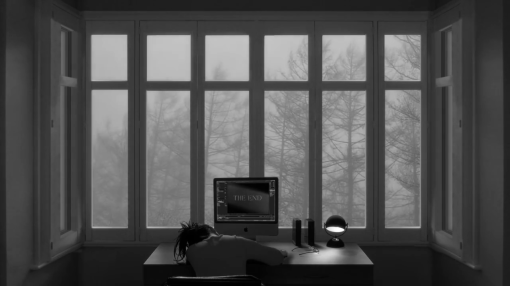
So Love was a one-off misfire where Gaspar Noé’s singular style came undone under the banality of the material. That’s partly because tracing the journey of a romantic relationship from inception to breakup requires an engagement with character psychology over a longer period of narrative time—something at odds with Noé’s cinematic temperament, primarily geared to short-term subjective phenomena. With Climax, flamboyant and stylish to the hilt, the filmmaker comes back to a narrative of a limited timeframe, in which character development and emotional maturity play little part. Unfolding almost in real time, the film centres on a dance troupe’s final rehearsal the evening before they leave on a US tour and the pre-departure party that follows.

Climax opens with a tracking shot of a woman crawling in the snow. The camera is drone-mounted and photographs the woman from overhead, producing a flat visual field. It circles the woman as she crawls and cries, circle being the chief visual motif of the film. The end credits roll, making it the second film at the 2018 Cannes festival to force the viewer to sit through the générique de fin. There’s an expectation that the story will unfurl backwards from this point as in Irreversible. Instead, Noé cuts to a series of talking heads taped on VHS. It’s a recording of the film’s actors talking about dance, drugs and sex. The footage plays on a CRT television surrounded by movie DVDs and books on cinema, art and philosophy. We aren’t sure who the viewer is, just as we aren’t sure whether there’s an orchestrating hand behind the spiking of the sangria at the party. Climax doesn’t have a single reverse shot; its participants are like fish in a tank observed by an omniscient eye, itself invisible. The filmmaker plays god, introducing an element of chaos into this world and studying its repercussions.

The dance sequence that follows the interviews—part of a longer, unbroken, 12-minute shot—is brilliant in the way individual performances find their place in the larger piece. Outside of a few coordinated passages, they are all freestyle, drawing from different genres, the only commonality between them being the audio beat. The performers react to the music instinctively and improvise, demonstrating that dancing is writing with the body just as filmmaking is writing with the camera. The number is choreographed for the camera which shifts axes as the piece proceeds. The rehearsal ends five minutes in, but Noé’s camera keeps going, following specific characters as they move around the floor to talk to others. This continuously shifting perspective parallels the dance number we’ve just seen and sets up the notion of Climax as one long dance sequence.

Throughout, the film emphasizes the similarity between dance choreography and filmmaking. The viewer of TV interviews in the beginning could be either the choreographer of Noé himself. Like choreography, filmmaking is collective writing that involves the manipulation of performer’s bodies in space according to a set of ideas. Noé’s film unfolds as a chain of pronounced gestures essentially without any meaning. Like the dance, it’s an instance of abstract writing that only intermittently has a signifying function. The dancers’ various moves, though referring to sexual and violent acts at times, are purely automatic, subconscious interventions that are performed, filmed and assembled together on instinct. The film is heavily improvised, made up as it proceeds (it was shot in sequence), and is one long tapestry of gestural work only symbolically liked to real-world phenomena.

The dance floor is a space where desire is fluid and, while participants have personal preferences, there’s a sense that any person in this twenty-odd group of young men, women and non-binary people could end up with anyone else. Noé chains together several bits of conversations—all filmed in two-shots—where characters talk about those off-screen. These dialogues enter increasingly sticky territory, until we discover that the sangria was laced with LSD. The dancers go unhinged after this point, as does the camera, and we follow their self-destruction in a virtuoso, 42-minute-long shot. It’s an impressive piece of conceptual art, with an impeccable sense of space delineation, whose force derives from the tension between the unseen, internal struggle of the characters and its external manifestation. That said, this is not In Vanda’s Room and Noé is moreover not interested in documentary. His camera choreography imitates the loss of direction the actors might be experiencing and unwittingly turns Climax into a cautionary film about drugs.

But the more crucial idea Noé seems to be working towards is the importance of discipline to artmaking. When the dancers go off the rails under the influence, and their worst instincts surface, we are surprised that it’s the same people who created the beautiful opening dance sequence of the film. The rehearsal’s rigour, singular determination and sense of communion with others gives way to survivalist violence and rapaciousness. Instinct gives birth to art, but when left undisciplined by craft and intellect, it enables the most repulsive human tendencies to flourish. Climax is Noé’s stab at the Apollonian-Dionysian dialectic. It’s also him assuring the viewer he’s not simply screwing around.

Jeanette

There are several contradictions in the TV version of Jeanette, Bruno Dumont’s reimagining of Charles Peguy’s The Mystery of the Charity of Joan of Arc as a neorealist musical. Firstly, there’s the protagonist herself: Jeanette (Lise Leplat Prudhomme) is only eight years old—not yet Jean d’Arc—but is torn apart by the poverty and suffering of the peasants around her. She sees that their souls are damned, and is disappointed by their apathy towards the English siege of France. She sings out her torment, addressing them to God, who sends forth the saints Michael, Catherine and Margaret to inform her of her mission. She keeps this annunciation from everyone else and it’s only three years later, when the English have besieged Orléans, that she assumes the responsibility. With the help of her uncle, she leaves home to meet the Dauphin of France and convince him about taking on the English.

The incongruence created by a child uttering Peguy’s complex, incantatory verse as though in a school recitation is amplified by Dumont’s stylistic choices. Jeanette is broadly naturalist in that it is made with amateur actors, real locations and direct sound. The story is mostly Jeanette conversing with her friend Hauviette (Lucile Gauthier) and madame Gervaise (one character played by two actors, Aline and Élise Charles, à la Buñuel). Like Pasolini before him, Dumont clothes his actors in plain outfits, there’s very little psychology in line delivery of his amateur actors and the landscape is elemental. The compositions are simple, even rudimentary, and veer on the painterly when the actors are filmed against the sky. As much as Straub, Pasolini or Oliveira, Jeanette recalls the theatre with its single perspective, single décor, improvised performances, and marked-out character entries and exits.

This visual asceticism, however, is tipped over by Dumont’s use of heavy metal music to which his actors sing, not always in pitch, beat or meter. The filmmaker has stated that this lack of finesse is the point, music and dance manifesting in bodies unprepared for them being the essence of Jeanette’s preordination. Characters bang their heads to bass guitar riffs, leap around to perform flips and splits. Dumont finds an intersection between the highs offered by metal music and Jeanette’s religious transports; cutting off the score, it would appear that her ecstasy is authentic. There is also a magical excursion in the appearance of the levitating saints, and absurd turns such as Hauviette walking bent over like a crab. Jeanette’s speech is all about the damnation of the soul, but Dumont’s camera is firmly fixed on Jeanette’s physicality: the way she clutches her garb, her bare feet hopping in sand and her unruly hair. Her perennial doubt and turmoil are in contrast with the constant sun illuminating the countryside—Dumont transposes Jean’s historical birth region of Lorraine onto his own native Nord and the film is shot at a point from which England is visible.

Jeanette provides specific pleasures through its many aesthetic tensions. Peguy’s text, even when presented as a rock musical, can be challenging to penetrate. The film’s sincere intention and anachronistic method situate it somewhere between satire and solemn drama, and I’m not so sure that Dumont really succeeds on either front. The result is merely quaint. Devoid of the socially-conscious edge of Lil’ Quinquin and Slack Bay, Jeanette feels frozen as a concept. Dumont’s intention is perhaps to rescue Joan of Arc from the National Front’s appropriation of the figure. His film teases out the human aspect of Jeanette. Her lies to her friends and parents in the quest for her personal truth register like but one instance of an eternal teenage condition. But neither making her a universal icon nor asserting her Christian piety is going to override the fact that she’s associated with the French national identity – a topic that I hope Dumont tackles in the second part.

A Wild Pear Tree

“Simple minds like to reduce a work to a central idea”, says Sinan (Aydın Doğu Demirkol) in a conversation with a local celebrity author. It’s a gibe at the critics of Nuri Bilge Ceylan’s The Wild Pear Tree, a polyvalent, multi-thematic portrait of life in the director’s native region of Çanakkale in the western extreme of Turkey. Sinan has just graduated and returned to his hometown of Çan for his teacher’s exam preparations. Çan is chiefly known to the world as the site of the Trojan war and for its war cemetery. Sinan hates the city, whose natural beauties have been overridden by industrial and domestic garbage. All his childhood friends have left the city for better prospects elsewhere. But he’s nevertheless written a personal book on Çan and its people. Through the film’s three-hour runtime, Sinan tries to secure funds for the publication of his book, talking unsuccessfully to the mayor and then a businessman who patronizes the arts because the corporation gives him contracts. The film is told entirely through his perspective; he is present in every scene of the film, and his subjectivity merges with the events depicted.

One of the primary notions Ceylan’s film examines is that of inheritance and legacy. On his return, Sinan connects with his two grandfathers, one a farmer living up in the hills and the other a retired Imam, still solicited by his younger colleagues for weddings and the like. Sinan’s father Idris (Murat Cemcir) is a school teacher and spends his weekends digging a well in the mountains close to his father’s house. Idris is of scientific temperament and believes that the villagers, including his father, are wrong about the village being barren. Sinan, in turn, rebels against Idris, whom he takes to be a gambling addict. It is said that Idris, once a white hope of the town, got mixed up in horse races and lost his house in it. But we never see him gambling and Sinan’s conviction that his father is a ne’er-do-well remains unsubstantiated.

A self-styled misanthropic, Sinan rejects this lineage, considering himself above all this. His disgruntlement with his forefathers is as much artistic as it is familial. In the conversation with the local writer, Sinan grows increasingly confrontational, provoking his interlocutor in typically-upstart fashion. He belittles the author for participating in literary conferences, insinuates that he’d not understand the kind of novel Sinan’s writing. When he manages to publish his book, he signs a copy for his mother and basks in self-satisfaction of having arrived (or rather left this region in an intellectual sense), and having been better than his father. His parricidal tendency, Ceylan seems to be hinting, is a form of wanting to be accepted and the trajectory of the character ends in his owning up to his own provenance. Ceylan’s return to his hometown to make this film is also a kind of owning up, a return to roots for a filmmaker whose calling is now international.

The loosely-autobiographical nature of The Wild Pear Tree is also suggested by the specific memories it offers. The film unfolds leisurely through a series of conversations Sinan has at home and outside. In the first of these, he speaks with a woman he knew as a high-schooler, perhaps a flame, who is now engaged to a rich man against her wishes. They kiss under a tree as the wind ruffles its leaves. In another conversation on literature, the businessman scorns Sinan’s suggestion that anything is to be learnt from the cheerfulness of the town’s old fruit-seller. Sinan’s subjective novel, of which we know next to nothing, is a defence of art as personal expression against the utilitarian approaches of the people he speaks with, who’d rather he writes about the town’s tourist attractions.

There’s a constant friction between the abstractions Sinan deals with and the rooted, pragmatism of his surroundings. In an arresting conversation with two clerics, the non-believing Sinan teases out the head Imam’s hypocrisies. A newer Imam talks about the necessary distinction between the popular Islamic scholars and the important ones, just like Sinan did with the writer. The whole exchange takes place as they walk from an apple tree in the hills down to a tea joint as the sun sinks. As is his wont, Ceylan films them as tiny beings in the landscape, the abstract contours of their theological debate set against concrete physical phenomena like the fading sunlight, smoke from chimneys, moos of cows and noise of motorbikes. The speciality of this dialectical presentation, already evident in Once Upon a Time in Anatolia, is that it can be interpreted differently by the Imams and Sinan, as per their proclivities.

There are references to the current situation in the country. The entire scenario is predicated on money problems and the issue of unemployment is a constant threat facing Sinan, who’s always looking for things to sell – an obsession he is oblivious to while he scorns his father for gambling. One of Sinan’s friends is now a member of the government-sponsored paramilitary (or military) mobilized to bash up dissenters. But Ceylan is not a political filmmaker – if anything he’s likely the state’s cherished cultural ambassador of cinema like Jia Zhang-ke now is. His sensibility, like Asghar Farhadi’s, is closer to the 19th century Russian novelists than anything modern, and The Wild Pear Tree stretches out like a long parable minus the moral clarity. A shot of Sinan, his father and his grandfather together pulling up a boulder from a pit only to drop it back is a cogent summation of the film’s existential thrust.

Mektoub My Love

There’s a shot some fourteen hours into Abdellatif Kechiche’s Mektoub, My Love: Canto Uno in which a baby goat stares right at the camera. It’s not planned but it’s the first time we are reminded of the director’s presence in a film that’s all fly-on-the-wall. Kechiche’s always-mobile camera registers the smallest wrinkle of human interaction; his film is a veritable encyclopaedia of modern French greetings, gestures and social rituals. It’s rigorous, it’s exacting, but it’s also incurably obsessed with the heroine’s body, especially its rear end. One thing is sure: Kechiche really puts the cul in culture. It’s not anything new for the maker of Black Venus, an incisive study of the objectification and progressive breakdown of the black, female body. But here, as in Blue is the Warmest Colour, the viewer’s gaze of the film’s subject isn’t questioned. The film opens with a sex scene, but the camera is squarely on the woman, an all-too-easy site of male identification that’s already pervasive in visual culture.

The ostensible point of view of this opening scene is the voyeur-protagonist at the window, Amin (Shaïn Boumédine), who is taken aback that this woman is sleeping with his cousin Tony while engaged to another man. Amin interrupts the session, prompting his cousin to flee and the woman, Ophélie (Ophélie Bau), to scamper for her clothes. The dialogue between Amin and Ophélie that follows is awkward as expected, but tensely humorous in its mixture of empty cordiality and latent expectation of sexual violence. Nothing untoward happens though, and Amin turns out to be not just the film’s most charming character, but a downright gent. The year is 1994, Amin is reluctantly studying medicine in Paris and has come home to Sète on the Azure Coast for vacation. Like the protagonist in The Wild Pear Tree, he is an artist at heart: he writes film scripts and photographs. And just like Sinan, Amin is present in every scene of the film.

Life in Sète revolves around his extended family, which manages a popular restaurant in the city together. It’s summer and Amin’s relatives, all uniformly good-looking, spend their days at the beach and evenings at restaurants and pubs. Mektoub is an endless series of beach and party scenes, and presents a dreamy idea of fun with boys and girls frolicking in groups – a 20th century version of fête champêtre paintings. The mood is invariably, suffocatingly upbeat, with one girl’s heartbreak providing a welcome, sombre counterpoint to the primary-colour emotions of the scenes. Kechiche’s film opens, funnily enough, with quotes from the Bible and the Koran about light, and the film is a showcase of beautiful sun-kissed bodies shot in immersive intimacy. After sundown, they are seen in the artificial lights of disco and bars. The men and women dance with and seduce each other in varying permutations and, given their vague relationships, the invitation to dance scan as competitive mating rituals. Kechiche films their dynamic like an ethnographer, observing the minutiae of the process of la drague, the progress of flirtatious conversations from everyday exchange to something more.

The film is narrated through Amin’s perspective, but the point of view is fluid within each sequence, with Kechiche’s camera moving around the restaurant to construct mini-scenes involving different characters, something like a Renoir tableau. One impressive aspect of Kechiche’s film is that, despite being coupled to Amin, it breathes freely. So we get a subtle, superbly-detailed conversation between women of the family trying to passive-aggressively break up Ophélie’s affair. Likewise, a moment with Ophélie and Tony trying to steal a kiss, fretting about the crowd in the pub, in a work full of explicit, very physical exchanges. Kechiche’s film brims with crushingly-banal small talk and they would be of high documentary value if they weren’t so repeated and generalized. There are conversations between Ophélie and Amin about his relatives that are tediously long and go nowhere in particular. The fatigue is deliberately induced for what Kechiche wants to contrast it with later.

Amin remains an observer and a reticent participant in all this. While his cousins are busy picking up girls, he isn’t interested even when girls proposition him. On the contrary, his conversations with prospective partners builds up from shop talk to end in awkward silence, whose tension remains unresolved. He prefers spending his morning taking photos or watching Pudovkin. There’s no suggestion he is indifferent to girls, especially Ophélie, whom he stares at whenever she’s intimate with someone else. But there’s no sense that he wants to sleep with her either. As a favour from Ophélie in exchange for keeping silent about her affair with his cousin, Amin asks her if she can pose nude for his photos. His emotional peak comes in a sequence at a goat shed – a calculated break from the headiness of the other scenes – where he photographs a goat giving birth. Scored to operatic vocals, it’s a moving scene, and Kechiche pitches it at as an experience more rarefied than what transpires in the rest of the film. Amin, like Kechiche, is presented as the artist figure, trying to preserve his integrity in a world full of distractions and shapely bottoms. The point is that you can either make art or have fun. It’s Kechiche exculpating himself: he’s not having fun filming these undulating bums and naked torsos, he’s making Art.

Once Upon a Time in Hollywood

[Spoilers below]

Quentin Tarantino’s new film, Once Upon a Time in Hollywood, weaves a fictional narrative around the Tate murders of 1969, in which a pregnant Sharon Tate and four of her friends were killed by members belonging to the cult of Charles Manson at her residence in Hollywood. The film unfolds through a collage of four perspectives: Rick Dalton (a hammy Leonardo DiCaprio) a waning Western TV star ruing his sunset, Cliff Booth (Brad Pitt), once Dalton’s stunt double, now his pal and go-to-guy, actress Sharon Tate (Robbie Margot), who has just moved in next door to Dalton with her husband Roman Polanski, and the Manson Family, a hippie commune living in Spahn Ranch, a run-down movie and TV studio where Dalton and Booth used to shoot. The film begins six months before the murder and charts Dalton coming to terms with his imminent professional irrelevance, Cliff’s apathetic life alongside Dalton and Tate’s stuttering rise to public recognition. If not for its ending, the film registers as a transitional work for Tarantino in the way it leaves behind many of the filmmaker’s stylistic traits.

To be sure, Once Upon a Time turns out exactly the way one would expect a film written by Tarantino about the Tate murders to. But it doesn’t look anything like a Tarantino movie. For one, there’s a lot more “dead time” here than in any of his previous films. Nothing much happens in these long stretches except for characters driving around Los Angeles, the radio turned on, wind in their hair, Tarantino asking us to just absorb the atmosphere. The extreme close-ups that he usually reserves for a telling detail is generalized and multiplied. There are at least three identical shots of the Manson Family members walking towards Tate’s house – a superfluity that is symptomatic of the whole film. The pace is measured and the individual scenes themselves are much longer than usual, many of them outlasting their nominal purpose. There are three protracted sequences dedicated to Dalton bemoaning his decline. The last of these unfolds as a conversation with a precocious eight-year-old child actor (Julia Butters). It’s a remarkably insipid scene, even more than the other two, too shallow to be sincere and too cliched to be smart, and it’s surprising to find it in such prominence in a Tarantino film.

Secondly, Tarantino’s relationship with his influences is given much more showcase and precious attention than we’ve come to expect from the filmmaker. Tate looks at a poster of The Wrecking Crew (1968), her newly-released picture with Dean Martin. While this would’ve been a passing glimpse in the director’s previous works, here we get a shot of Tate looking at the poster, then a close-up of the poster and a reverse-shot of Tate again. Scenes of the real Tate in the film are also played for us. When producer Schwarz (Al Pacino) names the Dalton movies he’s seen, we see a detailed film reel of fake films starring Dalton. The reel comprises of Westerns, a musical, and an action movie where Dalton torches Nazis with a flamethrower, and serves as a wish-fulfilment for the Tarantino. Home turf for QT, the Hollywood milieu might have allowed for many more tributes, a temptation that he avoids for fewer, more elaborate quotations.

What most distinguishes Once Upon a Time from Tarantino’s earlier works, however, is the startling absence of suspense and a curious undercurrent of sentimentalism. While the film intercuts between Dalton, Booth and Tate from the outset, there’s no tension that the juxtaposition produces. It’s February 1969 and we know that the murders happened only in August. The first conflict of the film, and its first instance of accelerated editing, doesn’t occur until two hours in, when Booth visits the Spahn Ranch and picks up a fight with one of the Manson Family members. The only expectation the viewer has all through the film derives from the tragic consciousness of the Tate murders and even that is thrown into doubt considering Tarantino’s tendency to rewrite history. Unlike in any other QT film, the film’s only real tense sequence arrives at the end, on the day of the murder, when the filmmaker quickens the crosscutting with arbitrary, pointless time markers, expanding the sequence with extreme detailing of events.

The film’s emotional locus is instead vested in the friendship between Dalton and Booth, one of the few sincere relationships in Tarantino’s body of work. The friendship gets its own emotional climax, in a restaurant scene where Dalton, now married and washed-up, confesses he can’t afford Booth anymore, and a parting shot in which Dalton tells Booth he was a good friend. Also nagging the film’s conscience is Booth’s tragic professional situation. Like countless professionals Hollywood’s technological progress has left behind, Booth leads a ghost-like existence in the shadow of Dalton, himself fast becoming a shadow. He lives in a trailer park, drives Dalton around and even does household chores. His vocation is of no use anymore in the new Hollywood, where actors are expected to do their own stunts. Tarantino’s ode to the profession includes a fight between Booth and Bruce Lee (Mike Moh), presented in long takes, and several shots of Brad Pitt doing stunt-like activities.

This sentimentalism might be interpreted as nostalgia, but what Once Upon a Time deals with is nostalgia for a time when nostalgia was possible. His yearning is not for the old movies and movie studios but the neon lights of cinemas and restaurants that once dotted the Hollywood landscape. It’s a yearning that’s second-hand, for Tarantino couldn’t have himself lived the experiences he describes. The film is set in 1969 (two years before The Last Picture Show was made), a time when the studio system had collapsed and the movie brats had started to shape up the business and method of making films. The Vietnam War (and protests against it) continues under the newly-elected Nixon. Tarantino frequently cuts from Dalton to Tate to set up a contrast between an eclipsing, old Hollywood of the fifties and the rising, new Hollywood of the late sixties. Somewhat of a relic, Dalton is modelled after the suburban, middle-class, Eisenhower-era executive. He is mostly seen at the lot or back home. He spends his evening preparing for work or in front of television. He prefers his beer over drugs, hates the hippies and wants nothing to do with the debauched lifestyle of the times. It’s noteworthy, for a film set in Hollywood, how little of Hollywood or its people we actually see. The only party we are shown owes to the presence of Tate, Jay and Polanski, people wholly of their era, unlike Dalton. As Tate watches The Wrecking Crew, Tarantino regularly jumps to Dalton’s shooting of a TV Western. It’s a “old-timey” Western, but made in Tarantino’s style of long takes and direct sound. We don’t see the camera crew for the most part and the decoupage is presented as Tarantino would conceive it. There are several shots in Once Upon a Time of actors snoring, spitting and slurping – sounds rare in classical Westerns. The intercutting between an actor performing and another actor watching herself performing signals the shift of American movies towards greater self-reflexivity.

This opposition between the simple forms and moral clarity of old Hollywood and the darker, self-reflexive anti-authoritarianism of new Hollywood takes on a politically-noxious flavour when combined with Tarantino’s desire to deny the Tate murders. In Once Upon a Time, the Manson Family members enter Dalton’s house instead of Tate’s. Booth, under the influence of an acid-soaked cigarette a hippie sold him, kills all of them with the assistance of Dalton, who is finally invited home by a relieved Tate. In other words, the old heroes of old Hollywood, with their clear-cut notions of good and evil, have protected the Polanski household from crazy hippies squatting over the ruins of Hollywood. The implications are odious: that though home-grown antisocial elements denigrate them, it takes soldiers and war heroes, like Booth once was, to protect the country; that the movies and TV shows of old might have shown violence, but the mediatized images of the Vietnam War have rendered the violence in movies more real, more immediate, making them even more responsible for the violence in society. Tarantino’s reactionary re-revisionism is the opposite of the necessary process of cultural reexamination filmmakers such as Penn, Peckinpah and Altman were undertaking during the time the film is set in.

In Tarantino’s dichotomous image of Hollywood, hippies, cultists, druggies, squatters, libertines, the counterculture in short, are pitted against a pragmatic, intuitive world of cowboys and Mexicans – a strangely anachronistic vision that seems to belong to the film’s era and not current day. There’s no equivalence between the Manson’s Family’s real violence and the fictional violence that Booth and Dalton exercise on them. They are home invaders and so any violence on them doesn’t carry the same moral sanction as their own violence does. Before they leave their car, the Manson Family discusses television shows. One of them wants to “kill the people who taught us to kill”. This twisted reasoning helps Tarantino justify his excesses: movie violence, no matter how graphic, is ultimately harmless compared to real violence. This gives him the carte blanche to abandon himself in the thrill of brutal imagery, as Booth smashes the face of one woman against various hard surfaces of the house, including a framed movie poster. Dalton burns another one down with a flamethrower.

It is, however, impossible to precisely pin down the politics of a Tarantino film and Once Upon a Time, like all Hollywood tentpoles, is riddled with ideological paradoxes that makes any reading tenable. It is quite possible that Tarantino simply wants to further his project of harnessing cinema’s capacity to forge myths and correct historical-representational errors. His film is set in Hollywood, an ahistorical zone where fact and legend mix. Booth is said to have killed his wife, but nobody knows. The production of its films is based on a lie that the actor and the stuntman are the same people. Tarantino recreates a scene from The Great Escape with Dalton/DiCaprio in place of McQueen, even as Dalton clearly states that he was never in the running. It’s a lie that QT visualizes nonetheless: why shouldn’t cinema belie history, when every sane person in their implicit contract with the movies knows it is all made up? One has to be as deranged as the Manson Family, the filmmaker seems to say, to take what is represented for fact. Most auteur films Hollywood tend to be bitter about the industry and its people, but Tarantino’s too much in love with its history for that. In the final passage of the film, he cycles through various characters watching prime-time television. Through the cross-cutting, this shared cultural experience takes on a communal quality. Something resembling a prayer, which is what movie-going is for Tarantino. The prayers have been answered. The movies have made America safe again, if only on screen.

First Reformed

[Spoilers below]

With First Reformed, Paul Schrader moulds his lifelong influences – Bresson, Ozu, Dreyer – into a film that resembles theirs in many ways, but is an entirely personal project. Veteran Ernst Toller (a terrific Ethan Hawke) lost his son in the Iraq War and was down in the dumps. Abundant Life, a corporatized megachurch in Albany, decided to give him a break by appointing as the reverend at the eponymous church in a small town in New York State. The church is of historical significance, but is mostly a tourist spot surviving by the grace of Abundant Life. As preparations are on for the 250th anniversary celebrations, Toller is requested by Mary (Amanda Seyfried) to talk to her husband Michael (Philip Ettinger), a militant eco-activist despondent over climate change. In an arresting conversation, which he compares to Jacob’s tussle with the angel, Toller turns out ill-equipped to console Michael, who doesn’t want Mary to have their baby. When he thwarts Michael’s plans for a suicide attack, presumably against a locally-headquartered, super-polluting corporate behemoth, Balq, Michael commits suicide. The reverend gives Michael a service that includes a protest song, a gesture that doesn’t go well with Abundant Life or its sponsor Balq. Disappointed with the Church’s blissful inaction towards pressing questions of our times, Toller finds himself filling the dead man’s shoes in several ways and experiences a crisis of faith of his own. Alcoholic and suffering from cancer, he decides to continue Michael’s mission.

The Gordian knot at the heart of Toller’s spiritual crisis, it appears, is the incompatibility between two world views, between the Church’s teaching of courageous acceptance and the global consciousness of the young people the reverend encounters. When Michael despairs about bringing a child into a world that’s heading towards disaster, Toller has no convincing answer; he asks Michael to choose courage over reason in face of uncertainty. It’s an appeal for resignation that Toller himself gets from Pastor Jeffers: it may be that the destruction of the world is part of God’s plan. That advice is not just an absolution of individual responsibility, it’s a falsification of one’s spiritual turmoil – the same kind of emotional violence that positivists wreak on people claiming to have experienced religious transport. What elevates Toller’s crisis of faith above a notional concept and gives it a particular force is that it’s rooted in the character’s personal history. Toller’s disillusionment with the Church’s tendency to reduce political issues to an abstract question of providence stems from his own guilt of not having questioned his faith in abstractions like patriotism. That his son was killed in Iraq is a political tragedy, not simply a personal misfortune as the Church would have it.

Michael’s response to his despair is calculated political violence. When Toller takes the explosives away from Michael’s garage, he also takes his life purpose away, turning the violence inward and killing Michael. Toller’s response to his crisis is identical. He comes in the line of Schrader loners, present in every scene of the film, trying to work through their anguish by acting on the world around. Toller’s spiritual sickness feeds on and into his physical sickness. He tries to give meaning to his impending death and cherry-picks ideas from the Bible to justify his turn to extremism, just as Jeffers cherry-picks to justify status quo. To preserve is to participate in creation, he writes, and thus to do God’s work. And to preserve, you have to sometimes destroy. When his bombing plan is hindered, Toller wraps himself with barbed wire and tries to drink drain-cleaning acid. Mary stops him, they embrace each other in a coupling of love and death as the camera roves around them to end the film. Ultimately agnostic, Schrader’s film cannot claim to provide a solution to the dilemma, only a momentary suspension.

The Franciscan austerity of First Reformed derives from an acute film-awareness. Right from its 1.37:1 aspect ratio (same as that of Winter Light) and its old-style cursive credits, the film announces itself as the inheritor of a cinema that Schrader described as transcendental. There is, specifically, a Bressonian vein in the choice of having a priest maintain a diary, his solemn voiceover, the opening shot of the church and the style of editing. The major part of the film unfolds between two Sundays, but the film doesn’t give provide any explicit markers. Sparsely furnished, with a large living room containing a sole, inexplicable chair, Toller’s Ordet-inspired quarters as well as Mary’s house are products of a theatrical mise en scène, a possible one-act play in which the character paces around the stage and monologues to the audience. Scenes transition from master shot to close-ups sparingly, which renders the latter more effective. A shot of Toller pinned in his seat holding a coffee cup drives home his agitation all the more directly. The tight, fixed-camera shot of the reverend and Mary on bicycle is Ozuvian in its liberative simplicity. Toller himself is an extremely self-aware character, analytical about his own feelings and cognizant of the vanity of his diary-keeping project. He compares writing to praying and, in his torment, Schrader recognizes the spiritual quandary of an era.

mother!

Another film with religious overtones, Darren Aronofsky’s mother! couldn’t be more different from Schrader’s sober film, what with its unabashed formal and thematic excesses. It showboats from the opening shot where Lawrence’s bloody face stares at the viewer against a burning backdrop. A writer (Javier Bardem) and his wife (Jennifer Lawrence) live in their isolated bungalow surrounded by vegetation. The building, the writer’s childhood home, was burnt down in a fire and the woman is rebuilding it entirely from memory. Her husband is experiencing a writer’s block and is growing aloof from her. When a suspicious fan (Ed Harris) comes into their house, he senses inspiration and invites him to stay over. The following day, the guest’s wife (Michelle Pfeiffer) moves in and one of their sons murders the other in the bungalow. The writer lets the mourning take place at his house, making way for the encroachment of dozens of obnoxious friends. When he finally finishes his play, it becomes a success and a horde of fans invades his house, destroys his property, and kills his baby, the writer welcoming all of it. The woman remains a helpless witness to the disintegration of her own life. Aronofsky’s film shifts from psychological horror to outright camp by the time it ends. The transformation is deliberate and is intended to sever the film from wan realism.

Aronofsky’s film is of a piece with The Wrestler and Black Swan, but with one crucial change: the narrative perspective is no more that of the artist figure, but of the woman he lives with. This tempers the overarching narcissism of the earlier films and turns the gaze back on to the artist, whose self-love now becomes a problem, the main problem. The artist here is a needy, vampiric god, sucking all the love and attention from his environment. The filmmaker is entirely critical of Bardem’s writer, to the point that he becomes a caricature, a pawn in sway to the adulation of his fans. Aronofsky’s sympathy is instead with Lawrence’s character. She is a caregiver, a homemaker maintaining the house and nurturing their child. Her dedication is met with indifference, the writer preferring to be left alone or recognized by others. Pfeiffer’s character grills her about her love life and insults her for not having a child. Ed Harris calls her a pretty face. Most direct and effective among the many allegories mother! accommodates is that of the universal mother itself.

The value of mother!, however, resides less in the interpretations it yields, which are no doubt numerous, than in the unrelenting atmosphere it creates that doesn’t allow the viewer a moment’s breather. There is perhaps a streak of sadism in dragging a character through an endless series of distressing situations which she has no power to tackle. This, of course, is a horror movie trope, the last girl who has to go through hell to come out alive. Aronofsky’s success lies in how closely he binds the viewer’s perception to that of the character. His characteristic, ever-moving camera is always fixed on Lawrence and from up close; the viewer is hardly allowed a glimpse of her surroundings before she is. This claustrophobic locking down of the viewer amplifies the horror and the suspense tenfold. Adding to this is the accentuated sound design that magnifies ambient noise to a point of threat. There are low frequency hums at certain points, but there’s no real musical score – a lack that’s barely noticeable.

Aronofsky can direct the hell out of a scene and if mother! provokes extreme reactions, it’s less because of its raw material than the way the filmmaker has turned it into a bludgeon that assaults the viewer from the get-go. He threads one gratuitous, strong image over another, one potent sound choice over another to effect a sensory overload. Aronofsky and cinematographer Matthew Libatique draw their visual cues from Andrew Wyeth as much from Tarkovsky, Malick or Hitchcock. It’s all one steady, monotonic build-up till the apocalypse at the end. Every time Lawrence’s character has a chance to intervene or get a word in, there’s an interruption – a fit of cough, the phone ringing, the stove going off – that pulls her back on the everyday treadmill. She’s always cleaning the house, fixing stuff, trying in vain to prevent its inevitable collapse. In this respect, she’s a reincarnation of the Deneuve character from Repulsion as much as she recalls Rosemary. The house is her sanctuary and its violation constitutes a rape. She is destroyed by the film’s end and replaced by another woman. The film’s campiness veers into noxious territory at times, but Aronofsky must be given the props for hyperbolizing as full-blown cinematic horror what is otherwise low-key everyday horror.

Parasite

[Spoilers below]

In the inaugural shot of Bong Joon-ho’s masterful new film, Parasite, the camera glides down from the view of a window, taking us into a netherworld where the Kim family lives. The setting is a semi-basement, a two-room residence whose only access to natural light is through this window. The family of four is leeching its internet from the Wi-Fi connection upstairs. The Kims are unemployed and make a living in the underground economy folding boxes for a pizza service. A public exterminator passes by and floods the house with smoke as the family continues folding its boxes. By the time the film ends in a green and sunny garden, however, we aren’t sure who the parasites are. Like Kore-eda’s Shoplifters, the previous Palme d’Or winner, Parasite describes a society whose marginalized figures find it necessary to bend the rules of the game just to stay afloat. Even more, it presents a contemporary dystopia in which the working-class has to fight against itself for social ascendancy.

When one of his successful friends leaves the country, Ki-woo (Choi Woo-shik), the son of the Kim family, gets the chance to tutor Da-hye (Jung Ji-so), the daughter of an affluent couple, Mr. and Mrs. Park (Lee Sun-kyun, Cho Yeo-jeong). Ki-woo learns that Mrs. Park, who has now christened him Kevin, has artistic aspirations for her son. So, he introduces his sister Ki-jung (Park So-dam) to her as Jessica, a famous art teacher. Jessica, in turn, schemes to get the family’s driver sacked and her father, Mr. Kim (Song Kang-ho), hired. Mr. Kim, promptly, has the house’s long-time maid replaced by his wife (Jang Hye-jin). The film proceeds like a mathematical theorem till this point, depicting the linear, rigorous takeover of the Park household by the Kims. As the Parks drive away on vacation, the Kims sit boozing in the sleek living room of the house. There’s an uncertainty as to what course the plot will chart, now that the Kims have what they wanted. The sexual charge between Kevin and Da-hye and between Mr. Kim and Mrs. Park hints at a dissolution of the Park family à la Pasolini. The film, however, takes a whole new direction right at the midpoint. What was so far a comedy with elements of the crime movie turns into a darkly-comic crime movie. The fired housekeeper comes back and reveals a bunker in the house where her husband has been residing for the past four years with her help. As the housekeeper and the Kims one-up each other, the Parks announce their return over phone. What follows is a remarkable passage involving conflict, stealth and subterfuge in which the Kims lock the housekeeper in the basement and get out of the house without the Parks noticing.

Like Shoplifters, Parasite depicts an impoverished family tying to meet its needs by working its way through morally questionable territory. They are, no doubt, qualified to do the jobs they take up, but the means they employ to get their break is shady. They forge documents, feed on Mrs. Park’s parental anxiety, prey on other members of their class and usurp their jobs. For the Kims, this well-orchestrated employment project is as theatrical as it is logistical. They fake elite provenance, perform in front of the Park family, manipulating their fears and prejudices to their advantage. That said, the Kims are a happy, loving bunch, sticking by each other at all times. They are always seen eating together and their big dinner in the posh living room attests to their genuine cordiality. Their rise is based on family solidarity, as is their incredible escape from the house. The family, in Bong’s film, is in fact the only bulwark against precarity: without the “chain of trust” that the Kim family form together, they’d fall apart.

The Park family, on the contrary is hardly seen together in the same shot. They never have their meals together, holed up as they are in different corners of their massive residence. Bong and co-writer Han Jin-won mount a broad critique of middle-class Korean family, lampooning their American obsession and their preference for western names, objects and social codes. They contrast the hierarchized relations within the Park family with the egalitarian dynamics of the Kims. Mr. Park has unflattering opinion about his wife, though he’d call what he feels towards her love. He doesn’t like the boundary between the driver’s seat and the back of the car violated and prefers that his workers stay within their line. Mrs. Park fear of her husband’s reproach is opposed to Mrs. Kim calling her husband a cockroach in jest. The whole problem comes about – and the plot moves forward – because Mr. and Mrs. Park prefer keeping information from one another. They refuse to openly talk with the employees they fire, relying on their own preconceived notions of how the servant class behaves to make their decisions. Their discreet existence has made them so gullible that all it takes to take them for a ride is a fancy visiting card.

“Lots of people live underground”, says the housekeeper’s bunker-dwelling husband to a surprised Mr. Kim. Parasite’s class-coded topography of high and low isn’t merely literal-minded symbolism, it corresponds to the spatial experience of different social classes. Perhaps for the first time since Kurosawa’s High and Low, we have a scenario whose metaphors are derived from the actual living conditions of the characters. The Kim family has to literally look up at the world. Their cellar of a house hardly gets any sun. Its window is a urinating spot for drunken drifters. When it rains, the whole house is flooded, “washing out” the residents. The basic necessities of life – clean air, water and sunshine – have been rendered luxuries in their world as in ours. The high-walled house of the Park family, on the other hand, is constructed at an elevation and sealed away from other humans. The Parks have a lush garden receiving abundant sunshine, where their Indian-crazy son pitches his tepee during the rain that floods the Kim home. They stock their daily supplies in the basement, but there’s a bunker even beyond that they’re unaware of. These bunkers, we are told, were traditional components of affluent households, constructed for the owners to take shelter during war or from debtors. Bong’s film is marked by several upward and downward movements that are physical as much as economic.

Fertile though the scenario is, the success of Parasite entirely rests on Bong’s orchestration of the material. The film proceeds at breakneck pace: Kevin’s comment about introducing Jessica is followed by a shot of the two entering the house, without any filler event intervening. Ditto with their father and mother. Their elaborate scheme to get the entire family employed at the house is presented as a montage cut to a string-heavy classical score. Bong constantly finds ways to break the monotony of over-the-shoulder shots in conversations with different configurations of actor positions. By nature of the script, the viewer cannot identify with any character in the film and Bong plays on this ambiguity all through. Our expectation in every scene changes rapidly depending on the characters involved: in the confrontation between the Kims and the old housekeeper, the sympathy lies with the latter, but as soon as the Parks are back home, the axis of identification changes. The set-piece of the family’s escape from the house is a mini-marvel of filmmaking that synthesizes all the narrative information the viewer is provided so far and provides new ones without diluting the tension. The intuitive manner in which it stitches together various spaces of the house is a tour de force of sequence composition.

Bong’s penchant for and adeptness in blending genres is well-known, and it’s an explosive generic cocktail he concocts in this film. The film weaves in and out of comedy, drama, horror, crime and even sci-fi, the multivalence palpable even on the soundtrack which overlays different genres of music. The tensest moments of the film are also its funniest. The sequence that follows the intense escape scene, in which the Kims discover their house flooded by the rain and take refuge in a state camp, provokes a complex of strong emotions one rarely experiences in cinema: relief (at their escape), worry (about the condition of the housekeeper), fear (of the Parks’ discovery of the bunker), pity (for the Kims’ flooded house), anger (at the Parks’ plans for a party). Bong’s editing is as intellectual as it is visceral. He intercuts between the Kim household drowning in rain and the bunker where the housekeeper and her husband are trapped, creating an extra-narrative working-class solidarity that’s only present subconsciously within the film. A shot of a character smashing another’s head with a rock is cut to an opera performance, the unnerving combination of low and high human impulses emblematic of the whole film.

Following Lee Chang-dong’s sensitive Burning last year, Bong gives us a work that puts Korea’s exacerbating unemployment problem under the scanner. Like Lee’s film, it throws light on Seoul’s segregated districts that keep social classes in increasing isolation from each other and which modulate the very manner these classes see themselves and each other. That it provides this insight in a form that’s as dynamic and enrapturing as it is intelligent and complex is Bong’s special success.

Toni Erdmann

Winfried (Peter Simonischek) is what the American president would call a world-class loser: a divorced, middle-aged man living with his ailing dog, eating frozen food and making ends meet working at an old-age home. He makes occasional visits to his old mother, plays pranks and has a sense of humour only the viewer can understand. When his dog dies, he goes into crisis and flies into Bucharest to be with his daughter Ines (Sandra Hüller). Ines is too busy with her consultation project that’s helping an oil giant outsource its jobs – a term that her client doesn’t want uttered. By his appearance and wilful behaviour, Winfried sticks out in Ines’ corporatized mise en scène – an endless alternation of offices and business meetings masquerading as parties – and is sent home after a costly faux pas. Out of desperation or concern – we don’t know – he decides to stay back in Bucharest and shadow every move of Ines’. The objective: to jolt his daughter out of her Hamster-wheel existence. Maren Ade’s Toni Erdmann takes the familiar scenario of estranged relationships and gives it a new life by fleshing it through a series of set-pieces brimming with incident.

With his loose T-shirt, unkempt, flowing hair and split spectacles, Winfried is clearly a pathetic figure, midway between Fellini’s clowns and Lisandro Alonso’s inarticulate loners. The film doesn’t pretend that he’s any more than that. He has no self-esteem, his jokes and the schtick with the false teeth fall flat. So do his attempts at playing the wise fool, his views on what’s important in life revealed to be vague and incoherent. For Ines’ birthday, he gifts her an off-the-shelf cheese grater. It’s only partly a joke. When she’s understandably taken aback, he shows her the wad of Euro bills attached to the grater and says that that’s the actual gift. He realizes that each of the two gifts is more offensive than the other, each serves as alibi for the other. This kind of double act, one insuring against the failure of the other, is typical of Winfried, who leads a kind of ironic existence. He’s always pretending to be someone else, pretence being his way of guarding himself from hurt. In the first scene, he asks a courier to wait at the door, only to come back as “his brother” to collect the package. We see him in costume and make-up throughout the film, weaving stories about himself and others.

Pranking is the only way Winfried can keep the world and himself at bay, but it is what helps him connect with his daughter too. After he forgets to wake her up for an important dinner, Ines all but forces him to go back home. That evening, she complains about him to her girlfriends at a party when Winfried, now sporting a suit and a wig, barges in as Toni Erdmann, a high-profile “life coach”. Toni is a parody of the corporate type, the only one that Ines understands or has time for. Toni encounters Ines wherever she’s with her coterie, thus authorizing himself with all her contacts. Through the figure of Toni, Ade’s film puts in confrontation Winfried’s open approach to life with the fakery of corporate culture, both staking claims on Ines’ time and energy. While Ines’ company wants her to be more charming, throw parties to show that she’s cordial, and basically imitate real life in order to succeed in business, Toni appropriates a corporate way of being, forcing Ines’ to take responsibility for him whenever he’s around. In a spoof of “bring your kids to work day”, Ines is obliged to take her father along with her to an important meeting because he’s handcuffed her to him, a favour he returns by dragging her to a middle-class Romanian family’s Easter gathering and coercing her to sing.

The film is hence centred on Ines’ “thawing”, her movement from her self-denying role as the perfect corporate middle-manager to her role as Winfried’s daughter. Fed up with having to put up a façade, she breaks down just before her big party for her Romanian colleagues, spontaneously turning it into a prank and acknowledging her inheritance. It’s an original set-piece, moving in an organic fashion from sad to weird and finally to hilarious and Sandra Hüller aces it. As much as Simonischek’s Wilfried is a type, Hüller contained response to him saves their dynamic from becoming one. The big outburst that the viewer expects never comes and is instead sublimated in a song Ines belts out. Ade dedicates dozens of shots just to observe the unique way Hüller moves. There’s an amazing shot of her working the zipper of her dress with a fork. She often reacts to Winfried’s excesses with an inward withdrawal, with accelerated blinking and subtle inflections of her posture. Though her Ines is expected to be on top of things at office and at dinners, she proves eminently capable of tuning out of her surroundings – a nuance in performance that makes final passage of the film where she spends an extended moment with her father entirely credible. It’s apposite that the film ends with her blank stare.

Toni Erdmann comes in the long line of humanist films championing the outcasts and deadbeats – that historically-bound section of humanity out of step, voluntarily or not, with the forward march of capitalism. Ade’s film is sensitive to class differences both within Winfried’s extended family – everyone tolerates him with a plastic smile – as well as between Ines and her surroundings in Bucharest. Ines is there in Romania as part of a larger project to take it out of post-communist doldrums, to bring the country up to speed with the rest of the European Union. But the oil industry is privatized, malls are running empty and jobs are going away. Ines and her clients seem to be in a bubble untouched by these details, meeting each other at upscale restaurants and pubs far from Romanians and Romanian life. So, Winfried’s uninvited intervention also has for result the breaking of this bubble. Ade’s intelligent and empathetic film plays out in a handful of languages and is a veritable snapshot of the European Union in all its promises and failings.

You Were Never Really Here

Lynne Ramsay’s You Were Never Really Here is a muscular psychological thriller, less successful than We Need to Talk about Kevin but cut of the same formal fabric, that revolves around Joe (Joaquin Phoenix), a veteran turned hitman, who specializes in bringing back abducted girls. Joe is known for his brutal but effective, seamless operation. Joe lives with his old mother in their New York home, likes a certain kind of candy and shops for his weapons in supermarket. His latest mission is to rescue the teenage daughter of the local senator who’s being held captive at a city brothel. Joe infiltrates the facility, kills the keepers and frees the girl, but she’s soon abducted again by an army of henchman sent to eliminate Joe and everyone close to him. He learns that the senator has been killed and that these men have been sent by the governor who’s running the whole racket. Joe decides to get into the governor’s house and rescue the girl again.

This is Ramsay’s first film set in New York and the milieu heightens the echoes the work gives of Taxi Driver. You Were Never Really Here is, in fact, in constant dialogue with Scorsese’s film. For one, both deal with ex-marines trying to integrate back into civil life and who experience a strong revulsion towards the condition of the city and the political figures exploiting it. Both protagonists see innocence embodied in the figure of the white, blond teenager forced into prostitution. And both films feature several shots of the lead male topless, their vulnerabilities exposed. But while Taxi Driver depicts Travis’ descent into hell rather graphically, You Were Never Really Here is insistent on eliding violence. All the violence in Ramsay’s film is only suggested, never shown. A shot of Joe punching a drug dealer is filmed from the side with only Joe visible, the viewer not allowed to identify with the aggressor but observe him from a distance. The entire shootout at the brothel is presented as CCTV footage cut to “Angel Baby” in monochrome and without a single violent visual. Joe’s final raid at the governor’s house is implied through tableaux of the aftermath.

But the more crucial reversal with respect to Taxi Driver lies in the film’s treatment of masculine self-image of the hero. Travis counters his powerlessness in face of the inhuman machinery of the city with a bloody fantasy of triumphal reassertion. Like many of Scorsese’s films, Taxi Driver plunges the viewer right into the lead character’s mind-space and lets the viewer sort out the implications. Ramsay’s film, on the other hand, affords the viewer a distance. Joe has glimpses of a childhood memory flash by now and then: his psychotic father brandishing a hammer, looking for his mother hiding under the table, while kid Joe stands helpless. This helplessness is reinforced in another series of flashing images: his inability as a soldier to prevent the murder of a girl by a teenager over a chocolate bar. This fear of having inherited his father’s toxicity and his repeated inability to save women under duress feeds into his anxiety as a rescuer of abducted girls. Joe’s (unintentionally humorous) self-flagellating reproaches of being weak is a far cry from Travis’ putting up news items lauding a local hero. The fount is corrupt: the men have failed, it’s up to the women to save themselves.

Like in Kevin, Ramsay appropriates horror movie tropes, employing them to illuminate urgent, personal concerns. Ramsay’s associative editing, which connects different elements of the film in unusual, subconscious ways, isn’t as visceral as it was in Kevin, perhaps because the flash inserts are all neatly tied to Joe’s war trauma, but it’s still uncanny in the way it’s hinged on flinch-inducing sensations: sand on feet, candy in mouth etc. You Were Never Really Here invokes film history without that awareness weighing down on it too much. The spirit of Hitchcock’s Psycho looms large and is pertinent given Joe’s obsession with cleanliness and his tortured relationship with women, his mother in particular. There are also recalls from The Searchers, Le Petit Soldat and Kevin itself. A man Joe fatally wounds holds his hand during his final moments, an existential truth that reappeared in cinema the following year, more successfully and less preciously, in Lee Chang-dong’s Burning, another film about a resentful ex-serviceman trying in vain to get back to normal life in a city that doesn’t make it easy.

Oru Kidaayin Karunai Manu

[Possible spoilers ahead]

Debutant writer-director Suresh Sangaiah’s Oru Kidayin Karunai Manu (“Mercy petition of a scapegoat”) follows a group of villagers setting out for their ancestral temple. One of them, Ramamurthy (Vidharth), has gotten married and it’s time his family sacrifices the goat they’ve been raising for years to carry out their vow. The extended family and other members of the community hire a lorry and start early. Following a mishap in the middle of nowhere, they find themselves with the dead body of a young man; they’re not sure whether they’ve killed him by accident or if he was dead already. After an entire day of confusion and half-measures, they call a lawyer they know (George Maryan), who comes to the spot to sort things out. Things, however, spiral out of control and the residents of the nearby village discover the truth behind the disappearance of one of their own. Shot with elements borrowed from the international arthouse style, Oru Kidayin Karunai Manu makes compelling interventions into the conventions of the “village film”.

The protagonist of Oru Kidayin Karunai Manu is not any particular character but the community – a great rarity in fiction in general. The first portion of the film describes this community as it gets ready for the road trip. We witness the preparation process in a mosaic-like fashion: the hiring of accompanying personnel, the renting of the lorry, the various jokes, arguments and suggestions circling within subgroups and the departure before daybreak,when the entire group assembles prim and proper. The thread that connects these different scenes is the notion of community itself. The individual characters have no significance in this scheme of things, each being a caricature with one or two very humorous tics. The result is a flat canvas full of innumerable, uniformly attention-catching incidents comparable to Bruegel’s peasant paintings.

The portrait, however, isn’t all fun and games. We see the internal dynamics of the community, the rules that emerge to regulate relations within the group and squash dissent. As crisis strikes, we see fault lines emerge, but they are quickly attended to by the expedient hierarchy of the collective (organized along several axes, men-women, elderly-young, family-outsiders). When the lorry driver, or anyone else, threatens to leave, he is intimidated into groupthink. The Vidharth character is collectively cockblocked by the community till the end, but nevertheless maintains his new-groom privilege even when he’s at fault. His happiness is shared by all, as is his guilt. Whatever happens within the community stays within. Perhaps for the first time in Tamil cinema, we are dropped into Dogville (not gonna make the obvious joke here).

The abrupt shift that occurs half-an-hour into the film reorients the converging point of the narrative from the goat’s sacrifice to the resolution of the dead man problem. The death that the community was preparing for is replaced by another one that’s directed inward. The sacrificial goat now has to be a person who takes the fall for the well-being of the community. As the men try to dig a hole for the corpse using cooking utensils, the rest of the group settles down at a deserted temple and sets up a stopgap kitchen in the dark, life and death feeding into each other. The shift is also reminiscent of Luis Buñuel in that it parachutes an old world steeped in its own conventions, prejudices and hypocrisies into a situation it’s fundamentally unprepared for. (Had Buñuel made this film, he would’ve had the group consume the dead body, but Sangaiah’s view of the community is too ambivalent for such radical gestures.)

Oru Kidayin Karunai Manu has for its central line the movement of the group from tradition to modernity. The group starts from the village and ends at the courthouse. Legends, myths and half-truths abound within the community. The film opens with photographs from village temples: idols of village gods who were perhaps once men, totems and talismans to be used in rituals, miniature cradles and ribbons tied to trees as vows. On the soundtrack is a folk ballad about an animal killing by the villagers – real or collectively-accepted like everything else here. As the preparations for the function are on, the goat gets its own apocryphal history by word of mouth. The characters are addressed by nicknames that have unsaid stories behind them. We can’t tell legend from fact because one constantly becomes the other. Though there are cell phones, the villagers’ contact with modernity as a knowledge system comes when they have to call the lawyer and the doctor to sort out their issue. When the truth is out, cohabitants of the dead man get into an armed skirmish with them, until the police intervenes in this medieval justice. The liberation of the sacrificial goat and the chicken, in this regard, coincides with the community’s final submission to modern law, which does not deal in half-truths. Though the group is acquitted, they never know the truth, for what they have seen is truth enough for them.

Remains the goat, the mute witness to the entire drama. It’s treated as property and objectified by the community, but the filmmaker endows it with sentience with several point-of-view shots. Its gaze, however, is neutral, incapable of ascribing moral value to the villagers’ actions. Like the donkey from Agraharathil Kazhuthai, it is located at the eye of the storm around which the human community polarizes and fights it out. Its own existential threat is ignored as the film shifts gears, making it somewhat of a superfluous appendage. The world remains a mystery to the goat, just like many things in the film are to the viewer. In this, the animal perhaps shares the filmmaker’s vision of the universe, a morally neutral space with an internal harmony, where one sacrifice is swapped for another, a lost son replaced by another. There’s no evidence that the filmmaker’s desire to keep the answers from us – the nature of the death, the lawyer’s intentions, the perception of the goat – stems from a coherent philosophical position, but it makes for a welcome ambiguity.

Kurangu Bommai

A nondescript don in inner Tamil Nadu has his hands on a precious idol and wants to smuggle it to Chennai. Acting as his courier is the naïve Sundaram (Bharathiraja), who is supposed to hand over the idol to the cricket-obsessed Sekar (Elango Kumaravel). Sekar decides to appropriate the idol and have Sundaram take the fall for it. Sundaram’s son Kathir (Vidharth), whom Sundaram believes to be employed as an engineer, makes his living in Chennai as a taxi driver. One day, Kathir finds a pickpocket making away with a man’s bag, apparently valuable, and retrieves it after a chase. But the man’s gone and Kathir decides to surrender the bag to the police. The bag, however, has a mind of its own and decides to go from one pair of hands to another. Writer-director Nithilan’s debut work, Kurangu Bommai (“Monkey picture”, referring to the image printed on the bag) crisscrosses the lives of its seven or eight central characters over the possession of the idol and, while always interesting, the result is less than illuminating.

A comparison of the film to Maanagaram is unavoidable, but also unflattering. Where Maanagaram (as do some other hyperlink films) embodies a specific conception of the metropolis and its residents, Kurangu Bommai can only imagine Chennai as a village where the characters bump into each other on cue. The film flattens its social landscape, its characters abstractions floating in an unmarked narrative space. The film’s story could take place anywhere or nowhere – with any group of characters – and it so happens that it’s in Chennai. The hero, a nonentity, posts a picture of the bag he has on Facebook, and the entire city seems to be on it. The issue here is not the implausibility, but the distorted idea of what connects the inhabitants of a city. The hero is supposed to be a driver, but outside of an opening montage, we never see him at work though he always appears in uniform. He’s given this profession as a screenwriting formality. He takes to extreme violence at the push of a button, people are killed and bodies disposed of without repercussions, because the director is thinking in terms of templates in order to arrive at the sucker punch he wants to deliver at the end.

If Kurangu Bommai manages to hold the attention despite its numerous contrivances, psychological inconsistency and lazy scene detailing, it’s thanks to its overall construction. The film shuttles between two timelines that unfold linearly and have a certain overlap. The first thread is piloted by Bharathiraja as he travels to Chennai to hand over the statue to contacts. The second one is led by Vidharth and his efforts to return the bag to its owner. The weaving of these two story-threads creates a series of changing questions in the viewer’s mind, first related to the destination of the bag with the statue, then to Bharathiraja’s fate, the discovery of his body and finally the form of revenge the hero will exact. The film shifts from one story to another at points calculated for effect. Some work, some don’t: the emotional climax the film’s been building towards, with Bharathiraja’s disappearance at the focus, occurs at a point earlier than its ideal location. Individual sequences, in turn, are over-edited, betraying an insecurity towards the script and the actors. Despite the softness he brings, Bharathiraja is too intelligent a public figure to pass as the slow-witted Sundaram. It’s Vidharth, doing less once again, who is more convincing.

« Previous PageNext Page »