Review


Based on a True Story

[Possible spoilers ahead]

Delphine (Emmanuelle Seigner) has had a success with her new novel, Vienne la nuit, and fans are queuing up to get their copies autographed. They have all been touched deeply by the book and believe that it speaks to their own personal problems. Unnerved by this unsolicited responsibility, and the series of poison letters she receives for having made money out of her family’s story, Delphine retreats into a shell, unable to write anything anymore. She meets the mysterious, charming Elle (Eva Green), her “biggest fan”, who casts a strange spell over her. Elle helps Delphine with her work, sorting her notes and giving her suggestions, and starts occupying an increasingly large place in her life. She disparages Delphine’s ideas and insists that Delphine must not give into the demands of what her editors want but write her great, “hidden book”. Delphine doesn’t resist the takeover and instead sees Elle as a potential subject for her next novel. What ensues is a tug-of-war between Delphine and Elle to unlock each other’s history. That description might make it sound like an arthouse cliché à la Persona, but Polanski’s circular film treats the obvious symbolism directly, without conceit, and steers clear of the lures of psychological interpretation.

Based on a True Story is an adaptation of Delphine de Vigan’s 2015 novel of the same name, reportedly an autobiographical work. A viewer of Polanski’s film can well imagine the extreme self-reflexivity of the book: here’s a novel about an author who withdraws into herself for four years following the success of her latest book. In 2011, Vigan wrote a personal book about her mother’s suicide and it took her four years to come up with Based on a True Story. She is married to the literary journalist François Busnel who, just like his character in the book, was mired in controversy for interviewing Vigan on his own show and who was traveling the USA interviewing authors at the time Vigan wrote this book. Elle (L. in the book) urges Delphine to reject fiction, dive into her memoirs and write about her own life, but Delphine argues that even autobiography needs a perspective and is, in the final analysis, fiction. The solution to Vigan’s problem of perspective is the character of L./Elle, who gives concrete, personal form to Delphine/Vigan’s memories.

Surmounting creator’s block by representing it is not new even to cinema – Fellini did the same thing in 8 ½ – but the special force of Vigan’s material comes from the social commentary it derives out of the situation. Vigan’s/Delphine’s creative paralysis comes from the conflicting demands society makes of her as a woman, an artist and a woman artist. L./Elle is the ideal version of Delphine, always perfectly groomed and dressed, capable of saying no to her editors and publicists, turning up to events she’s signed up for, rejecting the need for male companionship, and even burning down the house with her abusive father. She is a ghost-writer, which means she doesn’t ever have to burden herself with book tours, speeches and signing sessions, and can therefore concentrate on her writing all the time – a luxury that Delphine can only dream of. Delphine, on the other hand, is in a relationship with a famous journalist whose company she increasingly looks forward to. L./Elle’s self-confidence and unapologetic career-focus is in contrast to Delphine’s jealousy over her boyfriend’s courting of American authors and her guilt of ignoring her children. On screen, this pits Green’s impeccable elegance and command of space against Seigner’s maternal clumsiness and vulnerability.

Needless to say, Polanski’s adaptation – the very intention to adapt – unmakes the vertiginous mise en abyme the book constructs with Vigan at the epicentre. Even worse, the story of a middle-aged matron (played by Polanski’s wife) being supplanted by a younger, more beautiful woman introduces an uncritical element of male fantasy into the film, especially bothersome considering the filmmaker’s history. The film nevertheless works as a dramatization of the creative process, reimagines as it does the quotidian artistic dilemma of what to write about and whom to write for as a ghost story. We are not sure who is haunting whom, with Delphine trying to get into Elle’s head to mine material for her book and Elle taking over Delphine’s life to instruct her on what to write. Delphine keeps getting complimented for capturing her reader’s minds so accurately, but it is Delphine’s whose mind-space is constantly conquered by her reader-subjects. The artist writes on the world, but the world writes on the artist too, dissolving the boundary between the two. It’s truly the death of the author.

A few years ago, when I heard Haneke was making a film about the internet, I expected what we got from The White Ribbon and Amour: a declarative statement about the dangers of the digital age and its capacity for abetting evil. But Happy End is more open, more suggestive than the conclusive theses that were Haneke’s previous two films. To be sure, there’s hardly anything spontaneous about the new film and its shot compositions are still very calculated, perverse in their vehement disavowal of violence, but the manner in which information is presented or withheld forces the viewer to actively stitch the pieces together to understand what’s happening. Even when the final picture emerges, one is not entirely sure if all the behavioural details, choice of shots or narrative information have been accounted for, which makes for a summary that’s far from decisive.

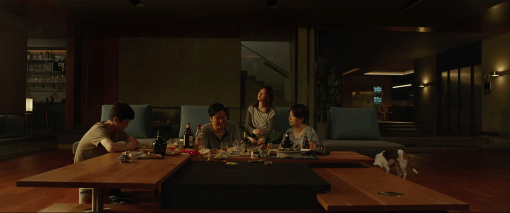
Michael Haneke’s Happy End, an oxymoron if there ever was one, is set in Calais in the northern extreme of France and centres on an upper-class white family that owns a public works construction business. The grouchy head of the Laurent family, Georges (Jean-Louis Trintignant) suffers from dementia and wants to kill himself. His doctor son Thomas (Mathieu Kassovitz) is married but is having a kinky online affair with another woman. Georges’ daughter Anne (Isabelle Huppert) heads the business one of whose sites her bumbling son Pierre (Franz Rogowski) manages. Following an accident at the site, in which a worker is seriously injured, their business comes under the risk of government sanction. Meanwhile, Thomas’s daughter Eve (an incredibly precocious Fantine Harduin) from his first marriage is forced to move in with him following her mother’s death. Present in the outer orbit of the Laurents are housekeeper Rachid (Hassam Ghancy), his family and the many refugees of the Calais jungle waiting to get across the channel.

None of these character relations are clear until late into the film. The Laurent family is given to us in shards, as though like pieces of a broken mirror. They appear to be representatives of an old order, the haute bourgeoisie, now crumbling under the weight of political and technological turmoil. Georges the patriarch has lost his mental faculty and thus economic power; he wanders the film looking for ways to die. In an interesting scene, he’s on his wheelchair in an impoverished part of town, having forgotten his way home. Amidst deafening traffic noise, he speaks to a group of male refugees, who don’t understand why he’s willing to give them his watch in exchange for information. Waning under his mother’s supervision, Pierre feels emasculated. Thomas doesn’t really believe in marriage anymore. Eve is out poisoning herself and other people. At the eye of it all is Anne, trying to unsuccessfully hold this European union together.

Numerous instances of digital media feature in the film. Eve records her life with her smart phone and sends the recordings to friends. She watches videos of YouTubers discussing their personal lives. Thomas’s affair takes place entirely on phone, e-mail and social media. This increased publicization of private lives, which Haneke clearly sees as dangerous, is contrasted with the infusion of the public affairs into the Laurents’ private lives. Their business is troubled by strikes in Scotland. The government is grilling Pierre to trace possible negligence as the cause of the accident. At Anne’s all-white engagement, Pierre brings in refugees from the area and creates ruckus. (Not that he’s the voice of the marginalized, he simply uses them as bugbear). The family members love each other, but you sense that it’s the wealth that ultimately holds it together, the stability of the family dependent on the stability of the capitalist social structure they represent. Happy End is Haneke’s vision of post-Brexit Europe.

Okja

[Possible spoilers ahead]

Bong Joon-ho’s Okja begins with Lucy Mirando (Tilda Swinton), the new CEO of Mirando Corporation, unveiling “super-pig”, a new porcine variant her GMO company has come up with to solve the world’s hunger problems. In order to soften its public image and garner popular support for the new pork variety, the company announces a “best super-pig” competition, in which super-piglets are given to farmers around the world for a duration of ten years. One of these creatures, now named Okja, grows up with Mija (Ahn Seo-hyun), an orphaned farmgirl living in the mountains of South Korea. When the competition day arrives, Okja is taken by Mirando to Seoul and then to New York against Mija’s wishes. Mija, with uninvited help a group of American activists from the Animal Liberation Front (ALF), follows Okja to New York to get her back home.

Bong lampoons Mirando Corp as being headed by a family of deranged egotists convinced of the nobility of their mission. There’s no pretence to realism here. Swinton, that epitome of ironic existence, draws from Cruella de Vil and Jake Gyllenhaal as Johnny, Miranda’s neurotic PR, clearly works off cartoon/anime types as well. Though he’s ultimately with them, Bong parodies the ALF activists too, with their facetious politeness and misplaced idealism. Both are, of course, gross exaggerations and Bong’s equating of both reeks of a cool cynicism towards his subject matter. On the other hand, the filmmaker invests all his heart into the world of Mija and Okja. The film spends considerable time depicting the Edenic life in the mountains, where men and CG animals live in symbiosis with nature. The elephantine Okja, a cross between a pig and a hippopotamus, eats a small dose of fruits, helps Mija and her grandfather in fishing and sustains the ecosystem with her droppings. Bong doesn’t question this violation of nature’s rules, effectively acknowledging Mirando’s claim of having created a superior animal.

As the film shifts to the technologized jungle of Seoul – a disorienting change from the mountains – the film takes on more complex tones. A long, compelling action sequence finds both Mija and the ALF members coming together to hijack Okja, plant a spy-cam on her and let her be taken to the Mirando test facility in New Jersey. There’s a conversation between ALF and Mija translated by a Korean member of the group that speaks to Bong’s status as a Korean director making English-language films. The punch-line for this scene comes later and with the splash of violence that was always on the cards. Meanwhile, at the Mirando lab, Johnny has successfully bred Okja with a male super-pig and whipped up a meal with samples from Okja’s body. Scenes such as these involving ALF and Mirando corrupt the innocent fable of Mija and Okja and change this children’s film into a genetically-altered organism in itself.

Yet, Okja is a Disney movie at the DNA level. In the Korean portion of the film, Okja is demonstrated to be an intelligent, non-human person capable of empathy and even sacrifice: she saves Okja from a fatal fall at the risk of her own life – another disconcerting characteristic for a manufactured animal the film doesn’t bother to question. The film’s final scene takes place in Mirando’s large-scale abattoir where super-pigs are stocked and killed. Bong shows us the slaughter and we are all the more repulsed because the animals are invested with human emotions. This anthropomorphism reveals an instrumental morality typical of Hollywood animation, which only humanizes animals that aren’t eaten. The super-pigs need to be saved not because all animals need to be saved, but because they are extremely useful, higher beings. As Mija and Okja walk out of the facility, lucky to be alive, a super-pig couple nudges out their piglet out the barbed-wire fence to be smuggled out by Okja. Followed by a collective howl of thousands of super-pigs doomed to die, it’s a very disturbing scene with unsavoury echoes of the Holocaust. It moves us for the wrong reasons. Tough luck if you aren’t a species with human-like expression.

Burning

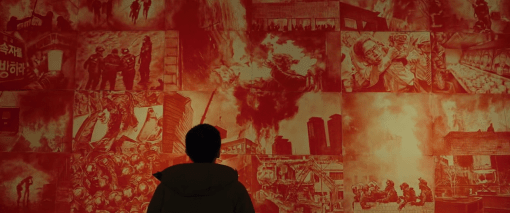
Lee Chang-dong’s first directorial project since Poetry in 2010, Burning portrays the civil life of an ex-serviceman Jong-su (Yoo Ah-in) who falls in love with a shop girl Hae-mi (Jeon Jong-seo). After a trip to Kenya, Hae-mi grows close to a dodgy, rich young man called Ben (Steven Yeun). Jong-su, meanwhile, discovers that his estranged father, who likes collecting knives, is tangled up in a case involving assault of a government official. In a marijuana-fuelled meeting at sundown at Jong-su’s house in the countryside, Ben reveals that he likes burning down greenhouses – a metaphor that Jong-su, wannabe novelist, picks up a little too late. Hae-mi vanishes and Jong-su spends his time stalking Ben to find out the truth. The closer he seems to get to the bottom of his girlfriend’s disappearance, the more it seems that he’s imagining things. Lee’s excellent film is a thriller that’s also an astute socioeconomic portrait. And the philosophical questions the thriller aspect of the film raises, Lee seems to be telling us, are also emanations of class conflict.

The protagonist Jong-su’s predicament is whether he has inherited any of the insanity and violence that characterizes his father. As a child, he was forced by his father to burn his mother’s clothes when she left home for someone else. The confusion as to whether he’s seeing things as they are or he’s losing it manifests in Jong-su’s slow response to happenings around him. He takes time to make sense and even longer to act (and Yoo realizes this slowness in his sluggish physicality). He’s trying to write a novel, but doesn’t know on what. Outside of odd delivery stints, he is unemployed, like many of his young compatriots. He refuses to take up a menial job, preferring to move back to his father’s now-deserted home outside Seoul. His relation to Ben (“Gatsby”) is also determined by class resentment and Lee’s film is clear-eyed about the classist spaces of Seoul. Ben lives in a swanky apartment in Gangnam, where Jong-su’s pick-up truck sticks out like a sore thumb. The places that Ben frequents (and which he sometimes invites Jong-su to) – the brewery, discotheque, gymnasium, art museum, the church even – are in stark contrast to Jong-su’s downtown hangouts and Hae-mi’s matchbox-sized studio in a noisier part of town. Lee includes several shots of the characters navigating Seoul’s various districts and of Jong-su driving around in his pick-up truck, following Ben’s Porsche, like Scottie from Vertigo. Just like Hitchcock’s film, Burning is full of repetitions, reflections, pairings whose patterns appear to impart sense to Jong-su’s quest and redouble his obsession.

Burning unfolds as a metaphysical thriller like Blow-Up, and Shutter Island. Its protagonist is never sure whether his understanding of the world is reflective of reality or simply a product of his broken self. But, as with most narrative films that intend to depict the enigma of perception, the ambiguity Burning constructs runs the risk of being undone by the nature of the medium itself. Lee’s film is inspired from two short stories both titled “Barn Burning”, one by William Faulkner and the other by Haruki Murakami – influences acknowledged several times in the screenplay. While, in literature, it’s possible to present reality as being entirely refracted through the protagonist’s subjectivity, the fact of having to film in third person adds an objective dimension to Burning’s narrative. Ben’s demeanour and behaviour is there on screen for the viewer to see for herself. Lee gives Ben all the trappings of a gay serial killer, and even if his protagonist is unable to make up his mind on Ben’s true nature, the viewer is pushed to. Sealing the issue is a final scene at Ben’s house where he is with another girl: Jong-su isn’t present here and the scene exists in order to bait the viewer and challenge her view of Ben. It would have better served Lee’s accomplished film to obscure Ben’s presence.

Kapoor & Sons

[Spoilers ahead]

When their grandfather (Rishi Kapoor) falls ill, Rahul (Fawad Khan), successful novelist, and Arjun (Sidharth Malhotra), struggling novelist, return home to parents Harsh (Rajat Kapoor) and Sunita (Ratna Pathak Shah). Arjun believes that Rahul’s perfect life is built at his cost and resents that his parents like his brother more. While supportive of Arjun, Rahul believes he has his head in the clouds and is unwilling to grow up. Harsh is sitting atop a failed enterprise and is annoyed with his wife’s desire to start her own food business. Sunita complains about Harsh’s financial incapacity and dependence on his brother. Another bone of contention between the brothers is the presence of Tia (Alia Bhatt), who is romantically attracted to both of them. This interpersonal algebra is further complicated as the film unfolds, to a point that the entire family is held in tense suspension by mutual grudge.

If the Kapoor family seems out of place in this Bollywood version of Coonoor, here emptied of its local population or landmarks, it’s partly because they are exceptional. Exceptional not only because they are upper class, but because they are unhappy in their own way. Kapoor & Sons stands out in the way it puts its hand into sticky areas of familial life not generally broached by Indian cinema, where moral centres are clearly defined when the family unit is threatened. Everyone in Kapoor & Sons has their reason, and no one’s really right or wrong. (That this detail registers as revolutionary speaks of the industry’s general compulsion to infantilize its audience.) The misery of the Kapoors is spontaneous, independent of external factors. To the world, it’s a happy family, but as the shiny wrappers come off, each member confronts the image the others have of them, confirming their suspicions of not having been truly loved.

The film is centred around grandfather Kapoor’s final wish of having the whole family convened for a photograph. This conceit makes for the film’s most effective set-piece: director Batra intercuts shots of the characters finding out truths about each other with the photo-shoot taking shape under the threat of rain. It’s thrilling and low-key tragic the way this quotidian inconvenience imposes a time pressure over the intense drama: the photograph can’t be made if the characters keep talking, but it won’t be made precisely because the characters haven’t talked enough. When they do assemble for the abortive photo-shoot, we realize that the crux of the problem lies not in the existence of secrets but the in lack of time for the characters in which to explain themselves to each other. Lack of time is what the photograph is about too: the photo purports to hold memories, but constantly lies, picking out a moment in time and stripping away its history. And the lie of the photogenic happy family is what the old patriarch wants to go down with.

Kapoor & Sons is located at the twilight of Bollywood’s old vision of family (community, filial respect, hierarchy, role-playing), now being fast replaced by an occidental vision informed by disruptive liberation narratives (romantic individualism, liberalism, free enterprise, feminism). It’s curious that, despite taking place in a Westernized upper-class milieu, the film looks backwards, dealing with old familial and civilizational sentiments: the guilt parents experience over their children’s perceived faults, the obligation children feel to fix their parents’ lives, the childhood hurt siblings preserve and nurture even as grownups. While Harsh’s and Sunita’s disillusionment with the familial institution is gradual and protracted, Rahul and Arjun face a rude awakening, having to confront primal truths: finding the father at the house of a lover, learning that the mother truly loved one child more than the other.

Commendably written and directed, Kapoor & Sons is constructed out of long, fleshed-out scenes, all of them conversations of some kind – a noteworthy quality in itself. While the effort to crank up the temperature is apparent (a pipe leakage, a dog entering a clean house, a tiff at a card game always at hand to heighten tempers), there’s a clear-cut evolution to every scene. As the film proceeds and the drama reaches a fever pitch, you sense that an expiatory sacrifice in order to appease the narrative gods: it’s not the old man as you’d expect, but his son, and this sudden hole in the family fabric creates a dual perspective of the tragedy, the grandfather’s and grandchildren’s. At the same time, the film treats its material preciously and often forces the issue, spending too much time reinforcing this sibling rivalry and verbalizing that which the actors already convey without words. Rajat Kapoor stands out, but Ratna Pathak Shah’s character is somewhat hollowed out. A more austere, improvisational approach, letting the actors define the contours of their characters themselves, would have helped in a more rounded picture, and made the cruelty family members are capable of towards each other all the more personal.

Bhavesh Joshi Superhero

Bhavesh Joshi Superhero confirms Vikramaditya Motwane’s status as a reliable metteur en scène, a filmmaker capable of mounting effective entertainment in various genres without much personality. He’s made four films so far: a coming-of-age drama, a literary romance, a lone man survival saga and, now, a social-minded superhero movie. All films with specific pleasures and specific ideas, but without any connecting theme. That Motwane isn’t an auteur is a moot proposition and, in the era of instant canonization, perhaps not even worth arguing about. What is of pertinence is that Bhavesh Joshi is his weakest film by far. The failure is instructive in its own way. His films, it now appears, are only as good as their material, and when the latter is uninspired, the films aren’t either.

Motivated by the nationwide anti-corruption movement of 2011-12, two young men from Mumbai, Bhavesh Joshi (Priyanshu Painyuli) and Sikandar Khanna (Harshvardhan Kapoor), launch an activist YouTube channel. Wearing black jackets, paper bags over their heads and carrying a smiley-faced LED panel, they confront various misdoings around them with a camera, uploading the videos online and garnering public support. The project is only half-serious, and, for Sikandar, a means to impress girls. Bhavesh is revolted when Sikandar bribes to get his passport issued and so punches him in rage. In revenge, Sikandar outs Bhavesh’s identity on the channel, just when he’s exposing the water mafia headed by the local MLA and enabled by the police.

Motwane treats the pair’s activism with irony, but when they move from policing individuals to confronting institutions, the film shifts to a serious tone and eventually into full-blown melodrama replete with a strawman villain spouting parables from Greek mythology. Casting relatively unknown actors allows for a surprising protagonist swap midway. For a film that intends to be topical – several reproachful references to the current government, the true-blue Gujarati name of the vigilante protagonist being an insurance against backlash – the characters are oddly unrooted, their familial and social situation not even getting a passing mention. This tendency for topicality is complemented by a desire for legend-building. When Bhavesh Joshi Superhero completes his first foray, we only see him as a silhouette against a burning background.

The compulsion to create a legend clashes with the work’s realist moorings to create a totalitarian vigilante story that pits one man against the entire universe. The film’s distrust of all state and public institutions results in one implausible plot point after another: because everyone is corrupt, the bad guys can get away with anything, anywhere. The opposition party has no voice, the police is rotten to the core, the media is manipulated by the powerful, and the public is swayed by the media. It’s Bhavesh Joshi (and YouTube) vs the World. Yet, it’s the media and the judiciary the script eventually looks to for resolving its plot and bringing the villains to account. For a film that started with the acknowledgement that justice is not a question of setting the crooked straight, but a long-drawn, institutionalized process of negotiation and influence, Bhavesh Joshi takes a quick U-turn.

Motwane and team imagine Mumbai like Gotham City, made and unmade over and over. The film’s best passage is a chase sequence in which the superhero on bike snakes in and out of not just the city’s roads, but impossible locations such as its local railway as well – a parody of a regular day for many residents of Mumbai. The film accentuates the home-made quality of its super-hero, he might as well be called Jugaad-man: we see him buy electronic parts from the black market, stitch together his own attire, customize his bike with makeshift power boosters. The action sequences, likewise, are shot with an improvisational, low-budget aesthetic to look like local variations on Soderbergh. The film tempers its seriousness with touches of humour: after a botch-up, the hero makes for the exit limping, his undercover identity consists of thick-rimmed glasses and an absurd, off-the-shelf bald patch he puts on with the help of a Chinese instructional manual. The final fight sequence takes place on a pipeline and Motwane shoots it like a video game – scattered grace notes in an otherwise ordinary venture.

First Man

Made during the runup to the golden jubilee celebrations of the first moon landing, First Man begins in the middle of action: Neil Armstrong (Ryan Gosling) manoeuvres his plane at the edge of atmosphere, veers close to catastrophe, but manages to land back on earth without much damage. The reason for his lapse of judgment, it is revealed, is that his toddler daughter is suffering from an incurable tumour. She dies shortly thereafter and Neil moves with his wife Janet and son to Houston, having been selected for the test programmes in NASA’s moon mission. Life in Houston has all the trappings of middle-class normalcy – sub-urban house with a lawn, grill parties with neighbours, pastel-coloured wallpaper – but Neil and Janet can never blend in. The moon mission is proceeding at full throttle against all odds, resulting in the loss of several astronauts, all Neil’s friends and neighbours.

It appears that, constantly touched by death, Neil is a stoic, melancholy man, not yet on the moon, but entirely not of this earth. He removes himself completely from family life, content to gaze at the moon every night. In the film’s most effective scene, he is forced by Janet before he leaves for the mission to have a final chat with his sons, which Neil completes like a press meet. Gosling channels some of his work from Lars and the Real Girl and one of the ironies First Man is going for is that this man, brilliant engineer but a social outcast, is constantly asked to bear the burden of history, to be in the eye of media attention, give press conferences, attend White House dinners, and be the receptacle of popular anger against the mission; that he had to go to the moon to be able to get back home. The thrust of Damien Chazelle’s interspersing of Neil’s incurable gloom and the agitations of the sixties is that, no matter one’s privileged social-historical situation, private grief is all-consuming and can’t be relativized.

In this, the film also seems to want to paint a metaphysical portrait of the sexes. Like Western heroes, Neil’s and his fellow male astronauts’ straying away from the pull of domesticity towards the unknown and the endless suffering of their wives and children comes across as descriptions of an eternal condition. The repeated superposing of the domestic scenes at home featuring Janet and children and NASA’s commentary of the mission is supposed to have an Odyssey-like weight, but only grows increasingly wearisome. Janet’s character, more than Neil’s, remains greatly underdeveloped (Claire Foy’s drama school tics condemn it to a type) and it’s symptomatic that this film, which namechecks various discontentment of the sixties, completely sidesteps the sexual revolution that could’ve given Janet a more rounded presence.

Some of the formal choices are interesting, especially its low-budget-movie tendency to avoid spectacle for suggestion of spectacle: most of the thrill is conveyed to us not through rocket ballets but via numbers on screen, the low-key score, the sound of metals clinging, the actor’s frenetic breathing and the claustrophobic setting of the capsule. Not allowing for sights outside the capsule makes for a subjective experience of impending death. It also reinforces the film’s parallel theme about man’s conflicted faith in technological progress. In a recruitment interview, Neil says that he wants to go to space in order to get a better perspective of life on earth, hinting at a distrust of technology that wasn’t able to save his daughter.

Given that everyone knows how Apollo 11 or the preceding missions panned out in reality, screenwriter Josh Singer pegs the dramatic power of his script on the time-limited nature of the mission. Kennedy’s declaration that an American will be on the moon within the decade taken alongside the impossible odds against which that goal has to be achieved lends the film the thrill of a countdown. Chazelle employs glass as a crucial element of his mise en scène and the material comes to reflect Neil’s emotionlessness, his distance from his family as well as the vastness of the unknown facing him. The last scene, loudly understated, is La La Land Redux.

High Life

The human aspect of space travel is also at the centre of Claire Denis’ first full-length English language production, High Life. Far in the future, death row inmates are given a choice to volunteer for a one-way mission to the nearest black hole. Strict rules are observed on board, the inmates are still treated like prisoners, with everyday tasks to be completed. Overseeing the ship is a slowly-disintegrating captain (Lars Eidinger) and a cookie scientist Dibs (Juliette Binoche), who is trying in vain to produce babies by artificially inseminating the female prisoners with semen samples from the male prisoners. With exposure to radiation mounting as they near the black hole, the prisoners get increasingly restless and Dibs keeps them sedated by adulterating their rations. But the strict prohibition of sexual contact between inmates leads to a breaking point and the mission is thrown into jeopardy.

Well, that is the story, but we don’t get to it right away. The film’s opening fifteen minutes constructs an otherworldly ambience. A glide through a misty garden with a mysterious shoe hints at earth. A baby is seen in a cradle surrounded by screens and electronic equipment, her father Monte (Robert Pattinson) speaks to her through the computers, but he’s perched on top of a spaceship trying to fix an issue. There’s no information about how these spaces are linked and the enigma creates fertile connections in the viewer’s mind. The film proceeds in several stretches through such mosaic of details, which are glued together through clumsy expositional elements such as an Indian professor in a train on earth spelling out the premise. The image of a man and his child aboard a ship heading nowhere is a combination of hope and doom that the film drops for the more ordinary spectacle of the inmates going bonkers.

The everyday events on the ship unfold gradually with sudden bursts of violence, causing the attrition of the crew. We are never sure how big the prison-ship is or what the exact relation between the spaces we see is, except that the garden is a more spiritually-invested zone that disinfects the inmates, gives them an experience of home and helps them come to terms with their dire situation. Monte resists Binoche’s charms to preserve his essence, but is overpowered by her and fathers a baby unbeknownst. His resentment and eventual acceptance of the child perhaps is perhaps what the film is most committed to, turning the story into an allegory of sorts for life on earth. The narrative shifts back and forth in time and there’s a twenty-year jump that finds the baby all grown, now picking up human concepts like faith and cruelty through videos still being transmitted from earth – an improbable Bildung we are asked to take on faith.

As is customary for Denis, particular attention is given to the various textures of the ship: the plastic curtains overseeing the garden, the fabric in “The Box” where prisoners go to let out steam, the padding on the ship’s walls, Binoche’s writhing skin, the actors’ hair which seems to have some special power in the narrative. Every bodily fluid that exists is roll-called and becomes a resource to be harnessed. Denis shoots in odd aspect ratios and that adds to the echo of Solaris resounding through the film. The film, to be sure, is a distinct auteur excursion into this derided genre. But it lacks the consistent ambiguity of The Intruder or the emotional beats of 35 Shots of Rum. Going one-up on the cynicism of Bastards, High Life seems to embody a bitter outlook towards not just civilization, but the human race in totality. Why bother?

Gully Boy

My issues with what I’d seen of Zoya Akhtar’s work so far were related to the question of perspective. The outlook of Zindagi Na Milegi Dobara and Bombay Talkies revealed an overprivileged life out of touch with the rest of the country, a personality entirely shaped by Western liberal notions having little empirical grounding. The works came across to me as unwieldy transpositions of popular ideas – McPhilosophy – onto Indian narratives. So, when I heard that her latest film, Gully Boy, was about a youth from Dharavi rising to stardom as a hip-hop idol, I had my prejudices: another Bollywood-Hollywood crossbreed, an underdog rap movie embodying a bourgeois ideology of making your own life, middle-class attitudes to poverty and shop-worn wisdom about following one’s passion, tailored to Western tastes with suitable amount of local colour added. While these tendencies are still discernible in Gully Boy, Akhtar and her co-writer Reema Kagti mount a powerful rebuttal to these prejudices. With great intelligence and feeling, they pre-empt the objection that wanting to transplant a musical phenomenon rooted in the African-American experience onto the slums of Mumbai is false consciousness. Their magnificent film demonstrates to us that, at this particular juncture in Indian history, it’s this very objection that’s reactionary, a product of false beliefs about what our society is and isn’t, that the image of a boy recording his voice on an iPad through a tea strainer is not the figment of an uprooted imagination.

Gully Boy is a portrait of “young India”, the dreamers as a recent book put it, a pan-social generation that is still embedded in old traditions, but takes its behavioural and aspirational cues from a wider international community. All they need is food, clothing, shelter and internet. When Murad (Ranveer Singh) writes his first rap lines in Hindi/Urdu, it’s in the roman script, a hybrid form just like the film’s bilingual titles. He sleeps, works and rolls cigarettes in the attic of his matchbox house in Dharavi. Murad goes to the mosque on Fridays and is answerable to the strict codes of the family hierarchy. He dreams of becoming not a movie icon or a ghazal singer – enticements that his immediate surroundings offer – but a hip-hop star, a notion foreign to his milieu. Words surround him all the time; he lives in a noisy environment and wakes up to the creeping sound of his parents quarrelling. He desires peace and privacy, also concepts foreign to his milieu, but the attic can only offer so much. As his father (Vijay Raaz) brings home a second wife less than his age, Murad plugs in the earphones to drown out the Shehnai and the sorrow. Akhtar cuts to his perspective. We hear a rap track as we see the newly-wed being welcome by the first wife. This escape from reality through music from another world, later amended by a return to reality through the same music, is dissonant and incongruent. Incongruence, however, is the point.

All through the film, Akhtar and Kagti emphasize the outsider perspective to the story and foreground their own foreignness. They populate their film with outsider figures: slum tourists whom Murad surprises with his knowledge of hip-hop, a European traveller who decides to stay back with Murad’s friend and guide MC Sher (Siddhant Chaturvedi), the rich family that Murad chauffeurs and, most notably, a Berklee student Sky (Kalki Koechlin) who produces music with Murad and Sher as part of her project. An alter ego of Akhtar’s, Sky brings to Murad’s universe an undiscriminating perspective, new social codes and modes of thought. She takes Murad on a night crawl to spray paint at construction sites, bus stops and shopping malls – artistic interventions which, in Murad’s world, are acts of vandalism. The kitchen of her quiet, spacious apartment is bigger than Murad’s house.  “I can’t believe I’m doing a music video” says Murad to her, to which she responds, “I can’t believe you were going to take up a job.” Gully Boy recognizes that change can come neither from within nor from outside but from a dialectical interaction of the two. Thanks to her material, Akhtar is able to refuse looking at Dharavi as a self-contained ecosystem isolated from the rest of the globe. The residents of her Dharavi are not poor-but-happy fatalists content with their everyday victories and limited social mobility. They dream big, they form their self-image from the outsider’s gaze. Murad derives his worth from the feedback he gets online. In a climactic showdown with his father, he points to the number of likes and comments on his videos and claims that he won’t let someone else tell him what he should aspire for. In doing so, the film throws a loaded challenge: a viewer tempted to judge Murad’s internationalist consciousness and ambition as shallow and false falls in line with the father’s point of view.

If it’s hip-hop that promises a ticket out of poverty for Murad, it’s the safer route of education for his long-time girlfriend Safeena (Alia Bhatt). Higher up on the economic ladder, Safeena is determined to become a surgeon and lead a life with Murad – in that order – whatever that takes. When she learns that a friend of hers is flirting with her boyfriend, she goes to the girl’s workplace and beats her up. This scene of two women fighting over a man seems overreactive and questionably comical, but it soon is revealed to be part of Safeena’s pathological jealousy: when she breaks a bottle over Sky’s head for courting Murad, it isn’t funny anymore. Safeena articulates her reason: she has one life and she will not let anyone run roughshod over it, even her boyfriend. Safeena is the counterpoint to Murad’s mother, who must resign herself to a life she didn’t choose. (In a nice bit of mirroring, Murad finds his temperament and muted masculinity echoed in Safeena’s father.) If Murad runs up against tradition in direct, confrontational ways, the headscarf-sporting Safeena fights it from within. She constantly lies and uses her perceived vulnerability to get what she wants. She will even weaponize the system of arranged marriage to suit her ends. In an astute bit of writing, the threat that she faces as a woman – of being withdrawn from the economic ladder and getting married off – is opposed to the threat that Murad faces as a man: the thread of being chained to the workforce. The freedom she desires she had? To be able to put on lipstick, go to parties with friends and stay out late – another loaded challenge to the audience to judge these as petty and shallow.

Every time we think a characterization, an event or a turn of phrase seems out of place in the film’s milieu, the film turns the suspicion back on to us, asking us why not. Why shouldn’t, in a film full of failed father figures, Murad’s masculinity be untouched by his circumstances? Why shouldn’t the words (“mazboot” to mean solid, “awaaz karo” to mean make some noise) sound translated from English? There’s a monologue towards the end questioning the 9-to-5 life, which sounds like the product of middle-class professional anxiety. But, the film repeatedly asks, why shouldn’t Murad question it, why shouldn’t he rap to a different beat? Why should this heightened consciousness about life necessarily be the prerogative of those higher up the social ladder? If the film characterizes this YOLO wisdom as being typical of a generation, it doesn’t skirt questions of class. Murad is forced to briefly take over his father’s job as a chauffeur to an upper-class, strawberries-for-breakfast family. In a heavy-handed scene saved by Ranveer’s lack of reaction, the man of the family urges his daughter to do her post-graduation, pointing to Murad’s status as a graduate. A while later, in the film’s best sequence, the girl storms out of a party back to the car. Murad observes her crying on the rear-view mirror. He doesn’t say a word and, as they drive home together, yellow lights from Mumbai’s street lamps washing down their faces, a voice-over begins: Murad has converted his inability to console her into a verse. Akhtar throws into relief their physical proximity and social distance with a shot of the car from the side. The voice-over provides Murad a liberty he doesn’t have in the diegesis.

Akhtar is responsive to the class-coded nature of the various spaces in the film. Murad’s presence in the recording studio, at upscale pubs or at Sky’s gated community have a friction matched by Sky’s decision to shoot her video in Dharavi. The austere warehouse where the rappers meet, on the other hand, promises a utopian space free of class distinctions. Several scenes take place at a playground in Dharavi, a zone of horizontal male bonding outside of community strictures, and Murad’s success story is one of being accepted into and assimilated by traditionally exclusionary spaces. In one scene on a New Year’s Eve, Murad is turned away by a bouncer from the vicinity of a rap concert. He shuts himself in the car in rage and shame and raps a verse. This response to being excluded from a public space by turning the private space of someone else’s car into a personal space for creation is part of Murad’s innate adeptness with space, his constant slipping from his attic to the terrace, to the bridge, to the round or to Safeena’s house. There’s an endearing romantic scene between the two, a spin-off of Romeo and Juliet, where Murad calls Safeena on the phone from outside her house. They speak to each other over phone but looking at each other: she’s on the balcony, he’s down below. This culturally-defined but entirely-comfortable distance is to be contrasted with the scene in the car with Murad and the rich girl.

Akhtar’s keen sense of space is coupled to an equally-sharp attention to behavioural detail. She observes the (predominantly male) hip-hop subculture with an ethnographer’s eyes, touching upon the various rituals, rites of initiation and social codes involved: the head-banging and arm waving, the animalistic circling around before a faceoff, the “bohot hard, bohot hard” (“hardcore, hardcore”) chants of encouragement, the spontaneous recruitment of groupies, the putdowns hinged on perceived lack of masculinity, and the class anger sublimated in performance. The attire, accessories and hairstyles of the participants, their body language, and even their choice to play the Dozens are derived from Black hip-hop culture and Akhtar makes no effort to disguise or attenuate this. She recognizes that this whole space is an opportunity for youth, marginalized and privileged, to leave behind their given identities and play out ones they have chosen for themselves from a sea of internationally available sub-cultural identities. These gestures and behaviours don’t exist outside the space of the warehouse and the concert hall: their being unrelated to the real world is their reason to exist. Hip-hop here is an external agent of change – like Sky, like Akhtar – offering an alternate mode of life, a parallel community outside of family, work, mosque, free of judgment and hierarchies. Notice the scene when Murad walks into the warehouse for the first time. He starts rocking to the music as soon as he hears it. It’s an instant recognition of one’s lot, a spontaneous initiation into a brotherhood forged on a beat.

The terrific rap is written by a battalion of hip-hop artists and music producers on whom the film is partially based: Divine, Naezy, Kaam Bhari, Spitfire, Ace, Dub Sharma, MC Altaf, MC TodFod, Desi Ma, the list is long. The verses are top rate and so are the roasts. But as pleasant is how Akhtar and her dialogue writer Vijay Maurya, who plays Murad’s uncle, show a great sense of prosody. The words they pick and the way the actors deliver them have a cadence and vitality rivalling the rap tracks. When Murad is christened ‘Gully Boy’, his friends repeat the name like an incantation. A moment earlier, the word ‘export’ was brilliantly rhymed with ‘visfot’ (explosion). One of the quarrels between Murad’s parents yields this bit of verse: “Baccha hai?/Haan/Baccha hai yeh?/Haan/Saala saand ki tarah chhati pe baitha hai baccha hai yeh?” (“A kid?/Yes/He’s a kid?/Yes/He’s sitting on my chest like a goddamn bull and he’s a kid?”). An exchange in Marathi between MC Sher and his father sounds straight out of a rap battle. Akhtar’s knack for picking up rhythms from Murad’s environment – the sound of door knocking, a passing train, the footsteps of Murad coming down the attic, the ubiquitous “bhai” (“brother”), the vowel-dominated Mumbai Hindi slang that ends imperative sentences with ‘ka’ (“pyaz katne ka, cooker mein dalne ka, teen seeti ke baad nikalne ka”) – hints at the source of his gravitation towards hip-hop, just as the factory noise of industrial Britain is said to be responsible for the blossoming of heavy metal music in the country.

Ranveer Singh is extraordinary as Murad and it’s one of the great Hindi cinema performances. Several scenes in the film would’ve simply collapsed had he interpreted his role differently. When you see him first as the unwilling participant in a carjacking, he is in the background of the shot, out of focus. Even when he is in focus, he’s barely conspicuous. Donning sweat shirts and jackets over a kurta or a loose shirt left untucked, a backpack, a talisman on his neck, mascara under the eyes, he cuts an awkward figure. There’s a constant softness to his voice, even when he becomes increasingly comfortable with the rap scene, that is in contrast with the coarser textures of his peers’. In his first open mic session, Murad is pushed by MC Sher to rap out his own writing. Ranveer reads the text out from his notebook to an “old-school” beat in metre, without any deviation or improvisation, like a primary-schooler forced to recite a poem for a competition. He misses the beat once: a calculated amateurishness worthy of Gary Cooper. This apparent innocence gives his tracks a moral power and rounds off the rough edges of the roasts. Notice the pitch drop in the final battle when he goes from “Tere kaale noton ki raid lag gayi” (“your black notes have been raided”) to “ab yeh sikka mera bolega” (“let my coin do the talking now”). The shifts in his tone when he speaks to Safeena, to his friends or to characters outside of Dharavi go hand in hand with his changing body language in different spaces. Just looking at him you could figure out the kind of location he’s in.

There’s a distinct lack of a feeling of bruised masculinity in Ranveer’s Murad – no rage or resentment – contrary to Vijay Raaz’s rather flat characterization. Unlike Safeena, Murad is not irreverent or calculating. His verses aren’t controversial or especially provocative, nor is his rhetorical style. They’re inward-looking, less about societal evils than about self-realization. With an unassuming Mumbai accent, Ranveer minimizes Murad’s own experience in front of others. He thanks MC Sher for the warm reception on the first day. When Sher tells him not to pay heed to rich kids dissing his provenance, he gently replies “no, brother, they’ve seen the world.” The first meeting with Sky at a pub is a lesson in modest cordiality. He will later thank Sky for not insisting on sleeping with him, innocent of the power dynamic at hand and of the etiquette of class relations. Look at Ranveer’s reaction to the recording of his first appearance: a toothy grin with his thumb on his lower lip, followed by a half-suppressed Charlie Chaplin laughter when a peer compliments him on a line. Or his first gig at a studio, where he measures his distance from the microphone with a trembling hand.

Ranveer’s self-subtraction is made more striking by being pitted against three remarkable performances. We first see Alia Bhatt’s Safeena, ironically, in a wordless scene with Murad, where the two, showing obvious signs of familiarity and comfort with each other, share a pair of headphones at the back of a bus. Safeena is diminutive and, her hair wrapped up under a colourful scarf, has the air of a soft-spoken schoolgirl. But her pluck and self-determination, bordering on hysteria when she gets violent, are in stark contrast with Murad’s timidity and constant doubt. She shouts and wails if necessary and segues from her standard-accent Urdu to Mumbai slang when needed. In her breakup call with Murad, a scene that is the conceptual reverse of their first romantic call, she sits on the bathroom floor with her hair untied, grilling her boyfriend at the top of her voice, her nose all red. Murad and Safeena’s complementing temperaments and command of space is also reflected in Murad’s relation with Siddhant Chaturvedi’s MC Sher and Vijay Varma’s Moeen. Chaturvedi’s is a patently star-making turn. In the scene at MC Sher’s tenement house with his alcoholic father, the simmering resentment and violence in Chaturvedi’s eyes is evident as glances at his father or when he says his mother ran away. The thrill and success of Murad’s first open mic session hangs entirely on approving reaction shots of Chaturvedi. Varma’s Moeen is a street fighter, residing in moral twilight, more rooted in the reality of Dharavi. He’s always in Murad’s orbit, supportive, but won’t share any of his lofty moralizing. Varma is always doing something interesting with his hair, hands and mouth, and his funny, moving performance, like Chaturvedi’s, seals a claim for a long haul in Bollywood.

Gully Boy is kinetically shot with a shoulder cam, as is par for many action movies, and it puts the audience on stage with the rappers. The rough yellow light of Mumbai outdoors is complemented by soft, bounced light of the interiors and the subdued colour palette. While the big dinner scene with the family is disorienting in its vague spatial relations, two particular scenes are lucidly edited with fine economy: the sequence at the hospital where Murad’s father promises his employer that his son will take over his job conveys the rigid chain of command through a fluid series of glances, and the scene at the party where Safeena assaults Sky superbly triangulates between Safeena, Murad and Sky’s points of view conveying their mutual jealousy and grudge. There are moments where the screenwriters pull the strings a little too hard and, I think, there are a handful of directorial missteps too. Sky’s video starring Murad and Sher is shot in Dharavi and features a questionable montage of workers posing for the camera. It’s an employment of the poor as wallpaper that Akhtar avoids elsewhere in the film. But Gully Boy is almost a unique phenomenon in that it manages to scoop out a piece of reality that brings into perfect harmony a social-historical analysis, the needs of the genre, and Zoya Akhtar’s position as a privileged artist. I doubt she can surpass this work. I also hope I’m wrong.

Roma

Alfonso Cuarón’s Roma is no doubt full of memories. But the question is whose? Made as a tribute to Cuarón’s childhood nanny, Roma unfolds solely through the perspective of Cleo (Yalitza Aparicio), the indigenous-origin housekeeper of a middle-class white family living in the Roma neighbourhood of Mexico City. The family stands for the director’s own and one of the four young children represents Cuarón himself. But we don’t know which one. Roma is not about him or any of his family members. Unlike in Spielberg or Fellini, it’s not the child’s experience that the film intends to recreate. Instead, the film presents the life of Cleo as conceived by the adult Cuarón. This results in a greatly sympathetic and reverential portrait, but the sympathy and reverence often cloud the humanity of Cleo.

One’s intellectual reaction to Roma might depend on where one stands on the issue of appropriation in art: is it right for a white, male filmmaker such as Cuarón to narrate the life of a native woman? I think Cuarón’s decision to hinge a film based on his personal life to the point of view of someone outside it is admirable and shows a humility and maturity surprisingly absent in the most intelligent of filmmakers. Roma makes it amply clear that this is not about Cuarón or his family, even though they are at the centre of it all and have their own cross to bear. It’s the story of Cleo over one tumultuous year.

At the same time, the life that Cuarón imagines for Cleo is curiously circumscribed by his own limited perspective of it. Cleo has little life outside the family and, whenever we see her away from home, it’s in service of the larger narrative thread regarding her romantic betrayal and pregnancy. Played by a non-professional, Cleo barely speaks except for the functional chitchat with the children and never expresses herself. This, of course, could be an empirical reality Cuarón has lived, but he extends this trait to her life outside work as well. Cleo has no inner life and her interaction with the other maid of the house, Adela, are almost always responses to Adela’s remarks. Political and social reality are strictly in the background and Cuarón limits the film strictly to the description of an everyday, emotional reality. We never know, quite intentionally, what relation Cleo bears to others of her community and station, or what she thinks of the protests going on in the city.

Much of Roma exhibits this disconcerting dual-perspective. Cuarón fills the film not with general cultural artefacts of the period but very specific memories – the toys sold outside movie theatres, two men taking shelter from rain under a small protrusion on the street, the tune of a wandering flute seller, stuffed heads of dogs displayed like trophies, the fanfare of the military marching through streets, a Fellini-like forest fire following an evening of revelry – so specific that they couldn’t be anyone else’s but Cuarón’s. Outside of an unsettling shot of earthquake debris fallen over a baby on a ventilator, there’s no sense of Cleo’s memories finding a place in the film. This tension between two incomplete perspectives is never resolved: Cuarón’s commendable intent to give Cleo the narrative space is undermined by the limitation of his vantage point. He can only imagine Cleo as a noble sufferer giving her all to his family – a stance that runs the risk of dehumanizing the character.

Given the “unmarketable” subject matter, the acclaim for the film on either side of the Atlantic is surprising and perhaps even welcome. Roma has the logistical muscle of Hollywood and the calculated reserve of an art film. The long-shot filmmaking with real sound, the use of non-professional actors, the stoic rhythm enabled in part by slow pan shots, measured editing patterns and muted dramatic progression is complemented by the spectacle that the film’s expert set-pieces offer (the scene at the beach is as breath-taking as the opening sequence of Gravity). Too bad that the space left behind by Cuarón’s conscious self-effacement isn’t filled by what he wishes would fill it.

BlacKkKlansman

At the beginning of BlacKkKlansman, a clip from Gone with the Wind is cut to a fake-archival harangue about miscegenation delivered by a white supremacist (played by Alec Baldwin), whom we never see again. The point is blunt; that Gone with the Wind was racist. This cut-and-dried approach is not new to director Spike Lee, whose previous work Chiraq used a range of in-your-face agitprop devices to animate a classical text and imbibe it with a welcome urgency. But here that MO falls flat, applied as it is to a material that has other ambitions. Inspired by a true story, BlacKkKlansman follows Ron Stallworth (John David Washington, son of Denzel), a Black detective from Colorado Springs who manages to get a membership to the Ku Klux Klan.

The year is 1972 and, as his first mission, Ron has to attend a speech by Kwame Ture to sense the response of the black students who’ve invited him. At first ambiguous, Lee’s attitude towards the speech is clarified in the precious way he edits it to show its power and influence over the awakening of Ron’s own Black-consciousness. It’s an abrupt transformation for a character that we’ve just been introduced to as a man who knows what he’s doing. Lee’s film proceeds by several such fickle happenings. The supremacists of the KKK that the Ron’s stand-in, Flip (Adam Driver), meets are all intentionally cartoons. They whoop and holler at a screening of The Birth of a Nation – a film geek’s idea of redneck entertainment. There’s a lot of racist slur thrown around whose purpose is not realism but provocation.

Poised between the Black Panthers and the KKK is the Colorado Springs police department Ron is part of. While the racism internal to the department is a talking point, the police force finally comes off as a group of well-meaning, tolerant individuals marred by a few bad apples. There’s an interesting idea about race as performance in the film, but the film’s thrust is towards an emphatic reassertion of identities. Early on, Ron’s assurance that the talk about race war among the Black students is just that, empty talk, is matched with Flip’s comment that the KKK members are blowhards who won’t dare to get into action. Just as one thinks the film is setting up a false and dangerous equivalence, Lee cuts between initiation rituals at the Klan and a gathering of Black students listening to a testimony about the lynching of Jesse Washington. The idea is that the two congregations are fundamentally, qualitatively different: one is about a violent assertion of power and the other is about memory and resistance. The blossoming of Flip’s Jewish consciousness when faced with ghastly antisemitic speech reiterates the notion: that minority identity politics is a defensive reaction to the threat of majoritarian aggression.

Lee is nothing if not topical and BlacKkKlansman is wrapped in a presentist perspective whose target is the current American government. Ron is warned about David Duke’s attempts to become mainstream through politics, the Klan members rail against PC culture, and slogans about making America great abound. After the film wraps up its excuse for a plot, scenes from the 2017 far-right rally in Charlottesville are played: the tiki torch march, Duke hailing the renewal of the right, the car attack and, finally, Trump claiming that both sides are equally condemnable, clarifying Lee’s primary reason for making this film. As the final shot, an upside-down American flag becomes black and white, in case you just woke up.

No Image

[Spoilers ahead, but I’d rather that the reader didn’t see this film]

Appearing nine years after his first film, Thiagarajan Kumararaja’s Super Deluxe is made of four parallel stories. In the first, a married couple (Fahadh Faasil and Samantha Akkineni) must dispose of the dead body of the woman’s illicit lover. The second story revolves around a group of adolescents who, owing to events triggered by the acquisition of a pornographic CD, find themselves in a deeper and deeper hole. In the third story, a transgender woman (Vijay Sethupathi) returns home from Bombay to connect with her estranged family. The fourth is centred on a fanatic (Mysskin) who starts a cult of his own, distancing himself from his wife (Ramya Krishnan) and son. Written by four people, all directors themselves, the film begins and ends with references to the sexual act and has vague ideas about masculinity and honour running through its episodes. But don’t let that distract you. Super Deluxe is an abject mess that can’t bother to reflect for a moment on why it’s doing what it’s doing; an object of collective cultural shame, one that we will look back at in ten years with great embarrassment and guilt.

The film’s first episode involving the couple begins with a ham-handed set piece: The man and the woman are trying to get rid of the body in the fridge while they have guests in the living room. There’s a passing remark about an alibi, but there is no reason for either the guests to be there in the scene or for the pair to carry out their activity in the presence of the guests. No reason, that is, except the filmmaker wanting to generate some frisson. There’s no emotional profile to the scene; the temperature starts at boiling point: the couple start arguing, of all things, about the shame of infidelity right away. It’s embarrassingly contrived and reeks of a screenwriting student convincing himself that what he has learnt in his workshops has validity. And you know right away that there were no women involved in the writing of this film, when you hear a leading lady using the words “matter” and “item” when talking about herself. The couple hits the road with the dead body and continue their bickering along the way. The man holds forth about social issues, uses his acting lessons as therapy and keeps slamming the woman using the term “uttami”. She acts guilty. They come out with the problems they have with each other, becoming closer in the process. At one point, the woman asks the man ruefully why can’t things work out between them if the man could get used to the dead body. Despite such monstrosities, the film wants us to care about this rapprochement. Fahadh Faasil and Samantha slip in and out of sincerity on cue, and the viewer is expected to follow suit.

Rife with shots of boys going about the town, the second episode presents itself as a comedy. Three horny teenagers need money to replace a broken television and do what middle-class teenagers typically do to get money: get involved in a murder plan with a local don. There’s a shred of tragicomedy in a story of young boys driven to hell in search of a porn movie, but that needs a distance so lacking in this film. Without any justification, it assumes that the audience shares its juvenile perspective; we are supposed to be tickled every time the boys talk about “matter”. And yet, this callowness is what we are expected to rise above at the end of the episode, where one of the boys gets a lecture about the morality of porn actors. The film’s tin ear for dialogue is most apparent in this segment; its idea of a joke is a boy riling up his friend by telling him he loves his sister. This sub-Chinni Jayant level of humour aside, this segment lacks a sense of situational comedy (the don decides to punish the boys by whacking them with a slipper) and seems to be making itself up as it goes along. The screenwriters know the end point they have to get to and mangle the plot to somehow get to the punchline. This episode merges with the fourth segment of the film about a middle-aged zealot convinced that he alone was saved by God from the tsunami. Along with a sidekick, he prays for the well-being of others who come to him in times of distress, but constantly wrestles with doubt. An interminable melodrama full of voice-overs, flashbacks and stroboscopic light, this episode asks us to consider the man’s trysts with doubt seriously, even when his awakening moment comes when his wife asks what if it were a teddy bear that he’d held on to in place of a Christ statue during the tsunami.

The third segment of the film, and its worst by far, follows a transgender woman named Shilpa who returns home to her son and extended family. Let’s charitably pass over the fact that the filmmakers felt necessary to use a cisgender actor to portray a transgender woman. Referencing transgender characters is a fixation for several modern Tamil filmmakers including the ones involved here. Noble their intentions maybe, these filmmakers have proven themselves again and again to be incapable of acknowledging the basic humanity of these transgender women without debasing them first. In Super Deluxe, Shilpa is subjected to a series of verbal and physical abuses from her relatives, from passers-by on the street, from the children and the staff at her son’s school and from an abominable cop – all presented to the audience with an elaborately cruel sound mix. In an unfathomably vile scene that counts among the worst in Tamil film history, the cop harasses Shilpa and forces her into oral sex. The entire sordid passage is presented in wide shots in excruciating detail, the camera not even possessing the shame to hide behind foreground objects as it does in the second episode. (The camera similarly gawks squarely at a hapless Samantha in a pre-rape scene in the first episode, just as it lingers long on her face when her husband hurls curses at her. Over and over, the filmmaker forces us to share the point of view of the aggressor.)

Nothing in the film until this scene at the police station has allowed the viewer to identify with Shilpa’s point of view. She is a cipher, a canvas on which to deposit all abuse. The only thing we get to know about her personal life is that she begs for money and smuggles children – popular opinions the film needn’t have bothered reiterating. There are more shots dedicated to the point of view of the dead body in the first episode than for Shilpa. So, in the scene at the police station, the only point of view the audience is allowed to recognize is the sleazy cop’s. The cop, of course, is a caricature and the audience is made to feel morally superior to him, while not having to anything to do with Shilpa beyond dispensing sympathy for her subhuman status. By making Shilpa the passive object of contempt, the film forestalls even the possibility of the audience’s identification with Shilpa that the casting of Vijay Sethupathi might have offered. There’s a special violence in the fact that the transference of identity that the film demands from its trans viewers for its other characters is not matched with a demand from its cis viewers towards Shilpa.

More evidence that the film takes the side of the cop and actively participates in Shilpa’s debasement: all through the film, Shilpa is presented to the audience in a form she doesn’t choose to be presented in. Except for the first shot of her getting out of the car, she is always showcased as someone incomplete and fake. In an award-baiting scene that follows, we see her patiently wearing her saree and putting on a wig to cover her baldness. Cut to a hideously-worded film song, this private moment that the film unwarrantedly seeks to show her as what she is and not what she chooses to be. At the police station, when asked for her name, she gives her old name. The moment is intended to show her fear of mentioning her assumed name, but it’s also one more of the film’s many moves to strip her of any dignity or agency. Shilpa’s undiscriminating son is offered as the moral centre of the episode, and it’s a shame that the film won’t extend the possibility of an empathetic viewpoint to its adult viewers.

All four episodes are periodically intercut and it’s evident very early on that they will all come together at the end. (That the film connects them with an old children’s joke is an embarrassment among countless others). The choice of when to shuttle between the episodes seems quite arbitrary. The editing deflates the tension so far setup in an episode and, since the viewer is never really invested in the characters, it matters little as to when the film comes back to that particular episode. Compare this with the intensified editing of Managaram, where the cutaways are thrilling because there’s so much at stake left unresolved. Many scenes in Super Deluxe are constructed with a handful of camera setups and the long-shot filmmaking and composition in deep space shows off the (literal) blocking of actors. Several shots frame the actors through doorways and windows, a capricious distance the film doesn’t employ for its voyeuristic scenes. Likewise, in the first episode, the woman asks her husband how many girlfriends he’s had. He says three and returns the question. In a long shot, she whispers the number into his ear. The number is withheld from the audience not for any concerns of privacy, but for the joke (a man having many girlfriends – drama, a woman having many boyfriends – comedy). The reserve that it shows in this shot and the lack of reserve in the shots of the same woman wailing are two emanations of the same attitude.

The film’s mannered, gonzo production design, consisting of exaggerated primary colours, and expressionistically-painted walls, is conceived to drown out the lack of a sense of place or time that marks the film. We are never sure where or which year we are in, or what the social situation of the characters is. The edgy aesthetic of backlit silhouettes and pop-music-suffused soundscape conceals a commitment-phobia, a fear of looking earnest and uncool. Shots are filled out with old film music lest some emotion creep in. The search for money in the second episode ends with an alien intervention. The film uses this deus ex machina because it thinks of itself as transgressive and too cool for realism. But it will allow itself the spectacle of women being degraded because, you know, that’s what the world is like, Realism. There are several points, especially in episodes three and four, where we are asked to invest in the characters emotionally – false emotional beats out of rhythm with the film’s ironic posturing. In the final scene, a doctor in a porn film goes on about the connectedness of all things and the historical nature of morality. This misplaced pomposity, preciously edited and scored and obviously intended to be taken at face value, is designed to spell out the film’s ideas and conceptually tie the episodes together, but afraid of sounding pretentious (which it nevertheless is), the film undercuts the message by making it a part of an on-screen porn movie. Super Deluxe appeals to the viewer’s benevolence, but is unwilling to return that faith. Why should it be taken seriously?

The Killing of a Sacred Deer

I’m one of those who think Lanthimos has something to say as an artist, even though The Killing of a Sacred Deer makes that opinion somewhat hard to defend. The film goes back to the universe of Dogtooth, with its isolated family governed by arbitrary internal regulations. Steven (Colin Farrell), his wife Anna (Nicole Kidman) and their children are the prototypical, white middle-class family with a posh suburban house and successful careers as doctors – unremarkable traits in all respects. When crisis strikes in the form of supernatural happenings controlled by Martin (Barry Keoghan), son of one of Steven’s unsuccessful patients, the family devolves into a primitive formation, with every member sucking up to the patriarch to stay alive. There are certainly echoes of Pasolini’s Teorema here and I do think Sacred Deer takes forward The Lobster’s reflection on the demands modern life makes of individuals as members in a social contract.

As is standard in Lanthimos’s cinema, the dialogue is wooden and delivered by the poker-faced actors as though reading out of a page. The subject matter is either meaningless everyday talk, whose painful banality and falsity are brought out more strongly by the toneless diction, or quaint remarks reminiscent of Wes Anderson. Even when the characters breakdown in rage or grief, there is a studied quality to the expression: the voice changes pitch, but still remains colourless and removed from the vacillations of real human speech. This, at times, produces hysterical exchanges such as the one about a lemon cake. The anxiogenic score, made of high-pitched oscillations, doubles the threat implied by the fluorescent-lit, antiseptic halls of the hospital or the yellow-tinted interiors of the house.

Lanthimos’ is an art first and foremost of framing. He thinks like a graphic novelist, taking as his challenge to find a point of view that is arresting in its obliqueness. He takes the least intuitive angle possible for a shot. A woman knocks at the door of a house with someone inside. While another filmmaker would put the camera behind the woman who is knocking the door or behind the closed door, Lanthimos plants it at right angles to her, showing no interest in the opening of the door. Shots are constantly saying something other than what the scene is about. A shot at the hospital with a bare-chested doctor and patient is scandalous without there being a scandal. The discerning viewer is always invited to study the framing of every shot, to reflect on why something is being presented this way. This, on the other hand, is also an invitation to be put off by the affectedness of it all.

Even when there are camera movements – and there are many – the primary interest is in the angle along which the camera glides. In wide-angle tracking shots at the hospital, the camera hovers just above the head of actors, who walk onward like characters in a first-person shooter. Other camera movements involve starting with close-ups of actors or objects and craning back to a wider view. This amplifies even banal gestures and words, such as when the camera tracks back from Kidman flossing her teeth talking about how wonderful their dinner guest was. But Lanthimos is not solely behind optical bait. There are several shots in Sacred Deer that are tender and beautiful too: like the close-up of Steven’s daughter on a bike with city lights reflected in her pupils, the Oliveira-like shot of feet in a three-character conversation scene, or the soaring rehearsal of a Christmas carol.

The Favourite

Based on a screenplay by Deborah Davis and Tony McNamara, The Favourite, presents a character study of three historical figures: Anne (Olivia Colman), the queen of England, her confidante and second-in-command, Sarah (Rachel Weisz), the Duchess of Marlborough, and Sarah’s cousin and maid Abigail Hill (Emma Stone). Anne is a broken woman, buried in grief over her dead children and cottoning on to whatever love she can get. The iron-willed Sarah is in love with the queen, but the political interest of the country is primordial to her. Abigail is a social climber, trying to rise up the strict hierarchy of feudal England and navigate its coded spaces by whatever means necessary. Abigail and Sarah’s vying for the queen’s attention and love has a direct influence on the country’s efforts in the ongoing war against France.

Handling such an elaborately-detailed material brings a new dimension to Lanthimos’ work, which has so far been built on strings of events pinned on an extraordinary, sparely-sketched premise. On the other hand, the filmmaker’s peculiar choices impart a rough texture, a modernist edge to the costume drama: fish eye lenses that suggest a cavernous, collapsing world, a workshop-like two-note musical score complementing the classical repertoire, the emphasis on the bawdier aspects of the script, the tongue-in-cheek division of the film into chapters, the caricatural, slow-motion inserts of palatial amusements resembling advertisements.

The Favourite is, however, atypical of Lanthimos’ style in several respects. Firstly, he’s working off a script not written by himself for the first time since his debut. Davis’ and McNamara’s writing is suffused with sharp lines that are a world away from Lanthimos’ dry sense of humour. Characters have clearly-defined ambitions and traits with hardly any gratuitous behaviour. The movement of the camera is more motivated than ever by that of the actors. Lanthimos and his regular editor Yorgos Mavropsaridis use dissolves, superpositions and sound bridges – not common sights in the director’s work. The edits are also less jarring and more conventionally meaningful, as when a shot of the queen lying laughing on the floor is followed by a shot of Sarah looking at her and then at Abigail, then by a shot of Abigail smiling at Sarah and finally by a shot of a bird being gunned down.

The most obvious deviation is, of course, in the manner of acting. In contrast to the poker-faced monoliths in Lanthimos’ earlier films, Coleman, Stone and Weisz portray their characters like open books, laying their complexes out in the open and giving them a tangible presence. A look at Sarah’s surprise when she finds Abigail in bed with the queen or the queen’s compassion as she sees Abigail melt down for her or Abigail’s piercing gaze after she’s gotten rid of Sarah is all one needs to understand their entire being. Leaning on these three stellar performances, Lanthimos brings to surface the tenderness latent but only sporadically visible in his previous films. In The Favourite, he creates a film with genuine affect that doesn’t undercut the love, jealously and heartbreak the characters feel towards each other. A Barry Lyndon comparison is valid in more ways than one.

Kuttrame Thandanai

Kuttrame Thandanai (“crime is punishment”), Manikandan’s explosive follow-up to Kaaka Muttai (2015), is a quasi-Hitchcockian thriller that takes a unique medical condition and draws out its narrative, cinematic, metaphorical and philosophical possibilities. Ravi (Vidharth) suffers from tunnel vision: his visual field is restricted to a small iris. He lives in a sparsely-furnished studio opening to the courtyard of his run-down apartment complex. He spends his mornings on the balcony observing his neighbours, especially a young girl downstairs. He learns that he is losing vision fast and needs to be operated – a fact that he can reveal to few people without fallout. After a day of disappointments, Ravi returns home to witness unusual happenings at the complex. He decides to get directly involved.

Ravi’s character is fleshed out with a compassion free of sympathy or pathos and neither is the world around him populated with disagreeable specimen. Vidharth portrays the character without any distinguishing tic or voice modulation. His Ravi is a man without a history, completely in the present, seeking to find his ethical code through the events that present themselves to him. There’s an inner life to him that is fittingly not offered to the audience. (For better or worse, the film leaves a whole range of situations unexploited. Mysskin, for instance, would’ve had an entire action set-piece revolving around the protagonist’s limitation. Or a tense cat-and-mouse game between Ravi and the lawyers he’s bargaining with.) There’s an endearing character, played by Nasser, who sees a son figure in Ravi but interacts with him with a calculated caution so as to not have another heartbreak. In a lesser film, this moral centre of the film would double as commentary and judgment. Here he simply is another cog in the alienation-inducing machine that is the city.

The initial portion of Kuttrame Thandanai is constructed around Ravi’s everyday routine – his difficult commute on bike to work, his time at the office where a co-worker has a crush on him, his client visits and his sessions at the hospital – and emphasizes the fundamental inhumanity of our urban spaces without putting too fine a point on it. The residents at the complex keep to themselves, not wanting to get mixed up in events outside home, even if at the cost of someone’s life. Manikandan finds an apt visual rhyme between Ravi’s vision and the peephole of apartment doors, the partial knowledge that results paralleling the film’s development. Ravi’s medical condition – of being able to see only what he wants – therefore becomes a particular manifestation of a general social and epistemological condition.

Manikandan builds the film with direct sounds and a plethora of over-the-shoulder shots and close-ups, creating an intimate portrait. At times, the film’s austere images cannot support Ilayaraja’s lush score, which announces itself every time it appears. Scenes at the apartment and Ravi’s office have a tangible presence that’s absent from most Tamil movies. And, yet, the script gives in to the temptation of a coup de theatre with a gratuitous and pat-sounding ending. It’s a decision that turns the film’s greatest strength to its shortcoming. Throughout the film, the audience is made to identify with Ravi’s perspective. At dozens of points in the film we have the shot combination “Ravi looking at things + reverse shot of what he sees through an iris + shot of Ravi looking again”. This couples the viewer tightly to Ravi’s experience of events, and there are very few scenes where Ravi is not a participant. Given this exclusivity the viewer enjoys, the film’s eliding of a crucial bit of information only to use it for a grand revelation is maddening. The ending catapults the film to a moral plane higher than Ravi’s, falsifying its own approach so far.

Aandavan Kattalai

When, in Aandavan Kattalai (“god’s decree”), the usual set of disclaimers and warnings are followed a message about avoiding middlemen, one expects a film that’s too clever by half. But no, Manikandan’s third feature actually takes that message seriously and gives form to it in various social-minded scenarios that are strung together to form the film’s plot. Hassled by debtors in their village, Gandhi (Vijay Sethupathi) and Pandi (Yogi Babu) decide to go to England with fake documents, masquerade as refugees from Sri Lanka and benefit from government welfare. Gandhi gets his visa application rejected and finds work with a theatre group in the city to avoid going back to his village. Thriving under the mentorship of the theatre director (Nasser), he decides to sort out his papers and get back to straight ways. There’s one problem: his fudged passport mentions a one-in-a-million name as his wife.

What strikes right away is how light-footed the writing is. Right after a set of idyllic establishment shots (the paradise lost to the rest of the film), Gandhi gets the directive from a friend to go west. No voice-overs, no songs, no setting up of the protagonist as the village hero; just an opportunity to kick off the picaresque adventure. The screenplay proceeds linearly – no flashbacks or parallel threads – and rarely where one expects it to go. There are no villains, no scores settled, even though there are insults and betrayals. The tone is consistently comical, but it doesn’t collapse into farce and caricature as much as Kaaka Muttai did. The characters are written around actor’s limitations – Vijay Sethupathi, Yogi Babu essentially reprise their stock roles – and even the secondary characters are given idiosyncrasies that smoothen the scenes they are in.

The film is structured as a romantic comedy couched within a comedy of migration and held together a series of satirical takes on what the writers perceive to be social ills of our time:  discrimination in housing, illegal emigration, increasing divorce rates, lack of security for women, the plague of middlemen in bureaucratic processes. The spirit of the opening warning against middlemen pervades the entire film: wherever Gandhi seeks out go-betweens to sort things out – the fake emigration agent, the passport office broker, the real estate agent, the marriage counsellors, even his friend who mediates between him and the heroine – things take a turn for the worse. Far from the tight drama and carefully-delineated world of Kuttrame Thandanai, Aandavan Kattalai is visually flat and full of contrivances, as isn’t unusual for a comedy. But the contrivances are so intricately mounted, full of symmetries and rhymes that it’s hard to imagine the film otherwise: the ingenious rom-com idea of divorce as the beginning of a romance, the dual figures of Pandi and Nesan, the apartment search that bookends the film in different ways, the opposed moral orientations of the protagonist in the two sections of the film with a heart-warming, theme-encapsulating inflection point where the theatre director hires Gandhi on faith at a single glance.

Generation Wealth

Lauren Greenfield’s latest work, Generation Wealth, finds her taking a plunge into a world of excesses, a culture obsessed with wealth, youth, beauty, sex, and power – permanent fixtures in her work as a photographer. Re-purposing material from her projects of the past thirty years, she reflects on the West’s continued fascination with having more, while also trying to understand her own fascination with this ideal. Generation Wealth is therefore a self-curated retrospective of sorts, a self-psychoanalysis, that brings into conversation topics as varied as high lifestyle of celebrity kids, eating disorders, plastic surgeries, new billionaires of the Communist world, pornography and the economic recession. While some of the connections seem strained and forced into a narrative, Greenfield’s conviction that these phenomena cannot be seen in isolation is admirable. Assembled using photographs from her previous projects and new interviews with the same subjects today, Generation Wealth weaves a Christian narrative of temptation, sin and redemption, complete with a pat message at the end.

A visual anthropologist by training, Greenfield admits that her method consists of documenting extreme examples in order to understand the mainstream. Through her VIP access to celebrity life (she comes in a line of Harvard graduates and went to the same elite schools as some of her subjects), she assembles a veritable freak parade of lost souls: a bus driver who went beyond her means for her plastic surgeries, a vulgar trader who was pursued by the FBI for fraud, a star-kid from LA who took to drugs, a toddler from the hinterlands who was catapulted to national fame, a stock broker who’s trying to conceive through IVF, a porn star who’s been through the unimaginable. Greenfield unveils their testimonies in bits and pieces and we are not sure until the end about what their current situation in life is. This withholding of information creates an unsavoury suspense that cheapens the investigation.

Greenfield has the unenviable knack of picking up the corniest lines from her interviews. She uses the most unflattering camera and editing choices, constantly undercutting her interviewees to make them look sorry or stupid. Subjects and authorities are clearly differentiated and grand-sounding theories about fame and money abound. We hardly get to hear from “the other side” without a judgment tacked on and this un-dialectical approach is aggravated by Greenfield’s simplistic association of words and images (capitalism + flashy disco lights). Having shown her interviewees’ failings, Greenfield proceeds to redeem them all by crosscutting their present-day situation – all of them having grateful meals with their children, choreographed for the camera – enshrining parenthood as the primordial purpose of life.

Of course, all this exploration brings Greenfield back to herself. In a criticism that’s actually complimentary, she equates her own workaholism with her subject’s fixation with more and more. In extended interviews with her parents and children, she meditates on the burden of legacy and the history of parental neglect as a source of success-obsession. There’s a shade of tragedy in that Greenfield is able to relate to her children only through her work and here she appears to be coming to terms with her anxieties about her own history as a mother. In a final scene reminiscent of JR’s Women are Heroes, her interviewees come to her new photo-exhibition (of which this film is an offshoot). They look back condescendingly on their younger selves, thankful for Greenfield for reminding them where they are from. The line between personal art and narcissism is thin and Generation Wealth often mistakes the latter for the former.

Everybody Knows

With Everybody Knows, Asghar Farhadi returns to Europe, this time to Spain whose harvest-season sun illuminates this story of open secrets and family intrigues. The setting also enables Farhadi to linger on some curious social rituals and gestures. Penelope Cruz’s Laura returns from Argentina with her teenage daughter for the wedding of her younger sister in Spain. Her birthplace is a medieval town with cobbled streets where her once land-owning family has been living for generations. Living in the same town is her old flame Paco (Javier Bardem) who manages the vineyards he once bought from Laura at a difficult time. While tensions in the family are visible even before the lovingly-shot wedding set-piece, the whole fabric unravels when Laura’s daughter goes missing on the night of the wedding. The audience constructs the characters’ history and their relationships piece by piece like a jigsaw puzzle, and the final image becomes clear only when the plot resolves itself.

Farhadi’s films are thrillers that are also character-studies, and Everybody Knows is no exception. Like its predecessors, it builds leisurely towards the crucial event that causes the characters to reassess their relationships with each other. Laura’s family resents her coming to the wedding without her husband and when her daughter vanishes it releases their long-suppressed resentments towards each other: Laura’s father brawls with neighbours who took his land in a game of poker thirty years ago, her sister confronts Paco for having short-changed Laura on the purchase of the vineyards, Paco’s wife objects to his taking so much concern for his old love, Paco detests Laura’s husband for his fake religiosity, Laura’s brother-in-law suspects her husband who hasn’t helped him despite being well-off. All the suppositions the characters make as to who might be involved in the kidnapping appear valid at first glance but are contradicted by subsequent developments. It’s to the plot’s credit that it doesn’t cheat the audience when it finally does reveal the details. And Farhadi’s anti-tourist approach to locales keeps outdoor scenes to a minimum.

On the other hand, Everybody Knows doesn’t have the same tragic weight as Farhadi’s other films. As it acknowledges right away, the secret at the heart of the film is really no secret and there’s no sense that the events would’ve turned out differently had the characters chosen to treat this piece of information differently. The real prime mover of the plot is the financial strain on the family and that dilutes the force of this melodrama given its focus is elsewhere. Moreover, the characters are related to each other through details of individual history and, except for Paco’s whose class pedigree is brought up, there’s no social friction palpable either despite the fact that part of the film involves the vineyards and the workers. There’s a feeling that, notwithstanding the revelations and outbursts, there is still so much to be discovered about the characters. That nobody really knows. As is usual for Farhadi, the actors carry the bulk of the film’s signifying burden and Barden and Cruz are always interesting presences. Mention must be made of the perversity of picking up the most beautiful people in the world and running them through less-than-beautiful situations: a dishevelled, frazzled Bardem in shorts sitting on his bed watching videos with earphones, a sleep-deprived Cruz lying face-down for an injection to the derriere.

« Previous PageNext Page »