Review


[From my column on studio-era Hollywood films for Firstpost]

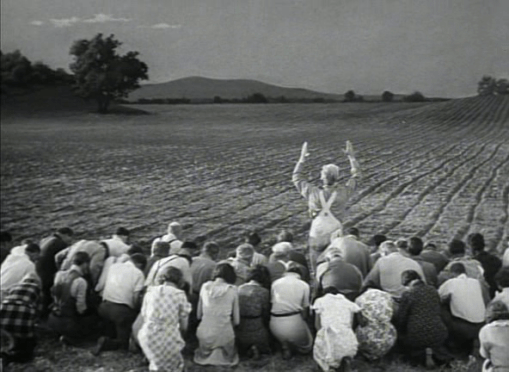
French filmmaker Jean Renoir, son of Impressionist painter Pierre-Auguste Renoir, moved to Hollywood following the German occupation of France in 1940. The Southerner, the third of the five films Renoir made in America, tells the story of the Tucker family, plantation workers who decide to grow their own cotton as tenant farmers on a piece of leased land. It turns out that, though fertile, the stretch of land they get requires a great deal of work. Worse, when they move in, the Tucker family finds that the ramshackle house on the land is barely inhabitable. But they decide to persist against the odds: the immense physical labour required of them, the ill-will of their neighbouring farmer Devers (J. Carrol Naish), the spring fever that affects their child and, most of all, the forces of nature. Structured over four seasons of a year, The Southerner stars Zachary Scott and Betty Field as Sam and Nona Tucker.

Adapted from by George Sessions Perry’s novel Hold Autumn in Your Hand, The Southerner is reminiscent of certain Depression-era films. The Tucker’s overloaded jalopy has echoes of the Joads’ vehicle from The Grapes of Wrath. The sharecropper backdrop, the Tuckers’ rickety home and their struggle with the land recalls King Vidor’s Our Daily Bread. But Renoir’s interest is neither social nor political. As a man from the Old World, he’s captivated by the unmistakably American subject of the story. Early in the film, Sam’s dying uncle asks him to grow his own crops instead of working as a farmhand. This characteristic American notion of being able to chart one’s own path, no matter one’s station in life, is at the focal point of Renoir’s film.

Renoir, whose final production before he left France was the classic haute bourgeoisie portrait The Rules of the Game, is manifestly fascinated by the self-sufficient, austere quality of this life close to nature. Throughout The Southerner is a dialogue between Renoir’s European sophistication and the New World pragmaticism of the Tuckers. This remove between the filmmaker and his subject is made evident by a scene that doesn’t exactly work: a boisterous wedding party in which the revellers take turns downing alcohol and knocking each other down. The simplicity and vulgarity of the celebration, in Renoir’s handling, seems too theoretical, too studied in comparison to similar scenes by, say, John Ford or Howard Hawks.

On the other hand, the filmmaker’s French sensibility affords him a distance that allows him to trace out a meta-narrative of America from the story. He emphasizes the Tuckers setting up a home in what is practically wilderness: shots of Sam securing the porch, Nona lighting up the stove, the chimney smoking for the first time, all acquire a symbolic weight that harks back to the pioneer settlers of the continent.

At the same time, there’s a timelessness to The Southerner that makes it more than a film about America and takes it closer to the story of mankind itself. To be sure, the setting is Texas during the first half of the 20th century and there’s a passing reference to the ongoing war. But, unlike the strongly contemporary and Californian Our Daily Bread, very little in The Southerner ties it to a particular place and time. In a microcosmic reflection of civilization, the Tuckers move from fishing and hunting to agriculture for their sustenance over the course of four seasons. This lack of particularity was taken to task by the critic James Agee, who found the depiction of Southern life in the film inauthentic.

However, for Renoir, this is an existence in constant tussle with nature, alternately established against its forces and lived at its mercy. He locates a streak of violence in the life of the Tuckers. The scene in which Sam smokes out a possum from the hollow of a tree and then shoots it down carries a touch of environmental dread redolent of Robert Flaherty. When Sam brings the animal home for supper, Nona says “Reckon we can eat now, folks”, sharpening her knife in a rather disturbing gesture. The Tuckers transform the land through their hard labour into a flourishing plantation, but nature has its own plans, sending down an off-season rain to destroy the crops.

There’s little space for culture in this tug-of-war between man and nature. Save for a couple of photos and a picture calendar, the Tuckers have no contact with culture. In a rather nasty barroom fight, the participants destroy rudimentary signs of culture—a jukebox, the sculpture of a woman—while, a bit later, Sam finds himself in knee-deep rainwater wearing a tuxedo. Much of the poetry of The Southerner derives from the idea that domesticity and culture need to be wrested out of a fundamentally hostile universe. The film’s final passage presents vignettes of this cosmic battle: cows and chicken stranded in the rainwater, ripe cotton flowers drowned, the Tucker’s home wrecked once more.

In this warlike scheme of things, men and women are expected to assume their conventional roles. The drive of the menfolk is also what blinds them towards more pressing realities: in his dogged determination to make something of the land, Sam rejects taking up a job at the town factory, which could save his ailing son right away. Devers the neighbour cuts the rope of his well to spite Sam even at the cost of having no water for himself. The womenfolk, on the other hand, are icons of care and consideration. Devers’ daughter secretly secures a pail of milk for Sam’s son against her father’s wishes. When Sam decides to give up farming after the floods, it’s the silent courage and optimism of Sam’s granny (Beulah Bondi) and Nona that encourage him to change his mind.

There is courage and optimism, but there are no heroes or villains in The Southerner. Renoir being Renoir, everyone in the film has their own reasons. Granny Tucker is a caricature of a nagging old woman, but the film lets you see her bitterness as the product of a long, bitter life marked by loss and grief. Devers’ resentment towards Sam’s success doesn’t come across as jealousy as much as an anxiety about the limited resources of the region and about his own failed life. Unlike the typical Hollywood villain, Devers incites pity, not anger. In an exchange about farming and factory work, Sam’s friend Tim (Charles Kemper), whose character and physicality both resemble Jean Renoir, tells Sam that “it takes all kinds to make up the world”, a cogent summation of the French filmmaker’s worldview.

As is expected of a Renoir film, The Southerner is alluring in its visual beauty: deep space compositions in natural locales, tracking shots through cotton fields and floodwaters, gentle pan shots inside the Tucker household, a measured editing rhythm, intimate two shots with Sam and Nona, Vidor-like framing of the horizon and a painterly shot design with foreground elements acting as repoussoir. But if there’s one element that most characterizes The Southerner as a Renoir work, it’s the harsh, realistic outlook that pervades the narrative. In contrast to the Hollywood tradition, no triumphalism marks the Tucker story. There are no miracles here that turn Sam’s farming enterprise into an immediate success. Renoir recognizes the impossible odds and appeals for a stoicism in face of these failures. Their farm washed out, the Tuckers get back to fixing their house. The stove burns once more, there’s coffee for now, the fields need to be ploughed and the seeds planted again. C’est la vie.


[Originally published at Firstpost]
[From my column on studio-era Hollywood films for Firstpost]

Ernst Lubitsch was a German immigrant to Hollywood who made some of the most memorable works of its Golden Era. His suave, sexy romantic comedies brought a touch of European elegance to Hollywood and helped found a genre that thrives till date. His sophisticated sense of screen comedy, characterized by subtle, effortless and precise exposition and seamless technique, has influenced comedic filmmakers ever since, not the least of all Billy Wilder, who was a screenwriter on two of his films. Lubitsch worked for almost all the major companies in Hollywood, but his finest achievement was a picture made outside of these studios. To Be or Not to Be (1942) was produced by Romaine, a house set up by Alexander Korda, and distributed by United Artists. Arguably the greatest Hollywood comedy of the sound era, To Be or Not to Be is a daring, intellectually provocative work that stands testament to the power of life-sustaining humour in face of unspeakable horror.

Days before Hitler’s invasion of Poland in 1939, a Jewish troupe in Warsaw tries to put up a play about the Nazis. There’s a disagreement between the actors and the director on whether it should be a comedy or a serious, realistic drama—a split equally applicable to Lubitsch’s film, which bandies the viewer between two approaches to the subject matter. After the Nazis take over, the troupe is forced to shelf the play and continue performing Hamlet. The early stretch of the film centres on a comic romantic triangle involving the troupe’s lead actor, Joseph Tura (Jack Benny), his wife and actress Maria Tura (Carole Lombard, in her last screen role) and an admirer of Maria’s, the war pilot Sobinski (Robert Stack). Warsaw is soon bombed by the Luftwaffe and the film turns into a tense espionage drama. Sobinski flees to England, and becomes part of the Polish division of the Royal Air Force.

The RAF division is infiltrated by Professor Siletsky (Stanley Ridges), a Nazi spy who gathers information about Polish underground resistance fighters. By the time, Sobinski discovers this, the professor is already on his way to the Gestapo office in Warsaw. Sobinski sets out to Poland to stop the professor, but is forced to go underground in Warsaw after the Nazis spot him. He enlists the help of the theatre troupe to mislead the professor, take the documents from him and kill him if need be. This puts the film back on the comedic track, with ingenious scenes of disguise, deceit and subterfuge to follow. Jura first masquerades as the Gestapo commander to get the professor’s files, but he blows his own cover in a fit of jealousy over the professor’s comments about Maria. He then masquerades as the professor to meet the real Gestapo commander Col. Ehrhardt (Sig Ruman), who soon discovers that the real professor is dead. Their mission accomplished, the entire troupe orchestrates an escape plan in which they fly out of Poland in Hitler’s own plane.

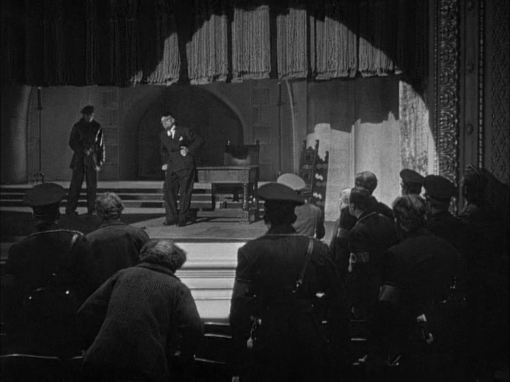
All through Lubitsch’s film is an osmosis between reality and artifice. In the film’s first scene, a street corner in Warsaw (itself recreated on a studio lot) is visited by Hitler behind whom a shop window closes like theatrical curtain. A while later, it’s revealed that this Führer was simply one of the troupe’s actors in disguise. A Gestapo interrogation scene turns out to be a scene from a play, while the bombing of Warsaw is described as a “show” put up by the Nazis “without a censor to stop them”. As the play is interrupted by real world events, the troupe finds itself converting real world into a play, transforming the theatre into a fake Gestapo office, scripting plot lines to fool the real Gestapo, writing new roles on the fly, and rehearsing their great escape. Running away from the spotlight, the professor dies on stage in a dramatic fashion. Lubitsch’s film, in which Americans masquerade as Europeans, is a battle of appearances, where Jewish actors masquerading as Nazis try to outwit a Nazi masquerading as a Jew.

This interplay between theatre and politics has an intellectual coefficient. “The logical result of Fascism is the introduction of aesthetics into political life”, wrote Walter Benjamin, and “all efforts to render politics aesthetic culminate in one thing: war.” The Nazi ideology, with its supremacist racial theories, its cult of beauty, its romanticisation of destruction and its eugenic researches, was at its heart aesthetic. It’s significant that To Be or Not to Be climaxes in a theatre where the Nazi top brass attends a play while the troupe attempts to sabotage it by mounting a little theatre outside the theatre (a scene that’s the direct precursor to Quentin Tarantino’s Inglorious Basterds (2009)). Shakespeare serves as a thematic backdrop to the film, embodying the noblest impulses of mankind in contrast to the fascist project. Hamlet’s eponymous monologue becomes an existential question for the Jewish actors, the answer to which lies in the “Hath not a Jew eyes?” monologue from The Merchant of Venice they use in one of their “skits”.

None of this, however, takes away from how funny the film is. “The Lubitsch touch” is a quality often attributed to the filmmaker. While there’s no set definition to the term, it variously refers to Lubitsch’s economic approach to storytelling (the several narrative ellipses that force the audience to deduce elided plot details), his manner of multiplying the effect of a joke (repetitions within scenes and across the film, with the punchline generally arriving much later than expected and with greater comedic force), his direction of secondary actors that elevates them to show-stealers (Sig Ruman’s caricatural, fawning Ehrhardt with his doubled dialogue and reversals of fortune) and his characteristic construction of a gag (the viewer notices the dead body of the professor at the Gestapo office before Tura does).

Lubitsch employs a whole array of comedic devices here: wordplay (“a laugh is nothing to be sneezed at”, says an actor defending a joke), wit (“what you are I wouldn’t eat” says a Jewish colleague to a ham actor), slapstick (king Hamlet’s crown knocking against a lamp), visual gag (the tracking shot of Sobinski leaving just as Tura starts his monologue), tonal incongruity (the sight of Hamlet ordering salami and cheese sandwich on phone) and situational comedy (the long shot of Tura discovering Sobinski in his bed). In a quintessential Lubitsch gag towards the end, we see an actor dressed as Hitler enter the house where Ehrhardt is forcing himself on Maria. We see Hitler entering before Ehrhardt does, and the pan shot of them discovering each other, petrified, is the comedic equivalent of Hitchcock’s theory on suspense.

Of course, the elephant in the room is the question whether one can make jokes on a subject as serious as Nazism, even if the full horror of the Holocaust wasn’t yet known. It was an objection made during and after the making of the film too: scriptwriter Samuel Raphaelson and music composer Miklós Rózsa quit the project, and certain critics excoriated the film on moral grounds, so much so that Lubitsch had to defend himself in the New York Times. History, however, has been kind to Lubitsch’s film. Like Chaplin’s The Great Dictator two years before it, it believes in comedy as a force of resistance. The very idea that a Jewish troupe rises above its differences to stand against fascism with humour, grace and intelligence, just like considerably Jewish crew of Lubitsch’s film, rests its case as a comedy. In Lubitsch’s own words: “What is the only picture that is still remembered from the last war? It’s not Griffith’s Hearts of the World, or any of the sad ones. It’s Chaplin’s Shoulder Arms.”


[Originally published at Firstpost]

[From my column on studio-era Hollywood films for Firstpost]

The period between the introduction of talking pictures in the late 1920s and the imposition of the censorship codes in 1934 is now known as the pre-Code era of Hollywood. Pre-Code films are characterized by a permissiveness in their depiction of sex and violence, but also by their subversive outlook towards several social issues. Made towards the end of this period, the Warner production Gold Diggers of 1933, directed by Mervyn LeRoy, is a racy backstage musical rife with the kind of elements that the Hays censor office will veto in the following years: women in underwear and skimpy stage costumes, or as sexy silhouettes changing clothes, their bums slapped my men, dialogue with double entendre and a scenario that’s gleefully amoral. But it’s also a story about four independent women who are more worried about work and money than their romantic relationships with men. In its own way, Gold Diggers embodies a strain of Hollywood’s response to the Great Depression during which it was made.

The film opens with a peppy number called “We’re in the money”, in which women wearing costumes made of fake coins belt out a cheerful denial of the economic crisis: “Ol’ Man Depression, you are through, you done us wrong! We never see a headline ’bout a bread line today.” Reality soon hits back as the police barge into the rehearsal and confiscate every little prop in exchange for outstanding loans. The show is closed even before it opens and the four leading ladies of the film—Polly (Ruby Keeler), Carol (Joan Blondell), Trixie (Aline MacMahon) and Fay (Ginger Rogers)—find themselves out of a job and penniless. The upbeat music sequence gives way to an overhead shot of three of them sharing a bed. Trixie steals a bottle of milk for breakfast as Polly swoons to a song their neighbour Brad (Dick Powell), a struggling pianist, croons. Romance is one of the things that Gold Diggers will furnish an antidote to financial problems.

To their pleasant surprise, the women learn that their old producer, Barney Hopkins (Ned Sparks), is putting up a new show and willing to cast them in it. The cigar-chewing Hopkins says that it’ll be a show about the Depression, that the girls will all have meaty roles and that even Brad, whose tunes he loves, will work as the music composer. Only problem: there’s no money for the show. Conveniently enough, Brad secretly happens to be a Boston Brahmin, heir to a New England banking empire. He sponsors the show, which causes suspicion among the actresses that he’s mixed up in a crime syndicate. Lawrence (Warren William), Brad’s uptight brother, is against Brad getting into show business and marrying Polly. He tries to buy Polly away, but ends up mistaking Carol for Polly. This prompts Carol and Trixie to take Lawrence and his lawyer for a ride, have them pay for their indulgences and even make them fall in love with them.

For a film that was made at a time when the wider public was wary of bankers and fat cats in general, Gold Diggers shows no resentment against the institutional power that Brad stands for. All anxiety about the Depression dissolves into a lukewarm comedy involving bumbling billionaires, shrewd showgirls and a cloying true romance. The film confirms Lawrence’s perception of showgirls as gold diggers all the way till the end, when their machinations are justified by profession of love. For the girls, on the other hand, the rich men represent a ticket out of the poverty permeating their lives. Like Hopkins’ show, Gold Diggers monetizes the Great Depression, but it offers hope and cheerfulness as the guiding response to economic problems. Like other contemporary backstage musicals, Gold Diggers is about people in need helping each other out. In its narrative of creative folks coming together to produce something beautiful amidst gloom and hardship, the films functions as an expression of the optimism that characterized the New Deal era.

The narrative, though, is little more than an excuse for Gold Diggers to chain together its main draws: the four musical sequences directed by legendary choreographer Busby Berkeley. Trained as a military choreographer, Berkeley had an unmistakeable style that directly or indirectly influenced scores of choreographer-filmmakers across the world, including Sanjay Leela Bhansali, Ashutosh Gowariker and Prabhu Deva. His orchestra of human bodies often involves an army of young men and women marshalled into striking geometric or organic patterns, supported by disproportionate, flamboyant props and stage design. Individual performers in these pieces are subsumed into a larger scheme made of repeating motifs, captured by a gliding, craning camera, which regularly pulls back or hovers above to record these formations.

The opening number, “We’re in the Money”, employs the dollar coin as a theme for costumes as well as décor. At one point, the girls on stage stand in an arc and execute a perfect Mexican wave with the coin-shaped placard they carry. The next set-piece, “Pettin’ in the Park”, occurs in the middle of the film and showcases a parade of couples romancing in various settings. The visual thrill stems from the repetition of similar-looking couples engaged in the same activity in sync. Even more characteristic is the third number, “The Shadow Waltz”, a breezy love song where a chorus of women, spruced up in petal-like dresses, plays violins bordered by neon lights. The stage lights go off at one point, and all we see are the neon violins, which in turn come together to form a larger neon violin. The sequence is a total work of art in which the sinuous music, lighting, costume, actor and camera movement all follow the central floral theme.

It is, however, the final musical number that the entire film builds up to. “Remember My Forgotten Man” is one of the high points of Golden-era Hollywood. The six-minute-long sequence depicts the plight of war veterans reduced to picking up cigarette butts, sleeping on street corners and standing in breadlines. Guided by Carol’s anguished lament for the “forgotten man”, the number brings into perfect fusion Berkeley’s penchant for repetition and political ideas of the time: a parade of hardy faces of lonely women waiting, followed by a scene of soldiers marching as a platoon which gives way to the same set of anonymous men standing in food queues, passing a single cigarette between them and pulling their coats in the cold—all set to a haunting, rhythmic, dirge-like musical score.

The musical sequences in Gold Diggers are presented as on-stage numbers, but it’s plain that they could’ve been conceived only for a film audience. The volume of actors, the scale of the stage, the spatial relations between people and the attention to minute performance details are unreal for a stage musical. Berkeley’s baroque stylization of the sequences is in contrast with the muscular aesthetic of the rest of the film. The narrative passages are kinetic and derive their nervous energy less from camera movement and editing than from frenzied actor movement and snappy dialogue delivery in which one line almost overlaps with another. There’s a two-minute-long shot with Warren William and Joan Blondell in which they fight and profess love, while a framed cheque hangs between them on a wall. Above all, it’s the four lead actresses who lend Gold Diggers its enduring vitality and charm.


[Originally published at Firstpost]

[From my column on studio-era Hollywood films for Firstpost]

Fritz Lang’s Cloak and Dagger (1946) was made at a peculiar historical moment in 20th century American history. The Second World War had just ended and with it the rivalry with Germany. But the Cold War, marked by red scare and communist witch-hunts, hadn’t yet begun. The effect of this unusually peaceful period, nevertheless characterized by an exhaustion with the long war and an anxiety about the nuclear future, is palpable both in the circumstances of the film’s production as well as its narrative. In its own way, Cloak and Dagger attests to the passing of the baton from Hollywood’s left wing, in the ascendant since the Great Depression, to the conservatives, who will dominate the industry in the subsequent decade.

Made by Warner Brothers, the film is set just before the end of the war and opens in southern France with one of its many wordless sequences: a reconnaissance mission involving freight trains, a liaison with an Allied informant at the back of a bar, a double-crossing leading to a double murder. Back at the Office of Strategic Services (OSS) in Washington D.C., we learn that Germany is amassing raw material for the development of an atomic bomb and that the OSS needs a scientist in their ranks to sabotage this development. So they solicit Professor Alvah Jesper (Gary Cooper), a physicist at “Midwestern University” working on the Manhattan project.

It’s a rather odd casting choice whose oddity is revealing too. As he’s written, Jesper is a nuclear scientist who speaks German, which suggests that his character was imagined as an immigrant (like Lang himself). Casting Cooper—and not someone like, say, Edward Robinson, the star of Lang’s previous two films—transposes a flavour of American exceptionalism over the anxious scientist character. But Jesper remains a man of science only for his first scene, in which Cooper, in suit, fixes a lab equipment, flexes his fingers and plays with an apple as he converses with the OSS emissary sent to persuade him. Convinced of the importance of using science only for humanity’s good, Jesper is reluctant at first, but joins the mission nevertheless when he thinks of the horror of a German nuclear weapon. Once recruited, Jesper becomes a full-time spy—a character that fits Cooper like a glove, even when he’s speaking German with an American accent.

Right away, Jesper flies to Switzerland to gather more information from Dr. Lodor (Helen Thimig), a German scientist who has just fled the Nazis. At the end of a series of twists, Jesper finds himself en route to Italy to meet with Lodor’s colleague Polda (Vladimir Sokoloff). After his illegal crossing into Italy via a lake—another tense, wordless sequence—he meets Gina (Lilli Palmer, also a German immigrant to Hollywood), an Italian resistance fighter who will help him contact Polda and lie low until an escape is planned. His first sight of her is when Gina removes her dark raincoat and hat in the cargo truck, her sexy white dress and blonde hair illuminating the dark interior of the truck. It’s a tender introduction that sets the tone for the film’s first major transition: following a long meeting with Polda, which slows down the narrative tempo and prepares us for the second movement of the film, Jesper is asked by his peers to simply hole up with Gina for a week.

This is where Cloak and Dagger turns into a full-scale romance, as its guiding perspective shifts from Jesper to Gina. The focus of their first night together moves from their mutual seduction, mediated by a hungry cat, to the scars from Gina’s past. We learn that Gina was a hopeful musician in love until the war forced her into an untrusting, broken girl who kisses without feeling. As they flee from her flat—now no more a safe space—to an abandoned circus to a lavish apartment and finally to the ruins, the film enacts a narrative of tortured domesticity, emphasizing the feeling of never being able to settled down. Their journey through these symbols of purity and homeliness becomes a reminder of what the war has damaged, perhaps irreparably. Even so, this time together with Jesper is a moment of respite for Gina, who finally dresses up in a nostalgia for life before the war.

While the transition to sentimentalism can seem jarring for viewers used to tight film noir narratives of the era, Cloak and Dagger deems it important and just to give Gina this passage of peace and warmth before the spy film resumes with all its violence and mayhem. For Lang’s film is first and foremost a fable about the loss of innocence—a theme that preoccupied the filmmaker throughout his working life. In 1945, the year before the film’s production, the Nazi concentration camps were discovered, shaking western civilization’s deep-rooted faith in progress. It was also the year atomic bombs were dropped in Hiroshima and Nagasaki, catapulting humanity into an age of fear and uncertainty.

One of the first Hollywood films to deal with the moral and existential repercussions of the nuclear era, Cloak and Dagger evokes the disillusionment of a civilization with the stories it has been telling about itself. The film was written by Albert Maltz and Ring Lardner Jr., screenwriters blacklisted in 1947 as part of Hollywood’s anti-communist drive, and Jesper’s opening speech spells out their pacifist dispositions. In an interview years later with Peter Bogdanovich, Lang revealed that the film’s original ending had Jesper discover an abandoned concentration camp with several thousand deceased inmates who had been forced to work on the bomb. This conclusion, with its suggestion that the real danger had only begun, was too strong for producer Milton Sperling, who instead ended the film triumphantly with Jesper returning to America with Polda.

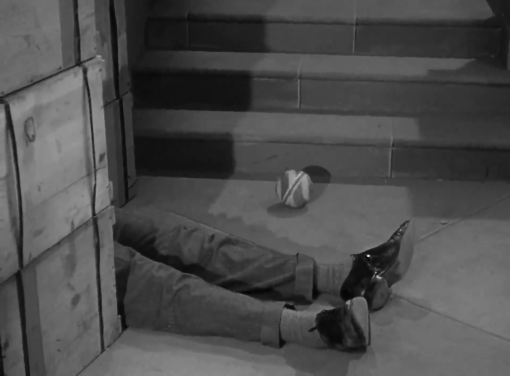
Jesper, too, experiences this loss of innocence in a stylized-yet-austere scene set in an apartment foyer, where he’s forced to fight a henchman tailing Polda. It’s an unsettling, very physical sequence of hand-to-hand combat in which the henchman digs his nails into his rival’s eyes while Jesper, with Gina’s help, strangles the man to death. That this peace-loving scientist of lofty ideals could suffocate a man with his bare hands is the kind of dark irony Lang was adept at driving home. A master of mixing tonalities, Lang amplifies the brutality of the sequence by cutting it with sweet accordion music playing in the streets. As the dead man lies on the floor, a ball comes bouncing towards him from the staircase—a quintessential Lang image of corrupted innocence that harks back to his German-language masterpiece M (1931).

Cloak and Dagger might also be regarded as one of the first examples of the Euro thriller—a sub-genre of Hollywood thrillers whose action takes place in attractive European locations and which is predicated on the prerogative of the American hero to go wherever he wants without hindrance. The challenges of the film’s plot are rather conveniently resolved by Jesper, who wanders around Switzerland and Italy without much trouble. The Italian streets splattered with Mussolini propaganda are, of course, shot in Hollywood studios, whose artificiality sticks out all the more considering Rossellini made the neorealist epic Paisan the same year. Realism of appearance, however, is not the primary concern here. Cloak and Dagger puts its finger on a paranoia that will come to define a decade, attaining its full proportions when the Soviet Union performs its first nuclear weapon test in 1949.


[Originally published at Firstpost]

[From my column on studio-era Hollywood films for Firstpost]

German-born Douglas Sirk moved to Hollywood in 1937 and made a name for himself as the maker of “women’s pictures”, melodramas with ill-fated romances and tragic characters. The term melodrama, originally referring to any drama set to music, carries a negative connotation in common parlance, but Sirk’s films infused the form with a critical consciousness that commented on the stories even as it presented them. In his supreme accomplishment, All that Heaven Allows (1955), Sirk uses the trope of forbidden love to mount a heartrending critique of what he takes to be a contemporary American malaise. The film begins with the shot of a church steeple, that symbol of small-time community. The camera descends from its clockface striking noon, glides over red leaves of autumnal trees and scans the identical-looking houses of a nondescript suburb in New England. Perfectly manicured lawns, mothers on sidewalks with their prams and the odd automobile: images of middle-class virtue that David Lynch will parody in Blue Velvet (1986). The camera stops at a randomly selected house where the story begins.

Cary Scott (Jane Wyman) is a widow of about forty resigned to her staid bourgeois existence of respectable motherhood and occasional cocktail parties. There are men in the local country club who make her proposals, decent and otherwise, but the choices she is allowed to have are hardly inspiring: to be the secret mistress of a man who sees her as an object of desire or to be the wife of an old, kind gent who may be in love with her. Her heart, however, has its own way, and she ends up falling in love with her hunky gardener, Ron (Rock Hudson), several years younger than her. Eating with his hand, his collars turned up and shirt unbuttoned, the tanned, subaltern Ron is everything Cary isn’t. Having rejected the rat race, he lives in a glasshouse in the woods, embodying the self-sufficient life Thoreau described in Walden. Ron is presented as a temperamental figure with dubious, even threatening motivations, and so we share Cary’s doubts about him even as we recognize the attraction he exerts.

The affair scandalizes her grown-up children, who expect Cary to “act her age”, and her community, where she soon becomes the object of vile gossip. The film makes it clear that it’s not so much the class difference as the difference in age between Cary and Ron that sends the townsfolk into a tizzy. That an older woman, practically middle-aged, could desire and be desirable to a young, attractive man is an affront to the puritan mores of the community, to whose order sexuality is a threat. Admiring herself in front of a mirror, Cary’s nerdy daughter, a Freud-loving psychology student, says that “sex becomes incongruous” after a certain age, clearly disapproving of her mother dating anyone younger. A moment later, looking at the red dress Cary has worn, her son asks her if it isn’t too revealing. He’ll later accuse her of seeing Ron as a “pile of muscles”. One obnoxious acquaintance at the country club party that evening insinuates that Cary is out of her line for wanting to wear an appealing red dress.

Sirk and screenwriter Peg Senwick caricature the country club as a nosy, disingenuous, gossip-mongering and casually spiteful group. When Cary brings Ron to the club for the first time, in order for him to be accepted by the town, the club members treat him like an alien species and call him names: “nature boy”, “earthy type”. This exoticism, of course, derives from the perceived sexual promiscuity of coloured folk—a subtext that German filmmaker (and Sirk’s protégé) Rainer Fassbinder will make explicit in his remake of the film, Ali: Fear Eats the Soul (1974)¸ in which the tanned Ron is replaced by a black man, an immigrant and Muslim to boot. On the other hand, the gathering of friends in the woods that Ron takes Cary to is a natural community, spontaneous in their joy and genuine in their affection. The first-name based intimacy of this group, consisting of rugged immigrants and other lively underclass specimen, is in direct opposition to the suffocative banality of the small talk at the country club, with its stiff formality and fake decency.

The two contrasting communities are an opportunity for Sirk—better placed as an outsider to do so—to bring two specific visions of America in dialectical opposition. Ron and his friends are spiritual inheritors of the 19th century transcendentalist movement, which advocated a life of solitude and self-sufficiency in harmony with nature, away from the corrupting influence of civilization. Cary and her town are, on the contrary, contemporary products of 20th century America. Sirk’s film was made during what is known as the Boomer era, a period of American post-war prosperity, accelerated consumerism and cultural conservatism. One of the defining phenomena of the period was the “white flight”: a large-scale migration of white people from the mixed-race urban zones to newly-developed suburban settlements. The war now over, once-employed women found themselves at home and away from entertainment options in the city, leading to an exponential increase in the sale of television sets across the country. When her son gifts her a television set as a cure to her loneliness, Cary is filmed as a reflection on the television screen, trapped by it.

Douglas Sirk was a true intellectual, perhaps the only one in Hollywood. As a youngster in Hamburg, he studied under art historian Erwin Panofsky, attended Einstein’s lectures on relativity and translated Shakespeare’s sonnets into German. He was an active theatre director working on both classics, in which he was well-versed, as well as contemporary plays such as his by peer Bertolt Brecht. In Hollywood, a land averse to intellectuals, he took on one of the most derided genres, melodrama, transforming overwrought material into clear-eyed modernist works. He managed to let his mise en scène, the ensemble of a film’s plastic elements, always convey more meaning than what the script allows for. His handling of Technicolor, in particular, was exemplary.

In All That Heaven Allows, he heightens the tints at Cary’s home, saturating the light with primary colours and producing dramatic shadows. He contrasts this artificiality of Cary’s milieu with the natural, earthy tones of Ron and his surroundings. Likewise, Cary is often photographed as though she’s imprisoned by her décor: furniture, window grills and their shadows. Her house, a veritable mausoleum in memory of her dead husband, is full of objects against which she is filmed in tight shots. In contrast, Ron’s mill-turned-home is warm-looking and sparsely furnished. Ron’s house and the surrounding nature are photographed in wide shots full of breathing space. Sirk was, in fact, influenced by Brecht’s theory of the theatre, which postulated that the audience must always be kept at a dispassionate distance from the spectacle so that they reflect on the story critically rather than get immersed in it. Sirk’s use of colour and composition was frequently directed to this end.

That, however, does not vitiate the emotional impact that All That Heaven Allows creates. It’s a highly moving work about the anxiety of having to live up to societal standards and the programmed fear of rejecting of them. Sirk, too, has no fear of the excesses the material presents. If the film has endured despite the sometimes clumsy and verbose script (inspiring no less than two remakes, great works in their own right), it is wholly thanks to Sirk’s treatment, which elevates it to another artistic plane.


[Originally published at Firstpost]


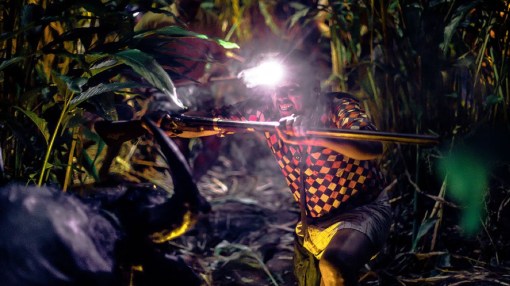
Jallikattu, the South Indian bull-taming sport, both lends its name to and serves as a metaphor for Lijo Jose Pellissery’s new film, which premiered in Toronto last month. Like the sport, which is not just an opportunity for young men to showcase their bravery and machismo, but also a yearly excuse for dominant castes to flag their importance, Jallikattu is about an animal that becomes a pretext for men to give expression to their aggression, resentment and anxiety. The film opens with a volley of shots lasting one second each—a metronomic editing pattern that will recur several times throughout the film—of yellow-lit faces opening their eyes to the dawn of a new day. Scored to the sound of percussions interspersed with vaguely primal choral utterings, the sequence weaves in shots of ants and worms in movement, in effect situating humans and nature on the same order of things. This rate of 60 shots per minute already puts us on our toes, but the intensity will unwaveringly increase without breather or detour until the nightmarish, all-consuming climax.

This mosaic-like scheme carries over to the first post-credits sequence as well. In a series of extremely brief shots cut to a monotonic rhythm, we see the routine of a tiny town in Kerala on a Sunday morning: a buffalo slaughtered before sunup, the meat sold to thronging crowds and delivered home by Antony (Antony Varghese), a mass at the church, an instance of domestic violence, another of uninvited romantic advance. There is some dialogue, but no central narrative movement except for the general description of the community with a few simmering tensions. It’s only when the film comes out of this pulsating rhythm that the narrative is set in motion. One particularly recalcitrant buffalo escapes slaughter and goes rogue, prompting men from the village and its surroundings to go after it. That’s it. The entire film is the increasingly violent hunt for the animal and its ugly repercussions.

The animal is presented at first as a force of proto-political anarchy that doesn’t see human constructs like fences, religion, private property and political parties. In a parody of communist revolution, it destroys plantations, shuts down businesses and galvanizes the villagers into a collective united in purpose. In a film without guiding perspectives or characters in the conventional sense, the buffalo serves as the absent centre that centripetally holds the separate points of view, presented here as fleeting vignettes. The existential reaction of an animal trying to evade death—a revolt of the Other, in the film’s cosmic view of things—binds the community in a common fear of the Other. But the buffalo turns out to be simply a catalyst that triggers the unstoppable combustion of the village. Long-repressed resentments, sexual jealousy and communal fault lines emerge, which find a violent expression in the course of the hunt.

As the animal flees from the deserted streets of the town into the jungle, the community too splinters into unruly mobs and regresses from civilization (like in Yojimbo, the gun-toting hunter proves to be less effective than the one with the machete). Like the animal, they stop respecting private property and enter other people’s houses. They catch an adulterer and humiliate him. Civility, law and order breaks down and the hunters—all men without exception—torch police vehicles and beat a cop up. Antony enters the house of the woman he desires and forces himself on her. Like in the Jallikattu sport, mob courage masks individual cowardliness, which resurfaces every time the animal charges at the men to disperse them into individuals. By now wandering the jungle harmless, the animal nevertheless becomes an issue of collective and individual male egos, leading to a bloody dogfight between Antony and his sexual rival, who charge at each other like raging bulls.

Progressively removed from naturalism and a sense of reality, the film escapes into pure abstraction after Antony stabs his opponent and runs out of the woods into a meadow. The discrete mobs meld into a fascist collective to pursue Antony. In the oneiric, painterly, Lars von Trier-like end sequence, an inexhaustible mass of possessed men jumps on Antony, continuously piling on top of him until they make up a single mountain of men, the formation covered in sludge, with Antony trying in vain to emerge out of it as an individual. In a brief, possibly redundant coda, the scene shifts to a cave where bare-chested men fight with torches over the carcass of a dead animal. If it’s startling enough to see a supremely tight, 90-minute film getting a mainstream distribution, the stylized final passage of the film—beyond the question of its merit—is a veritable miracle to have graced the screens.

The simplified, whirlwind tour of social ideologies that Jallikattu drives us through—capitalism, communism, anarchism, fascism, what have you—may not be for everyone’s liking, but it shouldn’t be the case with Pellissery’s exceptional sense of image making. Composing in deep space with direct sound, he has precise visual ideas for the film, which progresses from full field of daylight to reduced visibility of the night lit by flashlights and torches. The progression also corresponds to a shift from slender tracking shots through the village streets, relaying perspective from one character to another, to shots handling increasing amounts of humans in frenetic motion. The latter half of the film, with barely-lit animal and human bodies hurtling across the frame at high speed, push the image into the edge of perceptibility where, like in a Willem de Kooning painting, we notice the essential elements of form, but not the exact details. The sound mix, consisting of human cacophony in escalation, is equally a work of sonic abstract expressionism.

Pellissery hardly uses a closeup in the hunt, wide shots of men scouring the landscape being the norm. Characters insult one another, but there’s never a tight shot to capture reaction. Images of hundreds of men bearing torches descending the slope have a pointillist decorativeness. But for the most part, the emphasis is on depth of the frame. A large part of the movement in Jallikattu takes place along the Z-axis. Like Gus Van Sant’s Elephant, Pellissery’s fractured narrative uses a video game aesthetic where the Steadicam follows or leads character into and out of the frame—a pattern echoed in the numerous zooms in and out of tangential information on screen (a branch of a tree, insects, a sunset). These opposed movements are also characteristic of the men’s movement with respect to the animal: they rush towards it when it’s running away and fall away as it retaliates. In a mini set-piece within the larger set-piece that is the film itself, the hunters try to rescue the buffalo, now stuck in a pit, with a makeshift pulley system. Just before the animal lands on safe ground, Pellissery cuts away to secondary detail, returning only to capture the aftermath of the animal’s resumed rampage. It’s a striking example of how deliberate the film’s stylistic choices are. John Abraham invested masses of human bodies with meaning. Pellissery dissolves them in chaos.

[Possible spoilers ahead]

With his debut film, Maanagaram, writer-director Lokesh Kanagaraj staked his claim as an adept craftsman, but also showed the promise of a vision at work. In the film’s complex narrative tapestry, several outsider characters influence each other’s lives in anonymity, collectively enacting the mechanisms of the metropolis, here a visually denuded Chennai. At work was the kind of untouched idealism typical of debut works. His sophomore film, Kaithi (“prisoner”), while not without echoes of the talent that made Maanagaram, inducts the filmmaker into the commercial cynicism of the industry and assures him the passage to bigger, dumber projects.

Bejoy (Naren) heads a special unit of the police that has just seized a massive consignment of heroin. He stocks the captured cargo in the secret basement of the police commissioner’s office. A corrupt cop in the forensic department passes this information to the drug lord, who not only wants the payload back, but also the heads of the five cops who seized it. Bejoy meanwhile is at the Inspector General’s office eighty kilometres away for the IG’s big retirement bash. The drug lord manages to spike the alcohol at the gathering, causing every officer except Bejoy to collapse into a fit. Bejoy, with his fractured right hand, finds himself with forty dying officers and no one to help him transport them to the hospital. No one except Dilli (Karthi), a just-released lifer who was picked up on a whim by an officer before the party. Bejoy threatens Dilli into driving the truckload of unconscious cops to a hospital and then to the commissioner’s office, which is deserted except for Napoleon (George Maryan), a low-level cop who just reported for duty, and a group of college students retained for a petty crime.

This premise soon resolves into two discrete narrative threads that Kangaraj shuttles between, much like in his first film. In the first, Dilli and Bejoy drive in a lorry to the commissioner’s office while the drug cartel attempts to intercept the vehicle and kill the unconscious cops on it. In the second, a horde of the cartel’s henchmen tries to break into the commissioner’s office, as Napoleon and the students seal the premises. And there are minor interludes weaving in and out of these two threads: Dilli’s estranged daughter who tries to call him from an orphanage, the drug lords tracking the lorry through a mole hiding in it and the corrupt cop seeking to sniff out a police mole in the drug cartel. These five threads are connected within the film through phone calls of nearly every possible permutation, with each party informing, instructing, encouraging, each other and influencing each other’s spaces via telephone.

Like Maanagaram, Kaithi unfolds over a single night; in the first shot, the camera glides down from a clockface showing 8pm. Kanagaraj is so committed to the concept, which for him is as much a visual device, that he advances an event that should logically take place the following morning: Dilli meets his daughter, rather implausibly, right after a climactic bloodbath, in the darkness amid flashing red-blue lights of the police sirens. The camera work is similarly muscular, following characters from up close; there’s a nice, long shot of Karthi walking in his typically relaxed fashion, with the camera accompanying him as he walks from the lorry, traverses the poolside and goes to the buffet table. The visual texture, dominated by the yellow of headlights and streetlamps, is rather familiar, the dialogue is downright poor, and it’s in the delirious crosscutting that the film generates its entire thrill. Kanagaraj obviously loves to cut between sequences, so much so that he nests one parallel editing scheme within another: Napoleon’s defence manoeuvres inside the building are spliced with the students’ measures to seal entry points and the frenetic attempts of the gang trying to break in—a pattern that is itself couched within the larger, five-thread cycle.

Gripping as it is by its sheer mechanical force, does the parallel editing really work as it did so well in Maanagaram? It doesn’t, and for a number of reasons. Firstly, because the major narrative thread is dramatically flat. Dilli’s road trip with Bejoy is thwarted thrice by gangs trying to kill them. The excitement of this conflict vanishes right in the first instance, where Dilli is revealed to be a superhero capable to bringing down scores of men without trouble. Given this aspect, it is evident that the lorry will reach its destination against all odds. The fight scenes are confusingly edited to the point that we are unclear about what’s happening: a CG-shot cutting through three vehicles one behind the other sets up the peak moment of a fight, but what exactly follows is confusing in its spatial relations. A while later, the lorry is trapped on the hilltop with the henchmen surrounding the hill at the bottom (intertwined with the gang at the commissioner’s premise trying to get to the jail on top of the building). Dilli works out an escape, but again, it’s not clear what exactly he accomplishes.

Secondly, because the timelines are incompatible. Dilli’s transit takes a much longer time, especially with all the battles on way, than what Napoleon and the students have to defend the commissioner’s office. This long transit, as a result, dilutes the tight action of the second thread, which comes across as improbably protracted. Finally, because Kanagaraj diffuses the tension just as it hits a crescendo with a quiet passage: as the commissioner’s office is on the verge of recapitulation, we cut to Dilli reminiscing in a long, close-up about his past. It’s an unconvincing back story shoehorned to provide a showcase to Karthi’s acting prowess and to soften the hero. To be sure, it could’ve had no place earlier in the film, dedicated as the narrative is to cultivating a mystique to Dilli, but at this late point in the film, it stops the action dead in its tracks.

When the threads actually merge, one wishes they hadn’t. For, after Dilli reaches the commissioner’s office to save Napoleon and the students, the film devolves fully into a fascist aesthetic. Dilli uses a machine gun to take down the invading horde of drug traders (shorthand, of course, for anyone who is anti-cop, anti-law and order), who now fall like flies just like the poisoned cops of the opening passage. Shot with a borrowed seductiveness of flashing barrels and bullets falling down in slow-motion, the sequence is narratively, visually and conceptually gratuitous. It’s also cynical, as is the film’s tacked-on coda making claims for a sequel, because it gives in to a crowd-pleasing formula, pandering to a desire for violence and reserving berth for Kanagaraj’s transition to high budget moviemaking (he’s already roped in for the next Vijay vehicle).

There are, on the other hand, remnants of the imagination that made Maanagaram a success: the fairly tight narration without songs or flashbacks, drone shots of the lorry cruising the highway, the idea of a convict driving a truckload of switched-off cops, shots of the gangsters with white flashlights in the dark, a fight sequence in the commissioner’s office with papers on the floor cut to an intoxicating Ilayaraja number. The ironic beats are also present in the story elements. The police have collectively failed, corrupt or knocked out as they are after a night of revelry, and the only active cop is manipulative and virtually castrated. The brunt of their negligence falls on the innocent. The day is saved by a convict on the first day of his release and a constable before his first duty day.

Karthi, an intelligent actor who usually manages to convey a rich inner life beyond the script, is costumed like a religious man: a beard, a talisman on his ankle, holy ash on his forehead, a plain brown shirt, a lungi in which he conceals a smartphone, but also an iconic handcuff hanging from his right ankle. He eats and fights like a man possessed. After he’s finished his bucket-load of rice, he looks up and taps his thigh a couple of times before washing his hand in a pool. Karthi’s lazy gait and drawl projects a man who’s in control of the situation, but except for his two sentimental closeups, the actor doesn’t really seem committed to the role. Just look at him pretending to pour alcohol on the stab would on his back. Unlike Maanagaram, Kaithi is a closed film, satisfied with the pleasures of the genre. The plot revolves around drugs, a purely cinematic social issue of no real bearing—a choice indicative not as much as of a lack of seriousness as of the filmmaker’s sights on the big time.

The first half of Happy as Lazzaro, like Alice Rohrwacher’s previous work The Wonders, offers itself as a portrait of a community. The film opens at night time in the imaginary village of Inviolata. A group of men are serenading a young lady, but we see the scene from the point of view of the women in the balcony. There are about half a dozen of them of varying ages in the room—The Wonders prepares us to assume they are blood sisters. As the young man is asked into the house, we realize that this social ritual is a rite of passage for men and women alike. The women of the house offer drinks and snacks to the male visitors, sealing the relationship. Lit by a sole incandescent bulb, the scene is filmed like a home video and is chock-a-block with incident: grandma carried to her designated seat, a wine glass passed from hand to hand, a sleeping baby, an unexpected visit by a chicken. The specificity of these details makes it clear that they derive from Rohrwacher’s own memory, as is also evident a while later when a character from the city gives children candy after a tap on their forehead.

Inviolata, as the name suggests, is a commune untouched by time, geographically cut off as it was from the rest of the country following a flood in the seventies. There’s hardly any electricity, only a handful of light bulbs, no media and no technology save for one transport vehicle. The fifty-odd people of the village aren’t divided into families; they form a single social unit. They share accommodation and marry within themselves. Lording over them is the family of the marquise de Luna (Nicoletta Braschi), a tobacco baron who keeps Inviolata in the dark about the progress outside the commune. The villagers work as sharecroppers—a practice outlawed in Italy in the seventies—indebted to the marquise, who believes that exploitation is the way of the world. It’s not just the physical isolation of Inviolata sequestering the villagers; their fear and lack of curiosity turns them into sheep fenced in by legends and superstitions. Rohrwacher interweaves the oppression of the villagers with the barren landscape they inhabit, the juxtaposition producing metaphysical connotations about slavery.

One of the sheep in Inviolata’s womb is Lazzaro (Adriano Tardiolo), a cherub-faced, slack-armed, wide-eyed emblem of Doomed Innocence who is, in turn, exploited by the exploited villagers. Lazzaro is given the short shrift right from the first scene, where he’s the only one to get no drink and is sent out to guard the sheep while others celebrate. He is the village donkey, burdened with all chores, petty and heavy, of the villagers. Bullied by even babies, Lazzaro is at the very end of the oppression chain, abused by both the villagers and the young marquis, who manipulates him into a brotherly relationship as part of a kidnap ploy to extract money from his mother. Despite the string of disappointments that he faces, Lazzaro doesn’t show any emotion. He is, in fact, not human, floats as he does as a pure symbol amidst the physical reality of the film. At the midpoint, state authorities finally discover Inviolata and bring the villagers back to contemporary civilization. Lazzaro, as usual, is left out and remains in the deserted village for twenty years.

Part of the reason Happy as Lazzaro sustains interest is this intrusion of the fantastical into the realist tapestry of the film. In its first half, Rohrwacher’s film depicts the hardships of country life at what appears to be the turn of the nineteenth century in the vein of Olmi or Bertolucci. To be sure, there are anachronistic elements like the motor vehicles, but there’s no sense initially that the film is working against reality. We see the villagers at work, harvesting tobacco, tilling the fields and threshing hay. Their strongly Mediterranean faces, combined with the dazzling colour and light quality of 16mm film, recalls Pasolini, adding to the film’s lived-in aspect. But the magic-realist elements at the periphery—the rain of hay, Lazzaro’s catatonic spells—soon come to the fore, taking over the film once the villagers are rehabilitated. In the second half, when Antonia (a splendid Alba Rohrwacher) discovers that Lazzaro hasn’t aged a day unlike herself and the other villagers, she kneels in prayer to Lazzaro. Rohrwacher recognizes the comedy, but doesn’t undermine the piety the scene evokes. In a lovely shot coupling the profane and the sacred, she films Antonia and Lazzaro through a sheet in the back of a truck, making their profiles seem straight out of a religious painting.

Religion, as the opiate of the oppressed, is also at the crosshair of the film’s criticism: the hypocritical marquise gives Sunday classes to the folks of Inviolata, who are elated at the sight of a religious sticker. Rohrwacher’s sights, though, are on contemporary politics as well. Detailing the feudal relationship between the marquise and the villagers—and the villagers and Lazzaro—allows her to transpose these relations onto comparable power equations under capitalism. The first thing Lazzaro notices when he enters the city is a scene of immigrant workers bidding to get a fruit-picking contract. Lazzaro is the ideal worker: he doesn’t eat, sleep, shit or feel pain. Most importantly, he doesn’t question things. He is consequently at the bottom of the pyramid in either system. Despite the necessary progress it brings, modernity produces its own form of violence that one can’t put a face to. Happy as Lazzaro is a mannered but polyvalent work, with plenty of interesting details that can’t be reduced to a single idea. I look forward to Rohrwacher’s future films.

We see a man waiting at the beach, looking towards the sea. He is dressed in a purple frock coat, wields a sword and sports a tricorn. His left arm posed on the sword and his left knee bent, the man strikes a dignified pose. He’s filmed in profile, with the horizon bisecting the frame, like in a respectable oil painting. What is he waiting for? A ship to take him home perhaps. We don’t know yet, but waiting is what Argentinian filmmaker Lucrecia Martel’s fever dream Zama is about. The man, Don Diego de Zama (Daniel Giménez Cacho), is a small-time magistrate in a Spanish outpost in South America at the turn of the eighteenth century. He doesn’t have much to do in the village, except solve petty disputes between European-origin locals like himself and Indians, who have now come to terms with the new colonial order and its institutional violence. Zama longs to get back home to Argentina, where he claims to have a family. In order for that to happen, though, he needs his superior to write a letter to the Spanish throne.

Adapted from a novel by Antonio di Benedetto, Zama trains its attention on the less-explored intersection between the colonial project and sexual politics of the period. Zama is a single white man besieged by tropical malady and romantic frustration. It appears that process of his transfer back home could be expedited if he fathers a child. We learn this only later in the film, so Zama initially comes across as a loner looking to let off steam. He solicits the daughters of his landlord, a group of three white girls who turn down his advances, taking him instead to be their protector. He then warms up to the wife of the local treasury minister, Luciana (Lola Dueñas), whose mixed signals lead him down a dead end. He finally does produce a child, but with a native woman, which makes the case for his transfer weaker.

Zama is a man split between his European ancestry and his South-American birth—a fact that is brought up by Luciana and others to put him down. This anxiety of not being a “real” European translates initially in Zama into a fear of losing his racial purity. Just after the opening scene at the beach, he spies on a group of women bathing, covered in mud. At first, it’s not clear if they are white, black or native. When a black woman spots him and tries to nab him, he slaps her twice. There are also instances of the Europeans around him “going native”: a white doctor comes under the spell of a witch doctor and loses his moorings. There are legends about a ruthless European renegade, Vicuña Porto (Matheus Nachtergaele), who does unspeakable things to his captives à la Colonel Kurtz. On the other hand, as Zama’s professional situation grows bleaker, his romantic criteria become looser. He seeks only white women in the early part of the film, while his interest slowly shifts to mestizos and then to natives.

Zama details the disintegration of the pompous official of the first shot, looming large over the colonial landscape, into a hapless man at the mercy of natives. While he despairs about his transfer, which is always postponed for fickle reasons, Zama contracts the cholera spreading through the colonies. He loses his job, moves into a ramshackle hut where he’s taken care of by native women. He hallucinates, sees ghosts, his rational worldview now questioned, as was the case with the European tourist in Jan Zabeil’s The River used to be a Man. He does pull through, though, and the film jumps a couple of decades in time. Zama is now part of a mercenary outfit searching for Vicuña Porto. He’s grown a beard; his frock coat and tricorne are tarnished, but he blends better with the landscape than he did at the film’s opening. The search ends badly and concludes with Zama reduced to a shadow of his imperial self.

Martel treats this narrative obliquely, in a pronounced anti-realist style that allows for inexplicable incident to occupy the frame. As Zama and his peers are torturing a native into confessing a crime he didn’t do, the camera remains planted on the calm face of the white men. Later, when Zama is captured by a group of natives, there’s a frantic bit of editing that imparts a misleading feeling of danger. When he visits his landlord’s daughters, one of whom is raped by a subordinate who will also compete with Zama for Luciana’s attention, the ladies move about him like the Three Graces. A llama walks into the shot as Zama is discussing with his superior in his office. Martel imprisons Zama in nested frames and details of décor, and she accentuates the environmental aspects of scenes: the heat, barking dogs, buzzing insects, the clinking of distant bells that amplify Zama’s fever-induced perception of hopelessness. I’m not sure if all of Martel’s stylistic and narrative choices are successful, but there’s a sense that every shot and edit is thought over, giving Zama an artisanal quality comparable to Jauja.

[From my column on studio-era Hollywood films for Firstpost]

Our Daily Bread

In 1928, King Vidor made the silent masterpiece The Crowd for MGM. The film was about an ordinary couple, John and Mary Sims, trying to make ends meet in New York. John’s big dreams are crushed by the city and, at the end of the film, the couple reconciles itself to social insignificance and dissolves in the anonymity of mass entertainment. Vidor reprised these characters in Our Daily Bread (1934), transplanting them to the West Coast, but a lot had passed in the six intervening years. For one, America had plunged into the Great Depression, and men like John found themselves without jobs. In the first scene of Our Daily Bread, Mary (Karen Morley) wards off debtors as John (Tom Keene) returns after a fruitless day looking for jobs, his days of dreaming big far behind him. Mary’s uncle is coming home for dinner, so John trades their ukulele at the meat shop for a bony chicken. Uncle tells John that he has a vast piece of devalued land far from the city and that he’ll let him have it if he could make good use of it. A reaction shot of grateful, enthusiastic Mary and John relays to us that this is welcome news.

John and Mary move to the deserted ranch. The house there is run down, but they make do with what they have. John has no idea about farming, so he opens up the ranch to other depression-stricken, migrant workers passing along the way. A community soon forms at the site, with a host of skilled workers bartering their trade while working on the corn fields. Many of the trades are urban skills with little use on the ranch—trouser-presser, undertaker, music teacher, salesman—but the group manages to integrate everyone according to his capability. They pool in their resources, divide responsibilities and forge a veritable settlement. The settlers include Jews, immigrants and persons with criminal records, poverty being their only commonality. Vidor is evidently attracted by the notion of starting anew, of leaving the past behind, at a time when people have little left to lose. He dedicates several shots to characters sitting around a fire, signalling ideas of community and domesticity in the wilderness. He treats the moment when first corn bud sprouts with a violin-accompanied preciousness. In his first speech to these modern-day homesteaders, John invokes the early pioneers who didn’t need “jobs”, but found a way to work the land and live off it.

There’s a tepid romantic triangle woven over this narrative of communal triumph, with John getting involved with a moll called Sally (Barbara Peppers). But the affair is resolved just before the film’s climactic set piece in which the community has to dig a canal two miles long to irrigate the crops. It’s an exhilarating passage that’s a masterwork of rhythm, composition and choreography. We see men standing in rows, hunched over, digging the ditch and moving sideways in unison like clockwork (Vidor had timed their movement with a metronome). We hear their voices mixed with the sound of their footsteps and their implements. They work day and night, building canals with wood and tin sheets. Shots are composed in deep space with obstacles in the foreground making way for the advancing ditch. As the canal approaches the fields, women cheer in the background and the camera moves along with the workers. The editing quickens and framing become tighter. A violin surges on the soundtrack as the water is released, its crescendo imitating fluid movement. Men follow the flowing water, and use their bodies to stem the holes in the ditch. The violin gives way to a lofty choral passage just as the water enters the parched fields.

Vidor was a filmmaker with a strong visual sensibility—he was also a painter—and it shows even in this modest production. The film opens with a markedly diagonal shot of a staircase in an apartment complex—a diagonality that will reappear in the wipe transitions linking different scenes. This vertical urban space is contrasted later with the horizontal sprawl of the open fields, and the upward movement of the characters in the first scene with the downward movement of the water towards the viewer in the final shot. A champion of camera movement, Vidor constructs his scenes with gentle pans and tracking shots, as when the camera follows the couple into the house after they have expressed surprise at its condition. He often composes outdoor shots with the horizon near the top of the frame, and his low angles produce a sense of wonderment at nature’s bounty. A Christian Scientist, he binds men and nature in a religious aesthetic, with the farmers in the foreground facing the vast fields in the background, whose fruits they have to earn through the sweat of their brow.

Vidor was also a filmmaker with social-realist aspirations that didn’t go down well with the established studios. The Crowd dealt with the struggles of the average Joe and Jane within the alienating machinery of the city during a time of general economic prosperity. Hallelujah (1929) was a production with a mostly African-American cast intending to show Black life in the South. In an introduction to Our Daily Bread, filmed years later, Vidor explains that he proposed the idea for the film to MGM, who were encouraging but didn’t want take the risk. As a result, Vidor had to secure funding independently, mortgaging his house in the process. Produced by Vidor himself under the banner “Viking Productions” and distributed by United Artists with the help of Charlie Chaplin, Our Daily Bread was also one of the earliest films to comply to the production code of the Motion Picture Producers and Distributors of America (MPPDA), the effect of which shows in the film’s coy dialogue and sexual dynamics.

Our Daily Bread was inspired by an article in the Reader’s Digest about people returning to the land following the financial crisis. It’s also a work that resonates with the political climate of the time. President Roosevelt had initiated the economic relief measures of the New Deal the year before. In California, where Our Daily Bread was made, hundreds of cooperative communes just like in the film had formed to tackle the crisis. The story’s theme of collectivisation, its distrust of cigar-chewing banker types and, especially, its assertion of a working-class identity over racial and national identities lends it an obviously communist flavour. And Vidor reportedly modelled the ditch-digging scene on a similar sequence in Yuli Raizman’s Soviet production The Earth is Thirsty (1930). But Vidor was not a communist; he was a conservative who later joined the anti-communist group called Motion Picture Alliance for the Preservation of American Ideals. It may simply be that Vidor found the idea of a self-sufficient people building a community to be a very American notion.

Conservative studio heads such as MGM’s Louis B. Mayer and United Artists’ Joseph Schenck, however, feared that the film could provide a fillip to the campaign of Democratic candidate Upton Sinclair in the upcoming gubernatorial elections in November. Sinclair was a socialist proposing a programme to End Poverty in California (EPIC)—a radical set of collectivist measures that alarmed the studio elites. Schenck stalled the release of Our Daily Bread in California by several months. Mayer deducted a day’s pay from his employees to fund the Republican candidate. In order to denigrate Sinclair’s campaign, Mayer’s second-in-command, Irving Thalberg, commissioned fake newsreels about bums pouring into California to sponge off the state. Sinclair lost the elections.


[Originally published at Firstpost]
The sixth edition of the Urban Lens Film Festival, organised by the Indian Institute of Human Settlements, Bangalore, opened with the premiere of Lalit Vachani’s Recasting Selves. Revolving around the Centre for Research & Education for Social Transformation (CREST) in Calicut, the film is a respectful but not a celebratory description of the institute’s activities. With an aim to hone students from Dalit, Bahujan and Adivasi (DBA) background for jobs in the private sector, where there’s no affirmative action, CREST conducts five-month-long diploma courses for batches of thirty-odd students. Participants are trained in public speaking, presentation, group work, assertive body language, positive thinking and personality development. They learn the basics of corporate etiquette through engaging audiovisual support. The teachers are dedicated and nurturing, but don’t have illusions about the course. They acknowledge that it’s too limited an experience to be transformational. Recasting Selves, which follows the induction and graduation of one particular batch of students, is not a success story; yet some progress is made at the end: some students get placed, some become first graduates from their community, and some others go back to their traditional professions.

The film is a mix of talking-head interviews with the institute’s staff, vignettes from the classroom and scenes at students’ homes in villages far from Calicut. In the latter, we get a peek into the Aranadan community, to which one student belongs, their non-Vedic beliefs and their disappearing language. At the home of another, we have a conversation between the student, who wants to start a fashion boutique, and her tailor father, who advises her to take up a stable job. These exchanges are performed for the camera, which is a little discomfiting for the viewer as it is for the participants. Back in the classroom, during the presentation sessions, the handheld camera stands close to the students, sometimes making them freeze in fear. It redoubles their consciousness of being seen and heard, which is what is the course helps them overcome. On the other hand, the students are more articulate when the camera is on a tripod. They talk about their aspirations. They recount their personal experience of caste discrimination, or lack thereof, and present their opinion on reservation. All of this in English.

The batch is fairly divided between boys and girls. It’s a much better gender ratio, in any case, than at the IIM campus they visit for a workshop on public speaking: the sight of CREST girls in their colourful salwar kameez, moving as a mass into the IIM lecture halls implicitly questions the gender distribution at IIMs. Recasting Selves points out that, beyond their social identity, these students are also products of a pan-social generation. Not just in their entrepreneurial ambitions and ease with technology, but in their tendency to substitute questions of opportunity for questions of rights. In their desire to rise beyond politics and assimilate into the corporate workforce, they represent a paradigm shift within Kerala’s social politics. One Adivasi student, we are told, was actually a BJP candidate of his constituency, a choice that he explains in terms of exposure and personal progress. Politics, whose ubiquity Vachani captures in shots of party posters across towns, appears to have lost its hold on this generation, whose symbolic counterpart is the English-language coaching centre banners competing with the party posters.

There are traces of institutional critique as well. Vachani asks the head of CREST about the lack of DBA teachers in their campus. The director doesn’t see that as being an issue, while quickly promising to include “at least one Dalit faculty” soon. In an awkward moment of hand-wringing, a programme coordinator says he doesn’t think there’d be Dalit pedagogues willing to teach the social theatre that’s part of the curriculum. Likewise, a famous newspaper that recruits CREST students as interns discusses the under-representation of DBA groups in their newsroom—a concern that comes across as a PR talking point. These institutional blind spots call to mind an early scene in the film, where the CREST direction, apparently none of them from a DBA background, is choosing candidates based on representational quotas. The scene prompts the question of self-sustaining privilege in even socially-conscious academic and journalistic institutions, of who gets to say which groups are more vulnerable and need opportunities.

Running through the film is a tension between an assertion of the students’ caste identity and its suppression. The film was shot just weeks after Rohith Vemula’s suicide, and the discourse surrounding the event prompts students to confront their identities. They take cognizance of the invisible barriers they have come up against during their schooling. They recast their experience in terms of discrimination and envy. It is plain that Vemula’s suicide has instilled feelings of vulnerability. One of the boys points out that it could happen to any of them. At the same time, many students make it clear that they want to move on. Recasting Selves brings this dialectical line into sharp focus in the final sequence of the film. As part of their end project, students are required to mount a street play together. The choice of subject is between Vemula’s suicide and Bengali immigration to Kerala. Working with activist and theatre director Dakxin Bajrange, they research the two topics, make presentations and take a vote. The second topic wins by a significant margin. Asked why they don’t want to talk about Vemula, one of them says discussing caste isn’t going to fill their stomach. Another is just fed up of having to talk about discrimination all the time.

Going by their line of questioning, the CREST faculty are strongly in favour of the first subject. So is the film: when the students present the perceived ills of Bengali immigration—criminality, terrorism, job loss, lack of hygiene, language barriers—Vachani accelerates his editing to produce a feeling of dread that wasn’t present in the presentation on Vemula. It is evident that the film is underlining the intersectional nature of oppression, and the irony of the film crew and the non-DBA faculty wanting the students to engage with DBA identity politics isn’t lost on the film. Recasting Selves recognizes this as a double-bind in the discourse around caste. The students’ refusal to perform caste is located in a political landscape where communist consciousness has suppressed discussion about caste (one faculty member mentions that Kerala accounts for the fewest inter-caste marriages), itself couched within a climate of assertive identity politics.

In this light, their choice to speak about Bengali immigration scans as the other side of the coin: by deflecting the question of caste onto immigration, the students, it appears, are able to assume a broader Malayalee identity—a mainstreaming that the subject of Vemula’s suicide doesn’t afford them. It also speaks to their generational anxiety about vanishing opportunities within the fixed pie of neoliberal order. Vachani’s film demonstrates that this dilemma of the students is, moreover, the institute’s own. CREST intends students to work through their complexes by owning up to their roots. Their curriculum involves participants researching into the history of their communities. Outside their classroom, the boys and girls unite in folk ballads about feudal oppression. At the same time, the institute is forward looking; through its training in the theatre of social relations, it helps students be corporate-ready, to shed their caste identity and blend into the wider middle-class. Recasting Selves resumes this identity crisis in its the cut from the hardy face of an Aranadan woman at her village to a laptop screen in the classroom.


[An edited version was published in The Hindu]

« Previous Page — Next Page »