[From Luc Moullet’s monograph Cecil B. DeMille: The Emperor of Mauve (2012, Capricci). See Table of Contents]

Don’t Change Your Husband (1918)

After the nouveau riche of The Cheat, there are three comedies of remarriage, Old Wives for New, Don’t Change Your Husband and Why Change Your Wife, made between 1918 and 1919, which are a bit hard to tell apart and which were massive hits (787% profit for the last of these).

A husband gets tired of his wife (or the other way around), divorces her, remarries, but realizes that everything is exactly the same with the new mistress of the house: the same tics, the same quirks. He then reunites his first sweetheart again. This situation is quite common in America. Think of the multiple remarriages between Liz Taylor and Richard Burton.

Here was a pattern that suited everyone: the public was rather fond of characters that had many love affairs, one great love seeming monotonous in the viewer’s eyes. And all was well in the eyes of the puritanical censors if the unfaithful husband returned home.

Actually, in the first film, Old Wives for New, there’s no remarriage with the wife even though they are a couple with children, and he unites with a younger woman. It’s this development glorifying frivolity that must’ve determined the direction of the subsequent comedies. The film is interesting for its sense of understatement: characters are defined by shots of feet, of boots (you’d think Buñuel), of hands busy with a wide variety of activities (opening a safe, massaging, sewing, typing, crumpling bank notes: you’d think Bresson), of convoluted and voluminous hats. At the table, each one reads their paper (fashion or news) without looking at their spouse.

The fat lady undergoes the torture of weight loss programmes: they even roll her on the ground, wrapped up in a carpet, before we see her head trapped between two arms of a device that can purportedly restore her beauty.

Her husband dies, and the widow only thinks of choosing her attire for the funeral.

In the diptych that follows, there is an amused depiction of life at the household—a household without children, which simplifies the situation and avoids the wrath of moralist groups. Mister loves his dog, which Missus hates, preferring her cat. Mister snores, leaves ashes and cigar butts everywhere. Missus buys expensive clothes, which don’t please Mister. Mister stinks of onions or alcohol, works out with dumbbells or a rowing machine. He can’t tie his tie and wears disgusting shoes. These films recall Jacques Becker’s comedies such as Edward and Caroline or Rue de l’Estrapade, even Falbalas. The strokes are certainly broader, and DeMille doesn’t round off rough edges, addressing a public that is at times a bit obtuse. But exaggeration has its own charm at times. It works very well once you buy into the principle. It isn’t exactly life as it is lived, but comedies often broaden the strokes: have you seen a miser as stingy as Harpagon? A hypochondriac as excessive as Argan?

And it takes a lot of nerve, especially at a time where great adventures and great romances were dominating the screen, to pivot a film on the difficulty of shaving in the morning when your wife has taken over the bathroom. DeMille, who would later use ten thousand extras in the frame, employs a series of insert shots here: a cigar butt, two onions, a badly made dish—a tasteful minimalism.

I think that, among C.B.’s great films, these are the easiest to like. Works from the period 1924-1930, more striking in my opinion, require considerable effort, especially in the eyes of a Cartesian audience. It’s amusing to note that these “minor” comedies that C.B made almost reluctantly are often more accomplished than the blockbusters he dreamt of.

I tend to rate the first of the three, Old Wives for New, a little lower because its second segment leaves everyday life behind to focus on the banality of the plot.

In these films, we can sense a subliminal message for Mrs. DeMille from her unfaithful husband: “Don’t worry, Constance, you know well that I will always come back to you”, which was indeed the case.

The new wife is more uncouth, less well brought up, less educated and has a very mundane job.

This may have its advantages: she listens to trendy and lively music, while her predecessor preferred something more serious. It’s something of Sheila versus Schoenberg.

There’s a bitter observation here: men and women will always be the same. Things cannot improve even if one changed partners. A bitterness accentuated by the fact that, in the end, the wife accepts and submits to her husband’s whims: the presence of the dog, popular records and smelly cigars. This sexual class struggle is in full swing in Male and Female (1919). The play by James Barrie, author of Peter Pan, is faintly inspired by Marivaux and Slave Island: Lord Brockelhurst’s entire English family goes on a holiday on his boat to the South Seas. Shipwreck. And our new Family Robinson, who have never done anything with their own hands, are at the mercy of the butler, Crichton, who knows everything: where to find food, where to sleep, how to get new clothes. So he ends up taking over. He is cared for like a pasha by both the maid and the rich heiress of the family.

An amusing depiction of his various tricks ensues, of the struggle between the two rivals, rich and poor.

The butler has installed a device that automatically lights a fire as soon as a ship, presumed to be a lifesaver, appears in the distance at sea. The anguish of the rich young woman, who knows well that her handsome butler will be demoted if they return home, and that she will not be able to marry him. Delight of the neglected maid, who will now be able to elbow her way back into Crichton’s heart. With irony and bitterness, DeMille shows how the rules of the game work in the English high society: once back in England, the wealthy boast of their island exploits, actually accomplished by Crichton, who is careful not to contradict them. Insidious cruelty, linked here to the fact that they are English. It wouldn’t happen like that in America.

Wallace Reid in The Affairs of Anatol (1921): the mirror that turns you into a skeleton.

Certainly not, but everything isn’t all that easy either. After Male and Female, Saturday Night shows the plight of a socialite who falls in love with her chauffeur, is a bit ashamed about it, but goes ahead even so. She breaks her engagement in order to marry him. Things go well for a while, but the cultural difference between the gentry and the proles soon ruins everything.

In the magnificent Saturday Night, which Hitchcock put at the top of his list of ten best films in the history of cinema, which also features Forbidden Fruit, the rich Iris Van Suydam sits at the familial table presided over by her chauffeur husband, but she is horrified by the chewing gum that a guest sticks under the table before the meal in order to pick it up after dessert, which prompts him to take out his favourite toothpick from his pocket, by the sound of a train passing ten metres away (a gag reprised later by Joseph Mankiewicz in A Letter to Three Wives) and is disappointed by the piano at the place, which is actually a fake piano designed to hide the folding bed. Of course, her husband, concerned about proletarian etiquette, forbids her to smoke at the table and sees nothing wrong when a guest slaps her on the back…

These films reveal a fundamental contradiction: in the USA, a rich person may marry their chauffeur or laundress, but divorce seems inevitable as a result of the culture shock. The struggle between social classes is ridiculous and detestable, but there is a lot to be done before equality and conviviality can be achieved. DeMille is a man of advanced ideas, but there are limits. Two steps forward, one step back is Cecil B. DeMille’s favourite strategy…

In The Golden Chance, the girl from the slums who reaches the top manages well. But that’s because, we learn at the last minute, she is in fact the illegitimate daughter of an important family. She has the right upbringing in her blood…

The subject fascinates DeMille because he had also committed a comparable transgression: oh, he didn’t come from the slums, but he belonged to a family of broke intellectuals, his father a teacher and a playwright, his mother an impresario and he himself rotting in debt after his theatrical tours as an actor and his plays with very little attendance (thirty-two performances of The Royal Mounted in 1908). And suddenly, with the enormous commercial success of The Squaw Man (1,581% profit), he had become very rich in a matter of three months and could visit the most luxurious homes.

It should also be noted that the relationship between masters and servants, a theme initiated by DeMille, remains the favourite subject of great filmmakers of the first half of the 20th century: Jean Renoir (The Rules of the Game, Nana, The Diary of a Chambermaid), Luis Buñuel (The Diary again, Susana, El, Belle de Jour, The Exterminating Angel), Friedrich Wilhelm Murnau (The Last Laugh), Gregory La Cava (My Man Godfrey), Leo McCarey (Ruggles of Red Gap), Stroheim (Foolish Wives, The Wedding March), Douglas Sirk (All That Heaven Allows), not to mention more modern auteurs (Joseph Losey’s The Servant, Claude Chabrol’s La Cérémonie, Robert Altman’s Gosford Park, James Ivory’s Remains of the Day, Andrzej Wajda’s Lady Macbeth).

The flagrant inequality between classes in the preceding centuries, where masters and servants saw each other throughout the day, has seems shocking today, where the oppositions are revealed only during working hours, or at a distance. It is a source of comedy, a dark comedy: why is it him who has the power and the money, and not me?

These high-society comedies or dramas reveal particularities that are often little known. For example, in high society, the husband works a lot, dealing in numbers and telephone calls. And the wife has little or nothing to do. She is busy with volunteer or charitable activities: so it is in The Cheat, where she raises funds for the Red Cross (it was already there in The Squaw Man) and for those poor Belgians invaded by Germans in 1914. But what to wear for organizing the soirée? To buy the dress, she has to borrow, and so she asks the Japanese man for money, and the latter takes advantage of the situation. These are lady patrons, as in The Golden Bed (1924), where Flora Peake’s chief concern is to throw a party even more extravagant than the one given by the wife of her husband’s banker. One supposes that Cecil was referring to his wife’s private life.

Works such as Something to Think About, The Affairs of Anatol, Fool’s Paradise, Manslaughter and Adam’s Rib are in the same vein, the productions of the years 1918-1923 forming a homogenous group of high-society films: bourgeois love triangles, sumptuous sets, moneyed affairs.

The tasteful The Affairs of Anatol, adapted from Schnitzler, retains only a few of these elements: the figures of the two lead characters, the wife forced by her husband to throw the jewels offered by her ex into the river, but who doesn’t throw all of them, the husband who has his wife hypnotized so that she confesses the existence of her lover and who feels remorse for doing so. The most interesting character of the film is Satan Synne, the most depraved woman of New York, who sells herself at a high price and seems to promise the most advanced orgies. Her customers look at themselves in a mirror and see their skeletons… But we learn that all this is to pay for the medical expenses of her poor husband wounded in the war.

Manslaughter (1922): soup kitchens were already there in America.

Juxtaposing contrasting characters and sets, Saturday Night and Manslaughter form the pivot point between the naturalist films and the high-society films. In the second of these, we have an incisive portrayal of the mores of high society and then of life in prison, where the rich girl, responsible for the accidental death of a policemen, is sentenced to the same punishment as her former maid, guilty of stealing a ring from her. The humiliation of fingerprint registration, of the oppressive ceremony of incarceration, of daily life behind bars (incessant din, large-scale laundry, kitchen and garbage duties). It’s a kind of hell that our rich heroine ends up accepting, and which is complemented by an evocation of soup kitchens of the time, with their long queues, and where there are sometimes sumptuous bathrooms. It’s Zola in comic book form.

After this, DeMille exclusively moved on to more affluent milieux, which certainly corresponds to his own social progression, and later to places characterized by the wildest extravagance. Could we speak of naturalism when one leaves the slums to go film opulence and extravagance as they exist?

In Cristian Mungiu’s Graduation (2016), a physician tries to have his daughter’s exam scores doctored in exchange for letting a local official bypass the waiting list for a liver transplant. As a loving father and someone whose own hopes about a new life in post-Revolution Romania was dashed, he wants his child to leave the country for better prospects in Western Europe. Through this low-key story about the moral conflicts of a middle-class family, the film diagnoses what it sees as grave maladies afflicting contemporary Romania: the comprehensive erosion of public institutions by political mafia and crooked officials, the deep distrust between social classes, the disenchantment of the younger generation with their predecessors, and the concomitant brain drain towards the West.

These thematic undercurrents of Graduation become the very subject matter of Alexander Nanau’s compelling non-fiction work Collective (2019), nominated for the Best Documentary and Best International Feature awards at the Oscars this year. The film borrows its title from a nightclub in Bucharest that caught fire during a heavy metal concert in October 2015, killing 27 young people. The incident provoked nationwide protests against the ruling Social Democratic (PSD) government, whose shady licensing practices were believed to be at the source of the tragedy. The Prime Minister resigned, putting in place an interim government of politically unaffiliated technocrats for one year. This, Nanau’s film shows us, didn’t provide any hint of a solution, as the bottomless corruption of the system continued to take its toll on those who survived the disaster.

More than thirty of the survivors, who suffered relatively minor, less-than-fatal burns, died over the following weeks at the public hospitals they were admitted to. Digging for the truth behind these unexpected deaths, journalist Cătălin Tolontan of The Sports Gazette discovered a series of man-made horrors: the disinfectants used at the hospitals had been dangerously adulterated at the factory, and further diluted by the hospital staff, causing deadly bacteria to infect the patients. More revelations followed: collusion of the factory owner with hospital management, procurement department and policy makers, political appointments of unqualified public officials and licensing of unfit institutions, the death of an important piece of the puzzle that may not be a suicide, bribes, fake invoices, siphoning of healthcare funds, offshoring of black money, the trail of blood seemed endless.

As a counterpoint, and a braking force, to this downward spiral, Collective offers the figure of Vlad Voiculescu, the newly appointed Minister of Health in the interim cabinet. A repatriate from Vienna and an erstwhile patients’ rights activist, he registers as an honest and empathetic official, who recognizes the institutional rot for what it is. With his slouched posture, fidgety hands and expressive gestures, he presents a human, vulnerable face of the ministry. “The state can crush people sometimes”, he confesses in his meeting with Tedy Ursuleanu, one of the survivors of the fire. whose photograph hangs in his office as an emblem of his mission. Nanau’s film intersperses images of Tedy between its coverage of Vlad and Cătălin, constantly reminding us of the object of their pursuit of justice. Tedy has outlived victims with fewer burns, and as an outlier, she indicts the system that has failed others.

What is bracing about Collective is that, amid this despondent description of graft and profiteering, it paints a poignant picture of democracy in action, making us witnesses to the movement of justice: a watchdog media that holds those in power accountable, policy makers who take feedback from media to correct course, and both of them lending their ears to the victims, whose plaint serves as a guide to action. Nanau’s film pits the capacity of a few good men—honest politicians, media personnel, conscientious whistleblowers—to effect systemic changes against a foul political-bureaucratic-mediatic complex that has every interest in snuffing out such efforts.

More pointedly, the film characterizes democracy as a long and slow process of negotiation and compromise involving the incessant interplay of individual will, institutional inertia and societal moods. There is a resistance at work in every stage of the decision-making process that tempers the forward thrust. The desire to confess failure on part of the ministry is converted into political doublespeak by its spokespersons to soften the blow to the media, the press’s impulse to go all out against the establishment is kept in check by the adverse impact it could have on the public. What is needed are radical measures, remarks Vlad, but they can’t be made in haste. His campaign to make hospital management more transparent is spun by PSD-backed TV channels into a scandal involving organ transplants.

In other words, Nanau’s film taps into the dialectical processes at play in the functioning of a democracy. The press’s instinct to foster a healthy scepticism towards the government comes up against the ministry’s job of assuring the public that things are fine behind the red tape. Even within the establishment, the Health Minister’s insistence on telling the truth about the corrupt practices of state actors cannot, however, come at the cost of defacing the state organs these actors represent. Ultimately at stake, suggests Collective, is the push-and-pull between the need for transparent governance and the imperative to nurture the trust of the public in the institutions that shape their lives.

One recent film that Collective most resembles is the American documentary City Hall (2020), Frederick Wiseman’s sprawling four-hour record of the day-to-day operations of the Boston municipal corporation. Like Wiseman’s body of work, Nanau’s film is a fly-on-the-wall account that abstains from directly addressing its audience; there are no talking heads, no on-screen texts, no voiceovers to provide us guideposts as to what is happening. The burden of the film’s signification, and its entire creative effort, instead lies in the way the material is selected and assembled. But where Wiseman limits himself, in each of his films, to one particular institution, Collective moves horizontally, following a particular investigation across institutions and ignoring the other responsibilities of these organizations.

Wiseman once said of his documentaries that “the assumption, correct or not, is that the audience has [the capacity to think]—because the only safe assumption to make about the audience is that they are as smart or dumb as the filmmaker.” This is true of Collective too, but that doesn’t mean that Nanau’s film (or Wiseman’s, for that matter) is impartial or non-partisan. Its objectivity is the product of its reluctance to spoon-feed the audience, not a surrender of all critical thought. The film ends with the 2016 Romanian elections, which saw the incumbent PSD win with a historic majority, rendering all the voting advocacy preceding the polls somewhat hollow-sounding. Vlad is in utter disbelief. His father has a meltdown over phone and asks him, a little like the doctor of Graduation, to leave the country and go back to Vienna, where he can actually serve the people. It’s a demoralizing end to a short-lived period of hope, whose effect Nanau multiplies with a shattering coda: the family of one of the victims commemorates at his grave on Christmas day, just after the election results. Theirs is a long drive back home.


[Originally published at Firstpost]

[From Luc Moullet’s monograph Cecil B. DeMille: The Emperor of Mauve (2012, Capricci). See Table of Contents]

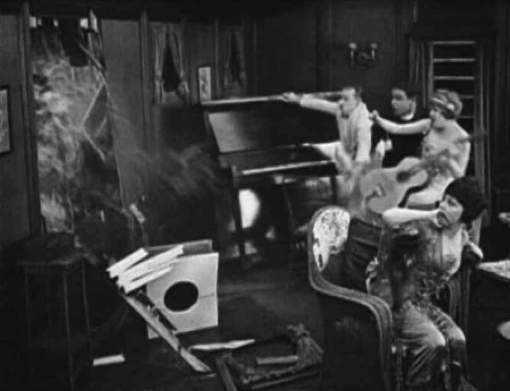
Edith Roberts in Saturday Night (1922): naturalism.

This is one of the most unsung aspects of our director.

Two years into his career, he turned towards a meticulous depiction of everyday reality and its sordid aspects. He certainly wasn’t the only one with such an inclination. There were also Raoul Walsh (Regeneration, 1915) and D.W. Griffith (The Mother and the Law, Broken Blossoms, the 1919 version, which was preceded by numerous short films such as The Drunkard’s Reformation).

At a recent screening of Kindling (1915), many viewers were surprised to find a Cecil DeMille film comparable to Ermanno Olmi’s Il Posto or Zavattini-De Sica’s Umberto D. It shows the daily life of a domestic help who comes under the control of swindlers and, without intending to, gets involved in a larceny against her boss. Fortunately, the latter is understanding, ends up turning a blind eye and even helping her. An unvarnished and naturalist portrait of the everyday life of an average young American. The pacing is flawless, punctuated by minute details of daily work. There are no bravura sequences here, unlike most other DeMille films. A very solid outline, revealing the harsh conditions of the ordinary American way of life. The least expensive of C.B.’s films ($10,039, or $231,000 in 2012) is also one of the best.

The same style accounts for the appeal of The Golden Chance (1915), its remake Forbidden Fruit (1921), The Heart of Nora Flynn (1915), the beginning of The Whispering Chorus (1917), one part of Saturday Night (1921) and Manslaughter (1922): films shot in studio, set in some reconstructed home interiors, with few characters. How to afford a suitable dress, how to change shoes with holes in them, how to find something nice to eat—these are the basic problems in these films, in addition to alcoholic, brutal husbands and philandering masters. There is something of Dickens here, the author of David Copperfield remaining, like in Griffith’s work, the writer of reference, without it being a question of direct adaptation.

Manslaughter (1922): naturalism with Leatrice Joy.

[From Luc Moullet’s monograph Cecil B. DeMille: The Emperor of Mauve (2012, Capricci). See Table of Contents]

The Cheat (1915): Tori the Japanese man (Sessue Hayakawa) in front of a Chinese shadow play.

At the beginning of his career, DeMille had to deal with the grievances of theatre owners, who complained that there were a lot of dark areas in his films’ visuals, and so asked for a price discount… He told them that he practiced chiaroscuro, and began boasting about it: he saw himself as the Rembrandt of cinema.

It’s likely that DeMille knew Rembrandt, given he came from a family of Dutch immigrants himself. DeMille incidentally means ‘mill’ in Dutch. Now, when we look at Rembrandt’s paintings, we see that chiaroscuro consists of alternating dark areas with bright ones, which, according to specialists, make for only one-eighth of the picture on an average. Faces, or parts of faces, may be in the dark. This technique creates a realistic effect: in real life, elements that seem the most important may very well be in the dark, especially at a time when there was no electricity. Not everything is handed to the viewer on a platter. Standing before the painting, he must participate, put the necessary effort to see, to discern it. This device produces the impression of relief: it helps establish a distance between what is clearly visible and what is hard to perceive. And it expresses a metaphysics: man is only a small part of the universe. The Taking of Christ, Judith at the Banquet of Holofernes, The Abduction of Ganymede, and Aristotle with a Bust of Homer are the finest examples of chiaroscuro’s accomplishment.

However, chiaroscuro is rare in DeMille’s work: two shots in Carmen, five shots in The Cheat, which bring out the secretive, mysterious quality of the Japanese man’s home, and also serve to mask a sexually aggressive behaviour, which could have been shocking. It’s more noticeable in The Little American, in the scene showing the sinking of Lusitania (fewer discernible elements make the job easier) and in the scene at the chateau where the heroine is pursued by Germans. Or else, only one profile of an actor is illuminated (The Warrens of Virginia).

It would seem then that this reference to Rembrandt is something of a publicity stunt.

On the other hand, often in DeMille’s work, only faces are visible on the foreground of the shot. Everything else in complete darkness—a good way to avoid expensive sets and extra lighting in these low-budget films, while also showcasing the technique, which has nothing to do with Rembrandt here.

It is, by the way, remarkable that when DeMille made Samson and Delilah, he didn’t resort to the chiaroscuro employed by Rembrandt in his three paintings featuring these characters.

In The Cheat, we see shadows of the characters on matted glass partitions common in the Japanese world, which helps us understand who is there and what is going on, sometimes solely with the help of extras—pure economy and narrative economy.

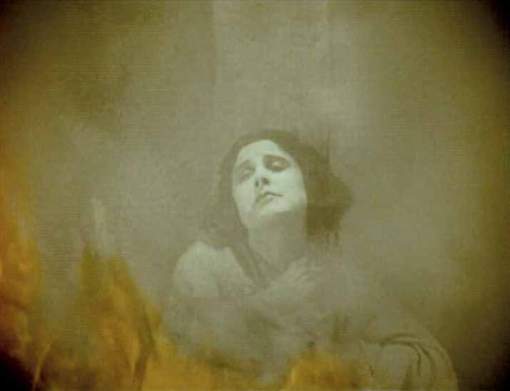
Another feature is the frequent presence of superimpositions. The uses are twofold: to evoke the appearance of the Virgin, angels and other representatives of the divine order, or signs of religion, such as the cross (Joan the Woman, The Whispering Chorus). In the latter, there’s the Angel of Good on the right and the Angel of Evil on the left whispering their advice to the lead character—hence the film’s title. Or the superimpositions help evoke public opinion, the supposed reactions of the crowd (nearly twenty separate rotating faces in inset—movements that brilliantly underline the hero’s disarray). Most of the time, DeMille amplifies the supernatural, artificial quality of these image implants with his choice of a blinding white, especially when it comes to the Christian Cross.

Raymond Hatton in The Whispering Chorus (1918): a superimposition of twenty heads that advocate good or evil.

Or these effects indicate that the hero is thinking of someone not present in the frame: the husband is with his girlfriend, but is thinking of his wife, with discrete superimpositions of the two faces at times.

The device tends to disappear after 1918, which meant that old-school criticism, estimating quality to be dependent on the number of superimpositions, blur effects, and slow motions, could claim, with William K. Everson and Kevin Brownlow, that DeMille ceased to be creative after The Whispering Chorus, thirty-eight years before the end of his career…

In fact, DeMille did pursue this path, rarely to be sure, as the public no longer appreciated these outdated violations of realism: in Forbidden Fruit (1921), the dollar sign appears in the eye of a penny-pincher and, in North West Mounted Police (1940), the victims of the brother’s desertion and the murderous machine gun, moving from left to right and then down, enter a small corner of the frame, next to the repenting man—an effect that probably won the film the Oscar for Best Editing.

Another outmoded effect is transition with wipes (moving vertical bars), present until 1951.

The Academy Award for Best Documentary was first given in 1943, a year after the United States had entered what would be known as the Second World War. Hollywood saw its top talent being mobilised for the cause. Actors and directors got busy promoting army recruitments, putting on shows for GIs abroad, selling war bonds and producing propaganda films. The Academy Award for these productions, broadly called documentaries, was part of Hollywood’s continuing contribution to the war effort.

A look at the twenty-five works nominated for the first edition of the award gives an idea of how loose the definition of a documentary was. Among the nominees are long and short films, pictures publicly and privately produced, animation and live action works. The only commonality they share — their only basis in reality, as it were — is an acknowledgement of and a support for the Allied participation in the war.

“What documentaries really have in common”, wrote British critic Judith Williamson, “is not so much truth, as the idea that they are true.” Even early landmarks of “documentary” filmmaking such as Nanook of the North (1922) tweaked the reality they depicted for poetic effect. Throughout the second half of the twentieth century, filmmakers around the world continued to render the distinction between fiction and documentary ever more indeterminate.

Even so, the distinction persists, both in the industry and in popular imagination. Distributors, lobbyists and award committees still prefer boxing documentaries into a single marketable category. One of the nominees for this year’s Oscar for Best Documentary, the Chilean film The Mole Agent directed by Maite Alberdi, plays on the ambiguity of the fiction-documentary divide, repurposing elements from mainstream moviemaking tradition to real-world ends.

The premise of The Mole Agent comes straight out of a spy thriller: a detective agency in Santiago wants to investigate possible elder abuse at an old age home in the city. The only way it could do this is by planting a “mole”, a senior citizen who will report happenings from within the institution. Sergio, an octogenarian and a recent widower, is hired for the job from among several candidates. Romulo, the head of the agency, briefs him on his mission and trains him in the use of various electronic gadgets. Sergio’s uneasiness with technology makes for some of the film’s funniest passages, as does director Alberdi’s ironic use of film noir elements.

After Sergio checks into the nursing home, we are introduced to a select few residents, who become veritable characters in the film: Rubira who keeps forgetting whether her children visit her, Marta the restless soul who is pacified by fake calls from an inexistant mother, Berta who takes a liking to Sergio, Petita the in-house poet, among others. The occupants of the home are predominantly women, and as a rooster in a hen house, the impeccable Sergio becomes something of a heartthrob. Even as he secretly reports back to Romulo over the phone, he too grows closer to the women, listening to what they have to say, complimenting them, and helping them out with their anxieties.

While supposedly a real-life account, the documentary garb of The Mole Agent comes off early into the film. Following Sergio’s admission into the home, we are made witness to a host of interactions between the residents. These are recorded by a filmmaking crew present at the facility even before the arrival of our protagonist. The occupants of the house notice these cameras and microphones, sometimes wary of this foreign presence.

Notwithstanding Romulo’s alibi that the crew has been sent there on the pretext of making a documentary about the home, the film’s fictionalization becomes apparent, especially in shots that anticipate Sergio’s movements into and out of certain spaces. Romulo gives Sergio hidden recording equipment, but we hardly see any footage from it that isn’t already covered by the on-site cameras. Besides, with a documentary crew on site, it is patent that the home’s management would be on their best behaviour, forestalling any shocking discovery Sergio might make.

The Mole Agent thus makes no bones about its fictional nature. Even so, the film revives certain questions about documentary ethics, questions also confronted by any discipline engaging with a social other. The nursing home has evidently consented to participating in the film, but the consent of the residents themselves, who are also filmed during their less-than-dignified moments, remains open to discussion.

This is, of course, the challenge involved in dealing with subjects whose capacity for informed consent may be compromised. When American documentarian Frederick Wiseman filmed the disturbing everyday operations of a state-run institution for the criminally insane in Titicut Follies (1967), there were objections that his film violated the right to privacy of the inmates, whose consent could never stand scrutiny anyway.

Likewise, some of the elders in The Mole Agent, suffering to various degrees from memory loss, delusion or general disconnect, may not entirely have been at ease being filmed had they been in the best of their health. However, despite occasional humour at their cost, the film treats them with dignity and affection, recognizing the complexities of their experience. It manages to resolve whatever moral quandary its premise may have posed by siding resolutely with the residents. Alberdi’s film ultimately speaks for and with the elders, not about them.

In the final minutes, Sergio concludes in his report that there is no abuse at the facility, and that what’s ailing the residents is simply interminable loneliness. This statement of purpose, so to speak, clarifies the original conceit of The Mole Agent. Rather than sustaining a mystery around Sergio’s presence at the establishment, the film chooses to designate him as a “spy” right at the outset, preparing the audience for some sordid revelations through his eyes. But the revelations never come. Instead of penetrating a hermetic world for our thrill, the film turns outward, reflecting our voyeuristic desire back at us: the infiltrator becomes an insider, reciprocates the love and trust of the residents, and ends up incriminating the very person who hired him.

In a way, then, the political argument of The Mole Agent is antithetical to the institutional critique of Titicut Follies. The establishment in question is less a failure in itself than a symptom of a larger failure: the superannuation of the aged once they have outlived their social utility. The nursing home is strewn with individuals whose grown-up children are too busy with their own lives to take care of or even visit their parents, those who have lost their spouses and are looking for romantic validation, and those who are struggling simply to keep their personhood intact.

When Romulo puts out an advertisement seeking super-senior citizens for a job, numerous men line up for the audition. In his interview, Sergio invokes the difficulty of finding a job as an octogenarian and remarks how mentally liberating it feels to be ‘useful’ again. Having been desperately lonely following the demise of his wife, the new project gives him a sense of purpose, something that seems inaccessible to most other residents of the nursing home.

So despite juggling documentary and fictional elements, The Mole Agent doesn’t intend to question ideas of truth. On the contrary, it is determined to state a simple truth about society, which it deems is best conveyed by the hybrid form it has chosen.


[Originally published at Firstpost]

On 2nd October 2018, Saudi journalist Jamal Khashoggi went to the KSA embassy in Istanbul to obtain documents that would enable him marry his Turkish fiancée, who was waiting outside the building. He did not return. A noted critic of the Saudi crown prince Mohammad bin Salman’s (MBS) policies, Khashoggi was choked to death in the conference room of the embassy. His body was dismembered and reportedly burnt in a barbecue pit over three days. In February this year, the White House declassified a report that stated in no uncertain terms that the grisly murder was carried out by intelligence agents acting under the express approval of the crown prince. US president Joe Biden has, however, refused to pass any sanction against MBS for the killing.

American filmmaker Bryan Fogel’s persuasive, pressing new documentary The Dissident, which premiered at the Sundance Film Festival last year, sticks so closely to these hard facts that it seems it has no other ambition than to state them as they are. It’s a worthy goal, especially in view of all the hand-wringing that political leaders across the so-called free world have been engaged in over the matter. Torch-bearers of free speech like the UK and France have loudly decried the murder, but shown themselves unwilling to do anything that will impact their arms trade with Saudi Arabia. The Arab world predictably rallied behind the kingdom, while countries like India and Pakistan, far from condemning the killing, welcomed an investment-bearing MBS with red carpet in 2019. This bending of a country’s foundational values under a heavy purse recalls Groucho Marx’s quip: “Those are my principles, and if you don’t like them, I have others.

Fogel’s film synthesizes the testimonies of Khashoggi’s fiancée, Hatice Cengiz, his friends and colleagues at the Washington Post, the Turkish officials who discovered and publicized the murder and other Saudi dissidents exiled across the world, especially Montreal-based video blogger Omar Abdulaziz. In doing so, it offers us a picture of the journalist’s personal and political situation during the weeks leading up to his visit to the embassy and of the fallout of the assassination in the weeks after. We also get a glimpse into the scope of Saudi intelligence operations, from large-scale computer farms that troll dissidents and set the narrative on social media to investment in technology that infiltrates mobile gadgets of targets across the world, allegedly even that of MBS’s buddy Jeff Bezos.

The Dissident is not an analytical work; Fogel’s approach has little to do with either the meditative formalism of a Laura Poitras or the long-sighted storytelling of an Adam Curtis. He holds the viewer captive to the here and the now, and his film is largely an ‘operative’ text that seeks to convince and call to action. To this end, he uses all the means at his disposal to hold the viewer’s attention. Several stretches of The Dissident have the licked finish of an international thriller: spectacular drone images of megapolises dotted with skyscrapers, a musical score that ratches up the tension, and an accelerated style of editing that weaves different kinds of testimonies to create a sense of inevitability to the events. A description of warring IT-operations is animated literally as a colony of dissident bees taking on an army of Saudi flies.

You can’t deny that this method is effective. After all, the film (nearly) pulls off the impossible by making us root for Jeff Bezos. But there are stretches where this ends-over-means approach irks. It’s one thing to dramatize Abdulaziz’s media operations in Montreal, but to have a camera wistfully track away from Cengiz as she stands outside the Saudi embassy borders on distasteful. There are multiple moments where we don’t know if what we are looking at is fictional re-enactment or documentary footage, for instance the low-fi visuals of people talking in cafés that accompany audio recordings, or pictures supposedly from Saudi Arabia’s social media war-room — images that seem suspended in the realm of alternative facts. As the then-president Donald Trump said of Khashoggi’s killing, “Will anybody really know?”

The Dissident is so focused on excavating and arranging facts that it seems to have come into being on its own. And its mission is so obviously vital that it seems decadent to talk of its artistic construction. While its accent on raw detail renders the film almost a-thematic, there is a motif to be discerned: the gradual redrawing of the contours of political affiliation that can shift the ground one is standing on. The film lets us know that Khashoggi was not always a heretic; that he was, in fact, an insider in the House of Saud, who represented a happy face of the regime. Even when he was critical, we are told, he was seen as a well-meaning reformist who believed in MBS’s vision. But with his reactions to the Arab Spring and concomitant Saudi-sponsored counter-revolutions, it appears as though he would fall lower and lower in the eyes of the kingdom, even though he continued nurture the same love for his country.

The film regularly tells us that Khashoggi was targeted for his dissent, but it hardly probes into the material of that dissent. This is important. There is a valid argument to be made somewhere that reducing a complex journalist to a martyr for free speech is a liberal contrivance that neglects the breadth of his life’s work. But Fogel’s refusal to delve into the details of Khashoggi’s criticism of the crown prince is a wholly defensible stance. The Dissident is a film about principles for which any discussion about how Khashoggi may have ‘provoked’ the Saudi government is already a concession. For Fogel’s film, dissent is an end value in itself, worthy of being protected and celebrated irrespective of its content. As such, it wouldn’t want to have anything to do with realpolitik. It is, after all, international realpolitik that has deemed that pursuing justice for Khashoggi comes at too high an economic price.

[Originally published at Firstpost]

[From Luc Moullet’s monograph Cecil B. DeMille: The Emperor of Mauve (2012, Capricci). See Table of Contents]

Joan the Woman: the Siege of Orléans, a beautiful disorder.

This title is a bit inaccurate, because there aren’t just films with Geraldine Farrar during this period, but these are his most ambitious and expensive films of the time, though not necessarily the best ones.

The collaboration with Farrar (who resembles the filmmaker Danièle Huillet a bit, but is less pretty of course) lasted five films. Curiously, he called upon her to play Carmen, obviously a silent version: the year was 1915. He chose her because she was the most famous soprano in America. It was a stupid choice: it’s as if Callas was asked to play Aida in pantomime. DeMille probably thought that a disc of Bizet could accompany the visuals in the theatres. It wasn’t to be: Bizet’s descendants were uncooperative when it came to rights, as was proven by their later opposition to Preminger’s all-Black Carmen, which was banned in France for some twenty years. The challenge for DeMille, a small-time, failed, hung-up playwright, was to bring the greatest Opera singer to Hollywood for the first time ever, just like he had got the famous stage actor Dustin Farnum to the West Coast to play The Squaw Man.

A prestigious affair…

Geraldine Farrar again played an opera singer, still a silent one, in Temptation (1915). Farrar was then thirty-four. It may have been believable on stage, with its distance, for her to play a nineteen-year-old Joan of Arc [in Joan the Woman, 1916], but not in cinema with its close-ups. Moreover, Farrar was something of a tank: you need a solid pair of lungs to sing. It was therefore the opposite of the traditional image of Joan of Arc, the frail young maiden who, with her faith and enthusiasm, defeated the powerful soldiers of the English army. So the spice, the paradox of the Joan of Arc story had vanished.

The film is worthy for the sequence showing the Siege of Orléans, the best battle scene shot by DeMille: a beautiful, chaotic and inventive wave of soldiers in action, with multiple arms under the fortifications, on the rampart walls and in the city. Carmen, in contrast, is interesting only for a brief sequence realistically showing the work of cigarette makers and was rightly sent up in [Chaplin’s] Burlesque on Carmen.

Farrar was followed by America’s sweetheart, Mary Pickford; or the triumph of the star system. Pickford’s salary came up to 71% of the final cost of A Romance of the Redwoods, a rather ordinary Western (in fact, a “Northern” since DeMille always preferred adventure films set near his native Massachusetts). In contrast, Pickford is remarkable in her spontaneity in The Little American, a contribution to the war effort (along with Joan the Woman, a film indirectly campaigning for entry into conflict, and Till I Come Back to You). DeMille hedges his bets: before the war in France, Pickford was seen trapped in the sinking Lusitania, which has a bit of Titanic about it. It’s all on the nose: Pickford, a young American girl above the fray, becomes, without wanting to, a heroine who saves the good French soldiers at the risk of her life… There are some rather melodramatic images here, with the trenches, the ruins, a Christ statue standing alone in the middle of rubble, and Pickford in a tearful pietà pose at its foot. Even so, the result is impressive. The scene may even have influenced Gance in J’accuse, made shortly after.   

Coming in the line of “great spectacles”, the last Geraldine Farrar film, The Woman God Forgot, is disappointing, offering us only a phoney Mexico from the time of the Aztecs.

Finally, this period is more interesting for its naturalist films and its low-budget melodramas.

Charlotte Walker, Raymond Hatton in Kindling (1915): a high point of naturalism.

On naturalism: going through DeMille’s work chronologically, it’s shocking to come across an almost neorealist film like Kindling, a pure gem that follows a series of uninteresting movies. What could have happened for DeMille to rise to the peak of his craft in one go? To be frank, the transition from the preceding period isn’t as clear-cut, which doesn’t make the critic’s job any easier. Later films like Maria Rosa or Chimmie Fadden Out West are just as disappointing as early attempts such as The Unafraid or Rose of the Rancho. There’s an element of chance shaping the choice of projects at any given point. I’ll come back to this naturalist period.

The melodramatic section includes very diverse films: the perfect outline of The Cheat (1915) contrasts with the complex and tormented itinerary of The Whispering Chorus (1917). The first part [of the latter film] is a realistic depiction of the life of accountant John Tremble and his family. When he is forced to flee following a forgery he has committed, the film becomes a wildly imaginative soap opera: he disguises himself, changes his physical appearance completely, assuming the identity of a dead body he finds by chance and which he passes off as his own. After a wide variety of episodes—a beautiful Chinese festival, a serious accident at work—he returns home. We learn that the police are after him for the murder of… John Tremble. Fortunately, his mother recognizes him and sets out to resolve the matter. But, alas, she dies two minutes later. He is arrested and lets himself be sentenced to death, not wanting to jeopardize the future of his wife, who is now married to a bigwig. The extraordinary nature of the story works very well, since it appears only slowly, halfway through the film, after an initial anchoring in everyday reality. We manage to understand everything of this extremely complicated story. A triumph of great melodrama, as is underlined by the film’s French title, The Supreme Redemption. The French titles of the films that follow reinforce their affiliation to the genre: Price of a Throne, Whirlwind of Souls, The Damned of the Heart.

Liberal imagination tends to consider translation as an act of building bridges between cultures. But if the history of colonialism and nationalist hegemony has any lesson to offer, it’s that building bridges isn’t necessarily a guarantor of mutual respect. Translation is an act of faith, and as someone who cannot produce new discourse, only affirm existing ones, the translator is essentially a powerless figure, even when his/her own existence is at stake.  

This powerlessness is front and square in the superbly-edited first scene of Jasmila Žbanić’s Quo Vadis, Aida?, nominated for the Academy Award for Best International Feature this year. Seated amid clouds of cigarette smoke, a tense but focused interpreter, Aida (Jasna Đuričić), translates between a group of civilians from Srebrenica, Bosnia, and a unit of UN peacekeepers. The locals are worried about the advance of the Serb army into their city, supposedly a UN-protected “safe area”, while the Blue Berets assure them that the NATO has their back.  

As the camera pans back and forth between the two camps, in a meditative manner that belies the tension of the situation, Aida translates words, but the essential part of the communication succeeds without her intervention: rising and falling pitches, quivering voices, defiant stares and denied handshakes. Aida is personally implicated in the standoff, but her emotional state has little bearing on either the tenor of the negotiation or its outcome. Hers is not to reason why, but to smoothen a process, even if the process is to dispatch a group of people to certain death.  

Quo Vadis dramatizes the days preceding the Srebrenica massacre, in which over eight thousand Bosniak Muslims were slaughtered. It weaves a factual account of how the genocide was allowed to happen with a fictional story told from Aida’s point of view. A host of factors are summoned to court: the deep-seated ethnophobia of the Serb soldiers, the cunning media manipulation of General Mladić (Boris Isaković), who orchestrated the massacre, the indifference of the NATO for whom Bosniaks were simply pawns on a political chessboard, the failure of the UN command to stand up to Mladić and their ignoble capitulation to him.

All this clear-eyed analysis would have been formally unwieldly were it not for the character of Aida, who binds these diverging perspectives together. Her unique position between the Bosniaks and the UN forces helps the film to never deviate too far away from her own story. Aida tries, with every means at her disposal, to rescue her husband and two sons from the fate reserved to the other members of her community. Part of Žbanić’s accomplishment is the way she manages to open up the film from this narrow narrative perspective to larger political questions in a fairly organic manner.

This tactic isn’t without considerable limitations. Though a Bosniak herself, Aida is a quasi-outsider who shares little with the huddled masses that make up the refugees at the UN camp. No Bosniak outside of Aida’s family has any individuality to speak of, and the only two characters to be singled out during negotiations with Mladić exist solely in order to be humiliated. Refugees are marshalled, instead, into a series of vignettes depicting the injustice and violence they are subject to — images that recall Hollywood’s recreations of historical atrocities in their unsettling virtuosity. The absence of any reference to armed resistance by Bosniak soldiers or civilians is, moreover, a political convenience that weakens the film’s argument.

Quo Vadis is at its strongest, though, when it sticks close to Aida, whom it follows with a handheld camera whenever it isn’t allowing us a moment of repose with static or slowly panning shots. Jasna Đuričić’s turn as Aida is formidable, and director Žbanić composes her shots around the character’s nervous physicality. Wearing trousers and an unbuttoned blue shirt over her blouse, the middle-aged Aida briskly moves through numerous obstacles at the UN facility, climbing up and down containers, and snaking in and out of its makeshift offices. The frame can barely contain her energy. Associated all through the film with two objects — cigarettes and loudspeakers — she becomes a powerful visual anchor for the viewer.

War films have a tendency to lionize their protagonists, turning them into heroes who shape or defy the course of history. Quo Vadis, however, takes pains to underscore that Aida is not a hero. Her character has little by way of ideals or even work ethic; she is willing to translate patent lies and she is willing to not translate uncomfortable truths. She is an accidental interpreter and would rather be rescuing her family than arranging toilet facilities or delivering babies at the camp. Aida is determined to save her husband and two sons, even if it means passively shepherding the other refugees to their grave, and she has no compunction about this. For her, it isn’t about justice or community rights, it’s about familial survival. And this relative moral complexity holds the character at a healthy distance from the viewer.  

But the real human complexity arrives with the film’s extended coda in which Aida comes back to Srebrenica years after the war. She is a foreigner in her own neighbourhood, which is now occupied by Serbs. In her class at school are children of the genocide victims, but also those of the perpetrators and enablers. Could Aida ever love teaching again, given that it was one of her former students who helped deport her husband and sons? With victims now expected to put their past behind and be part of the same civil society with war criminals, the notions of truth and reconciliation ring hollow. Performing together on a single stage for a school programme, the ethnically diverse kids look alright. That would, at least, be Aida’s hope.


[Originally published at Firstpost]

Apples

A burly guitarist stands at the corner of a street trying to master the notes of “Twinkle, Twinkle Little Star”. A man passing by listens to him intently and drops a coin in appreciation of the effort. The passer-by knows a thing or two about starting from scratch, for he is one of the thousands in the city to be diagnosed with amnesia, an epidemic that seems to have neither cause nor cure. A lucky few have family members who come to pick them up from the hospital, countless others are simply labelled “unidentified”: individuals with no identity or social network to speak of.

The passer-by is the unnamed protagonist of Apples, Greek filmmaker Christos Nikou’s compelling if somewhat mannered directorial debut, currently screening in the Viewing Room of the Dharamshala Film Festival. One of the “unidentified”, he is convinced by the doctors at a neurological hospital to sign up for their “New Identity” programme, which aims to help these blank slates start life anew. Installed in a sparsely furnished apartment, the man receives regular “tasks” from the chief doctor via audio cassettes that he must complete and furnish proof of with photos. The tasks are increasingly convoluted and psychotic, instructing the protagonist to crash a car, jump from heights and worm his way into the household of a recently deceased.

The element that fuels the narrative of Apples, and sustains our curiosity, is the mystery around the man’s relationship to his past and the uncertainly about the direction of his future. The character wanders across playgrounds, theatres, discotheques, strip clubs, pubs and parking lots, completing eccentric assignments that take him vaguely through the signposts of childhood, adolescence and adulthood. There is a sense that he is undertaking these tasks with the sole purpose of converting them into polaroid souvenirs. A pointedly millennial condition, this obligation to create a new album of life events, to prove that he has lived these moments, supplants the experience of these events itself.

The pathos of the lead character’s attempts to narrativize his life is undercut by hints that he may not entirely be the tabula rasa that we take him to be. From early on into the film, we are made privy to incidents that reveal that the man might be consciously running away from a past and is, in fact, not amnesiac. His resistance to being identified at the hospital, his “stealing” of symptoms from other patients and the rare instants where he lets his guard down suggest that what the man may be suffering from is not forgetfulness but memory.

Part of what is admirable about Apples is that, far from intending to cheat the audience as to the truth about the protagonist’s condition, it proposes the character’s dual being as authentic in itself. Nikou’s film is about grief and its repression, and it submits that the desire for a spotless mind is as inextricable a part of human existence as the will to forge a personal history. To this end, the director refuses to let us into the protagonist’s mind and plays instead on his inscrutability. The character, who understandably dresses up as an astronomer at a costume party, is never quite anywhere.

Played by a bearded Aris Servetalis, who cuts the figure of a stoic philosopher parachuted into modern Athens, the protagonist says very little, expresses even lesser. Even when he sings or dances, he looks like he’s executing an idea of song and dance. Nikou, who dedicates the film to the memory of his father, instead fixates on shots of the actor eating, sitting or staring into the distance. Looking at him biting into one apple after another, we wonder if anything at all lies behind his cryptic, silent stare.

Apples is thin on narrative incident or exposition, and fashions itself above all as the study of a cipher. As is de rigueur in cinema of this kind, Nikou shoots in shallow-focus, pivoting his compositions on Servetalis’s sculptural face and upper body. The actor is consistently decentred in the frame, reflecting the character’s loss of centre and the feeling of being never blending into the landscape. Outside of another “unidentified” woman (Sofia Georgovassili), whom the protagonist meets during one of his tasks, there are few full-fledged characters, which encourages Nikou to stay away from shot-reverse shot patterns.

Contemporary Greek filmmakers operating in this narrative mode can barely escape comparisons to Yorgos Lanthimos, with whose idiosyncratic, high-concept works Apples has considerably in common. Besides borrowing his lead actor from Alps (2011), Nikou channels his compatriot in his taste for absurd plot developments, unorthodox shot composition, clinical indoor settings and handling of secondary characters, who are suitably caricatured in voice and gesture to the benefit of the protagonist.

Nikou, though, pitches his film at a level above realism—the viewer is simply expected go along with the premise, which may not stand logical scrutiny—but several notches below Lanthimos-like parable. He accentuates the incongruence by a calculated anachronism: his film looks by turns contemporary and futuristic, but is strewn with props that are forty years old. While such preconceived quirks as the film’s 4:3 aspect ratio have by now become veritably academic, Apples keeps it light and avoids being overwhelmed by its film-awareness.
 

[Originally published at Firstpost]

[From Luc Moullet’s monograph Cecil B. DeMille: The Emperor of Mauve (2012, Capricci). See Table of Contents]


Cecil DeMille at work.

The first film was both an artistic success and a commercial triumph, achieved at the age of thirty-two (DeMille was born in 1881), which suddenly made Hollywood the capital of cinema. The Squaw Man (1914) is often misunderstood: it is not “the man who was a squaw”, but “the husband of the Indian woman”, which is the film’s French title. The strength of this production is its rapid pace centred on a story with twists and turns, since it is about an Englishman wrongly accused of fraud, who is forced to leave the country of his birth, before emigrating to New York and then to the Rocky Mountains, where he has an affair with an Indian woman, who is soon driven to suicide. He is exonerated and returns to England with his half-breed son to find the woman he loved. It’s actually much more complicated than that. There is here not only the interest generated by complete changes of place and milieu (the London gentry and the Wild West), but also the complexity of the various plots. In short, it was to become a model for more than fifty years of film history. No time to get bored.

It’s surprising to note that none of the twelve films that follow is at the level of this striking debut. There’s at times a certain observational humour in the life of the husband of a stage star, a real prince consort (What’s His Name?), and in the vaguely Henry James-like quality of a cosmopolitan affair (The Man from Home). And I love the gag from The Captive conceived by DeMille’s favourite screenwriter, Jeanie MacPherson: a prisoner of war is placed in a farm to work the fields, with a harness on his back. But once the war ends, it is he who places the harness on the shoulders of his boss, whom he has married. There’s an almost identical gag in Male and Female four years later. It’s not much. There are minor comedies in this period featuring a mediocre but successful comic, Victor Moore, midway between Fernand Raynaud and Jean Lefebvre (the two Chimmie Fadden films, Wild Goose Chase), and Westerns or adventure films (The Girl of the Golden West, The Virginian), but DeMille will learn to use the Western to his advantage only twenty years later.

Seen today one after the other, these movies disappoint in their casualness: whether they are set in Turkey, the Rocky Mountains, Andalusia, Montenegro, near Naples or Mexico, they have all been shot in the same Californian landscapes, with their small arid hills. There are the same houses and the same actors, who reflect very little of the physical characteristics of the local people.

This decline could be explained by the fact that The Squaw Man was co-directed by Oscar Apfel, who was more experienced than Cecil, who was going to be left to his own devices on the following films and was going to learn his lessons, which were honestly a bit laborious.

And then DeMille didn’t expect such a success. He may have been caught unawares, without a project close to his heart. It’s because everyone, attracted by such a triumph, asked him for more films…

1915: thirteen films in the year. A record! Some have said that this profusion was somewhat imposed on him by Lasky, his producer. He served as an example for other directors under contract. He showed them that he wasn’t one to laze around. He ensured excellent returns. But at this rate—more than one film a month—it’s hard to make anything good.

It should be noted that these films, shot on location for the most part, were, however, mostly adapted from plays, a cultural sphere that DeMille knew well since he was a playwright and an actor. It seems that he wanted to restore a certain prestige to cinema, then considered minor entertainment by the people of Boston, by bringing to it what he thought was the best in theatre, including plays by Booth Tarkington (future Pulitzer Prize winner and the author of The Magnificent Ambersons) and David Belasco, the numero uno of the stage around 1915, with whom Cecil and his father had already collaborated. This was enough to overcome the reticence of his older brother, William DeMille, who vigorously criticized him for getting mixed up in a kind of show business that was totally unworthy of their family.