The history of battle,” wrote Paul Virilio in 1984, “is primarily the history of radically changing fields of perception.” Examining the relationship between war and images, the French philosopher advanced that, through the ages, victory in an armed conflict has always been a matter of perceiving and representing enemies and enemy territories; that, in industrial warfare, “the representation of events outstripped the presentation of facts”. He continues: “Thus, alongside the army’s traditional ‘film department’ responsible for directing propaganda to the civilian population, a military ‘images department’ has sprung up to take charge of all tactical and strategic representations of warfare for the soldier, the tank or aircraft pilot, and above all the senior officer who engages combat forces.”

Virilio’s analysis has only become more accurate with time. A few years ago, MIT developed a camera that can look around corners — an invention that has obvious military application. In March this year, the U.S. Army publicized their goggles that allows soldiers to remain inside their armoured vehicles while being able to see everything happening outside. To be able to see the source of danger without exposing yourself to it — the Rear Window principle — is already a battle half-won. Photography and filmmaking have therefore increasingly been at the centre of contemporary military strategy.

The work of German filmmaker Harun Farocki (1944-2014) has, over decades, thrown light on the profound, multi-layered links between war, photography and cinema. His films echo Virilio in demonstrating how, in modern warfare, terrains are mapped out in extensive detail, combat tactics are thoroughly simulated in software and variables of battle are controlled to such a degree that the actual field operation simply becomes a logistical formality. In such an asymmetric war, the side that controls machine-filmed, amoral and objective images of a region is one that has already conquered it. To see is to capture.

Two films screened at the recently concluded Visions du Réel festival in Nyon imbibe the spirit of Farocki’s work and explore the intersection between images and war with great cogency and rigour.

Directed by Massimo D’Anolfi and Martina Parenti, the Italian feature War and Peace lives up to the ambitions of its lofty title. The opening part is set in a film archive, where researchers study footage from a “forgotten war”: the Italian invasion of (current-day) Libya in 1911. Perhaps the first war expressly filmed for public consumption back home, the clips show soldiers advancing in the desert and or assembled outside captured sites. These films, we are told, played a part in creating the fiction that was unified Libya. As it did elsewhere under various imperial film units, cinema here served as a colonizing force, with the power of writing history residing with those who wield the camera.

The second segment of the film parachutes us into a crisis unit in Italy that helps locate and repatriate civilians and military personnel stuck in war-torn areas around the world. More than a century since the Libya invasion, technology has now democratized image-making. Even the “enemies” have the means to fashion their own narrative through film. Thanks to global media and the internet, these images of war can now be produced, distributed and immediately seen across the world. We observe experts at the crisis unit investigating and interacting with these videos to navigate the chaos of the present. It’s effectively a battle for the control of future history.

Production and control of images of war is also the theme of the third part of the film, set at a French military academy. A new batch of recruits in what Virilio called the “images department” is being trained in the techniques of photography, visual composition, voiceover commentary, live telecast and filmmaking. At the end of the course, a whole combat operation is simulated in the campus for these trainees to shoot and edit into a wide-screen Hollywood-like movie, as though the primary goal of war was to fabricate images, “representation of events” outstripping “presentation of facts”.

War and Peace nevertheless concludes with a reflection on cinema’s power to prevent history from falling into oblivion. As footage of post-war devastation and testimonies of Holocaust survivors wash over reel cans, we realize that while cinema may not have been able to forestall historical tragedy, as Jean-Luc Godard lamented, its true mission may simply be to pick up the pieces, to preserve the memories of the victims of war. And that perhaps is the only way cinema could film peace.

Bellum – The Daemon of War deals with similar ideas as War and Peace, but weaves them into human interest stories. Made by David Herdies and Georg Götmark, the film follows three subjects living at different corners of the world: an engineer in Sweden, an American photographer working in Afghanistan and an Afghan war veteran in Nevada, USA. They don’t meet one another in the film, but their lives are all shaped by war and Western attitudes to war.

Fredrik Bruhn, the Swedish engineer, is involved in designing an AI-powered military drone that will take autonomous decisions on bombing a perceived target — a game-changing invention that will eliminate the need for any human intervention in combats. Bill Lyon, the war vet suffering from PTSD, has trouble reintegrating into civilian life and hopes to go back to the front, not just for the money, but also to regain some semblance of normalcy. Paula Bronstein is a photojournalist from the East Coast who covers the aftermath of the Afghan war. We see her directing her subjects with makeshift lighting, wandering the streets of Kabul coaxing children for a pose or signing photo-books at her exhibition back in the United States.

Bellum emphasizes that these are nice people. Bruhn is a doting father and a science enthusiast. Bronstein is empathetic and wants to put a human face to the fallout of the war. Despite his hatred for the conditions in Afghanistan, Lyon too is a loving husband. Well-meaning though they might be, it becomes apparent that their life and work are marked by a certain guilt surrounding the fact of war. This is evident in the case of Lyon, who has seen his friends and colleagues die in the field, but Bronstein’s own activity may not be untouched by a liberal sense of culpability about her country’s interventions in Afghanistan. Bruhn’s efforts to eliminate the human factor of war, too, is an attempt to eradicate feelings of guilt about liquidating an enemy, which, the film’s narrator notes, is the only real restraining force in an armed conflict.

Elsewhere, the narrator remarks that armies don’t use just cardboard silhouettes for target practice anymore, but well-defined human-like figures, such that soldiers find themselves in a situation as close to real life as possible. Lyon drives past a large military facility in Nevada, where a life-size replica of Kandahar was set up. Such hyper-realistic simulation environments, which were the subject of Farocki’s four-part Serious Games (2010), are ultimately designed to blur the boundary between reality and fiction and to have combatants take one for the other.

It’s judgment that defeats us,” says an embittered Colonel Kurtz (Marlon Brando) at the end of his famous monologue in Apocalypse Now (1979). What Bellum points to us is that this judgment, this human fallibility, is the variable that technology seeks to eliminate from the equation of war, seeking to forge amoral killing machines that will, somehow, do the “right thing”. In this mission, these two films show us, cinema will be always on the side of the powerful.


[Originally published at Firstpost]

[From Luc Moullet’s monograph Cecil B. DeMille: The Emperor of Mauve (2012, Capricci). See Table of Contents]

Joan the Woman (1916): first flagellation in DeMille’s work.

One of the most evident, and strangest, characteristics of his work is its sadomasochism—something that is as present as the theme of water in Renoir, the opulent women dear to Fellini, the port towns in Demy or Hitchcock’s suspense. This clearly proves, if proof was ever needed, that DeMille is an auteur.

It all began in 1915, with the first truly interesting films by our filmmaker, and continued without any notable interruption until the last opus in 1956.

Delight Warren (The Unafraid) is threatened with the worst torture if she does not sign a cheque.

The Cheat revolves around a rich Japanese man who brands a socialite guilty of rejecting him after he had lent her a large sum of money. According to him, one doesn’t go without the other. You don’t see this barbaric act in this understated film where everything works on evocation, the unsaid. But we do see what precedes and follows it, and everything around it. This understatement is obviously more powerful than if DeMille had filmed it all. It remains within the limits of good taste, and we can imagine everything…

DeMille shot The Cheat by day, and at night, he directed The Golden Chance, in which young Mary Denby is whipped by her alcoholic husband, who unjustly accuses her of all vices. The film is set in a contemporary America, but the action recalls the melodramatic situations of London-based novels, particularly the work of Charles Dickens (Nicholas Nickelby, Oliver Twist, David Copperfield), where the whipped child constitutes a leitmotif.

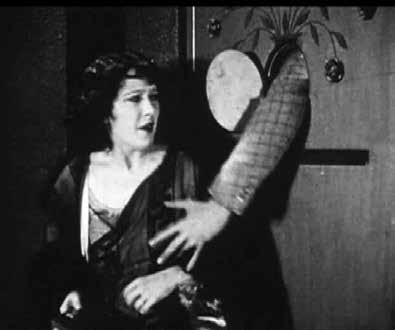
It was Joan the Woman the following year, where the heroine is threatened with being interrogated by the English, which is in keeping with historical reality. But there is also this astonishing scene where a French peasant woman, accused of collaborating with French troops resisting the invaders, is suddenly stripped naked by His Majesty’s soldiers and severely flogged. This is a kind of action that has not been recorded in history, and which doesn’t seem very credible. Moreover, the filmed episode has little to do with Joan of Arc. We find no such scene in any of the many films made on the Maiden of Domrémy. It should be noted that, to avoid the charge of indecency, DeMille had taken the precaution of casting a very flat-chested actress in the role.

In Why Change Your Wife (1919), the heroine tries to disfigure her romantic rival with vitriol. It isn’t vitriol, in fact, but eyewash intended to frighten the girl, and to thrill the audience with this unsettling threat.

To this, I would add the paw of the lion on the body of an unconscious Gloria Swanson in Male and Female (same year).

The whip, decidedly a central prop in our auteur’s work, appears again in the two versions of The Ten Commandments (1923 and 1956), since it was frequently used in the Egypt of the Pharaohs, and especially in The Road to Yesterday (1925), where the English lord Ken whips his rival to death, just after the gypsy woman is condemned to the stake.

The Plainsman (1936): Calamity Jane (Jean Arthur) never lets go of her whip.

The King of Kings (1927) retraces the martyrdom of Christ in all its stages. There is, of course, a masochist component in the whole of Christian universe. In Jesus’s journey, we can see the itinerary of a man who did everything possible in order to be tortured and crucified. Had Pontius Pilate pardoned him, he would have been really annoyed and couldn’t have justifiably claimed the role of a glorious martyr. And his example led several Christians to try to imitate him. We would be justified in wondering whether it isn’t the Christian impulse that drove DeMille towards sadomasochism.

The Godless Girl (1928) is set in a juvenile prison, where, for more than one minute, the evil guard subjects the handsome, rebellious Hathaway to a powerful jet of ice-cold water. And when the young lovers meet and try to kiss each other from either side of the fence, he unleashes a strong electric current through the barbed wire so that the heroine cannot detach herself from the fence and burns her hand: a shot reveals a smoking cross imprinted on her palm (a cross again).

I almost forgot the Tsarist officer in The Volga Boatman (1926) who orders a young boatman to shine his boots, which he has slightly soiled by accident, and deeming his speech insolent, whips him on the face. Already back in The Little American, there was the German officer who orders poor Mary Pickford to remove his boots, which isn’t an easy job.

The Sign of the Cross is perhaps the one film by our auteur that goes the furthest in this domain. There is firstly the child that the Romans tie to a rope and lower into a pit with hellfire (a torture that Joan of Arc was threatened with too) so that he confesses where the Christians meet.

There is then the pleasure of the viewers in the arena—father, mother and son—who try to get the best seats possible and bet on the surviving gladiator. A pleasure mixed with dread before the martyrdom of Christians (a situation that is repeated, in a minor way, at the temple of the Philistines at the end of Samson and Delilah): we are spared no detail (except in the redacted version at the request of the censors, who nevertheless let go of shots of dykes and boy toys). The highlight is this ravishing starlet in a bikini tied up in front of a menacing crocodile. These are brilliant, very powerful scenes, especially since the visuals are sumptuous, but which make The Sign of the Cross look like a sick film.

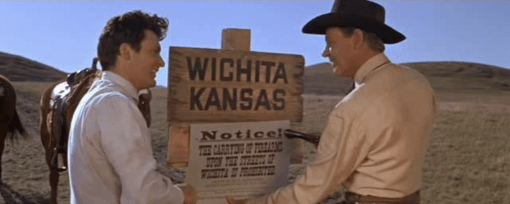
All through The Plainsman (1936) and Union Pacific (1939), the beautiful Jean Arthur and Akim Tamiroff wield a menacing whip, which attacks objects around people, but never the people themselves. The Hays Code of 1934 was here.

At the beginning of North West Mounted Police (1940), it’s Paulette Goddard, a rather wild young girl, who is spanked by Tamiroff. She will be spanked again, with the relative protection of her pretty rich heiress costume, by the dandy Ray Milland, who finds her too capricious, at the beginning of Reap the Wild Wind (1941). In Unconquered (1946), we witness the preparations for the flogging of the same Paulette Goddard, who is decidedly used to corporal punishment, a torture that is called off at the last second. For the sadomasochistic audience, it’s the cracking of the whip and the concept of flogging that counts (and allows it to imagine the foreseeable consequences with delight) as much as the physical act, just as it was the idea of disfiguration with vitriol (which doesn’t take place) that marks the viewer’s mind (Why Change Your Wife). This avoids the reproach of the censors and the restrictions pertaining to children.

A novelty: at the end of Samson and Delilah (1949), the whipper Delilah and the whipped Samson are fully agreed on the use of the prop. She even apologizes to him for the pain she is about to inflict on him. It is part of the plan laid by Samson, who, as the viewers at the temple are fooled by this stratagem, then seizes the whip from Delilah, the latter leading him to the pillars of the building.

There is a very interesting variation of this in the middle of The Greatest Show on Earth (1951): the animal trainer Lyle Bettger, jealous of the special attention that his sweetheart, the beautiful Gloria Graham, pays to the circus director Charlton Heston, blackmails her during an act, by letting her remain under the elephant’s heavy foot for longer than expected: a guiding gesture from the trainer would be enough for the beast to crush her pretty face. In The Sign of the Cross, the animal brings down its foot for good.

I’ve saved the best for the last: Cleopatra, where the sadistic ritual is intimately linked to sexuality. To seduce Mark Antony, Cleopatra presents him with an astonishing spectacle where seductive nymphs, fished out from the sea in large nets (a woman was already fished out with a bait in Old Wives for New), come out of shells that look like vulvas, to perform lascivious dances, surrounded by the dance master’s whip and circles of fire that he raises around them and through which they move. It’s a delirious spectacle that attests to great virtuosity on the part of our filmmaker, and a rather implausible one at that: it’s hard to imagine a woman who, in order to win the heart of her enemy, organizes such a macho show focused on other women.

In Cleopatra again, during the Battle of Actium sequence, there is this very oppressive shot of a chariot’s cogwheel crushing a soldier’s face.

The reader will perhaps forgive me for forgetting other scenes of the kind, which are often brilliant and rather nauseating, the two adjectives being linked indissolubly.

The Sign of the Cross (1932): gladiators and Christians in the arena.

This psychopathia sexualis is well in line with the image Cecil DeMille fashioned for himself: with jodhpurs and a baton in the hand (like his mentor David Belasco), he had all the makings of the perfect sadistic grandmaster.

We may wonder, is this whole arsenal there to please a public fond of sadomasochistic rituals? Or does it correspond to a personal need? I’m tempted to answer with the latter option. In fact, it all began as early as 1915, at a time when the film viewer’s sadistic needs were neither known nor exploited. One had to wait until the advent of the horror film, Tod Browning and James Whale, in the years 1925-1930, and then the actor Burt Lancaster, the most masochist of all, to find a comparison. In literature, Lovecraft himself comes after DeMille. One would even be justified in thinking that DeMille may have furnished ideas to masters of horror such as Tod Browning or James Whale. It was perhaps also that the public success of these scenes encouraged DeMille to persevere.

Why? Why? It’s not the essayist’s role to discuss this subject. Apart from Christian influence, which I’ve already alluded to, it should be noted that C.B.’s sadism is often exercised on women. And he was a frustrated man, at least during his youth: bald at a young age, he looks like the typical image of a small-time accountant in his photographs. And after 1914 and her miscarriage, his wife, for medical reasons and perhaps because she wasn’t interested in it, refused sex, a situation that seems to have lasted for the last forty-five years of their marriage. To be sure, our man made up for it elsewhere, after he achieved success and fortune. But this situation must have been hard for him. It reminds us of the scene in The Road to Yesterday where Ken tries to axe his way through the door of his wife’s bedroom. It’s a situation that must have left behind a mark, a desire for revenge, a recourse to deviant practices… But frustration can also be very fruitful for an artist: the situation of the DeMille couple is the same as that of the Faulkner couple.

Let us not forget a consistent foot (and shoe) fetish, as evidenced by Old Wives for New, Don’t Change Your Husband, Male and Female, Forbidden Fruit, The Affairs of Anatol, Feet of Clay, The Volga Boatman, Wassell and, of course, The Greatest Show on Earth, among others from 1918 to 1951.

Starting May 10, the indefatigable Laurent Kretzschmar (of the Serge Daney in English blog) will be putting up translations of over 20 texts that Daney produced during the Cannes Film Festival of 1984. To convey a sense of how prolific and rapid Daney was, the articles will go up on the same days that they were published 37 years ago.

Though understandably uneven, it’s really a remarkable and lively set of articles with very little trace of festival fatigue or complacency. The dossier includes texts on Bergman, Ray, Huston, Herzog, Skolimowski, Angelopoulos and Carax, among others. Keep an eye out for “Twice Upon a Time in America”, a double review of new films by Sergio Leone and Wim Wenders, which, in my opinion, is one of Daney’s finest ever pieces.

I was privileged to closely read these translations a few months ago and discuss them with Laurent. Working with a style as vivid and untamed as Daney’s (and as different from Luc Moullet’s) was a rewarding experience, but it is from Laurent’s own translation, highly sensitive to nuances of tone, temperature and register, that I learnt the most during the process.

So merci beaucoup, Laurent, for this priceless opportunity to collaborate. And for this gift.

Site: sergedaney.blogspot.com

Schedule (I’ll update the links as and when the posts go up):

[From Luc Moullet’s monograph Cecil B. DeMille: The Emperor of Mauve (2012, Capricci). See Table of Contents]

Joan the Woman (1916): Joan (Geraldine Farrar) on the stake, first attempt at colour for DeMille.

DeMille was seen as a tyrannical and domineering filmmaker, as affirmed by the choice of his favourite costume (jodhpurs in particular) which contributed to making him the perfect macho.

At the same time, one notices that he was someone who thought a lot about the interests of his collaborators and was very faithful to them: no other filmmaker can boast of having made their first forty-four feature films with the same cinematographer, Alvin Wyckoff in this case. Jeanie MacPherson was his go-to screenwriter from 1915 to 1937 and was instrumental in developing the couple conflicts in his high-society films. From 1919 to 1956, he had no other editor than Anne Bauchens. In almost all his films between 1918 and 1956, he cast his ex-girlfriend Julia Faye, even if she had lost some of her appeal with age. It is quite moving to find the same names in the credits of both the 1956 and the 1923 version of The Ten Commandments, not just Bauchens and Faye, but also cameraman Peverell Marley.

It is clear that he acted like the head of a theatre company, obliging Paramount to put some of his collaborators on permanent contracts, even if they didn’t work every year on his films. He got angry with the company, which wanted to break with this principle.

He produced fifty-two films between 1926 and 1928, sometimes on dense and unusual melodramatic subjects. It was an opportunity for him to hire most of his favourite actors and technicians, who would have otherwise been shown the door at Paramount.

I can think only of Chabrol who could assemble a veritable family of collaborators over a very long period of time. This is very different from the method of a creator like Maurice Pialat, who changed technicians from one film to another, or even during the shoot.

It was typical of a theatre director to sometimes give each of his favourite actors very different roles (Theodore Roberts labelled a crooked old billionaire or a wheezy grandfather, and suddenly turning into Moses, Raymond Hatton, the handsome Frenchman of The Little American transformed into a small-time accountant in The Whispering Chorus) that didn’t always suit them exactly. It could work very well in the theatre because of the audience’s distance from the actor. It sometimes becomes risky in cinema, with its tighter shots. Look at this thirty-four-year-old actress who plays Joan of Arc.

In Why Change Your Wife and Madam Satan, the hero doesn’t recognize his wife, who is dressed and made up differently. In The Whispering Chorus, it is the other way around. It’s an accepted convention in the theatre, which doesn’t work in cinema, where you feel, in the tighter shots, that the husband is very close to the wife and cannot fail to recognize her.

Two devices, frequent in DeMille’s work, derive from the theatre: the use of a small window in the background (The Squaw Man, The Ten Commandments, Union Pacific) and the use of a curtain (The Road to Yesterday, Samson) which opens and closes at will onto another set. A pure filmmaker would have moved from one set to another, with camera movement or scene changes.

A man of the theatre: this is obvious, since in his early days, he adapted several plays and tried to hire the best actors from Broadway. He favours static shots, such as the brilliant 1:42 minute shot in Union Pacific where he follows the evolution of a courtship. And he made films in every genre, like a theatre director who can tackle Scapin the Schemer as well as Phèdre.

In cinema, the director is generally more pigeonholed. Look at Hitchcock or Chabrol (crime films), Leone and Joseph Kane (Westerns), Capra or Edwards (comedies), Craven or Romero (horror films).

[From Luc Moullet’s monograph Cecil B. DeMille: The Emperor of Mauve (2012, Capricci). See Table of Contents]

The Story of Dr. Wassel (1943): Gary Cooper prays to Buddha for help… and Buddha obliges.

It’s this aspect that C.B. DeMille is often limited to by dictionaries and common mortals.

Yet, if we look at things in more detail, we notice that he has made, counting generously, no more than eight epics out of the seventy films that comprise his work. In chronological order of the beginning of the story, they are:

1260 BC: The Ten Commandments (1956 version)

1230 BC: the first third of the Ten Commandments (1923 version)

1200 BC: Samson and Delilah

49 AD: Cleopatra (a film with no connection to Christianity)

33 AD: The King of Kings

65 AD: The Sign of the Cross

1189: The Crusades

1429: Joan the Woman

The remaining sixty-two films unfold in a more modern setting, almost all of them between 1815 and 1950. Sixty-two against eight.

There is hence a clear predominance of modern times. What is then the reason for this misleading brand image?

Above all, the much higher cost of ancient films, and as a corollary, the much larger number of their viewers (even if The Crusades was a flop) and the existence of classic scenes (re-enactment of the crossing of the Red Sea).

Then there is the fact that most of these epics are talkies (and not silent) and more recent.

This brand image places DeMille at a disadvantage today, because it is clear that his best work isn’t set in ancient times.

Besides, the idea of DeMille as a Biblical or religious filmmaker is questionable: none of the first forty-four films by our auteur, with the exception of Joan the Woman and, at a push, Something to Think About, deals with a theme of that kind.

It would seem that the reference to Christianity isn’t the decisive element of these films.

As early as 1914, DeMille was a fan of the Italian film Cabiria, a blockbuster about the war between Rome and Carthage, from 218 BC to 202 BC, which was built around the movement of crowds and the grandiose character of Carthaginian architecture, born partly of religious fervour, but a fervour that had nothing to do with Christianity. Similarly, one could consider The Woman God Forgot (1917) as an evocation of Aztec civilization and religion, and appreciate a certain form of respect towards Buddhism in The Story of Dr. Wassell (1943). It’s Gary Cooper’s prayer which, in the course of a magnificent scene, seems to trigger the arrival of British rescue troops. Cleopatra and the unfinished Helen of Troy project have nothing to with the Christian God. Religion certainly interests DeMille, but it’s a general, almost ecumenical idea of religion whose chief merit is having given birth to grandiose and spectacular architectures.

So there was a displacement that took place: for DeMille, who always considered Cabiria to be the greatest film of all time (a rather surprising reaction for an American given all his colleagues praise films from their own country first and foremost), the great pagan spectacle constitutes the chief interest of these “Christian” films (Samson and Delilah, The Sign of the Cross, The Ten Commandments). DeMille bases his art on the fascinating architecture imagined by these Barbarians, these rebels opposed to the true God, all the while extolling the exploits of the true believers who fought them and tried to destroy the monuments erected by the “heretics”. There are few references in DeMille’s work to Christian art, which is less spectacular and original than the art of the so-called barbarians.

There are some in Joan the Woman and The Road to Yesterday, but very few. An ambiguous position: DeMille made all this money thanks to the art of the enemies of these Christians whose tireless missionary he was. The same is true of Antonioni, Fuller and Buñuel. They vilified the world of concrete, war and Christianity, which nonetheless made their best effects possible.

It is true, however, that DeMille sometimes makes fun of this barbaric art by revealing all its extravagances, especially in Samson and Delilah. Be that as it may, if they are ridiculous—it’s the reign of kitsch—this ridiculousness is terribly impressive.

To better understand this late intrusion of Christianity in DeMille’s work, in the forty-fifth film (discounting the very negative image of the gluttonous, chain-smoking reverend in Don’t Change Your Husband), two facts must be taken into account:

The first is that DeMille, born in the most Protestant, Puritan state in America, i.e., Massachusetts, was brought up in an environment deeply marked by religion, thanks in particular to the influence of his father who had studied for a while to become a priest. A traditional religious fervour, which was innate and self-evident, without any particular anxieties or crises, and which remains anchored in the childhood years that produced it.

We will see later that this belief remains very childlike, even childish, which makes for its charm.

The second is that, just before The Ten Commandments of 1923, Hollywood was experiencing a period of turmoil: the drug-induced death of one of C.B.’s favourite actors, Wallace Reid, the murder of director William Desmond Taylor, who was something of a libertine, the suspicious death of a guest on the yacht of comic actor Fatty, the scandal surrounding Chaplin and his first wife, Mildred Harris.

And DeMille was likely to be the next on the blacklist, since he threw very lavish parties every weekend, in the absence of his wife, in his sumptuous country villa, named Paradise, with masked balls and a bordello-like atmosphere. So it was only natural that he should make the first move in imagining an inexistent public referendum, which voted overwhelmingly in favour of a future film on religion. With The Ten Commandments, he became Hollywood’s Mr. Religion, so he became almost untouchable. He was later even named Knight of the Holy Sepulchre.

The reverend (Theodore Roberts) in Don’t Change Your Husband (1918): you’d think Buñuel…

The religious meaning of The Ten Commandments of 1923 doesn’t lie as much in the Egyptian prologue evoking the Exodus as in the modern segment, which takes up two-thirds of the film. Here we have a sanctimonious old mother, slightly mocked for her excessive rigidity (in the first cut, she was even more ridiculous, but it is said that DeMille cut out a lot to smoothen the rough edges), and her two sons, one who does everything by the book and the other who behaves like an aggressive capitalist parvenu: a real-estate developer stealing from his client, he uses poor quality cement for his new building which collapses, killing his mother in the process and violating three commandments—”thou shalt not kill”, “thou shalt not steal” and “honour thy father and thy mother”—and cheats on his wife with a schemer (“thou shalt not commit adultery”) etc. Like the army of Ramses II, he ends up in the waters of the Red Sea, but at the wheel of his posh and powerful speedboat.

A schematic, caricatural and second-hand message that makes the film rather ridiculous, with an excess that is nevertheless (unintentionally) amusing in an ironic way.

Perhaps the best part is this family scene where the good brother, with his girlfriend and the little dog, goes to eat… hot dogs at a corner shop. It’s a pleasant surprise to find such a scene in a film called The Ten Commandments.

And then, there is this other magnificent, very kitschy scene where the evil hero, who is blackmailed by his wily Chinese mistress, finds no other solution than to kill her.

The Ten Commandments of 1956 stretches what was narrated in one hour in the original silent version over three hours and forty minutes. Nine months of shooting, a revenue of $90 million (against a cost of $13 million), thanks to the excessive hype particularly around the famous special effect: the waves that part in the Red Sea to let the people of Israel pass and fall back again to drown the Pharaoh’s army. It’s a special effect done with the help of gelatine masses that swell and spill out under the pressure of gases sent through fine tubes and with the help of the film strip running in reverse. An effect that is in theory better than the one in the silent version: the corridor in the sea is now rectilinear, and not curved, which makes it look much deeper. But the abstraction of black-and-white in the first film was more effective than the essential realism of colour, which here only brings out the artifice even more. This long-awaited and disappointing episode is followed by a sequence which crudely lingers on the arrival of ten consecutive fireballs that engrave the ten commandments on a stone thanks to rather futurist, comic-book-styled effects repeated ten times over. All this ridiculous ceremonial for sometimes highly obsolete messages such as “thou shalt have no other gods before me”—while ecumenism is de rigueur today among Christians, with a kind of inter-union of religions—or somewhat outdated or futile ones such as “thou shalt not make unto thee any graven image”[1] or “thou shalt not take the name of the Lord thy God in vain”.

This effect, too, gives the impression of artifice. That is the paradox of Cecil DeMille’s religious films: all the special effects, which express miracles born of divine will, are very proper, very clean, a bit Ikea-like, hypermodern and futurist even when they are all set in a distant past. The same was true with the angels appearing in The Whispering Chorus and Joan the Woman, which were made forty years earlier and are more striking.

The worst thing is the declamatory quality of the dialogue. I understood everything without ever looking at the subtitles. I was flattered, because I got the impression of understanding English perfectly. But I later realized that this was one of the characteristics of turkeys, and that in great films, like those by John Cassavetes or Woody Allen, it is very hard to understand everything, because there is real work done there, a search for natural speech. I think it was Christopher Fry, the writer-scriptwriter, who noted the particularity of epics: everyone speaks very slowly. Epics marshal very famous, high-profile characters: Moses, Ramses, and it would seem impossible not to bestow them with an authority, dignity and self-assurance worthy of their rank. This is even more noticeable in Cleopatra, where Julius Caesar and Mark Antony also appear. Conclusion: we understand everything, but the diction is monotonous, Oxfordian, and unintentionally comic. These illustrious characters lose all humanity and naturalness. They become reciters, robots without depth. And it’s hard to tolerate this for close to four hours.

Talking pictures didn’t always serve DeMille well, whose art was located at a level of abstraction to which the realism of speech couldn’t adapt. A talking version of The Road to Yesterday would have been ridiculous. Samson and Delilah is above all an adventure film, set incidentally in a Biblical backdrop, where everything is done, like in The Ten Commandments, to introduce Hollywood’s boy-meets-girl and vaudeville’s triangle formulas. DeMille hit back at his detractors: “If you don’t like my films, you don’t like the Bible”. The Bible was very laconic about these episodes from the past. DeMille may not have betrayed it, but he added a whole lot of things he liked and which were likely to appeal to the American public.

The King of Kings, the story of the Passion of Christ, is disappointing in the sense that it remains a stilted, nervous film. DeMille is visibly afraid of making mistakes. It’s religious kitsch par excellence, which benefits from a magnificent work by cameraman Peverell Marley and set designers Mitchell Leisen and Wilfred Buckland. It’s a very sober work, quite opposite to DeMille’s customary style, based on extravagance. There are highly calculated gradations of whites and especially blacks here. The visual ambience of the Passion brings out the gloomy content of this key episode of spiritual life. It is interesting to note that most films or film projects on the Passion, like those of Duvivier, Stevens and Dreyer (which was unfinished), take the sober direction inaugurated by DeMille and by paintings of the previous centuries: the ideal thing, for a subject like this, is to shoot black-and-white in colour.

Understatement reigns supreme: the flagellation of Christ is only shown in silhouette. During the ascent to Calvary, the camera frames the Cross, not Christ.

All this deserves respect, but this humility isn’t exactly C.B. DeMille’s strength, and the viewer is terribly bored over a runtime of close to three hours. The only really interesting moments are the brief stretches where we see the sinner Mary Magdalene in her luxurious chariot drawn by five zebras, recalling the eccentricities of The Golden Bed or Madam Satan.

The King of Kings (1927): the sinner Mary Magdalene (Jacqueline Logan) on her chariot drawn by five zebras.

The Sign of the Cross ends with this implausible episode where Marcus, the head of Nero’s guard, who had hitherto been totally insensitive to the Christian faith, is determined to share the fate of his beloved in the lion’s den. It takes all the talent of our filmmaker to get the public to accept this. Here is a challenge often found in DeMille’s work: it’s completely unbelievable, but we are won over by the filmmaker’s ardour in trying to impose such absurdity on us. I don’t know if we believe it, but we admire Cecil DeMille’s obstinacy, his determination in defying all Cartesianism. He subjugates us, he begs us to take part in his project, and we become, with tears in the eyes, his fans, his dutiful slaves: he has dared to, and we respond favourably to his astounding audacity, all the more so because this kind of scene appears at the very end of the film, after a long preparation. We experience the same thing in The Road to Yesterday, The Volga Boatman, The Plainsman and Unconquered.

The final seconds of The Sign of the Cross moreover contain what could be considered the peak of kitsch art: we stay back inside the prison near the arena, after the Christians have left to be devoured by lions. The jail door begins to close. We then see, in the middle of this door, a bright horizontal slot which seems to be the reflection of a window located behind it. But soon after, we also see an identical, vertical white line that combines with this apparently realistic reflection to form a perfect cross. It seems totally natural, stripped of all artifice: at the beginning of the scene, we accepted this horizontal reflection as a reproduction of reality. And this vertical addition seems to be of the same order… DeMille thus succeeds in his trick of making us accept what is obviously the height of artifice as realism.

Let’s pass over The Crusades, both a flop and an artistic failure, where the intrusion of musical form into a pious film is unproductive and where Henry Wilcoxon’s mediocre and declamatory performance destroys all effects.

The choice of making Joan the Woman warrants some explanation. The film evidently takes a direction opposite to those of the aforementioned films, which fashion themselves as champions of Christianity and those who represent it. But let’s not forget that it was the clergymen of England who burnt Joan at the stake and, like many of his countrymen, DeMille felt certain reservations towards this country, which had totally enslaved the American territory. This is very noticeable in many of his films. Moreover, Joan of Arc came before Henry VIII, so she was the victim of English Catholicism. Puritans and Protestants had nothing to do with it. And the Englishmen who burnt Joan redeem themselves, as we shall see, by helping the French in their fight against the Germans in 1917.

Religion reappears in a more precise manner in films that aren’t Biblical epics, but are set in a contemporary milieu, with pullovers and business suits: The Road to Yesterday (1925) and The Godless Girl (1928).

This unexpected intrusion of religion into the modern world is to be related to the fact that the financier of these films, Jeremiah Milbank, was devout. Both films show the conflict between atheists and Christians, a conflict that, for us French, seems somewhat bizarre in the 21st century, especially as it takes on extravagant dimensions here: in the first of these films, Beth, a 100% atheist, falls madly in love with handsome Jack. A wedding is in sight. But—the horror—Jack comes to the following dinner in his pastor attire. No question of marriage whatsoever anymore…

In The Godless Girl, Judy, the head of a group of atheist students at a high-school opposes George, the leader of the Christian students movement. Brawls. One dead.

In all these films, religion seems to be just a pretext. DeMille is closer to Lewis Carroll than to Daniel-Rops. The protagonists are on one side or the other. They don’t express their motivations, their doubts, the deepest reasons for their eventual changeover, if they exist at all. It’s completely the opposite of films by Bergman, Dreyer or Bresson. Everything remains very superficial.

This means that, except in the case of these last two films, which elevate the sudden change of ideals to the level of a surrealist artwork, the choice of making a religious film doesn’t work out in favour of our filmmaker all that much. It even goes against him. Those who follow public opinion and see DeMille above all as the filmmaker of The Ten Commandments and Biblical epics are likely to not appreciate him at all, whereas watching apparently more modest works like Kindling or Saturday Night has the potential to turn them into enthusiastic supporters. The Biblical films work on their form, their style alone, while C.B.’s modern films combine the filmmaker’s art with the power and humour of a sociological study.


Footnote:

[1] Note that this second commandment implicitly prohibits cinema.

[From Luc Moullet’s monograph Cecil B. DeMille: The Emperor of Mauve (2012, Capricci). See Table of Contents]

The Ten Commandments (1956): the “painting” of the three suppliants.

Colour became the fundamental element of these last two periods.

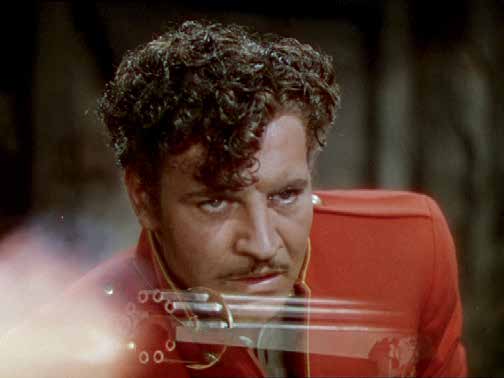
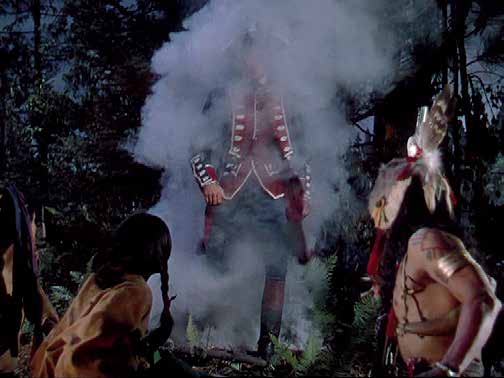
Inaugurating the work on colour in 1940 with North West Mounted Police (probably inspired by his 1908 play The Royal Mounted), DeMille took the easy way out, satisfied with stuffing the frame with the largest possible number of soldiers, with their red uniforms against the blue night. It was the easy way out again, though in a less exclusive way, in Unconquered (1946).

But from Reap the Wild Wind (1941) on, there was a new orientation that was unexpected and which is still forgotten in the work of this filmmaker who is often deemed conventional, primitive and barbaric. There is an exquisite preciousness at work here, the work of a minor master, founded not on bright rainbow colours typically harnessed by Natalie Kalmus, the Technicolor consultant of the time, but on almost pastel-like halftones, buttercup orange, Provence yellow, peacock blue, bright blue, crimson, purple and especially mauve. We don’t see Susan Hayward die, but we understand everything the moment we see her red-and-orange shawl saved from the rubble. It was above all the costumes that made this chromatic extravaganza possible, notably in scenes showcasing the lives of the rich in Key West (Florida) and Charleston (South Carolina) around 1830: cabriolet rides and balls, which are nice opportunities to show richly dressed characters moving around, entering or leaving the frame surreptitiously. Colour in movement is what we find in an even more developed state in Samson and Delilah and in The Greatest Show on Earth; the extras count less for what they represent in the story than for the relation between their costumes in the frame: a touch of crimson here, a touch of mauve there to get a shot of a harmonious, original and ravishing composition. It can be useful to let a costumed extra walk across the foreground very fast. One thinks of the Minnelli of Meet Me in St. Louis, of Nicolas Poussin’s and John Sargent’s mauves. The Greatest Show on Earth poses a problem: does the colour composition owe to DeMille and his staff, or were the ballerinas and clowns of the Barnum circus already dressed like that, with their multicoloured props? I noticed that this work on colour is wholly in line with the one in preceding films like Samson or Reap the Wild Wind.

No matter who did what, the main thing is what exists, what DeMille imagined or accepted, with the help of costume designer Edith Head, and that’s the astounding virtuosity of the result.

The visual composition is sometimes extended to the sets—the pink roses of Reap the Wild Wind—and to the exteriors, which are often shot in studio, or completed using transparencies. A recurring set is that of the bath or of washed clothes near a small lake (Unconquered, Samson, The Ten Commandments in the scene with Moses and his wife), a very precious set with a mosaic of halftones complementing the dark blue of the sky… and the water. In his excellent study published in issue no. 5 of Cahiers du cinéma, Jacques Doniol-Valcroze compared this arrangement to Hubert Robert’s Roman landscapes. These discrete compositions offer a respite from the primitive aggressivity of the epics.

Here is a subtle DeMille, far removed from the colossal DeMille often described by the press.

The only real interest of The Ten Commandments (apart from the extreme precision of its framing) is the work on colour and composition, with its skilful mix of very different colours in the same shot, not just mauves, but also many shades of yellows, and vast skies that are very black or very red—compositions that are somewhat undermined by the fixity of the camera and the actors. The best shot is the one borrowed from Géricault’s painting The Raft of Medusa, situated just before the crossing of the Red Sea, where we see three suppliants in inclined and varied positions, their arms wide apart. It’s all the more accomplished as it lasts barely three seconds. For once, DeMille has been able to tap into the power of concision.

The finest sequence owes everything to colour. I’m talking about the ten plagues of Egypt, with its festival of deadly lightnings, where, against all expectations, the Nile gradually turns completely red over the course of a shot. The rapid accumulation of effects is astounding. Note the filmmaking trick: to show that the red of the blood is invading the waters of the Nile, Moses’ staff is placed obliquely in the frame to serve as a marker, a gauge that allows us to clearly see the red colour approaching the staff and then crossing it.

It is in leaving the Lumière factory that the workers give themselves over to cinema, that they attain the status both of actresses and of future spectators. Moving away from work, they enter the enchanted world of entertainment. For the world of work is only weakly enchanted (enchanting), and unlikely to be enchanted in return by cinema, except in the form of a nightmare…

– Jean-Louis Comolli, Images Documentaires 24

On 22 March 1895, in the Rue de Rennes in Paris, inventor and industrialist Louis Lumière presented a private demo of a motion picture system he had devised with his elder brother Auguste. The device was called Cinématographe, and the 17-metre strip of celluloid used to show its working was titled Workers Leaving the Lumière Factory in Lyon-Monplaisir. Lasting about fifty seconds when projected at a certain speed, it showed a mass of labourers, mostly women, leaving the Lumière facility at lunch hour from either side of two gateways. The audience at the demo, composed of businessman, researchers and photography enthusiasts, was very different from the people on screen, as most movie audiences would be in the coming decades. Traditionally considered the first ever motion picture, Lumière’s film bound labour and cinema together for eternity, the image of workers leaving the factory being a veritable birthmark for the medium.

What is less well-known, however, is that there were at least three versions of the film. In the first two iterations, the gates are already open, and the workers flood out from the first frame onwards. Even so, the factory is not emptied by the time the picture ends — that is, by the time the camera runs out of film. The culprit appears to be a horse buggy that takes time to come out of the facility. The third version premiered in the first commercial showing of Lumières’ films in the Grand Café on the Boulevard des Capucines in Paris on 28 December, 1895. In it, the door opens only after the film has begun, and thanks to the absence of the buggy, the workers get out in time and the door is (almost) closed. Now considered the definitive version, this “first film” in the history of cinema, was in fact a remake of a remake.

Why did Louis Lumière make several versions of the film? One theory is that, since there were no internegatives in the film development process at the time, the original negative degraded with every new print made. The picture had to be therefore reshot onto a new negative so that fresh copies could be made for various screenings across the continent. Another hypothesis is that the Lumières didn’t like the quality of the picture and judged that the factory gates should close before the camera ran out of film. After all, a door opening and closing in the manner of a theatrical curtain had a certain spectacle about it that is missing in the first two versions, which drop us in medias res, so to speak.

Whatever the reason, it is believed that, after the first version of March 1895, the brothers summoned their workers for repeated takes, sometime in early summer. The planned day of reshoot falling on the Lord’s Day, the Lumières requested their employees to come to the factory after the Sunday mass to simulate the scene of workers leaving for lunch on a workday. As a result, in the second and third versions of the film, the participants’ hats and clothes are fancier, their mood more cheerful: one female employee mischievously tugs at the skirt of another just as they take leave from each other. The actors themselves seem wiser to the presence of the camera, more professional, so to speak. In comparison to its predecessors, the third film is on the whole more harmonious, less chaotic, the flow of workers out the gates more streamlined. Except for an implacable canine and his bicycle-bound master, who appear in all three versions, the play of chance in this definitive version is minimal.

It is not known whether the participants were paid for any of the versions, if not as the first actors of cinema, at least as workers doing overtime (on a Sunday to boot — France wouldn’t become officially secular until ten years later). At the time, there was no law in effect in France limiting the working hours. Labour unions were illegal in the country until 1884 and the General Confederation of Labour (La CGT), France’s first and largest confederation of labour unions was established only in September 1896, sometime between the private and the commercial screenings of Lumières’ film. On 1 May 1891, incited by Paul Lafargue (a son-in-law of Karl Marx’s), textile workers up north organized demonstrations in favour of the eight-hour work day. In the town of Fourmies, soldiers opened fire on the demonstrators, killing nine young people.

The protests were an emanation of the ferment across the Atlantic, where there was considerable labour unrest in the preceding decade. In May 1886, workers in Chicago rallied in favour of a universal adoption of the eight-hour work day, until then applicable to only certain sections of the American workforce. The rallies turned violent, a bomb exploded and several people died. Three years later, the Second International, adopted the 1st of May as the International Workers’ Day to commemorate the events in Chicago and to continue the campaign for the eight-hour work day. The demonstration at Fourmies was part of this campaign.

Much has changed in the nature of labour, its conditions and its screen representation in the century since Lumières’ film. Workers Leaving a Factory seems to possess a historical innocence that is impossible to recapture now. The men and women leaving the Lumière factory did so in an era of industrial optimism and ground-breaking scientific progress. It wasn’t until the First World War, and its technologized warfare, that this faith in scientific rationalism was seriously questioned. With Fordism rendering skilled labour ever more marginal and the Great Depression causing unprecedented levels of unemployment, industrial work could no longer be viewed the same way. The downbeat image of hunched, robotic workers changing shifts in an underground industrial-city in Fritz Lang’s Metropolis (1927) or the cut from a herd of sheep to contemporary workers leaving the subway in Chaplin’s Modern Times (1936) altered the primal scene of Lumières’ film irrevocably.

For the centenary anniversary of Workers Leaving a Factory, German filmmaker Harun Farocki made a video work of the same name, which traces the cinematic genealogy of the “first film”. Analysing photographed images of workers at factory gates through the years, Farocki deems it “an image like an expression, which can be suited to many occasions”. His film views the area outside the factory as a dialectical space. For one, it is the place of direct confrontation between Labour and Capital: between picketers and guards, between strikers and the police. The factory gate becomes the membrane that separates work from workers, an economic system from its constituents. It is at the factory gate that Labour and Capital identify themselves by identifying the other

Farocki also regards this space as facilitating diverging definitions of the public and the private. On one hand, the factory entrance mashes private individuals into the mass being called workforce. It is for this reason that much of popular cinema centres on life outside work. In these films, narratives about individual lives begin once work is over and the impersonal, faceless workforce dissolves into separate somebodies. They replace the viewer’s leisure time with that of the characters, our problems with theirs and provide vicarious pleasures and catharses. “Whenever possible, film has moved hastily away from factories” says Farocki’s narrator, noting that in one hundred years of cinema, there have been more prisons and correctional facilities than factories and workers. It is indeed telling that mainstream cinema has shown itself better equipped to depict work when it is a form of punishment or a crime than when it is part of an everyday reality.

On the other hand, suggests Farocki’s film, the area in front of the factory gates is itself subject to competing notions of property and theft. While the territorial imperative of Capital defines this liminal space as the company’s private property, for the workers it becomes a public area of discussion, congregation and protest. “Where the first camera once first stood, there are now hundreds of thousands of surveillance cameras”, goes Farocki’s narrator, pointing out how cinema unwittingly became an instrument to safeguard Capital. The apparent innocence of Lumières’ film may, however, be fallacious too. With the camera cranked by Louis Lumière himself, and his employees dutifully hurrying out of the factory under his instructions, it could be argued that even the first film was a form of surveillance footage.

Surveying the factory gates is evidently in the interests of owners, but what happens when employees do the surveying? In the era of invisible labour — the rise of the class of knowledge workers, the erosion of the boundary between workplace and home, and the ceaseless digitization of all work in general — does it even matter if the factory gates are watched over? Some companies certainly think so. In his digital video Workers Leaving the Googleplex (2011), American artist Andrew Norman Wilson recounts the repercussions of filming and talking to workers leaving the “ScanOps” facility at Google headquarters in Mountain View, California. These temp workers, responsible for digitizing printed matter for Google Books, are comprised chiefly of people of colour and don’t have the same rights as other contract employees at the firm. Wilson, himself a contract employee with the tech giant at the time, was sacked for violating the non-disclosure agreement even though his footage barely shows any worker leaving the building. If Lumières’ film has any lasting politico-cinematic lesson, it’s that bosses will always want to be the ones holding the camera.

[Originally published at Firstpost]

[From Luc Moullet’s monograph Cecil B. DeMille: The Emperor of Mauve (2012, Capricci). See Table of Contents]

The Ten Commandments (1956): the golden calf sequence with the whole image filled with extras.

In 1949, DeMille was sixty-eight years old. He seems to have been obsessed with the idea of finishing his career on a film that would cost as much as possible, make the most money, be the longest of them all and impose the name of Cecil B. DeMille for all eternity. That is what can be felt at the beginning of Samson and Delilah (1949), The Greatest Show on Earth (1951) and The Ten Commandments (1956), completed two years before the filmmaker’s death. These three films begin with a preamble which is far above the relative banality of the story that follows: we see the Earth spinning, an emphatic commentary (sometimes read out by the filmmaker) seems to offer a moral, even a metaphysics.

And the films are increasingly long: Samson clocks 128 minutes, the next film 150 minutes and The Ten Commandments runs for 225 minutes, whereas the first version of the latter devoted only one hour to its ancient segment.

The costs (and revenues) went up too: $3,097,000 (Samson), $3,873,000 for The Greatest Show, but The Ten Commandments had the biggest budget of its time: $13,272,000.

To be objective, it must be noted that the budget of Samson, shot in only eleven weeks, was modest: the film cost less than a contemporary comedy like It’s a Wonderful Life. It was probably because Paramount was scared of History, and Antiquity in particular, and wanted to limit the damage after the crushing failure of C.B.’s last American epic, The Crusades, which delayed the production of Samson by thirteen years, and of a British Caesar and Cleopatra. The actors who were cast, Hedy Lamarr as well as Victor Mature, weren’t top-stars at the time, and the film only has one really expensive scene: the last sequence at the temple. So it wasn’t very different from the strategy of the years 1919-1922, with their ancient interludes, which I will talk about later.

Is it this relative lack of money that explains some of the anomalies detrimental to the film?

The fact remains that the choice of Angela Lansbury to play Hedy Lamarr’s elder sister is rather incongruous, since Lamarr was thirteen years older than Lansbury, and it shows. And then, you don’t feel that Samson has lost his hair, which, being brown, remains very visible. Perhaps Victor Mature refused to have his head shaved. Moreover, after the alleged haircut, his hair has contradictory lengths, to say the least [1]. This probably corresponds to a non-chronological shooting schedule.

Except at the end, the action remains quite slow, especially during the episode of Samson’s seduction by Delilah. The characters dwell on their complex and shifting motivations. The tempo here resembles that of an opera, necessarily moderato because it takes longer to sing than to speak. DeMille may have originally wanted to adapt Saint-Saëns’ opera.

But given its consistency, the viewer eventually accepts the principle.

The film tends towards abstraction, Beauty and the Brute, with DeMille embellishing and circling around these basic definitions.

Let us pass over C.B.’s casualness towards the Bible, in which Semadar in not Dalilah’s sister. In any case, these questions about plausibility and fidelity to the Bible are rather ridiculous if we consider that the Old Testament states that Moses, prefiguring Jeanne Calment, died at the age of one hundred and twenty.

The Ten Commandments doesn’t work. Sensing that the film will be his last, DeMille wanted to stuff as many things as possible into it. The result is torn between four contradictory directions:

a distant, frontal, Brechtian presentation;

an accumulation of similar effects, which becomes tiresome over almost four hours;

a rich work on colour range;

an emotional-political plot worthy of a mediocre B-movie (Moses and the Pharaoh as romantic rivals—some cheek).

The Greatest Show on Earth (1951): the circus troupe after the train accident, every man for himself.

On the other hand, The Greatest Show on Earth, which in fact received the only Oscar for Best Picture awarded to DeMille, remains a fascinating work. It revolves around a grand touring circus, Ringling Bros & Barnum, with the different acts of the show being interspersed with criminal and romantic subplots, highlighting the various participants of the circus, thanks to some skilful editing. This alternation avoids any risk of boredom. It isn’t just a question of alternation, since pure spectacle and individual subplots come together in several shots. I’m thinking particularly of the magnificent scenes following the train derailment, where we see animals, elephants, lions and others, walking across the wreck of the train, trucks, iron and woodwork, and circus props, near the injured, those attending to them and those running all over the place to salvage property and worry about the fate of their dear ones. As in The Story of Dr. Wassell, DeMille frames five to ten people in the same shot, people going in different directions, remaining in highly varied positions—lying down, standing up, leaning across, constantly talking at the risk of speaking over each other. This handling of small groups produces results that are ultimately more rewarding than those of shots with massive crowds, with which DeMille is often identified with. Their humanity is much stronger.   

Cinema here becomes a veritable creation of a world, a bit like in The Thing from Another World, made by Hawks the same year. Circus and cinema become one. The slightly pompous statements of the preamble take on an unexpected dimension thanks to simultaneous images showing the preparation of the premises and the raising of the circus tent’s main mast—a moving lyricism, based on great sobriety.

It’s a pity that DeMille didn’t make any other film around the production of a show, a subject that he obviously knew very well after sixty-eight films, and which he had probably tackled in the scenes at the film studio in We Can’t Have Everything (1918), alas lost, and broached in What’s His Name (1914).

We have there the old problem of paying a troupe full time rather than limiting its activity to more profitable one-offs, a problem that had partly justified DeMille’s breakup with Paramount in 1925—the fight against unemployment in Cecil DeMille’s work…

And of course, there is the interference between work and emotions, a bit like in Renoir’s French Cancan, the rivalries between stars…

There is a totalitarian side to the film: DeMille wants to stuff everything in without offending anyone, the Church, the police, the financiers, the frauds, even the audience, and something that really takes the cake considering our filmmaker: the vanity of money (cf. the shot, towards the end, of banknotes lost in the disaster). The only reproach that could be made is that the usual effects—chaos, visual composition, permanent ubiquity, verbal jousts—are repeated, in all their excellence, for two-and-a-half hours here. The actions may be different, but the way they are performed remains the same.

One could balk at it. DeMille’s art isn’t an art of the fugue. But this inventive accumulation amazes, stuns the viewer—a hammer-like aesthetic, with many nails to go with it. We end up accepting even the “Stars and Stripes Forever” aspect of the film.


Footnote:

[1] Similarly, in The Road to Yesterday, the dialogue specifies that the shadow moving on the wall is that of Schildkraut, whom we see immobile in the following shot—a continuity error.

[From Luc Moullet’s monograph Cecil B. DeMille: The Emperor of Mauve (2012, Capricci). See Table of Contents]

Union Pacific (1939): the comedy of turning heads.

After these erratic years, divided between epics and modern films, DeMille returned to the only tried-and-tested standard, that of adventure films, and particularly Westerns.

From 1934 until his death, DeMille did not make any more contemporary films, with the exception of The Greatest Show on Earth, based on the exoticism offered by circus spectacle, and The Story of Dr. Wassell, which rests on another exoticism, that of the war in Indonesia. It was perhaps a mistake, for these two modern films are the best of this period. Never again, in the twenty years that followed, did he experience commercial failure.

Almost all these films centre on a male star, Gary Cooper (four films) or Fredric March or Joel McCrea. The hero is often provided with a double, a friend, a rival or an opponent, who goes astray or, being the only one to survive, prevails over him (The Plainsman, Union Pacific, North West Mounted Police, Reap the Wild Wind). This recalls the two brothers of The Ten Commandments, even the two DeMille brothers.

These films are less ambitious, less innovative on the artistic level. Sobriety is the rule here, in contradiction with our filmmaker’s usual impulse. Movies like The Plainsman (1936) or The Buccaneer (1937) are very professional, highly accomplished films, one based on the glorification of Western myths, the other on excess, but there is nothing, or almost nothing, in them that allows us to recognize C.B.’s handiwork. In The Plainsman, the actors are always in character: they always have something to do, and that’s what gives the film its entire power.

We recognize our auteur a little more in Union Pacific, a spirited film which recently met with a peculiar success: selected in 1939 for the first Cannes Festival, which was cancelled due to the war, it was awarded the grand prize of the festival sixty years later—a slightly excessive reward since Hawks’ Only Angels Have Wings is more strikingly original and powerful. Union Pacific takes up a motif dear to DeMille, that of trains and railway disasters, which was already central to The Road to Yesterday and Saturday Night. Particularly noteworthy is the row of fifteen drunken heads in the saloon that turn around one after the other, and another effect that has been repeated many times since: the villain is about to shoot the hero, who turns around and kills him; he has seen the villain’s reflection in the mirror.

Another feature common to all these films: from 1939 onwards, DeMille only shot in colour. He was the first filmmaker in the world to abandon black and white for good. After several oscillations between monochrome and polychrome, Hawks took the plunge only in 1953. For Vidor, it was 1954; Ford and Hitchcock waited till 1962. One film towers above the rest while respecting the same principles as the other films of the decade. It’s The Story of Dr. Wassell (1943), I’ll come back to it.

[From Luc Moullet’s monograph Cecil B. DeMille: The Emperor of Mauve (2012, Capricci). See Table of Contents]

The Sign of the Cross (1932): the evil Nero (Charles Laughton) between his two manicurists.

The prodigal son now returned to Paramount, sheepish after a series of flops, sealed by the failure of the third The Squaw Man, a mediocre abbreviation of the original, and that of a project in Russia.

With The Sign of the Cross (1932), it was really a game of double or nothing. It turned out to be double. It wasn’t a question of setting the cashbox on fire anymore. This epic cost even less than his recent modern films, the banal Western spectacle of The Squaw Man, or the student conflicts of The Godless Girl. Yet it contains one of the finest camera movements in the work of our filmmaker: the crane shot that superbly takes us from the arena to the stands with Nero, his court and the Roman people. It’s a bargain-priced epic, but brilliant at times, followed by more modern films like This Day and Age (1933), a fast-paced police story, and Four Frightened People (1933), which turns out to be a complex and highly curious case. In theory, the film was a new variation on Male and Female, so it was something reassuring for Paramount. It isn’t a shipwreck here, but an epidemic, the bubonic plague. The result smacks of studio work, even if the film was partially shot in Hawaii: it isn’t believable for one second, especially when Claudette Colbert, who is bathing in the open, has her underwear stolen by a monkey. The sound is really studio sound, a little like in Madam Satan, when the hero jumps from the airship into a lake: the sound effect is that of a body jumping into an indoor pool. And this fakery makes you laugh out loud. The whole film works on an ironic level; it recalls Beat the Devil (John Huston, 1953) or even Ed Wood. There is an escalation of falsehood and fakery here, probably unintentional, that I found highly enjoyable and hilarious (I had tears of laughter), with oscillations between reality and fantasy that keep the suspense alive. This is perhaps a perverse reaction on my part, having to do with to the basic principle: “the worse it is, the better it is.” But the audience didn’t agree: another commercial failure. The film didn’t even open in France, an extremely rare case in the work of our auteur.