A for American Cinema

Perhaps more than any of his Nouvelle Vague comrades, Moullet retained a fascination with classical American cinema all through his writing and filmmaking life. Some count with numbers, some others with John Ford’s filmography.

B for Backpacking

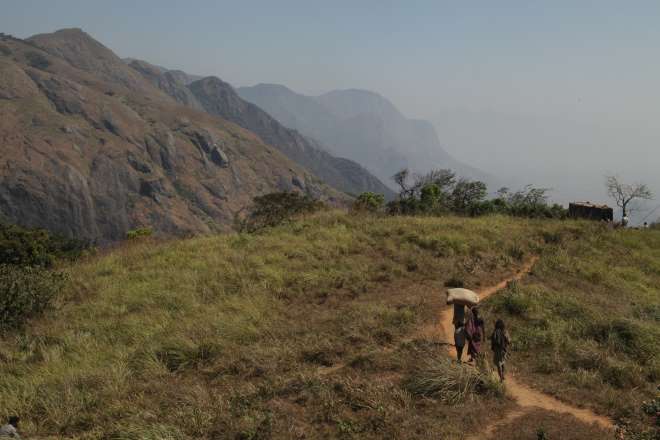
Moullet has stated more than once that his real profession is trekking (which explains his love for movies with people on the move). That cinema is just a hobby. A hobbyist’s cinema then, free of the need to make statements or find a purpose.

C for Cinephilia

A great fidelity towards cinema over other arts. There’s are a few literary references, hardly any to painting and almost none to music or theatre in Moullet’s work—quite unlike his New Wave peers. The Cahiers du cinéma is the abiding literary material on screen.

D for Doors

Probably as many as in the Dardennes. There are four or five door-related events in the very first short film, including an appearance by Moullet himself. There’s a whole film about the different ways of bypassing the Paris metro turnstiles.

E for Economics

A perennial obsession with finances, both from a macroscopic, economic point of view and in the transactional, everyday sense. A shopkeeper recounts her dealing with a serial killer. Moullet: “Did he settle his account?”

F for Fake

Master of false histories and forged statistics, Moullet was a devoted explorer of the mockumentary. His short films, in particular, dwell in the slippage between the documentary form and the fictional nature of things being said.

G for Geography

Mountains, plateaus, marshes, rivers, grasslands, slag heaps are the central characters of Moullet’s cinema. It is what he paid the most attention to in his writing as well. Many of his works are virtually excuses to film certain landscapes.

H for Housework

No helping hand to lend, no shopping to do, no firewood to pick up, or dishes to wipe. Everyone is condemned to the anti-dialecticism of intellectualism. Write, write, write forever. I think, therefore I am… but no, I think therefore I don’t wipe, for there’s nothing to wipe.” Not in his films though.

I for Irony

The Moullet persona is a product of contradictory impulses, his great delusions of grandeur undone by the pettiness of his concerns. A neurotic, self-deprecatory figure somewhere between Jerry Lewis and Woody Allen, with a touch of the silent greats.

J for Joke

The Moullet screenplay is an occasion for chaining together quips and visual gags. The joke is often a radical simplification of a situation (Moullet stealing newspapers from a vending machine) or a radical elaboration (a two-minute sequence of a man noting down something from a newspaper).

K for Kitchen

Food, of course, is at the centre of Genesis of a Meal, but has a tangential presence all through. Hunger grounds the intellectual being, the act of cooking, preparing the table and consuming all serve a purpose of reverse-transubstantiation.

L for Lists

“I have 72 ideas for key scenes, I arrange them to have a logical order”. Enumeration is the chief manner by which Moullet builds his films and texts, which overflow with lists of all kinds, often rattled off by the characters themselves.

M for Maps

The capital of French cinema, he wrote, is a rhombus in the Centre region of the French hexagon. The capital of madness, we are told, is a pentagon between the Alpes-Provence regions. A body of work suffused with cartographic imagination.

N for Nowhere

The cinema’s poet laureate of boondocks and bleds paumés, Moullet takes particular pleasure in discovering and deriding the most disconnected and isolated settlements in the country. Mean? Perhaps, what comedy isn’t?

O for Omnidirectional

A Moullet film is a collection of unicellular entities with no central nervous system or sense of time and space. It wants to go nowhere and everywhere at once. The longer the film is, the more apparent its atomization.

P for Province

For a filmmaker born and working in Paris, Moullet gives the city of lights awfully little representation. His cinema doggedly heads for the provinces, militating for a relocation of French capital to the town of Imphy, population 4000.

Q for Quantity

Moullet, who determined that 3.5m² was enough for a new parliament, is nothing if not metrically rigorous: “I had to buy half a dozen cutlets, a half-hour worth of wine, 100 metres of noodles, a litre of fresh eggs, 4 francs of olives, and a pound of cake.”

R for Resourcefulness

Shots, soundbites, narrative threads from one film, one piece of film criticism will be reused in other. Repetitions abound, and not just for the sake of humour. The Moullet cinematic universe—and one could speak of a veritable universe here—is finite and ever-shrinking.

S for Statistics

I’d gather technical information—number and duration of shots and shooting, budget, box office of the film etc.—which made subjective positions sound objective.” “Contrary to expectations, certain statistics are even more subjective than critical opinion.

T for Transport

Four people depart from Paris for the provinces. One leaves in train, one on a motorbike, another on a bicycle and the last one takes a car. The time to their destination is in inverse proportion to the speed of their modes of transport.

U for Unemployment

Moullet might be the filmmaker most concerned with unemployment, of all of France as much as his own. The sight of waste heaps strewn across Nord-Pas-de-Calais is for him as much an opportunity for job creation as it is aesthetic real estate.

V for Vélo/Love

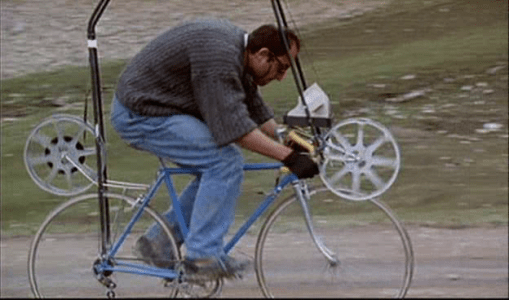
“Here I had a satisfying relationship that could last hours. One I could dominate, one which involved no problems. I tried to ride in a straight line. The more circuitous things got to be, the more I liked straight lines. I wish my life were a straight line.”

W for Whip pans

The camera oscillates between two points of interest, expressing indecisiveness, or an act of comparison. This dishonoured device finds shelter in Moullet’s cinema, a veritable refuge for such kind.

X for Xerophilia

Fear of water is the main subject of Ma première brasse, but water bodies (or lack thereof) are permanent fixtures. Moullet stays away from the coasts and is attracted to the driest of regions in France. The one film he made in the US was set in Des Moines, Iowa.

Y for Youth

A perennial boyishness, self-styled petulance and a lifelong refusal to grow up and “be serious”. A film on mortality he made at seventy is shot through with an adolescent flippancy towards death.

Z for Zsygmondy

Like the eccentric accommodation scheme of the eponymous refuge, Moullet’s writing and films are often demonstrations of analytical frameworks that are in part or wholly arbitrary. Just like the setup of a good joke.

[From my column on studio-era Hollywood films for Firstpost]


Made by Paramount studios and starring Kirk Douglas who passed away this month, Ace in the Hole (1951) is one of Billy Wilder’s best-known pictures. The film is a satire about a newspaperman Chuck (Douglas) in rural New Mexico who orchestrates a media frenzy around a miner (Richard Benedict) trapped inside a mountain. Chuck colludes with the local sheriff (Ray Teal), who is running a re-election campaign, and the local engineers to ensure that Leo isn’t rescued for at least six days, by which time the story would snowball into a national phenomenon and he would be hired by the top agencies in New York. Wilder, known for his tough, cynical classics, was also producer on the film, ensuring that his acidic sensibility dominated the film.

Wilder develops the story wholly through the warped mind of Chuck, who it seems would do anything for a scoop, including sustaining a tragedy for the sake of readership. “Good news is no news. Bad news sells better.”, he tells his naïve colleague, the photographer Herbie (Robert Arthur). He isn’t religious and smirks at the local beliefs about Indian spirits haunting the mountains. But that doesn’t prevent him from exploiting the angle for his story.  Chuck thus positions himself as the rational man towering over the simpletons of hinterland America, who are little more than fodder for his media circus, an agnostic for whom nothing—not the living, not the dead, not the living dead—is sacred.

Wilder doesn’t overwhelm the viewer with all this pessimism right away. The film’s script modulates the character gradually and subtly. Chuck is introduced as a rather affable character—overconfident but eminently likeable for that reason. His wayward career shows no sign of a moral compromise and he does uphold certain ethical principles as a reporter for the Albuquerque Sun-Bulletin. Moreover, being played by a star like Douglas naturally renders the character endearing. But the tensions slowly surface as Chuck’s sociopathic fantasies come forth, masked as professional aspiration. His eyes light up when he hears about a prospector stuck inside the mountains. Making his way through the caves, he tempts Herbie with stories of journalistic greatness.

Chuck becomes more and more menacing as the story unfolds, a transformation reflected in the accumulating paraphernalia around him: a new telephone connection, a fax machine in his room and, then, the return of alcohol. In the process, Wilder divorces the audience’s perspective from Chuck’s, who now becomes an object of critique rather than identification. Wilder’s satire spirals away from Chuck to include other characters who exploit Leo’s predicament in their own ways. Most important of these is Leo’s wife Lorraine (Jan Sterling) who also wants to leave the boondocks by latching on to Chuck. In an unnerving scene, she cosies up to Chuck, who views her seduction as a deviation from the media narrative he’s crafting and violently slaps her to put her back in line.

            Chuck’s cynicism, though, hits a wall when his plans go awry. In the battle between the telephone cable and the cross on the wall of his room, old-fashioned values triumph: Chuck experiences guilt, which he tries to violently deflect on to Lorraine. And so, the film curves into a Christian fable of sin and suffering. Not a fable from the New Testament though: in the end, Chuck gets to address the crowd from the top of the mountain, but his speech feels less like Christ’s sermon than like Moses’ exhortations on the Sinai. Wilder’s film offers no redemption for Chuck, only punishment; he doesn’t even get to make his great confession.  

Billy Wilder’s renown as a scriptwriter has often come at the expense of his strengths as a filmmaker. True, the screenplay of Ace in the Hole is nimble and constantly moves forward without flashbacks or dream sequences. Even the passage of a whole year is accomplished with a straight cut. The virtues of the script, however, don’t take away from Wilder’s economic but vigorous approach to image-making and scene building. The triggering action of the script—an out-of-work journalist walks into a small-town newspaper office—is portrayed in just four shots, establishing Chuck’s character and nonchalant attitude right away.

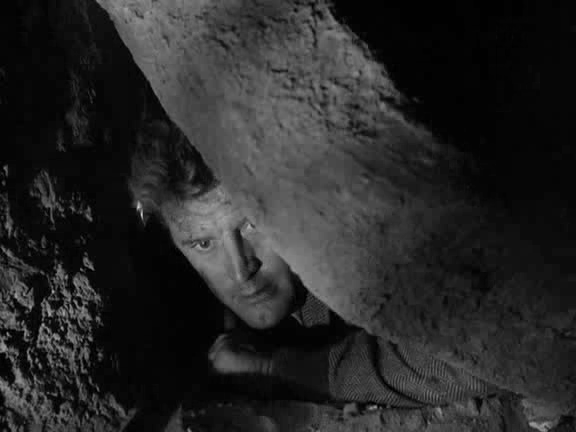
            Wilder’s images in the film are dynamic, with an emphasis on the diagonal throughout. The recurring shot of Chuck peering at Leo through a gap in the rocks has a straight line slashing across the screen, producing a sense of both instability and claustrophobia. A scene of Chuck corrupting the sheriff by promising him a re-election is shot in a tight space to conjure an atmosphere of twisted intimacy. Wilder makes the lighting progressively dramatic, and the shots are increasingly invaded by shadows as the film advances. He films Chuck from a slightly low angle all through, the compositions taking his character from assertive to threatening to positively malevolent.  

             Central to the composition is the figure of Kirk Douglas himself. An emblem of classical, rugged masculinity, Douglas had a face that was uncertain in its signification. While his wavy locks and genial smile gave him an air of a Greek god, his cleft chin, like those of Robert Mitchum and Cary Grant, and protruding jaw line bestowed a slightly sinister aura. Douglas plays with this ambivalence in Ace in the Hole. His characteristic head tilt combines with his leaning posture to accentuate the diagonality of the shots. Douglas peppers his performance with fleeting but eye-catching gestures—a matchstick dragged over a typewriter, the flip of a bottle, a snap of the suspenders, a spectacular drop of his cigarette into a glass of water after persuading the sheriff—to suggest a master rhetorician at work.  

            Chuck is a New York man, a master of the universe for whom a job at a small-town press is just a sojourn. Douglas conveys this sense of superiority in the fable-like first scene in which he strolls, unannounced and unflappably, into the newspaper office to sell himself. His tone and gesture paint him as a man who stands tall over the poor chumps of Albuquerque. But he becomes restless when he finds himself stuck with his $60/week job even after a year. In a remarkable scene filmed in a single shot, he paces about the news room, delivering a begrudging paean to New York life, evoking both nostalgia and desperation. His zing returns when he smells a breakthrough story, and he plays up his east coast exceptionalism by rough-housing a deputy sheriff.

            While within the classical Hollywood tradition of satire, whose practitioners include Charlie Chaplin, Frank Capra and Preston Sturges, Ace in the Hole feels rather modern, partly because Wilder refuses to soften it with a morally upright protagonist. Its lampooning of people vacationing in front of the mountains is broad and caricatural, but it is also discomfiting in its pungent suggestion that it takes a city to bury a man. Like the best satires, Wilder’s film spreads wide outside of its immediate milieu to accommodate a broader cultural criticism.

Ace in the Hole is, in a way, a critique of capitalism, of the American promise of upward mobility so prevalent in its time. Everyone is Wilder’s film is either selling or consuming something at the cost of someone else. While Leo’s condition is a free resource for journalists and businessmen to exploit, Chuck conspires with the authorities to eliminate competition and ensure his monopoly. This idea of a systematic exploitation and commodification of human suffering—and not as the result of a single individual’s moral perversion, but as the rational logic of a system—is part of what lends Wilder’s film its unrelenting and unnerving quality. 


[Originally published at Firstpost]


[The following is a translation of Georges Didi-Huberman’s Sortir du Noir, a long, open letter to László Nemes on his film Son of Saul, published by Ēditions de Minuit in 2015.]


Paris, 24th August 2015


Dear László Nemes,

Your film, Son of Saul, is a monster. A necessary, coherent, beneficial, innocent monster. The result of an extraordinarily risky aesthetic and narrative wager. How could a film about the Behemoth1 that was the Nazi extermination machine in the enclosure of Auschwitz-Birkenau in 1944 not be a monster compared to the stories we are used to seeing each week in theatres in the name of “fiction”? Is your film something other than fiction? Of course not. But it’s a fiction that’s as modestly as it is audaciously attuned to the very particular historic reality it deals with. Whence the ordeal of discovering it. During the screening in the dark of the theatre, I wished at times, not to close my eyes, but that all that you bring to light in this film returned to darkness, even if for a brief amount of time. That the film closed its own eyelids for a moment (which does happen sometimes). As though darkness could offer me, in the midst of this monstrosity, a space or a time to catch my breath, to breathe a little amid that which was taking my breath away from shot to shot. What an ordeal, indeed, is this bringing to light! What an ordeal is this flood of images and this hell of sounds tirelessly giving rhythm to your narrative! But what a necessary and fertile ordeal!

Like many others, I went into the dark of the theatre equipped with some preliminary information—an incomplete knowledge, of course; that is everyone’s lot—about the (historical) story that your (filmic) story deals with, namely the Nazi death machine and the role played by members of the Sonderkommando, special teams formed from interned Jews whose terrifying work is soberly described at the beginning of your film in a title card that defines them with the expression “Geheimnisträger”, “carriers of secret”. Your story (your fiction) gets out of the dark: it “carries” the secret itself, but in order to carry it into light. It is dedicated through and through to the story (to the reality) of the diabolical fate of the Sonderkommando members at Auschwitz-Birkenau: not a single shot in the film that isn’t backed up, that isn’t directly drawn from sources, from testimonies, to begin with the extraordinary secret manuscripts that you claim to have discovered in the special edition of the Shoah History Review published in 2001 under the title Voices Under the Ashes2.

Despite having gone through the same sources as you, I was left without a defence, without any protective knowledge, by the images and cries of your film. They grabbed me by the throat in many ways. Firstly, I must confess that it felt like seeing something of my oldest and most painful nightmares in front of me. There’s nothing personal in that: it’s the power of nightmares to reveal to us the structure of reality, and it’s the power of cinema to reveal to us the structure of nightmares which so often make up reality itself. I automatically think of the situations that made up the reality you narrate—and which survivors like Filip Müller and Primo Levi3 attest to—these situations without respite for anyone, and where all of life’s energy, its capacity for invention, cunning, decision, persistence, with its genius for seizing the most improbable opportunity, well, all this nevertheless led to a death sentence.

(more…)

Ottha Seruppu Size 7 (“Single Slipper Size 7”, 2019, R. Parthiban)

The claim that it’s a single-actor film is indeed a falsity, a gimmick. Sure, we see only one actor on screen (Parthiban himself), but we hear a dozen more on the soundtrack. Worse, it takes pains not to show any other actor even in scenes not featuring Parthiban. So the camera would look away from implied actors, whose exchanges we nevertheless hear. In its minimalist story that could’ve perhaps worked just as well without the conceit, a detained serial killer, interrogated by three or four high-level police officers, confesses liberally to his crimes, but walks out scot free. To avoid the monotony of looking at him speaking for a hundred minutes, actor-director-writer Parthiban cycles through a range of zany camera angles, playing with scales of objects at different distances from the camera. The framing is now partial, now distorted. Parthiban walks in and out of the view of the camera, both the film’s and of the one in the police station recording his testimony. For a major part of its runtime, we share the perspective of the police officers and never once that of Parthiban. This renders him less a character we identify with than a purely external being performing for the camera(s). On the other hand, in a theatrical gesture, we hear the voices that he hears in his head, which invites us to understand his psychology and also serves to insist that he’s not faking his way through the interrogation. I think the end result remains largely stage-bound, with concomitant light and sound effects. Be that as it may, there’s much pleasure to be had in watching the actor get so much manoeuvring space to showboat his unique personality. He forges a quintessential Parthiban character in his serial killer, a Socratic figure whose modesty, piety and powerlessness belie his wit, wisdom and wile. This fusing of Parthiban’s real life identity, his work as a writer and an actor turns him into an all-round film entertainer not unlike Jackie Chan or Takeshi Kitano.


Godhi Banna Sadharana Mykattu (“Wheatish Complexion, Average Build”, 2016, Hemanth M Rao)

Rao’s debut effort wedges together two stories. In the first, a 66-year-old Alzheimer’s patient, Venkob (Anant Nag), strays away from the home he’s admitted in, prompting his caretaker (Sruthi Hariharan) and his estranged, corporate rat of a son (Rakshit Shetty) to go look for him. In the second, two henchmen trying to hide a dead body end up taking shelter with Venkob at the home of a middle-class family. The twinning of stories has two advantages. First, it doubles as a showreel for Rao, who could demonstrate to future producers that he can handle a romantic melodrama as well as a crime thriller. (It apparently worked; his next was a police procedural produced by Puneeth Rajkumar’s new house.) But it also helps balance the film, which is otherwise a bland family drama or a tepid thriller developed in the broadest strokes possible. The characters are all are well-worn types with little inflection. The callousness of Venkob’s son, especially, is drummed up to an unsustainable pitch. It predictably breaks down with Venkob’s disappearance, and the character mellows down. As he searches for his father, he also discovers through oral testimonies his private habits, his romantic past, and his community influence, and realizes that his father wasn’t as generic and boring as the titular missing-person description suggests. In the process, he owns up to his own past, finding his roots and narrativizing his own life. Most of the search takes place through montages and song sequences, and the film itself is overly chopped up, far from the appreciable economy of Kavaludaari. If it’s still moving, it’s largely thanks to Anant Nag, who plays it light, not invoking every characteristic of Alzheimer’s patients. His essential simplicity bestows his character a basic dignity despite the ill-treatment meted-out to it by the script.


Taramani (2017, Ram)

Pray you don’t meet director Ram at a dinner. He is the kind of character who can’t pass the salt without giving you a five-minute lecture on the politics behind it. He might not be one to step inside pubs or to work at a call centre, but that doesn’t prevent him from pontificating with great authority on their social dynamics. A gay man in a hetero marriage? Ram knows exactly how he feels. A cuckolded husband? You got it. An adulterous North Indian housewife? Ram’s got you covered. The word pedantic doesn’t begin to describe this type. In Taramani, possibly the most reprehensible Tamil film of the past few years, this personality is given free rein as the director plays the wise prophet in an obnoxious, smart-ass voiceover. As he holds forth about the evils of globalization, employing preciously symbolic CGI birds realistically brought to life by an offshore VFX company, the viewer pictures a smug individual who has figured it all. The film’s ostensible story centres on the relation between a liberal, westernized, conveniently Anglo-Indian single mother (Andrea Jeremiah) and a nondescript, upwardly-mobile, resentful man (Vasanth Ravi). If the film sets their perspectives in parallel early on, it soon tilts the balance to establish a grand theory about the inadequate Indian male grappling with the sexual revolution of the past twenty years. Ram’s hand of judgment falls heavily on (straight) men—fair enough—but he proves himself utterly incapable of acknowledging the basic dignity of women without making martyrs out of them, without surrounding them with countless failed models of masculinity. This strategy also serves to acquit the filmmaker, who incriminates these broken men to conceal his own misogyny. The pat conservatism of a film like Maalai Nerathu Mayakkam, which deals with the same subject, is more honest than the pretend progressiveness of this sham. Taramani is a shameless piece of intellectual fraud.


Angamaly Diaries (2017, Lijo Jose Pellissery)

Angamaly Diaries is about gangs of young men from respectable social backgrounds flirting with lawlessness. The testosterone accumulates from frame one and, in an escalation of macho one-upmanship, blows up on their faces. There are shades of City of God here, but Pellissery doesn’t judge the community (on the contrary) and offers no higher moral ground. Instead, the filmmaker is paying tribute to the Christian-majority town of Angamaly in Kerala, whose meat trade and beef- and pork-dominated cuisine become primary motifs of the film. Diaries has formally very little to do with Pellissery’s next two films. While Ee.Ma.Yau and Jallikattu are explosives with a long fuse, building up to a crescendo through long, snake-like passages, Diaries is a serial firecracker proceeding at a breakneck pace from the get-go. Several episodes in the film have an average shot length of less than a second, the rapid edits and camera movements reflecting in their aggression the violence of the milieu portrayed. I was reminded on futurist-cubist superpositions in the way Pellissery chops up even brief actions into unrecognizable bits and stitches them back together to produce an impression rather than coherently describe events. So unlike in the later films, editing is the primary motive force and the creator of meaning here. Diaries is also decidedly a more commercial film, with its voiceover and music that reins in the otherwise chaotic proceedings, and without any of the philosophical pretensions of its successors. But if the film makes for such a crowd pleaser, it’s largely thanks to Pellissery’s work with his actors. His film is flooded with colourful characters, all of them played by debutant non-professionals. Even so, a majority of these actors leave a strong impression. The reason for this, I think, is that, in contrast to the use of non-professionals in other films in this roundup, the mostly male performances here are all set at a very high pitch, and they register with us principally through the actors’ physicality and bluster. To use the food metaphor so pervasive in the film, it’s like dousing all your dishes in the same spicy sauce. Leaves you excited one way or another.  


C/o Kancharapalem (2018, Venkatesh Maha)

The popular success of C/o Kancharapalem speaks to both the strengths and shortcomings of streaming giants like Netflix. On one hand, the fact that a modest, independent production such as this has found a sizeable audience speaks to the platform’s curatorial power and appetite for risk. But it also testifies to how easily public taste can be shaped. C/o Kancharapalem is practically a student film—a telefilm at best—whose natural home so far might have been Youtube or Sunday afternoon television. But it’s position on Netflix alongside super-productions, prestige pictures and auteur cinema does disservice to both the film and its more competent peers. The film interweaves four short stories, each involving a forbidden romance and all of them set in the titular neighbourhood of Vizag in India’s east coast. The female characters in all four stories hail from a conservative, caste-marked, patriarchal setup, which they are courageous enough to break out of through an affection for the other. This turns out to be an affront to family honour for the men gatekeeping their lives and leads to invariably sad consequences. Then there’s the question of religion, either as faith or practice, which modulates the four love stories. As can be guessed from that synopsis, the film pursues the parallels closely, even mechanically, resulting in an emphasis on the overarching concept (think Griffith’s Intolerance) at the expense of detail and texture. It cuts between the stories rather arbitrarily, sometimes forgetting an arc or two altogether for considerable stretches of time. This produces a curiously uneven emotional profile in which tensions in some sections are resolved while others remain. The film is, of course, not without endearing moments, especially in scenes involving the older pairs, but the actors are asked to do much more than they are capable of and the algorithmic quality of the scenario saps all surprise.


Merku Thodarchi Malai (“Western Ghats”, 2018, Lenin Bharathi)

Aka Profit Motive and the Whispering Wind. For most of its runtime, Merku Thodarchi Malai is a low-key portrait of a specific-geographic location: the ghat section on the frontier between Tamil Nadu and Kerala. Nature, of course, is indifferent to state boundaries, and most of the people we see co-habit within a continuum of languages, customs, beliefs and worldviews. We witness life and work in the mountainous region through the eyes of porter Rangasamy (Antony). We get a sense of the local economy, the trade routes, the inhabitants’ relaxed attitude to money, and the near-total lack of a desire for profit. Business is important only so far as it sustains life. There are accidents and there’s a bit of drama, but for most part, Lenin develops a static, existential picture of lives lived at the mercy of nature, which knows nothing of human needs and sorrows. And then comes the coup de grace: a series of events that wrecks the film down in order to build it anew. Troublesome emotions like greed and wrath take on monstrous proportions through politics and come down on the region like an avalanche. Lenin rapidly, but rigorously, sketches the consequences of the breakdown of an agrarian society tenuously held from collapse by labour unions. GMO firms, land mafia, modern machinery and development projects quickly follow, corrupting the ecosystem beyond recognition. The filmmaker lingers on a shot of a shopkeeper noting down what Rangasamy owes him in a ledger—the incipient notion of debt marking the arrival of new economic relations. Like in Happy as Lazzaro, the brute force of modernity brings in newer forms of bonded labour. The community dissolves, and with it its faith and solidarity, forcing even its non-contributing members to take up jobs in the new economy. The last half hour of the film turns our perspective inside out, forcing us to recognize the landscape now as a bearer of grief at the mercy of a human order. Merku Thodarchi Malai is that rare film which is political without being sentimental. There’s a murder that happens, but it’s presented purely as an existential reaction devoid of moral connotations. Lenin concludes with an absurdist wallop in which a uniformed Rangasamy is hired to guard his own unfenced land—now a private property housing a windmill—and protect the free winds from… what exactly? As Lenin’s drone camera flies farther and farther backwards, we see all the surrounding plots of land—each one bearing a tragedy perhaps—occupied by more windmills, those shiny white icons of clean, green progress now looking like gravestones. If you want to know what Marxist cinema looks like today, this is the preeminent film for your consideration.

[From my column on studio-era Hollywood films for Firstpost]

Adapted from Ayn Rand’s madly popular 1943 novel, The Fountainhead (1949) is the story of Howard Roark (Gary Cooper), a genius modernist architect whose refusal to accept established styles and conform to public standards make him a pariah among his peers. Roark declares that his primary quest is his work itself, not its possible beneficiaries. He does not accept the judgment of collectives and knows that no “group, board, council or commission” would give him projects. Recognizing his greatness, but lacking the courage to be by his side, are Dominique (Patricia Neal), an architecture critic in love with Roark’s work (and thus Roark), and Wynand (Raymond Massey), a self-made media baron trying to regain the strength of character he lost on his way to the top. Running the crusade against Roark is Toohey (Robert Douglas), a social-minded critic at Wynand’s publication who is convinced of Roark’s genius and wants to break him down for that very reason.

            Much of the drama of the script, adapted from the novel by Rand herself, passes through a romantic triangle. Dominique is in love with Roark, but is afraid that the world will grind him down. To protect herself from the heartbreak, she marries Wynand, who also loves Dominique. Wynand is a very nuanced figure, an antagonist trying to redeem himself, who sees in Roark the man he could have been, but was too scared to become. Roark, for his part, is a cipher, an emotional monolith who refuses to compromise his work, whatever be the personal and professional cost of that attitude. The characters’ attraction to each other are modulated less by erotic fervour than their appreciation of each other’s moral outlook.

There’s a starkly new style of acting afoot in Vidor’s film, no doubt informed by the nature of the material at hand. Unusually for a Hollywood hero, Roark is not someone the viewer identifies with. Vidor’s direction divorces our perspective from that of Roark, whom we get to know only through information supplied by other characters. In the opening volley of exchanges, Roark stands as a silhouette at the edge of the frame, as his varying interlocutors describe his personality by way of cautionary advice: stubborn, uncompromising, visionary, individualistic, too idealist for this business. Throughout the film, we hear about the brilliance of Roark’s Frank Lloyd Wright-like designs, but we’re never told why they are so.

Cooper, in turn, dials down his already minimalist style and turns the character into a near-mythical figure. Many shots present him from the back, his obscured profile lending him a larger-than-life presence. Rand’s story constantly compares buildings to people and locates the integrity or inauthenticity of architects in the designs they produce. Roark, like his creations, is solemn, impassive, upright, impenetrable and flawless. Cooper is really playing a slab of marble here. He stands tall, hardly moves and performs very few actions. Except for a pair of gestures involving his fingers, his hands always remain close to his body or in his pockets. Whatever reactions he has, he conveys using microscopically calibrated facial expressions. His general unflappability becomes a moral quality, set against the neurotic body language of characters like his frazzled, covering peer Keating (Kent Smith). This idea of laconic speech and reduced physical movement conveying a superiority of character was already present in Cooper’s role in Mr. Deeds Goes to Town (1936), and it’s taken to its philosophical extreme in The Fountainhead, thanks in no small part to Rand’s scenario.

Similar principles are at work with Patricia Neal’s character. In the initial stretches of the film, Dominique is dead-eyed, never blinks or moves her pupils when she fixates on something. She is cold and removed, her distance an expression of self-protection and a fear of loss of control. In her first scene, she tosses away a pretty statue because, she says, it’s too beautiful for this wretched world. Her melancholy defiance and whip-wielding dominance, of course, melt away when she lays eyes on Stark’s chiselled body drilling down a marble. As a result, Neal’s eyes become progressively warmer, her hands less in control. Vidor cranks up the sexual tension to untenable levels, curiously sublimating it in architecture talk. The dynamic culminates in the proto-fascist iconography of the final scene where Dominique, now wholly submitted to her love, ascends via a fork lift towards Roark, who stands atop a skyscraper looking down at her, his hands on his hips.  

This melodramatic framework is fundamental, and not incidental, to Rand’s script. In direct opposition to Freud, Rand believed that a person’s emotional life was founded on a bedrock of reason and that one could direct one’s sentimental life by rational analysis. “A man falls in love with and sexually desires a person who reflects his own deepest values”, she wrote. In flagrant contrast to the Hollywood model, Roark and Dominique fall in love with each other through an appreciation of each other’s moral, intellectual virtues. A long scene of romantic confession takes the shape of Dominique’s admiration for Roark’s nonconformism. This notion of an amorous relationship based on “rational self-interest”, if it isn’t given a lie by Rand’s own love life beset by passion and jealousy, at least makes for odd drama.

Another aspect of Rand’s script that goes against the grain of classical Hollywood is its unapologetic verbosity. Rand adores reiterating her declarations against mass culture (incriminating Hollywood indirectly), collectivism, altruism, solidarity and common standards in exceptionally lofty, impossibly articulate dialogue. She puts her most scandalizing lines in the mouth of Roark’s rival Toohey, whose cigar-blowing critic is a caricature of the New York intellectual. This writerly excess reaches its crescendo in an extended courtroom scene where Roark spells out his (and the film’s) philosophy in unequivocal terms. Like Roark, Rand sold the film rights on the condition that not one word of any of this be changed.

All the same, Vidor activates the material with a vertiginous imagery scored to Max Steiner’s thunderous score. Vidor’s style here can justifiably said to be baroque. His strong, rectilinear compositions in deep space make dazzling use of Edward Carrere’s modernist interiors and the highly directional lighting. A scene set at a marble quarry is a veritable series of minimalist canvases harnessing the straight edges of rock formations to great effect. Vidor’s eye for geometry is visible even in minor scenes like an idyllic interlude of three characters relaxing under a tree. The filmmaker’s characteristic camera movements impart a dynamism to scenes threatened by Rand’s wordiness. Even the long-winded courtroom speech is made snappy thanks to Vidor’s fluid sequencing and Cooper’s deadpan line delivery.  

Warner Brothers had bought the rights to Rand’s novel during the war, but it couldn’t be made into a film because of America’s pro-Russia stance at the time. In 1949, however, things were markedly different. The Cold War had begun and anti-communist sentiment was in the air. The House of Un-American Activities Committee (HUAC) pursued its investigation into leftist infiltration of Hollywood. At the famous HUAC hearings of 1947, Cooper and Rand were summoned as friendly witnesses to denounce communism, which they did in their own unmistakable manner. First among those promising cooperation and clean-up was Jack Warner, the head of the studio that saw a major workers’ strike in 1945. It’s something of a bitter irony that Warner Brothers, known for its socially-conscious cinema and films about the little man, would go on to make a work that decried these very values. But the climate had changed, and one thing that the old Hollywood moguls understood well was which direction the winds blew. The Fountainhead was fashionable once more.


[Originally published at Firstpost]

[The following is a translation of Luc Moullet’s tribute to Jean Douchet that appears in the January issue of Cahiers du cinéma. I’m grateful to Andy for sending the piece to me.]

I met Jean Douchet when he came to Cahiers du cinéma some months after me at the end of 1957. Truffaut, Godard, Chabrol and others, more and more taken up with preparing for and directing their first films, hardly had time—or the desire, at times—anymore to continue to write criticism. I and Douchet were delegated to take over, as much at Cahiers as at the Arts magazine. We were hence partners, accomplices and at the same time competitors (without overtly expressing this internal struggle). Douchet spent a large part of his time at his seat at Cahiers or at the Cinémathèque, making contacts with young viewers whom he encouraged to write for Cahiers, and with small parallel groups at Cahiers, such as the one that had formed around the Mac-Mahon theatre. He had a real entourage, in contrast to Rohmer, who often refused external contacts. More affable, and exhibiting great civility, he had an advantage over me, who was more preoccupied with making my first short films. But at the Arts magazine, he barely stayed longer than me, following the media backlash against the Nouvelle Vague at the end of 1960. Douchet’s activity at Cahiers was marked by initiatives such as the creation of a Prix de la Nouvelle Critique (which awarded, to his great anger, the prize for the most overestimated film to Psycho) and by strong critical stances for or against certain directors. Douchet violently opposed Buñuel, Antonioni, Bertolucci, Kubrick, Peter Brook, Autant-Lara (against whom he lost a lawsuit). This sectarian quality, his somewhat esoteric way of speaking, suited him well: he was highly inspired by spiritualism and the secret societies he haunted. Thereafter, in the spring of 1963, following the eviction of Éric Rohmer from Cahiers, he slowly left the magazine.

            After this, he was mostly involved in public speaking, moderating debates at the end of film screenings, or on television in programmes on cinema, or as a teacher. His writing activity, at times destructive, hence made way for an oral activity, for a dialogue with the viewer, for a more convivial, more measured attitude. For more than half a century, he spoke with a certain serenity, seemingly beyond petty fights, beyond all famous filmmakers (except Antonioni, whom he could never stand). At the end of the day, a richer, more indulgent, more mediatory attitude—a real ombudsman—than during his time at Cahiers. Studying films in minute detail, and thanks to video cassettes, he discovered hidden meanings in certain sequences of Fritz Lang, notably in Fury and While the City Sleeps, that no one before him had noticed. Over the years, he had acquired a Santa Claus-like status. His majestic portliness won him all kinds of good wishes, and numerous filmmakers, from 1958 till his last years, happily gave him cameos, small roles in which he excelled, harnessing his inimitable appearance and voice. Among his very rare forays into filmmaking, one must note two unexpected accomplishments: a short comedy, Et Crac ! (1969), in which Bulle Ogier and Claude Chabrol engage in delicious fantasies, and La Servante aimante (1995), where he successfully integrated the backstage and the hidden face of theatre with Goldoni’s play.

[Possible spoilers ahead]

It’s of little doubt that there is a distinct personality behind Mysskin’s films. Thanks to his acting jobs and interviews, the director is such a familiar figure that it’s also hard to see his films without imagining him personally commenting on the proceedings. But watching his past couple of works, and hearing him speak, I’m beginning to wonder if this distinct personality is of any interest anymore at all. Whenever Mysskin’s body of work seems poised to deepen in a particular direction, he marshals some unrelated inspiration or childhood fascination into a project that takes him back to square one: Takeshi Kitano, Bruce Lee, Arthur Canon Doyle. His latest, titled Psycho, is a tribute to Alfred Hitchcock. What remained intact throughout Mysskin’s meandering filmography was his capacity to tightly plot a story and hold the audience in a state of melodramatic high—an ability that collapses in this new film.  

            This is a movie about a serial killer, whose identity and MO we learn in the very first scene. Shortly after, a psychologist explains to us the motivation behind his particular brand of murders. Soon the structure for a thriller falls into place in the form of three intersecting tracks. In the first, we see the killer (Rajkumar Pitchumani) going about his job, picking up his victims and dispatching them. In the second, the police force is seen investigating into the kidnappings and murders. And in the central track, a blind music conductor (Udhayanidhi Stalin, conveniently bespectacled) is forced to carry out a parallel investigation because the killer’s latest victim is his romantic interest (Aditi Rao Hydari). In that, he is helped by a foul-mouthed, quadriplegic ex-officer (Nithya Menen) and her mother (Renuka).

            All these characters are archetypes carrying echoes of Mysskin’s earlier creations. They have no social background, except that they belong to the filmmaker’s floating universe, where characters don’t need any logical reason to have names like Angulimala, Kamala Das and Sylvia Plath. This literal-mindedness has hardly been a hindrance to enjoying Mysskin’s films because these types are generally swept into a closely-knit narrative of tremendous forward momentum. Some of that is still present in Psycho, but the overarching structure is so lazily conceived that they are here revealed for what they are: a grab bag of character tics and story elements characteristic of the filmmaker assembled into an unsightly, unwieldy whole.

            The most obvious failure is the second thread involving the police force. It’s a dead-end narrative that’s ostensibly borrowed from some other of Mysskin’s unfinished scripts. Familiar forward and backward camera movement follows the cops as they discuss the case walking towards scenes of crime. The investigative unit is led by a plainclothes officer (filmmaker Ram), who sings old Tamil film songs when under stress. This idiosyncrasy promises a hidden intelligence, but he ends up doing something so stupid that you realize his modesty was well justified.

As for the serial killer, Mysskin hangs so many references and backstories on him that it’s plain he hasn’t thought through the character enough. Clean-shaven and well-off, the man appreciates classical music. He’s given a history of Catholic school abuse. There’s then the Buddhist fable of Angulimala, like whose bandit our killer collects pinkies. We are also told that the victims are women who are at the top of their respective fields. His lair is a pig farm lit in incandescent hues and production-designed in familiar bloody, metallic palette. All of this is swept under a last-minute sympathy for the devil. As is customary with crime movies, Mysskin sketches a parallel between the killer and the protagonist, both affluent orphans, driving luxury cars with fancy numbers, listening to Beethoven, but the equivalence doesn’t hold, mostly because our protagonist is a cipher.

            Finally, there’s the main narrative track, which starts with an aggressive romantic pursuit. It never takes off because it leaps to its emotional peak too soon in a moody night-time party scene lit by row lights. The hero sings of his love for the heroine, who bewilderingly conveys her hesitation by getting off her chair and sitting down twice in succession. Romance isn’t Mysskin’s strong point (his one sustained attempt at it, in Mugamoodi, was an embarrassment), and he’s clearly trying to force the issue in order to get the investigation going. A curious little subversion is at work in having a ragtag bunch of invalids (a blind musician, a quadriplegic cop, an elderly woman and a pot-bellied man) get ahead of the police in tracking down the perpetrator. But it soon becomes apparent that they exist in order to satisfy a concept. A colossally pointless drive sequence prefaces the climax, an excuse for an emotional transition through song with little logical link to the narrative.

            At first glance, it appears that what pulls the viewer along, despite all these failings, is the way the team unravels the killer’s identity and location. But Mysskin, who made Psycho between two detective movies, is evidently deploying a fixed formula. Every revelation is preceded by a perplexing demand or action of the protagonist—he now needs two pigs, he now needs a measuring tape—which leaves the viewer guessing until the next scene, where the reason for his demand is revealed. This sensation of being left behind momentarily by the plot is indeed pleasurable, but the strategy becomes mechanical when you notice that the scriptwriter is withholding information that could well have been given without a scene’s detour. The inferences that the musician ends up making aren’t always novel or even pertinent to the case.

Psycho is Mysskin’s ninth directorial venture. There’s a perceptible change in his technique. While there’s no reserve to be sensed in aural assault of the sound design and the anxiety-inducing score he gets from Ilarayaraja, his sequencing is more restrained, the camera placement and movement less showy. Mysskin’s filmmaking is indeed an idiolect. That it sounds nice doesn’t necessarily mean it’s meaningful. After nine films, it’s still not clear to me where he’s headed. What moves him, disturbs him, excites him, outside of the countless movies and books that he namedrops? His apolitical aestheticism is a welcome difference from his more intellectual peers, but he seems incapable of following up on a line of thought. Wholly derivative (from himself and from others), Psycho jeopardizes his sole defence against that objection—that style is thought. Remains the feeling that this film could’ve been made by someone parodying Mysskin.

It only takes two minutes for Sam Mendes’ WWI saga 1917 to set up its premise. A pair of lance corporals (George MacKay and Dean-Charles Chapman) are entrusted by the General (Colin Firth) no less to courier a message to another battalion camping nine miles away. Failure to convey the message before dawn will result in the sure death of 1,600 soldiers. Its implausibility aside, this is an extremely cinematic setup, allowing the story to follow a pair of characters from point A to B. But Mendes chooses to film the entire two-hour narrative in an apparently single take, in the process snuffing out the rich possibilities of the premise.

            Like Dunkirk, 1917 is an experiment in film narrative. And like Nolan’s film, it is a failure that’s instructive in the way it fails. The director of Dunkirk had interwoven not just three timelines, which is standard practice, but three timescales: unfolding over a week, a day and an hour but sharing the same screen time. But in popular cinematic grammar, multiple closely intercut narrative threads evoke a sense of simultaneity. Failing that, a thematic correlation as is the case with films like Cloud Atlas or Wonderstruck. Nolan’s consciously anti-grammatical film demands the viewer to actively shift the time markers in their head back and forth, compelling him/her to recognize the various ways war is experienced by its participants despite a unity of mission. Whatever the mechanistic thrills of this formal scheme, the process remains intellectual, far more exigent than the intuitive pleasures offered by the accelerated editing of The Dark Knight series.

            1917 complements the challenge, choosing to preserve the spatial and temporal integrity of the narrative by filming it in a single shot. We understand right away, thanks to the history of war movies, that the corporals are going to make it to their destination no matter what, but we also know that they cannot possibly cover nine miles in two hours of real time, considering that they travel mostly on foot. It’s then immediately clear that Mendes has to fudge his filmmaking for the story to reach its conclusion. While the single shot setup purports to offer a slice of real time, as in Jafar Panahi’s Offside, the narrative itself is telescoped artificially into two hours.

            Mendes conveys a sense of passing distance and time, without it actually happening, by chaining together a series of starkly different landscapes: cramped trenches, marshlands, lush meadows, drab fields, a surreally lit, ruined city, water bodies and trenches once more. The movement of the corporals from one landscape to another serves the same purpose as a fade-out in conventional movies: to evoke a sensation of ellipse in the viewer. What we then have is an edit-less edit, like in those commercials where the actor seamlessly moves from one vastly different environment to another while seeming to simply walk across rooms. The principle is that of video games, where we find the same idea of telescoping longer durations and distances into shorter screen time, even when the player has a feeling of contiguous experience.

            The lack of cuts undermines the effect in another way too. Given that the viewer is planted in the here and the now, there’s no suspense against which the corporals’ action is to be measured. Hitchcock’s theory of suspense involves the revelation of dramatic stakes by a cutaway (to a ticking bomb, for instance). But considering we never know what’s at risk while the corporals are getting delayed, or if they’re getting delayed at all, we don’t share the urgency that the protagonists express time and again. The French film critic and theorist André Bazin championed long take realism, but only insofar as it preserved the spatial tension of a scene. The shot of an Inuit trying to hunt a seal, in Bazin’s example, has more impact presented in a single shot because it reproduces the danger involved as is. In contrast, conceit of 1917 perennially relegates the danger off-screen, rendering every dramatic development merely a shock.  

            “We experience life much closer to one longer continuous shot”, says Mendes in an interview. But do we? Anyone who has ever watched two people converse across a table will realize that we don’t pay attention to the empty space between them as our eyes leap from one speaker to the other. Our cognitive processes don’t track our ocular movement; our brain incessantly edits out insignificant information. Even our eyes constantly shuttle within a scene, causing counterintuitive mental compensations. Classical Hollywood continuity editing, which relies on closely stitching together vital bits of information from a single space, is thus perhaps more truthful to real experience than the long take. Defending classical scene construction over long shot filmmaking, Jean-Luc Godard wrote: “I would even see in that spatial discontinuity occasioned by shot changes, which certain devotees of the ‘ten-minute takes‘ make a point of despising, the reason for the greater part of the truth which this figure of style contains.

            Indeed, the formal schema of 1917 ensures that it lacks the psychological charge that even the most rudimentary war films contain. Mendes and cinematographer Roger Deakins rightly suppose that their camera must be able to move 360 degrees around the actors to capture their expression. There are even a handful of closeups in the film to underscore dramatically important moments. But these closeups are simply relayed as discrete packets of new information (grief, shock etc.) without actually anticipating them. The viewer’s identification with a protagonist often passes through a combination of an action and the protagonist’s immediate reaction to it. Think of Kirk Douglas walking through the trenches looking at the cowering soldiers in The Paths of Glory. The continuous camera movement of 1917, however, prevents shot-reverse shot constructions. Here, the roving camera introduces a delay between action and reaction, allowing the viewer to get ahead of the protagonists. Or we see the actors’ reaction before the camera pans to what they are reacting to, which makes the reaction only mysterious.

            Finally, the notion of transforming the most horrifying of wars into an awe-inducing spectacle carries a stench of Big Money cynicism. To be sure, the idea is to immerse the audience into a time-space where there’s no time for mourning or contemplation, where the only action allowed is to move on, physically and mentally. “It doesn’t do to dwell on it”, tells a higher-up to one of the corporals after a tragedy. And there are references to the “horrors of war”, to death and destruction. But all of that is wrapped up in a triumphalist narrative closer to a speedrun through a particularly hard third-person shooter than a meditation on war. Deakins and Mendes concoct several visceral, stunning passages, breaking the monotony of the conceit with regular changes in scale, pace and tone. The viewer is perpetually aware of the creation of this spectacle, even when it tries to conceal it. This self-awareness, though, is led nowhere but a dumb submission to technical virtuosity.

Writing about his son’s enthusiastic visit to the offices of a comic book publisher, American critic Robert Warshow reflected on the benefits of disillusionment: “I think Paul’s desire to put himself directly in touch with the processes by which the comic books are produced may be the expression of a fundamental detachment which helps to protect him from them; the comic books are not a ‘universe’ to him, but simply objects produced for his entertainment.” Maybe 1917 is a new kind of war movie, a proto-Brechtian project that produces an illusion of the world even as it induces a doubt as to how that illusion was produced. And maybe that’s a good thing. We’ll know in time.

[From my column on studio-era Hollywood films for Firstpost]

The White Flight phenomenon of the 1950s saw middle-class America withdraw from the cities and settle down in the suburbs. This resulted in the television supplanting cinema as the preeminent medium of entertainment. The film industry intended to tackle this by offering unique attractions and introducing more spectacular formats such as the widescreen CinemaScope. The aim was to lure audiences from the cosiness of suburban houses back to theatres. One of the most prominent examples of CinemaScope, Nicholas Ray’s Rebel Without a Cause too sought to shake up the tranquillity of suburban life by exploring the disquiet simmering beneath its apparent peace and propriety. The constituent of this disquiet is juvenile resentment and dissent, but unlike The Blackboard Jungle (1955), Rebel Without a Cause tackles the subject entirely from the perspective of the youngsters.

            In the first scene, three teenagers are seen detained at the police station at night: Jim (James Dean) for drunkenness, Judy (Natalie Wood) for vagrancy and Plato (Sal Mineo) for killing puppies. Ray expertly cuts from one character to another to develop of a collective portrait of youth gone astray. As the cops interrogate the trio, we get an idea of the reason underlying their worrisome action. Jim, the protagonist, bemoans a lack of authority in his life. His cuckolded father (Jim Backus), who can’t stand up to his nagging wife (Ann Doran), disappoints him with his indecisiveness and timidity. In his fear of inheriting his father’s spinelessness, he roughs up anyone who calls him a ‘chicken’, prompting his parents to move towns to cover up his aggression. At the police station, he gets thrown down by the interrogating officer, who earns Jim’s respect for that.

Judy’s father doesn’t dote on her the way he used to when she was a child. Suddenly expected to behave like a woman, Judy draws the attention of her parents through her transgressive behaviour. Plato lives with a guardian ever since his parents separated and left him alone. Armed with a pistol, he lashes out at anyone abandoning him. The film makes it amply clear that these are not teenagers from difficult economic backgrounds. The youth we see are affluent; most drive around in their own cars and live in large suburban houses. It is, in fact, the materialist and convenient life of post-war America, devoid of a sure moral grounding, that the boys and girls are reacting against. Rebel Without a Cause is thus an account of a generation coming to age at a time of peace, but also one of empty spiritual lives.

Produced by Warner Brothers, the film traces its lineage partly to psychiatrist Robert Lindner’s eponymous book on psychopathy. While its script does offer ample psychoanalysis of its characters, Nicholas Ray isn’t interested as much in offering a study of these wayward youngsters as obliging the viewer to share their viewpoint. Criminal behaviour is evoked, but it remains off-screen, registering simply as symptoms of a more fundamental problem. Classical Hollywood’s poet laureate of youth, Nicholas Ray immerses us into a world in which adults are only powerless spectators. His focus is on young people living through the final hours of a tumultuous period in their lives. The film unfolds in just over a day, a duration in which the teens break with their parents, make friends, experience death, find love and come of their own.  

            In one famous scene, the school takes its students to the Griffith Observatory in Los Angeles for a show on constellations. The youngers’ rivalries and grudges seem positively petty set against the commentator’s remarks on the insignificance of human life on the cosmic scale. On the other hand, the emotions they are living through is a veritable end-of-the-world scenario for them. Jim and his peers are, as it were, “half in love with easeful death”, even though they don’t wholly understand the concept. They engage in a sensational knife fight outside the observatory in a display of one-upmanship. That night, they continue their battle in the form of a “chickie race”, which involves driving stolen cars towards a cliff and jumping off at the last moment. Jim survives, but his rival Buzz (Corey Allen) perishes.

            As Jim unsuccessfully explains to his parents that he should turn himself in and walks away to the police station, the other youngsters decide to threaten him against it. This leads to a long night of strife in which all the teenagers of the town are out on the streets, the adults relegated to the margins of this failed society. Running away from the mob, Jim, Judy and Plato end up at a deserted mansion near the observatory. They romance, crack jokes and horse around in the dark—a behaviour much removed from the death-stricken panic of the hour before. If the film’s depiction of the youngsters’ amoral power games was a sharp deviation from the clear moral binaries of classical Hollywood, this indifferent response to a fatal incident borders on the scandalous.

            In their playacting at the mansion, the trio simulates a nuclear family—Jim the husband, Judy the wife and Plato the child. And in this improvised roleplay, they come to work through each other’s complexes and satisfy one another’s needs. The diminutive Plato sees in Jim and Judy parents who will never abandon him like his real parents did. Judy finds a protective figure in Jim, under whose affectionate kisses she can grow up at her own pace. And in standing up for Judy and Plato, Jim walks out of the shadow of his father’s cowardliness to find a stable moral compass. None of these roles is real, but it is good enough to take them through their night of sentimental education.

            “It’s an age where nothing fits”, remarks Judy’s mother. She’s talking about Judy straddling childhood and adult life, but it could well be a comment on Ray’s use of the Cinemascope. Shot in a dizzyingly wide aspect ratio of 2.55:1, the film employs the horizontal spread offered by the format in striking ways. In the very first shot, Dean falls down drunk on the road, his body slowly contracting to accommodate itself into the frame. Objects and actors hurtle across the screen at great speed all through the film, and Ray’s compositions in deep space, his unusual camera angles and movements, his anti-grammatical editing produces a strong, baroque aesthetic. Ray pays great attention to the teenagers’ clothing and footwear, whose primary-colour dominated palette clashes violently with the brown-and-grey outfits of the adults and the sedate, beige wallpapers of the houses.

            The single most non-conforming element, however, is the figure of James Dean himself. His very presence in the film, conveys a sense of spontaneous revolt. The memorable image of him in his iconic red jacket, collar upturned and his fists in the pocket, is a picture of coolness as much as of barely contained rage. Dean’s is a truly modern performance in the vein of Marlon Brando. His improvised body language, with muffled gestures and a lowered head, and his purposefully inarticulate line reading draw him inward from the screen, cultivating an aura of seductive mystery about him. Dean died in an accident a month before the premiere of this film at the age of 24. His death catapulted his celebrity onto a mythical plane, turning him into an enduring symbol of youth rebellion. Rebel Without a Cause, his most famous film, embodies what its French title describes: a lust for life.


[Originally published at Firstpost]

Gantumoote (“Baggage”, 2019, Roopa Rao)

That a coming-of-age tale told from a girl’s point of view seems exceedingly fresh partly points to cinema’s conditioning of the audience to the primacy of the male gaze. Rao’s film is the hidden half of a story we are intimately familiar with: a lively, popular boy loses his way in life because of his romance. Rao filters the story entirely through the perspective of her protagonist Meera (Teju Belawadi, daughter of filmmaker Prakash Belawadi), in whose voiceover the film unfolds. At times superfluous and overpowering, the anachronistic voiceover oscillates between the adult Meera, trying to make rational sense of her experience, and her teen self, living life as it presents itself, and nevertheless provides fruitful tensions with the image. From the outset, Rao portrays the movie buff Meera as someone who likes to see (the interaction of screen and spectator has generally been the prerogative of male cinephiles). Through countless shot-reverse shot constructions, she makes the viewer share Meera’s awakening of desire. All through, the emphasis is on Meera’s autonomy, her right to be alone, to want alone, to suffer alone. Rao plays off specific gestures (Meera pulling her boyfriend by his shirt sleeves, his preventing her from biting her nails) against a series of moods (the anxious wait for first kiss in monsoon, the languid summer vacation), specific memories of Meera’s against her lack of knowledge of events beyond her purview. Even when it goes in and out of student film territory, Gantumoote is carried forth by Belawadi’s incredible turn. Her frame drooping in harmony with her eyebrows, she looks over the shoulders, hers or her beloved’s, her eyes conveying her inner life with the directness of subtitles. She is an instant star.


Ee.Ma.Yau (“R.I.P”, 2018, Lijo Jose Pellissery)

Ee.Ma.Yau deepens the suspicion I had watching Jallikattu: that Pellissery works like a painter. First comes the underlying structure; in this case, the social machinery of a small-town Christian community that springs into action following the death of a member. Overseen by a trusted friend of the deceased’s son, a doctor, a priest, a policeman, an undertaker, a printer, a coffin maker, a gravedigger and a music band galvanize around the dead alcoholic. Overlaid on this impersonal societal analysis, like colours on a drawing, are human emotions and characteristics: desire (of an man wishing a grand farewell to his dead father), malice (of a man who is bent on arousing suspicion around death), self-righteousness (of a priest who makes it his mission to complicate things), greed (of a coffin maker trying to sell an expensive unit), generosity (of a friend willing to abase himself to alleviate his friend’s suffering) and compassion (of a rival battered by the dead man). Like Jallikattu, this is a film about how these individual qualities overwhelm and destroy the community from within, turning a complex collective calculus to see off a man with civility into a spectacle of uncivility. Despite the (sometimes unwatchable) sordidness of the happenings, the stress is on the basic dignity of individuals. Pellissery’s characteristic, long Steadicam shots bridge indoors and outdoors, connecting the perspectives of characters that were only pieces in a communal mosaic before the death. The uniformly caffeinated performances are pitched above everyday realism, but below cartoonishness. While his work on the image is still strong—the floodlight-bathed coastal town has a distinct character—Pellissery has no qualms dealing in the abstract or being literal-minded: a blunt coda resumes the film’s philosophical motivations. A potent shot of cheap liquor you don’t want to try again.


Suttu Pidikka Utharavu (“Shoot at Sight”, 2019, Ramprakash Rayappa)

An unmitigated disaster. All it takes is five minutes to figure that this is the work of a bona fide hack. It’s the director’s third film and he’s apparently never heard of a tripod. One could say that Rayappa really puts the motion in motion picture. Three men (or four, who cares, certainly not the filmmaker) rob a bank and hole up in a cramped residential colony of Coimbatore, Tamil Nadu. A hot-headed officer (Mysskin, paying his bills) is on their heels. It so happens that a group of terrorists are hatching a bombing plot in an apartment in the same colony. The specificity of location suggests that the writer-director has a personal connection to it. But all we learn about the area is that it’s overridden by ostentatious and treacherous North Indians, and so the good policemen of Tamil Nadu are obliged to carry out a clean-up job. A big twist at the end is intended to overhaul our understanding of the events. The director is clearly aware that he’s been cheating his audience so far, and tries to cover his tracks with no avail. The result is a cheap prank in the vein of The Usual Suspects. There’s a monumentally irritating constable character whose stupidity is amped up solely for the big twist to work. The sole point of interest is the final reveal montage: in maybe fifty shots in three or so minutes, we get to hear the whole backstory—an indication of Tamil film audience’s increasing capacity to absorb a great volume of sudden information, a capacity thoroughly abused here.


Kavaludaari (“Crossroads”, 2019, Hemanth M Rao)

A valuable archaeological find was robbed and the family of the archaeologist murdered in 1977 at the peak of emergency—the original moment of the Indian public’s disenchantment with politics and its practitioners. The case, thought to be a stub, is pursued by a traffic policeman (Rishi) after 40 years when unidentified bones of three individuals are found during a road-widening project. The cop collaborates with the original officer who investigated the case (Anant Nag) to complete the puzzle. Co-writer of Andhadhun, Rao renders the idea of the police officer living with his case literally, as the people involved in the murder materialize in his apartment with post-production effects. The film starts out as a more ambitious portrait of men and their obsessions, problematizing the investigators themselves, but eventually settles on a traditional whodunit arc. Rao loads the narrative with information after information, plot thread after plot thread, whether they serve to enrich it or not, whether they are indispensable or not. The surfeit of information in itself—mimicking the cognitive experience of navigating today’s mass and social media—sustains a feeling of mystery and importance. The film is generally a couple of steps ahead of the audience, but imagines it is taking them along. In a crucial montage, the suspense is taken to an artificial crescendo through an intercutting between three different spaces. It’s supposed to create an anticipation about the identity of the killer, but what it does instead is produce an anxiety that something grave is underfoot. This mechanistic approach to thrill aside, Rao exhibits an admirable economy of exposition. Several sequences are constructed out of the fewest possible shots, the camera craning across space to furnish additional details. There’s a charming shot of the two investigators waiting in a car in which Anant Nag tries to trap a CGI fly as Rishi observes with amusement from the back seat.


Thondimuthalum Driksakshiyum (“Evidence and Eyewitness”, 2017, Dileesh Pothan)

Having eloped, Prasad and Sreeja (Suraj Venjaramoodu and Nimisha Sajayan) are on their way to the north of Kerala when Sreeja’s matrimonial gold chain is stolen by a criminal (an ostentatiously self-effacing Fahadh Faasil) who swallows it when caught red-handed. The trio ends up at the police station of a tiny town to sort out the issue. It’s an open-and-shut case with no information withheld from the audience, and the film rejects novelistic suspense and epistemological mysteries. The director keeps riffing in scenes set in the police station by weaving in peripheral incidents of petty crime, which increases tension by delaying plot progression. This allows him to mix contrasting tones to great effect, visually (as in the shot of the devastated wife sitting next to colourful balloons), narratively (the triviality of the crime set against the seriousness of consequences) and conceptually (the sanctity of a marriage having to pass through a thief’s rectum). In an unusual characterization, he describes the police force as a rather transparent establishment where information trickles up and down with ease. The cops get comfortable with the plaintiffs on a first name basis, while the latter grow familiar with all the policemen. More sharply, the film spirals out of the story of small-time felony to weave a quasi-philosophical picture of individuals caught up in the whirlpool of impersonal institutional imperatives. The film’s Rashomon-like network of perspectives are centripetally held by the act of stealing a gold chain. The husband (seeking the stolen valuable), the wife (seeking honour and justice), the criminal (seeking liberty), the constable who lets him escape (seeking a closure to the case) are acting on a constant drive for self-preservation, but they are also capable of tremendous, sporadic grace. The equivalence between Prasad and the criminal—echo of another Kurosawa, Stray Dog—is perhaps overly stressed, but it doesn’t take away from the considerable accomplishment of this film.


Kirumi (“Germ”, 2015, Anucharan)

Anucharan wrote, edited and directed this debut feature. Kathir (Kathir) is an unemployed young man, offended by the disdain of his friends and family for his predicament. When he gets an opportunity to work for the police as one of their black-market mercenaries—employed to gather information, collect bribes and rough up suspects—he sees a way out of his impasse. He makes quick progress, soaring up the preferential ladder until he becomes too big for his shoes. There’s very little feeling for milieu here. We don’t get a sense of Kathir’s social situation. He seems to glide in and out of lower-middle class domesticity, rubbing shoulders with an unmarked pair of financially struggling friends, an underground police informer (Charlie, playing the kind of decent everyman that so well suits him), politically-enabled gambling lynchpins and, later, higher-up police officers. What it lacks in nuance and local colour, Kirumi makes up for with a smart structure. Taking the titular microbe as analogy, it sketches the tragedy of a disruptive agent that infects the corrupt body of the police institution—kept from total collapse by internal rivalries and mutual suspicions—only to end up strengthening its immunity and be rejected. Kathir is presented as someone resenting his lack of power and esteem, and his short-lived ambitiousness a product of his power trip. His horniness is regularly invoked, I suppose, as a reference to his compensatory, self-destructive masculinity. The filmmaking is cranked up for effect and the emotional peaks are somewhat misplaced. But the ending, with its perversely welcome cynicism in the mould of Chinatown, is refreshingly anti-climactic, understated and conceptually at home.