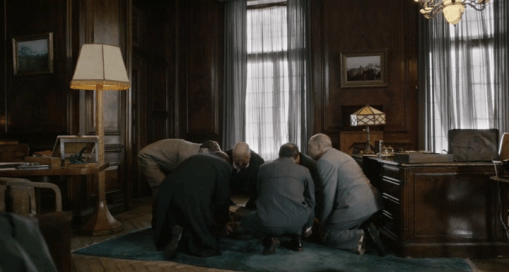
Arjun Reddy

That it’s a rickety, confused film aside, the fulgurant popularity of Arjun Reddy, Sandeep Vanga’s debut about a macho young doctor’s failure in love, his suffering, his suffering, his suffering and his salvation needs consideration: Kabir Singh, its Hindi remake, is the biggest hit of the year and the film is being remade in other languages as well. At a point in time when public imagination is mostly occupied by films “inspired by true events”, the success of Arjun Reddy seems almost anomalous. The negative publicity around the film, with protests from the moral brigade as well as women’s groups, which felt it necessary to attack it by policing young people dating, can explain the box-office, but not the film’s apparently genuine acclaim, especially among women. It’s perhaps that the protagonist, Arjun Reddy (Vijay Devarkonda), represents the self-image of a new generation that knows what it’s doing, “doesn’t see caste”, and questions the values the previous generation took for granted, but he is far from the first to do so, being only the next step in the evolution of the modern Indian male Nagesh Kukunoor portrayed in his debut film Hyderabad Blues twenty years ago.

While the key to the film’s popular triumph might simply be the combination of a handsome lead actor, angsty music, edgy violence and a wily marketing campaign, part of the film’s appeal, I think, also derives from the oppositions Vanga brings into play. Arjun is a genius surgeon with a character flaw. We first see him dipping a bottle of alcohol into the apartment tank to dilute the booze—an epigrammatic image of self-centeredness. He constantly smokes or drinks; the only time his mouth is free is when it’s under the surgical mask. The first time we see his face, it emerges from wisps of smoke, as though he were literally on fire. Hot in his pants, he barges into a neighbouring apartment, brandishes a knife at a friend-with-benefits to force her to remove her pants. He is interrupted, so he tosses a handful of ice into his trousers to cool down. But a while later, he heads to the hospital, where he explains the imminent procedure with great patience to an elderly man in Hyderabadi Urdu. This split image assures us that, personally tarnished he may be, he is professionally unimpeachable and, since his profession involves people, morally too. The flaw, which changes through the film, only serves to reinforce his righteousness and certitude.

Even though she is only half a foot shorter, Shalini Pandey (as Preethi, Arjun’s romantic interest of a higher caste, Tulu background) seems diminutive in comparison to Devarkonda—a difference in perceived height that gives a paternal dimension to the motherless Arjun. The film cuts back and forth between Arjun’s ruined present and his halcyon days at the medical college, between the clean-shaven boyish youth of the university and the brooding Apollo of emanating locks of today, between the upright man of action and the horizontal, inertial being. Vanga has a taste for tonal contrasts: a fight scene at the college quickly turns into a man-to-man talk over cigarettes; Arjun and Preethi’s first meeting is cut to a Carnatic song; even the film’s upbeat ending is scored to a wistful score denoting a bitter victory. It may be that the audience takes an instant liking to outrageously good-looking people put in dark situations: it gives the feeling of being closer to otherwise unapproachable figures. Just as when Arjun later sulks against pretty landscapes of Europe later in the film. Vanga rallies his scenes around the firsts of Arjun’s life—the first glance, first kiss, first smile, first sex, first slap, first drink, first drug, first accident etc.—the endless repetition of which renders them banal.

Arjun Reddy has been taken apart for putting Arjun’s obnoxious behaviour on a pedestal and for its apparent misogyny. It’s an important, valid objection, but one that doesn’t take into account how the film’s formal strategies work against prevalent misogynistic principles of Indian cinema to an appreciable degree. It is true that Preethi is a docile cipher with no character—par for the course—but it is also true that the character is intentionally hollowed out for the film to present an idea of ghostly romance in which a strong, fully-formed personality completely takes over a weak, unformed one. Except for one false scene at her home, where she vainly imitates Arjun, the film is never about Preethi and always about him. There’s no courtship involved in their romance, only Arjun’s compulsion to protect her from perceived threat. The film clearly registers the discomfiting quality of their dynamic: till her smile following their first kiss, the baby-faced Preethi is completely passive to Arjun’s actions. Shots of her huddled with her equally hapless classmates, combined with the lack of any approving reaction shot from anyone to Arjun’s behaviour, cut a sorry—not romantic—image.

Preethi is harassed by a guy from another college. It is of note that the harassment itself—which would have been photographed in all its sordidness in another film—is elided and the viewer is not given the chance to partake in that humiliation. All we see is Arjun’s reaction to the event and Preethi’s ensuing relief. Arjun slaps Preethi once in the film. The action is presented in two shots joined by a cheat cut: we see him moving his hand and then we see her flinch. Again, the film refuses a chance to make the slap seem more ‘realistic’. (Preethi slapping Arjun earlier, in contrast, is part of the master shot). The scene in which he forces a woman at knife-point is played as a comedy, but not without turning it back on to Arjun, who remembers his dean’s warning about the scalpel turning into a weapon in his hands. Finally, unlike most Indian film heroes, Arjun doesn’t turn hateful of all women when his romance fails. Sure, he still loves her, but the film doesn’t present this failure as some injustice meted out to him. This is one reason the unending stretch of Arjun drinking, drugging himself don’t elicit pity as much as a low-key disgust.

Another reason these passages don’t settle into self-sympathy is because the film is too much in love with the actor to reduce him to that. Arjun Reddy is wholly a film about Vijay Devarkonda. Like the title that fills the screen edge-to-edge, the actor suffuses the film with his very being. Vanga’s camera is fixated on Devarkonda walking, sitting and, more often, sleeping. When he is seated on a chair after a surgery with his bloody gloves on, talking to a nurse who crouches in a mix of fear and maternal attention, the camera also crouches and the actor appears like a king on a throne. It’s curious how reluctant the director is to cut away from shots of Devarkonda. A good part of his scenes takes place in the master shot where actors come into the frame to talk to Arjun rather than getting their own shots. In an exchange with a college administrator, the camera remains on Arjun’s face—again, photographed from below—even when it’s his interlocutor that’s speaking. Elsewhere, Arjun scares his friend away from the bathroom and, even though the dialogue between the two is underway, the camera is fixed on Devarkonda speaking to his friend screen.

The director demonstrates considerable trust in the two principal actors to hold their shots, which results in far fewer edits than mainstream films hurl at us. The film’s central scene of the couple arguing (about others) is mostly a single shot, with the two actors approaching the camera as the argument grows more dramatic. It’s a dumb idea of blocking that imitates a passer-by’s point of view, but it holds our attention in its dumbness. In the subsequent shot, she clings to him, begging him not to go, as he tries to writhe out of her grasp—he wants to only hold, not be held. It’s a key image of the film, for it’s the first (and maybe the only) time we see him uncomfortable in his space. Brought up in a mansion in Banjara Hills, Arjun is a master of the universe for whom there are no barriers. He gets to any place just by wanting to: lecture halls, women’s hostel, shooting spots, other people’s houses. He wills private spaces into being and the rest of the world enables it for him. Even when he’s thrown out, he makes it clear that he leaves of his own accord.

Arjun is, however, a static character—he remains the same from start to finish. In one early scene, his grandmother (Kanchana) tells her friends about Arjun being persistent about finding a lost toy as a child. Bizarrely enough, her friends interpret this symptom of pig-headedness as a sign of hope against hope. You expect that his character arc will involve him learning the importance of letting go, of learning that the world is not always for his taking. But no. Persistent, Arjun is till the end. Even as a grown up, he behaves like an entitled child, complete with a diaper at one point. He points at people and they come and go per his wish. The girl he chooses to fall in love with, too, first appears before him among a row of other girls, like products at a toy store window. Preethi is a toy, and he moves her limbs like an action figure. Arjun’s selfishness is amply underscored throughout the film; he attempts suicide on the day of his brother’s wedding. Back in medical college, the dean scolds him for turning a football match into a bloody skirmish and shaming the institute, Arjun tells him that the fight was justified and he did it for the sake of the institute. “That’s how I am”, he tells the dean.

And so, despite its vivid detailing, the film turns out incurably blinkered. It wants us to see barriers when none exist. It sidesteps the chief question the plot poses: why does Arjun’s romance fail? He thinks it was the caste system and the tradition of arranged marriages that did him in. For a character who is proven to be above institutions and people—all those invisible barriers real people have to put up with—this faux-victimization doesn’t cut it for a moment. There’s no answer, for instance, as to why Arjun doesn’t go pick Preethi up the day after he’s been thrown out of her wedding. (Her consent was never a question anyway.) The real answer is that the film needs time to wallow long in the sorrow of a man whose only grief in life so far is a lost toy. “Suffering is private”, says Arjun’s grandmother understandingly. But Vanga makes a show of it: the spectacle of a vampire left with nothing to feed on but itself. Because nothing really changes at the end of the whole ordeal, pretty much anything can (and does) go into the final one hour of the film. Scenes ramble, organization goes haywire and filler shots abound. Secondary actors get more work in entirely dispensable scenes: there’s a particularly trying set of scenes with a housemaid.

Through all the physical and professional degradation Arjun goes through—he gets into trouble after he operates under the influence—he remains morally and philosophically sound. The more he goes into the dumps, it appears, the more he is capable of seeing things better than others. He maintains that it’s only a phase that he’s going through; the very conviction that it’s only a phase bestows on him a wisdom superior to the clamouring crowd around him. It’s evident that the film will snap out of this stupor only with a sacrifice: it’s predictably his grandmother, the only person with an intellect and moral sensitivity comparable to Arjun. They are given a tender final eyeline match that doesn’t correspond with the film’s reality. Her death cures everything—in other words, nothing was wrong in the first place—he reconciles with his family and friends, and goes on an Italian vacation. In a self-parodical, incredibly hackneyed sequence, Arjun stares into the infinite indifferent to the pretty sights of Cinque Terre (the film isn’t indifferent though). We are supposed to read this as some sort of grieving and maturation, wholly at odds with the static character of the picture. The film is wrapped up with a glibly conservative photo finish as Arjun, non-ironically, is shown assimilated in the same structures he earlier railed against.

I think Sandeep Vanga is justified in making Arjun Reddy all about its titular character at the expense of others. But his belief that the spontaneous combustion of an absurdly overprivileged male is of interest in itself is not backed up by the insight required to validate it. Between defenders who champion it as a film that goes into sticky territories of human experience in disregard of liberal holy cows and critics who have objected to its narrative politics, I tend to favour the latter. Asking filmmakers to be more morally accountable and to interrogate the choices they make is not antithetical to a pursuit of truth. Images don’t simply translate reality according to the artist’s ideas. They inscribe themselves into a representational history that modulates their meaning and affect. It would do well for filmmakers to be aware of the language they speak.

A “Nonsense” Gem

Arts no. 471; 23 September 1959.

Never Give A Sucker An Even Break

We aren’t surprised that Passez muscade, whose original title is the deliciously euphonic and mysterious Never Give a Sucker an Even Break, appears in France some eighteen years after it was made. This attempt, which the Surrealists gladly categorize among the twenty greatest dates in the history of cinema, perhaps constitutes the best example of nonsense offered to us on screen. W. C. Fields’ film, like Hellzapoppin’ which follows it chronologically, goes farther than the Marx Brothers without however equalling them. And the public is likely to express its frustration by a certain reserve.

The champions of nonsense for the sake of nonsense will praise it to the skies for its intentional alone. Those who hate nonsense will leave the theatre furious at the end of fifteen minutes. However, in fact, if this film is so amusing, it’s somewhat despite the nonsense. Because the idea of this genre is to go against all established rules, especially those of good taste, quality and reason. To put it simply, let’s say that the result tends to become better when the film becomes worse. The critic has nothing to counter this perfectly-founded argument, all the more so because Fields has thought ahead. Through a device often reused since, he tells us the story of a crazy old actor who submits a nonsensical script to a director, a script which will obviously be rejected but whose unfolding on screen we follow.

To be sure, it’s not unpleasant to see the cinematic materialization of automatic writing, which so far has seemed to be the domain of animation. Animation makes everything possible and it’s been a long time since the viewer has batted an eyelid to such excess of improbability. On the other hand, the unreality of the filmed image, rarely highlighted, strikes us at every step. These mad car races, these inaccessible rocky peaks, these free falls of the hero across space fire our imagination. But a film like Rally ‘Round the Flag, Boys!, which accepts the laws of logic, is ten times funnier, ten times truer and also ten times more beautiful. To discover the real through falsehood, or falsehood through the real, is a more successful approach than that of Fields, forced to remain forever in a purely critical universe.

The absurd soon becomes tiresome and the amusing aspects that remain could also have been part of a more realistic and commercial movie. I’m thinking of the beautiful scenes between Fields and the bar owner, between the director and his young actress. Such observational humour, which has no place in a burlesque and which is generally banished from the Marx brothers’ films, is ultimately Fields’ greatest success.


[From Luc Moullet’s Piges choisies (2009, Capricci). See Table of Contents]
Ismael's Ghosts

“I have to reinvent myself”, says the filmmaker Ismael Vuillard (Mathieu Amalric), begging his wife Sylvia (Charlotte Gainsbourg) not to leave him. It’s hard to disagree with, considering Arnaud Desplechin’s Ismael’s Ghosts is yet another autobiographical work tossing at us the same names, themes and hang-ups that characterize his work with hardly anything to speak for it. All through cinema history, middle-aged male filmmakers, generally in their fifties, seem to have had this compulsion to fictionalize themselves on screen, warts and all, regularly mistaking self-exhibition for personal art. Their urge to either exaggerate or downplay their perceived faults more often than not comes across as self-approved absolution, non-apologies by way of apology, and barely-veiled exercises in narcissism and self-therapy. Even the classics of this “genre” (The Quiet Man, 8½, All that Jazz, Deconstructing Harry) are clouded by an over-proximity to the subject. These mid-career works are, it must be noted, different from personal projects filmmakers begin their career with: while the latter spring from a necessity to express, the films in question are invariably symptoms of a creative exhaustion if not an existential crisis. Ismael’s Ghosts provides little justification as to why the personal story of a womanizing filmmaker getting into an artistic block should interest the viewer.

The film begins as a zappy espionage thriller about a diplomat-turned-traitor Ivan Dedalus (Louis Garrel). We don’t see Ivan, but a legend is built around him by the other diplomats at Quai d’Orsay. This sequence, it turns out, is a film by Ismael—a deliberately-dumb provincial fantasy of exciting life—based on his estranged brother, now posted in Egypt (and actually based on Desplechin’s own diplomat brother Fabrice). Ismael claims to be a widower, his wife Carlotta (Marion Cotillard) having disappeared twenty-one years ago. He has a tender filial relationship with Carlotta’s filmmaker father Henri Bloom (László Szabó), also prone to nightmares and panic attacks like him. In a flashback presented through her perspective, Ismael solicits Sylvia in a sticky but authentic manner whose presumptuousness is tempered by the formal language of courtship. In a humorously creepy scene, he insists on entering Sylvia’s apartment against her objections, only to inspect its mise en scène and get out in a jiffy. For Ismael, the apartment space is an index to Sylvia’s personality, a manifestation of the id that reveals everything one needs to know about a person. He should know: his own ancestral home in Roubaix, where he hides after fleeing a shoot, is a storehouse of supressed memories and unregulated drives.

Psychoanalysis and its language are, of course, permanent fixtures in Desplechin, whose previous two features were called Psychotherapy of a Plains Indian, Three Memories of My Youth. The repressed phantom of Ismael’s Ghosts is Carlotta, who walks back into Ismael’s life as though spat back by the sea. What ensues is an unwinding of Ismael’s personal and creative life, as Sylvia leaves in heartbreak and jealousy. After sleeping with Carlotta, a hurting Ismael abandons his ongoing film to go hole up in Roubaix (Desplechin’s own hometown), where he hallucinates and goes into a downward spiral like Scottie Ferguson. When his producer comes home to take him back to Paris to finish the film, he claims he’s grieving his brother who died years ago. The producer discovers that his brother, the real Ivan, is well alive and furious at Ismael’s attempt to use his life as movie fodder. Ismael, it would seem, “kills” people off in order to both suck up the sympathy of people willing to love him and feed his own creation. When the producer confronts him again, he narrates the rest of his film: an increasingly crazy tale of international espionage that finds Ivan mistaking a Jackson Pollock scholar for a Russian spy. In this frenzy, Ismael shoots his producer in the arm. Just because.

Ismael’s Ghosts is pieced together through the perspectives of several characters. The scenes become progressively shorter as the film proceeds, sometimes reduced to a couple of shots. This perspectival dispersal isn’t dissimilar to Pollock’s “all over” paintings which, the Russian scholar claims, are actually figurative and compress Pollock’s personal relations onto the canvas. But it’s Ismael’s perspective that the film privileges. “My job (as a filmmaker) is to disappear” he claims to an actress he sleeps with (and who portrays Ivan’s girlfriend in the film within the film, perversely enough). And the action movie Ismael is making, which we see vast stretches of, is Desplechin’s way of disappearing in a film that’s otherwise too full of him. In genre terms, Ismael’s Ghosts is a schizophrenic oscillation between comedy, horror, action, melodrama (containing a couple of scenes with genuine affect) and Bergmanesque art film. It’s a highly film-aware work, employing both silent cinema tropes (irises, superpositions and back-projection) and a baroque aesthetic of accentuated colour, flamboyant camera movements, a florid string score and disjunctive edits. The actors place themselves on the neurotic scale, their caffeinated body language and expressions registering as parapraxes. There’s a lot of dressing and undressing in the film, which I suppose is also symbolic in some way. All this hyperactivity and intertextuality, however, masks a void at the heart of the film, a lack of faith in itself. Desplechin’s cinema needs a reboot.

The Double Lover

When, in The Discreet Charm of the Bourgeoisie, Buñuel and Carrière had their characters wake up from a nightmare only to find themselves in another, they were mocking the practice of bourgeois cinema to neatly pack middle-class fears into exciting but essentially harmless narrative excursions. The tendency allows the characters and the audience to get a taste of the life on the “other side” but also maintain distance by waking up/returning home when things get too hot. Freud demonstrated that dreams aren’t arbitrary images but rigorously-structured emanations of the subconscious. The Freudian invasion of cinema, however, has meant that anything put in a dreamlike narrative is expected to be meaningfully assimilated into the film’s structure. In François Ozon’s psychosexual drama The Double Lover, an apparent reworking of a Joyce Carol Oates novel, pretty much anything goes. The protagonist Chloé (Marine Vacth) may or may not be lying, may or may not be hallucinating, may or may not know the people around her. Either way, it is of little consequence. To her shrink, she says lines like “I want to remain weak” and “I exist when you see me like that”. The Double Lover would’ve functioned as a camp spoof of European art movies had it not been so serious about itself.

There is a story, though. Chloé, an ex-model, has pain in her stomach, but her doctor tells her there’s nothing physically wrong with her (first of the several false flags the film plants). She is sent to a psychiatrist, Paul (Jérémie Renier), who falls in love and moves in with her to a new apartment. Chloé discovers the existence of a lookalike of Paul called Louis, also a psychiatrist, from whom Paul is apparently estranged. Wanting to know everything about her dodgy but loving boyfriend, Chloé takes sessions with Louis, who turns out to be professionally and temperamentally the opposite of his brother. He humiliates Chloé, becomes increasingly punitive and finally rapes her, which Chloé, of course, likes—this domination cures her of her frigidity though not her pains. Paul proposes marriage, forcing Chloé to put an end to her trysts with Louis, who reveals a dark secret from the brothers’ past.

Chloé works at the Palais de Tokyo as a museum guard and the gallery’s white walls and empty exhibition spaces register as her psychological landscapes: the visceral photographs and tortured sculptures we see are, in fact, derived from images from The Double Lover. The film develops wholly from Chloé’s broken perspective, which justifies distortions of narrative information, but renders the reality of other characters irrelevant. The film, in fact, elides one crucial information in order to wrap up the plot. A creepy-seeming, horror-movie neighbour is thrown in for easy chills, and to provide a relief from the sight of the same two actors. Ozon uses a soundtrack full of false cues, always implying terror where none exists. His film recalls a host of predecessors: Hitchcock most of all, but also Cronenberg of Dead Ringers and A Dangerous Method, Polanski of Rosemary’s Baby and The Tenant, De Palma of Body Double and Passion, and even Aronofsky. In fact, The Double Lover in on such a familiar narrative and aesthetic beat that it seems machine-generated from these films: the same use of old American pop songs, the same circular-spiral camera and architectural descriptions, the same mirror motifs that are by now self-parodical arthouse shibboleths.

Ozon’s film equates psychoanalysis with fucking, both forms of the same action of penetrating a person. The idea is, of course, rather old and rests on the dual implication of the verb “to know”. The three characters take turns exercising phallic violence on each other, reflecting the changing power equation between them. Ozon’s camera constantly zooms in and out in an imitation of the sexual act. At one point, when Chloé orgasms, the camera penetrates her mouth and reaches her vocal cord. In one of the film’s first images, a shot of her vagina dissolves to a shot of her Marion Crane eye. Given it’s a film about parasitic twins, even a brash rape fantasy is furnished as character psychology. True to theme, Ozon uses several cloven compositions—split screens, but also CGI sequences of characters physically bifurcating. There’s a music-video like passage of twin boys wrestling with each other as Vacth and Renier stare directly at the camera. The glimpse of post-winter Paris and Ozon’s colour-coded mise en scène aren’t enough to relieve us from the airlessness of this by-the-numbers thriller.

Claire's Camera

Minor project by auteurs can sometimes serve as keys to their entire body of work. Think of Fellini’s A Director’s Notebook, Godard’s Scenario for Passion or Hal Hartley’s Surviving Desire. Until Claire’s Camera, I could appreciate the wispy pleasures of Hong Sang-soo’s films, the super-light production values, their handcrafted toy-like structure and their endearing improvisational texture, but I couldn’t understand what Hong was getting at as an artist. Running for about 68 minutes—a wonderful runtime for films to have—Claire’s Camera is one more of Hong’s parallel universes, another permutation of his typical character descriptions, dramatic situations and scene compositions. But I think it offers something more and comes close to a statement of intent by this notoriously self-effacing filmmaker: making films is a way to deal with loneliness, to experience catharsis by way of representation.

What allows for this authorial transparency in Claire’s Camera is the presence of the Claire herself, played by a delightful Isabelle Huppert. With her yellow blouse and trench coat, dotted panama hat, little blue handbag and polaroid camera, Claire is an instant screen icon, the kind that makes it to fan art and DVD covers thanks to its unique profile. There’s a perpetually-drunk, philandering fifty-year-old filmmaker character, So Wan-soo (Jung Jin-young), whose film is playing at Cannes and who is obviously a clone of Hong’s, but he’s not the director’s alter ego here. It’s Claire, obsessed with taking pictures of people, even when they are visibly in distress. She tells So that people are not the same after being photographed. In other words, people are mystified or demystified in their photos; they’re always more or less than what they were, but never the same.

When asked why she takes photos, Claire responds that “the only way to change things is to look at things again very slowly”. Hong’s cinema, too, is about relooking, reexperiencing the same things over and over with the hope of illumination or change. The repetitions and restaging in these films function as a kind of therapy, a dwelling on small details that guilty conscience takes to be the source of big mistakes. There is then a philosophical underpinning to the reverberations of Hong’s universe—a notion of eternal return that is at once cathartic and hopeful. Yourself and Yours, Hong’s previous film which makes its appearance in a half-hidden poster in the first shot here, imagined the revival of a broken relationship through the reiteration of the gestures that birthed the relationship in the first place. The film was made the same year Hong filed for divorce over his affair with actress Kim Min-hee, who plays the part of Man-hee, a film agent once in affair with director So, in Claire’s Camera.

Hong shot the film in Cannes in 2016, a year he wasn’t showing anything at the ongoing festival. A thoroughly anti-touristic filmmaker, Hong nevertheless takes inspiration from the locations he makes films in. The sun-kissed Riviera setting allows him to pay tribute to his French influences in subtle but extraordinary ways. There’s, of course, the reference to Rohmer in the title, the final freeze frame à la The 400 Blows, and Huppert’s profession as a music teacher. It is, however, the spectre of Marguerite Duras that looms large in the film. Director So has Claire read him lines from C’est Tout—a charming image of Huppert speaking French in a Korean film she’s supposed to speak English in. Like the works of Duras, Claire’s Camera seems to unfold in an impossible, perhaps cyclic timeline. Huppert’s Claire is a kind of time master, who is able to meet characters for the first time multiple times. The film shuttles between past and present, but it isn’t certain if these time relations are sacrosanct.

Like in Last Year at Marienbad, we aren’t sure that the characters have met each other earlier, and that they are only pretending otherwise. The same words, shots, sounds and situations float around the film to be picked up later as an echo. Claire’s Camera is so chock-a-block with twin scenes, dialogues and compositions—two scenes of brutal disavowal, two scenes of three people eating, two shots of Man-hee filmed from the back, two zooms of her working at the office, two romantic escalations between So and women and so on—that the viewer can predict the sort of vignettes that will follow. Hong’s film is a low-key exploration of memory and forgetfulness in the vein of Hiroshima mon amour, another film about the encounters of a filmmaker in a land half a world away.

Hong’s is a cinema of two shots. The more the merrier, to be sure, but shots with more than two characters tend to be unstable or turn into drinking binges. One the other hand, shots with one character, such as someone smoking or walking, are always small pauses or intimations for another character to arrive. Hong’s films appear to be acting out in their form, as it were, the fear of being alone. The ideal is two—the number that calls for social drinking, confession or romantic advances. Claire’s Camera contains individual scenes with five of the six pairs possible with his four-character setup. Together with countless similar shots from Hong’s oeuvre, they constitute an exorcism, and an epigrammatic definition of what cinema is: two people talking.

On the Beach at Night Alone

            Made the same year as Claire’s Camera, On the Beach at Night Alone begins with a closeup that becomes a two shot through a reverse zoom. The scene is a café in a western country during winter. Two Korean women (Kim Min-hee and Seo Young-hwa) discuss how beautiful and liveable the city is. We aren’t told which city this is—clues suggest that it’s in Germany—and it’s only referred to as “abroad” when Kim’s character, Young-hee, is back home. A street market is visible at the edge of the frame, but that’s all the glimpse we get. Hong as a filmmaker never allows himself the decadence of a pretty sight. The second part of the film takes place in a supposedly-picturesque, sleepy town in the northern part of South Korea, but the director shows us nothing outside of a nondescript street corner. A hotel room with French windows opening to a beautiful view of the sea is expressly blocked by a window cleaner, whose purpose in the film is just that.

On the Beach forms a narrow diptych with Claire’s Camera: both are set in European countries in opposed times of the year; both feature Kim as a temperamental film professional jilted by a middle-aged filmmaker. But the driving perspective of the narrative is entirely the women’s rather than that of Hong’s alter-ego. Seo plays a wistful woman who has left her husband to move to Europe. Young-hee is spending time with Seo, but her thoughts are with her filmmaker-lover back home. The two women find European men attractive as well as gentle: they play piano for her, they serve her food and, most of all, they don’t question her. The Korean men Hong populates the film with, on the other hand, are just short of vultures. They are presented as presumptuous if not creepy, overbearing and unduly inquisitive. Young-hee tries to start her life anew in both Europe and back home, but is thwarted by Korean men in both cases: the European section ends with a Korean stalker literally carrying her away from a beach.

The uniform and unsubtle manner in which Korean men are caricatured here leads to only one inference: Hong is projecting. Excusing himself by pointing to the failing of all Korean men is no excuse, so he incriminates himself more directly in the inevitable, large dinner scene that forms the film’s climax. Young-hee’s filmmaker-lover is drinking with her and his group of assistants when the discussion shifts to his ongoing film. He talks about his personal approach to filmmaking, prompting Young-hee to wonder if it isn’t boring to talk about oneself all the time. The director’s coterie of yes-men mutters something about the irrelevance of subject matter. Young-hee launches into a righteous outburst questioning the director’s right to make films about his ex-lovers. The filmmaker breaks into tears over his own torment and diffuses the tension of the scene. Hong’s men are usually bumbling, but the serious director here is all the more comical in his seriousness. Hong is clearly in a self-flagellating mode, but his character contours are so soft, the strokes so light that it doesn’t feel exhibitionist in the way Lars von Trier’s recent works do.

While On the Beach fails its male characters, it gives its women characters the space and voice they deserve. Although structured around absent men, the first part of the film is simply images of women eating, walking, talking and shopping together. Young-hee gets to deliver a long tirade on love during a binge and then kiss another woman, Jun-hee (Song Seon-mi), with whom she develops something resembling a romance. And in what counts as a shooting star in Hong’s cinematic sky, she gets a solo shot in which she smokes and sings a song. In the final shot of the film, she wakes up at a beach to thank a man whose feet alone we see. Hong’s cinema has prepared us to expect this to turn into a two shot. But no. Framed against a vast grey sky, Young-hee bows to a void and walks away alone—a reversal of the first segment’s ending and a radical assertion of solitude in a cinematic universe mortified by that thought.

CICIM Munich no. 22-23; June 1988.

Le Pont du Nord

French cinema of the last few years is based, above all, on the personality of its directors. To trace great trends in it runs the risk of giving a false impression since they are often foreign or contrary to the personality of the leading filmmakers, who run the risk of being sidestepped by our desire for generalization.

We then run the risk of forgetting unclassifiable auteurs or ones in constant evolution such as Demy, Varda, Biette, Gainsbourg, Serreau or Depardon. We run the risk of forgetting a very important stylistic principle such as Robert Bresson’s Partitivism: in his framing, the director of Lancelot du lac indeed tends to isolate one part of the body, to exclude the head, to favour an object or a series of objects, the moment the interest of the image seems hinged on this body part.

But if one had to absolutely put a label on current French cinema, I’d say that it’s a school of hazard. If the preceding decades had produced an art very much planned out in advance, one which attained its limits because of the permanent repetition of this premeditation, contemporary filmmakers, on the other hand, set out on in search of hazard, which alone seems to be capable of bringing something new. We have here Rozier, Rivette, Pialat, who, in the course of the film (Maine Océan, Le Pont du Nord, À nos amours), veer off into a fascinating, unplanned direction. Even a super-classical filmmaker like Rohmer adopted this practice in Le Rayon vert. This is also the working principle of the magnificent Petite suite vénetienne made by Pascal Kané and of Godard’s films. We even find a premeditated hazard in Bergala (Faux-Fuyants, Où que tu sois), whose scripts set off in directions which (wrongly) seem the products of chance. More simply, such hazard can be discovered by the actor’s improvisation (in Doillon, in Téchiné).

That brings us to a cinema of actors, hinged on the expression of emotions binding two or more characters together. A cinema that replaces social tapestry with bourgeois individualism so criticized by the Marxists. That’s normal for a country like France which, in the past forty years, hasn’t really know great crises: neither famine, nor revolution or dictatorship or war.  This is the cinema of Rohmer, who strikes us with his exacerbated minimalism, of Doillon, whose psychoanalytic sense is in struggle with a taste for improvisation and in whose work love comes about through the artificial creation of a conflict, a breakup, of Pialat, of Breillat (Tapage nocturne) and often of Truffaut (La Femme d’à côté).

There is also a cinema founded on the grandeur of the image which, except in Garrel, seems independent of the principle above. Contrary to what one might suppose, this essentially visual cinema, full of light and shadow effects (Garrel, Bard, Azimi, Duras) is often a broke cinema with a precarious existence. A new variant is the music-video-movie (Beineix and, on a more elaborate level, Carax): every shot wants to be a masterpiece and is built on a strong conception of lighting. But this is often at the expense of the story, if by misfortune, there is a story.

Another characteristic is the dissociation of image and sound, which we find in Hanoun, Duras, Straub, Godard, Ruiz, a new variation on counterpoint as defined by the Russians in 1930. The most famous example is the noise of seagulls over Parisian metro in Godard’s films – a way of glorifying both elements through their contrast, where an audiovisual coincidence usually tends to put the viewer to sleep.

Counterpoint doesn’t stop there in Godard. It is systematized, extended to other elements every time it can be, notably to the relation between different parts of the image. Ruiz, on the other hand, narrates a fantastic story on trivial images (Brise-glace, L’Hypothèse du tableau vole).

In France, there is a family of dark humourists (Mocky, Blier, Marboeuf, Grand-Jouan, Sentier). There is also a whole new art born of the economic necessity of shooting quickly (one to three weeks for Vecchiali, Duras, Biette). We also notice writer-filmmakers moving from one mode of expression to another with the greatest of ease. Among the golden quartet of current literature (Weyergans, Duras, Breillat, Cavanna), three of the four have made films. Rohmer alternates between theatre and cinema. Pierre Kast has been able write a novel, Le Bonheur ou le Pouvoir, the same year he made a film, Le Soleil en face, which are both of high quality. End of specialization…

We also find classical filmmakers of quality (Chabrol, Rohmer, Truffaut), who – the first two at least – are faithful to a traditional structure in the same genre. More generally in the past few years, we notice a return to narrativity, to a more classical presentation, the structuralist and poetic audacities of post-1968 tending to disappear perhaps under the influence of commercial censorship or self-censorship. It’s difficult today to imagine non-narrative films like those of Bard or Silvina Boissonas, even of Garrel. On the other hand, there is a public and critical consensus towards narrative forms like those of Chabrol and Rohmer, quite identical from one film to another, which allows for a certain perfection but also carries the risk of fossilization. French cinema, like the Italian one, tends to become a cinema of the old. At Venice in 1984, French cinema was represented – brilliantly for that matter – by the four great Rs: Rouch, Rohmer, Resnais, Rivette, with an average age of sixty-two. In contrast, the fifties generation has brought us no revelation whatsoever till date.

Experimentation seems to be reserved for certain senior filmmakers who can have their way thanks to their reputation: Resnais, whose every new film constitutes a challenge, a wager, Duras, who approaches her themes through successive recurrence of undulatory movements, Godard.

Ever since Jack Lang became the Minister of Culture (1981-1986), France is also the host country for foreigners like Hollywood once was: South-Americans (Ruiz, Jodorowsky, Santiago, Solanas), North-Americans (Kramer, Berry), Algerians (Allouache), Japanese (Oshima), Italians (Monicelli, Ferreri), Egyptians (Chahine), Polish (Zulawski, Polanski, Wajda, Borowczyk), Greek (Papatakis), Belgians (Akerman), Portuguese (Oliveira), Dutch (Ivens), which makes the notion of nationality often outdated.

Another surprising aspect is the pre-eminence of meteors, exceptional films overlooking an uneven or disappointing body of work (Blier’s Tenue de soirée, Deville’s Dossier 51) or other unique or near-unique works (Debord’s In girum imus nocte et consumimur igni, Koleva’s L’État de bonheur permenante, Dubroux’s Les Amants terribles, Breillat’s Tapage nocturne, Rouqier’s Biquefarre, Devers’ Noir et Blanc). Isolated bodies of work like those of Lampedusa, Clarin, Chamisso, Lautréamont, Lowry. This unsettles a number of people in the country where the politique des auteurs was born.

We can also list negative commonalities: predominance of crime movies, highly stylized photography working against the film, moral anachronisms (soixante-huitard behaviour in films set in the past), virtuoso verbalism of the characters for the dialogue writer to showboat with, leftist boyscoutism, where we find nothing more than in the day’s edition of Libération, overload of plot twists to avoid slow passages, lack of first-hand information about the milieux described, endless repetition of characters’ chief trait etc.


[From Luc Moullet’s Piges choisies (2009, Capricci). See Table of Contents]

Nocturama

Jean-Luc Godard’s self-styled student revolutionaries were nothing if not talkative. They crippled themselves into inaction debating over praxis and theory. For them, as for many other Godard’s radicals, the time for action was long over, it was now time for contemplation. Not yet for the youth we accompany in Bertrand Bonello’s enigmatic, double-faced Nocturama. We first see them in action, walking, boarding and getting off the subway, always moving and doing something. There’s barely a word in the first quarter hour, which proceeds by an intense accumulation of shots of characters traversing the length and breadth of Paris in great hurry. The transfers they make in the subway mirror the way the filmmaker cuts between them. This mosaic of perspectives, combined with the precise time ticker, makes a vague promise that the characters will all be eventually connected. Their surreptitious behaviour reveals that they’re involved in a conspiracy, an idea dear to Nouvelle Vague filmmakers. It wouldn’t be some time until we learn that they’re carrying out a series of assassinations and bombings in the heart of Paris, a city we see from a bird’s eye view in the first shot.

As the threads converge, we are presented with brief flashes into the characters’ past: some of them are preparing for Sciences Po and ENA, others are interviewing for dead-end jobs. They are from different racial and social backgrounds, but we’re not given any information as to how they meet each other, leave alone how they agree on a terrorist plot. This narrative gap is characteristic of Bonello’s film, which doesn’t bother spelling out the reasons for the bombings or the gang’s intentions. From the bits of information we do get, we understand that they are a faintly anarchist bunch working against what they take to be the current world order. The real France is present, muted in the background—global capital, dwindling job market, National Front, surveillance state, legalization of marijuana—but it’s only accessory to the film. What Bonello is interested in in this first part of the film is instead the mechanics of the bombing plot, the perceptual calculus involved and the sense of people invested in an abstract mission. The filmmaker dispels any echo of contemporary Islamic terrorism, and focusing on this improbable terror outfit is his way of stating his goals.

After the bombings and killings have been carried out, and as a curfew is declared in Paris, the gang takes refuge in a large, evacuated shopping mall in the middle of the city. The film makes a reverse movement from this point, tracing the dissolution of the group that was so far united on a quest. Amazingly enough, the characters believe they could get back to normal life if only they lay low in the mall for a day. They spend this time indulging themselves, wearing the mass-market clothes on display, playing with the toys, drinking up the champagne, and playing pop music on the gadgets in the electronics section. In short, they become the consumer society they despise. This portion of the film is a picture of decadence worthy of Fassbinder or Visconti, as a group once full of conviction and meaning devolves into hedonistic aestheticism. There’s even a lip-synched song one of the boys sings under a garish make up. The film turns melancholy as the inevitable end approaches, and the random violence the gang inflicts on the city finds its response in equally senseless, faceless violence of the state.

In an early flashback, one of the gang members discusses the ideal structure for a political thesis for a university examination: introduction of the problematic, dialectical presentation of arguments, a personal point of view and a conclusion—a very French, Cartesian approach to exposition that Nocturama deliberately eschews. There is no indication that the bombings were the consequence of something specific, except a global sentiment that “it had to happen”. Nor does the filmmaker take a moral stance towards their actions or their end. In fact, Bonello forestalls any sympathy for his characters through his cubist superposition of perspectives, which swaps a dramatic event with a slightly different version of the same over and over. These perspectives are not intended to be seamless, but go back and forth in time in a slightly redundant and absurd manner in a parody of closed-circuit footage omnipresent in the film.

Somewhere in Nocturama is probably a jibe at the compromised idealism of the soixante-huitards, but Bonello’s preoccupations are more philosophical than political. He’s interested in how actions are shaped by personal and symbolic meaning and how the lack of meaning can conversely produce a mechanical society. The two sections of the film converge towards different truths, one political and contingent, the other existential and eternal. After the gang has assembled in the mall, one of the boys feels estranged from the mission and slips out of the building to wander the deserted city. He’s out there to precipitate the gang’s downfall but also to make some sense of its actions. The time for action is over, the time for reflection begins.

Non-Fiction

Going by his last three features, Olivier Assayas’s films are two seemingly unrelated works welded at the hip, bound together only by an abstract idea. Clouds of Sils Maria was about the tragedy of an actor’s aging, but also about the over-visibility of star culture. Personal Shopper was at once a ghost story, a peek into the unseen side of celebrity life, and a horror tale about digital media. His new film, Non-Fiction, deals with the crisis of the publishing industry in face of the digital revolution and the ethical problems of fiction that is too personal, but it’s also a comedy about adultery among middle-aged, middle-class cultural types. These films present themselves as puzzles that promise to fit together were the viewer to supply the connecting piece.

Guillaume Canet plays Alain, the chief editor of a publishing house that’s in the process of figuring out its strategy in a fast-changing literary climate. Laure (Christa Théret), the young expert in charge of charting the firm’s digital roadmap and with whom Alain is having an affair, believes that the only way to stay relevant is to be radical, to treat tweets and texts as legitimate publishing material. Alain has just turned down the latest manuscript of Léonard’s (Vincent Macaigne), which his wife Selena (Juliette Binoche), a television actress, finds to be his best work. Léonard is in a relationship with Valérie (Nora Hamzawi), who is assistant to a rising politician of the left and who cannot humour her partner’s bouts of self-doubt and self-deluding resentment.

Like in a traditional French comedy, Assayas creates a chain of romantic affairs between the characters, but his focus is not on the entanglements they create. He treats them like hypotheses in a theory. The characters are all in the grip of professional and cultural upheavals: Alain has to react quickly and suitably to newer forms of literary consumption, Selena has to come to terms with the idea of television franchises, the monk-like Léonard must rethink the moral quandary involved in narrating the personal life of others, Valérie must understand the role perception plays in the political arena. In a way, all these issues stem from the extreme visibility, access and availability new media offers its consumers, forcing producers to constantly reinvent themselves or become obsolete. In this, Non-Fiction is of a piece with the director’s previous two films.

But what does it all have to do with adultery? I think the missing piece of this puzzle relates to the notion of double lives, which happens to be the film’s French title. Connected to their phones and tablets, the characters of the film are always elsewhere than where they are physically present. The face they present to others takes priority over their everyday relation to the people they live with, which is what adultery is at heart. Léonard insists that his novels are veiled in a smoke screen of fiction such that readers won’t suspect their autobiographical links. This self-image he creates is suppose to absolve him of the emotional violence he wreaks on the people he writes about. In positing this, Non-Fiction demonstrates a continuity between older, pre-internet forms of social behaviour and current ones, just as how Personal Shopper imagined chatting over internet as a form of spiritual séance.

Assayas’s film is also, however, a progression of tiresome, talky vignettes of people discussing the implications of internet, the devaluation of information, the narcissism involved in rejecting narcissism, the resurgence of physical books, the drawbacks of democracy and the relevance of criticism in the age of artificial intelligence. Even when actors perform them as casual dialogues over aperitif, the exchanges are overwhelming in the amount of reflection they pack. And I don’t think it’s particularly rewarding to dwell on them, function as they do as a form of smoke screen themselves to hide the film’s simple, more direct themes. Save for the final sequence filmed at a beautiful coastal location, the film is also visually exhausting with its endless supply of over-the-shoulder compositions shot in warm, indoor lighting.

The Death of Stalin

Stalin jokes place the listener in a moral double bind. If there’s beauty in the capacity of humour to sublimate unspeakable horror and make life bearable, the idea of laughing at these jokes strikes us as ghastly precisely because it trivializes terror of the purges and the gulags. There’s no such dilemma about Hitler jokes, possibly because the kind of evil he stood for lives among us to date, whereas we are allowed to assimilate Stalin into history’s endless roster of multi-coloured dictators. Who, though, has the right to make Stalin jokes? The common people who lived under his rule, surely. But can today’s Russian citizens? Or the descendants of those who disappeared? Armando Iannucci, the writer-director of The Death of Stalin, certainly doesn’t think that’s a quandary, and chooses to treat Stalin as a collective civilizational inheritance like Jesus Christ or Julius Caesar. In Crimes and Misdemeanors, Alan Alda’s TV producer declares that comedy is tragedy plus time. It may be either too soon or too late to make a comedy on Stalin’s death. Iannucci, however, has decided that it’s just about time.

The film opens with its finest sequence, a brilliant, concentrated set-piece that blurs the boundary between comedy and horror, beauty and savagery, and terror and absurdity—just like the Stalin jokes. It’s 1953, a couple of hours before Stalin’s death, and Radio Moscow is having a live performance of a Mozart symphony. The Soviet premier calls the director of the station and asks him to ring back in seventeen minutes. The terrified director calls the premier back exactly in seventeen minutes just as the studio audience explodes in applause. Only then does he (and do we) realize that Stalin has timed the call to the end of the symphony. Stalin gives curt orders for the recording of the performance to be sent to him right away. The only problem: the concert wasn’t recorded. In panic, the director rushes to the orchestra, asking them to take their positions and replay the entire programme. To replace the part of the audience that left, the guards at the radio station go pick up random peasants from streets at gunpoint. Meanwhile, the police of the interior ministry, NKVD, is busy rounding up people on Stalin’s execution list. The film intercuts both these commotions, not making it clear which set of people are being picked up for what—an uncertainty reflective of the detainees’ own experience.

While the shell-shocked director prepares for the call, Stalin (Adrian McLoughlin) adds new names to his execution list, with Mozart playing on the radio. He hands over the list to Beria (Simon Russell Beale), whom he joins for a dinner alongside Khrushchev (Steve Buscemi), Molotov (Michael Palin) and Malenkov (Jeffrey Tambor). The men make bawdy jokes, force themselves to laugh at Stalin’s dumb repartees and sit through his movie screenings unwillingly. They will later note down the jokes that worked and the ones that didn’t so that they can improve their performance the next time around. It’s not the contrast between a decadent elite and a country in fear, but the necessity for maintaining an appearance at all levels of Russian social life that is suggested here. The symphony and the dinner are simulacra, like Stalin’s funeral pageantry later in the film, intended to hide less cheerful realities (The fear of punishment, Molotov’s imminent arrest, the internal hatred for Stalin). The remarkable set-piece lasts all of fifteen minutes and its astute plot-driven comedy is fleshed out by Iannucci’s customary, razor-sharp dialogue (“—He’s a great man with a great ear.” “—Two great ears.”), which is likely the film’s primary reason to exist.

The stellar opening sequence sets the rest of the film for a failure, which is understandably more mechanical and less inventive and funny. Divided into arbitrary chapters based on ridiculous protocol to be followed upon the premier’s demise (appropriately presented in an equally ridiculous Copperplate Gothic-like typeface), the plot follows the power struggle between Beria and Khrushchev, both of whom want to reshape the republic’s future per their own less-violent conceptions. Their real ideological differences are ignored by the film; this fight over non-existent differences is perhaps the point, just as its implication that Beria could have been any fall man, that Khrushchev could’ve just as well lost the war for history. The content of the Soviet politburo’s policies is of no concern to the film, it’s the form it has ideas on: Iannucci presents the politburo as a man-eat-man battleground for power, its meetings as verbal minefields where one wrong word could change the course of history. Upon Stalin’s death, something similar to democracy emerges within the chief committee, with all the contradictions of that system in place: in order to take control, Beria and Khrushchev find themselves having to influence the other members of the politburo by whatever means necessary, psychological or tactical. In outlining the surprisingly short roads between democracy and groupthink, the film boomerangs halfway back at its Western audience, whose own political climate of “saying the right thing” its satire resonates with.

Anglo-normative (“Beria-r”) without feeling the need to justify it, The Death of Stalin makes no pretence to realism or accuracy—a fact that attenuates its arguably offensive intentions. In fact, the film works off the incongruence of language and setting, treating Soviet Russia as mere costume and décor in a mostly-British sitcom (tea and buns for Stalin’s daughter) where Buscemi and Olga Kurylenko are guest performers with native accents. While the film goes through the motions in its second half, the jokes keep coming (—Malenkov after his inaugural speech: “Yes, ‘bread and peace’. I knew it would work. It was between ‘peace’ and ‘sausages’.” —Khrushchev: “Both good things, but you know where you are with a sausage.”). And it’s surprisingly inventive on the visual front. The tortures at Beria’s NKVD facility are relegated to the edge of the frame, making them perversely register with greater force and humour. A shot of Stalin’s son fighting with a guard over a pistol is milked for all its absurdity by contrasting it with the dignified pose of others in the shot. And I think the film might be unique in that it makes shots of people standing in a circle or a line talking (as in a bad TV drama) carry an ideological weight. Sophisticated, dialogue-driven comedy is a kind you don’t expect in English-language films anymore (it’s in the purview of television), so The Death of Stalin is a rarity. Your mileage may, however, vary.

Loveless

In The Student, Kirill Serebrennikov’s film from three years ago, a young man becomes a religious zealot and polices his classmates using quotes from the Bible. This shocks his progressive Jewish teacher, but the management shrugs its collective shoulder, considering him merely misunderstood. This return of suppressed superstition into current day Russian life is very much present as an undercurrent in Andrey Zvyagintsev’s new film, Loveless, but it’s only touched upon, not hammered down like in The Student. The director’s fifth feature, Loveless revolves around a husband and a wife who hate each other to the depths of their being. They are in the process of a divorce and neither wants to take custody of their taciturn twelve-year-old son Alyosha (Matvei Novikov), on whom their hatred spills over. Aloysha is not like the Antoine Doinel of The 400 Blows, who could just escape the domestic orbit into a premature adulthood. He is crushed by this everyday hell. There’s a heart-breaking shot of him hiding behind the bathroom door crying when he learns that his parents plan to pack him off to a boarding school.

The year is 2012 and speculations about the end of the world are in the air. The ‘family’ lives in the outskirts of Moscow in a high-rise apartment that they are selling off. Boris (Aleksey Rozin) the husband has a desk job and is worried that his boss, an orthodox Christian, would sack him were he to learnt of his divorce. Zhenya (Maryana Spivak) the wife works at a salon. Both of them are having an affair. Following their first, incredibly sordid fight, the film pursues their everyday routines separately: Boris at the office and later with his pregnant lover, Zhenya at the salon and then with her rich businessman lover. As the film loses sight of Aloysha, so does the couple; the boy vanishes from the house without a trace. Zhenya informs the police, but they wash their hands off, deeming the complaint too trivial and pointing her to a civil organization involved in such cases of lost children. Marshalling scores of volunteers, this group sets out to look for Aloysha with a concern and rigour that’s the only silver lining in this utterly despondent film.

Boris and Zhenya aren’t just horrible parents, but hideous people worried about Aloysha’s disappearance only because of its potential impact on them. Zhenya is presented as a shallow woman who spends her time instagramming, waxing herself and sleeping with her lover. Boris comes across only a notch better, but is just as despicable in his selfishness and cowardice. Thoroughly compromised early in the film, their declarations of genuine love and good faith to their lovers doesn’t fly at all. In a discomfiting scene that can find its home in a screwball comedy, Boris and Zhenya are forced to drive together to her mother’s house to look for Aloysha. She wants to smoke, he warns her not to. She asks him to raise the windows, he turns up the volume of the metal music. She screams at the top of her voice. Such unbound mutual hate calls for an act of violence to resolve it, but it never comes. It’s instead deflected onto Aloysha’s unknown fate. The question at the core of Loveless seems to be this: what does it mean for two completely broken, empty people incapable of giving love (outside of compensatory proclamations) to be responsible for a child?

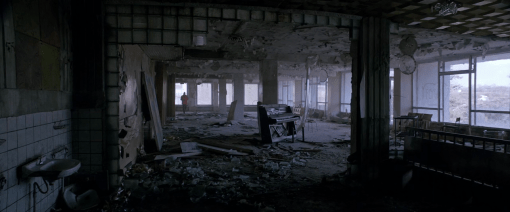
I don’t think Andrey Z’s interest is solely personal here and Loveless, like his earlier works, is obliquely political. In one of the first shots of the film, the camera is planted at the entrance of a building. Children storm out after a day’s school and walk past the camera. After a while, the camera follows a boy who happens to be Aloysha, but it could’ve been any of the other kids. Loveless presents his parents as merely a symptom of an extremely self-absorbed consumer society. The authority figures in the film—Boris and Zhenya, her paranoid mother, but also the police—just don’t care. The state having failed its subjects, it’s up to the civic bodies to fend for the people. The institution of loveless parents produces the machinery of lovelessness that is the volunteer group looking for Aloysha. They search for the boy high and low and end up in an abandoned facility in the woods—a dilapidated hotel with peeling walls, dripping roof and rotting furniture which combines with the winter landscape outside to produce a post-apocalyptic picture echoing Chernobyl. It may not take a village to raise a child, but it certainly takes a village to look for one. At the end of the film, Boris and Zhenya aren’t happy even with their lovers. He dumps his new toddler into a cradle to go watch the news on the Russian intervention in Ukraine. She walks away from her new husband watching the news to go exercise on a treadmill. Wearing the Russian Olympic jersey, she’s running but going nowhere—a blunt symbol to end a blunt film.

Journal de la SRF no. 7; February 1982.

Sauve qui peut la vie

The best films in France today have, for the most part, what is called a “reduced” audience: between 15,000 and 1,000 viewers for Femmes femmes, J’ai voulu rire comme les autres, Passe-Montagne, Le Berceau de Cristal, Courts-circuits, Guns, Rue du Pied-de-Grue, Dora, Daguerréotypes, Vincent mit l’ane…, In girum imus nocte…,Sérail, L’Automne, Agatha, Out One, Dehors dedans, Paradiso, Le Jardinier…

The responsibility for these “failures” is often attributed to a non-conformity to the standardization imposed by the Big Villain, the three-headed oligopoly. But that’s to forget that the situation is similar, or worse, in our neighbouring countries without an oligopoly (Benelux, Switzerland) and that, in most of these cases, the Big Three have done what they could… That’s to say very little. For the problem is more serious: there is a refusal by the majority of the viewers to leave their house to go to the movies.

Hence the importance of television, our staple medium, over which our attachment to the past often prefers theatrical screenings. Let’s recall Gilson’s La Brigade: 3,000 theatrical admissions, 9 million television viewers.

It’s viewers who push the oligopoly (which sometimes prefers the nice role of the patron of the arts) towards standardization through trends, genres, and guaranteed names so that their precious time away from home and the money they spend are a sure investment while the quality of the films could only be the product of copyists.

Over eighty years, this demand for standardized products, reinforced by the capitalists of silent cinema, has continued to a point where, for a lot of viewers, the notion of quality has become one with the notion of standard. Especially in France, the cradle of an old, tired civilization, much less open to difference than the American and the African ones. For proof, you just have to look at all the customers who walked out of the aforementioned films midway.

It’s difficult to overwhelm the viewer when we, the filmmakers, ask retailers for the same cigarettes, the same aprons, beefsteaks, rump steaks, the same brand of shirts through the years.

And how could a viewer appreciate Rivette, De Gregario or Kast if he doesn’t know South-American literature (which too has a readership in France of less than 15,000), an indispensable stage in the thought process of these filmmakers? Can he appreciate Grandperret’s sense of ellipse if he has never tried his hand at editing and if he hasn’t been exasperated like us by the humdrum of the dominant narrative? If he watches ten films a year, isn’t it normal that, like the non-filmmaker creators in Cannes juries, he finds originality in the standardized product that we, after two hundred viewings a year, hate?

From Matisse to Schoenberg, from Joyce to Calder, from Beckett to Straub, contemporary art tends to be an art for the initiated. Is it possible to appreciate modern painting without having followed every step of its evolution over the last hundred years? Can we like a book without learning the language? Renoir, who passes for a popular filmmaker, said that, of the five thousand customers at Gaumont-Palace, only five really saw the film. By this measure, are the viewers of “hits” like Providence or Sauve qui peut really more in number than those of Duras or Hanoun?

That’s why the chief problem of French cinema will not be resolved by economic planning, but by the compulsory teaching of cinema at school, the analysis of films and the study of the evolution of cinema on television channels.

Teaching literature at school can be questioned. But it’s thanks to it that we don’t praise Ponson du Terrail to the detriment of Stendhal, Delly or Des Cars instead of Bernanos or Proust. On the other hand, they tell you: L’Arche perdue, les Baskets and the Disney factory over Duras, Garrel and Rivette.

The public must be changed.

Another major problem: earlier, the spectator used to make his choice based on the theatre, the genre and the star. Today, he also tends to choose according to the auteur of the film. To such a point that very few great filmmakers succeed in concealing themselves behind the genre or the actor. They are automatically assimilated into “auteur cinema”. In the olden days, before being a film by X or Y, Monsieur Lange passed for a crime movie by Jules Berry, La Petite Lise and La Vénus aveugle for serial melodramas. Les Dames du bois de Boulogne for a worldly drama by Paul Bernard. La Ronde for a bawdy film. These at least had their share of guaranteed earnings as genre films or star films – something which would be impossible today.

The tragedy is that the public which demands auteurs, unless it spends its entire life at the movies, can only “absorb” a limited number of these auteurs, those which constitute a must, in general one per country, Bergman, Saura, Wajda, Tarkovsky, S. Ray. In France, there are Truffaut and Resnais, and, in the standing room, Rohmer, Godard, and then Lelouch-Sautet-Tavernier-Blier (even if their status as auteurs is questioned). The others are in the anteroom.

Now, in France there are a hundred auteurs, another hundred pretending to be, and another thousand waiting for the chance to prove that they are auteurs. The “politique des auteurs” has thus created a gigantic garbage. Solution? Make double-billing compulsory to include an ‘arthouse’ film, encourage increase in production methods and video distribution. Create the idea of a regional auteur through a quota for regional films, eating a little into international auteurs. Promote a larger number of French auteurs at the expense of fake auteurs (Schlöndorff, Ken Russell, Scola).


[From Luc Moullet’s Piges choisies (2009, Capricci). See Table of Contents]

[I wrote this review of Textes Critiques, the complete collection of Jacques Rivette’s film criticism issued by Post-Éditions, earlier this year.]

Textes Critiques

Jean-Luc Godard quipped that his criticism represented a kind of cinematic terrorism. Serge Daney said his writing taught him not to be afraid to see. The Parisian publishing house Post-Éditions has made available a long overdue collection of his articles in French to decide for ourselves. Jacques Rivette became a filmmaker even before he became a critic. When he came to Paris from Rouen in 1950, he had already completed a short film, unlike Truffaut, Godard, Rohmer or Chabrol, his colleagues-to-be at Cahiers du cinéma and later fellow New Wave directors. By his own admission, he never wanted to be a film critic, not in the traditional sense of the term. But, considering his own dictum that “a true critique of a film can only be another film,” he never ceased to be one.

Textes Critiques as an object has the appearance of a cinephilic totem: half-a foot in size, portable, with a French flap cover in black and white featuring only an evocative photo of the author taken by Truffaut in 1950. The minimal outer design flows into the volume, a collection of Rivette’s writings devoid of photographs, film stills or images of any other kind‑an austere presentation that reflects the solemn quality of Rivette’s texts. Apart from an insightful introduction by co-editor Luc Chessel, there’s no extra fat to go with the articles: no biographical sketches, testimonies or commentaries. In other words, you don’t get any information about Rivette’s early years, his gravitation towards cinema, his activity during the months he didn’t publish reviews, the momentous “putsch” of 1963 at Cahiers or the (in)famous December ’63 special on American cinema running over 250 pages that appeared under his editorship, partly responsible for driving the magazine to the verge of bankruptcy.

Collected in the first of the five sections of the book are all of Rivette’s writing between 1950 and 1965: about 75 pieces, most of them published in Gazette du cinéma, Cahiers du cinéma and Arts. The second chapter is a re-publication of an extended discussion between Rivette, Jean Narboni, and Sylvie Pierre from 1969 on the topic of montage. The third, short section is a collection of tributes to André Bazin, Truffaut, and Henri Langlois, while the fourth brings together nine unpublished articles. Among the latter is a valuable collection of entries from a diary Rivette maintained between 1955 and 1961—a series of short, Bresson-like maxims, theoretical pilots and notes-to-self. The book ends with an insightful interview between Rivette and Hélène Frappat on the question of what makes an object of art worth critical consideration. No explanation is offered as to why the discussion on montage (published without the accompanying photograms or its original four-column format) merited selection over any of Rivette’s other roundtables at Cahiers or why the Hélène Frappat interview is more befitting a concluding chapter than any other interview with the cineaste. Ce qui est, est.

The mode of address is clearly different between the pieces from Cahiers and those from Arts. While the former’s specialized audience and acknowledged partisanship gives Rivette—and his young colleagues—license to passionate excesses, emphatic declarations and mystical aphorisms, the wide readership of Arts imparts discipline and argumentative clarity to the articles. Yet Rivette’s prose remains complex, constructed with long sentences and hefty theoretical arguments. Like the American critic Manny Farber, he feels no obligation to even summarily describe the plot, the cast or the circumstances of a film’s production. The focus is squarely on setting up the polemic or deriving general precepts about the seventh art.

In “Critic Going Everywhere,” Donald Phelps characterized Farber’s film criticism as multi-directional, gnawing away at the peripheries of what a film has to offer and “getting as far away as possible from any point, any centripetal force.” Rivette’s writing reaches outward too, frequently spiraling away from the film at hand to arrive at a provisional theory of all cinema—a theory that is always in the making, redefined and refined with every new encounter with the screen. Thus, a commentary on Chaplin’s Monsieur Verdoux (1947) serves as a launchpad for a meditation of the tension between reality and cinema. An evaluation of Alexandre Astruc’s Les mauvaises rencontres (1955) becomes a demonstration of the possible ways of talking about a debut work. A review of Otto Preminger’s Saint Joan (1957) provides an occasion for revaluating all post-war American cinema.

Yet, Rivette’s is far from an academic approach that takes films as mere evidence for substantiating a theory. These centrifugal reflections emanating from a single film are nevertheless rooted in it, enabled by it. When he concludes, in a review of Angel Face (1953), “What is cinema but the play of the actor and the actress, of the hero and the décor, of the word and the face, of the hand and the object?”, Rivette is offering as much an appreciation of the specific pleasures of Preminger’s new film as a general manner of looking at the cinema. Despite the constant evolution of Rivette’s critical position, several concerns have a permanent presence in his writing, almost all of them rooted, incredibly enough, in the sparkling, lucid first essay he published at the age of 22, “Nous ne sommes plus innocents” (1950), in the Bulletin of the Latin Quarter Cine-club run by Maurice Schérer.

REALISM

An abiding belief in realism—not the representational realism of the novel or the psychological realism of the qualité française, but the brute ontological realism of the film image—comes across as a cornerstone of Rivette’s thought as a critic and a filmmaker, a conviction that what is seen on screen derives its power from the camera’s mechanical transcription of what did take place in reality. In his first essay, he prescribes a goal for the filmmaker: “Simply inscribe on film the manifestations, the mode of life and being, the behaviour of the little individual cosmos; film coldly, in a documentary manner: the universe goes on; the camera reduced to the role of a witness, an eye.” And, in a review of Cocteau’s Orphée (1950): “The filmmaker must know to respect what he films, to submit himself to his object.” Such strong faith in the realist axiom perhaps goes some way in explaining the indifference, if not downright hostility, of the Young Turks of Cahiers to vast areas of experimental cinema engaged with more plastic-painterly qualities of the medium.

In this, and their unerring, uncritical celebration of Jean Renoir, Rivette’s earliest articles, like Godard’s, reveal a strong influence of André Bazin. Godard would work his way out of Bazin’s shadow by defending classical editing over long-shot filmmaking in pieces like “Defense et illustration du découpage classique” (1952) and “Montage, mon beau souci” (1954). Rivette, for his part, turns to technology for coming into his own. In “L’âge des metteurs en scène” (1954), an enthusiastic appraisal of the possibilities of CinemaScope, one can see him working with and against the ideas of his mentor. A characteristically Bazinian statement early in the essay—“One must be deaf not to be haunted by the clear, lively timbre of Lilian Gish’s voice.”—makes way for a grim pronouncement—“The search for depth of field is outmoded”—and a Greenbergian criterion: “Could great mise en scène, like great painting, be flat, revealing depth, not through gaps, but through notches?”

ACTOR/ACTION

One more aspect that Rivette’s written work shares with Farber’s is its eye for the human element of films. The physical presence of an actor, the concrete nature of his/her gestures and movement are, for Rivette, the primordial, structuring components of cinematic aesthetic. In his first essay, he compares the inescapably specific quality of the film image, its uniqueness of time and space, with the universal quality of literary production: “a shot always belongs to the realm of the accidental, to a unique and unrepeatable success; a sentence can be rewritten at will.” The following piece on Renoir’s The Southerner (1945) furthers the thought: “It’s once again proven that the word ‘script’ has no meaning and that there is neither now or ever a ‘script’: a film is people who walk, kiss, drink and bump their heads.”

An even more formidable but unpublished article from the same year, “The Act and the Actor,” made available in Textes Critiques, broaches the question of film actors. After some provisional but compelling reflections on the viewer’s identification with the figures on screen, Rivette goes on to anoint the actor not only as the single most important ingredient of a film, but as its very purpose to exist. “Every film is a documentary on the actor,” he remarks. “Everything must be subjugated to the actor […] Everything is but a means to reach him, from the camera movements that search him to the décor that refers to him.” He continues: “The universe has no cinematic value but in its certain relation with man who confronts and enters it […] Far from subjugating him to some or various ‘components’ of the film, everything must be ordered according to him, from him who gives everything its raison d’être.” And finally, after establishing a monistic relation between the actor and his “acts”: “Movement, gesture, act: these are then the elements the filmmaker employs; he must harness the actor as his only means of expression.”

FILM LANGUAGE

Rivette’s writing, right from “Nous ne sommes plus innocents,” militates against the pervasive idea of film as language. He traces this original sin in the universalization of D. W. Griffith’s specific idiom by later filmmakers: “The clumsy systematization of a language, of a syntax that Griffith must’ve confusedly elaborated to express himself and which was simply the superficial consequence of his particular universe put the worm into the fruit, which was to literally devitalize cinema in increasingly deaf and subtle forms.” This starkly resembles Luc Moullet’s arguments later in a lecture titled “On the Toxicity of Film Language” delivered in Pesaro in 1966: “The French who imitate American cinema are but appropriating the means conceived by Griffith and DeMille to express in the best possible way their personal universe, marked by Southern spirit and a puritanism that has nothing to do with the universe of the French directors.” While Moullet goes on to declare that “language is thus alienation,” Rivette simply characterizes cinema as a “language without law.” In other words, a means of information and expression with no inherent grammar.

PURE CINEMA

Refusing to engage in the debate concerning cinema as a pure form—which also amounts to a refusal to engage with the other hot debate of post-war French culture between “form” and “content”—Rivette’s criticism, covertly but consistently, thinks of cinema as a non-sovereign if not parasitic form. Certainly, there is mise en scène and authorship, but “nothing opposes or even separates [theatre and cinema]: both pertain to the realization of an ‘active’ universe.” This leads Rivette to some startling aphorisms: “cinema is nothing but what filmmakers do,” “mise en scène is the script,”, “[cinema] exists only its becoming, it’s what we make of it.” And from an unpublished text from 1963: “Don’t box cinema into its (so-called) classical definition. Like tonality is not the entire history of music, American cinema (of mise en scène) is only an era.” This conception of cinema as being in continuum in other art forms goes hand in hand with Rivette’s increasing interest and education in modern painting and music: his reviews of the period allude to an atonal cinema and Jean Fautrier, Jean Dubuffet, and Anton Webern are constants points of reference. It also fits together with Cahiers’ theoretical turn under Rivette’s leadership in the same year. This period saw the magazine’s first interviews with figures truly outside of the domain of cinema—Roland Barthes, Pierre Boulez and Claude-Lévi Strauss. This opening up—and perhaps the eventual subjugation—of film discourse to other sociological disciplines has, as the essays in the book show, as much to do with Rivette’s theoretical proclivities as with the magazine’s general sensitivity to the spirit of the times.

MODERN CINEMA

Throughout the book is an active if tentative search for a definition of what constitutes modernity in cinema. So, Journey to Italy (1954) makes “all films [grow] older by ten years” and Les mauvaises rencontres is “a young film, made by a youngster, for the young.” One gets a feeling that, for Rivette, modernity and youth were indissociable, just as it was for Daney who could see only a “continuation of Vichy” in the old faces still populating the post-war French screens. Elsewhere, in a review of I Confess (1953), Rivette bluntly announces that the secret of modern cinema is beyond the realm of criticism, being available only to filmmakers. But modernity is also, of course, related to conscience. A series of notes on the concept of modern cinema simply begins with the postulate, “Modern art is conscience.” The somewhat mystical passages that follow describe various forms this conscience could take: distance from the object, a rejection of classical efficiency, the preference for confession over fascination. It’s only decades later, in “The Secret and the Law,” the interview that concludes the book, that Rivette rejects the idea of innocence (in opposition to which a modern conscience could be set up) as fiction. Leaning on Kleist, he submits that the best an artist could do is “to see if there isn’t a small door at the back which would allow us to return to the original paradise.

CHRISTIANITY

Religious parlance is most obviously present in “Lettre sur Rossellini”: “The genius of Rossellini is possible only within Christianity […] Rossellini has the eye of a modern, but also the mind of one: he is the most modern of us all; it’s always Catholicism that is the most modern.” But it also makes its appearance in diverse other forms—“Sin,” “Soul,” “God”—across the essays: “The flesh is visited by the spirit” (on Under Capricorn [1949]); “More than any other art, cinema knows to approach the mystery of incarnation.” (Tale of a True Man [1948]); “The perfect ‘neo-realist’ actor… body in search of a soul.” (Il Bidone [1955]). While it could be seen simply as florid language laden with colorful metaphors, the historical and cultural climate they were written in demands scrutiny. As Antoine de Baecque examines in La cinéphilie: L’invention d’un regard, the Young Turks at Cahiers du cinéma and Arts were consciously positioning themselves against the Old Guard of the left, hobnobbing with extreme-right figures and assuming conventional, right-wing stances. In a critical context where Truffaut could defend Nazi collaborators and Rohmer could write about cinema as the “expression of a superior race and civilization,” it’s hard to see any irony or innocence in Rivette’s lament that the contemporary public “believes neither in God nor the devil and snickers when one speaks of sin” or his proposition that cinema is at heart a Catholic form embodying the mystery of incarnation.

But the single most important object of Rivette’s critical quest is the relation between mise en scène and metaphysics—a question that features so regularly in the reviews and notes that it seems the critic was unsatisfactorily wrestling with it all through his life. A fetishization of the material aspect of cinema was always a part of post-war French cinephilia, but it was the young critics of the period writing in magazines like Cahiers who gave it intellectual and moral legitimacy by tying the purely material quality of mise en scène to metaphysics, to ethics, to specific ways of looking at the world. That is how Bazin defended the excesses of the young critics in an essay titled “How can one be Hitchcocko-Hawksian?” (1955). That is how tracking shots became a question of morality and vice versa. That is how, in “On Abjection” (1961), a single forward movement of the camera deemed a filmmaker morally contemptible.

Rivette invokes this metaphysics in many forms: as an idea of the world that comes into being just as the world is represented, a personal secret that reveals itself in its conflict with reality, a fidelity to the fundamental laws of the human body. Again and again, the filmmaking enterprise is defined as the unconscious disclosure of an invisible world, “a link between something exterior and something secret that an unexpected gesture unveils without explanation,” and the filmmaker as “the one who has the sentiment of a thing before filming it, who expresses this sentiment by varying his turn of phrase and whose sentiment is linked to a general philosophy (a metaphysics or at least a moral).” This line leads him to declare metaphysics as precisely that which escapes all human control: “Perhaps metaphysics is the arbitrary part of creation, which, surpassing the frameworks of human creation and everything capable of pinning it down, can only be the work of the hand of some god.” A filmmaker’s either got it or he hasn’t: la politique des auteurs as Jansenism.


The SquareRuben Östlund’s The Square realizes that satirising contemporary art world is the easiest thing to do. So it makes up for it with a paralysing nuance that comes across as taking two steps forward and one backward. Östlund’s ambivalence towards his subject is apparent from the first scene. An uninitiated American journalist (Elizabeth Moss) asks the director of a contemporary art museum, Christian (Claes Bang), to explain a piece of curatorial text written in artspeak. He mumbles something about the context of exhibition, which the journalist accepts without question. The scene is supposed to be a sendup of the inscrutability of modern art, but the text the journalist reads out sounds legitimate, as does Christian’s response. This scene is followed by shots of the demolition of an old, imposing sculpture at the museum’s entrance whose place a modern work called The Square will take. This destruction is supposed to be read by us as sacrilege. But later in the film, Christian explains the meaning of The Square to his kids through family anecdote in a way that makes an authentic case for the work.

The artwork in question, The Square, I believe, is a genuinely interesting installation, and belongs to the family of contemporary sculptures that converts the hallowed halls of the art museum into a public space of confrontation. A four metre by four metre square of LED lights, it carries the following motto: “The Square is a sanctuary of trust and caring. Within it we all share equal rights and obligations.” Östlund follows up this on-screen statement with shots of the homeless in Stockholm. The blunt juxtaposition brings out the real problem with The Square and its utopian intentions: access to the museum itself is a question of social status and the mutual trust the work seeks to foster is in effect upper-class solidarity. On the other hand, Östlund refuses to see the museum or the art world as a monolith. The young marketing executives who come up with an awful, exploitative ad campaign for The Square are lampooned directly, but Christian is a well-rounded character shown to be capable of empathy and change.

Christian, though, is embedded in a power structure that he consciously makes use of. When a subordinate of his refuses to run a personal errand for him, he threatens the young man by turning it into a question of professional trust. He sleeps with the journalist well aware of the equations at play. He has preconceived notions about those living in low-income housing and doesn’t realize the implications of accusing everyone in an impoverished, immigrant-dominated apartment complex in order to zero in on one person who’s stolen his wallet and phone. At the same time, he comes out of his cocoon to own up to his mistakes and to trust others. When he loses his daughters at the mall, he entrusts his shopping bags to a homeless person. In a video-taped apology to an immigrant boy grounded at home because of his accusation, Christian displaces personal culpability into sociological abstractions, but finally takes his two daughters with him to meet the boy in person.

It would be more fruitful to see The Square not as a satire but a set of qualified observations about contemporary art and its institutions. The film understands museums as cultural establishments run like corporates needing to balance their role as proponents of progressive values and purveyors of artistic expression. When Christian is forced to give a press conference about the offensive promotional video, he’s taken apart by both socially-minded liberals and “defenders of free speech”. Christian’s existence is so sophisticated, so wrapped up in layers of irony and simulation that he becomes unable to tell the real from the artificial. He prepares his impromptu speeches in advance, even their improvisational bits. The gets taken for a ride by a con job at a public square, but is unfazed by the real violence taking place during a performance act. The Square’s single most important insight might be this: interpersonal trust in public spaces, all but killed by increased social inequality, can only resurface as parody in art museums for those with no need for it.

The most evident syndrome of this malady afflicting modern art establishments appears in a grand dinner scene in which a male performance artist (Terry Notary) wanders naked in imitation of a primate amidst tuxedoed patrons of the museum. At first amusing, his doubly-performative act turns out to be an escalation of hostilities culminating in a real attack on a woman. In this return of the repressed, the implicit social-behavioural contract of the museum space breaks down and the patrons are hard put to find an appropriate response to the aggression—a crisis paralleling the emotional violence the museum inflicts on the world around through its publicity campaign and the impossibility of the outside world to proportionally react to it.

The film’s cinematography is reminiscent of Lanthimos’ work in its unstable, dynamic compositions employing the architectural elements of the museum. Östlund’s chops as an entertaining filmmaker is apparent in the dinner scene and the thrilling sequence where Christian delivers the letters as his subordinate tries to protect their car from curious street hawks, passages pregnant with impending violence. But the film is also full of open threads and pointless sequences seemingly left loose for the purpose of ambiguity. The film maintains an air of mystery only because it constantly contradicts itself, afraid to look like a newspaper cartoon about modern art.

Western

In Western, Valeska Grisebach poses a series of interlocking power relations between characters and their communities that sets in conflict their individual selves and their group identities. Meinhard (Meinhard Neumann) is part of a German crew trying to setup a power plant in the woods of Bulgaria near the Greek frontier. The raw material for construction hasn’t arrived yet arrived at the site, so the crew spends its time lazing around on the river bank, knocking down beers, hitting on women of the nearby village, plucking fruit from private compounds and generally driving around at night. The men even plant a German flag to mark out their territory. Meinhard, in contrast, goes into village to get to know the residents. Over time, he makes friends even though he doesn’t speak Bulgarian. He helps them out with building wells in the village and, in turn, Adrian, one of the villagers, lets him use his horse and even has his nephew teach Meinhard to ride.

Supposedly an ex-legionnaire, Meinhard is a wanderer with no family or home. His reaching out to the villagers is an attempt at belonging to a place and a people. But what Western demonstrates is that, connect though he might with the residents, Meinhard will never be able to escape the larger identities circumscribing his individual, personal behaviour. The villagers refer to him as the German. They bond with him through positive clichés about Germans. One of them breaks ice with him using German military anecdotes. Meinhard, in turn, doesn’t realize that his symbolic gestures of belonging—giving his pocket knife to Adrian’s nephew, taking part in gambling, threatening a local lynchpin when he roughs up Adrian—align him along certain fault lines within the community. As an outsider, he can only see the village as a monolith to assimilate into, but doesn’t realize that his status as a higher-paid, well-travelled, working-class man from a developed country situates him in a complicated dynamic with the village residents; that the welcome the villagers extend him is precisely predicated on him being an outsider.

Meinhard’s relation with the crew, meanwhile, deteriorates just as he develops a rapport with the villagers. His German colleagues don’t like him hanging out late in town, pursuing women they’re after, or preventing them from using the village’s scanty water source. Like with the soldiers from Herzog’s Signs of Life—a work that Western alludes to—their worst instincts come out when they’re subject to boredom and lack of purpose in a foreign country. One of them justifies the flag-hoisting and points out that they’re the ones helping Bulgaria develop. After an untoward, selfish incident, Meinhard warns his crew chief Vincent (Reinhardt Wetrek) that he’d kill him if such things happen again. Meinhard’s severity alienates him from his own kind, but his self-effacing liberalism doesn’t exactly allow him to become one with the villagers. He’s left stranded at the end, dancing alone at a country festivity in a parody of communal participation, like many a tragic hero of arthouse cinema.

Grisebach constructs her film as a series of convivial scenes of groups of people conversing over drinks and food—this applies both to the Germans and the Bulgarians in the film, united in spirit in their desire to belong to a community. The passages of the film where Meinhard spends time with the villagers are tender in their imagination of the possibility of language not being a barrier in human relations. A film unfolding at a particular place and time, Western nevertheless functions as an encapsulation of larger political drifts (and, in this, it recalls the other recent, incisive film about the crisis of the EU, Toni Erdmann): the dubious promises of mobility offered by the European Union, the transition of Bulgaria from communism to a neoliberal order, the westward migration of its citizens for better prospects, and the living echoes of German-Bulgarian wartime relationship. The focus, as with many German films, is the weight of national history on individual consciousness.