First Reformed

[Spoilers below]

With First Reformed, Paul Schrader moulds his lifelong influences – Bresson, Ozu, Dreyer – into a film that resembles theirs in many ways, but is an entirely personal project. Veteran Ernst Toller (a terrific Ethan Hawke) lost his son in the Iraq War and was down in the dumps. Abundant Life, a corporatized megachurch in Albany, decided to give him a break by appointing as the reverend at the eponymous church in a small town in New York State. The church is of historical significance, but is mostly a tourist spot surviving by the grace of Abundant Life. As preparations are on for the 250th anniversary celebrations, Toller is requested by Mary (Amanda Seyfried) to talk to her husband Michael (Philip Ettinger), a militant eco-activist despondent over climate change. In an arresting conversation, which he compares to Jacob’s tussle with the angel, Toller turns out ill-equipped to console Michael, who doesn’t want Mary to have their baby. When he thwarts Michael’s plans for a suicide attack, presumably against a locally-headquartered, super-polluting corporate behemoth, Balq, Michael commits suicide. The reverend gives Michael a service that includes a protest song, a gesture that doesn’t go well with Abundant Life or its sponsor Balq. Disappointed with the Church’s blissful inaction towards pressing questions of our times, Toller finds himself filling the dead man’s shoes in several ways and experiences a crisis of faith of his own. Alcoholic and suffering from cancer, he decides to continue Michael’s mission.

The Gordian knot at the heart of Toller’s spiritual crisis, it appears, is the incompatibility between two world views, between the Church’s teaching of courageous acceptance and the global consciousness of the young people the reverend encounters. When Michael despairs about bringing a child into a world that’s heading towards disaster, Toller has no convincing answer; he asks Michael to choose courage over reason in face of uncertainty. It’s an appeal for resignation that Toller himself gets from Pastor Jeffers: it may be that the destruction of the world is part of God’s plan. That advice is not just an absolution of individual responsibility, it’s a falsification of one’s spiritual turmoil – the same kind of emotional violence that positivists wreak on people claiming to have experienced religious transport. What elevates Toller’s crisis of faith above a notional concept and gives it a particular force is that it’s rooted in the character’s personal history. Toller’s disillusionment with the Church’s tendency to reduce political issues to an abstract question of providence stems from his own guilt of not having questioned his faith in abstractions like patriotism. That his son was killed in Iraq is a political tragedy, not simply a personal misfortune as the Church would have it.

Michael’s response to his despair is calculated political violence. When Toller takes the explosives away from Michael’s garage, he also takes his life purpose away, turning the violence inward and killing Michael. Toller’s response to his crisis is identical. He comes in the line of Schrader loners, present in every scene of the film, trying to work through their anguish by acting on the world around. Toller’s spiritual sickness feeds on and into his physical sickness. He tries to give meaning to his impending death and cherry-picks ideas from the Bible to justify his turn to extremism, just as Jeffers cherry-picks to justify status quo. To preserve is to participate in creation, he writes, and thus to do God’s work. And to preserve, you have to sometimes destroy. When his bombing plan is hindered, Toller wraps himself with barbed wire and tries to drink drain-cleaning acid. Mary stops him, they embrace each other in a coupling of love and death as the camera roves around them to end the film. Ultimately agnostic, Schrader’s film cannot claim to provide a solution to the dilemma, only a momentary suspension.

The Franciscan austerity of First Reformed derives from an acute film-awareness. Right from its 1.37:1 aspect ratio (same as that of Winter Light) and its old-style cursive credits, the film announces itself as the inheritor of a cinema that Schrader described as transcendental. There is, specifically, a Bressonian vein in the choice of having a priest maintain a diary, his solemn voiceover, the opening shot of the church and the style of editing. The major part of the film unfolds between two Sundays, but the film doesn’t give provide any explicit markers. Sparsely furnished, with a large living room containing a sole, inexplicable chair, Toller’s Ordet-inspired quarters as well as Mary’s house are products of a theatrical mise en scène, a possible one-act play in which the character paces around the stage and monologues to the audience. Scenes transition from master shot to close-ups sparingly, which renders the latter more effective. A shot of Toller pinned in his seat holding a coffee cup drives home his agitation all the more directly. The tight, fixed-camera shot of the reverend and Mary on bicycle is Ozuvian in its liberative simplicity. Toller himself is an extremely self-aware character, analytical about his own feelings and cognizant of the vanity of his diary-keeping project. He compares writing to praying and, in his torment, Schrader recognizes the spiritual quandary of an era.

mother!

Another film with religious overtones, Darren Aronofsky’s mother! couldn’t be more different from Schrader’s sober film, what with its unabashed formal and thematic excesses. It showboats from the opening shot where Lawrence’s bloody face stares at the viewer against a burning backdrop. A writer (Javier Bardem) and his wife (Jennifer Lawrence) live in their isolated bungalow surrounded by vegetation. The building, the writer’s childhood home, was burnt down in a fire and the woman is rebuilding it entirely from memory. Her husband is experiencing a writer’s block and is growing aloof from her. When a suspicious fan (Ed Harris) comes into their house, he senses inspiration and invites him to stay over. The following day, the guest’s wife (Michelle Pfeiffer) moves in and one of their sons murders the other in the bungalow. The writer lets the mourning take place at his house, making way for the encroachment of dozens of obnoxious friends. When he finally finishes his play, it becomes a success and a horde of fans invades his house, destroys his property, and kills his baby, the writer welcoming all of it. The woman remains a helpless witness to the disintegration of her own life. Aronofsky’s film shifts from psychological horror to outright camp by the time it ends. The transformation is deliberate and is intended to sever the film from wan realism.

Aronofsky’s film is of a piece with The Wrestler and Black Swan, but with one crucial change: the narrative perspective is no more that of the artist figure, but of the woman he lives with. This tempers the overarching narcissism of the earlier films and turns the gaze back on to the artist, whose self-love now becomes a problem, the main problem. The artist here is a needy, vampiric god, sucking all the love and attention from his environment. The filmmaker is entirely critical of Bardem’s writer, to the point that he becomes a caricature, a pawn in sway to the adulation of his fans. Aronofsky’s sympathy is instead with Lawrence’s character. She is a caregiver, a homemaker maintaining the house and nurturing their child. Her dedication is met with indifference, the writer preferring to be left alone or recognized by others. Pfeiffer’s character grills her about her love life and insults her for not having a child. Ed Harris calls her a pretty face. Most direct and effective among the many allegories mother! accommodates is that of the universal mother itself.

The value of mother!, however, resides less in the interpretations it yields, which are no doubt numerous, than in the unrelenting atmosphere it creates that doesn’t allow the viewer a moment’s breather. There is perhaps a streak of sadism in dragging a character through an endless series of distressing situations which she has no power to tackle. This, of course, is a horror movie trope, the last girl who has to go through hell to come out alive. Aronofsky’s success lies in how closely he binds the viewer’s perception to that of the character. His characteristic, ever-moving camera is always fixed on Lawrence and from up close; the viewer is hardly allowed a glimpse of her surroundings before she is. This claustrophobic locking down of the viewer amplifies the horror and the suspense tenfold. Adding to this is the accentuated sound design that magnifies ambient noise to a point of threat. There are low frequency hums at certain points, but there’s no real musical score – a lack that’s barely noticeable.

Aronofsky can direct the hell out of a scene and if mother! provokes extreme reactions, it’s less because of its raw material than the way the filmmaker has turned it into a bludgeon that assaults the viewer from the get-go. He threads one gratuitous, strong image over another, one potent sound choice over another to effect a sensory overload. Aronofsky and cinematographer Matthew Libatique draw their visual cues from Andrew Wyeth as much from Tarkovsky, Malick or Hitchcock. It’s all one steady, monotonic build-up till the apocalypse at the end. Every time Lawrence’s character has a chance to intervene or get a word in, there’s an interruption – a fit of cough, the phone ringing, the stove going off – that pulls her back on the everyday treadmill. She’s always cleaning the house, fixing stuff, trying in vain to prevent its inevitable collapse. In this respect, she’s a reincarnation of the Deneuve character from Repulsion as much as she recalls Rosemary. The house is her sanctuary and its violation constitutes a rape. She is destroyed by the film’s end and replaced by another woman. The film’s campiness veers into noxious territory at times, but Aronofsky must be given the props for hyperbolizing as full-blown cinematic horror what is otherwise low-key everyday horror.

Parasite

[Spoilers below]

In the inaugural shot of Bong Joon-ho’s masterful new film, Parasite, the camera glides down from the view of a window, taking us into a netherworld where the Kim family lives. The setting is a semi-basement, a two-room residence whose only access to natural light is through this window. The family of four is leeching its internet from the Wi-Fi connection upstairs. The Kims are unemployed and make a living in the underground economy folding boxes for a pizza service. A public exterminator passes by and floods the house with smoke as the family continues folding its boxes. By the time the film ends in a green and sunny garden, however, we aren’t sure who the parasites are. Like Kore-eda’s Shoplifters, the previous Palme d’Or winner, Parasite describes a society whose marginalized figures find it necessary to bend the rules of the game just to stay afloat. Even more, it presents a contemporary dystopia in which the working-class has to fight against itself for social ascendancy.

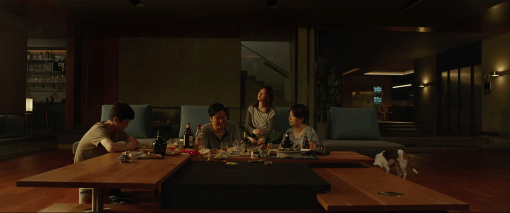
When one of his successful friends leaves the country, Ki-woo (Choi Woo-shik), the son of the Kim family, gets the chance to tutor Da-hye (Jung Ji-so), the daughter of an affluent couple, Mr. and Mrs. Park (Lee Sun-kyun, Cho Yeo-jeong). Ki-woo learns that Mrs. Park, who has now christened him Kevin, has artistic aspirations for her son. So, he introduces his sister Ki-jung (Park So-dam) to her as Jessica, a famous art teacher. Jessica, in turn, schemes to get the family’s driver sacked and her father, Mr. Kim (Song Kang-ho), hired. Mr. Kim, promptly, has the house’s long-time maid replaced by his wife (Jang Hye-jin). The film proceeds like a mathematical theorem till this point, depicting the linear, rigorous takeover of the Park household by the Kims. As the Parks drive away on vacation, the Kims sit boozing in the sleek living room of the house. There’s an uncertainty as to what course the plot will chart, now that the Kims have what they wanted. The sexual charge between Kevin and Da-hye and between Mr. Kim and Mrs. Park hints at a dissolution of the Park family à la Pasolini. The film, however, takes a whole new direction right at the midpoint. What was so far a comedy with elements of the crime movie turns into a darkly-comic crime movie. The fired housekeeper comes back and reveals a bunker in the house where her husband has been residing for the past four years with her help. As the housekeeper and the Kims one-up each other, the Parks announce their return over phone. What follows is a remarkable passage involving conflict, stealth and subterfuge in which the Kims lock the housekeeper in the basement and get out of the house without the Parks noticing.

Like Shoplifters, Parasite depicts an impoverished family tying to meet its needs by working its way through morally questionable territory. They are, no doubt, qualified to do the jobs they take up, but the means they employ to get their break is shady. They forge documents, feed on Mrs. Park’s parental anxiety, prey on other members of their class and usurp their jobs. For the Kims, this well-orchestrated employment project is as theatrical as it is logistical. They fake elite provenance, perform in front of the Park family, manipulating their fears and prejudices to their advantage. That said, the Kims are a happy, loving bunch, sticking by each other at all times. They are always seen eating together and their big dinner in the posh living room attests to their genuine cordiality. Their rise is based on family solidarity, as is their incredible escape from the house. The family, in Bong’s film, is in fact the only bulwark against precarity: without the “chain of trust” that the Kim family form together, they’d fall apart.

The Park family, on the contrary is hardly seen together in the same shot. They never have their meals together, holed up as they are in different corners of their massive residence. Bong and co-writer Han Jin-won mount a broad critique of middle-class Korean family, lampooning their American obsession and their preference for western names, objects and social codes. They contrast the hierarchized relations within the Park family with the egalitarian dynamics of the Kims. Mr. Park has unflattering opinion about his wife, though he’d call what he feels towards her love. He doesn’t like the boundary between the driver’s seat and the back of the car violated and prefers that his workers stay within their line. Mrs. Park fear of her husband’s reproach is opposed to Mrs. Kim calling her husband a cockroach in jest. The whole problem comes about – and the plot moves forward – because Mr. and Mrs. Park prefer keeping information from one another. They refuse to openly talk with the employees they fire, relying on their own preconceived notions of how the servant class behaves to make their decisions. Their discreet existence has made them so gullible that all it takes to take them for a ride is a fancy visiting card.

“Lots of people live underground”, says the housekeeper’s bunker-dwelling husband to a surprised Mr. Kim. Parasite’s class-coded topography of high and low isn’t merely literal-minded symbolism, it corresponds to the spatial experience of different social classes. Perhaps for the first time since Kurosawa’s High and Low, we have a scenario whose metaphors are derived from the actual living conditions of the characters. The Kim family has to literally look up at the world. Their cellar of a house hardly gets any sun. Its window is a urinating spot for drunken drifters. When it rains, the whole house is flooded, “washing out” the residents. The basic necessities of life – clean air, water and sunshine – have been rendered luxuries in their world as in ours. The high-walled house of the Park family, on the other hand, is constructed at an elevation and sealed away from other humans. The Parks have a lush garden receiving abundant sunshine, where their Indian-crazy son pitches his tepee during the rain that floods the Kim home. They stock their daily supplies in the basement, but there’s a bunker even beyond that they’re unaware of. These bunkers, we are told, were traditional components of affluent households, constructed for the owners to take shelter during war or from debtors. Bong’s film is marked by several upward and downward movements that are physical as much as economic.

Fertile though the scenario is, the success of Parasite entirely rests on Bong’s orchestration of the material. The film proceeds at breakneck pace: Kevin’s comment about introducing Jessica is followed by a shot of the two entering the house, without any filler event intervening. Ditto with their father and mother. Their elaborate scheme to get the entire family employed at the house is presented as a montage cut to a string-heavy classical score. Bong constantly finds ways to break the monotony of over-the-shoulder shots in conversations with different configurations of actor positions. By nature of the script, the viewer cannot identify with any character in the film and Bong plays on this ambiguity all through. Our expectation in every scene changes rapidly depending on the characters involved: in the confrontation between the Kims and the old housekeeper, the sympathy lies with the latter, but as soon as the Parks are back home, the axis of identification changes. The set-piece of the family’s escape from the house is a mini-marvel of filmmaking that synthesizes all the narrative information the viewer is provided so far and provides new ones without diluting the tension. The intuitive manner in which it stitches together various spaces of the house is a tour de force of sequence composition.

Bong’s penchant for and adeptness in blending genres is well-known, and it’s an explosive generic cocktail he concocts in this film. The film weaves in and out of comedy, drama, horror, crime and even sci-fi, the multivalence palpable even on the soundtrack which overlays different genres of music. The tensest moments of the film are also its funniest. The sequence that follows the intense escape scene, in which the Kims discover their house flooded by the rain and take refuge in a state camp, provokes a complex of strong emotions one rarely experiences in cinema: relief (at their escape), worry (about the condition of the housekeeper), fear (of the Parks’ discovery of the bunker), pity (for the Kims’ flooded house), anger (at the Parks’ plans for a party). Bong’s editing is as intellectual as it is visceral. He intercuts between the Kim household drowning in rain and the bunker where the housekeeper and her husband are trapped, creating an extra-narrative working-class solidarity that’s only present subconsciously within the film. A shot of a character smashing another’s head with a rock is cut to an opera performance, the unnerving combination of low and high human impulses emblematic of the whole film.

Following Lee Chang-dong’s sensitive Burning last year, Bong gives us a work that puts Korea’s exacerbating unemployment problem under the scanner. Like Lee’s film, it throws light on Seoul’s segregated districts that keep social classes in increasing isolation from each other and which modulate the very manner these classes see themselves and each other. That it provides this insight in a form that’s as dynamic and enrapturing as it is intelligent and complex is Bong’s special success.

Otras Inquisiciones (The Exterminating Angel)

Cahiers du cinéma no. 145; July 1963.

The Exterminating Angel

I remember this sally of Rohmer’s: “Moullet, I know why you love Buñuel. It’s because you’re both slackers.” The greatest compliment of my life.

The title was Rivette’s idea. He told me that it was the title of a publication by a certain Borges. So, I read Borges afterwards.

This film, among the strangest and most audacious in the history of cinema, could’ve been made only on the momentum imparted by Viridiana, grand prize at Cannes in 1961, and, it seems, Last Year in Marienbad, grand prize at Acapulco in December 1961, awarded just before the shooting of this film in February-March 1962. Not that Resnais influenced Buñuel in any way. But the commercial success of Marienbad, combined with the similarity of characters, setting, the related mystery and the apparent incomprehensibility, allowed Buñuel to imagine a commercial future for his old project The Castaways of Providence Street.

The accidental resemblance to Marienbad stops at this superficial level since the two films are as different as they can be: one is extra-temporal and extra-social; the other is a testimony to our times and our society. One describes the psychological world; the other describes the real world and, if the subjective has a prominent role to play in it, we cannot appreciate the work without resorting to certain fundamental, objective and unquestionable interpretations. Finally, if Marienbad is a point of departure, The Exterminating Angel is a point of arrival in cinema history as well as in the career of its creator.

Even so, it’s important that the viewer is thrown into the film without any warning. The work seeks to be like the life that man encounters at birth without any reference whatsoever. And any warning, even an evasive one, places the meaning of the work in a particular territory that can’t be confirmed as its own before the end of the film. Is the film a materially-explicable prank played by the Nobiles? We can suppose so when the lady of the house tells her servant not to let the bear into the living room as planned because one of the guests doesn’t like jokes. Or when the valet appears to deliberately spill the stew. Is it a prank played by Buñuel? We could think so. Many people think so too and believe, not without reason, that it discredits the film. But that’s to forget that a prank can have deeper meaning. The greatest artists, including the most modest and the most personal, like to conceal the depth and the personal quality of their work under the guise of a prank. But, here, the fundamental explanation isn’t a prank; it’s one of the secondary explanations. Is it an intimate reverie like Marienbad, a symbolic, parabolic or a metaphoric film? And which symbols, which parable and which metaphor are we talking about?

The viewer’s uncertainty and hesitation produce in him the anxiety that haunts him every day and from which the discovery of the Fundamental Secret in the very last shots delivers him. The film’s structure hence models itself on the developmental structure of the human mind, from childhood to maturity. Maturity is an individual conquest. No doubt that, to arrive there, one must make a personal effort of breaking through to the Secret that the film’s apparent incomprehensibility and its prankish appearance weakly guard.

The Exterminating Angel is hence a detective film, the greatest of detective films, since its object is not the discovery of the culprit – although, here too, at the end we discover a culprit the nature of whose identity is crucial – but the discovery of the nature of our human and social condition and its motivations. Through the secret of the enigma and the ascent to knowledge, we discover the secret to happiness.

This need for a protective prank explains Buñuel’s attitude: “The best explanation of The Exterminating Angel is that, reasonably, there is none.” There is none, reasonably, but there are some, unreasonably: the film being cosmic and synthetic, it contains the rational and the irrational at once, one inside the other. Reasonable explanations that we are right in giving apply to a world alien to reason. Like the ending of El and Nazarin, even L’âge d’or and Archibald, the whole of The Exterminating Angel can be explained by a mix of reason and affectivity, demonstration and poetry, which allows Buñuel to declare that there’s no conscious intention here. In his works, reason is linked to instinct, and that’s why his film is the first truly abstract film and why it remains lively at the same time. The Exterminating Angel is the first screen adaptation of The Spirit of the Laws (or of Discourse on the Method, or Ethics, or Principia, as you wish), but it’s The Spirit of the Laws by way of Henry Miller.

The Exterminating Angel indeed has all the trappings of a theorem, but it’s not one, it doesn’t aspire to be one, as Buñuel mentions. It’s that there’s no logical continuity in the meaning of its actions, no dramatic scaffolding at the level of characters and their relationships or their oppositions. The work is made of straight lines – essential elements, relatively reasonable and explicable – interspersed with several broken line segments – hard to explain, secondary elements – that seem to contradict the former on a purely logical level, but reinforce them on a superior level, firstly because their meaning is similar and secondly because their lack of a superficial relationship to a theorem eliminates all impression of didacticism.

These straight lines can be defined with the help of two keys, which are also the only keys to the film and which offer an unquestionable and objective character foreign to the rest of the film.

The first is that the impossibility of leaving (or entering, which amounts to the same) is to be explained not by a physical reason, but by the absence of will in a human being living in a particular milieu, a definite society, who can never follow a personal line of conduct, nor stray away from beaten paths.

The second has to do with a metaphor based on the rule of cross-multiplication: just as they are subjected to a slow and complete degradation of themselves when they can’t leave the Nobiles’ residence, the guests will be victims of a similar degradation when they can’t leave the church. In other words, what takes place at the Nobile residence, in fact, takes place at the church. The fear of censorship seems to have necessitated this metaphor, avoided in L’âge d’or, which was a more biased but less disguised adaptation of The 120 Days of Sodom.

This rule of cross-multiplication is made clear by the impression the viewer has of both sections of the film and their mutual relationship. The two sections, by construction, are placed on the same level, with the difference that the first is all about length and precision while the second is about the allusive and imprecise force of its brevity, the evocative mystery proper to its elliptical nature. If we indicate the living-room section by L and the church section by C, we obtain the following relation, whose numbered quality doesn’t seem to take away from artistic reality too much:

Since L = C, we have,

L (Degradation x 84’) = C [(21 x Degradation) x 4’]

The elliptical brutality of the last section and the speed with which we arrive at the renewal of the phenomenon of avolition gives us the impression that it’s going to return with ten or twenty times the force.

Is the relationship between the two sections located on the level of a superior and meaningful reality that one Cahiers writer called Brechtian or on the level of concrete reality, of psychological evolution? Is there an evolution to be traced in the alienated characters who liberate themselves only to find themselves in another, more serious alienation? Here, we are reduced to interpretation. The two possibilities seem to be well-founded in their own way. The first section of the film tells us that man has no escape if he locks himself up in society’s rules, opposed to the imperative rules of nature, which can manifest themselves within society’s rules only in a barbaric and secret form in direct contradiction with the spirit of these social rules.

The second part reveals the profound cause of these social rules: religion; this time, the exterminating angel of the Bible has turned against the faithful. The only way to escape this grip is to take a step back, by a kind of conjuration, to erase the past through the purification of passions Aristotle spoke about. It’s necessary to pull out evil by its roots so that purification can happen, not at the branch level, namely social reforms which are necessarily ineffective, but at the level of religious reformation, without which the degradation of man will persist, just as social troubles will persist outside, as the last shot clearly indicates.

This message isn’t wholly new as an idea. It’s simple, unsophisticated. It might seem extraneous to us who believe ourselves to be free of religion’s stranglehold. But the messages of Griffith, Welles – whose Rosebud is very similar – are of the same simplicity and they are also biased. What counts, in fact, is not the meaning or the intrinsic and discernible value of the message, but the force with which the filmmaker expresses it and his success in making us accept it as he expresses it on screen.

Now, the presentation of the film in the form of a rebus, justified by the mysterious character of concrete reality, compels the viewer, through the same process by which he has recognized the meaning of the film, to “accept” it as the product of an intimate collaboration with the filmmaker. Had the facts been presented more crudely, without any ellipse, we wouldn’t have bought into it since our participation wouldn’t have been required. So much so that the rigour of “instinctive reasoning” here is admirable and flawless: in eighty minutes, all the various forms of man’s alienation and degradation are envisaged, to the point of making us completely forget that they could be biased. We get the impression of a synthetic and cosmic study, too perfect to be false or even incomplete, even less susceptible to be replaced.

The broken line segments pose a problem: isn’t the outside world, represented by the servants, the people, and the police, also alienated since it suffers from an inverse but nevertheless comparable avolition? Aren’t there other parallel, or opposed, forms of alienation taking shape under the influence of these social rules?

The filmmaker’s dark humour manifests itself in many dissimilar forms. It’s either expressed by the characters or it is expressed by the filmmaker at the expense of his characters, whether they are masters or servants, when they claim to make us laugh.

Is it the raft of the Medusa or the ark of Noah, whose sheep were also destined for consumption, in the last shot, or do they evoke the herd of the faithful to be hoodwinked? Triple ambiguity.

Even when they contradict each other, these elements have a half-logical, half-affective meaning that has nothing symbolic about it.

The Exterminating Angel is the only film where there can be no symbols: a symbol is the sign of something abstract located in a concrete reality. Now, everything here is located on a meaningful reality which claims to take the appearance of concrete reality only to satisfy a dramatic necessity – the viewer must make the effort himself to return the film back to the level of reality it’s located in – and to respond to the demands of a modesty which is one of the dominant qualities of the work.

In contrast to Les Abysses, where Papatakis endlessly repeats the same shocking images to the point that they don’t shock anyone anymore, in The Exterminating Angel, Buñuel softens all the diverse actions which, on reflection, turn out to be of monstrous oddity. He arrives there respecting the hard times specific to all life, hard times that are not dead times because they are nonetheless bestowed with meaning. He arrives there eliminating all dramatization and often resorting to a suggestive and less inhumane ellipse.

It’s that there is no misanthropy in Buñuel. Even men alienated by clerical society aren’t contemptible and their efforts, either to liberate themselves or to save their dignity within these social rules, are evoked here with an attention, a respect devoid of any contempt, with an almost-Christian humility.

It is indeed remarkable that the most anti-religious of filmmakers (The Exterminating Angel, in view of its various mocking titles, its construction right from the credits on, and its meaning, is an essentially religious film, but also the most powerful work ever created against religion) – the most anti-religious in “content”, let’s make it clear – is one of the most Christian in “form”. Following Nazarin (1958) and Viridiana (1961), The Exterminating Angel is the third part of the triptych based on the principle of the Christian parable which, under the guise of a contemplative chronicle, justifies this perpetual, distant and inquisitive aerial survey of the camera and places the film on a superior level, that of facts and characters, which sometimes surprises the viewer, accustomed as he is to the actor, to the point of getting bored or falling asleep, with good reason or otherwise, before these chronicles.

The acting style and the simple, monotonic diction so dear to Buñuel seem to coincide perfectly with the principle of the parable film and the principle of repetition particular to a subject exempt almost in its entirely from any progression. The convergent accumulations produce an unseen poetry of reiteration without a particular shot ever being redundantly used. Taken to its conclusion, this poetry attains the level of fascination1.

Buñuel’s power thus lies in producing emotion and in ending up with the greatest efficiency through unusual means that are apparently at loggerheads with the film’s goal: a classical cinema based on acting and aesthetics gives way to a modern cinema based, as I see it, on the Idea and its multiple poetic possibilities, whose success, rare amidst many failed attempts, is of an incomparable degree and proportional to the originality and the difficulty of the undertaking.

For those who blindly consider this new art as the sign of an impossibility of expressing oneself through means more common to the “essence of cinema”, let’s remember that this definitive film, third part of Buñuel’s triptych of parables and third part of his dark humour triptych following El (1952) and The Criminal Life of Archibald de la Cruz (1956), also reprises certain para-surrealist themes and reveals in the dream sequences a visionary power and an imagination comparable to those of Murnau’s Faust and applied to an entirely new material in the rest of the film. That’s why, better than Faust, The Exterminating Angel constitutes one of the most sublime creations of human genius.


1Contrary to its reputation, The Exterminating Angel is not difficult to understand, it’s difficult to like: our admiration is a product of the perfection of a “dramaturgy of de-dramatization” as original as it is discreet in its effectiveness. In this underexplored domain, the construction is of an invisible rigour and audacity comparable to that of The Young One in the classical domain. In the American pure cinema, we were frequently aware of the ideas behind shot changes; here, a similar invention takes place with the change of shots, which are in fact dictated by ideas of succession of ideas, by ideas of succession of subjects.


[From Luc Moullet’s Piges choisies (2009, Capricci). See Table of Contents]

Toni Erdmann

Winfried (Peter Simonischek) is what the American president would call a world-class loser: a divorced, middle-aged man living with his ailing dog, eating frozen food and making ends meet working at an old-age home. He makes occasional visits to his old mother, plays pranks and has a sense of humour only the viewer can understand. When his dog dies, he goes into crisis and flies into Bucharest to be with his daughter Ines (Sandra Hüller). Ines is too busy with her consultation project that’s helping an oil giant outsource its jobs – a term that her client doesn’t want uttered. By his appearance and wilful behaviour, Winfried sticks out in Ines’ corporatized mise en scène – an endless alternation of offices and business meetings masquerading as parties – and is sent home after a costly faux pas. Out of desperation or concern – we don’t know – he decides to stay back in Bucharest and shadow every move of Ines’. The objective: to jolt his daughter out of her Hamster-wheel existence. Maren Ade’s Toni Erdmann takes the familiar scenario of estranged relationships and gives it a new life by fleshing it through a series of set-pieces brimming with incident.

With his loose T-shirt, unkempt, flowing hair and split spectacles, Winfried is clearly a pathetic figure, midway between Fellini’s clowns and Lisandro Alonso’s inarticulate loners. The film doesn’t pretend that he’s any more than that. He has no self-esteem, his jokes and the schtick with the false teeth fall flat. So do his attempts at playing the wise fool, his views on what’s important in life revealed to be vague and incoherent. For Ines’ birthday, he gifts her an off-the-shelf cheese grater. It’s only partly a joke. When she’s understandably taken aback, he shows her the wad of Euro bills attached to the grater and says that that’s the actual gift. He realizes that each of the two gifts is more offensive than the other, each serves as alibi for the other. This kind of double act, one insuring against the failure of the other, is typical of Winfried, who leads a kind of ironic existence. He’s always pretending to be someone else, pretence being his way of guarding himself from hurt. In the first scene, he asks a courier to wait at the door, only to come back as “his brother” to collect the package. We see him in costume and make-up throughout the film, weaving stories about himself and others.

Pranking is the only way Winfried can keep the world and himself at bay, but it is what helps him connect with his daughter too. After he forgets to wake her up for an important dinner, Ines all but forces him to go back home. That evening, she complains about him to her girlfriends at a party when Winfried, now sporting a suit and a wig, barges in as Toni Erdmann, a high-profile “life coach”. Toni is a parody of the corporate type, the only one that Ines understands or has time for. Toni encounters Ines wherever she’s with her coterie, thus authorizing himself with all her contacts. Through the figure of Toni, Ade’s film puts in confrontation Winfried’s open approach to life with the fakery of corporate culture, both staking claims on Ines’ time and energy. While Ines’ company wants her to be more charming, throw parties to show that she’s cordial, and basically imitate real life in order to succeed in business, Toni appropriates a corporate way of being, forcing Ines’ to take responsibility for him whenever he’s around. In a spoof of “bring your kids to work day”, Ines is obliged to take her father along with her to an important meeting because he’s handcuffed her to him, a favour he returns by dragging her to a middle-class Romanian family’s Easter gathering and coercing her to sing.

The film is hence centred on Ines’ “thawing”, her movement from her self-denying role as the perfect corporate middle-manager to her role as Winfried’s daughter. Fed up with having to put up a façade, she breaks down just before her big party for her Romanian colleagues, spontaneously turning it into a prank and acknowledging her inheritance. It’s an original set-piece, moving in an organic fashion from sad to weird and finally to hilarious and Sandra Hüller aces it. As much as Simonischek’s Wilfried is a type, Hüller contained response to him saves their dynamic from becoming one. The big outburst that the viewer expects never comes and is instead sublimated in a song Ines belts out. Ade dedicates dozens of shots just to observe the unique way Hüller moves. There’s an amazing shot of her working the zipper of her dress with a fork. She often reacts to Winfried’s excesses with an inward withdrawal, with accelerated blinking and subtle inflections of her posture. Though her Ines is expected to be on top of things at office and at dinners, she proves eminently capable of tuning out of her surroundings – a nuance in performance that makes final passage of the film where she spends an extended moment with her father entirely credible. It’s apposite that the film ends with her blank stare.

Toni Erdmann comes in the long line of humanist films championing the outcasts and deadbeats – that historically-bound section of humanity out of step, voluntarily or not, with the forward march of capitalism. Ade’s film is sensitive to class differences both within Winfried’s extended family – everyone tolerates him with a plastic smile – as well as between Ines and her surroundings in Bucharest. Ines is there in Romania as part of a larger project to take it out of post-communist doldrums, to bring the country up to speed with the rest of the European Union. But the oil industry is privatized, malls are running empty and jobs are going away. Ines and her clients seem to be in a bubble untouched by these details, meeting each other at upscale restaurants and pubs far from Romanians and Romanian life. So, Winfried’s uninvited intervention also has for result the breaking of this bubble. Ade’s intelligent and empathetic film plays out in a handful of languages and is a veritable snapshot of the European Union in all its promises and failings.

You Were Never Really Here

Lynne Ramsay’s You Were Never Really Here is a muscular psychological thriller, less successful than We Need to Talk about Kevin but cut of the same formal fabric, that revolves around Joe (Joaquin Phoenix), a veteran turned hitman, who specializes in bringing back abducted girls. Joe is known for his brutal but effective, seamless operation. Joe lives with his old mother in their New York home, likes a certain kind of candy and shops for his weapons in supermarket. His latest mission is to rescue the teenage daughter of the local senator who’s being held captive at a city brothel. Joe infiltrates the facility, kills the keepers and frees the girl, but she’s soon abducted again by an army of henchman sent to eliminate Joe and everyone close to him. He learns that the senator has been killed and that these men have been sent by the governor who’s running the whole racket. Joe decides to get into the governor’s house and rescue the girl again.

This is Ramsay’s first film set in New York and the milieu heightens the echoes the work gives of Taxi Driver. You Were Never Really Here is, in fact, in constant dialogue with Scorsese’s film. For one, both deal with ex-marines trying to integrate back into civil life and who experience a strong revulsion towards the condition of the city and the political figures exploiting it. Both protagonists see innocence embodied in the figure of the white, blond teenager forced into prostitution. And both films feature several shots of the lead male topless, their vulnerabilities exposed. But while Taxi Driver depicts Travis’ descent into hell rather graphically, You Were Never Really Here is insistent on eliding violence. All the violence in Ramsay’s film is only suggested, never shown. A shot of Joe punching a drug dealer is filmed from the side with only Joe visible, the viewer not allowed to identify with the aggressor but observe him from a distance. The entire shootout at the brothel is presented as CCTV footage cut to “Angel Baby” in monochrome and without a single violent visual. Joe’s final raid at the governor’s house is implied through tableaux of the aftermath.

But the more crucial reversal with respect to Taxi Driver lies in the film’s treatment of masculine self-image of the hero. Travis counters his powerlessness in face of the inhuman machinery of the city with a bloody fantasy of triumphal reassertion. Like many of Scorsese’s films, Taxi Driver plunges the viewer right into the lead character’s mind-space and lets the viewer sort out the implications. Ramsay’s film, on the other hand, affords the viewer a distance. Joe has glimpses of a childhood memory flash by now and then: his psychotic father brandishing a hammer, looking for his mother hiding under the table, while kid Joe stands helpless. This helplessness is reinforced in another series of flashing images: his inability as a soldier to prevent the murder of a girl by a teenager over a chocolate bar. This fear of having inherited his father’s toxicity and his repeated inability to save women under duress feeds into his anxiety as a rescuer of abducted girls. Joe’s (unintentionally humorous) self-flagellating reproaches of being weak is a far cry from Travis’ putting up news items lauding a local hero. The fount is corrupt: the men have failed, it’s up to the women to save themselves.

Like in Kevin, Ramsay appropriates horror movie tropes, employing them to illuminate urgent, personal concerns. Ramsay’s associative editing, which connects different elements of the film in unusual, subconscious ways, isn’t as visceral as it was in Kevin, perhaps because the flash inserts are all neatly tied to Joe’s war trauma, but it’s still uncanny in the way it’s hinged on flinch-inducing sensations: sand on feet, candy in mouth etc. You Were Never Really Here invokes film history without that awareness weighing down on it too much. The spirit of Hitchcock’s Psycho looms large and is pertinent given Joe’s obsession with cleanliness and his tortured relationship with women, his mother in particular. There are also recalls from The Searchers, Le Petit Soldat and Kevin itself. A man Joe fatally wounds holds his hand during his final moments, an existential truth that reappeared in cinema the following year, more successfully and less preciously, in Lee Chang-dong’s Burning, another film about a resentful ex-serviceman trying in vain to get back to normal life in a city that doesn’t make it easy.

Oru Kidaayin Karunai Manu

[Possible spoilers ahead]

Debutant writer-director Suresh Sangaiah’s Oru Kidayin Karunai Manu (“Mercy petition of a scapegoat”) follows a group of villagers setting out for their ancestral temple. One of them, Ramamurthy (Vidharth), has gotten married and it’s time his family sacrifices the goat they’ve been raising for years to carry out their vow. The extended family and other members of the community hire a lorry and start early. Following a mishap in the middle of nowhere, they find themselves with the dead body of a young man; they’re not sure whether they’ve killed him by accident or if he was dead already. After an entire day of confusion and half-measures, they call a lawyer they know (George Maryan), who comes to the spot to sort things out. Things, however, spiral out of control and the residents of the nearby village discover the truth behind the disappearance of one of their own. Shot with elements borrowed from the international arthouse style, Oru Kidayin Karunai Manu makes compelling interventions into the conventions of the “village film”.

The protagonist of Oru Kidayin Karunai Manu is not any particular character but the community – a great rarity in fiction in general. The first portion of the film describes this community as it gets ready for the road trip. We witness the preparation process in a mosaic-like fashion: the hiring of accompanying personnel, the renting of the lorry, the various jokes, arguments and suggestions circling within subgroups and the departure before daybreak,when the entire group assembles prim and proper. The thread that connects these different scenes is the notion of community itself. The individual characters have no significance in this scheme of things, each being a caricature with one or two very humorous tics. The result is a flat canvas full of innumerable, uniformly attention-catching incidents comparable to Bruegel’s peasant paintings.

The portrait, however, isn’t all fun and games. We see the internal dynamics of the community, the rules that emerge to regulate relations within the group and squash dissent. As crisis strikes, we see fault lines emerge, but they are quickly attended to by the expedient hierarchy of the collective (organized along several axes, men-women, elderly-young, family-outsiders). When the lorry driver, or anyone else, threatens to leave, he is intimidated into groupthink. The Vidharth character is collectively cockblocked by the community till the end, but nevertheless maintains his new-groom privilege even when he’s at fault. His happiness is shared by all, as is his guilt. Whatever happens within the community stays within. Perhaps for the first time in Tamil cinema, we are dropped into Dogville (not gonna make the obvious joke here).

The abrupt shift that occurs half-an-hour into the film reorients the converging point of the narrative from the goat’s sacrifice to the resolution of the dead man problem. The death that the community was preparing for is replaced by another one that’s directed inward. The sacrificial goat now has to be a person who takes the fall for the well-being of the community. As the men try to dig a hole for the corpse using cooking utensils, the rest of the group settles down at a deserted temple and sets up a stopgap kitchen in the dark, life and death feeding into each other. The shift is also reminiscent of Luis Buñuel in that it parachutes an old world steeped in its own conventions, prejudices and hypocrisies into a situation it’s fundamentally unprepared for. (Had Buñuel made this film, he would’ve had the group consume the dead body, but Sangaiah’s view of the community is too ambivalent for such radical gestures.)

Oru Kidayin Karunai Manu has for its central line the movement of the group from tradition to modernity. The group starts from the village and ends at the courthouse. Legends, myths and half-truths abound within the community. The film opens with photographs from village temples: idols of village gods who were perhaps once men, totems and talismans to be used in rituals, miniature cradles and ribbons tied to trees as vows. On the soundtrack is a folk ballad about an animal killing by the villagers – real or collectively-accepted like everything else here. As the preparations for the function are on, the goat gets its own apocryphal history by word of mouth. The characters are addressed by nicknames that have unsaid stories behind them. We can’t tell legend from fact because one constantly becomes the other. Though there are cell phones, the villagers’ contact with modernity as a knowledge system comes when they have to call the lawyer and the doctor to sort out their issue. When the truth is out, cohabitants of the dead man get into an armed skirmish with them, until the police intervenes in this medieval justice. The liberation of the sacrificial goat and the chicken, in this regard, coincides with the community’s final submission to modern law, which does not deal in half-truths. Though the group is acquitted, they never know the truth, for what they have seen is truth enough for them.

Remains the goat, the mute witness to the entire drama. It’s treated as property and objectified by the community, but the filmmaker endows it with sentience with several point-of-view shots. Its gaze, however, is neutral, incapable of ascribing moral value to the villagers’ actions. Like the donkey from Agraharathil Kazhuthai, it is located at the eye of the storm around which the human community polarizes and fights it out. Its own existential threat is ignored as the film shifts gears, making it somewhat of a superfluous appendage. The world remains a mystery to the goat, just like many things in the film are to the viewer. In this, the animal perhaps shares the filmmaker’s vision of the universe, a morally neutral space with an internal harmony, where one sacrifice is swapped for another, a lost son replaced by another. There’s no evidence that the filmmaker’s desire to keep the answers from us – the nature of the death, the lawyer’s intentions, the perception of the goat – stems from a coherent philosophical position, but it makes for a welcome ambiguity.

Kurangu Bommai

A nondescript don in inner Tamil Nadu has his hands on a precious idol and wants to smuggle it to Chennai. Acting as his courier is the naïve Sundaram (Bharathiraja), who is supposed to hand over the idol to the cricket-obsessed Sekar (Elango Kumaravel). Sekar decides to appropriate the idol and have Sundaram take the fall for it. Sundaram’s son Kathir (Vidharth), whom Sundaram believes to be employed as an engineer, makes his living in Chennai as a taxi driver. One day, Kathir finds a pickpocket making away with a man’s bag, apparently valuable, and retrieves it after a chase. But the man’s gone and Kathir decides to surrender the bag to the police. The bag, however, has a mind of its own and decides to go from one pair of hands to another. Writer-director Nithilan’s debut work, Kurangu Bommai (“Monkey picture”, referring to the image printed on the bag) crisscrosses the lives of its seven or eight central characters over the possession of the idol and, while always interesting, the result is less than illuminating.

A comparison of the film to Maanagaram is unavoidable, but also unflattering. Where Maanagaram (as do some other hyperlink films) embodies a specific conception of the metropolis and its residents, Kurangu Bommai can only imagine Chennai as a village where the characters bump into each other on cue. The film flattens its social landscape, its characters abstractions floating in an unmarked narrative space. The film’s story could take place anywhere or nowhere – with any group of characters – and it so happens that it’s in Chennai. The hero, a nonentity, posts a picture of the bag he has on Facebook, and the entire city seems to be on it. The issue here is not the implausibility, but the distorted idea of what connects the inhabitants of a city. The hero is supposed to be a driver, but outside of an opening montage, we never see him at work though he always appears in uniform. He’s given this profession as a screenwriting formality. He takes to extreme violence at the push of a button, people are killed and bodies disposed of without repercussions, because the director is thinking in terms of templates in order to arrive at the sucker punch he wants to deliver at the end.

If Kurangu Bommai manages to hold the attention despite its numerous contrivances, psychological inconsistency and lazy scene detailing, it’s thanks to its overall construction. The film shuttles between two timelines that unfold linearly and have a certain overlap. The first thread is piloted by Bharathiraja as he travels to Chennai to hand over the statue to contacts. The second one is led by Vidharth and his efforts to return the bag to its owner. The weaving of these two story-threads creates a series of changing questions in the viewer’s mind, first related to the destination of the bag with the statue, then to Bharathiraja’s fate, the discovery of his body and finally the form of revenge the hero will exact. The film shifts from one story to another at points calculated for effect. Some work, some don’t: the emotional climax the film’s been building towards, with Bharathiraja’s disappearance at the focus, occurs at a point earlier than its ideal location. Individual sequences, in turn, are over-edited, betraying an insecurity towards the script and the actors. Despite the softness he brings, Bharathiraja is too intelligent a public figure to pass as the slow-witted Sundaram. It’s Vidharth, doing less once again, who is more convincing.

Ugetsu

Cahiers du cinéma no. 95; May 1959.

Ugetsu

In 1959-1960, I wrote several long articles (including this one) at Cahiers du cinéma which won me a certain prestige. Why this sudden effervescence? Because the big names of Cahiers had just moved onto filmmaking. And I was occupying empty chairs.

The most faithful review would perhaps consist of multiplying exclamations, superlatives and metaphors, of speaking of the clarity of crystals and the purity of water. But, at the risk of introducing a tonal rupture between the work and its criticism, we must go further. The very intention of criticism – which, unless it needs to fit in half a page, must put up with the treacheries of analytical convention – is not to go after the work’s essence. While there is such a thing as cinematic evidence, it’s impossible to speak of evidence when it comes to criticism. Gratuitousness and complete relativity alone can be the judges of our seriousness and competence. Yes, there’s no other approach to genius than to miss the forest for the trees.

In addition to platitudes and poetic references, I confess being the victim of another temptation: to take Ugetsu for a Japanese film by Mizoguchi when, in fact, it’s a film by Mizoguchi, comma, Japanese. It’s the nature of masterpieces to surpass the boundaries of collective civilizations – if I can be excused for this barbaric and paradoxical association of words that considers as fact that which can only be virtual – from which they nevertheless emanate. One must be aware of the origins, but also accept finally that they explain nothing. One mustn’t say that only the Japanese could have reached this high – a good joke: with Ugetsu, they have for once equalled the greatest works of the West. Confident about our quantitative superiority when it comes to quality, we tend to push our goodwill too far – perhaps due to snobbism, but especially because it costs us so little, applies as it does to exceptional and unquestionable works. And, through different means, we arrive at almost comparable results. I don’t think I’m getting too far from the subject at hand when I cite the Ray of On Dangerous Ground, the Murnau of Tabu for the shot and scene structure, the Preminger of Bonjour Tristesse for the direction of actors rather than Hiroshige and Hokusai, Kinoshita and Kurosawa, Noh and Kabuki, who are evoked without discrimination – rightly or wrongly, knowingly or not – when it comes to anything Japanese. At the most, we could say – something I wouldn’t take the responsibility for – that it’s a Noh view of Kabuki in the first part, and a Kabuki view of Noh in the second.

What we westerners don’t understand – native symbolism, that is – has no importance whatsoever. What a phrase book can decipher is of no artistic interest and that’s why it’s excellent to see a Mizoguchi without subtitles from time to time – it’s as fascinating as the most fascinating show in the world, that of rushes.

The most important thing is not to understand, but to understand that there’s something to understand and that we don’t understand: the means is the end here, since the ending will always turn out to be banal; it wouldn’t get you too far to understand that beans symbolize death, or anything of that kind. In fact, what’s more serious is that certain subtle connections, deriving from the mutual confrontation of symbols or the confrontation of symbols with what we understand, elude us. I propose a question: can the Japanese understand better than us the amazing scene of Miyagi’s death, which we believe to be based, just like our modern cinema, on action and not on ideas? Is it a westerner who could boast of having better understood the meaning of Man of the West, Ordet, Elena than that of Ugetsu?

Ugetsu greater than Mizoguchi

Come to think of it, is Ugetsu really this clear crystal, this pure gem that I just evoked, dazed by my first contact with the film? It’s possible to think so of The Crucified Lovers, Princess Yang Kwei-Fei, monotonous and more literally-Japanese monogataris. Ugetsu is not a film of pure sensitivity like them, made without apparent effort within an artisanal framework. It’s a work of labour and research. My thesis would be that Ugetsu is greater than Mizoguchi. It’s the most complex film in the world and the simplest at the same time, since Mizoguchi considers the complexity of what he shows with a constantly even distance and objectivity. It’s at once the most accomplished art and a withdrawal from this art. The perfection of imperfection and the imperfection of perfection. The perfect balance, in short. The sublimity of Ugetsu stems from the fact that it contests other films on equal terms and that it reigns over them immediately nonetheless. The frames brim with effects, but it’s up to the viewer to go look for them, and not up to the director to bring them to us on a platter through some expressionist solicitation.

Ugetsu, I repeat, is a film entirely on the margin of the eight-five other films that make up Mizoguchi’s filmography, which goes around in circles to end somewhere near Princess Yang Kwei-Fei. And this is perhaps thanks to the transcendence of chance and constraint. Like all works of old age worthy of that name, Ugetsu is a synthetic work. We know that, with age on his side, the creator ponders the vanity of an endless accumulation of invention, and sets out to seek his calling elsewhere. But beware, it isn’t in the Kamchatka or the halos that he’ll discover this elsewhere: the film would then run the risk of being the product of a pure idea, with no other connection to the physical world than through the channel of a retrospective. I prefer Ugetsu to the second part of Ivan the Terrible, more complete than the first, because the force of a juvenile cinema goes hand in hand there with the nobility of an adult cinema.

If it’s difficult to speak about Ugetsu, it’s because it’s a film, not a book, and a film that could never have been a book. The meaning of Ugetsu is resolutely cinematic, hence monist, as opposed to the fallacious atomism of literary creation. What is the film actually about? The unity of all things, their continuity, their confusion. The point of view of Ugetsu is located on the level of imagination, in the literal sense of the word, and that’s why idea and perception in it are closely related. The present and the past, life and death, real beings and ghosts, failure and success, what difference does it make at the end of the day? None, although we know that only the present has a physical reality, that ghosts don’t exist. The fact remains that we imagine them and that it’s true that we imagine all that we imagine; that only what we imagine is true and sovereign, by the very fact we imagine them: unless, with scientific progress, we discover another form of knowledge overnight. And we don’t have the right to cherry-pick aspects of this fact, since rejecting even one part of it is to admit that we can deny the physical world, that we can reject everything, since there is no priority, whether its source is direct or indirect, in everything that can make up an image1. And it’s this monism in which intelligence can see only contradictions that constitutes the entire being of the film, since we are less able in this film than any other to distinguish form or content.

Akinari is betrayed

Well, let’s talk about it, the content. The film is based on two stories from the collection Ugetsu Monogatari (1776) by Akinari Ueda (1734-1809), the Japanese Mérimée. In fact, compared to Thomas Kurihara’s old, expressionizing film, whose remake it is, Ugetsu doesn’t owe much to Ueda. See for yourself:

In “The House in the Thicket”, a peasant leaves his wife home alone to go sell cloth in the city. War follows; on his way back, he gets robbed, falls sick, wanders away, returns home after seven years and finds his wife there; but he realizes the next day that it was the ghost of his dead wife that received him the previous evening in order to encourage him to persist with his task.

In “The Lust of the White Serpent”, a young intellectual is tempted by a serpent that has assumed a female form. He brings back a precious sword from the enchantress’s solitary house and is interrogated by his family about the matter: he is arrested for theft of the Treasure of God since, obviously, no one knows the enchantress or her house. He is sent to prison only for a few months, having proved that he was victim of a demonic possession. But the Thing redoubles its rage, takes the form of our hero’s wife, kills her, before returning to its ophidian form and being put in a cage.

Mizoguchi has dropped all this melodrama and added a lot of material of his own: faced with the threat of the Shibata army plundering villages and recruiting farmers, Genjuro, a peasant attracted by the profits of pottery, and his brother-in-law Tobei, who dreams of becoming a samurai, leave town with their respective wives, Miyagi and Ohama, to sell pots, vases and tablecloth at the city market. En route, Miyagi and her son turn back to avoid rapist pirates; but she is killed on the way. Finishing his sales, Tobei becomes a samurai and finds Ohama, whom he had abandoned, in a brothel; they start all over again. For his part, Genjuro, suddenly rich, becomes the lover of princess Wakasa, who is simply the ghost of a young girl who couldn’t find love during her life. A bonze reveals the mortal danger he runs and immunizes him against the spirit, with whom he brutally breaks up. Completely impoverished, he comes back home to find Miyagi. But, the following day, he wakes up to the unpleasant surprise that it was Miyagi’s ghost that had received him the day before in order to encourage him to accept his fate, to continue with his task and to raise his son with the help of his sister and his brother-in-law. There are hence important differences between the film and Akinari’s text. Genjuro’s son, his profession as a potter, Wakasa’s human (and no more animal) nature, the secondary couple Tobei-Ohama: these are what Mizoguchi added after having expunged quite a lot.

Wakasa and Miyagi hold hands

Ugetsu shouldn’t be seen, based on its conclusion, as an apology for resignation and for specifically bourgeois values. Mizoguchi never proposes anything: his art is to show us the beauty of a world of extreme simplicity, but this beauty must be renounced in order for it to be grasped; without which we wouldn’t even see it. Just as how God would only be a myth if evil didn’t exist, everyday life would lose all meaning without Wakasa. Man must abandon the humdrum of existence – and this is Mizoguchi’s original sin – which he often does at the price of his life, in order to experience the beauties and dangers of the glory that seduces him, and only then will he be able to truly appreciate the simple life given to him. This is how the curve becomes a straight line. Beauty always has a moral significance, either in its consequences or in itself. Ugetsu is, if I’m allowed this gibe, a successful Run of the Arrow, it’s the onward and the return trip, the addition plus the subtraction. This turn of phrase determines the construction of the film, which narrates the story of two couples; one survives, not without the cruellest wounds; the other perishes (in fact, in the original script, Tobei and Ohama were to kill themselves); the superimposed happy ending upsets the balance of the film, which is neither optimistic nor pessimistic; we know since long that Mizoguchi’s universe is one of indifference, and the cruel fate of Tobei and his wife establishes a link with his other films.

Every scene in the film is matched with another one, similar in subject but different in manner: two lance murders; two ghost appearances; two trips to the city; Genjuro turns his mould two times etc. Every movement is responded to by another one in the opposite direction, as in the introduction and the epilogue, the arrival at the market. Every gesture, every movement that the creator puts in place is the formulation of a prejudice, an exercised prerogative about the existence of the universe. The first reflex is to cross arms and do nothing. On the contrary, Mizoguchi goes one step ahead of error and erases it on his way back. By this onward and return movement, he substitutes for a void something that we can consider at least as the presence of a void.

The movement of the artist

Like all synthetic works, Ugetsu is a work marked by domination, the filmmaker’s domination of his material and of himself (hence the abundance of long shots in the depiction of psychology). That is, by self-justification. The works of great men generally champion a way of life which is that of common mortals, while their own is exceptional. Well, Ugetsu establishes a link between the artist and his work. It insists on the humility and the necessity of creation. Genjuro is an artist: his profession as a potter is perhaps the one that resembles that of a filmmaker the most. I don’t think this is an interpretive hallucination: the aesthetic conversation between Genjuro and Wakasa on the secret of beauty have everything a message needs; no doubt that they must be applied to the work of our auteur. Creation, the artist’s as of the peasant, is portrayed as a temptation, but also as the only redeeming temptation in this world where everything is but temptation, since it’s the only noble one. At the outset, every artist is a rebel, a dissenter; but the very fact that he is an artist leads him to discover beauty and his thirst for wealth and fame, which can only be satisfied through a spiritual progress sanctioned by success, turns slowly into a search for beauty and morality. In his essence, the artist is an impure being who, beyond theory and principle, temptations fulfilled and rendered vain, if only thanks to intelligence which is his domain, becomes the purest of all. While everyone, in The Crucified Lovers as much as in Portrait of Madame Yuki, was a prey to the irremediable, in Ugetsu, which is Mizoguchi’s Under Capricorn in a way, an exception among eighty-six films cut from the same cloth, Prospero, pardon me, Genjuro triumphs over the irremediable by accepting it. And, through his evolution, we perceive Mizoguchi’s evolution. We often forget that filmmakers are filmmakers and that the most important problem for them is not racial or social, for the good reason that they have no reason to fear racism at the moment and that almost everyone is guaranteed to anyway find a job that allows them to not die of starvation. The most important problem is that of their existence and their role in society: are they pariahs or beings like others? Is there a chasm between the characters they depict, most often men in the crowd, and themselves? No, the answer is simple, it’s enough to be a maker of objects. But very few films give us this answer, and it’s even rarer that the artist’s life is closely associated with the details that have made this answer possible. After several apprenticeships with the sublime through the conventional, here’s a lightning strike.

What follows is a return to the norm: after such a peak, Mizoguchi will continue to make films like he did before, in a style that isn’t “new style”. And what he sings of here is this perpetual movement of the artist that justifies his vain and relentless labour. Ugetsu is Ugetsu and the critique of Ugetsu. Genius and humility are united once and for all in a perpetual oscillation.

At full speed

Of all Japanese films, of simply all films, Ugetsu is unquestionably the quickest, the most brutally quickest. Just ninety-three minutes for a script so rich that anyone else, Japanese or not, would’ve extended over three hours. In each scene, which is often a single shot, the action is presented at top speed, with strictly minimum editing. The Americans – and God knows how much they’ve tried – could never attain such concision. And Mizoguchi, before as much as after Ugetsu, drew much of his power from an extremely slow tempo. Why this change? Because Masaichi Nagata, in response to the increasing commercial success of his films in Europe and to the reservations that got the too-slow Oharu only a simple Silver Lion at Venice as opposed to a Golden Lion for Kurosawa, decided so. If Ugetsu is a masterpiece, it’s largely due to western influences and not the noblest ones at that. For my part, I don’t see anything wrong with that; and I will not follow these purists who are satisfied only when they can’t understand anything by dint of total esoterism. If we Europeans seek to renew ourselves through contact with the Orient, why shouldn’t the Japanese draw from curious Latin and Anglo-Saxon exoticisms? It’s surely not the first time that a masterpiece has sprung from the meeting of two most dissimilar civilizations. The seeds of this constrained evolution – but voluntary this time around – were already present in the previous Mizoguchis, animated by the same rhythm, no matter that it was slow or fast, which didn’t allow for the superfluity of well-mannered transitions and edits.

It would be ridiculous to think of this constraint as a disadvantage, especially as Mizoguchi, who isn’t mad and, as an aside, whose name we pronounce “Mizogutchi”, has completely annihilated the principle by pushing it to its extreme and extending it to all aspects of the mise en scène. But he couldn’t have thought of it all by himself.

Is it a question of telling us that we are at the countryside? And wham! A shot of the fields, interrupted right away by another insert of a lake, and lake in Japanese means Lake Biwa. A single shot, slightly mobile, shows us the hero and all the potentials of the drama. Thirty seconds after the credits, we know everything, thanks to an expertly concise and elliptical dialogue, which makes characters address each other as “my wife”, “my brother” etc. and describe the character traits of each one in an adjective. And Mizoguchi never stops rushing towards his final goal. A speed that would upset the Japanese as much as the European. All great films purport to show us God’s point of view; we already know that, I invent nothing, but what I didn’t know until now, and which Ugetsu just taught me, is that they are made for an ideal viewer who is more than “in the image” of God, who is God. It feels ten times faster for us, and we need ten viewings to be on equal footing with the film since, alas, the rushes must’ve already been pulped. The effects are conceived to enrapture the artist, or someone in his place, and not the viewer.


1I made fun of myself in Up and Down, where I utter this line while getting on the bicycle: a slope of 6 degrees.

[Translator’s Note] Moullet has fun typing out the full title of the film in French, Les Contes de la lune vague après la pluie (“Tales of the hazy moon after rain”), every time he refers to it – a running joke lost in translation. Clearly, he was paid by the word.


[From Luc Moullet’s Piges choisies (2009, Capricci). See Table of Contents]

Based on a True Story

[Possible spoilers ahead]

Delphine (Emmanuelle Seigner) has had a success with her new novel, Vienne la nuit, and fans are queuing up to get their copies autographed. They have all been touched deeply by the book and believe that it speaks to their own personal problems. Unnerved by this unsolicited responsibility, and the series of poison letters she receives for having made money out of her family’s story, Delphine retreats into a shell, unable to write anything anymore. She meets the mysterious, charming Elle (Eva Green), her “biggest fan”, who casts a strange spell over her. Elle helps Delphine with her work, sorting her notes and giving her suggestions, and starts occupying an increasingly large place in her life. She disparages Delphine’s ideas and insists that Delphine must not give into the demands of what her editors want but write her great, “hidden book”. Delphine doesn’t resist the takeover and instead sees Elle as a potential subject for her next novel. What ensues is a tug-of-war between Delphine and Elle to unlock each other’s history. That description might make it sound like an arthouse cliché à la Persona, but Polanski’s circular film treats the obvious symbolism directly, without conceit, and steers clear of the lures of psychological interpretation.

Based on a True Story is an adaptation of Delphine de Vigan’s 2015 novel of the same name, reportedly an autobiographical work. A viewer of Polanski’s film can well imagine the extreme self-reflexivity of the book: here’s a novel about an author who withdraws into herself for four years following the success of her latest book. In 2011, Vigan wrote a personal book about her mother’s suicide and it took her four years to come up with Based on a True Story. She is married to the literary journalist François Busnel who, just like his character in the book, was mired in controversy for interviewing Vigan on his own show and who was traveling the USA interviewing authors at the time Vigan wrote this book. Elle (L. in the book) urges Delphine to reject fiction, dive into her memoirs and write about her own life, but Delphine argues that even autobiography needs a perspective and is, in the final analysis, fiction. The solution to Vigan’s problem of perspective is the character of L./Elle, who gives concrete, personal form to Delphine/Vigan’s memories.

Surmounting creator’s block by representing it is not new even to cinema – Fellini did the same thing in 8 ½ – but the special force of Vigan’s material comes from the social commentary it derives out of the situation. Vigan’s/Delphine’s creative paralysis comes from the conflicting demands society makes of her as a woman, an artist and a woman artist. L./Elle is the ideal version of Delphine, always perfectly groomed and dressed, capable of saying no to her editors and publicists, turning up to events she’s signed up for, rejecting the need for male companionship, and even burning down the house with her abusive father. She is a ghost-writer, which means she doesn’t ever have to burden herself with book tours, speeches and signing sessions, and can therefore concentrate on her writing all the time – a luxury that Delphine can only dream of. Delphine, on the other hand, is in a relationship with a famous journalist whose company she increasingly looks forward to. L./Elle’s self-confidence and unapologetic career-focus is in contrast to Delphine’s jealousy over her boyfriend’s courting of American authors and her guilt of ignoring her children. On screen, this pits Green’s impeccable elegance and command of space against Seigner’s maternal clumsiness and vulnerability.

Needless to say, Polanski’s adaptation – the very intention to adapt – unmakes the vertiginous mise en abyme the book constructs with Vigan at the epicentre. Even worse, the story of a middle-aged matron (played by Polanski’s wife) being supplanted by a younger, more beautiful woman introduces an uncritical element of male fantasy into the film, especially bothersome considering the filmmaker’s history. The film nevertheless works as a dramatization of the creative process, reimagines as it does the quotidian artistic dilemma of what to write about and whom to write for as a ghost story. We are not sure who is haunting whom, with Delphine trying to get into Elle’s head to mine material for her book and Elle taking over Delphine’s life to instruct her on what to write. Delphine keeps getting complimented for capturing her reader’s minds so accurately, but it is Delphine’s whose mind-space is constantly conquered by her reader-subjects. The artist writes on the world, but the world writes on the artist too, dissolving the boundary between the two. It’s truly the death of the author.

A few years ago, when I heard Haneke was making a film about the internet, I expected what we got from The White Ribbon and Amour: a declarative statement about the dangers of the digital age and its capacity for abetting evil. But Happy End is more open, more suggestive than the conclusive theses that were Haneke’s previous two films. To be sure, there’s hardly anything spontaneous about the new film and its shot compositions are still very calculated, perverse in their vehement disavowal of violence, but the manner in which information is presented or withheld forces the viewer to actively stitch the pieces together to understand what’s happening. Even when the final picture emerges, one is not entirely sure if all the behavioural details, choice of shots or narrative information have been accounted for, which makes for a summary that’s far from decisive.

Michael Haneke’s Happy End, an oxymoron if there ever was one, is set in Calais in the northern extreme of France and centres on an upper-class white family that owns a public works construction business. The grouchy head of the Laurent family, Georges (Jean-Louis Trintignant) suffers from dementia and wants to kill himself. His doctor son Thomas (Mathieu Kassovitz) is married but is having a kinky online affair with another woman. Georges’ daughter Anne (Isabelle Huppert) heads the business one of whose sites her bumbling son Pierre (Franz Rogowski) manages. Following an accident at the site, in which a worker is seriously injured, their business comes under the risk of government sanction. Meanwhile, Thomas’s daughter Eve (an incredibly precocious Fantine Harduin) from his first marriage is forced to move in with him following her mother’s death. Present in the outer orbit of the Laurents are housekeeper Rachid (Hassam Ghancy), his family and the many refugees of the Calais jungle waiting to get across the channel.

None of these character relations are clear until late into the film. The Laurent family is given to us in shards, as though like pieces of a broken mirror. They appear to be representatives of an old order, the haute bourgeoisie, now crumbling under the weight of political and technological turmoil. Georges the patriarch has lost his mental faculty and thus economic power; he wanders the film looking for ways to die. In an interesting scene, he’s on his wheelchair in an impoverished part of town, having forgotten his way home. Amidst deafening traffic noise, he speaks to a group of male refugees, who don’t understand why he’s willing to give them his watch in exchange for information. Waning under his mother’s supervision, Pierre feels emasculated. Thomas doesn’t really believe in marriage anymore. Eve is out poisoning herself and other people. At the eye of it all is Anne, trying to unsuccessfully hold this European union together.

Numerous instances of digital media feature in the film. Eve records her life with her smart phone and sends the recordings to friends. She watches videos of YouTubers discussing their personal lives. Thomas’s affair takes place entirely on phone, e-mail and social media. This increased publicization of private lives, which Haneke clearly sees as dangerous, is contrasted with the infusion of the public affairs into the Laurents’ private lives. Their business is troubled by strikes in Scotland. The government is grilling Pierre to trace possible negligence as the cause of the accident. At Anne’s all-white engagement, Pierre brings in refugees from the area and creates ruckus. (Not that he’s the voice of the marginalized, he simply uses them as bugbear). The family members love each other, but you sense that it’s the wealth that ultimately holds it together, the stability of the family dependent on the stability of the capitalist social structure they represent. Happy End is Haneke’s vision of post-Brexit Europe.

Okja

[Possible spoilers ahead]

Bong Joon-ho’s Okja begins with Lucy Mirando (Tilda Swinton), the new CEO of Mirando Corporation, unveiling “super-pig”, a new porcine variant her GMO company has come up with to solve the world’s hunger problems. In order to soften its public image and garner popular support for the new pork variety, the company announces a “best super-pig” competition, in which super-piglets are given to farmers around the world for a duration of ten years. One of these creatures, now named Okja, grows up with Mija (Ahn Seo-hyun), an orphaned farmgirl living in the mountains of South Korea. When the competition day arrives, Okja is taken by Mirando to Seoul and then to New York against Mija’s wishes. Mija, with uninvited help a group of American activists from the Animal Liberation Front (ALF), follows Okja to New York to get her back home.

Bong lampoons Mirando Corp as being headed by a family of deranged egotists convinced of the nobility of their mission. There’s no pretence to realism here. Swinton, that epitome of ironic existence, draws from Cruella de Vil and Jake Gyllenhaal as Johnny, Miranda’s neurotic PR, clearly works off cartoon/anime types as well. Though he’s ultimately with them, Bong parodies the ALF activists too, with their facetious politeness and misplaced idealism. Both are, of course, gross exaggerations and Bong’s equating of both reeks of a cool cynicism towards his subject matter. On the other hand, the filmmaker invests all his heart into the world of Mija and Okja. The film spends considerable time depicting the Edenic life in the mountains, where men and CG animals live in symbiosis with nature. The elephantine Okja, a cross between a pig and a hippopotamus, eats a small dose of fruits, helps Mija and her grandfather in fishing and sustains the ecosystem with her droppings. Bong doesn’t question this violation of nature’s rules, effectively acknowledging Mirando’s claim of having created a superior animal.

As the film shifts to the technologized jungle of Seoul – a disorienting change from the mountains – the film takes on more complex tones. A long, compelling action sequence finds both Mija and the ALF members coming together to hijack Okja, plant a spy-cam on her and let her be taken to the Mirando test facility in New Jersey. There’s a conversation between ALF and Mija translated by a Korean member of the group that speaks to Bong’s status as a Korean director making English-language films. The punch-line for this scene comes later and with the splash of violence that was always on the cards. Meanwhile, at the Mirando lab, Johnny has successfully bred Okja with a male super-pig and whipped up a meal with samples from Okja’s body. Scenes such as these involving ALF and Mirando corrupt the innocent fable of Mija and Okja and change this children’s film into a genetically-altered organism in itself.

Yet, Okja is a Disney movie at the DNA level. In the Korean portion of the film, Okja is demonstrated to be an intelligent, non-human person capable of empathy and even sacrifice: she saves Okja from a fatal fall at the risk of her own life – another disconcerting characteristic for a manufactured animal the film doesn’t bother to question. The film’s final scene takes place in Mirando’s large-scale abattoir where super-pigs are stocked and killed. Bong shows us the slaughter and we are all the more repulsed because the animals are invested with human emotions. This anthropomorphism reveals an instrumental morality typical of Hollywood animation, which only humanizes animals that aren’t eaten. The super-pigs need to be saved not because all animals need to be saved, but because they are extremely useful, higher beings. As Mija and Okja walk out of the facility, lucky to be alive, a super-pig couple nudges out their piglet out the barbed-wire fence to be smuggled out by Okja. Followed by a collective howl of thousands of super-pigs doomed to die, it’s a very disturbing scene with unsavoury echoes of the Holocaust. It moves us for the wrong reasons. Tough luck if you aren’t a species with human-like expression.

Burning

Lee Chang-dong’s first directorial project since Poetry in 2010, Burning portrays the civil life of an ex-serviceman Jong-su (Yoo Ah-in) who falls in love with a shop girl Hae-mi (Jeon Jong-seo). After a trip to Kenya, Hae-mi grows close to a dodgy, rich young man called Ben (Steven Yeun). Jong-su, meanwhile, discovers that his estranged father, who likes collecting knives, is tangled up in a case involving assault of a government official. In a marijuana-fuelled meeting at sundown at Jong-su’s house in the countryside, Ben reveals that he likes burning down greenhouses – a metaphor that Jong-su, wannabe novelist, picks up a little too late. Hae-mi vanishes and Jong-su spends his time stalking Ben to find out the truth. The closer he seems to get to the bottom of his girlfriend’s disappearance, the more it seems that he’s imagining things. Lee’s excellent film is a thriller that’s also an astute socioeconomic portrait. And the philosophical questions the thriller aspect of the film raises, Lee seems to be telling us, are also emanations of class conflict.

The protagonist Jong-su’s predicament is whether he has inherited any of the insanity and violence that characterizes his father. As a child, he was forced by his father to burn his mother’s clothes when she left home for someone else. The confusion as to whether he’s seeing things as they are or he’s losing it manifests in Jong-su’s slow response to happenings around him. He takes time to make sense and even longer to act (and Yoo realizes this slowness in his sluggish physicality). He’s trying to write a novel, but doesn’t know on what. Outside of odd delivery stints, he is unemployed, like many of his young compatriots. He refuses to take up a menial job, preferring to move back to his father’s now-deserted home outside Seoul. His relation to Ben (“Gatsby”) is also determined by class resentment and Lee’s film is clear-eyed about the classist spaces of Seoul. Ben lives in a swanky apartment in Gangnam, where Jong-su’s pick-up truck sticks out like a sore thumb. The places that Ben frequents (and which he sometimes invites Jong-su to) – the brewery, discotheque, gymnasium, art museum, the church even – are in stark contrast to Jong-su’s downtown hangouts and Hae-mi’s matchbox-sized studio in a noisier part of town. Lee includes several shots of the characters navigating Seoul’s various districts and of Jong-su driving around in his pick-up truck, following Ben’s Porsche, like Scottie from Vertigo. Just like Hitchcock’s film, Burning is full of repetitions, reflections, pairings whose patterns appear to impart sense to Jong-su’s quest and redouble his obsession.

Burning unfolds as a metaphysical thriller like Blow-Up, and Shutter Island. Its protagonist is never sure whether his understanding of the world is reflective of reality or simply a product of his broken self. But, as with most narrative films that intend to depict the enigma of perception, the ambiguity Burning constructs runs the risk of being undone by the nature of the medium itself. Lee’s film is inspired from two short stories both titled “Barn Burning”, one by William Faulkner and the other by Haruki Murakami – influences acknowledged several times in the screenplay. While, in literature, it’s possible to present reality as being entirely refracted through the protagonist’s subjectivity, the fact of having to film in third person adds an objective dimension to Burning’s narrative. Ben’s demeanour and behaviour is there on screen for the viewer to see for herself. Lee gives Ben all the trappings of a gay serial killer, and even if his protagonist is unable to make up his mind on Ben’s true nature, the viewer is pushed to. Sealing the issue is a final scene at Ben’s house where he is with another girl: Jong-su isn’t present here and the scene exists in order to bait the viewer and challenge her view of Ben. It would have better served Lee’s accomplished film to obscure Ben’s presence.

Cahiers du cinéma no. 304; October 1979.

Cahiers (300th edition)

            I’d said that my film Origins of a Meal was equivalent to a cow’s neutral gaze. But not everyone had the same opinion about this gaze.

Dear Cahiers,

I feel, perhaps mistakenly, called into question by Godard in your 300th issue. He presents “three photos of cows: it seems evident to me that they all have a different expression.” “The gaze of these animals is anything but neutral. It’s a truly critical gaze.” The third photo shows a cow with a bell, the second one without a bell and the first cow without a bell doesn’t appear to be the same as the second. These are three different cows, as Godard confesses when he speaks about “three photos of cows”.

Moreover, the face of the first bovid is a three-quarter profile, while we only see the left part of the face of the other two cows.

These differences in identity, lighting, angles bring about a slight difference in gaze (not of the first two anyway) and attitude. In the same technical conditions, Godard could well have taken, as a tribute to Hitch, three photos of Giancarlo Giannini, current-day Delon and Robert De Niro and claimed that it pertained to a critical gaze. Godard simply proves is, in fact, that the attitude and the gaze of one cow is not identical to those of another, especially when the technical conditions are different. But what if they were comparable?

To be fair, what was needed was three photos of the same cow in similar technical conditions. Then, I think, we’d have arrived at the same neutrality over time, just like with the three aforementioned “artists”. After reading Cahiers, I went to various pastures (Alps, Pyrenees, Massif Central) where I got a confirmation of this famous neutrality. This sameness of gaze, from birth to death, is even the opposite of a critical gaze, which is clearly not the same when faced with the trivial and when faced with facts conducive to criticism.

I can’t help but raise my voice against this undertaking of Godard’s, who seeks to rob cows of their unique privilege which men have access to only very rarely.


[From Luc Moullet’s Piges choisies (2009, Capricci). See Table of Contents]

Kapoor & Sons

[Spoilers ahead]

When their grandfather (Rishi Kapoor) falls ill, Rahul (Fawad Khan), successful novelist, and Arjun (Sidharth Malhotra), struggling novelist, return home to parents Harsh (Rajat Kapoor) and Sunita (Ratna Pathak Shah). Arjun believes that Rahul’s perfect life is built at his cost and resents that his parents like his brother more. While supportive of Arjun, Rahul believes he has his head in the clouds and is unwilling to grow up. Harsh is sitting atop a failed enterprise and is annoyed with his wife’s desire to start her own food business. Sunita complains about Harsh’s financial incapacity and dependence on his brother. Another bone of contention between the brothers is the presence of Tia (Alia Bhatt), who is romantically attracted to both of them. This interpersonal algebra is further complicated as the film unfolds, to a point that the entire family is held in tense suspension by mutual grudge.

If the Kapoor family seems out of place in this Bollywood version of Coonoor, here emptied of its local population or landmarks, it’s partly because they are exceptional. Exceptional not only because they are upper class, but because they are unhappy in their own way. Kapoor & Sons stands out in the way it puts its hand into sticky areas of familial life not generally broached by Indian cinema, where moral centres are clearly defined when the family unit is threatened. Everyone in Kapoor & Sons has their reason, and no one’s really right or wrong. (That this detail registers as revolutionary speaks of the industry’s general compulsion to infantilize its audience.) The misery of the Kapoors is spontaneous, independent of external factors. To the world, it’s a happy family, but as the shiny wrappers come off, each member confronts the image the others have of them, confirming their suspicions of not having been truly loved.

The film is centred around grandfather Kapoor’s final wish of having the whole family convened for a photograph. This conceit makes for the film’s most effective set-piece: director Batra intercuts shots of the characters finding out truths about each other with the photo-shoot taking shape under the threat of rain. It’s thrilling and low-key tragic the way this quotidian inconvenience imposes a time pressure over the intense drama: the photograph can’t be made if the characters keep talking, but it won’t be made precisely because the characters haven’t talked enough. When they do assemble for the abortive photo-shoot, we realize that the crux of the problem lies not in the existence of secrets but the in lack of time for the characters in which to explain themselves to each other. Lack of time is what the photograph is about too: the photo purports to hold memories, but constantly lies, picking out a moment in time and stripping away its history. And the lie of the photogenic happy family is what the old patriarch wants to go down with.

Kapoor & Sons is located at the twilight of Bollywood’s old vision of family (community, filial respect, hierarchy, role-playing), now being fast replaced by an occidental vision informed by disruptive liberation narratives (romantic individualism, liberalism, free enterprise, feminism). It’s curious that, despite taking place in a Westernized upper-class milieu, the film looks backwards, dealing with old familial and civilizational sentiments: the guilt parents experience over their children’s perceived faults, the obligation children feel to fix their parents’ lives, the childhood hurt siblings preserve and nurture even as grownups. While Harsh’s and Sunita’s disillusionment with the familial institution is gradual and protracted, Rahul and Arjun face a rude awakening, having to confront primal truths: finding the father at the house of a lover, learning that the mother truly loved one child more than the other.

Commendably written and directed, Kapoor & Sons is constructed out of long, fleshed-out scenes, all of them conversations of some kind – a noteworthy quality in itself. While the effort to crank up the temperature is apparent (a pipe leakage, a dog entering a clean house, a tiff at a card game always at hand to heighten tempers), there’s a clear-cut evolution to every scene. As the film proceeds and the drama reaches a fever pitch, you sense that an expiatory sacrifice in order to appease the narrative gods: it’s not the old man as you’d expect, but his son, and this sudden hole in the family fabric creates a dual perspective of the tragedy, the grandfather’s and grandchildren’s. At the same time, the film treats its material preciously and often forces the issue, spending too much time reinforcing this sibling rivalry and verbalizing that which the actors already convey without words. Rajat Kapoor stands out, but Ratna Pathak Shah’s character is somewhat hollowed out. A more austere, improvisational approach, letting the actors define the contours of their characters themselves, would have helped in a more rounded picture, and made the cruelty family members are capable of towards each other all the more personal.

Bhavesh Joshi Superhero

Bhavesh Joshi Superhero confirms Vikramaditya Motwane’s status as a reliable metteur en scène, a filmmaker capable of mounting effective entertainment in various genres without much personality. He’s made four films so far: a coming-of-age drama, a literary romance, a lone man survival saga and, now, a social-minded superhero movie. All films with specific pleasures and specific ideas, but without any connecting theme. That Motwane isn’t an auteur is a moot proposition and, in the era of instant canonization, perhaps not even worth arguing about. What is of pertinence is that Bhavesh Joshi is his weakest film by far. The failure is instructive in its own way. His films, it now appears, are only as good as their material, and when the latter is uninspired, the films aren’t either.

Motivated by the nationwide anti-corruption movement of 2011-12, two young men from Mumbai, Bhavesh Joshi (Priyanshu Painyuli) and Sikandar Khanna (Harshvardhan Kapoor), launch an activist YouTube channel. Wearing black jackets, paper bags over their heads and carrying a smiley-faced LED panel, they confront various misdoings around them with a camera, uploading the videos online and garnering public support. The project is only half-serious, and, for Sikandar, a means to impress girls. Bhavesh is revolted when Sikandar bribes to get his passport issued and so punches him in rage. In revenge, Sikandar outs Bhavesh’s identity on the channel, just when he’s exposing the water mafia headed by the local MLA and enabled by the police.

Motwane treats the pair’s activism with irony, but when they move from policing individuals to confronting institutions, the film shifts to a serious tone and eventually into full-blown melodrama replete with a strawman villain spouting parables from Greek mythology. Casting relatively unknown actors allows for a surprising protagonist swap midway. For a film that intends to be topical – several reproachful references to the current government, the true-blue Gujarati name of the vigilante protagonist being an insurance against backlash – the characters are oddly unrooted, their familial and social situation not even getting a passing mention. This tendency for topicality is complemented by a desire for legend-building. When Bhavesh Joshi Superhero completes his first foray, we only see him as a silhouette against a burning background.

The compulsion to create a legend clashes with the work’s realist moorings to create a totalitarian vigilante story that pits one man against the entire universe. The film’s distrust of all state and public institutions results in one implausible plot point after another: because everyone is corrupt, the bad guys can get away with anything, anywhere. The opposition party has no voice, the police is rotten to the core, the media is manipulated by the powerful, and the public is swayed by the media. It’s Bhavesh Joshi (and YouTube) vs the World. Yet, it’s the media and the judiciary the script eventually looks to for resolving its plot and bringing the villains to account. For a film that started with the acknowledgement that justice is not a question of setting the crooked straight, but a long-drawn, institutionalized process of negotiation and influence, Bhavesh Joshi takes a quick U-turn.

Motwane and team imagine Mumbai like Gotham City, made and unmade over and over. The film’s best passage is a chase sequence in which the superhero on bike snakes in and out of not just the city’s roads, but impossible locations such as its local railway as well – a parody of a regular day for many residents of Mumbai. The film accentuates the home-made quality of its super-hero, he might as well be called Jugaad-man: we see him buy electronic parts from the black market, stitch together his own attire, customize his bike with makeshift power boosters. The action sequences, likewise, are shot with an improvisational, low-budget aesthetic to look like local variations on Soderbergh. The film tempers its seriousness with touches of humour: after a botch-up, the hero makes for the exit limping, his undercover identity consists of thick-rimmed glasses and an absurd, off-the-shelf bald patch he puts on with the help of a Chinese instructional manual. The final fight sequence takes place on a pipeline and Motwane shoots it like a video game – scattered grace notes in an otherwise ordinary venture.