Rocket Singh: Salesman of the Year (2009)
Shimit Amin
Hindi


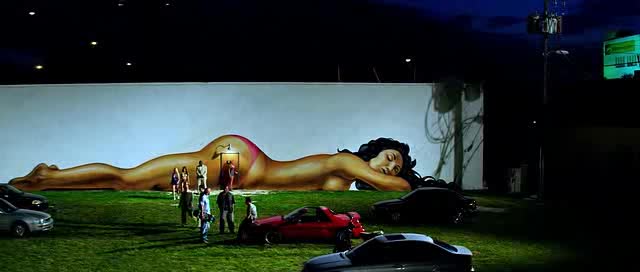
Rocket SInghDirector Shimit Amin’s instinctive love for the underdog and screenwriter Jaideep Sahni’s seeming distaste for Big Business come together in Rocket Singh – a movie that is as perceptive and entertaining as it is naïve and predictable. It’s Rocky for the Generation Sell that pits corporate rapacity against homespun entrepreneurship. Ranbir Kapoor plays Hapreet – a barely-adequate everyman who tries to make his way through modern professional landscape – with great intelligence, internalizing the character’s religious repression, his lack of parental identification and the subsequent absence of retributive masculinity. Amin’s cheesecake aesthetic, on the other hand, recalls Wes Anderson and Edgar Wright in equal measure, with its geometric mise en scène, affinity for strong horizontals, the easy-on-the-eye symmetric composition, shrewd visual detailing and, especially, the sprightly editing, which telescopes actions with split second shots while letting conversations take their own pace. The office and its peripheral spaces are moral zones in Rocket Singh that define and delimit character behaviour. The workplace here is a veritable battle field – a characteristically male playground – fraught with surveillance and territorial dispute. (The cubicles’ layout itself reminds us of trench warfare.) The film succeeds in conveying to a good extent the crushing power of concentrated capital. And Amin is capable of fine subtlety, as is clear from the honesty and pronounced everyday quality of some of the sequences. But he is equally prone to repetition and overemphasis. Rocket Singh is a film that wants to put a human face on commercial enterprise, and it’s unable to understand corporate ruthlessness without putting grimacing human faces on to it. It appears to be unaware that modern offices are exactly what it laments they aren’t – employee-friendly, customer-oriented and rewarding of new ideas. Perhaps it makes for better drama this way. But it also immunizes its object of critique by characterizing its fallibility as product of human misconduct – big businesses are corrupt because the people running them are. Hapreet advices his boss towards the end: “Business is not numbers, business is people.” Guess what, that’s what every CEO says too.

PS: I admit I had fun throughout trying to guess what colour turban Ranbir Kapoor will come wearing next.

Aamir (2008)
Raj Kumar Gupta
Hindi


AamirRaj Kumar Gupta’s breakout debut, an adaptation of the Filipino-American indie Cavite (2005), starts off like a post-9/11, Hitchcockian wrong man thriller about an expatriate physician, Aamir (Rajeev Khandelwal), who returns to Mumbai only to be swept into a terrorist enterprise. Like Ghanchakkar (2013), the film presents to us the pathetic spectacle of a self-identity progressively disappearing. Aamir is a liberal, middle-class, rather unmarked Muslim who believes that a man makes his own life through hard work, until he is shoved into a tour of underprivileged Mumbai and an acknowledgement of his privileged upbringing. Through a grim series of manipulated tasks, he is forced to see the society from the fringe, to acknowledge the existence of people who invisibly shape his existence and to be an outsider in his own country. Gupta constructs his sequences tautly, without injecting adrenaline too artificially and without any major blunder except Amit Trivedi’s score. His film’s aesthetic of surveillance resembles that of Kathryn Bigelow, with a number of POV shots of Aamir from the viewpoint of the city’s buildings and inhabitants, and broadcasts the precise feeling of being monitored. The slow-motion, too, is used very effectively, in providing the audience not only with a breather to absorb the moral gravity of a scene but also the protagonist’s experience of being in the interminable now. Gupta’s Mumbai – an infernal, indifferent piece of alienating machinery – is the abyss in which Aamir discovers faith and the film’s got one of the most uplifting images of faith in my memory: Aamir embracing a suitcase during a moment of beatitude, itself couched inside unspeakable despair. Aamir treads a very fine line between sickening moral parable and cynical portraiture and does a remarkable stunt of balancing social determinism with spiritual individualism. Its philosophical virtue almost solely lies in its ending – in the mere existence of an ending – that calls out the intellectual fraud of films like The Terrorist (1998) and Paradise Now (2005).

Maqbool (2003)
Vishal Bhardwaj
Hindi


MaqboolVishal Bhardwaj’s Maqbool is set in a strangely sparse and ruralized side of Mumbai and tells the story of the rise and fall of Maqbool (Irrfan Khan), the right hand man of underworld lynchpin Jahangir (Pankaj Kapoor, doing a Marlon Brando) and the secret lover of his wife Nimmi (Tabu). Tabu and Irrfan are at the top of their game in this sparkling adaptation of Macbeth, which spins Shakespeare’s portrait of the toxicity of power into a searing study of masculine insecurity. Unlike the will to power of his classical counterpart, Maqbool’s actions are brought about by a kind of necessity born out of amorous desire and sexual jealousy. He is moreover possessed by the idea of legacy and bloodline. To know whether the child from Nimmi is his or Jahangir’s is literally a question of life or death for him because, you know, parricide runs in the family. While Lady Macbeth’s sudden descent into guilt and madness seems quite at odds with the cold and calculated nature of her act, Nimmi’s gradual disintegration is grounded in her perceived failure as a mother, in a doubt that her carnal desire has possibly deprived her child of a father. Her character is a screenwriting coup, for what could easily have devolved into a Grand Scheming Woman archetype is instead made as fully human and conflicted as Maqbool. Bhardwaj builds his world at a leisurely but steady pace and elaborates on The Bard’s lean tale, providing backstories to the originally secondary characters, especially Jahangir whose ignominious prise de pouvoir is but one turn in an unceasing cycle of power struggle. The only witnesses to this eternal recurrence are the two greasy cops (Om Puri and Naseeruddin Shah) who, unlike Macbeth’s Greek chorus of neutral witches, are active participants in the fulfillment of their prophecies by dint of deliberate inaction. Maqbool’s characters live in a limbo between the sacred and the profane – a universe where the pious turn debauchers, loyalists turn traitors and lovers turn murderers. It’s a film of great directorial rigour. The microscopically-tuned cinematography, cutting and performances hit the precise values each scene demands. I’ve put up three of the many extraordinary sequences below. Check out how seamlessly it constructs complete spaces and with what economy and accuracy each gesture, edit and change in framing conveys key details.

 Maqbool - Meeting


Maqbool - Gifts


Maqbool - Engagement

Pain and Gain

After gods, after revolutions, after financial markets, the body is becoming our truth system. It alone endures, it alone remains. In it we place all our hopes, from it we expect a reality which elsewhere is leaking away. It has become the centre of all powers, the object of all expectations, even those of salvation. We are those strange, hitherto unknown humans: the people of the body.

–The Coming of the Body (Hervé Juvin)


When we first see Daniel Lugo (Mark Wahlberg) in Pain & Gain (2013), he is pumping away outside a gym facility in Miami. Dwarfed by an image of physical perfection better than him, he heaves out short phrases of self-motivation with every crunch: “I’m big… I’m strong… I’m hot”. It’s the summer of 1995, we are told, six months after Lugo’s fate-sealing detour from ordinary life, and it’s time he paid for his transgression. Cut to the past. “My name is Daniel Lugo and I believe in fitness”, go the first words of the voiceover, channeling the opening lines of The Godfather (1972), where a man declares that he believes in America. The two sentiments are not too far off for, according to Lugo, to be fit is to be American. To not groom your body is then to be unpatriotic: “If you’re willing to do the work, you can have anything. That’s what makes the US of A great. When it started, America was just a handful of scrawny colonies. Now, it’s the most buff, pumped-up country on the planet.” The body in Pain & Gain is not simply a metaphor for America, its promises and its cult of the self; it’s the very incarnation of these things, of the Great American Dream.

Lugo believes in this dream more sincerely than anyone else. He takes pride in being self-made. He reads biographies – embodiments of the myth of self-sufficiency – of men whose “reach exceeds their grasp”. He borrows his world view from the movies and takes at face value the successes of Rocky Balboa, Tony Montana and Michael Corleone – various manifestations of the American way to the top. Lugo’s eventual failure is not because he hasn’t imbibed well the value of individual enterprise; it is because he has imbibed it too well. Like all his well-meaning compatriots with social ambitions, he believes that you can get whatever you want in life if you worked hard enough. No pain, no gain. But then he also assimilates the dark corollary of that ideology: if you don’t have what you wanted, it’s because you haven’t worked hard enough. He attends self-improvement classes and convinces himself that he just needs to be a “doer” to transcend his rickety financial situation. ‘Do’ becomes an intransitive verb for Lugo. He does things to get what he wants. It doesn’t matter whether or not he does the right things.  He thinks he can improve himself and also make America a better place by simply acting out of free will. He becomes blind to any effect the external world can have on him, to any invisible boundaries that might thwart his endeavours. The more hopeless his circumstance, the more he seems oblivious to it. And every time a situation gets out of hand, he regresses back to the one thing he has control over: his body.


Pain and Gain

Pain and Gain

The acute observations that Pain & Gain makes helps foreground the body-centrism that marks postmodern ethos. It recognizes that the body is today both the most-prized capital for the individual as well as the most-productive domain of his investment, that, instead of being a means to a transcendental end (religious mortification, ideological sacrifice), it is the end in itself. While it might be true that, in a post-historical cultural climate, the body becomes the site of resistance to all homogenizing, subjectivizng ideologies, only the most fiercely individualistic and socially-isolated among us can succeed in rejecting the corporeal norms that the images around impose on us. What doesn’t overtly instruct us in the name of beauty instructs us under the guise of health. But then, within a fractured food system, even health becomes a luxury of the affluent. A few centuries ago, the body presented a sort of contradiction to the seeming omnipotence of wealth. Not just in its eventual mortality but also in its essential intolerance of alimentary richness. Now, the wealthy buy their way to better food while the rest sustain themselves on industrially-manufactured junk. (One of Lugo’s clients expresses his distaste for salads, pointing out that it was invented by the poor. He’s right, but it is today the preeminent rich man’s food.) If good health, longevity and comfort be the prerogatives of the well-off, it also gives rise to a curious desire for physical exertion. Millionaires tending their own garden in order to dirty their hands, artists taking up projects that make them feel closer to the working class, enthusiasm for expensive extreme sports, increasing population of premium gymnasiums – the examples of  this sublimated death drive are numerous. I am reminded of the protagonist of Cosmopolis (2012), whose alienation from all tangible reality provokes a search for physically destructive experience.

Lugo identifies with the idea of body as the locus of economic activity instinctively. He thinks that physique is an initial capital given to everyone of us whose full potential needs to be realized through constant self-improvement, and that to squander these “gifts” is un-American. (Even the arm candy he hires, an east-European stripper, is convinced that her body is a passport to the American Dream.) He puts to use this theory of body-as-capital without reflection or qualification. He promises his boss, the gym owner, that he will triple the institution’s membership in a short span of time. He tells him that his facility has no chance of surviving if it continues to concentrate on its elderly members, the reasons being (a) that the old are more at risk of injury and hence are bad publicity and (b) that the aged have lesser motivation and time left to invest on their bodies compared to the young. The gym, Lugo says, needs new blood: “you cannot build a muscle Mecca without muscle”. He entices younger customers with free body waxing service. He gives free membership to strippers to attract newer clients. His Sun Gym is a veritable meat market where muscle needs to be invested to get more muscle.

Pain and Gain

Lugo’s rise on the social ladder is predicated on a similar maximization of his body potential. He ropes his fellow gym instructors Adrian and Paul (Anthony Mackie and Dwayne Johnson) into his kidnapping scheme on the conviction that the trio, with their superior athletic ability, can do the job better than even Delta Force. Adrian needs money for the expensive injections that he must take for his sexual dysfunction and for his dinners with chubby dates. Even the pious but dimwitted Paul, whose religiosity and its demands of material transcendence must counterpoint the bodily preoccupations of his comrades, believes that God has given him the power to knock people out if needed. The trio’s morbid crimes continuously run against the intractability of the corporeal. Pain & Gain is one of the few films that I can recall which underlines how difficult it is to kill someone, while acknowledging how easily modern culture enables it. The gang tries to knock off their captive; they torture him, crash him, burn him and run him over twice, in vain. At a later point, they struggle to get rid of two corpses by chopping them up. (The breast implants of one of the two victims go on to become incriminating evidence.) Their whole rigmarole of detention, torture and extortion takes place in a gonzo warehouse for sex toys – a cross between industrialized commerce and body idealism; corporal capitalism, so to speak.

There is no ostensible moral compass within the film and all the characters fall under the critical hammer. There are neither uncompromised heroes nor unblemished victims here. Even the respectable private investigator (Ed Harris) who finally nails Lugo’s racket seems to get a gentle rap on the knuckles. As he comes back to his chic villa by the shore after wrapping up the case, his wife remarks, lamenting the murders: “Some people just don’t know a good thing when it’s staring them in the face.” The seeming sincerity of her words is undermined as it’s immediately juxtaposed with Lugo’s desire to be like everyone else. It’s a stark reminder that this law enforcer, who can’t simply sit in his posh home and enjoy his retired life, is not exactly cut from a different existential fabric compared to Lugo. None of this is to say that the film is blithely cynical, for as much as we recognize the depravity of all its characters, we also impart our sympathy to each of them in turns. Like in The Wolf of Wall Street (2013), the film’s moral position is sufficiently evidenced by its aesthetic choices and doesn’t need to be elucidated through a literary mouthpiece. Both Daniel Lugo and Jordan Belfort are self-appointed Nietzscheans who put to full use their physical and mental prowess to cheat and beat the system. Their success is the grotesque form of the aspirations of those around them, but unimpeded by dubious moral compunctions.


Pain and Gain

Pain and Gain

Pain & Gain is directed with a verve and nerviness comparable to Scorsese, whose influence is palpable in the film’s relayed voiceovers, sound bridges, gliding camerawork, rapid shifts in timeline, economy of exposition and high-key performances. While the on-screen texts seem too clever by half, director Michael Bay’s other stylistic excesses – his flamboyant, market-friendly colour palette, his sporadic submission to vulgarity and echoing of adolescent attitudes – are all fruitfully absorbed by the polemic edge of the material. The best sequences of the film, in fact, display an elegant classicism rare in the post-continuity cinema of Hollywood. (Note how laconic and sharp the sequence composition is when the trio meets at the gym for the first time: trust, suspicion and solidarity transmitted in a few shots of tightly controlled actor gestures and cuts.) It’s a small wonder that a much-derided director and largely-undistinguished pair of screenwriters could come together to produce a work of tremendous cultural insight and expressiveness. It may be that Pain & Gain is a fluke masterpiece, and it’s a hell of a lot of fun.

Mad Max: Fury Road (2015)
George Miller
English


Fury RoadMad Max: Fury Road, directed by George Miller, has been hailed as some sort of Halley’s Comet of Hollywood filmmaking. Early reviews have waxed poetic about its action filmmaking chops, its scene-by-scene inventiveness and its supposed verbal terseness and have somewhat misguidedly fetishized its use of real stunts in place of CGI – something that flummoxes me given how much of CGI is, in fact, utilized in the film. Though I found its limited inventiveness adolescent, its dialogue superfluous and banal and its direction exhausting, with its corny, rapid zooms, split second edits, its pointless disruption of spatial integrity, the eye-sore inducing orange-teal colour scheme and the lack of emotional weight that marks the best of action cinema (there is a reason why the chariot race in Ben Hur works), I did not find myself provoked enough to write a putdown of the film. Action films, after all, have the capacity to accommodate and neutralize a wide range of shrill notes and who’s to argue that critics shouldn’t derive aesthetic pleasure out of this sub-Boetticher material. However, recent think pieces have started exalting its writing, especially the film’s politics, which is what has finally pushed me to type this note out. Let’s see what Fury Road is about. The film is set in a post-apocalyptic wasteland, where a tyrannical patriarch, Immortan Joe, controls the city’s water supply and raises men to become war machines and women to become baby-dispensers. Joe and his boys regularly go to war with neighbouring districts for oil; they gather oil so that they can ride out to war. It makes no sense and may be that’s the point. One day, Furiosa (Charlize Theron), the only woman in Joe’s army, renegades and drives away with a massive rig containing not just oil, but also Joe’s five wives whose reproductive rights he has colonized with medieval chastity belts. In the women’s ride to neverland, they are joined by nomad Max (Tom Hardy), who is undergoing a crisis of masculinity after having failed to save his family from destruction, and Nux (Nicholas Hoult), who has liberated himself from Joe’s paternal authority. Together, they bring down Joe’s reign and establish a more just society under Furiosa. I suppose the film thinks this is all intelligent and subversive. We are expected to buy into the film’s declarative “This is America today” posturing. Like all mainstream moviemaking, Fury Road has the privilege of attracting academic and critical interest with a half-committed ideology while hiding behind an excuse of simple entertainment when examined deeper. (It celebrates the same automobile fetish it seeks to criticize.) Miller and co-writers mount on screen the most basic feminist meta-narrative, without any sort of personal inflection or rough edges. (There is, as addition, awfully problematic bits like a conspicuously scarved woman and those deluded war boys dreaming of a better hereafter and yelling “witness me” while leaping to death.) The resulting work has the subtlety of a jackhammer and pays lip service to a set of stillborn theoretical ideas that place nothing at stake. At its worst, it panders to a set of politico-cultural beliefs in a way that is not different from the market segmentation of studio machinery. This is the mainstream counterpart to Michael Haneke’s “I’ve got it all figured out” brand of smug filmmaking. It’s allegorical cinema for those who hate allegorical cinema.

Nirbaak  (2015) (Speechless)
Srijit Mukherji
Bengali


NirbaakSrijit Mukherji’s Nirbaak (“Speechless”) tells four stories of doomed, extraordinary love. There is, first of all, a man in love with himself (a delightful Anjan Dutta), one so self-absorbed that the only time he reaches out to another person outside himself is when he imparts pithy advice to a heartbroken girl: “Love yourself”. There is, secondly, an unrequited love of a tree for a woman (Sushmita Sen) featuring arboreal onanism and animist BDSM – a pressing subject that, I daresay, has never been attempted on film till now. The third segment is about the jealous love of a dog for his master (Jisshu Sengupta), while the last speaks of a love beyond the grave. A professed tribute to Salvador Dali (a monument of self-love and self-pleasure, if there was one), Mukherji’s rather well behaved exquisite corpse nevertheless contains ideas outré enough to make Kim Ki-duk envious. For a good part of the movie, the filmmaker weaves his scenes nimbly, cycling through a few precise camera setups, experimenting with some zany angles and having fun with an anti-realist sound palette. It is in the third section, where psychological realism supplants absurdist comedy and bland shallow fields replace the interesting wide-angle interior cinematography so far, that the mildly amusing tips over into the annoying. What should have been a weird but strangely dignified image of a dog’s possessive love instead becomes kitsch, suffused with absolutely redundant POV shots through the animal’s eyes rendered in monochrome. That, and not the intent to portray the toxic love between man and animal, is anthropomorphism. The ultimate impression of Nirbaak is that of an earnest student film: too focused on its conceptual framework to allow for accidents, too transparent in its technique to sustain mystery and too disciplined to befit the personality it is dedicated to.

Bombay Velvet (2015)
Anurag Kashyap
Hindi


Bombay VelvetWhat struck me most about Anurag Kashyap’s unanimously derided Bombay Velvet was how thoroughly unoriginal it is. Right from the history of Bombay-that-might-have-been to the black eye that Johnny (Ranbeer Kapoor) carries, the film builds a relentlessly artificial world far from the realist trappings of Gangs of Wasseypur (2012). The universe of Bombay Velvet is media-saturated, drowned in cinematic codes that paint a portrait of the city as a jarring mix of Boston, Chicago, Los Angeles and New York movies. So this reimagining of Bombay as a sort of Hollywoodized America has as a welcome and perhaps unintended consequence of defamiliarizing the city, giving it a new foundational myth akin to that of America at the turn of last century – a perennially rootless territory that actively erases traces of its past, a new world for those who wish to cast off their social identities and chase a new dream and a promised land of real estate rush and hedonist abandon. The lasting effect, however, is that of a simulacrum, a Disneyland. It all finally has the air of a cinephilic wish fulfillment project that imagines how great it would have been had Scorsese made a film on Bombay. Films as cinephilic navel-gazing is not new and there is nothing wrong about them either, but this one comes across less like a cinephile infusing his material with his movie loves than him incarnating his movie loves through indifferent material. When he cites Raoul Walsh, it feels less like a tribute to his formative movie experiences than a tribute to Scorsese paying tribute to his formative movie experiences. This kind of double quotation completely erases Kashyap’s authorship, but not in any subversive way. But this was to be expected of a generation of filmmakers fed on New Hollywood. The Movie Brats, thanks partly to the French New Wave, plundered classical cinema for personal use and emptied its signifiers of any meaning outside cinephilia. And films that tend to pillage these already pillaged films are very likely to come out the way Bombay Velvet has. One gets the feeling Kashyap would perhaps have liked to belong to Scorsese’s generation. The lament is understandable: it is desirable to have grown up on cinema than cinephilia.

The View From The Train
Patrick Keiller
Verso, 2014


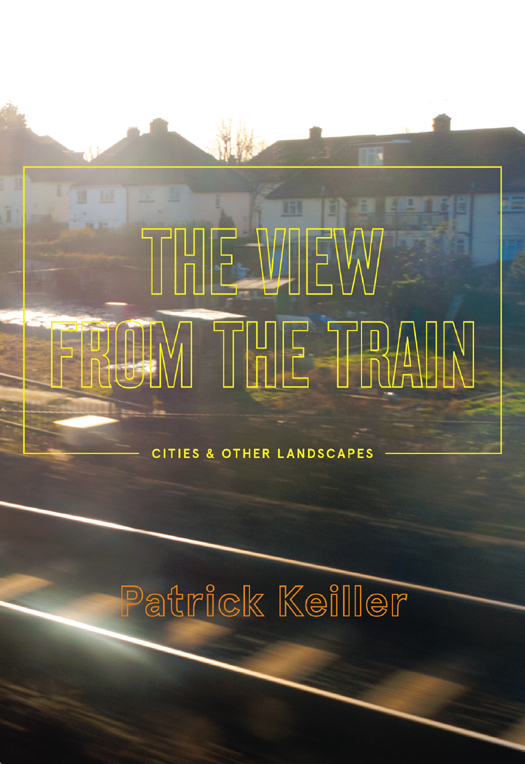
British filmmaker and photographer Patrick Keiller’s The View from the Train features thirteen essays written over a period of almost 30 years – roughly overlapping with the length his career – dealing with cinema, architecture, public housing system in the UK and physical space in general, seen in the context of the city of London. Presented in the order they were written, these essays were written originally for various architectural journals and catalogues and hence contain considerable repetition of material. While some of these pieces are not very rewarding for those unfamiliar with London’s townscape (or the works of Charles Dickens, which forms the subject of one of the essays), the others offer valuable and original insights into not just the subjects discussed but also Keiller’s own filmography, his working methods and his artistic ambitions.

Like his third feature film Dilapidated Dwelling (2000), The View from the Train deals primarily with London’s public housing in whose dilapidated state Keiller finds a kind of contradiction in late capitalism’s promises of material abundance and universal prosperity. To be sure, since the Industrial Revolution, the general condition of life has improved in Europe. The life expectancy has seen an increase while access to luxury goods has become easier. The cost of housing, on the other hand, has not stopped increasing, especially in London where, Keiller says, the rate of construction of new buildings has saturated and the majority of the existing structures are over a century old. He points at the economic system as reason for this domestic malaise:

…under advanced capitalism it is increasingly difficult to produce and maintain the dwelling…Modernity, it seems, is exemplified not so much by the business park or the airport, but by the dilapidated dwelling.

Moreover, he sees this characteristic as belonging to a bigger tendency in modernity, perhaps descending from the protestant work ethic that dominates Anglo-Saxon nations: the glorification of the values of work over those of domesticity. He summarizes thus:

The dominant narratives of modernity – as mobility and instant communication – appear to be about work and travel, not home. They are constructions of a work-oriented academic elite about a work-oriented business elite.

As a response to this near-impossibility of changing public and domestic spaces of London, Keiller proposes, the idea of subjective transformation of space enjoyed a growing popularity in the city. This, he believes, harks back to artworks and movements of the past, such as the short stories of Edgar Allen Poe and Eric Baudelaire, in which we witness a subjective capacity to reinterpret the city space, and the theories of Surrealism and Situationism, whose proponents sought a subjective metamorphosis of everyday reality in their ‘rediscoveries’ of abandoned objects and buildings. Keiller reminds us that this is not an academic concept without practical application:

Transformations of everyday space are subjective, but they are not delusions, simply glimpses of what could happen, and indeed does happen at moments of intense collectivity, during demonstrations, revolutions and wars.

This remark above recalls the aesthetic transformation of public spaces during moments of great political crisis (as demonstrated in Sergei Loznitsa’s recent film, Maidan (2014), where the central square in Kiev becomes a site for the theatre of revolution). Nevertheless, according to Keiller, this return to popularity of Surrealist and Situationist – movements with revolutionary intentions – practice and philosophy in the 1990s in London doesn’t signify as much an atavism as the bourgeois appropriation of these movements:

The dérive and psychogeography were conceived, in a more politically ambitious period, as preliminaries to the production of new, revolutionary spaces; in the 1990s they seemed more likely to be preliminary to the production of literature and other works, and to gentrification, the discovery of previously overlooked value in dilapidated spaces and neighbourhoods.

Elsewhere, Keiller investigates the mutual influence of architecture and cinema. He argues that cinema in inspired by architecture, but more importantly, it opens up various possibilities for the latter in the form of spatial critique. Cinema illustrates and critiques existing spaces and points at the possibility of new, unrealized spaces. Old films reveal historic changes in architecture and landscape and help us reevaluate current day architecture and city design.

The best passages of the book, are however, the last essays in which Keiller studies the relation between cinema and trains. Cinema is intimately related to the railways ever since its birth. The first films of the Lumière brothers present a train arriving at a station. The rapid succession of passing landscape seen from inside the train bestowed in the spectator-traveller a thoroughly modern mode of perception which made the comprehension of cinema’s moving images possible. He writes:

Both cinema and the railway offer more or less predetermined and repeatable spatio-temporal continuities, so that it is perhaps not surprising that railways crop up in cinema as often as they do. Films even physically resemble railway tracks – long, parallel-sided strips divided laterally by frame lines and perforations, as is the railway by sleepers.

In the best essay of the book, Phantom Rides: The Railway and Early Film, he analyzes films made before the 1900s and characterizes two film genres in which the railways played a pivotal role. The first consists of films that depict passing panoramas during a train journey. Scholars call the second category Phantom Rides – films that present the view of railway tracks as seen from the front or the rear end of the train. Taken together, these two genres of early cinema offer perceptual experiences which embody in them a unique image of modern times:

This sequence [from Brief Encounter (1948)], with its added superimpositions and narration, confirms an interpretation of the railway panorama – suggested by Promio’s first examples – as an image of the stream of consciousness. In 1913 Sigmund Freud wrote, famously, that psychoanalysts might usefully tell their patients to ‘say whatever goes through your mind. Act as though, for instance, you were a traveller sitting next to the window of a railway carriage and describing to someone inside the carriage the changing views which you are seeing outside. The phantom ride, on the other hand, more particularly resembles Henri Bergson’s ‘predatory’ image of duration introduced in Matter and Memory (1896), in which the present is ‘the invisible progress of the past gnawing into the future’


(Originally posted here)

Uttama Villain

“People tell me I’m narcissistic but I disagree; if I were to identify with a figure from Greek mythology it wouldn’t be Narcissus, it would be Zeus.”

-Sandy Bates (Stardust Memories)

“If it’s a wedding, I must be the groom. If it’s a mourning, I must be the corpse.”

-Vallavarayan (Ejamaan)

Prometheus, punished for his transgression of the divine laws of Creation, must be one of the most crucial symbols of modernity and is certainly something of a patron saint for modernist art. In this proto-democrat is incarnated the secular myth of the artist as creator, as opposed to the artist as messenger. The legend that looms over Uttama Villain is that of Hiranyakashipu, the illicit child of Prometheus and Narcissus, in whom the actor-writer of the film, Kamal Haasan, sees an alter ego. Now Hiranya was – or rather is – a special one. He is not only in love with himself, but wants the entire world to worship him. But then, in Kamal’s inverted version of the myth, Hinranya is a hero, the artist figure who cheats death and achieves immortality, the implication being that a profound narcissism must lie at the heart of all artistic enterprise. This is as close to a self-defense from Kamal Haasan as we are going to get.

The film opens with a mirrored image – a reverse shot of a projector in a movie hall – signaling its strictly behind-the-scenes ambition. Kamal plays Manoranjan, a popular star churning out vacuous movies who is jolted out of his passivity by the news of imminent death. He wants to make one last film with his estranged mentor Margadarsi (K Balachander) – the one he wants to be remembered by. There is hardly anything that needs unveiling here. Here’s the sixty-year old actor, contemplating aging, death, fame, relevance and legacy, placing his self squarely in the foreground, without really sliding it behind a curtain of impersonal entertainment like he usually does. This is part of the reason why Uttama Villain falls more in line with European auteur cinema than with the multi-authorial, generic cinema of movie industries.

The other, more surprising trait that situates the film in the arthouse tradition is its narrative construction. Unlike any of Kamal’s recent pictures, the three-hour long Uttama Villain takes its own time to unfold – ironic enough for a film about the lack of time. Scenes breathe easy. Transitions between public and private spaces take place like clockwork. There are no twists, no revelations, no withheld pleasures. In other words: no poisonous vials, no ticking bombs, no safely-guarded secrets. Throughout the film, there is no additional information that the characters know which the audience doesn’t. This atypical lack of any narrative legerdemain is amazing, for it means that there are no big emotional payoffs that await the audience. This is probably Kamal’s riskiest script to date. On the other hand, there are redundant scenes, those whose objectives have been already either established or well understood. For instance, the earliest bits with Jacob Zachariah (Jayaram) or those featuring Manoranjan’s manager (M S Bhaskar).

At a late point in the film, Manoranjan points at a tree of life chart hanging on the wall in his cabin containing the photographs of those close to him. He says it would help him not forget these people. This, of course, appears to be the very intention behind Uttama Villain: a tree of life project of its own that brings together important individuals close to Kamal personally and professionally (barely an actor here who hasn’t worked with Kamal before). More importantly, this is an attempt by the actor to narrativize his own life and to place himself in a personal and professional continuum. When his daughter (Parvathy Menon) hints that he is the villain in her life, Manoranjan quips that he is trying to be a hero in his own. This film is a veritable response to the question “Who is Kamal Haasan?” posed by those around him, sure, but also himself.

There are numerous precedents to this type of confessional cinema – Wild Strawberries (1957), Kaagaz Ke Phool (1959), 8 ½ (1963), Startdust Memories (1980), Deconstructing Harry (1997), and more pertinently here, All That Jazz (1979), of which a great writer once wrote: “There is something convenient and self-pitying about artists using their works as confessionals, where a modicum of inbuilt repentance tries to fish for unwarranted redemption, but there’s also something irresistibly human and disarming about it.” And there lies the rub. For a work that seeks to bare it all, Uttama Villain is astonishingly anodyne and unblemished. There is nothing about it that portrays Manoranjan/Kamal (there is little reason to doubt the congruity between these two personalities) as anything other than a nice bloke caught in wrong circumstances, none of the honesty and messiness that comes with this type of personal cinema. This is not as much Kamal Haasan opening himself up to us as it is him telling himself the story of his own life. There is certainly a lot of intimately personal material in here, whose truth can only be judged by those very close to the actor, but, for the outsider, the overwhelming impression is that of a martyred saint. One always senses a remove, a separating wall between his true self and the sort of self-portrait he paints here. It is as though Kamal can’t stop acting even in his real life, as though he can’t step out of the character of Kamal Haasan that he is playing every day and kill it, at least a bit. Immortality is indeed tragic.

 ————————————————————————————————————————————————————-

PS: I realize that I have not even mentioned the elephant in the room: the film within the film. I liked this segment, with its pleasant use of traditional forms and their innate expositional superfluity, and wondered what a full-length children’s movie from Kamal would look like today. The segues into and out of this track, in particular, are fantastic in the way they bridge narratives of vastly varied visual and emotional textures. More interestingly, it presents us a Kamal Haasan we rarely see these days: vulnerable, self-deprecating, less than perfect, pawn of nature and fate. I take it that the story of this section forms a counterpoint to that of Manoranjan in oblique ways and helps posit the various dualities that underpin this project, specifically, and Kamal’s filmography, in general. I find it unrewarding, not to mention to be complicit in stoking the Kamal Haasan cult, to go into the specifics, but let me just say this: The final, downbeat shot of the film – a zoom into the actor’s grainy face on screen strongly echoing for me the last shot of Altman’s Buffalo Bill (1976) – is something I never expected from Kamal Haasan at this point in his career. It is a moment that throws into question both my view of the man and all the sureties that the film has been hitherto standing on. It is the only truly equivocal image of in film in which everything else is set on a platter for academic interpretation. Has Manoranjan indeed conquered death through his art? Is immortality a product of individual enterprise? Is having your image projected on a screen for eternity immortality at all? What does it mean to live on as a shadow without body? Hell if I know.

OK Kanmani
 
Mani Ratnam’s new film, OK Kanmani, opens rather atypically, with a bloody in-game sequence cut to the track Kaara Attakaara (“player”): a strange mix of irony and foreboding that contrasts the unheroic nature of the romance in the film while announcing the fantastical quality of the narrative that we are about to find ourselves in. To be sure, there are no villains here to be vanquished, no great external hurdles for the lead couple to surmount. Unlike in the metaphysically structured Kadal (2013), there is no place for abstract Good and Evil in this universe of nuanced morals. At the same time, this world is not entirely congruent with our own, as is evident from its barely suppressed romantic idealism composed of separate but complementing male and female fantasies. We, the audience, want to love like they love; we want to suffer, if at all, like they suffer.

OK Kanmani finds Mani Ratnam returning to his beloved city of Bombay. Mumbai, this time around, actually. The summer showers are around the corner when Adi (Dulquer Salmaan) arrives in town from Chennai by train. Right away, he sees Tara (Nithya Menen), through a series of speeding trains, attempting to jump off from the platform across his. This emblematic coupling of arrival and departure would become a defining element in the six months that the couple would live together for. One of purposes for making this film seems to me to be to give a sort of cultural sanction to live-in relationships, which have of late come under attack by nationalist outfits, by bringing them into the mainstream in however comprised a form. This is Mani Ratnam being topical without puffing his chest and critical without throwing leftist journalism at us.

It is also from this point of view that the countless echoes of Alaipayuthey (2000) in this film become productive. While the earlier film centered on youngsters marrying without parents’ consent, OK Kanmani is about them living-in without the idea of marriage or long-term commitment. In the new film, caste and class differences are not even important, as long as the institution of marriage is respected. This shift between what is socially acceptable and what is not within a span of 15 years demonstrates in its own way how Mani Ratnam’s cinema has been both a response to cultural changes as well as a symptom of it.

OK Kanmani’s problems are predominantly formal. As much as the director-screenwriter avoids flab by cutting down the number of principal characters, the material here is too scanty to justify its feature length. Given that it’s only the two leads that have any other dimension than the archetype assigned to them, we have a challenging situation where most part of the film needs to be written around these two. The result is, at times, monotonous and structurally unsound. Consider the scene in which Tara leaves for Jaipur for two days. We see Tara packing her bags and leaving. The film cuts to the number Sinamika, at the end of which Tara returns home. Where a better script would have cut to an outdoor scene with secondary characters, OK Kanmani finds itself compelled to insert a song to avoid the disorientation and airlessness caused by Tara’s otherwise immediate return. What’s more, it uses this unjustified outing to initiate a subplot whose purpose is inexplicably elided for a while.

The film’s entire drama is predicated on the dynamic between the couple wherein one of them starts emotionally investing too much in the relationship just when the other is moving away; that is, on the fuzzy line around which one is either too far or too close. This tension between the need for commitment and recognition and the fear of responsibility, between individual liberty and the search for meaning, between career and relationship, between arrival and departure is what gives the film its thrust. As in many Mani Ratnam films, OK Kanmani is suffuse with shots of the hero following the heroine – through shopping malls, roads, markets, hospitals – like some twisted Orpheus myth. (This seems to be a cherished image in Mani Ratnam’s romantic imagination: men following women out of frustration, attraction, guilt but never domination – always as a powerless agent.) The dynamic is also reflected in the relationship between the couple’s elderly hosts (Prakash Raj and Leela Samson), one of whom has Alzheimer’s which takes her slowly away from her loving husband. (The two actors interpret their roles with a quiet dignity that prevents them from becoming frigid symbols). Lest this rather palpable tension elude us, the script verbalizes it for us regularly. “Don’t shout at him as if you were his wife”, reminds a friend of Tara’s. “How must Tara feel about your departure?” asks Adi’s colleague. The verbosity is startling for a director notorious for his brevity.

The individual scenes, in themselves, are a mixed bag. At its best, OK Kanmani finds Mani Ratnam doing a Mani Ratnam. Scenes like the one at the church wedding and those set in public transport are clear examples of the director flexing old muscles. On the other hand, those that treat the two leads separately in their workplaces raise eyebrow. The segment where Adi pitches his video game idea derives from a movie maker’s idea of video game development. Same is to be said of the long montages of Adi and Tara having fun in the city. It is a bit disappointing that one of our most creative directors’ idea of fun is limited to shopping, partying and wandering on vehicles. There is no indication, aesthetic or otherwise, that this image of romantic fun is being held at a distance by the director. This is not the evidence of a director abstaining moral judgment, but one who seems to be working on the ‘ídea’ of fun than fun itself. While there is much to be enjoyed from seeing a veteran filmmaker – and one fully capable of exercising mastery over his material, as this film exemplifies in parts – responding to changing times, there is also that residual feeling that the times may have left him behind in some respects.