“I’m writing you all this from another world, a world of appearances. In a way the two worlds communicate with each other. Memory is to one what history is to the other: an impossibility.”
– Sans Soleil (1983)
It is possible to build a case that a person called Chris Marker, who reportedly passed away two weeks ago in Paris, never existed; that the name is a mnemonic for an underground art collective, a projection of an auteurist film culture that tends to preserve the aura of a reclusive artist or a convenient label to denote audiovisual echoes from another world: a world of images, a world of appearances. Rarely photographed and even less frequently interviewed, Chris Marker, born Christian François Bouche-Villeneuve in 1921, is something of an invisible man in the hallowed halls of world cinema. Generally associated with the Left Bank of the French New Wave, alongside high priests of cinematic modernism such as Alain Resnais, Alain Robbe-Grillet, and Marguerite Duras, Marker has been credited as a pioneer of the Film Essay – a free-form genre marked by a strong authorial voice in which cinema most resembles non-fiction writing. Although it is true that he has produced some of the most groundbreaking, most challenging and most riveting film essays to date, it would be gross injustice to pigeonhole an artist who has not only engaged with a range of documentary forms like cinema vérité, agitprop, film diary, artist profile, travelogue and the home movie, but also wandered across media – literature, photography, video games, interactive multimedia and cinema – to explore his chief metaphysical and political concerns: time and space, history and memory.
‘Wandering’ was what Marker truly did. With the curiosity of a child, the fascination of a foreigner and the detachment of a drifter, he hopped media in search of the most eloquent articulation of that which haunted him the most. Unlike some of his New Wave peers, cinema, for him, was never an end in itself, but yet another medium – as powerful and as insufficient as any other – that could directly deal with ideas close to his heart. His films are incomplete in the sense they are not predetermined theses disbursing answers, but intellectual terminals where trains of thought depart from. There is a sense of mystery and rediscovery that these films impart to everyday experience, as though prompting us to look at the world anew, that could have been conceived only by a bonafide outsider, a person who does not belong anywhere but everywhere. A perennial globetrotter, an aesthetic voyager and an escape artist par excellence, Marker, as it were, never belonged to a single place or time. Such an elusive yet enchanting perspective is what informs the central theme of his most renowned work: the science fiction short La Jetée (1962), the tragedy of a man simultaneously stuck and unstuck in time.
Part a playful tribute to Alfred Hitchcock’s Vertigo (1958), part a serious study about the nature of cinema, La Jetée is composed entirely of still photographs. In the film, a man possessed by the image of a woman he saw in his childhood – now long dead – goes back in time to meet her, with full knowledge that he will lose her again. Marker’s spellbinding film literalizes the “double death” that haunts every photograph and which Roland Barthes and Susan Sontag would expound on decades later: the realization that a person in a photograph one is looking at is already dead and will be dead in some time after the photograph was taken, the dread that Eduardo Cadava called “memories of a mourning yet to come”. It realizes that the photographic image has neither a history nor a future and that it is the actuating force of cinema that provides it with both. The idea of such a malleability of memory and history – personal and collective – and an obsession with the enigmas of space and time motivates another of Marker’s hypnotic films: the sprawling, shape-shifting Sans Soleil (1983).
A masterwork of the free-associative essay form, Sans Soleil endlessly tosses one idea against another, examining the way we restructure personal and collective memory and construct our identity – as an individual and as a society. The film is riddled with questions relating to the differences in human experience that a geographical and temporal dislocation brings. Why is it that one is alive here and now? What if one was born in a different place or in a different time? In one way or other, these concerns have pervaded nearly his entire filmography starting from the extremely witty, self-reflexive film diary Letters from Siberia (1957). Through the decades, Marker has proven himself to be a relentless chronicler and examiner of the visual media that surround and shape us. His films have probed, in various forms and to various degrees, the deepest tissues that connect us subconsciously to the moving images of cinema. And it is only befitting that we thank him, in true Markerian spirit, for all his discoveries we are yet to make.
(Originally published in The Hindu)



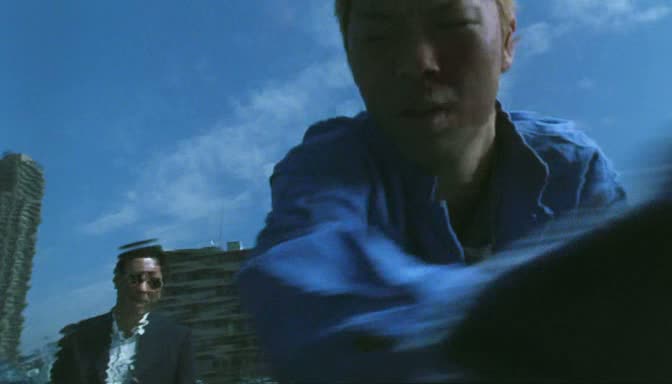

 Satoshi Kon’s remarkable debut feature Perfect Blue (1997) begins with an action scene from a television episode of Power Rangers, revealed only shortly later to be a live performance by the actors in a public auditorium. As the resoundingly unsuccessful show winds down, we hear some young audience members sourly point out that it was nothing like the television version. This idea of the virtual, the illusionary coming across as more real than the real drives the central conflict of Perfect Blue, in which an erstwhile pop idol, Mima, finds herself becoming the prisoner of her own fabricated personality. A good ten years ahead of its time, Satoshi Kon’s film frighteningly presages the progressive virtualization and publicization of our personalities. Mima loses out to one of her fans who does a better job of impersonating her than herself and develops a persona for Mima that’s truer than reality. Perfect Blue doesn’t merely subordinate reality to illusion and personality to identity, but thoroughly undermines the possibility of constructing such dichotomies, as reality and illusion bleed so thoroughly into each other that it is not just impossible, but also immaterial that they be separated. Even with its deceptively assuring closure, a la Shutter Island (2010), the film pulls the rug of reality from under our feet and leaves us hanging like Scottie Ferguson. Very much like Mima, the audience struggles with the instability of the movie’s construction and attempts (perhaps in vain) to hold on to a solid ground from which to view things, to secure its own sanity. Directed with an extremist’s taste for visceral shock and a modernist’s eye for reflective surfaces, Perfect Blue challenges the psychological seriousness of many similar live-action features, while benefiting from its choice of the medium.











 <>
<>


 The Seventh Art