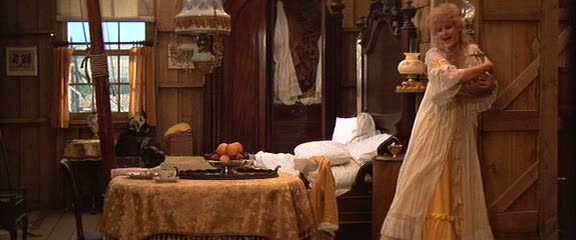
There’s an interlude here with Lucille, the Coloratura, where Bill apologizes for possible being a disappointment the previous night. There’s a clear parallel between Bill’s professional trajectory, in which he is increasingly convinced that he’s not ‘authentic’, his ‘performance’ is not good and not living up to expectations of his fore-fathers, and his sexual conquests, where he proceeds from the alpha male in total control, to a confident man holding ground to one being simply turned down, as chalked by the three opera singers of the film. This interlude more or less marks the start of Bill’s partial de-mythification (like McCabe in Altman’s previous Western) and we see his body language and tone softening down. Before he gets to conquer the Coloratura, he notices, by chance, that the Indians have begun dismantling their teepees and that Bull and Halsey are leaving the place. Enraged, he calls for a posse, to put up an improvised show: The Story of How Buffalo Bill Rode Into A Territory He Knew Better Than The Back Of His Hand And Reclaimed The Escaped Indians. As he comes back to his cabin to dress up, he updates Lucille about the situation and searches for his jacket. When he doesn’t find it, he shouts making a parody of whatever he is: “Dammit, where’s my real jacket?”. While the posse gets ready, Altman alternately cuts between the sunlit outdoors and the earthy indoors of Bill’s cabin, very much like a silent movie, implicating cinema (which endorsed the Western myths almost from its inception as a narrative form) in the Wild West’s codification processes. The coloratura herself is little more than a relic from the past.
Buffalo Bill and the Indians

The posse leaves with grand musical accompaniment, Bill leading on a white horse and the rest following on brown ones. Buntline opines once again: “When Bill’s dressed for a ride and mounted on his stallion any doubts about his legend are soon forgot. Yes, Bill’s fine physical portrait hides any faults his mind possesses. But any tracker will tell you if you don’t know what you’re after you’d best stay home”. The Legend Maker seems to have progressively become a de-mythifier (or rather re-mythifier). And soon enough, Bill and gang return. Both the audience and the rest of the company at the campus see the posse in a long shot, with no sight of Bull or Halsey. The in-house band gets ready for a thunderous welcome. But as the group draws nearer, they realize that they haven’t got a good image to multiply the sound with, like a director who can no longer redeem a terrible scene with his score. Bill hasn’t come back with the Indians. The great story that he imagined would be written today was spoilt by reality, just like how the brave cowboy who dashed to spot Bull moments before, returns drenched and off his horse. Reality punctures a potential legend.

Buffalo Bill and the Indians

Buffalo Bill and the Indians

Buffalo Bill and the Indians

Buffalo Bill and the Indians

The dejected posse returns in total silence. Bill enters the encampment and looks at the triumphant painting of himself (Custer?) on a horse. Altman zooms in on the painting, and then on Bill. Like a kid who’s failed his father, he stands nearly whimpering. Altman zooms in on the painting again, cutting Bill off the frame. Burke and Nate try to convince him that it is not his fault, and that Fort Ruth was never meant to be a prison in the first place. Burke suggests publishing in the papers that Bull escaped after trying to set fire to the arena. An apathetic Bill goes into his room, shuts the door. And we hear a gun shot, then two or there more. Nate and the rest are shocked and think Bill shot himself, as if suicide was the only act that would befit the situation and the legend that is Bill. We believe that too, thanks to how we’ve been trained by genres tropes. Again reality thwarts an apt ending and we all discover that Bill was merely trying to shoot the canary that Lucille has. Bill’s sharp shooting capabilities seem to have bid farewell, like his sexual prowess (reminding us of his pistol conversation with Lucille the first time they met), as he misses the bird each time. A frustrated Bill returns to the meeting room and finds Bull and Halsey at the doorstep. Surprised, he calls them in asks the reason for their departure. Halsey tells them that Bull was up in the mountains visiting the moon in its path and that the squaws were relocating the tents to a different part of the bank. Halsey tells Bill that Bull will do what he would like his people to see at the show: make the big grey horse dance.
Buffalo Bill and the Indians

Buffalo Bill and the Indians

Buffalo Bill and the Indians

Buffalo Bill and the Indians

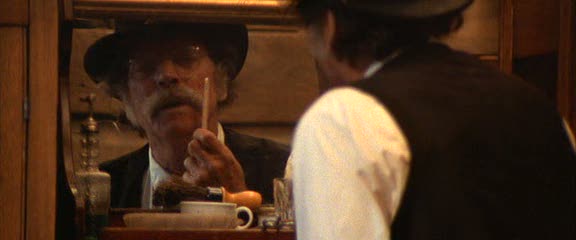
Buntline again: “Responsibility is a funny thing. It’s different for stars than for ordinary folks. That’s why stars spend so much time in front of mirrors. To see if their good looks can overcome their judgment”. The dentist, at whose place, he is in, urges him to spare the literalism for now. The patient – the audience stand in – winces in pain. Buntline stares at the mirror. Cut to Bill staring at the mirror, talking to his image. He is convincing himself that Bull lied to him and that he must have been hiding in the mountains. He says, furthering the equivalence between Bull and him: “Now I can understand why he lied to me. He’s got to look good in front of his people, same as I”. He ‘chooses to overlook the entire incident’ ‘generous and flexible’ that he is. The camera zooms out from the image before including the real bill in the frame, as if questioning who the real man is and who the image is. The whole crew assembles for a group photo in front of the office. Bill protests Bull’s standing near Annie Oakley. Halsey refuses to budge and asks $25 for relocation. Bill rejects the offer – another reminder that the enterprise is driver more by capital than ideology – and plans to manipulate the photograph later – like many modern day filmmakers – and move Bull to the Indian side of the photo.

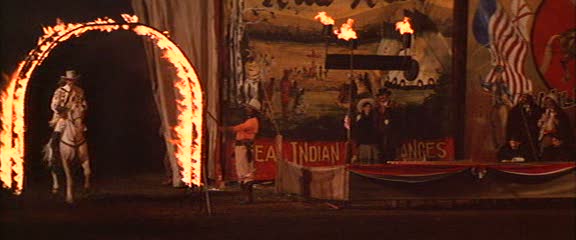
One black worker – Burke calls him ‘darkey’ – at the telegraph office rushes in to announce that there’s a wire from the president. The assembly breaks and leaves (Bill, with self-made band music) for the telegraph office to learn that President Cleveland will be visiting Fort Ruth and staying for a night. Sitting Bull’s dream becomes real. Everyone’s surprised as well as excited about this. Buntline delivers another theory about Indian and white dreams and points out that things are starting to take an ’unreal’ shape. Cut to the night when Cleveland (Pat McCormick) comes to the camp. He is, as usual, introduced to us in a long zoom shot: a rather portly figure, a caricature of a man straight from Keystone two-reelers, sitting on a stage-like dais alongside his excessively lean wife (Altman regular Shelley Duvall). One crew member remarks, conflating politics and entertainment: “That bear is a star. He’s bigger than Buck Taylor”. Politics as entertainment and politics of entertainment are two ideas Altman’s film continuously chips at. McCormick’s performance here as Cleveland is akin to Timothy Spall’s much reviled portrayal of Winston Churchill in The King’s Speech (2010). It is meant to be hammy, to be obviously a ‘performance’. Like the Oscar winner, Altman’s picture is partly a chronicle of shows, of politics as performance and of stage presence as power. When Nate introduces with “Meet America’s national entertainer”, the camera lingers on Cleveland. Cut to Bill appearing fro behind the screens through a wooden arch on fire.

Buffalo Bill and the Indians

Buffalo Bill and the Indians

Buffalo Bill and the Indians

Buffalo Bill and the Indians

Buffalo Bill and the Indians

Buffalo Bill and the Indians

Bill, after a small stunt on his horse, welcomes the president and the first lady. Altman nearly center-frames with the torches burning in the background out of focus. Clearly, his film is consciously partaking in this legend-building activity. He calls the Wild West show as “the father of the new show business”, not the mother, suggesting the patriarchal codes that govern this organization. Throughout the film, women are seen either entertaining Bill or doing petty work around the campus, except, of course, Annie Oakley, who is the one woman who poses any resistance to Bill at all. Cleveland is told that Bill “writes all his original sayings himself”. Cleveland, who discusses with his adviser for every statement and gesture, like an actor consulting with his director, replies that all great men do that. The first act is by Annie and Frank. The president and his wife are visibly impressed until Annie fires a wrong one that goes through Frank’s shoulder. Like any great performer, Frank tries not to reveal this accident and wraps up the show. “The Show Must Go On” – That justification which sweeps every misfortune under the rug in the name of professionalism. For Frank, like many in the crew, a successful show is more important than anything else. Cleveland is agitated and confirms with Burke if this was all “a part of the act”. After a filler act depicting the induction of an Indian into the American family, Sitting Bull enters the arena, speaks in Native American tongue, takes out a gun, points towards Cleveland before firing towards the sky. Cleveland is gobsmacked. And so is everyone, before they realize that it was done to make the grey horse dance. Recovering, Cleveland jokes that it is no wonder that it was done by an Indian because it is an un-American thing to do. Again and again, the show pans out like Brechtian theatre, provoking the audience, before it is repackaged into the norms of standard theater.


Section

III – III – IVV

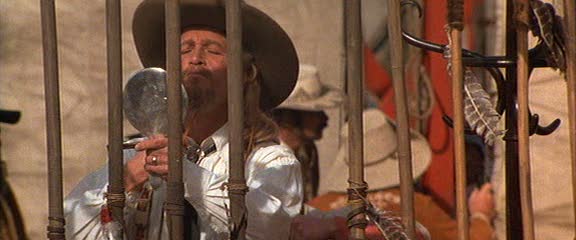
A group of Indians enter the Mayflower campus as the narrator informs us that “The great chief of the Sioux tribe Sitting Bull, is here with us. And he’ll be in the same arena with the noblest white skin of all”. Altman and DP Paul Lohmann shoot the group with a telephoto lens, much like Bill who watches it using a spyglass. We see Bill through a zoom-in as well, as he tries to catch sight of his opponent. One Indian of an imposing stature wearing a red shawl stands out from the rest in the group. Everyone in Bill’s crew is convinced that that man is Sitting Bull. Their Sitting Bull is a based on an idea of how a formidable Indian should ideally look like – a Sitting Bull that would really set the box office on fire – than on facts. Even before the group enters the campus, we hear legends and myths about Sitting Bull. Even the audience is led to believe, thanks to Altman’s casting and framing, that the man in red is the real chief. A gaudy theatrical entry, backed by stereo-typical race-based music, brings Bill to the welcome ceremony where he learns too late that the small man behind the one in red is the real Sitting Bull. Altman himself frames Newman heroically sitting on the horse and supervising the crowd on ground. When Bill tells the chief: “Me and my staff are the best at what we do. And what we do is make the best look better”, we realize that Bill is the prototype of the capitalist industrialist, America’s first CEO, trying to hit peak efficiency and performance.

Buffalo Bill and the Indians

Buffalo Bill and the Indians

Buffalo Bill and the Indians

Buffalo Bill and the Indians

Buffalo Bill and the Indians

Upon learning the identities of both the Indian in red and Sitting Bull, he assures them before he takes leave that the latter won’t be mistaken for a ‘below average run-of-the-mill Indian Chief’: “I just wanted to welcome you here to Buffalo Bill’s Wild West. You’ll find it ain’t all that different from real life. Gentlemen, Injuns…”. Different from real life it ain’t, but not in the sense Bill means. If Bill is the CEO of the organization, Nate is the CFO. In their encampment, after the meeting, the crew discusses the future. Nate says: “We all know sociable chaff is cheap but history, real history is hard come”, as if it’s a commodity to be acquired as soon as possible. As Nate segues back to singing hosannas to Bill, Altman cuts back and forth to the Indians planning to pitch their teepees across the river. Even before the company learns of this and finishes ridiculing the idea, it notices that the Indians have already completed their mission. Bill tries to act normal and tells the crowd that it is better that Sitting Bull stays across the river so that he can watch him all the time. This is the second time when the film draws comparisons explicitly between Bill and Bull. Bill’s a man, as would be clear in the ‘soprano’ stage of the film, obsessed with his own image. Here he is, for the first time, wanting to watch Sitting Bull ‘all the time’ from his chair. He then goes on to theorize that an Injun always turns down your first offer.

Buffalo Bill and the Indians

Buffalo Bill and the Indians

Buffalo Bill and the Indians

Soon enough, Sitting Bull and his right hand Halsey (the Injun in red , Will Sampson) visit Bill and co. to talk about the chief’s stint at the Wild West show. When Halsey, Sitting Bull’s mouthpiece, speaks in Native terms about the latter, Bill tries give back imitate “the same kind of murky logic” that Halsey used. Burke intervenes to tell that Sitting Bull was there to ‘relive his history for thousands of paying customers’. Altman isolates the two parties completely, never allowing them to be seen together, like a turn-based strategy game, cutting across the table every time someone speaks. Halsey demands blankets for the whole clan (agreed to, thanks to the “benevolence of Buffalo Bill”), six weeks of advance (also eventually agreed to since Bull will be here until the unlikely even of him meeting the president of the country) and rights over photographs of Sitting Bull (at which Bill loses it, the corporate head that he is). Meanwhile, Bull is attracted by a music box, although he does not know its function. Music plays a key role in the film, both as performance accompaniment and as indicator of culture.

Buffalo Bill and the Indians

Buffalo Bill and the Indians

Buffalo Bill and the Indians

An abrupt cut from the meeting brings us to the arena where Bill is practicing sharp shooting takes us right into his personal life: a letter from his wife accusing him of affairs with milk maids and opera singers and of being a chronic drinker and calling for a divorce. Another collage of performances at the playground – shooting, whipping, horse racing – before Burke introduces Bill to the second singer – a coloratura – in the film. After a quick chitchat ripe for Freudian mining, Bill is told by Nate that President Cleveland will not be coming to the Wild West and that Bull will be stuck there for life. Nate asks Halsey to come with him to demonstrate the kind of show he will be involved in and also says that their production team is the only one to show the reds and the whites without taking sides – another reminder that his Wild West show is more a business enterprise predicated on sale value than ideological enterprise based on political value. In the demo, a black American stands in for Sitting Bull because, Bill tells us, “he’s the closest we got on our staff to a real Injun”. Bull is not impressed. Halsey tells Bill and co. that the war didn’t happen the way it is being depicted in the demo and that Bull wasn’t in the field at all. Altman composes both Bull and Bull in the same frame and at either end, as if trying to balance each version of the war.

Buffalo Bill and the Indians

Buffalo Bill and the Indians

Buffalo Bill and the Indians

Cut to Bill’s private room, with Margaret the Contralto singing. We learn that Bill’s long hair is fake and that he hopes they become real one day. The opera makes way for faint Native chants during the evening, as Bill ponders. He tells Margaret that she has to leave because he has to concentrate on Bull. Of course, he’s also thinking of Lucille the Coloratura. This seemingly minor shift is followed by a key scene in which Halsey and Bull revisit the Wild West team for another unplanned meeting during the midnight. The apartment is filmed as if it is dingy. Indian artifacts adorn the walls like prizes. No one is awake and Bull reaches for the music box. Halsey wakes Bill up and he is frustrated that he has been caught without his false hair. In a pretty charged conversation, Halsey asks Bill to rewrite the script and to present a version in which the hero McLaren was a mass murderer who slew women, children and dogs without provocation. Nate pacifies Bill before he erupts and tells him that they could still pull it off with proper arrangement and music. It’s a dynamic scene with a war field like atmosphere where the battle is for representation of history. It is here that the portrayal of the Wild West show as an (subconsciously) ideological apparatus rich with possibilities of alternate apparatuses and meta-narratives becomes most literal and most pointed. Bill stays silent, takes a swig off his glass, sits alongside Bull and urges in vain for a heart-to-heart conversation. He takes offense to Halsey’s claims the “he murdered women, old men, and children”. It’s a remarkable moment of character exposition. Halsey was talking just about Custer but Bill can’t help but hear that it was all about him. It is as though he believes that he stands in for Custer and that takes responsibility of the entirety of white history at the frontier. Right after that, Bill throws the first of the two side-splitting tantrums in the film: “You have till noon to get outta here!” and walks off the meeting with a murmur; “It’s harder being a star than an Indian”. It’s harder not being any star, but this particular star of this particular show, who has taken upon him subconsciously the burden of being answerable to both his predecessors and successors.

Buffalo Bill and the Indians

Buffalo Bill and the Indians

Buffalo Bill and the Indians

The next day Bill is told that Annie Oakley, the moral centre of the film and the only person who finds any sanity in Halsey’s claims, is planning to leave with the Indians. He decides to call her back. She asks Bill why he can’t listen to Bull for once to which he replies: “I got a better sense of history that that”. Writer Alan Rudolph said elsewhere (but which many writers attribute to this film – I didn’t find it here) that history is what gets the most applause. And Bill’s sense of history is, at least on an unconscious level, just that. At this point, we assume that Bill’s just lying through his teeth for sustaining his myth and don’t suspect for a moment that he might be believing in what he is saying. Annie’s obstinacy forces Bill to retain Bull. (Altman makes space for a sight gag to comment on Bill’s situation). The first show goes underway and plays to packed houses. Bill makes his entry just before Altman cuts to Buntline in the bar trying to sketch another theory for Bill: “No ordinary man would ever take credit for acts of bravery and heroism he couldn’t have done. And no ordinary man would realize what huge profits could be made by telling a pack of lies like it was the truth. No, Bill Cody can only trust his senses. And when his senses fail him he might see things as they really are”. As the Legend Maker gives us first signs that it isn’t as simple as a willful obfuscation of truth that Buffalo Bill is executing, Bill rides into the arena to an uproar followed by the anthem “Oh Say, Can You See?”. Like most genre heroes from Hollywood, Bill is truly professional, unapologetic about what he is doing and really loving that he’s excelling in it.

Buffalo Bill and the Indians

Buffalo Bill and the Indians

Buffalo Bill and the Indians

After Annie Oakley’s act, in which she misses twice – but covered up – and a couple others, Sitting Bull’s big show comes up. Bill tells Halsey that Bull will discover now what show business is all about and that he’ll come back to him begging for more. “Sitting Bull’s going to suffer a worse defeat than Custer ever did. Custer got to die. Bull’s just going to get humiliated”. Nate announces Sitting Bull as the most murderous redskin alive. With clichéd Injun music blaring, the small-framed Bull enters the arena modestly and amidst catcalls. He really wasn’t what people were expecting. They didn’t want the real Sitting Bull but the ideal Sitting Bull. But as a pair of Indians sings Native American chants, along with which Altman presents a low angle zoom into Sitting Bull composed against a banner of his, befitting a mythical hero, the crowd comes back to life. It’s a strange moment where the audience seems to have found the authenticity they want in this show. With this sort of music, it appears that this Sitting Bull makes a good Sitting Bull. Altman here seems to be throwing light on cinema’s own myth-constructing process where the best – and not necessarily just – image and the sound conspire to create a lasting falsity that people can trust. Bill, watching from behind screen, is stunned; his mouth agape as Bull returns and the screen falls over him. Envy might just not be everything.

Buffalo Bill and the Indians

Buffalo Bill and the Indians

Buffalo Bill and the Indians

Buffalo Bill and the Indians

Buffalo Bill and the Indians


Section

I – II – IIIIVV

Buffalo Bill and the Indians


“Art is not the reflection of a reality; it is the reality of that reflection.”

La Chinoise (1967, Jean Luc-Godard)

“In a violent and contemporary period of history, it is myth that invades cinema as imaginary content. It is the golden age of despotic and legendary resurrections. Myth, chased from the real by the violence of history, finds refuge in cinema.”

– Jean Baudrillard

“When the legend becomes fact, print the legend.”

The Man Who Shot Liberty Valance (1962, John Ford)


Robert Altman’s Buffalo Bill and The Indians, or Sitting Bull’s History Lesson was made and premiered in 1976, when the country was celebrating its 200th anniversary of independence. Altman had already taken a stab at this bicentennial in his previous film Nashville (1975), where we are presented with a fragmented sketch of America as a nation at crossroads. Buffalo Bill is also Altman’s second western feature after the tremendous McCabe & Mrs. Miller (1971), which was nothing less than a re-imagining of the Western myth as founding of industrial capitalism. It is interesting to think why writers Altman and Alan Rudolph embarked on this project of adapting Arthur Kopit’s play and resurrecting the figure of Buffalo Bill at all. If McCabe tried to clinically de-mythicize the archetypal Western hero, it didn’t do as much to question its own myth-creating properties. In Buffalo Bill, Altman’s everything-but-the-kitchen-sink method finds precise articulation in the text and the text, too, lends best to a stylistic that is as diverse and off-kilter as Altman’s. All his directorial techniques serve both aesthetic and thematic purposes in this film, especially the overlapping, conflicting soundscapes and imagery (used effectively in a film that is explicitly about conflict of narratives and ideological contestation) and the notorious zoom (altering, illustrating and mocking the protagonist’s persona). Utilizing sound and image in complex, inventive ways, Altman not only critiques popularly represented Western myths but also their modes of representation, especially when it comes to the film’s own. Throughout, the ceaselessly self-conscious film undercuts its own criticisms by questioning their assumptions and authority to such a successful extent that we begin to take everything that it claims with a pinch of salt. A searing portrait of the West (and the Western) as a deadly mixture of patriarchy, nationalism, entertainment and unbridled xenophobia, Buffalo Bill finds Altman at his caustic best.

In fact, self-critique begins right from the first frame as fanfare blares over a monochromatic United Artists logo, registering its own status as an entertainment product. The first image we see, likewise, is near-mythical and patently ‘Western’: a surreal landscape, out of focus, which the American flag being hoisted cuts through. The opening credits appear in a gaudy typeface and a faux title for the film reads: “Robert Altman’s Absolutely Unique and Heroic Enterprise of Inimitable Lustre!”. The message is clear: Buffalo Bill is no finer than the typical roadside fair or, as we would see, Bill’s own Wild West show in every aspect. As the bugle plays on tirelessly, as it would do throughout the film, the camera pans gradually to the ground as if establishing the scene and the history of the West. The first spoken words in the film are heard as the narrator announces:

“Ladies and gentlemen, your attention please. What you are about to experience is not a show for entertainment. It is a review of the events that made the American frontier. In less than 15 years, this nation will celebrate the 20th century. We do not know what awaits us in the future but we do know the past that laid the foundation. And that foundation was not built from heroes but from the anonymous settler. Their home was but a shack roofed in with sod. One door shut out the wind and storm one window greeted the dawning day. These brave souls survived not only nature but the savage instincts of man, paving the way for the heroes that endured. So welcome to the real events enacted by men and women of the American frontier. To whose courage strength, and above all, faith this piece of history is dedicated.”

If we are to disregard the ironic stance that the film would take at the set of statements here, the opening scene so far plays out as the classic Western metanarrative, with the lone ranger conquering the savage frontier and building civilization from scratch. The attitude of the film, however, is akin to the opening ethnographic documentary of Ken Jacobs’ Star Spangled to Death (1957-2004), where we are shown and told the story of a glorious white couple teaching science, hygiene and table manners to kids and women of an African tribe. Given the year of both Altman’s and Jacobs’ films and the extent to which the portrayal appears caricatured, it is impossible to take the narrator’s words with a straight face. As a result, the film’s diegesis is split open, much like The Player (1992) -the one film that is closest to Buffalo Bill in terms of how it functions – where the possibility of cordoning off the narrative universe is thwarted right from the first shot.

Buffalo Bill and the Indians

Buffalo Bill and the Indians

Buffalo Bill and the Indians

As the “savage” natives raid on white women and children, moving around them on horses in circles, like a strip of film around a bobbin – serving a thematic function, which reaches apotheosis in the final scene, as well – we witness the film’s actual title being displayed: Buffalo Bill and The Indians, or Sitting Bull’s History Lesson, the subtitle in the title serving a special purpose. And as the cowboys turn the tables on the raiding Indians in a story justifiably without context or the specifics, the acting credits play on. Instead of an actor’s name being mentioned against the name of the character he/she plays, we see it alongside the “type” of the character – The Star, The Producer, The Publicist, The Indian, The Indian Agent, The Legend-Maker etc – calling to attention the film’s own myth-building. And suddenly, another voice different from the narrator (Altman? the show’s director?) shouts: “cease action!” and it is revealed that what we had so far seen was rehearsal for a Wild West show. Dead men rise to their feet and makeshift houses are moved by horses. Some corrections are suggested to performers to look more authentic. One native is hurt and men say it “looks real”. However, we are still not sure where performance ends and where reality begins. We are still dangling without a reference.

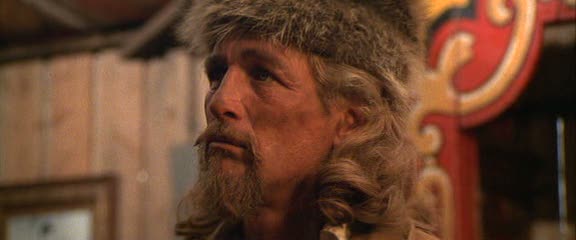
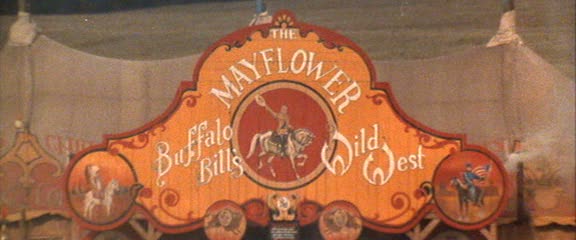
Cut to the Legend-Maker and Buffalo Bill’s ex-producer Ned Buntline – played by a legend himself, Burt Lancaster – who recites the tale of how he made Buffalo Bill out of a scrawny looking kid on the street. Flanked by a bunch of supporting actors and bracketed by two pillars of the bar and his voice mixed with a feeble version of the now-familiar fanfare, Ned is introduced already, with a gradual zoom-in, as a fiction maker and a piece of fiction himself. Almost immediately after this we are shown another minor Legend Maker – the old guard who works at The Mayflower fair where Buffalo Bill’s performs – who chalks his own story about Bill to a bunch of Indian kids. There might be a little gesture of humour here in how everyone claims importance with respect to Bill, but it also off-handedly establishes the film’s major theme: history as a contested territory. It is here that we see Altman’s typically chaotic collage editing of for the first time as we move from the Legend Maker, to the guard, to one-handed sharpshooter Annie Oakley (the beautiful Geraldine Chaplin, who carries a baggage of vaudeville, showmanship and entertainment along with her name), to her husband and moving target Frank Butler (John Considine) to The Producer Nate Salisbury (Joel Grey) and to The Publicist Maj. John Burke (Kevin McCarthy).

But not Bill. We haven’t met Bill yet, although we have an idea of his stature from second hand sources. When Frank goes to meet him in a hurry, we hear Bill for the first time, almost throwing a fit. Even now, he’s hidden behind a huge promotion banner containing his image. As we would see, Bill is always hidden behind his ‘image’. By prolonging both Buffalo Bill’s and Paul Newman’s introduction, Altman’s film reinforces the mythic nature of both these celebrities. As Frank fills two glasses of beer to take to Bill (multiple actions unfolding simultaneously is nothing new to Altman’s cinema), Nate speaks about his performance as a black American in shows with another troupe he was associated with, before going on to typecast a few other nationalities: “There were times when I was asked to play a colored. Now do I look like a colored? But when I had to play a colored, I was a colored. I thought like a colored. I drank like a colored. I walked like a colored. I was a colored”. Nate is not (intentionally) sending up method acting, but his decidedly irrational belief that he could play a black American with total authenticity puts him on par with some of our celebrated ‘actors’. Much of the outlook of Bill’s crew, himself included, towards Native Americans is derived from this sort of epistemological confusion, a notion that they can truly understand, decode, model and replicate the Indian psyche.

Buffalo Bill and the Indians

Buffalo Bill and the Indians

As Frank enters Bill’s room, we watch Burke vacating the room, assuring Bill about casting: “Everything historical is yours, Bill”. Soon, the word about his new story idea for the next season – “enemies in ’76, friends in ‘86” – spreads and Buntline figures that the foil for Bill would be no other than Indian Chief Sitting Bull (Frank Kaquitts), who would not be shot by the army until a certain Sioux treaty is signed, and would be humiliated and de-mythicized at the show. (“A rock ain’t a rock once it’s gravel”). When Bill’s nephew Ed Goodman (A stiff Harvey Keitel) doubts if Sitting Bull was interested in show business, one of the writers for the show replies, “If he wasn’t he wouldn’t have become a chief.”, betraying the group’s general inability to interpret the world outside of the parameters of entertainment business. This is followed by another legend from the old guard about Sitting Bill. We now have a bit of history about the Chief and some myths surrounding him before we get to see him at all, just like Bill. And this is the first of a number of instances where the film strikes an explicit parallel between the two “heads of clans”.

Buffalo Bill and the Indians

Buffalo Bill and the Indians

Buffalo Bill and the Indians

Buffalo Bill and the Indians

Buffalo Bill and the Indians

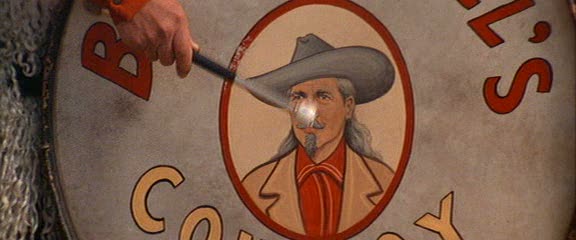
Following a surprise insert of a stunted zoom shot of Sitting Bull’s clan, Buntline talks about Bill’s dubious resolution to cut down on his drinks, after which the film cuts to a shot of the first of three opera singers who accompany Bill, as she passes by a triumphant painting of General Armstrong Custer, who Bill model’s himself after to an insane extent (that the painting could well be of Bill himself), on his white horse. (Arranged according to the scale of their singing, these three singers – The Mezzo-Contralto, Lyric-Coloratura and Lyric-Soprano played respectively by Bonnie Leaders, Noelle Rogers and Evelyn Lear – also form the thematic checkpoints in Bill’s self-delusive odyssey). It is only after this that we have the first glimpse of Buffalo Bill and Paul Newman – announced as America’s national entertainer by Nate – as he rides into a rehearsal show amidst heavy applause and fanfare, like a star. Another sequence with non-associative cross-cutting between Bill learning of Buntline’s return to the campus and of the hurt Indian’s passing and Nate welcoming the rest of the Indians around him to “America’s national family”. Nate gets instructions to have Buntline vacate the campus. He goes to confront Buntline. Nate is the one character in the film who acts most obviously as the writers’ mouthpiece, tossing off one provocative line after another. His lines would most probably be the ones to structure discourses surrounding the film. When trying to persuade Buntline to move out, he gives us this one out of the blue: “We’re gonna cody-fy the world” suggesting how he plans to make Bill a universal figure invading all imagination and the Manichean view of the frontier that that entails such a project.


Section
I – IIIIIIVV

Ne Change Rien (2009) (Change Nothing)
Pedro Costa
French/English


Change NothingPedro Costa’s latest film Change Nothing (2009), at a visceral level, rekindles the experience of watching that stunning cinephile bait of his, O Sangue (1989). Like his debut work, Change Nothing is presented in monochrome (although apparently not shot that way) with a contrast ratio to kill for, in which the white appears whiter and black appears blacker. Consequently, Costa, who shot the film himself in DV, achieves a flat field which results in a number of eye-teasing compositions, such as the one in which actress and singer Jeanne Balibar – the subject and star of the film – seems to have grown a pair of angel wings. More than ever, Costa works with light like a painter who’s been given only a limited quantity of colour would, meticulously sculpting Balibar’s distinct visage out of darkness. This exacting precision required for an artistic endeavour is what Change Nothing is ostensibly ‘about’, as it goes about recording Balibar and co. rehearsing, improvising, recording and live-performing a variety of vocal pieces. (There are also a couple of off-track sequences involving a live choir and a pair of Japanese in a bar). The reference here is, of course, Godard’s Sympathy for the Devil (1968), which interpreted radical politics and art-creation as essentially incomplete ventures requiring audience participation. Costa’s film, however, seems more modest and self-sufficient, as it single-mindedly records Balibar’s relentless dedication to her work (and, implicitly, the director’s towards his as well). It undermines the illusion of a work of art being a smooth, finished product by situating it at the end of a long history of imperfections, goofs and possibilities. Ironically, Costa’s rigorous and ‘perfected’ film perpetuates this very illusion. In a way, then, the 100 minutes that we see is only a minor part of Costa’s project, the majority (the remaining 78 hours!) of which will, unfortunately, go unseen.

Rosetta (1999)
Luc Dardenne, Jean-Pierre Dardenne
French


RosettaDardenne brothers’ finest film Rosetta (1999) is what remains after you have run it through all possible theoretical discourses. (Funny as it sounds, for all its anti-psychological bent, Dardennes’ cinema lends itself best to psychoanalysis, with abounding mother-son, mother-daughter and father-son relationships across the films). A genuinely humanistic work that just can not be accommodated without conflict into a single, rigid world view, Rosetta finds the Dardennes’ hand-held, long-shot, “being there” realism at the peak of its prowess. There is a keen sense of space, of lived time and of felt experiences here. With an astonishing, naturalistic sound design that carries as much importance as the image (the irritating noise of the moped, for instance, virtually reveals the whole dynamics of specific scenes, without the help of a single image), There is no moral simplification or any sort of condescension that marks many otherwise empathetic films dealing with the working class. Through Rosetta’s actions, which cannot be easily classified into right and wrong, the Dardennes provoke a reassessment of the audience’s own political stance (especially the liberal one, wherein the just and the lawful are generally assumed to be at loggerheads with each other). More than any other of their films, it is here that we sense and feel the physicality of the Dardennes’ unvarnished world the most. When Rosetta (Émilie Dequenne) is pushed into the bog, we choke, when she finds her drunkard mother down at the doorstep, we let out a sigh of exhaustion and when she struggles to carry the gas cylinder home to do the unthinkable, we want to reach out and take it away from her hands. Harsh, harsh, harsh, harsh, harsh, just harsh.

The Owl's Legacy

Chris Marker’s epic series The Owl’s Legacy (1989) is neither a deeply ‘auterist’ work nor a brilliant piece of Cinema. It is, plainly, the documentation of a thirteen-part symposium on Ancient Greece enabled by the Onassis Foundation and conceptualized by Marker. However, the amount of ground it covers and the number of new directions it opens up for us to think about contemporary politics, science, culture, law, economy and art (specifically, cinema) makes it one of the richest works of criticism that I’ve come across. It is extremely unfortunate, then, that it is neither available on video officially in any form nor spoken about really widely. Following a slew of earnest mails (OK, two mails) asking me if there was any site where the film can be viewed online with English subtitles, I decided to upload the copy I have of the entire series. Of course, all credits go to the original uploader who floated TV rip on the internet. It is because of people like her/him that the Internet has turned out to be the greatest repository of culture, globally.

[Note: There is no monetary interest for me in this endeavor and if you feel that the series shouldn’t be put online the way I have here, please drop a note in the comments section]


1. Symposium, or Accepted Ideas


2. Olympics, or Imaginary Greece


3. Democracy, or the City of Dreams


4. Nostalgia, or the Impossible Return


5. Amnesia, or History on the March


6. Mathematics, or the Empire Counts Back


7. Logomachy, or the Dialect of the Tribe


8. Music, or Inner Space


9. Cosmogony, or the Ways of the World


10. Mythology, or Lies like Truth


11. Misogyny, or the Snares of Desire


12. Tragedy, or the Illusion of Death


13. Philosophy, or the Triumph of the Owl

(Incomplete)

The Neon Bible (1995)
Terence Davies
English


The Neon BibleTerence Davies’ The Neon Bible (1995) opens with a patently surreal, metallic-blue image of a steam engine coughing to a start. The landscape we see is uncannily alien not only because it is shrouded in steam, but also because it is Davies’ first film in a foreign country. Davies, possibly inspired by the horizontality of south side America, shoots in widescreen for the first time (and how!), departing from the cozy aspect ratios of his British films, with a healthy contempt for the shot-reverse shot grammar, squarely centre-framing his characters and providing a palpable sense of isolation marking them. Adapted from John Kennedy Toole’s debut novel (written when the author was just 16), The Neon Bible is ostensibly a transition work for Davies. One could have, in fact, seen this sort of a picture coming right after his previous film, given how it had exhaustively mined the British filmmaker’s interests, providing a magnificent summation of his career thus far. Consequently, The Neon Bible straddles not only the experimental, elliptical structures of all his earlier works and the more straightforward narrative of The House of Mirth (2000), but also the honest, affecting, personal expression that had so far been the hallmark of Davies’ work and genre conventions and tropes that seem to have tagged along with this American outing of his. Davies attempts to impart a personal dimension to the text by punctuating it with sequences involving church, cinema and classroom – the three most characteristic spaces in Davies’ cinema – and the indistinct borders between each of them. But then, he also designates a rank cliché borrowed from independent cinema as one of the two important characters of the film: the aging, washed-up artist played by Gena Rowlands (who reprises and recycles her work with Cassavetes). However, the scenes involving the lead David (Jacob Tierney) are much more authentic and moving, especially the Sokurov-like episodes with his mother.

Thampu (1978) (aka The Circus Tent)
Govindan Aravindan
Malayalam

“World-famous performers. Hilarious clowns. Leopards, Goats, Monkeys and other exotic animals. Miracles, acrobatics you have never seen in your lives. Don’t wait for anyone. Art loving residents, watch the Great Chitra Circus.”


https://theseventhart.info/wp-content/uploads/2011/04/kummatty.jpgThe state of the great Indian filmmaker Govindan Aravindan, who would have turned 75 this year, is not much different from one of his most famous characters, Esthappan, about whom every one talks about and whom no one has seen. An even more unfortunate fact is that few of his films are available on home video or underground distribution networks – the ones available are in an extremely bad shape – and the situation doesn’t seem like its going to get any better. When even ‘bankable’ art house filmmakers like Adoor Gopalakrishnan and Girish Kasaravalli don’t have all their works out there on discs, a truly marginal (and truly challenging) filmmaker like Aravindan, who was neither a professionally trained filmmaker nor a filmmaker who made cinema his profession (He did have a day job, if I’m right), could only hope for a miracle. Thampu (1978), my favorite Aravindan film of the ones I’ve seen, is as simple as they come, in terms of the plot: A circus troupe arrives at a village, sets up their tent, performs and leaves. And Aravindan films exactly that. We see in fine detail – pretty much like a fly-on-the-wall documentary – how the troupe enters the village, how it sets up the tent, promotes the show, practices, performs multiple shows, incurs losses and finally leaves. Like Tati’s amazing Jour de Fete (1949), Thampu is a film that is a chain of moments, actions and impressions.

Besides Jour de Fete, there are a number of films that Thampu channels. First is, of course, Ruttmann’s Berlin: Symphony of a Great City (1914) in the way Aravindan develops a tone and an ambience by choosing to shoot the deserted streets and the old buildings of the village with great affection, as though they were all alive. We can also see assorted elements that Tarr would incorporate in his later films: long shots of outdoor action, processions, celebratory dances, inebriated people, papers all over streets, high-pitched diegetic music and even an enigmatic head of the circus troupe. Then there’s the ‘c’est la vie’ approach to circus and life – life at circus and circus of life – of Chaplin’s Circus (1928). But the most fruitful reference point for Thampu would have to be the middle period films of Federico Fellini, especially The Clowns (1970) and Amarcord (1973). Like the former, which deals with the circus as well, Thampu is a touch elegiac about the profession, about the waning interest towards circuses and about clowns of yesteryear being disregarded and discarded as troupes lose business. And like Amarcord, Thampu unfolds as a string of vignettes of the village – children on the streets watching the circus monkey perform, workers leaving the factory after a hard day’s work, villagers crossing the river on a boat to catch the evening show, the village prostitute carrying on with her work and, generally, the dead times of a life lived more leisurely – all directly from what seems like adolescent memory, so typical of Fellini’s cinema as well.

ThampuThe prime structural and visual motif – a rarity considering given how ‘spontaneous’ the film seems – of Thampu is that of the circle. The film opens startlingly with a three-minute, near-silent sequence – redolent of Adoor Gopalakrishnan’s equally experimental opening of Swayamvaram (1972) – that presents the circus crew entering the village in their truck and it closes with a similar sequence as they move out of the village, with no apparent impact on either the village or themselves. Within the story, circles of power result in circles of suffering and circles of mute suffering, cyclically, perpetuate circles of power. The local elite who has returned from abroad, Bidi Menon, maintains his own circle of bourgeois connections and practices while manager Panicker’s circus (etymology check: “circle”) crew is a closed circle of friends and families putting up assorted acts in the circus ring. Power abuse in Menon’s family is mirrored in that of Panicker’s. (Aravindan, of course, cuts between the two ‘circles’ in order to establish this equivalence. Both the family heads are even portrayed by bald actors with a good degree of resemblance). In both, people – the women in Menon’s group and the aging performers in Panicker’s group – are subordinated and condemned to a lowly existence (The protracted inter-cutting between the old clown and the monkey getting ready for their respective acts is one of the very few instances of heavy-handed-ness in the film). Only Menon’s son, who realizes his entrapment – within concrete houses, amidst drinking bouts and alongside rock music records – tries to break out of this circle, even if it means entering another – that of the circus. (The last shot is, at once, full of hope, anxiety and pathos). It’s not a bit clichéd as it sounds at all, for all these relationships remain nearly inconspicuous under the ‘tender’ surface of the picture.

It’s tempting to declare Thampu as a work that is all surface and no centre. The film is fragmented, constructed as a series of visual and aural impressions of an event, as an elliptical memory of images from the village fete. Like Ruttmann, Aravindan shoots the empty streets and bylanes of the location with care, as though attempting to find something in these surfaces. Aravindan’s cinema is, in more than one sense, surfaces in search of a centre, images in search of a story. In Kummatty (1979, a remarkable ‘children’s book movie’, if there ever was one), the eponymous, mysterious bogeyman becomes the talk of the village kids, who seem to spin their own myths about him. The identity of the titular stranger in Esthappan (1980, a quasi-Marxist update on Citizen Kane (1941)), is nothing but the sum of the village folks’ anxieties, fears and hopes. Same is the case with electricity in Oridathu (1987, the portrait of a nation in its Mirror Stage). Far from dealing merely with central MacGuffins, these pictures emphasize the present over the absent, the visible over the invisible, appearance over meaning. (Even in a deceptively straightforward documentary like Anadi-Dhara (1988), the director underscores physicality, of people trying, with glitches, to exhibit their native art within a totally alien environment). This trait seems all the more radical given that it stands in direct opposition to the conventions of Parallel Cinema – the category under which Aravindan’s name is generally placed – whose works are built around heavy, politically-charged texts. Aravindan, on the other hand, constructs his films top-down, using his images to develop rhythms and moods rather than to drive the plot. He knows well that cinema begins where meaning ends, that cinema is the preeminent art form of the visible and that no philosophical or psychological depth can make up for the visceral impact of the photographic image.

ThampuThampu could be classified, in a broad sense, as falling under the ‘aesthetic category’ of Contemporary Contemplative Cinema (CCC), a mode of filmmaking that Indian filmmakers rarely get into. Like the major works of CCC, it eschews narrative for texture and psychology for gestures. The film generally works with long shots and little employs speech, pruning down sensational elements and using a naturalistic mise en scène and an observational style. However, unlike most CCC films, Thampu uses a lot of music, most of them diegetic. There are songs that play on the radio, songs from the circus loudspeakers and a bunch of them even sung directly by characters. However, each of these occurrences is presented in a nearly-documentary format, as a part of everyday life of the villagers. The result is fascinating in the way the movie ventures into territory generally alien to CCC and yet works within its paradigms. Throughout the film, there is a tug-of-war between performance and naturalism. Rather, one complements the other. Decidedly over-the-top, spectacular scenes from the circus performance are intercut with the audience’s faces whose startled reactions are little spectacles in themselves. We watch the performance of their faces as they watch the faces of their performers. We are made the spectators of faces as we watch the faces of the spectators. The contrived and repetitive, even if bravura, acts of the circus troupe are countered by the fresh, spontaneous gestures on the audience’s faces, as if trying pointing to Parallel Cinema a whole new type of filmmaking.

The indoor scenes, on the other hand, are highly synthetic (not in a derogatory sense). For one, the scenes at Menon’s house are filmed like a newspaper caricature, composed like a tableau at times. But even in the other scenes at the circus, the naturalism of the documentary sections (the circus show, the streets of the village etc.) is replaced by a highly stylized aesthetic that uses monochrome backgrounds before which actors move, perform and talk in a self-consciously artificial fashion. Even here, there is a push-pull relationship between conscious performance and the naturalism vested in the documentation of that performance (a dialectic that forms the central working principle of Anadi-Dhara). The circus manager, Panicker, is played by Bharath Gopi, one of India’s finest actors. He plays Panicker straight, without any attempt to convince that he’s into the skin of the character or that this is how a circus manager behaves. Like Cassavetes’ strip club owner (but not half as empathetic towards his workers) he just is. Gopi’s portrayal is a termite art of the highest order and his face here is one that you won’t forget for a long time. In fact, it’s tough to forget any of the faces one watches in this movie. Quite simply, Thampu is a film about faces, like how Kummatty is a film about horizons of all kinds. Aravindan, somewhat like Bartas, cuts from one face to other, using them like notes in a melody, as if conjuring them up from childhood memory. As in Shirin (2008), there is something expressive about these faces, their reaction to a small-scale spectacle revealing more than what’s visible. And like the Kiarostami film, we realize that the screen space extends on to us, inviting us to revel in this small-scale spectacle of faces.
 

Here is a set of interviews of Govindan Aravindan speaking about his films. On Thampu:


When you planned the film THAMPU, what was uppermost in your mind: was it the problems and insecurities of the circus artists or the response of the villagers to the circus tent?

I planned THAMPU as a documentary feature. The film was shot in Thirunavaya on the banks of Bharathapuzha. I came to this village with ten to fifteen circus artistes who had already left their circus company. We did not have a script, and we shot the incidents as they happened. What we did on the first day was to call all the villagers and perform a circus act for them. There were a lot of people who had not seen a circus before. We shot their responses as they were watching. We did not ask them to do anything. After the initial hesitation, they forgot the lights and the shooting and completely got involved in the circus. It was all very original. At that time the village was also getting ready for the Ayappan Vilaku festival, which we used in the film. Finally the whole village got so involved in preparing for its festival, they lost their interest in the circus. The film ends there. In fact it is a location film.

Well, in THAMPU also, there is a discontented young man.

This character was there in the film – young man from an upper middle class family returned from abroad and settled in the native land. I am fascinated by these kind of people. You see similar people in UTTARAYANAM also. This ‘return’ has been with us for a very very long time. Earlier people ‘returned’ from Singapore, Burma, Ceylon etc. Now they ‘return’ from the Gulf. That is the only difference. When they ‘come back’ they will build a big bungalow and live isolated from the others around. Their relationships are confined to those of similar ‘type’ – they will of course have their “weekend gatherings”. The question is why do they ‘come back’ if they are unable to or do not want to mix with the people around? My young man is someone who is discontented with this sort of isolation and wants to be in tune with the people and surroundings. He does not like to sit at home. He starts learning to read Malayalam and then ask the circus whether he can join them and ultimately goes away with them.

Just a small comment. Although apparently ‘regional’, your films, one could say are much broader – Indian. Your comments on contemporary issue reflect more a cynicism towards the present (as in your cartoons) than a nostalgic return to the past. To get back to the film – the young man has never been to see a circus, has he?

No. When the circus goes back he just goes along with them.

When a circus is on the move, the artists are resting or asleep. They have nothing to expect or remember from the places they visit or stay in. This young man takes a decision to go with them. Why? Perhaps a recognition that he is no different from them! Or is this decision merely coincidental?

He could not get along with his family. To escape the home atmosphere he goes and finds a place under the Banyan tree and learns to read etc. I have included in the film the moment of his decision to join the circus. At home he was surrounded by rock music while he himself loves classical music. There you see him asking the circus to take him along. The circus manager tells him to get into the van. At that moment he has not identified himself with the circus – he is merely escaping from his environment. No one has taken note of him in the circus company. The film ends with the sequence of him sleeping by the side of the circus clown.

For the circus, this journey is a stagnation. A period of rest, where as for the young man this trip is a progress and escape.

We cannot really say predict what he will become or do… He could become anything…even a circus clown… We are not making it clear. The emphasis is on his escape from the immediate environment.

As you are talking about the journey of the young man, it occurs to me that all your films have this aspect of a voyage to self-discovery or a ‘movement’ towards betterment of humanity. e.g. in KANCHANA SEETA, Rama carrying the sacrificial fire and going into the Sarayu River; in UTTARAYANAM, Ravi going into the forest; the arrivals and departures of the bogeyman in KUMMATTY according to the seasons; in CHIDAMBARAM Shankaran Kutty’s search for peace in his troubled conscience etc. Your films seem to be myriad manifestations of the deep desire of human kind for answers, peace, meaning…?

(Remains silent)

The Dilapidated Dwelling (2000)
Patrick Keiller
English


The Dilapidated DwellingBritish helmer Patrick Keiller’s third feature, The Dilapidated Dwelling (2000), constructs its discourse around the housing industry in Britain. Examining how buying a house in England is becoming an increasingly expensive affair – at a time when capitalism, ironically, provides us with every facility to bring the world inside our homes – Dwelling presents an elaborate critique of modern British architecture, while branching off into other directions as well. Keiller seems to have found in the housing system some sort of blind spot in the economic logic of late capitalism, wherein its claims – apparent freedom of choice for the consumer, predictable demand-supply-price relationships and total automation – run into dead ends. Taking off from this, Keiller investigates the work of Buckminster Fuller, whose futuristic designs for mass-produced houses could never see the daylight, in order to find out why automated housing systems – such as in Japan – could never make it in the West. Unlike any of his other films, Keiller uses interviews and news reels in Dwelling, making the film more conventional and streamlined than his other works. But then, facets that pretty much define Keiller’s cinema, like the love-hate relationship between image and sound (Keiller’s images always seem to float feely underneath the tight textual fabric), moods and surfaces, the private and the public, the visible and the intangible, psychology and sociology (abandoned in the later works), the aesthetic and the ethical (the paradoxical narratives of his early short films), literature and cinema (his cinema is, in a way, about the corresponding advantages and shortcomings of both), also mark Dwelling, which explores the intertwined relationship between social and domestic formations and which attempts to rethink spaces – national, ideological and domestic.

Essential Killing (2010)
Jerzy Skolimowski
English/Polish/Arabic


Essential KillingJerzy Skolimowski’s Essential Killing (2010) opens with helicopter shots of a nearly otherworldly desert with dizzyingly abstract contours – more of a psychoscape than a landscape – through which Taliban (?) soldier and protagonist Mohammed (Vincent Gallo) maneuvers unsuccessfully. Maneuvering is what Mohammed does throughout the film, as he sneaks out of an American (?) facility and traverses the frozen geography of what seems like Russia (?), while his memories, fantasies, visions and reality coalesce to form an amorphous psychic force that drives him. (For a film that’s so keen on ‘observing without judgment, this sort of alternate psychoanalysis is threatening if not fatal). The irony here is that Mohammed, supposedly a brainwashed killing machine for whom death translates to martyrdom, is exhibiting the highest forms of survival instinct. And an assortment of this kind of contradictions – behaviour as a negation of ideology – is what Essential Killing aims for. While his ‘mission’ might propel unwaveringly him towards death, Mohammed – now that his imminent death is not entirely of his making as he might have liked it to be – is continuously moving towards a rebirth of sorts, as is suggested by behavioral details such as his inability to speak, walk properly and, well, his drinking of milk from a woman’s breast. While his mission dictates that America is his enemy, he tries virtually to make it his home, blending in with his landscape (as he did in his country in the opening segment), apparently moving ever close to a promised land. Skolimowski might have wanted to counterpoint the dominant image of the Taliban terrorist – like Laura Poitras – with a sober opposite which portrays him as a weakling clinging on to life, but his interminable bout of decontexualization, coupled with his tendency to reduce cinema to a denotative art form, removes any sting from his political stance.