Thampu (1978) (aka The Circus Tent)
Govindan Aravindan
Malayalam
“World-famous performers. Hilarious clowns. Leopards, Goats, Monkeys and other exotic animals. Miracles, acrobatics you have never seen in your lives. Don’t wait for anyone. Art loving residents, watch the Great Chitra Circus.”
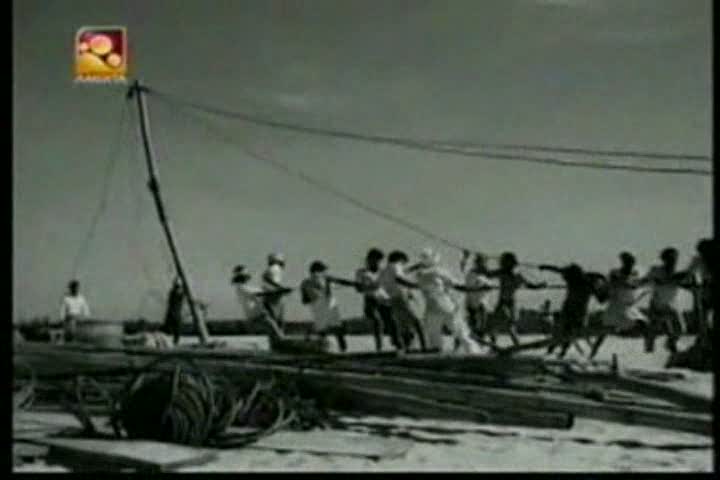 The state of the great Indian filmmaker Govindan Aravindan, who would have turned 75 this year, is not much different from one of his most famous characters, Esthappan, about whom every one talks about and whom no one has seen. An even more unfortunate fact is that few of his films are available on home video or underground distribution networks – the ones available are in an extremely bad shape – and the situation doesn’t seem like its going to get any better. When even ‘bankable’ art house filmmakers like Adoor Gopalakrishnan and Girish Kasaravalli don’t have all their works out there on discs, a truly marginal (and truly challenging) filmmaker like Aravindan, who was neither a professionally trained filmmaker nor a filmmaker who made cinema his profession (He did have a day job, if I’m right), could only hope for a miracle. Thampu (1978), my favorite Aravindan film of the ones I’ve seen, is as simple as they come, in terms of the plot: A circus troupe arrives at a village, sets up their tent, performs and leaves. And Aravindan films exactly that. We see in fine detail – pretty much like a fly-on-the-wall documentary – how the troupe enters the village, how it sets up the tent, promotes the show, practices, performs multiple shows, incurs losses and finally leaves. Like Tati’s amazing Jour de Fete (1949), Thampu is a film that is a chain of moments, actions and impressions.
Besides Jour de Fete, there are a number of films that Thampu channels. First is, of course, Ruttmann’s Berlin: Symphony of a Great City (1914) in the way Aravindan develops a tone and an ambience by choosing to shoot the deserted streets and the old buildings of the village with great affection, as though they were all alive. We can also see assorted elements that Tarr would incorporate in his later films: long shots of outdoor action, processions, celebratory dances, inebriated people, papers all over streets, high-pitched diegetic music and even an enigmatic head of the circus troupe. Then there’s the ‘c’est la vie’ approach to circus and life – life at circus and circus of life – of Chaplin’s Circus (1928). But the most fruitful reference point for Thampu would have to be the middle period films of Federico Fellini, especially The Clowns (1970) and Amarcord (1973). Like the former, which deals with the circus as well, Thampu is a touch elegiac about the profession, about the waning interest towards circuses and about clowns of yesteryear being disregarded and discarded as troupes lose business. And like Amarcord, Thampu unfolds as a string of vignettes of the village – children on the streets watching the circus monkey perform, workers leaving the factory after a hard day’s work, villagers crossing the river on a boat to catch the evening show, the village prostitute carrying on with her work and, generally, the dead times of a life lived more leisurely – all directly from what seems like adolescent memory, so typical of Fellini’s cinema as well.
 The prime structural and visual motif – a rarity considering given how ‘spontaneous’ the film seems – of Thampu is that of the circle. The film opens startlingly with a three-minute, near-silent sequence – redolent of Adoor Gopalakrishnan’s equally experimental opening of Swayamvaram (1972) – that presents the circus crew entering the village in their truck and it closes with a similar sequence as they move out of the village, with no apparent impact on either the village or themselves. Within the story, circles of power result in circles of suffering and circles of mute suffering, cyclically, perpetuate circles of power. The local elite who has returned from abroad, Bidi Menon, maintains his own circle of bourgeois connections and practices while manager Panicker’s circus (etymology check: “circle”) crew is a closed circle of friends and families putting up assorted acts in the circus ring. Power abuse in Menon’s family is mirrored in that of Panicker’s. (Aravindan, of course, cuts between the two ‘circles’ in order to establish this equivalence. Both the family heads are even portrayed by bald actors with a good degree of resemblance). In both, people – the women in Menon’s group and the aging performers in Panicker’s group – are subordinated and condemned to a lowly existence (The protracted inter-cutting between the old clown and the monkey getting ready for their respective acts is one of the very few instances of heavy-handed-ness in the film). Only Menon’s son, who realizes his entrapment – within concrete houses, amidst drinking bouts and alongside rock music records – tries to break out of this circle, even if it means entering another – that of the circus. (The last shot is, at once, full of hope, anxiety and pathos). It’s not a bit clichéd as it sounds at all, for all these relationships remain nearly inconspicuous under the ‘tender’ surface of the picture.
It’s tempting to declare Thampu as a work that is all surface and no centre. The film is fragmented, constructed as a series of visual and aural impressions of an event, as an elliptical memory of images from the village fete. Like Ruttmann, Aravindan shoots the empty streets and bylanes of the location with care, as though attempting to find something in these surfaces. Aravindan’s cinema is, in more than one sense, surfaces in search of a centre, images in search of a story. In Kummatty (1979, a remarkable ‘children’s book movie’, if there ever was one), the eponymous, mysterious bogeyman becomes the talk of the village kids, who seem to spin their own myths about him. The identity of the titular stranger in Esthappan (1980, a quasi-Marxist update on Citizen Kane (1941)), is nothing but the sum of the village folks’ anxieties, fears and hopes. Same is the case with electricity in Oridathu (1987, the portrait of a nation in its Mirror Stage). Far from dealing merely with central MacGuffins, these pictures emphasize the present over the absent, the visible over the invisible, appearance over meaning. (Even in a deceptively straightforward documentary like Anadi-Dhara (1988), the director underscores physicality, of people trying, with glitches, to exhibit their native art within a totally alien environment). This trait seems all the more radical given that it stands in direct opposition to the conventions of Parallel Cinema – the category under which Aravindan’s name is generally placed – whose works are built around heavy, politically-charged texts. Aravindan, on the other hand, constructs his films top-down, using his images to develop rhythms and moods rather than to drive the plot. He knows well that cinema begins where meaning ends, that cinema is the preeminent art form of the visible and that no philosophical or psychological depth can make up for the visceral impact of the photographic image.
 Thampu could be classified, in a broad sense, as falling under the ‘aesthetic category’ of Contemporary Contemplative Cinema (CCC), a mode of filmmaking that Indian filmmakers rarely get into. Like the major works of CCC, it eschews narrative for texture and psychology for gestures. The film generally works with long shots and little employs speech, pruning down sensational elements and using a naturalistic mise en scène and an observational style. However, unlike most CCC films, Thampu uses a lot of music, most of them diegetic. There are songs that play on the radio, songs from the circus loudspeakers and a bunch of them even sung directly by characters. However, each of these occurrences is presented in a nearly-documentary format, as a part of everyday life of the villagers. The result is fascinating in the way the movie ventures into territory generally alien to CCC and yet works within its paradigms. Throughout the film, there is a tug-of-war between performance and naturalism. Rather, one complements the other. Decidedly over-the-top, spectacular scenes from the circus performance are intercut with the audience’s faces whose startled reactions are little spectacles in themselves. We watch the performance of their faces as they watch the faces of their performers. We are made the spectators of faces as we watch the faces of the spectators. The contrived and repetitive, even if bravura, acts of the circus troupe are countered by the fresh, spontaneous gestures on the audience’s faces, as if trying pointing to Parallel Cinema a whole new type of filmmaking.
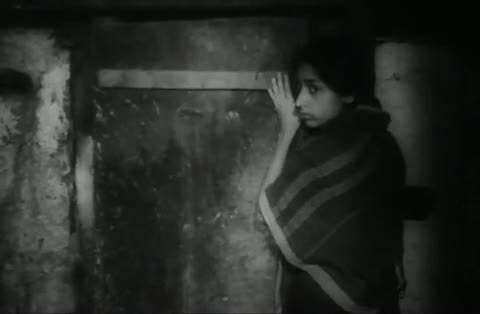
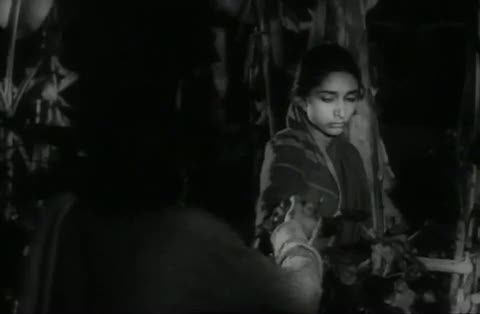
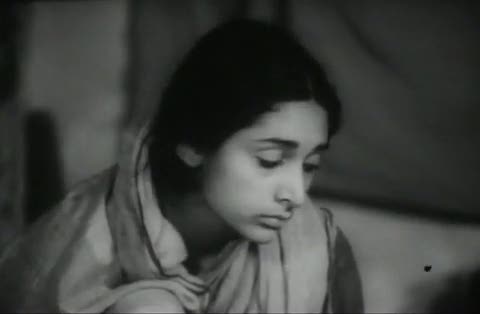
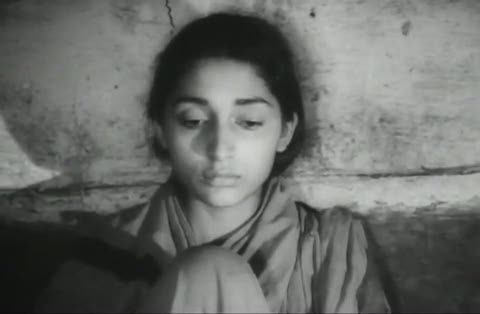
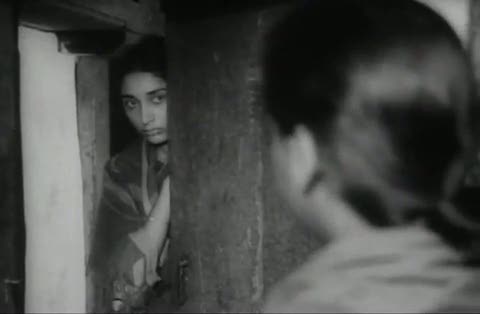
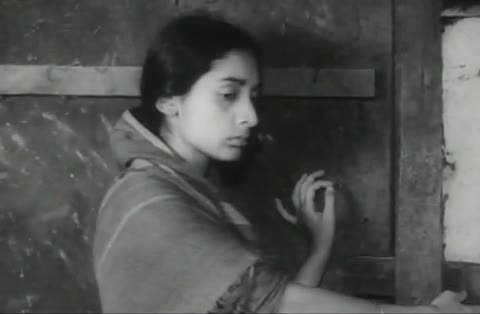
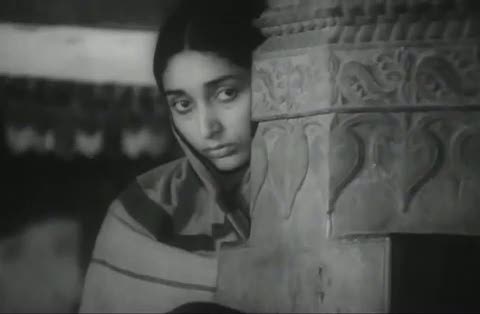
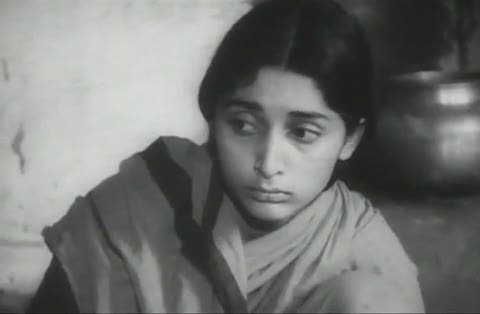
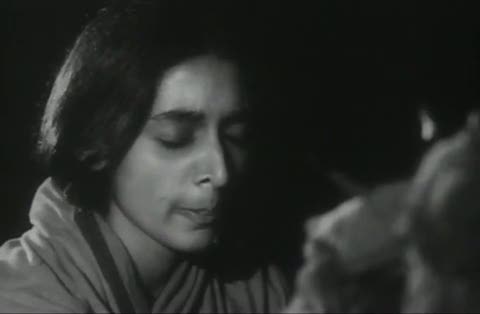
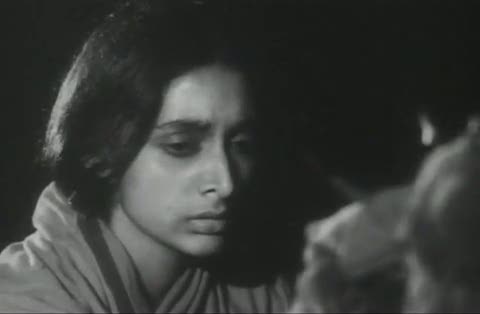
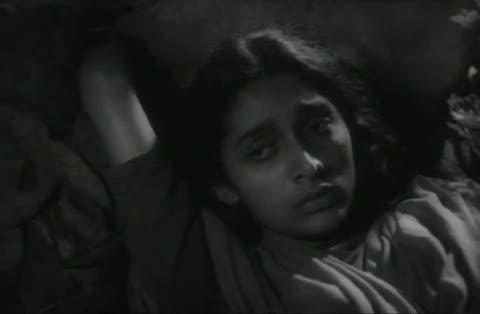
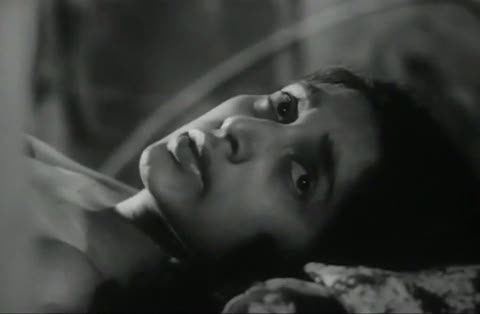
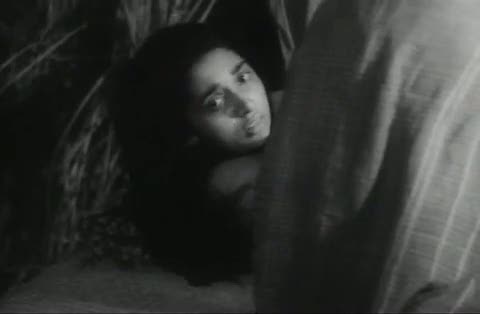
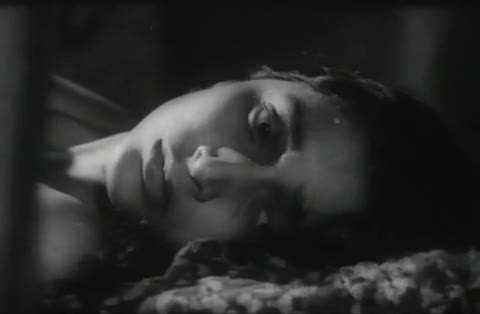
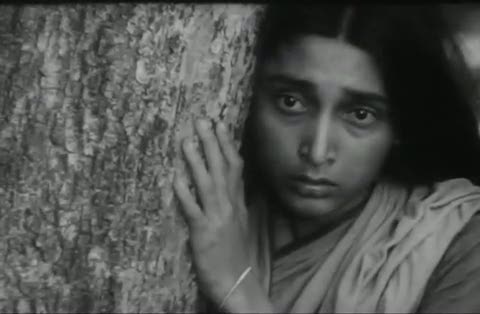
The indoor scenes, on the other hand, are highly synthetic (not in a derogatory sense). For one, the scenes at Menon’s house are filmed like a newspaper caricature, composed like a tableau at times. But even in the other scenes at the circus, the naturalism of the documentary sections (the circus show, the streets of the village etc.) is replaced by a highly stylized aesthetic that uses monochrome backgrounds before which actors move, perform and talk in a self-consciously artificial fashion. Even here, there is a push-pull relationship between conscious performance and the naturalism vested in the documentation of that performance (a dialectic that forms the central working principle of Anadi-Dhara). The circus manager, Panicker, is played by Bharath Gopi, one of India’s finest actors. He plays Panicker straight, without any attempt to convince that he’s into the skin of the character or that this is how a circus manager behaves. Like Cassavetes’ strip club owner (but not half as empathetic towards his workers) he just is. Gopi’s portrayal is a termite art of the highest order and his face here is one that you won’t forget for a long time. In fact, it’s tough to forget any of the faces one watches in this movie. Quite simply, Thampu is a film about faces, like how Kummatty is a film about horizons of all kinds. Aravindan, somewhat like Bartas, cuts from one face to other, using them like notes in a melody, as if conjuring them up from childhood memory. As in Shirin (2008), there is something expressive about these faces, their reaction to a small-scale spectacle revealing more than what’s visible. And like the Kiarostami film, we realize that the screen space extends on to us, inviting us to revel in this small-scale spectacle of faces.
Here is a set of interviews of Govindan Aravindan speaking about his films. On Thampu:
When you planned the film THAMPU, what was uppermost in your mind: was it the problems and insecurities of the circus artists or the response of the villagers to the circus tent?
I planned THAMPU as a documentary feature. The film was shot in Thirunavaya on the banks of Bharathapuzha. I came to this village with ten to fifteen circus artistes who had already left their circus company. We did not have a script, and we shot the incidents as they happened. What we did on the first day was to call all the villagers and perform a circus act for them. There were a lot of people who had not seen a circus before. We shot their responses as they were watching. We did not ask them to do anything. After the initial hesitation, they forgot the lights and the shooting and completely got involved in the circus. It was all very original. At that time the village was also getting ready for the Ayappan Vilaku festival, which we used in the film. Finally the whole village got so involved in preparing for its festival, they lost their interest in the circus. The film ends there. In fact it is a location film.
Well, in THAMPU also, there is a discontented young man.
This character was there in the film – young man from an upper middle class family returned from abroad and settled in the native land. I am fascinated by these kind of people. You see similar people in UTTARAYANAM also. This ‘return’ has been with us for a very very long time. Earlier people ‘returned’ from Singapore, Burma, Ceylon etc. Now they ‘return’ from the Gulf. That is the only difference. When they ‘come back’ they will build a big bungalow and live isolated from the others around. Their relationships are confined to those of similar ‘type’ – they will of course have their “weekend gatherings”. The question is why do they ‘come back’ if they are unable to or do not want to mix with the people around? My young man is someone who is discontented with this sort of isolation and wants to be in tune with the people and surroundings. He does not like to sit at home. He starts learning to read Malayalam and then ask the circus whether he can join them and ultimately goes away with them.
Just a small comment. Although apparently ‘regional’, your films, one could say are much broader – Indian. Your comments on contemporary issue reflect more a cynicism towards the present (as in your cartoons) than a nostalgic return to the past. To get back to the film – the young man has never been to see a circus, has he?
No. When the circus goes back he just goes along with them.
When a circus is on the move, the artists are resting or asleep. They have nothing to expect or remember from the places they visit or stay in. This young man takes a decision to go with them. Why? Perhaps a recognition that he is no different from them! Or is this decision merely coincidental?
He could not get along with his family. To escape the home atmosphere he goes and finds a place under the Banyan tree and learns to read etc. I have included in the film the moment of his decision to join the circus. At home he was surrounded by rock music while he himself loves classical music. There you see him asking the circus to take him along. The circus manager tells him to get into the van. At that moment he has not identified himself with the circus – he is merely escaping from his environment. No one has taken note of him in the circus company. The film ends with the sequence of him sleeping by the side of the circus clown.
For the circus, this journey is a stagnation. A period of rest, where as for the young man this trip is a progress and escape.
We cannot really say predict what he will become or do… He could become anything…even a circus clown… We are not making it clear. The emphasis is on his escape from the immediate environment.
As you are talking about the journey of the young man, it occurs to me that all your films have this aspect of a voyage to self-discovery or a ‘movement’ towards betterment of humanity. e.g. in KANCHANA SEETA, Rama carrying the sacrificial fire and going into the Sarayu River; in UTTARAYANAM, Ravi going into the forest; the arrivals and departures of the bogeyman in KUMMATTY according to the seasons; in CHIDAMBARAM Shankaran Kutty’s search for peace in his troubled conscience etc. Your films seem to be myriad manifestations of the deep desire of human kind for answers, peace, meaning…?
(Remains silent)












 The Seventh Art
