Tamil auteur Myshkin’s third venture Nandalala (2010) has its opening credits rolling over an image that seems straight out of Solaris (1972): two weeds gently swayed by the water flowing over them. Likewise, in the film, Bhaskar (Myshkin) and Agilesh (Ashwath Ram) are two kindred fishes flowing upstream, possibly trying to undo their births into this brutal world, in search of their origin: their respective mothers. As is made explicit in a near-surreal night scene at the beginning, the fear of being abandoned – by mother, by the state and by God – forms the backbone of Myshkin’s film. Walking along the margin of the highway like those reptilian critters we see, the duo comes across and strikes a rapport with a number of people almost all of whom live on the fringes of society. Bhaskar and Agilesh, themselves, are misfits who’ve broken away from the establishment – the asylum and the school. Those in the mainstream, on the other hand, are seen in the safety of their houses and cars. Paranoid, hateful, hypocritical and downright barbaric, they seem distrustful of everything that might distract them from their well laid plans. (That Myshkin casts himself in a starless film that he had to struggle to get funds for makes this a story of a marginalized filmmaker struggling with the industry as well). Social integration, however, is not what Nandalala aims for. For Myshkin, as is represented in the opening shot, it is the society that is constant flux around these central characters who find meaning in their relationship with each other rather than their position in the society. (The last scene is probably a little more cynical than it appears to be). Punctuated by Fordian skylines and generally jarring bird’s eye view shots that desert the characters, Nandalala, over-scored, overacted, imprudently written and characteristically over-directed at times, nevertheless continues to refine and fortify Myshkin’s cinema of physicality with its long shot filmmaking, chopped framing, brittle cutting and Mifune-esque performances.
Olivier Assayas’ ambitious five-and-a-half hour biopic Carlos (2010) is obsessed with movement. For one, it attempts to chronicle at length the activities and philosophy of those radical counterculture movements of Europe in the 60s and the 70s. It is also keen on charting the movement of history in relation to its central figure – an aspect that is perhaps the most fundamental part of the film’s text. Then there is its endless preoccupation with physical movement: of people and of goods. Some commentators might point out that Carlos plays out as a good history lesson. Actually, it makes for a better geography course. From South America to Europe, from Africa to Asia, Carlos is always on the move. One could say that, like the shark, he will perish the moment he stops moving. (In this respect, the picture’s last line, after Carlos is captured by French feds, is terribly befitting). He is almost entirely defined by his location and his political orientation at any given point in time can be deduced if the country he lives in is known, which is why Assayas’ film is as much a travelogue as it is a biography. For Carlos, men are no different from the countries they represent – a mentality that eventually turns against him for good. Carlos is always on the move too, with its syntax infested with zooms, pans, tilts and dollies, as though it’s breathlessly trying to catch up with its subject. That’s why the film’s most telling shot is almost purely photographic: a very gradual zoom-out shot of a plane standing still at the Tripoli airport after it has been denied permission to land. Following the juggernaut that the film hitherto was, this decidedly incongruent shot leaves the viewer gasping for air. This is probably how Carlos feels at that moment as well, for he stands on the brink of a massive failure. Till this point, the film’s heady trajectory and Carlos’ cardiograph would have looked exactly the same.
Now, all this talk about Carlos in the present tense might sound nonsensical given that the real Carlos is an old man serving life sentence in northeastern France. But one must also keep in mind that Assayas’ Carlos is purely a fictional character built upon the filmmaker’s vision and based only partially on the real Ilich Ramirez Sanchez, as is noted in a clear-worded disclaimer flashed at the beginning of each of the three segments of the movie. This deviation is what saves the film from becoming an insipid reportage like The Baader-Meinhof Complex(2009), another genre film that tried to tap into the zeitgeist of the age. (In fact, the first section of Assayas’ film is no better than Edel’s, with the director spending hours together reconstructing what could have been dispensed with an intertitle or a newsreel; but narrative telescoping is not even remotely a part of the agenda). Shot on 35 mm (although I bet at least a few shots were done on video) and spanning about 25 years, Carlos religiously charts the rise and fall of the eponymous terrorist/revolutionary, played by fellow Venezuelan Edgar Ramirez, in a surprisingly straightforward fashion. Painstaking production design that pays attention to period, geographical and cultural details – no mean job for a picture that spans numerous years and countries – and a nearly-anachronistic soundtrack which is almost always used in contrast to the imagery mark the major deviations from the genre. And Assayas’ camera is more than willing to parade these details, in addition to Ramirez’s seemingly malleable physique, and the result is a film with myriad empty, connecting shots.
To a large extent, Assayas’ film views Carlos as a chronic narcissistic turned on by weapons and women. “Weapons are an extension of my body” he tells a woman before thrusting a grenade under her skirt. He caresses firearms as if they were his lovers and kicks around women as though they were his handguns. Throughout, Carlos’ physical prowess and virility are equated with his military power. Scenes depicting his military exploits are interspersed with his conquests in bed. His political career in the film is bracketed by shots of him standing stark naked in front of a mirror and admiring well-built body and him lying on a stretcher clutching his private parts under the paunch. All this sounds awfully contrived on paper, but the fact that Assayas derives these metaphors from undisputed biographical details helps turn such tepid arthouse tricks into a clever piece of artistry. However, all this is made evident an hour into the film and Carlos remains more or less an unchanging protagonist for the rest of the film. Like Sorkin’s Mark Zuckerberg, Carlos is the fixed centre of the film around which the universe rearranges itself, in turn redefining and reshaping him. (In retrospect, the last line of Fincher’s film describes him to a T). Does he hypocritically change sides despite his apparently unchanging cause or is it the volatile course of events that have remapped his loyalties? Is the world too dynamic for an old timer like him to catch up or is he a mere mercenary – a selfish, two-bit petit-bourgeois, as his friend puts it – afraid of death? It is probably the latter, although he would like to think not.
Curtained and distorted by wisps of cigarette smoke, Carlos is an amorphous figure, with ever changing identities, loyalties and worldviews, and a master of disguises (like Assayas himself, who seems to be hopping genres and feeding on them). Like your typical movie star, he appears to be always conscious of what he’s wearing and not half as much about what he is speaking or doing. As a matter of fact, the film illustrates, he is more a performer than a revolutionary or a terrorist. Throughout, Carlos revels in theatricality. Like Edgar Ramirez, he is a polyglot and before one thinks that he might not know a particular language, he delights himself with a mini-performance delivered in that very language. Fifteen minutes into the film, in its first explosive conversation, we get a sneak peek into the five-hour play that is to come. Carlos’ friend points out to him that he is only craving for applause. He tells her, “You’ll be hearing my name a lot”, and asks her to look at him when he’s talking. During the OPEC raid, he models himself after Che Guevara, complete with the beard and the beret (an actor playing a half-actor-half-revolutionary playing a revolutionary), and introduces himself as “My name is Carlos. You may have heard of me”. The conference room itself resembles a theatre, where he directs his seated audience-actors and performs before them from the end of the hall, Elsewhere, regularly, he shouts, he throws tantrums and he flips, occasionally spouting hyperbole without apparently understanding them a la actor extraordinaire Jules Winnfield.
[Carlos (2010) Trailer]
“Without newspapers you don’t exist”, says one interviewer to him – a day before he finds a bullet in his medulla – winning a half-affirmative smile from Carlos. And why not? It is, after all, of his doing. He is the writer, director, the actor and the PR man of his life. He is, also, his own audience. Carlos lives outside himself. If his inner life comes across as something enigmatic to us in the film, it must be the same to him as well. Assayas does not push hard on the psychological front and is concerned more with the “what” of the story than the speculative “why”. It is not a human character, but the totality of events involving Carlos that is the hero of his film. He does not try to delve into the psyche of the man, or some such thing, to make his point. Instead, he lets Carlos’ actions reveal how self-contradictory a person he is. (Ramirez’s non-Method portrayal itself comes across as all surface and no center, as if he’s playing a mummy that’s been totally hollowed out) One might wonder whether he really believes in all those flowery platitudes that he mouths off now and then. (After all, he respects the truth value of clichés). It doesn’t really matter, suggests Assayas’ film, for his actions turn out to be far removed from the directives of these rhetorical remarks. He announces that he is a man of peace and that he loves life while he is more than happy to lodge an extra bullet or two into a man who only tried to resist him. He tells the interviewer that he studied dialectics in Moscow but also insists that no one tell him what to do. He speaks to the Saudi Arabian oil minister in fatalistic terms while, elsewhere, he comments that he is entirely responsible for his men. Possibly the greatest irony that marks Carlos’ life, which one federal agent notes towards that end, is that, for all his anti-capitalistic, anti-American baloney, he really had no criminal records against America.
In fact, this whole enterprise that Carlos sets up and develops is more symptomatic of corporate capitalism than anti-capitalistic revolution. Missions are throttled and determined by the inflowing funds rather than their agenda. A delayed assassination plan allows for competition to seal the deal. We witness countries nourishing anti-state organizations for political gains in the exact manner that corporations fund parties for fiscal benefits. The world is a market and revolution, a business. Pretty much like modern economics, Carlos illustrates how the numerous political maneuvers in different parts of the world are linked intricately to each other and often in contradicting ways (which reminds one of Godard’s observation regarding Jews, Hollywood, cinema halls and Mecca in his last). The film, itself, is directed and edited like a corporate thriller full of roundtable discussions and cutthroat business strategies. Moreover, Carlos is ostensibly a “gangster movie” as well, with its detailed account of the rise of an underdog, his notoriety and his disgraceful fall (in addition to its multiple nods to The Godfather (1972)). But then, there’s only a little difference between the two genres anyway. Mike Wayne notes in his book Political Film: The Dialectics of Third Cinema that the gangster figure – a man who steals from the rich and keeps it for himself – in popular cinema is emblematic of the dark side of capitalism while the bandit – the Robin Hood variant – represents a subversive if temporary threat to the same system. One could take this further and observe that the revolutionary goes one better than the bandit in that he is interested in not merely providing temporary monetary relief for the poor, but in toppling the establishment that creates a need for bandits. The tragedy about Carlos (and many of his cohorts) is that he fails to recognize if he is being the revolutionary that he wants, an ineffective bandit out of touch with the masses or a parasitic gangster running a reign of terror.
Placing Carlos’ example in a broader context, Assayas’ film makes a strong if not the ideal case against armed struggle. It probes, as does Bellocchio’s masterful Vincere (2009) (although Assayas’ ideological investment is relatively insubstantial), into a hermetic passage in history and opens it up for present day-analysis. Like Edel’s film, but with a far more focus and detachment, Carlos examines how an armed movement with an urgent, uncompromising objective is bound to foster authoritarianism and how a revolution is deemed to go against itself when its operative hierarchy branches out from a single spearhead – the father, if you will. Make no mistake, whatever organizations Carlos was associated with, they were, thanks to their pigheaded adherence to a shallow and monolithic view of the world, undemocratic (“soldiers must fear their leader” goes the rule of thumb), racist (anti-Zionism easily mutates into anti-Semitism), sexist (especially when radicalism is uncritically married to certain religions, one of which Carlos is reportedly a proponent of), imperial (a pro-Palestine stance, it seems, reads as an anti-Kurdish one), bourgeois (by forming a bohemian clique far removed from the lumpenproletariat, the group it pretends to champion) and downright fascist. All these symptoms are even more relevant in the post-9/11 world where the resistance to occupation has translated into such a blanket rejection of western traditions that movements often lose sight of what is genuinely progressive and what is not.
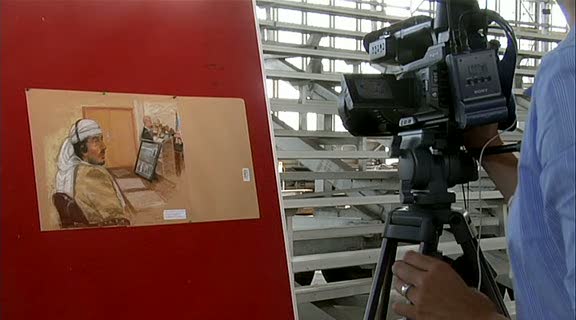
The approach of Laura Poitras’ documentary The Oath (2010) is akin to having your cake and eating it too. And your neighbour’s. And the next one as well. Split between two geographies and worlds – Yemen, where Abu Jandal – erstwhile Al Qaeda member and Bin Laden’s bodyguard – drives the streets for a living, and Guantanamo Bay, where Salim Hamdan – Jandal’s brother-in-law and a driver in the same organization – is imprisoned by the US government on charges of “supporting terrorism materially” – The Oath attempts to indirectly examine both the alleged indoctrination of young Jihadis for the purpose of suicide bombing and the Bush regime’s seemingly opaque and opportunistic justice system. Cutting back and forth between conversations with the loquacious, confident and charming Jandal and the uninhabited, melancholy premises of the detainment facility where Hamdan is held, Poitras establishes a parallel between the two men: both are prisoners over whom the possibility of death looms every instant and who, paradoxically, find safety in the very jails that hold them. (Jandal, placed high on Al Qaeda’s hit list, seeks refuge in the prison of TV images while Hamdan ghettoizes himself out of fear after he returns). “I’m a soldier, I’m not a martyr”, says a hypocritical Carlos in Assayas’ latest work. Jandal maintains the same, even though he sees no wrong in blowing up passenger planes. Poitras does enough to build on Jandal’s self-contradictions to paint a portrait of him as a conflicted buffoon whose only oath of loyalty is to life – not God, religion or political cause. But then, the film’s agenda doesn’t stop there. Poitras is liberal enough to dispel the conservative notion of Jihadis as mean killing machines and to label all her subjects as being “merely human”, but she’s also selectively neocon in that she develops a Freudian sketch of Islam and Jihad which does nothing to challenge the equally-distorted western perception of these larger institutions. This self-serving worldview notwithstanding, The Oath makes for an intriguing watch in the way it keeps stressing the gargantuan role that the visual media has come to play in our daily lives and administrative systems where the presence of a camera is the sole screen that separates memory and forgetfulness, justice and tyranny and life and death.
Kak Ya Provyol Etim Letom (2010) (How I Ended This Summer)
Aleksei Popogrebsky
Russian
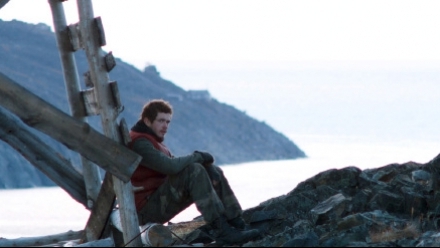
Aleksei Popogrebski’s How I Ended This Summer (2010) chronicles an unspecified number of days in the life of Sergei (Sergei Puskepalis), the sole operator of a meteorological survey unit on a remote island in the Arctic Ocean, and the younger, hipper Pavel (Grigoriy Dobrigin), an intern at the station. Popogrebski embellishes his widescreen canvas with breathtaking images of Chukotka, Russia, which appears as though it is the very edge of the earth. For Sergei, however, it is the very edge of his life, for confronting this seemingly limitless stretch of unpopulated, hostile and godforsaken terrain is like confronting the human condition itself. Faced with this predicament, Sergei holds-on to illusions that comfort him the most: work (however mechanized and pointless it may be) and family (both his real family that lives on the mainland and his newfound ‘son’ Pavel). Communication, or rather the inability to establish it, forms the prime motif of Popogrebski’s film. Be it between the island and the mainland or between two individuals in the same room (and, since we are in that realm, between man and God), meaningful communication seems to be a luxury. (The film abounds with radioactive emissions, short waves and SMS smileys while there are only a few shots shots where we see two people together in the frame). Taking the idea of the lack of communication to a more tangible domain, How I Ended This Summer could be seen as a quasi Cold War allegory – a reading that’s quite plausible given that residual nuclear deposit on the island is what drives the plot – where an utter lack of understanding and introspection on the part of both the superpowers not only proved internecine, but has also left an indelible mark on generations to come. Popogrebski, of course, can’t propose a retroactive solution. He can, and does, only look forward to a renewed future, even if it means starting with a simple hug.
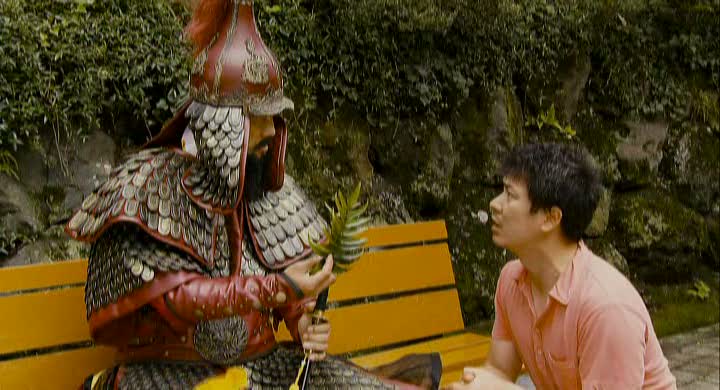
Hong Sang-soo’s easy-to-type Hahaha (2010) is the kind of picture that critics comfortably dismiss as light and frivolous. That’s because Hahaha is light and frivolous. And consciously so. The film presents two young friends who accidentally meet and decide to hang out in a pub nearby. During their bout, they take turns to recite their experiences during last summer in a sea-side town. As the two mildly amusing stories unfold, we realize that they are not all exclusive as both tellers believe. We see characters and events that span the two stories, time-line of one story flowing into the other and the characters’ paths intersecting in bizarre and not-so-bizarre ways. Perhaps these two men are drunk enough (or dumb enough) to not realize that their stories share a single universe. Or it may be that one of them is only playing along and making his story up. Or maybe both of them are playing a game of Exquisite Corpse. It is also equally possible that both of them are sincere and it is Hong who is pulling their legs by actually making a film out of their stories wherein he fuses and confuses separate characters. The two stories are contaminated by regularly occurring zoom shots that lend the film the look of a bad sitcom or, more accurately, an amateur video made on the sets of Hahaha which reveal the artifice of it all. Existentialist in approach, Hong’s film argues, as does Allen’s Melinda and Melinda (2004), that one’s life is how one interprets it to be and that value of things resides only in one’s perception of those things. Consequently, like Allen’s film, one of the stories is high on marital drama and the other, on romantic comedy. (Actually, the former ends up being hysterical while the latter is pretty bland). But the film is also a testament to the power of stories in embodying our desires and overcoming our fears and a lighthearted appeal for the existence of personal, eccentric histories – personal and national – as opposed to the unquestionable, unfruitful facts handed down by text books.
God created man in his own image. Aaron Sorkin’s Mark Zuckerberg (Jesse Eisenberg), it appears, created the 21st century man in his own image: a two-dimensional, unchanging prisoner of a projected persona. This threatening, ever-endangered entity called the “image” – social and cinematic – is what both Mark Zuckerberg and director David Fincher are respectively after in The Social Network (2010), the one picture of recent times that has given birth to the finest of film criticism*. The closest the trajectories of these two figures ever come in the film is the surprising moment when Zuckerberg wields a digital camera to photograph his friends diving into the pool. Clearly, Fincher’s romanticizing of Zuckerberg’s dream run attempts to equate the latter with a film director – to possibly Fincher himself, although it is a bit difficult to imagine David Fincher as anything but the establishment – in the way both of these misfits vainly put up with the bureaucratic minutiae of the head honchos and thrust their vision – the images – forward even if it means compromise on personal fronts. Both of them overcome the schemes and vagaries of the real world – emotions, accidents and flaws – using the surety of binary numbers: Zuckerberg with his codes, Fincher with his Red One. Zuckerberg, however, belongs to both film noir and fantasy. He is both Jake Gittes who learns to give up hope the hard way and David who defeats the Goliaths of Harvard, both Mario who tries to win back his princess and the dragon that tries to imprison her in a digital jungle, both Faust and the Devil, a crusader who makes a million enemies to regain a friend. What makes The Social Network particularly rich is its beneficial (and sort of natural) ambivalence towards copyright, Web 2.0 and, in general, capitalism. In fact, Sorkin and Fincher seem to view Web 2.0 as being simultaneously socialistic and capitalistic, democratic and Darwinian, a refined laissez-faire system where the individual decides, drives and controls and a great leveler that brings down established social hierarchies in a matter of hours and a few keystrokes. These are exactly its pitfalls as well.
Persistence Of Vision (Image Courtesy: Cannes Festival Site)
A spectre is haunting Europe – the spectre of its own past. So seems to suggest Jean Luc-Godard’s golden jubilee work Film Socialism (2010), the one film of recent times that has produced the least insightful body of criticism so far (with some of them being downright vengeful; one wonders if the film would fared better with the critics if Godard’s name wasn’t attached to it). The latter observation should come as no surprise for neither does the film provide the comfort of a clear, overarching authorial voice as in History of Cinema (1988-98) nor does it overtly embrace – as some recent works of the director have – the free associative essay form. What we have, rather, is a documentary with conscious fictional texts embedded within or a self-conscious documentary of a shoddy fictional production. Film Socialism’s ontological confusion might be a throwback to Godard’s films of the late eighties, but the picture that is closest to this one, to my mind, is Last Year at Marienbad (1961, more on this later).
The film is divided into three segments (or “movements”) the first and longest of which, titled “Things such as”, is set on a cruise ship (which has been noted to possibly denote a floating Europe – both financially and historically), whose passengers seem to represent a microcosm of Europe present and Europe past (including intellectuals who carry out dialectical conversations). Amidst the fragments of dialogues, scenes and visuals runs a plot involving an ex-Nazi turned Jew who might have appropriated a huge sum of money from the Bank of Spain. The brooding environment of the ship’s deck at twilight, the seeming absence of contact between various groups of people on the vessel, the contemplative images of the sea (water being equated to money right from the first line) that punctuate the segment and the general sense of hopelessness that pervades it – all serve to create a post-apocalyptic atmosphere redolent of Tsai Min-liang’s cinema. Likewise, the filmmaking here seems both like a desperate act to salvage and synthesize from what remains of a glorious civilization and a typical Godardian attempt and appeal to return to zero. The first facet is reflected in the fractured nature of this section, wherein shards of banal, familiar images, texts, words and sounds are sewed together (a treatise on Husserl gets to sit alongside Lolcat videos) using equally eclectic assortment of digital media (ranging from cheap cell phone camera footage to crisp high-definition, from unfiltered, noisy microphone recordings to studio-mastered sound), while the latter manifests as an intermittent but perennial discourse on the value of things and the possibility of reversion to barter system where, probably, the concept of surplus labour vanishes. (Godard’s use of nearly-unintelligible Navajo subtitles, in this sense, might be an offer to barter the film’s half-articulated ideas for our participation).
The second section, called “Quo Vadis Europa”, involves a middle class French family whose ‘head’ is disillusioned by the state of affairs of the nation. The children of the family take to anarchistic politics following which they adopt rigorous policies in the usage of language and show an increased involvement in the arts. Whether this is a straightforward parody of the Leftist agitation of the 60s (whose poster boy Godard undeniably has become, when it comes to cinema) or a serious consideration of an atavistic return of student radicalism (and the consequent sloganeering) is somewhat unclear, but these sequences marry the apparent emotionality and solemnity of the director’s post-eighties work with his flamboyant rigor of the years before in a manner that seems like new territory even for Godard. (It is mainly the absurd scenario – reminiscent of the filmmaker’s works featuring Jean-Pierre Léaud – of this segment that prompts the former reading. Both Melville and Herzog compared student anarchists to children and dwarfs respectively during the seventies. However, Godard’s insistence here that the spirit and ideas of the age persist through language seems more sober and hopeful and less nostalgic and playful).
The third part of the film – “Humanities”, an epilogue of sorts resembling the scintillating “Hell” segment of Our Music (2004) – takes us further back in time, into ages which are now considered ancient. I say ‘considered’ because the film appears to refer to our perception of those time periods than the periods themselves. This is an era where we see images of relics of Aegyptus, prisoners of Palestine and ruins of Naples alongside Eisenstein’s version of the Odessa massacre and Rossellini’s documentation of an archeological excavation. There is no logical reason for us to consider the first set of images as belonging to a remote past and the other to a more recent time (the same way it is illogical to consider one set as fictional and the other as real). Mythology and history interpenetrate irreversibly. (Elsewhere, Godard points out how Eisenstein’s restaging of the October Revolution now passes off as the actual event). In every case, cinema distorts, realigns or plainly obscures our perception of history, as does the written language to an arguably lesser extent. “It’s not the literal past that rules us, but the images of the past” said George Steiner. Like film technology, these images have persisted in our vision through the ages, distilling and redefining the past along the way. The visual language of photography, with its deceptive simplicity and misleading verisimilitude seems to have ‘become’ what it sought to represent. (“Roman Jakobson shows during the winter of 1942/43 that is it impossible to separate sound from meaning” quotes the film). Cinema is not just the defining phenomenon of the 20th century, it is the 20th century. Like the inhabitants of the cruise ship, we all seem to be aboard this boundless, floating fleet of images having almost no anchor to reality, in this quagmire of symbols where to say is to be, in this inverted world where our own footmen – our languages, our currencies – have become our rulers.
[Film Socialism (2010) Trailer]
Language is, of course, the central object of investigation in Film Socialism (as it is in almost all of Godard’s pictures; he calls Film Socialism his “Farewell to Language”). Money is treated as a language for communication at the outset and an examination of the possibility of returning to zero of economics is also extended to the possibility of return to zero of communication (Someone utters the maxim: “silence is golden”). (The Navajo text for the film is perhaps the first attempt at this, with its unambiguous, rudimentary words being uncontroversial and untainted in comparison to the meaning-laden sentences a proper set of subtitle would have provided. Like the Navajo subtitles, Film Socialism is composed of discrete, clear, nearly incongruous images which sacrifice meaning for concreteness). Speaking of concreteness and directness, Godard seems to have found a new respect for objects and surfaces in this film. The first movement of the picture, at least, is a cinema of superficies. Be they of the wet floors of the ship or of a slot machine at work, the images of this segment seem to acknowledge objects for what they are rather than as symbols or props. One could suspend the movie at any random point and admire the beauty of the objects seen, without any consideration of the context. Each image, each cut and each sound seem to have found their proper place, like these objects. Given that this section is a reflection on the value of (manmade) things, this apparent piety towards commonplace articles – made more palpable by the ‘immediacy’ of digital video and the use of static shots – is perhaps Godard’s (and cinema’s) way of appraising the objects he films.
Furthermore such use of images as objects invokes the issue of copyright and intellectual property, which the French has been long against. (The film’s opening credits cites all the film clips, sounds and texts used in the film and there’s the FBI copyright warning, surprisingly, at the end with the text “when the law is wrong, justice comes before the law”, as if asking if images of objects could be subjected to laws of private possession at all. Godard’s plundering, of course, ranges from John Ford to YouTube). During the seventies, Godard was not just concerned with making political films, but, as James Monaco points out, making films politically. Godard and company recognized that the whole enterprise of cinema – production, authorship, marketing, distribution and exhibition – inherently espouses an ideology and to subvert the ideology called for a subversion of all these systems. This also meant an effacement of individual authorship and ownership (for a person who had been at the forefront of auteur criticism). The movement, of course, fell apart and Godard went back to an even more personal mode of filmmaking. However, even with their esoteric eccentricities and idiosyncrasies, his films continued to possess the same critical charge and formal rigor. In that sense, Film Socialism might not (just) be a film about socialism but one that is made socialistically in the way it lets its audience take responsibility for and ownership of its text.
I’m, of course, only speculating. Part of the problem in properly responding to the film arises from the confusion regarding whether we should take what we see at face value or as symbols, metaphors and allegories, whether these things exist for the sake of an interpretation and not as themselves. Each shot simultaneously prompts interpretation and invites us to explore its surface. Susan Sontag, against all temptation to interpret it using literary prisms, praised Last Year at Marienbad for “the pure, untranslatable, sensuous immediacy of some of its images, and its rigorous if narrow solutions to certain problems of cinematic form”. The same could be said about Film Socialism, which, for me, replicates the experience of watching the Resnais film. More than the fluidity of form or the repudiation of grammar, it is the lingering feeling that it might all just fall into place if we only stayed with the film – if we could just enter the film – for long enough that makes Film Socialism resemble Marienbad. “Conversation flowed in a void, apparently meaningless, or at any rate, not meant to mean anything. A phrase hung in midair, as though frozen, though doubtless taken up again later. No matter. The same conversations were always repeated, by the same colorless voices” could well be a paragraph from a description of Godard’s film. Like the floating phrases of Marienbad that are periodically picked up, the Film Socialism is a work that would, no doubt, be visited regularly by those fascinated by it, as I am, even if that fascination isn’t all for the right reasons. If the rumours are anything to go by, Godard might just have retired at the peak of his prowess.
Copie Conforme (2010) (Certified Copy)
Abbas Kiarostami
French/Italian/English
A possible manifesto for postmodernism, Abbas Kiarostami’s Certified Copy (2010) reminds one of a million other pictures – from the director’s own early films, through Godard, Rossellini, and Hitchcock, to Scorsese, Hou and Jarmusch – in both its major and minor strokes. This actually goes well with the film’s central argument of there being no originals in art as well as life. It asserts, as does Jarmusch’s latest, that meaning and authenticity exist in one’s gaze of objects rather than the objects themselves (Like the director’s previous film, this one reverses the artist-audience relationship and suggests that the viewer is the original author of works of art), that the question of authenticity is obviated if a (relative) truth could be arrived at through artifice, that no art can be inherently original given that it is feeds on and reshapes reality and that all aspects of human existence – appearance, language, behaviour, relationships and gestures – are reproductions of existing templates. Building upon the latter argument, the film examines the importance and inevitability of role-playing in our lives through the lead characters/actors (Juliette Binoche and William Shimmel), who bear an original-copy relationship themselves. Through them, the film proposes that there is no absolute ‘self’ and that it is only within context and within a relationship that each ‘role’ we play obtains a meaning. It is not that these two characters are faking it during one half of the film, but just that – like Sartre’s waiter – these inauthentic people segue from one level of role-playing to another (On one level, Certified Copy is a film where actors play characters playing characters playing characters). Akin to Shutter Island (2010), Certified Copy is divided into two realities, with the verity of each half being valid only in relation to that of the other. However, there’s much more to Kiarostami’s film than such straightforward illustration of philosophical ideas. (Like Scorsese’s movie, this one wears its themes on its sleeve, thereby undermining them.) Throughout, it probes where the essence and authenticity of a film rests: in its grand, ethereal ideas or in its banal, concrete physicality. Does the spirit of Certified Copy lie in its precise, recursive structure and its intricate mise en scène or is it in the minute, magical gestures of Binoche’s visage and the gentle eroticism of her loose-fitting gown?
Shankar’s Endhiran (2010) is the sort of material that would have proven gold in the hands of a director like Bertolucci or Hitchcock. It has been over a decade and a half since ‘Superstar’ Rajinikanth started playing himself in his movies, maintaining a Brechtian relationship with his audience wherein the actor would slip in and out of the context of the films on whim. And Endhiran only seems like a logical consequence of that choice. Watching the film, it would be useful to remember that the Tamil film and television industry fetishizes the Rajini image to such an extent that all spin-offs from it – spoofs, impersonations, derivatives and pastiches – are celebrated endlessly. New age actors imitate and try to emulate him all the time, with some of them even proclaiming that they’re the next ‘Superstar’. It has, more or less, come to a point where the Rajini image has assumed an immortal life of its own while the man responsible for it has been deemed a faint echo. Given this postmodern, post-Rajinikanth situation the industry is in, much of the premise of Endhiran – a grouchy, ageing, eventually-envious scientist builds a nearly-invulnerable android modeled on his younger self, which goes berserk and multiplies itself to the point where the original (copy) loses its value – feels faintly autobiographical. An affront in every which way to the generally revered tenets of Hollywood storytelling (and science) predicated on plausibility, causality and relevance – as if the writer-director has taken all those Chuck Norris-based Rajinikanth jokes to heart – Endhiran might just be the harbinger of something that was always within the reach of this industry: Tamil camp!
Noted British street artist Banksy’s Exit through the Gift Shop (2010) is a confounding beast in that it purports to be a documentary by Banksy on a man called Thierry Guetta who attempts to make a documentary on Banksy (along with other street artists). The first section of the film brings us the essence of street art, its intention to democratize art by bringing it out of arthouses and into the streets. (One of Banksy’s “guerilla installation” works depicts a lady wearing a gas mask). Gradually, the film’s focus shifts to Guetta himself. He is presented as an inarticulate, passionate camera buff fetishizing the recorded image (presaging his unrestrained fetishizing of pop culture later on), as a romantic who believes that recording every moment of one’s life increases the value of one’s gaze and, in a sense, as a Banksy-like artist working on the streets of life. Along the way, it takes a lot of potshots at the reception of avant-garde art centered on the grand debut of Guetta. The interesting thing here is that it doesn’t judge Guetta’s works till the very end, thereby toying with our perception of these works as well (some of them indeed seem praiseworthy and were probably made by Banksy himself). But then, Exit does have an agenda of its own. It evidently stands against celebrity culture and the commodification of street art. It seems to propose that street art has to be a physical endeavour more than a conceptual one and that the physical presence of the artist during creation is of utmost importance. Ironical it is that Banksy himself has held a number of exhibitions and is a revered name in art circles. This is perhaps the whole point of the film. Exit could be read – if not as a self-serving promotional campaign – as Banksy’s attempt to come to terms with his failed anonymity, as an effort to resolve the contradictions associated with his name (through the figure of Guetta) and as a form of self-criticism which recognizes that he has become a brand despite himself.
 Tamil auteur Myshkin’s third venture Nandalala (2010) has its opening credits rolling over an image that seems straight out of Solaris (1972): two weeds gently swayed by the water flowing over them. Likewise, in the film, Bhaskar (Myshkin) and Agilesh (Ashwath Ram) are two kindred fishes flowing upstream, possibly trying to undo their births into this brutal world, in search of their origin: their respective mothers. As is made explicit in a near-surreal night scene at the beginning, the fear of being abandoned – by mother, by the state and by God – forms the backbone of Myshkin’s film. Walking along the margin of the highway like those reptilian critters we see, the duo comes across and strikes a rapport with a number of people almost all of whom live on the fringes of society. Bhaskar and Agilesh, themselves, are misfits who’ve broken away from the establishment – the asylum and the school. Those in the mainstream, on the other hand, are seen in the safety of their houses and cars. Paranoid, hateful, hypocritical and downright barbaric, they seem distrustful of everything that might distract them from their well laid plans. (That Myshkin casts himself in a starless film that he had to struggle to get funds for makes this a story of a marginalized filmmaker struggling with the industry as well). Social integration, however, is not what Nandalala aims for. For Myshkin, as is represented in the opening shot, it is the society that is constant flux around these central characters who find meaning in their relationship with each other rather than their position in the society. (The last scene is probably a little more cynical than it appears to be). Punctuated by Fordian skylines and generally jarring bird’s eye view shots that desert the characters, Nandalala, over-scored, overacted, imprudently written and characteristically over-directed at times, nevertheless continues to refine and fortify Myshkin’s cinema of physicality with its long shot filmmaking, chopped framing, brittle cutting and Mifune-esque performances.