Frantic (1988)
Roman Polanski
English

There is always someone who’ll do you one better
 

FranticThe more one learns about the life and works of Alfred Hitchcock, the more one sees how influential he has been on the generation of filmmakers that followed. More than the techniques and cinematic devices that Hitchcock had helped shape and the themes that he consistently dealt with, it is his very methodology of working – the now-legendary precision of his craft, the authorial domination that he seems to have exhibited (Godard had once equated him to tyrants and dictators) and the relentlessness of his approach – that seem to intrigue many. Interestingly, it is these very elements that elevate the films of Hitchcock into the realm of personal cinema wherein the director seems to have exerted a ruthless control over his films’ world in response to the unruliness of the real world. Although many filmmakers, such as Martin Scorsese and Quentin Tarantino, have forayed into the distinctive universe of Hitchcock, few filmmakers seem to be completely obsessed with his art. Directors such as David Lynch, Brian De Palma and Roman Polanski, each in their own unique way, have been carrying on the legacy of the master filmmaker with spectacular results. The filmography of the latter, especially, betrays such an obsession with that of Alfred Hitchcock that one can almost predict the next logical step for the director.

The major theme that pervades the entire body of work of Roman Polanski is that of the fickleness of the boundary between Good and Evil – the ease of induction of the former into the latter and the (in)ability of Good to recover from this demonic metamorphosis. For Polanski, like Hitchcock, Evil is an undeniable fact that lurks and simmers just beneath a veneer of order, propriety and Goodness. Most of his protagonists transition from a world of safety and predictability into a chaotic netherworld – from superego to id, if you will – where all their cherished beliefs go for a toss. The Bates Motel is just a turn away from the main road. Even when he adapts from existing works of literature, as in The Tragedy of Macbeth (1971), Tess (1979) and Oliver Twist (2005), his interest has always been on what motivates men to cross over to the other side. This theme relates directly in Polanski’s films to the question of commonplaceness of Evil and the existence of fascist tendencies within each one of us. A Freudian might connect this to Polanski’s traumatic childhood in the Jewish ghettos. Furthermore, this abstract theme also forms the template for a more personal examination of the male psyche, its fears and its insecurities. Evidently, these facets are also hallmarks of Hitchcock’s films and Polanski’s triumph lies in appropriating these elements and imparting his own artistic vision and personal dimension to them.

Even a cursory glance at Polanski’s early films illustrates both the presence of this motif and Polanski’s preoccupation with Hitchcock. Knife in the Water (1962) and Cul-de-sac (1966) are clinical, minimalist studies of the male psyche, reminding us of films such as Lifeboat (1944), and are direct predecessors of the film under consideration. Repulsion (1965) is, in some ways, a companion piece to Psycho (1960) and presents a pretty, young woman Carol (Catherine Deneuve) struggling against the fear of sexual conformism and ultimately breaking down in an alien land. Chinatown (1974) gives us Jake Gittes (Jack Nicholson) driving around Los Angeles with a wounded nose (that reminds one of the impotent, plastered leg of L. B. Jeffries in Rear Window (1954)) trying to get to the bottom of the supposed conspiracy around him, a la Scottie Ferguson, and eventually getting sucked into the inevitable spiral of impotence and death. Unlike what Hitchcock does in Vertigo (1958), Polanski does not severe our identification with the protagonist and makes us share his delirium throughout. The Tenant (1976), Polanski’s greatest film, is a glorious melting pot of Polanski’s Hitchcock influences, specifically Psycho, Rear Window and Vertigo, the essence of all his previous films and his Napoleon complex. Despite its flamboyance and non-committal nature, the two mirroring halves of What? (1972) are redolent of Vertigo.

North By Northwest

Frantic

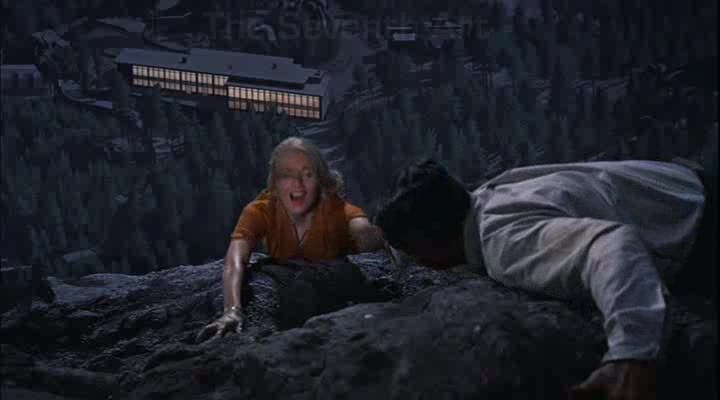
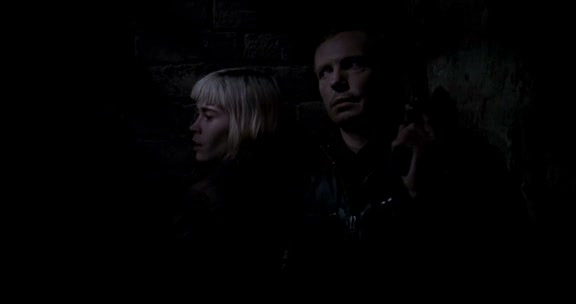
Frantic (1988) is no different, although one could argue that Polanski’s disillusionment with the American ideals, especially that of Liberty (Interestingly, he was rallying for the same against the communist regime of Poland in his short films), adds an extra layer to the proceedings. The very economy of the title – Frantic – recalls the directness of the titles of Hitchcock’s films. Written by Polanski and regular collaborator Gerard Brach, Frantic is a thriller in the vein of Hitchcock’s espionage films and follows Dr. Richard Walker (Harrison Ford) scouring the sunlit streets and dark underbelly of Paris in search of his wife Sondra (Betty Buckley). The film opens with the POV shot of a car travelling on the highway as if to suggest the imminent journey of the protagonist deep into his own psyche. In the car are Mr. and Mrs. Walker reminiscing about the city of Paris, where they had their honeymoon two decades ago. “It’s changed too much” remarks Richard. He might very well have been talking about their matrimony. The cab breaks down. The replacement tyre is also flat. Perhaps that’s how the Walker couple is too. The Walkers find another taxi to arrive at Le Grand Hotel and check in to Room 402 where a strikingly directed, 10-minute set piece unfolds.

As the couple indulges in amusing romantic talk that rarely shows signs of a crumbling relationship, we get occasional glimpses of Richard’s possessiveness about Sondra and a tinge of dissatisfaction on her part towards him (“Promises, promises”). Although there is no specific set of devices that Polanski employs for identification with a character (The first human POV shot comes only after the half-hour mark), thanks to his star persona, we immediately identify (in a positive manner) with Ford. We still see him as a charismatic, flawless, blue collar version of Indiana Jones. Richard takes a nap after a shower and finds his wife missing when he wakes up. Of course, one could resort to the old solution of labeling whatever happens after this as merely a bad dream that Richard has and that interpretation does have some validity. But whether it happens really or in his mind is really irrelevant for what is important is the profound change that Richard’s personality undergoes. It is after this incident that Richard leaves the safe and orderly world of conferences and hotel room formalities into a chaotic underworld of smuggling, murder, double dealing and racial politics. And it is in this precarious world in which Richard’s presumptuousness and superiority is revealed and regularly punished.

Paris is no more the city of love that he had seen twenty years ago. It is as “dangerous” and “dark” as the notorious alleys back home. In this unpromising climate, Richard embarks on a detective mission on his own, like Roger Thornhill, in order to “bring back” his wife, now that he has lost confidence in both the Parisian police and the American embassy there. He tries to make his way through his obstacles using the seemingly limitless amount of money he has got and, to an extent, succeeds. But eventually, money proves to be too weak a weapon to control and shape the unruly and the near-bureaucratic world around him. The world around him continuously reveals how powerless and unimportant he is. Ford is no more the omnipotent, omnipresent and the omniscient adventurer who could get an autograph from Hitler, escape from South American tribes and permeate the deepest of Indian caves with ease.  He has aged and is, truly, away from Hollywood. The medicine man becomes a drug user. The revered VIP is seen roaming around barefoot with a junkie. His sense of security and identity is dislodged piece by piece to the point that he indulges in fistfights with random strangers in a random apartment without a shred of dress to cover him. The hotel’s security officer suggests that perhaps Sondra is with “someone she has been thinking about” to which Richard reacts with amazement and denial. This is perhaps his biggest fear for Richard – of losing his wife and of her finding a better man (“There is always someone who’ll do you one better” he says, albeit in some other context). The possibility of that happening seems very high, given the status of their relationship. And this way, Polanski takes apart the myth of the American Hero – a man who simply has to be the best, there’s no two ways about it.
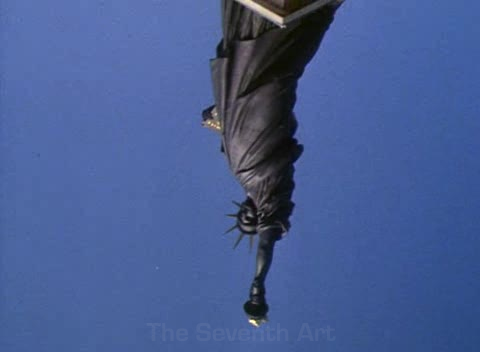
FranticOf course, the last half-hour of Frantic is a significant failure. For one, it contradicts the themes set up so far in the film. While, till now, Walker’s pride and smugness was stripped off layer by layer and his own powerlessness pointed out to him endlessly, the last half an hour restores his original status as an American Hero who can penetrate any setup and rescue anyone. What had been a nightmare till now (Ennio Morricone’s surreal score deserves applause) turns into a dream where every move of Walker’s turns out right and with expected consequences. There might be a reason to this incoherence. Polanski was apparently forced to cut 15 minutes of the film and change the ending (note that Polanski was considered washed out by now). I hear, from a not-so-reliable source, that in the original ending that Polanski wrote, Sondra turns out to be a double agent herself. This twist ending would have served two purposes. First, it would have made a political statement, although superficial, about America’s involvement in the Israel-Palestine conflict (The nuclear detonator is concealed inside the miniature Statue of Liberty; the film was made during the Reagan era). Also, it would have been the final blow to Walker’s ego. His worst fear – that his wife is with someone else and that he is not competent enough for her fantasies – would have come true.

The studio’s intervention is telling. By having Richard plan and win the climactic showdown and save his wife heroically, the studio’s move only reinforces the glory of American conservatism that the film had hitherto satirized (Surely, the Walkers are conservatives.  The Statue of Liberty a visual motif in the film. Richard mentions that they don’t vote anymore. Polanski and Brach don’t even give them token liberal statements to make). The Statue of Liberty which had till now been tossed around stands upright as the Walkers reunite. Additionally, the studio’s cut reestablishes the patriarchal structure of the Walker family that was threatened by the situation (It is only Richard who gets to give orders to his children). The whole point of the film is potentially undermined by the studio’s decision. Polanski would make amends for this blunder with his next film, Bitter Moon (1992), where too a couple plans to travel to the exotic east and rekindle their lost love. If the quintessential hero figure of Harrison Ford was the equivalent of Hitchcock’s Cary Grant, the stammering, insecure Hugh Grant would be that of James Stewart. In Bitter Moon, Nigel (Hugh Grant) ventures away from the boredom of his marriage and into his own erotic fantasy without a clue that he is still far from his wife’s. Polanski both brings down the last shred of esteem in the male character and the patriarchy that he embodies with the twist at the end (which is the kind of device that he seems to have had in mind for Frantic). Polanski, cleverly, even throws in gratuitous amounts of nudity, possibly, to appease the studio.

Interestingly, there is another film that achieves what Polanski’s film unfortunately doesn’t. Of course, Alfred Hitchcock’s Vertigo serves as the inspiration for Frantic, with the male fantasy being destroyed and chastised by the mysterious woman he seeks. And perhaps David Lynch’s Lost Highway (1997), which I’ve not seen, deals with the same thing too. But Frantic is remarkably similar to Kubrick’s final film, Eyes Wide Shut (1999). Kubrick’s film has often been compared to Polanski’s The Ninth Gate (1999) because both films deal with secret societies and strange rituals. Kubrick’s film is, in fact, closer to Frantic than The Ninth Gate, in which Polanski was eyeing something else altogether. In Eyes Wide Shut, Tom Cruise plays Dr. Bill Harford (Richard Walker in Frantic is also a doctor and Harford is an acronym for Harrison Ford!) who is nudged into a cat and mouse game of pursuing his wife’s fantasies and trying to build his own. Tom Cruise is the direct successor, in some ways, to Harrison Ford. Both are the icons of the confident, self-assured man in Hollywood. No one would imagine the existence of a weak, possessive and insecure person beneath their flawless exteriors. Had Polanski made his film a decade later, my guess is that he would have most definitely cast Tom Cruise in the lead role. While Polanski’s planned ending stops at the male’s disillusionment, the destruction of his dream and his subsequent return to harsh reality, Kubrick goes one step further and proposes what might be done for reconciliation.

Sharunas Bartas

Sharunas Bartas 
(1964-)

Lithuanian film director, one of the most outstanding representatives of cinematographers. His contacts with cinema began in 1985 with the TV serial “Sixteen-years-olds” (dir. Raimondas Banionis), where Bartas played one of the main roles. He is a graduate of the Moscow Film School (VGIK). He made his directorial debut with his diploma film, the short documentary “Tofolaria” and mediocre-length film (which called spectators’ attention) “For the Remembrance of Last Day” (1989), where the real personages are “acting themselves” according to the principles of feature film. The author further “purified” the specific cinema language in the full-length film “Three Days” (1991), which was awarded the prize of oicumene committee at Berlin Film Festival (for the problems, the importance of the theme, the profundity) in 1992, and FIPRESCI Prize for the originality of the style, the significance of the theme, the beauty of pictures. This is a story (almost without plot) about three young Lithuanians visiting Kaliningrad-Karaliautchus-Kionigsberg – a moribund, outraged town. The traditional dramaturgy is ignored in later Bartas’ films, as well: “The Corridor” (1994, it was shown at Berlin Film Festival), “Few of Us ” (1995, shown in Cannes, in the program “Other Point”), “Home” (1997, shown in the same program in Cannes). All of them are works of free structure, minimalistic form, philosophical associations. The works of Bartas are not well-known and analysed in Lithuania, but they have a small, faithful round of admirers in the West. (Bio Courtesy: The Auteurs, Image courtesy: Wikipedia)


Lithuanian auteur Sharunas Bartas is the kind of filmmaker one would immediately be tempted to label “pretentious” and “self-indulgent” because there is absolutely no concession whatsoever that he gives to the viewers in terms of the narrative, artistic, political and personal ambitions of his films, burying them deeply within their part-hyper real and part-surreal constructs. All his films have hinged themselves onto a particular moment in Lithuanian history – the nation’s independence from the USSR, just prior to the latter’s complete collapse – and they all deal with the loss of communication, the seeming impossibility of true love to flourish and the sense of pointlessness that the political separation has imparted to its people. The characters in Bartas’ films are ones that attempt in vain to put the dreadful past behind them, traverse through the difficult present and get onto a future that may or may not exist. With communication having been deemed useless, they hardly speak anything and, even if they do, the talk is restricted to banal everyday expressions.  Consequently, Bartas’ films have little or no dialog and rely almost entirely on Bressonian sound design consisting mostly of natural sounds. Also Bresson-like is the acting in the films. There are no expressions conveyed by the actors, no giveaway gestures and no easy outlet for emotions.

The outdoor spaces are deep and vast in Bartas’ films while the indoors are dark, decrepit and decaying. The landscapes, desolate, usually glacial, nearly boundless and seemingly inhospitable, are almost always used as metaphors for a larger scheme. His compositions are often diagonal, dimly lit and simultaneously embody static and dynamic components within a single frame. Interestingly, his editing is large Eisensteinian and he keeps juxtaposing people, their faces and landscapes throughout his filmography. But since the individual images themselves possess much ambiguity of meaning, the sequences retains their own, thereby overcoming the limitations of associative montage. Another eccentric facet in Bartas’ work is the amazing amount of critters found in his films. There are puppies, kitten, frogs, seagulls and flies seen around and over his characters regularly. May be, not considering the specific connotations that these creatures bring to these scenes, the intention is Eisensteinian here too – to indicate that the characters have been reduced to a level lower than these beings, unable to either communicate with each other or be at peace with nature, devoid of the notions of nationality and politics.

In many ways, the cinema of Bartas stands in between that of Andrei Tarkovsky and Béla Tarr – both filmmakers concerned with chronicling life in a communist state. While the childhood memories, existential crisis and spiritual yearning in Bartas films directly has its roots in Tarkovsky’s films (all the films starting from The Mirror (1975)), the visual (dancing in entrapping circles, meaningless glances and chatter over banquets and eventual self-destruction of the drifting characters) and aural (the Mihály Vig-like loopy and creepy score consisting of accordions, accentuated ambient noise) motifs, stark cinematography and political exploration are reminiscent of Bartas’ Hungarian contemporary. But, more importantly, it is the attitude towards his characters that puts him right in midpoint between Tarr and Tarkovsky. Bartas’ work has so far been characterized by two impulses – a warm nostalgia and sympathy for his characters that betrays the director’s hope and love for them, as in Tarkovsky’s cinema, and an overpowering cynicism, clearly derived from the (post-neo-realist) films of Tarr, that keeps remarking how the characters are all doomed and done for. This (unbalanced) dialectic is evident in Bartas aesthetic itself, which employs copious amounts of extremely long shots and suffocating close-ups. In the former, characters are seen walking from near the camera and into the screen, gradually becoming point objects eaten up by the landscape while, in the latter, Bartas films every line and texture of their faces with utmost intensity in a way that obviously shows that he cares for them and the pain that they might be experiencing. This conversation between optimism and pessimism towards his people also places him alongside the Armenian filmmaker Artavazd Peleshian – another historian of traumatized lives in a Soviet state before and after independence.


Praejusios Dienos Atminimui (In Memory Of The Day Passed By, 1990)

In Memory of the Day Passed ByOne of the finest films by Sharunas Bartas, In Memory of the Day Passed By (1990) is a somber, evocative mood piece set in post-independence Lithuania and opens with the image of large flakes of snow moving slowly along a river. This is followed by a shot of a woman and her kid walking on a vast, snowy plain and moving away from the viewer until they become nonentities assimilated by their landscape. This pair of shots provides a very good synopsis of what Bartas’ cinema is all about. The rest of the film presents us vignettes from the daily life of the people living in the unnamed city, possibly Vilnius, and from the garbage dump outside it. One of them presents a tramp-like puppeteer wandering the streets of the city without any apparent destination. Like the puppet that he holds, the people around him seem as if their purpose of living has been nullified, now that the national strings that had held and manipulated them so far have been severed. Consequently, there are many shots that deal with religion and the intense Faith that these people seem to be having, perhaps suggesting a yearning for the replacement of a superior power that guides them. Bartas suffuses the film with diagonal compositions indicative of a fallen world – a world that can go nowhere but the abyss. Appropriately, the film closes with a variation of its opening image: flakes of snow flowing downriver – an apt metaphor for the many nations that would drift without a base after the disintegration of the Soviet Union.

Trys Dienos (Three Days, 1991)

Three DaysThree Days (1991), Bartas’ maiden feature length work, unfolds in a harbor town in Lithuania where two men and a women search for a shelter in the largely uncaring place, possibly to make love. The first Bartas film to feature his would-be collaborator (and muse) Yekaterina Golubeva, Three Days plays out as a post-apocalyptic tale set in an industrial wasteland, complete with decrepit structures and murky waters, where both positive communication (Even the meager amount of dialogue in the film turns out to be purely functional) and meaningful relationships (Almost everyone in the film seems to be a vagrant) have been rendered irrelevant. Every person in this desolate land seems to be an individual island, stuck at a particular time in history forever. The visual palette (akin to the bleached out scheme of the director’s previous work) is dominated by earthy colours, especially brown, and the production design is highly redolent of Tarkovsky’s Stalker (1979). The actors are all Bressonian here and do no more than move about in seemingly random directions and perform mundane, everyday actions. Like in Bresson’s films, there is no psychological inquiry into the characters’ behaviour and yet there is much pathos and poignancy that is developed thanks to the austerity of Bartas’ direction and the intensity of Vladas Naudzius’ cinematography. The film is titled Three Days, but it could well have been titled ‘three months’, ‘three years’ or even ‘eternity’ for, in the film, all time is one, the notion of future nonextant and hope for escape futile.

Koridorius (The Corridor, 1994)

The CorridorIf Three Days presented people stuck in time and moving aimlessly through desolate landscapes, The Corridor (1994) gives us ones stuck geographically and drifting through abstract time. Bartas’ most opaque and affecting film to date, The Corridor is a moody, meditative essay set at a time just after the independence of Lithuania from the USSR and in a claustrophobic apartment somewhere in Vilnius in which the titular corridor forms the zone through which the residents of the building must pass in order to meet each other. Extremely well shot in harsh monochrome, the interiors of the apartment resemble some sort of a void, a limbo for lost souls if you will, from which there seems to be no way out. Consisting mostly of evocatively lit, melancholy faces that seem like waiting for a miracle to take them out of this suffocating space, The Corridor also presents sequences shot in cinema vérité fashion where we see the residents drinking and dancing in the common kitchen. Of course, there is also the typical central character, played by Sharunas Bartas himself, who seems to be unable to partake in the merriment. Conventional chronology is ruptured and reality and memory merge as Bartas cuts back and forth between the adolescent chronicles of the protagonist, marked by rebellion and sexual awakening, and his present entrapped self, unable to comprehend what this new found ‘freedom’ means. Essentially an elegy about the loss of a sense of ‘being’ and ‘purpose’, The Corridor remains an important film that earns a spot alongside seminal and thematically kindred works such as Paradjanov’s The Color of Pomegranates (1968) and Tarkovsky’s The Mirror (1975).

Few Of Us (1996)

Few of UsFew of Us (1996) is perhaps the least political of the already highly noncommittal works of Sharunas Bartas. Not that this film does not base itself strongly on the political situation in Lithuania, but that the now-intimate backdrop of independent Lithuania is transposed onto a remote foothill in Siberia where a tribe called the Tolofars maintains a spartan life style. It is into this rugged, almost otherworldly land that the beautiful protagonist of the film (Yekaterina Golubeva) is air-dropped like an angel being relegated to the netherworld. She seems as isolated from the people of this land as the Tolofars are from the rest of the world. However, as indicated by the incessant cross cutting between the worn out terrain of the village and the contours on Golubeva’s face, this mysterious, hostile and unforgiving landscape is as much a protagonist of Bartas’ film as Golubeva is. With an eye for small and intricate changes in seasons, terrains and time of the day comparable to that of James Benning, Bartas pushes his own envelope as he lingers on eyes, faces and landscapes for seemingly interminable stretches of time. Each image of the film carries with itself an air of a still paining, vaguely familiar. All this sure does bring to surface the experimental and, I daresay, self-conscious nature of Bartas’ work, but what it also does is familiarize us with the hitherto alien and draw connection between this abstract representation of protagonist’s cultural disconnection in Tolofaria and the typical Bartas territory of desolate, directionless lives lead by the people of post-Soviet Lithuania.

A Casa (The House, 1997)

The HouseThe House (1997) opens to the image of a mansion as the narrator reads a confessional letter written to his mother about their inability to communicate with each other. The house and mother are, of course, metaphors for the motherland that would be explored in the two hours that follow. It seems to me that The House is the film that Bartas finally comes to terms with the trauma dealt by the country’s recent past that he has consistently expressed in his work. Consequently, the film also seems like a summation of the director’s previous films (One could say that the characters from Bartas’ previous films reprise their roles here) and a melting pot of all the Tarkovsky influences that have characterized his work (especially the last four fictional works of the Russian). Shot almost entirely indoors, The House follows a young man carrying a pile of books as me moves from one room of the Marienbad-like mansion to the other, meeting various men and women, none of whom speak to each other and who might be real people of flesh and blood, shards of memory or figments of fantasy. The house itself might be an abstract space, as in The Corridor, representing the protagonist’s mind with its spatial configuration disoriented like the chessboard in the film. Furthermore, one also gets the feeling that Bartas is attempting to resolve the question of theory versus practice – cold cynicism versus warm optimism – with regards to his politics as we witness the protagonist finally burn the books, page by page, he had so far held tightly to his chest.

Freedom (2000)

FreedomSharunas Bartas’ chef-d’oeuvre and his most accessible work to date, Freedom (2000) is also one of the most pertinent films of the past decade. Taking off from the wandering trio setup of Three Days, Freedom begins with a chase scene right out of genre cinema transposed onto Bartas’ highly de-dramatized canvas. The two men and women seem to be illegal immigrants who are on the coast guard’s wanted list. If The House was national politics distilled into a claustrophobic setting, Freedom is the same being set in seemingly limitless open spaces. The most rigorous of all Bartas films, Freedom is the kind of film Tarkovsky might have made had he lived to see the new century. Like the Russian’s characters, the people in this film are all marginal characters (and are often aptly pushed from the centre of the frame towards its margins) who want to escape the oppressive, unfair politics of this world and become one with nature and the unassailable peace it seems to possess. Alas, like in Blissfully Yours (2002), they are unable to depoliticize their world and start anew. The tyrannical past is catching up with them, the present is at a stalemate and is rotting and there is no sight of the future anywhere. Bartas expands the scope of his usual investigation and deals with a plethora of themes including the artificiality and fickleness of national boundaries, the barriers that lingual and geographical differences create between people and the ultimate impermanence of these barriers and the people affected by it in this visually breathtaking masterwork.

Septyni Nematomi Zmones (Seven Invisible Men, 2005)

Seven Invisible MenThe most unusual of all Bartas films, the pre-apocalyptic Seven Invisible Men (2005) starts off like a genre movie – a bunch of robbers trying to evade the police after stealing and selling off a car. It is only after about half an hour, when one of them arrives at a farm that is near completely severed from the rest of the world, that the film moves into the world of Bartas. Seven Invisible Men is the most talkative, most rapidly edited and the most politically concrete of all the films by the director and that may precisely be the idea – to serve as a counterpoint to all the previous movies. All though there is too much talk in the film, rarely do they amount to meaningful conversations, bringing the characters back to the hopelessness of the director’s earlier works.  Like Freedom, all the characters here are people living on the fringes of the society – con men and ethnic and religious minorities – who seem to have sequestered themselves with this settlement of theirs. All these characters seem to be trying to escape their agonizing past and the politics of the world that seems to give them no leeway in order to start afresh (The heist may have been the last attempt at escape), in vain. In the final few minutes that recall Tarkovsky’s The Sacrifice (1986), we see the house, in which the characters have been living in, burn down to dust. But, unlike Tarkovsky, it is Bartas’ cynicism that overwhelms and he sees his characters as ultimately self-destructive beings that have lost all control of their lives and hope for a better future.

Indigène d’Eurasie (Eastern Drift, 2010)

Eastern DriftThe trajectory of Bartas’ filmography, in a sense, runs anti-parallel to that of Béla Tarr, with whom the former shares a number of artistic, political and philosophical inclinations, and has moved from extreme stylization to rough-hewn naturalism, from near-total narrative abstraction to flirtation with generic structures, from semi-autobiographical meditations set against the backdrop of Soviet collapse to highly materialist tales of marginal lives in the Eurozone. (In fact, one could say that the exact tipping point occurs at Freedom.) Eastern Drift finds the filmmaker moving one step closer to conventional aesthetic as well as dramatic construction and follows Gena (Bartas himself), who is on the run after he knocks off his Russian boss after an altercation over a hefty sum of money. Even though the film has the appearance of a Euro-thriller, with the protagonist hopping from one major city of the continent to another, each of which regularly gets its token establishment shot (and all of which look very similar for the untrained eye), it actually moves against the grain the sub-genre. Unlike the traditional European action picture, in Eastern Drift movement – the prime action over which the narrative is founded – itself is problematized. A large part of the proceedings is made up of Gena trying to sneak in and out of buildings as well as countries and finding himself thwarted at almost every move. An antithesis to the utopianism of Eurozone and its myth of intra-continental mobility, Eastern Drift crystallizes and futhers Bartas’ preoccupation with suffocating national borders, although the scenario over which he builds his argument remains moot.

[“Children Lose Nothing” – Sharunas Bartas’ segment in Visions of Europe (2004)]

(Continued from Part 1)

Shijie (The World, 2004)

The WorldIf there is a film that perfectly sums up the state and outlook of the third world in the first decade of the new century, it has to be Jia Zhang-Ke’s The World (2004), first of the director’s film to be made with official consent. The very premise and setting of the film – a bunch of youngsters working a world park where you can witness life-size replicas of wonders from across the world – provide us with the various undercurrents that characterize the film without being ostentatious. Much like the previous Jia films, the people in The World are terribly out of sync with the environment surrounding them. This is a land where the terrible distances of the real world are pruned down to a few miles, yet the distance between individuals has increased manifold (The cramped and decrepit dressing rooms provide a counterpoint to the grandeur of the park’s front end). This is a zone which enables one to fulfill one’s desire to escape into a whole new world, yet one has to lose every shred of his/her individuality to do so (One of the early shots shows us a bunch of uniformed workers who don’t appear much different from the props they are carrying). This idea of one’s identity being stripped off, layer by layer, is built into the whole structure of the film. Dialects are normalized, costumes are changed by the minute and passports are confiscated. One of the characters towards the end tells: “It’s nice being in someone else’s home” – a delusion that seems to be common to all the residents of this synthetic world.

Sanxia Haoren (Still Life, 2006)

Still LifeStill Life (2006), which might be the best film by Jia Zhang-Ke yet, presents two stories sewn together thematically and temporally by two significant pan-and-cut shots. The first of them presents a coal miner, Sanming, from rural China moving to Three Gorges to meet his wife after 17 years and the second one gives us a young woman, Shen Hong, traveling to the same place to meet her husband whom she hasn’t seen for 2 years. Using these two threads connected by the China’s Three Gorges Dam project, Jia examines both the disparities, including that of class (Sanming works at the bottom of the rung while Shen Hong’s husband supervises the project), generation (Sanming’s traditional values are pitted against Shen Hong’s strength and resilience) and gender (Sanming and Shen Hong can be seen as the antithesis to each other’s spouses), and the commonalities that characterize the two different worlds that Sanming and Shen Hong inhabit. The prime motif that permeates Still Life is the destruction of the old and the birth of the new. Sanming yearns to return to the past while Shen Hong runs away from it. Residences are cleared to make way for the dam. English language shows its head regularly. And songs about eternal love play on the soundtrack ironically. Lastly, Jia’s film is also a paean to the marvels of the human body – the body that can create and destroy structures much, much larger than it, the body that is ultimately rendered inconsequential (as underscored by Jia’s striking compositions of man constantly being loaded down by the weight of his own creations) by the national importance of the structures themselves.

Dong (2006)

DongMade as a companion piece to the superior film Still Life, much of whose footage it shares, Dong (2006) sits somewhere alongside The Mystery of Picasso (1956) and The Quince Tree Sun (1992) in the way the director uses another artist – a painter, as is the case with the other two films – to examine the nature of his own work. Dong follows actor and painter Liu Xiao-Dong (who makes a brief appearance in The World) as he completes two of his five-piece paintings – one at the Three Gorges Dam construction site and the other in Bangkok, Thailand. Like Jia, Liu is a realist. Even he prefers to document his subjects from a distance as it provides him “better control and precision”. But when one of his subjects dies in an accident, all he can do is patronize the deceased person’s kids. Is Jia reflecting on the purpose of his own work? Perhaps. Although I believe that there has been an indictment of patriarchy, especially its presence in art, throughout Jia’s body of work, it is most manifest in Dong. In the first segment, Liu admires the body of his naked male models and paints them with utmost enthusiasm while, in Bangkok, he calls his models as “scantily-clad women” and completes his work somewhat dispassionately. We then notice that he is in an alien land not just in geographical terms. Again, it would not be an overstretch to consider much of this satire as self-criticism, given that Jia himself has been unrestrained in marveling the male body in his work, specifically in Still Life.

Wuyong (Useless, 2007)

UselessUseless (2007) could be considered as a logical extension of Still Life and Dong because it deals with a number of ideas common to those two films. Divided into three segments each of which takes up a unique perspective of the Chinese textile industry, Useless is a dense, meditative essay on production, consumption and function of art. It’s hard not to think of the film as an attempt by Jia to discover his responsibility as an artist and to locate himself within the cinema of his country. Throughout the film there is a battle between aesthetic and functionality of art – a struggle that seeps even into the film’s form – that is manifest in the segments involving mass depersonalized production, custom “auteurist” design catering to the west and smalltime tailoring to suit individual needs. However, Jia’s film does not take a pre-determined stance and shares our indecisiveness. The very fact that the director chooses “impersonal” high-def over the intimacy of film illustrates the complexity underlying the question. Furthermore, Jia’s film also examines the chasm that exists between the oriental and western perceptions of beauty and art. What is a fact of life in China – soiled bodies, dirty and worn out clothes – is considered an exotic, delicately assembled work of art in the west. Female nudity is commonplace in western art whereas male nudity takes its place in the oriental counterpart. When Jia pans his camera over female models getting ready for a show at Paris Fashion Week, one is reminded of the opening shot of Still Life where Jia’s male models sit unclothed in a boat, ready for their performance in the film.

Er Shi Si Cheng Ji (24 City, 2008)

In 24 City (2008), the latest of Jia’s great works, the director interviews several people all of whom are connected in some way to the prestigious aircraft manufacturing site, Factory-420, in Chengdu city that is now being torn down to make way for a residential complex. What Platform does in the present tense, 24 City does in the past. Each of these accounts so clearly elucidates what is essentially positive and what is not about life in a communist regime. The sheer joy of living as a symbiotic community seems to be counterbalanced by a tendency of individual wishes getting overridden by collective objectives. Throughout, these testimonies effortlessly present how, once, personal tragedies were invariably connected to national decisions and how an individual was able to define himself only with respect to his community (One character even clarifies her name using a city as reference). Furthermore, these accounts also give a vivid picture of the depersonalized and dehumanized way of work at the same factory after China’s cultural reforms in the late seventies. Jia juxtaposes images of the factory being destroyed with the faces of his subjects suggesting the demise of a wholly different way of life and thought. But all is not so sweetly nostalgic about Jia’s film. The set of interviewees consists of a mixture of people who’ve actually been through what they say and actors enacting such people. Are these accounts the absolute truth or are they the comfortable versions of the past concocted by memory with the passage of time? How much of an actor is there in each of these people? Jia, never ever cynical, is content in playing the Godard-ish ethnographer. Brilliant.

Heshang Aiqing (Cry Me A River, 2008)

Cry Me A RiverPicture Jia repenting for not being completely nostalgic in 24 City and deciding to assuage that guilt with a purely fictional feature. The 20-minute short Cry Me A River (2008) is just that. A group of middle class friends, well in their thirties, meet up, have dinner with one of their professors and talk in pairs about how their lives have been after they went their own ways. This must be the first time Jia is working within the tepid confines of a genre and he does remarkably well to leave his signature all over. But it is also true that Jia is one of the few directors who truly deserve a picture in this genre, given the consistency with which he has dealt with the theme of cultural transition in his films. Wang Hong Wei and Zhao Tao seem to be almost reprising their roles from Platform, which gives the film a touch of autobiographic authenticity, considering how often the director has used former actor as his alter ego. We are far from the sweet old days of Platform where the very sight of a train was rare. It’s now a matter of a few hours crossing the whole of China. As the professor and the students have their dinner, two actors in traditional theater costume perform at the restaurant with a huge bridge as the backdrop. Two characters travel on a boat in a river whose banks are adorned by old buildings, reminiscing and confessing how much they still love each other. They are, of course, going down the river of time with a clear knowledge that they can’t reverse its flow.

Hai Shang Chuan Qi (I Wish I Knew, 2010)

I Wish I KnewA project commissioned by the state in view of the upcoming Shanghai World Expo, Jia Zhang-ke’s I Wish I Knew (2010) is a thematic extension of 24 City and is much more freely structured and much broader in scope compared to its predecessor. The larger part of the film presents interviews with older residents of Shanghai (along with those of Taiwan and Hong Kong) who gleefully recollect their family’s history, which reveal the ever-growing chasm between the city’s past and present. Personal histories seem to be based on and shaped by the city’s tumultuous politics and culture. We see that the people being talked about were viewed as mere ideological symbols incapable of erring or transforming. In addition to his employment of mirrors and reflective surfaces suggesting both documentation and subjectivity, Jia films the interviewees in extremely shallow focus as if pointing out their being cut off from the present (It takes them the sound of breaking glass or the ring of a cellphone snap back to reality). This tendency is contrasted with the final few interviews of younger people where we witness how life can change course so quickly and how one can assume multiple social personalities on whim and float about like free entities. Losing one’s sense of existence in a particular environment is perhaps not a big price to pay after all for the seeming freedom of choice it gives. One’s history is no longer defined by one’s geographical location. One is no longer bound by dialectical ideologies. There is apparently no influence of the past on the present, in every sphere of life, whatsoever. Mistakes of the past are obscured by the glory of the present and the loss of values, by cries of progress. Jia’s view of the city is, against our wishes for a disapproving perspective, neither nostalgic nor rosy. It’s holistic.


[“Black Breakfast” – Jia Zhang-Ke’s segment in Stories on Human Rights (2008)]

Jia Zhang-Ke

Jia Zhang-Ke 
(1970-)

Born in 1970 (Fengyang, Shanxi Province), Jia Zhangke studied painting, developed an interest in fiction, and in 1995 founded the Youth Experimental Film Group, for which he directed two award-winning videos. He graduated in 1997 from the Beijing Film Academy, and his first feature, Xiao Wu (1998) was very successful at the Berlin, Nantes and Vancouver festivals. The following films Zhantai (Platform, 2000), and Ren xiao yao (Unknown Pleasures, 2002) were selected in competition respectively at Venice and Cannes. He established Xstream Pictures in 2003 in order to promote young talented directors from all over China. He directed Shijie (The World) in 2004 and his latest film Sanxia haoren (Still Life) received the Golden Lion Award at the Venice Film Festival 2006. (Bio Courtesy: Cannes Festival, Image courtesy: Glamour Vanity)


“Juxtaposing a person with an environment that is boundless, collating him with a countless number of people passing by close to him and far away, relating a person to the whole world, that is the meaning of cinema.”

– Andrei Tarkovsky


If the filmography of Jia Zhang-Ke is to be summed up in a single line, it has to be the above statement. Along with Apichatpong Weerasethakul, Jia appears to be the pick of the past decade and has made his way into almost every best-of-the-decade list out there. With a body of work that spans only a decade and a half, the Chinese has already authored at least four great works that clearly illustrate the director’s consistency of vision and his command of the filmic medium. What sets Jia apart from his contemporaries like Tsai Ming-Liang and Hou Hsiao-Hsien is the narrative and thematic specificity that pervades the whole body of his work. While the latter directors have sometimes de-contextualized their narratives and resorted to broad strokes in order to, perhaps, deliberately universalize the issues they are dealing with, Jia almost always particularizes. It is true that, like the other two senior directors, Jia keeps coming back to the same set of motifs and questions, but there is always a thread that runs through his films alongside these investigations that examines his own role and responsibility as a Chinese, as a filmmaker and as a Chinese filmmaker.

Jia seems to have established his signature aesthetic very early on in his career. Even in an early and relatively minor work like Pickpocket (1997), one can see that Jia, like Tsai and Hou, favours long shots, filmed from at a distance, and uses direct sound to wondrous effect. Then there is the trademark pan shot, which Jia treats like a brush running over a very wide canvas woven in time, whose use only proliferates with the years. Jia employs this pan shot to often depict people separated by space and time and the relationship they bear with the environment they live in. This unhurried, evocative shot directly ties Jia’s cinema to those of Tarr, Wenders, Polanski, Tarkovsky and Angelopoulos, the last of whom is the filmmaker Jia seems to closest to, thematically and formally. His actors are regularly seen squatting – a primal and distinctly human gesture that distinguishes man from the artificial, industrial universe around him. Most times, his scenes unfold in the master shot itself, as Platform (2000) and The World (2004) clearly testify. When the scenes are not shot in natural light – night scenes, for instance – they are, more often than not, lit by a single light source that is present in the diegesis itself.

From In Public (2001) onwards, Jia seems to have taken a liking for the HD digital format (shot masterfully by Yu Lik Wai) that seems to impart an extra layer of realism and intimacy to the films. Additionally, the director does not hesitate to shift the tone within his films abruptly – a playful tendency that is also palpable in Weerasethakul’s films. One moment you witness a solemn, moving conversation and in the next, you see characters floating about in animated spaces or buildings lifting off the ground like rockets. Apart from this, Jia’s vertically unsymmetrical framing is redolent of Godard’s early political features and he similarly embeds his characters within images of reconstruction and modernization of the place they live in. Also Godardian is the fact that there are hardly any “empty shots” (Godard’s terminology) in Jia’s films. He never depicts an action just for the sake of carrying the story forward or supplying petty information. To borrow Godard’s example, if a man crosses a street in a Jia film, one can be sure that either the director is interested in the man’s gait and gesture or the details of the street he is walking on or, as is usually the case, the relationship between the two.


Xiao Wu (Pickpocket, 1997)

PickpocketThe only Jia film with a single protagonist that I’ve seen, Pickpocket (1997) is also the director’s most accessible film. With a script whose likes one would find in the neo-realist films of yesteryear, Pickpocket chronicles the life of the titular small-timer, Xiao Wu, played charmingly by Jia regular-to-be Wang Hong Wei, as he loiters about doing his work in the streets of Fengyang, the director’s hometown. The questions of identity and cultural dislocation, which would intensify in the filmmaker’s subsequent works, already register a strong presence in this film. Jia employs direct sound to capture ambient and stray noises of the town that suit the film perfectly. Often, Xiao Wu’s voice is overpowered by the noise from the town streets or by the blaring pop songs that flood the soundtrack, which also particularize the film’s time line, suggesting the beginning of China’s globalization process. The soundtrack is complemented by the seeming omnipresence of the local television network that seems to either intrude into people’s private affairs or feed people with more dollops of pop culture. Xiao Wu is the quintessential Jia character, a flawed individual who has failed to catch up with the changing times (while all his colleagues have successfully boarded the train) and, as a result, pays the price. It is only after he (literally) sheds his old attire and learns to sing pop songs that he somewhat feels he is a part of his surroundings. As he sits arrested to an electric pole at the end, with the townsfolk staring at him curiously, one only thinks of the inevitability of this outcome. Forget the train, Xiao Wu hadn’t even got on to the platform.

Zhantai (Platform, 2000)

PlatformPlatfrom (2000), widely regarded as the director’s finest film, opens with a theatre performance that extols Mao’s communist revolution, setting up the theatre motif that permeates the entire film. Set at a time when China’s globalization measures were put into action, Platform is an epic film that actually gives the viewer the feeling of being there and drifting along with this endearing team of travelling players that stands for a whole generation – that of Jia’s – struggling to cope up with the drastic cultural transition that the measures have induced. That Jia sets the film in his hometown of Fengyang is of much importance because, according to Jia himself, it is one of China’s many towns that is far removed from the decision making machinery at Beijing and merely rolls along with the impetus given by the culture shock. Jia builds his film accumulating one insightful observation upon another, taking his characters through various signposts, such as screening of foreign films, permission for pop songs and private owned apparel shops, which indicate the direction the revolution is taking the country in. Characters go into sudden flights of fantasy, as they would in later films too, and step into improvised dance sequences and on-stage performances in an attempt to transcend the stalemate they are presently in. Jia’s film is a finely balanced mixture of nostalgia, elegy, cynicism, and hope, but never does it criticize its characters for their acts. It recognizes shares their surprise and alienation, recognizing and embracing them as flawed individuals who are yet to get onto the speeding train of progress and off the platform of cultural disjunction.

Gong Gong Chang Su (In Public, 2001)

In PublicIn Public (2001), made when Zhang-Ke was scouting locations for his next film, is the most abstract of all the director’s works for it completely sacrifices a narrative for something more expressive. Running for just over half an hour, In Public is the first film by the director to be shot in digital and presents vignettes from various public places, including a railway station, a bus stop, a bus, a pool hall and a discotheque, whose images inherently bear what Jia explored in his previous two fictional features. The key sequences come towards the end, in which we see people enthusiastically participating in activities at the pool hall and at the karaoke, where the effect of China’s modernization on a remote town’s populace is most evident. Even amidst the interesting impromptu dancing lessons that are taking place in the room, Jia’s ever-curious camera (often easily spotted by the people it shoots, helmed by regular collaborator Yu Lik Wai) keeps going back to a bald man sitting on a wheel chair at one end of the room. As the camera tilts down to the chair, we see a portrait of Mao Zedong hanging from the down. If not anything else, In Public serves as a distillation of the director’s techniques with its long and medium length shots, slow pans and his discerning eye for industrial landscapes. Jia’s attention is as much on the public places as it is on the people who inhabit them. He takes equal pleasure in dwelling on an arbitrary face that attracts him and in filming people from a distance, studying their behaviour in these public spaces.

Ren Xiao Yao (Unknown Pleasures, 2002)

Unknown PleasuresIf Platform was Jia traveling along with the touring theatre and sharing their culture shock, Unknown Pleasures is the director stepping back and looking at his counterparts of the next generation. The fact is underscored with the help of Wang Hong Wei who, as usual, remains the director’s alter ego and makes a cameo appearance, playing a variant of Xiao Wu. Slightly more cynical than all other Jia films, Unknown Pleasures is also the most light-hearted of them all, betraying a love and sympathy that the director has for his characters. A couple of middle class teenagers – Bin Bin (Zhao Wei Wei) and Xiao Ji (Wu Qiong) – knock about the town without any apparent motive when one of them falls in love with the mistress, Qiao Qiao (Zhao Tao, modeled after Mia Wallace), of a local gangster. In one scene, Xiao Ji, a parody of himself, talks to her about the bank robbery in Pulp Fiction (1994). In fact, the whole film borrows much from the Tarantino film. Xiao Ji dances at the local disco with Qiao Qiao, only to get repeatedly beaten up by the gangster. He decides to rob a bank which turns out to be only marginally less funny than a Woody Allen sketch. Jia’s film apparently has China’s “single-child” policy for population control as its backdrop and Jia might just be pointing out how this has resulted in an entire generation feeding and growing up on ideas and attitudes proposed by pop culture. But, keeping in mind the director’s previous couple of works, one may conclude that Jia’s primary intention is to portray the aftermaths of a cultural shift that is just too drastic for its participants to cope up with.


(To Be Continued…)

Rope (1948)
Alfred Hitchcock
English


RopeFollowing the idyllic establishment shot of a quiet little street in Manhattan, which sets up the film’s notion of commonplaceness of evil, Alfred Hitchcock’s wonderful Rope (1948) presents us with an image from a murder that gives away the identities of both the victim and the killers. What follows is not a de-dramatized whodunit, but a taut psychological examination of the gruesome act that transcends its immediate settings. One criticism of the film that I can’t agree with is that it is too theatrical. Surely, a filmmaker with such refined cinematic sensibility as Hitchcock can never be content with merely filming a play. In fact, one could say that Rope is a seminal film that clearly defines where theatre ends and where cinema begins. Hitchcock’s rigorous framing scheme elucidates perfectly how cinema can, indeed, be more restrictive than theatre and how the fact that there lies a whole world beyond the cinematic frame can be harnessed for maximum effect. Hitchcock’s manipulation of space and his direction of the actors keep highlighting his central themes and character relationships. The shots are extremely long and fluid, giving a real sense of “being there” (not in the way those horrible shaky cams do). And, of course, there is the profundity of the text itself. Arthur Laurents’ script (in whose formation Hitch surely must have had a hand, considering how thematically consistent Rope is with the director’s filmography), probes the darkest corners of the human soul, analyzing the fascist tendencies inherent in all of us, however removed it is from our consciousness.

Sulanga Enu Pinisa (2005) (aka The Forsaken Land)
Vimukthi Jayasundara
Sinhala

“I committed no sin. I’ve always wanted to earn paradise. But I won’t die in this desert without a holy place. If you die here, you’ll be reborn as a toad or a snake.


The Forsaken LandSri Lankan filmmaker Vimukthi Jayasundara’s debut and only film to date, The Forsaken Land (2005), opens at dusk with the shot of an armed man carefully surveying a vast stretch of land, walking over it in a zigzag pattern and pausing occasionally to observe specific points on it. Following this, we see a montage of seemingly unrelated images – a hand running over a tube light, a rigid arm jutting out of a stream of water and a couple sleeping, filmed head on – that recall Weerasethakul’s films for some reason and announce the otherworldly nature of this land where the story is to unfold. The Forsaken Land embodies the quintessence of the radical, new age aesthetic known as Contemporary Contemplative Cinema with its penchant for protracted, long shots and accentuated, hyper-real direct sound (particularly the sounds of elements of nature), its keen eye for landscapes and its tendency to favour the documentation of rhythm of life and gradual changes in human behavioral patterns over construction of intricate plots and dense theoretical analyses and announces (as do most of the films employing this aesthetic) that the time for action is over and the time for reflection has indeed begun. Having been slammed by the right wing for being anti-war and, indirectly, pro-terrorist, and received threats from the ruling majority, Jayasundara hasn’t made a film since.

The Forsaken Land is set at a time when war between the Sri Lankan government and the Liberation Tigers of the Tamil Ealam (LTTE) has reached a deadlock and is at a point where either side can trigger the next phase of battles. But it becomes clear, as the film unfolds, that this abeyance of war is just an illusion of peace that will be disrupted anytime, as indicated by the threatening presence of tanks, trucks and jeeps everywhere.  The film charts the lives of six individuals living in a remote area in southern part of the country – Anura (Mahendra Perera), the lone guard at the local military outpost who goes to duty everyday to protect it from a nonextant enemy, his wife Lata (Nilupli Jeyawardena) who stays home, spending her time observing the world around her, his sister Soma (Kaushalya Fernando) who goes to work in the town nearby and who is either unmarried or has lost her spouse, his colleague, the old man Piyasiri (Hemasiri Liyanage), who seems to have a strange affinity towards the little girl Batti (Pamudika Sapurni Peiris), who may or may not be the daughter of Soma and a soldier Palitha (Saumya Liyanage), who has an affair with Lata. Not only is none of these relationships made clear, but they are also rendered irrelevant. Information is aptly given in extremely small amounts with only barebones of a story to support it.

The Forsaken LandThe first thing that one notices in the film is how sparse the locales are. There are hardly any people seen. There is no connection of the village to the world around it save for the occasional bus that takes Batti to her school and Soma to her workplace. There are no TVs, no radios or even newspapers that are seen in the film (till Soma decides to buy a radio from her salary). Anura’s house, itself, stands as the lone man-made structure in this seemingly limitless plain. Additionally, the film does not particularize the location and hence it can be assumed that Jayasundara is universalizing the conditions of his central characters. It is not only a geographical vacuum that these characters seem to be living in, but also in political, moral and cinematic vacuums, Clearly, these characters are suspended in the hiatus between two brutal civil wars, unable to settle down into a permanent life style. They amuse themselves with petty sexual games and illicit affairs while murder is not an uncommon act around here. Somehow, all the characters in the film seem to have landed smack dab in the amoral middle of the moral spectrum (Only Anura turns out to be residing in a void within this void, with a shade of positive morality within, as indicated by the final minutes of the film). Moreover, in the indoor scenes of the film (there aren’t many), Jayasundara and cinematographer Channa Deshapriya light and film these characters in such a way that they seem to live inside a black void, unable to get out and soon to be annihilated by it.

But these people also harbour a hope, in vain, of escaping this limbo. Palitha wishes that he can go north and fly a helicopter, Soma decides to move out and teach at schools in other villages and Anura criticizes Palitha for blaspheming, betraying his belief that there is a higher power that will carry him through. They even speak about reincarnations in these lands forsaken by god. But, of course, they are sucked back by the void and dragged back into the vicious circle. It’s a circle alright. Piyasiri tells Batti a story about a dwarf girl and a hunchback. Like the hunchback who destroys his own house (and later himself) to protect his vanity and keeps doing the same mistake ad infinitum, all these characters seem be going in the same enclosed path (This seems to be the very case with the civil war, in fact, where for some arbitrary ideologies, people seem to be killing each other). Like the eternal repercussions of the hunchback’s deeds, the mistakes of the past – both personal and national – seem to bear upon each of the adults in the film. Only Batti, the icon of future and posterity in the film, with her innocence and untainted morality, free of any scar from the past, offers some hope when she boards the bus out of this blasted village as the film fades to black.

The Forsaken LandAnura guarding the outpost that is far from being under threat is reminiscent of Herzog’s Signs of Life (1968), where, too, the very purpose of existence of the characters was questioned. But unlike Herzog’s protagonist who attempts to induce aggression onto the ruined, dead and harmless surroundings, the characters in Jayasundara’s film succumb to it. The sudden passivity that follows an intense period of violence seems to have thrown them out of control. But, rather than Herzog, Jayasundara’s use of landscapes to underscore the moral depravity and pointlessness of the character’s lives suggests Rossellini and Antonioni. The house the characters live in is breaking down; there are hints of death around them regularly; the characters are ironically cleansing themselves now and then as if to rid themselves of this stagnation. Why, the building that unites all the characters and is placed physically on the highest ground, as if it is a sacred monument, is, of all things, a toilet. There is an image in the film early on of Anura sitting naked, stripped of his uniform and hence his identity, within bushes holding on to his gun. This could well represent the whole idea that the film presents. What’s the use of a weapon when you are dying out there, stark naked? What’s the use of boosting your defense systems when your people are dying of hunger and cold? However, Jayasundara’s film, although a maiden work, rarely lends itself to such propagandistic statements and, instead, lets us discover what it is like to be out there.

Godard once remarked that the best film on Auschwitz is one that unfolds in the house of one of the prison guards. Jayasundara’s film comes very close to that. It is more interested in what the war has done than the war itself. The focus of the film is the indelible scars a war leaves on its land and its people. The people in The Forsaken Land are those who have not been able to get rid of the inertia of fear and instability triggered by the war. They have resorted to nihilism, indulging themselves in superficial relationships and casual sex, perhaps in a belief that this state of peace is only transitory and there is no escape from the war. Like the fortunate turtle, which Batti finds, that escapes the claws of the vulture for a brief period of time, like that fish out of water waiting for the rain to pull it back into its routine, these people are merely waiting for fate to sweep them along and out of this limbo. And Jayasundara’s film proficiently shows us how such a precarious situation can prompt a human being to shed all the values he/she holds dear. By actually presenting the insanity that happens during a period of ceasefire, in the form of tortures and custody killings, as grotesque, brutal and indigestible, Jayasundara’s film indirectly questions the absurdity of justifying the very same routines during the war as acts of glory and honour.

Zamani Barayé Masti Asbha (2000) (aka A Time For Drunken Horses)
Bahman Ghobadi
Farsi/Kurdish


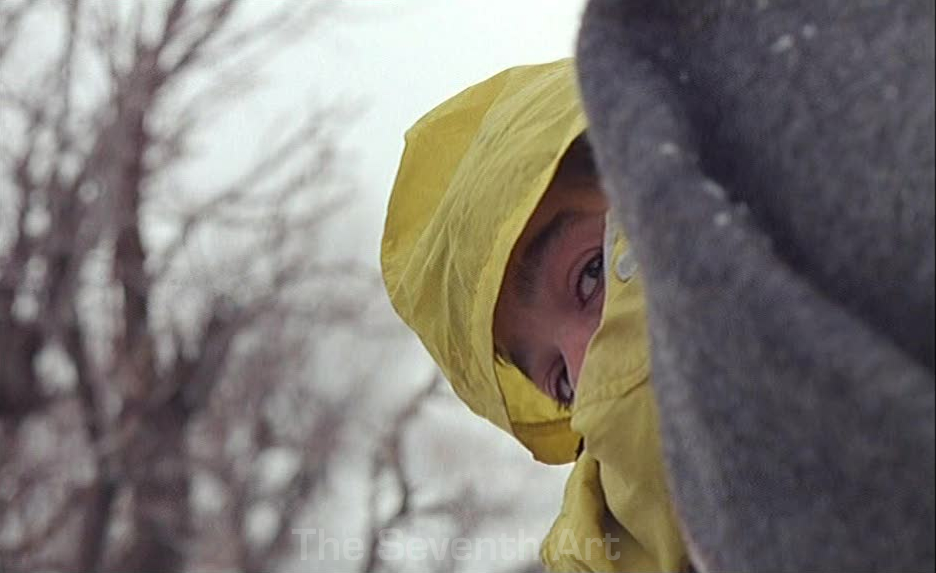
A Time For Drunken HorsesThe pacific snows of wintertime Kurdistan belie the despair and brutality that simmers underneath. This is a world where adults indulge in fist fights over daily wages while children make the most enormous of sacrifices to protect each other. A zone where a mule, a child and a girl are pretty much interchangeable assets. Straddling these awkwardly defined worlds of childhood and adulthood is Madi (Madi Ekhtiar-dini), a teenager whose physical disability renders him no stronger than a three-year old, and his brother and his sisters who intend to take him across the borders, into Iraq, to have him operated. These are motherless children who have just lost their father in a land mine accident, make a living by smuggling goods across the border and, yet, go to school in a subconscious belief that education will save them someday. Although not as unnerving as the director’s nearly otherworldly Turtles Can Fly (2004) or as lighthearted as Marooned in Iraq (2002), Bahman Ghobadi’s A Time for Drunken Horses (2000) still remains a stark portrait of the life and times in a war-torn land where danger lurks at every step, literally. Ghobadi’s is the kind of film that Zavattini, De Sica and Rossellini would give a standing ovation to. Favoring long shots and shooting on-location (which happens to be the director’s homeland), Ghobadi strikingly integrates his protagonists into their surroundings in a manner that highlights what the tiny, tender beings are up against. Despite that, one can’t help but accept all those adages about the artificiality of borders and the invincibility of the human spirit, when, finally, the little boy cuts through the national fence and leads his drunken horse, carrying Madi, towards redemption, perhaps.

(Continued from part 1/2)

Hao Nan Hao Nu (Good Men, Good Women, 1995)

Good Men, Good WomenGood Men, Good Women (1995), the final part in Hou’s trilogy on Taiwanese history, could well be considered as the first in a series of highly experimental films by Hou Hsiao-hsien. Dividing the film into two time lines – one set in the Chiang Kai-Shek era of White Terror and the other in contemporary Taiwan – Hou investigates both the unifying spirit and the chasms that exist between the nation’s past, present and future. A lonesome actress Liang Ching (Annie Shizuka Inoh) is to play the role of Chiang Bi-Yu, a Taiwanese resistance fighter from the 1940’s. Ching’s confrontation with the painful history of her nation coincides with a confrontation with her own dark past, where we learn about her stint as a bar host and her affair with a man named Ah-Wei (Jack Kao), whose murder she becomes an accomplice to, for three million bucks. The betrayal of a group of loyal partisans by the very side it wished to fight for serves as an agonizing reminder of her betrayal of a man who loved and trusted her. Hou’s highly stylized direction cuts back and forth between the scenes from the past that use soft, black and white footage and those from the present, shot in a bland colour stock, both of which mingle at one point, pointedly suggesting the marriage of collective and personal histories that gives a not-so-rosy picture of the future. Good Men, Good Women is a transitional film for Hou in the way it acts as a bridge between the idea of inseparability of past and present indicated by The Puppetmaster (1993) and that of absolute isolation of the two from each other that characterizes Goodbye South, Goodbye (1996).

Nan Guo Zai Jian, Nan Guo (Goodbye South, Goodbye, 1996)

Goodbye South, GoodbyeWith Goodbye South, Goodbye (1996), Hou seems to have bid farewell to narrative cinema for good. It is safe to declare that absolutely nothing happens in the film, for right from the first shot of the film, where we witness a bunch of blasé youngsters sitting in a train and one of them losing signal on his cellular phone, to the last one where a car carrying those people crashes to a standstill, there is simply no indication that the vicious circle that the characters are treading on will break some day. Neither their choices nor their actions seem to make any difference to the drug-addicted, gamble-driven, aimless and nihilistic lives they seem to be leading. They live for the moment, without a shred of consideration for the consequences or causes of their present actions (They open a restaurant where they end up telling the customers what they should eat!). With an absurdly exaggerated colour scheme, consisting mostly of primary colours, Hou builds the film as a string of moments, each rife with dark, brutal humour (“Did she slit her wrists again?”), that gradually reveal how a whole generation is living with neither an apparent memory of the past nor a hope for the future. Alternating between scenes of motion – trains, motorbikes and automobiles – and transit, whose destination is never once clear, and utter motionlessness, shot in dimly lit, cramped interiors, Goodbye South, Goodbye is a stark and affecting portrait of a stalemated generation whose loss of identity seems to mirror that of the nation they are living in.

Hai Shang Hua (The Flowers Of Shanghai, 1998)

The Flowers of ShanghaiCould there be a more baffling and contrasting follow up to the apparent frivolity and irresponsibility of Goodbye South, Goodbye (1996) than The Flowers of Shanghai (1998), Hou’s only film to be set entirely in the pre-WW2 era? Slightly redolent of Zhang Yimou’s magnificent Raise the Red Lantern (1991), The Flowers of Shanghai, set during the turn of the nineteenth century in the brothels of Shanghai, presents us a series of seemingly endless conversations and bouts presided by men, presumably belonging to the officer class of the ruling government, who indulge themselves by patronizing the courtesans and playing drinking games on the table. Hou’s most relentless and most rigorous film till date, The Flowers of Shanghai is shot completely indoors, with carefully orchestrated actor choreography, consisting almost entirely of medium shots and with a intensely reddish lighting scheme throughout that evoke a high degree of claustrophobia and suffocation, which perhaps mirror the experience of the flower girls themselves (the exact feeling that is induced when one watches Ten (2002)). It is hard not to think of the film as a political allegory given the fact that the whole film plays out within a single, enclosed structure and the intricate way in which relationships are reduced to ideas of ownership, subscriptions and contracts. However, even if the case for political abstraction is dismissed, The Flowers of Shanghai still remains a scathing examination of power and freedom of a highly marginalized section of people living under a decidedly patriarchal structure – an exploration that remains as potent even in the most modern of times.

Qian Xi Man Po (Millennium Mambo, 2001)

Millennium MamboMillennium Mambo (2001) arrives, at the turn of the century, as a timely reboot to Hou’s Daughter of the Nile (1987). Like the protagonist of the latter film, Ah-Sang (Fan Yang), Vicky (Qi Shu) finds herself in a stalemate of sorts, with no relationship to really hold on to, and wishes to escape into the past as a means of overcoming the abyss called future. She seems haunted by the idea of beginning anew in a new place and a new time and is fascinated by the antiquity of Hokkaido, Japan, the old people who live there and the old cinema posters that adorn its slow-clad streets. However, unlike Ah-Sang, she seems numbed by her condition so as to not show any signs of desperation for escape. There are echoes of both Tsai Ming-Liang and Wong Kar Wai in this film in its existential overtones and (yet) brimming optimism. In stark contrast to the medium-shot rigor of his previous film, Hou’s aesthetics are freewheeling and he shoots in cinema vérité format, employing a mildly accentuated colour palette and a large number of loosely focused, handheld shots and close ups that was hitherto uncharacteristic of the director. Like some of his previous films, Hou seems to be interested more in capturing the rhythm of life during a specific time period in Taiwanese history than anything else. Consequently, Hou employs a highly evocative techno soundtrack and punctuating slow motion shots that gives one the affecting feeling that these are moments of utmost transience to be cherished for eternity, much like the evanescent face imprint that Vicky leaves on snow.

Kôhî Jikô (Café Lumiére, 2003)

Cafe LumiereCafé Lumiére (2003) is the kind of film that I would have expected from Jarmusch, given his preoccupation with Japan and, specifically, Ozu (No wonder he cites Hou as one of his idols). However, in retrospect, it looks like that no other director deserves making this film as much as Hou does. That is because Café Lumiére serves both as the updation of Ozu’s themes for the new century and as the next logical step in Hou’s body of work. Most minimal in terms of plot in all of Hou, Café Lumiére continues Hou’s exploration of the new generation that has been cut off from its past and that seemingly unbridgeable generation gap that exists between the members of two generations – a characteristic Ozu theme that had its cultural roots in Post-war Japan – in this post-globalization world. However, Hou examines this chasm from an outsider’s point of view, as and through a person straddling the cultures of Japan and Taiwan – a stance that permeates the whole film, tying what is quintessentially Hou to that which is quintessentially Ozu. Hou’s stylistics, too, become inseparable from the Japanese director’s as he concocts similar ground level compositions, with meticulous actor choreography filmed in long shots and  separated, at times, by major ellipses. Like Jarmusch’s latest, Hou’s film is also one about transition – one without any particular destination – and he adorns the film with images of trains and railway stations. In fact, Hou’s film is the cinematic equivalent of the painting that Hajime (Tadanobu Asano) creates in the film, indicating a generation that rests within the womb of a dense network of trains, slowly bleeding.

Zui Hao De Shi Guang (Three Times, 2005)

Three TimesHou Hsiao-hsien’s most acclaimed film, Three Times (2005), brings him back to overtly political filmmaking after a hiatus of, arguably, four films. Divided into three segments – set in 1911, 1966 and 2005 in Kaohsiung, Dadaocheng and Taipei respectively – Three Times seems like a distillation of three of the director’s earlier films. Hou’s aesthetics change with the time period the film deals with (in a highly cinematic sense too). He uses a green filter, a mixture of outdoor and indoor shots and a soundtrack composed of romantic songs for the first segment, a red filter, largely medium shots filmed indoors with a static camera and a classical soundtrack for the second and a blue tinge and fluid camerawork with a number of close-ups for the third, reflecting the spirit of each age. But Hou’s film is far from a simple comparison of lives in three distinct time periods. Hou is more interested in the underlying similarities and ironies more than the apparent and inevitable differences. Like many of the director’s previous films, Three Times is an exploration of the distance between individuals, the communication gap that separates them and the ways those distances and gaps are bridged. In the bittersweet, first segment, letters and boats serve the purpose of bringing people together, with words complementing when stretches of silence aren’t enough. In the second segment, voices are entirely muted as intertitles replace conversations. In the final one, despite the infinite means of communication and commutation available, characters don’t seem to be able to connect either with each other or with their past, as they ride off in their contraptions to nowhere.

Le Voyage Du Ballon Rouge (The Flight Of The Red Balloon, 2007)

The Flight of the Red BalloonThe Flight of the Red Balloon (2007) might just be Hou’s greatest accomplishment to date.  Hou’s second film on foreign soil is aptly set in Paris, France – the city of arts – and takes off from Lamorisse’s childlike short The Red Balloon (1956). The latter trivia is very important and provides thematic context to Hou’s film. The balloon in Lamorisse’s film becomes a symbol of beauty and of art, abandoning a cruel world that rejects it and embracing and protecting those who recognize beauty in the mundane. Likewise, in Hou’s film, Simon (Simon Iteanu) is surrounded by a number of art forms – music, literature, photography, puppetry, cinema and painting – and mother figures – his actual mother, his nanny, his piano teacher, his “pretend sister” and, of course, the all-mysterious red balloon. Hou, evidently inspired by the city, creates a fractal of art forms around these wonderful people in the film who seem to be striving to capture instantaneous reality and achieve peace and perfection through the art forms they practice. Hou uses semi-transparent, partially reflecting surfaces and has melodious music pieces accompany the most quotidian of images to underscore both the impossibility of life to attain the utopia of art and the presence of art in everyday life, all around us (The dense, final scene of the film employs Félix Vallotton’s painting, The Ball, to highlight how art is created out of the ordinary and how it embodies a desire to overcome the imperfection of reality). When Suzanne (Juliette Binoche) asks the blind tuner if he can tune the piano back to normal, she might well have been taking about her life.

Léon Morin, Prêtre (1961) (aka The Forgiven Sinner)
Jean-Pierre Melville
French


The Forgiven SinnerOne of the two most unusual features by Jean-Pierre Melville (the other one being the incredible The Silence of the Sea (1949), also set during the German occupation of France), The Forgiven Sinner (1961), is also one of the director’s many fine films. Ingeniously mixing the flamboyance of the then nascent Nouvelle Vague, through its casting, (partial) location shoot and non-classical cutting, and the revered tradition of the European art cinema and the studio cinema of the United States, in its classical staging, expressionist lighting and production design, understated performances and non-modernist literalism, Melville, perhaps inadvertently, plays with the audience’s perception of his film. The Forgiven Sinner is set in a little town in France, towards the end of the Second World War, and tells the tale of pastor Léon Morin (Jean-Paul Belmondo, whose New Wave image is cleverly subverted here), who indirectly participates in the French resistance by sheltering Jews, and a Communist woman Barny (Emmanuelle Riva) who seems to be attracted to him. What begins as a series of witty conversations between a reasonable theist and a staunch atheist gets complexly interwoven with the politics of France at large as the characters equate, in both metaphorical and concrete senses, conscious resistance to physical temptation with resistance to imperial occupation and the guilt of desire with the guilt of collaboration. Melville’s direction, however, remains non-judgmental and brilliantly keeps remarking, through a spectacular interplay of avant-garde editing and meticulous mise en scène, the ironies underlying the characters and their situations and how, in fact, Léon and Barny are both on the wrong sides.

Love, Sex Aur Dhokha

Through The Rear Window 
(Image courtesy: BigOye.com)

Let’s not make wrong assumptions. Dibakar Banerjee’s Love, Sex Aur Dhokha (2010) is not an experimental film, although it is considerably avant-garde in comparison to the existing norms of Bollywood, with its premise, non-professional casting, sound design and somewhat non-conformist grammar. The promos may have given one the idea that it is a film that works in ultra-Brechtian mode. Far from that, the film doesn’t ever breach the fourth wall, thanks to its choice of making the film appear entirely subjective (It actually isn’t as is revealed by certain shots). Another misconception the promotional ads might have given birth to is that Banerjee’s film is highly agenda-driven. This was my biggest fear too, that Banerjee might be presenting an extended, dressed-up message pertaining to mass media and reality TV.  Thankfully, not considering its minor flights into Madhur Bhandarkar-ness, the film eschews making any overt statement and lets the implication of its choices speak for itself. Banerjee uses a number of clever and not-so-clever tricks to make the film straddle the zones of populist and experimental cinema, the brilliant and the banal and art and entertainment. But, perhaps, the best part about the whole venture is that it stands witness to the fact that it isn’t just because of the star or studio system that our cinema is in such a poor shape. And that good cinema can well be produced under shoestring budgets.

Love, Sex Aur Dhokha presents three stories, running for about 40 minutes each, each of which is introduced by an apt B-movie title, suggesting the highly fictional and staged nature of the segments to follow. Indeed, each of the three stories amounts to some form of performance or the other. The first segment gives us a student filmmaker, Rahul (Anshuman Jha), who idolizes Aditya Chopra and is trying to complete his diploma film that takes off from his mentor’s much loved Dilwale Dulhaniya Le Jayenge (1995). The second part tells the story of a retail store manager, ironically named Adarsh (Raj Kumar Yadav), who is terribly pressed for money and plans to break through, not without much hesitation, by rigging up a sex scandal. And the third section gives us a television reporter, Prabhat (Amit Sial), and his aide, whom he saves from suicide, trying to blow the cover of a vulgar pop-star by setting up a sting operation. Banerjee uses the oldest trick of the new millennium to tie the three disparate stories together, using overlapping narratives and intersecting references and conversations, whose artificiality shows up at a few places, but not so much as to make the choice seem completely inorganic. In all three segments, there is at least one diegetic camera recording all the events – of Rahul’s professional camera, the CCTC cameras and Prabhat’s spy-cam – whose footage Banerjee splices and slices to form a seamless narrative.

The first segment, at first glance, seems cut off thematically from the other two. However, gradually, it reveals itself as a gateway to the other two segments, which starkly diverge from the idea the first one presents. Rahul, like the bumbling duo of Ishqiya (2010), does not understand the difference between life and art. He believes that life can proceed the same way as one of his mentor’s movies. He tries to port Bollywood culture on to his life – scribbling his beloved’s name on trees, eloping with friends’ help a la Saathiya (2002) and making late night phone calls to surprise his sweetheart. One even wonders if his real name is Rahul or if it is another one of his lame attempts at merging life with pop art. In other words, he does not realize that his life is the exact negation of the film he is making. A cut from the smiling face of Shruti within the film gives way to the image of her crying in reality. A scene in Rahul’s film is interrupted by a similar incident happening in real life. Shruti’s father turns out to be far from the generous father in his film. Rahul films his life 24×7, in order to send it to his idol some day, with a belief that it is as fairytale-like as the films he likes (there is even a kiss scene in this section that is severed from the frame in a manner characteristic of Bollywood). Rahul, eventually, pays the price for not understanding the vast chasm that exists between reality and its popular representation, an instance of which he is creating as his diploma project (I don’t understand why Banerjee feels the need to exaggerate the film within the film so much to emphasize this dichotomy. Comic relief, maybe).

[LSD Trailer]

Having established the disjunction between truth and its representation, Banerjee’s film attempts to explore the ethics of representation in the second segment of the film. Banerjee bases this part of the film fittingly in a supermarket – the temple of commodification and commerce. Characters, especially the two women in this segment, are almost always filmed standing amidst aisles filled with FMCG products, wearing clothing that is as colourful as the products themselves. One person in the mall tells us how commercially profitable the CCTV is, citing the hefty amount of money that the footage of a shootout brought. Welcome to the world of consumer capitalism, where violence and sex are commodities to be proliferated, packaged, advertised and sold. The moral conflict that Adarsh is presented with, when he has the option of switching off the CCTV system, is the quintessential moral question underlying capitalism – just how far will you go? In fact, the target is capitalism in all three segments of the film. Only that it is indicted through its powerful agents – mass media and Bollywood. Adarsh himself is a more polished and less addicted version of Rahul in the way he is unable to comprehend the difference between reality and its representation (and, hence perhaps, the gravity and possible consequences of his moral choice). In a cheeky homage to Jean-Luc Godard’s Band of Outsiders (1964), Adarsh gloriously “performs”, in true Bollywood fashion, a fake death stunt while he frets when an actual shootout follows. The sex scene itself is filmed head on and plays out between the storeroom shelf and a curtain suggestive of a theatrical performance.

Following this segment on the ethics of representation, Banerjee takes up the tautological (and Godardian) question of representation of ethics. This third section of the film, which deals with a sting operation performed by a private news network, is, on paper, the richest segment of the film for it’s the most morally ambiguous of the three. Morally ambiguous because, unlike the other two segments, we just aren’t able to embrace any particular side or character here. The pop-star’s activities may be highly questionable and even downright immoral, but so are the methods of the news network. Each character in this segment is prostituting himself/herself in one way or the other (Of course, here too, the punching bag is capitalism). Only that the news network, the self-proclaimed keeper of truth and justice, seems licensed to do it. More than acting as a medium of announcement, this news network, as in reality, likes to work as a moral police, telling its people what is ethically right, what is wrong, when to be enraged at someone and when to cheer for some lame event. There is apparently no difference between what the news network editor does and what Adarsh does. However, there is a ray of hope that is presented in this segment in the form of (again, the aptly named) Prabhat, the least unethical person in the film and the alter ego of the director himself perhaps, who refuses to hand over any of the footage that he has shot, sacrificing fame and money for integrity.

Of course, Banerjee’s film isn’t as consistent and ambitious in presenting us with such moral ambiguity. The characters in the first two segments are mostly black and white and we are told beforehand whom to root for and whom to curse. But as such, the film has a set of ethics (evident from its editing pattern), close to that of Prabhat’s, which it staunchly adheres to, even to the point of flaunting it. The possibly sensational sex scene is dimly lit and choreographed at a considerable distance from the camera that it is completely de-eroticized. So is the case with the murder in the first segment. In all three segments, reality is manipulated to a large extent for the sake of representation – Rahul’s film, the MMS clip and the sting operation footage – with a profit motive. Although the titular love, sex and betrayal form the prime motifs in the first, second and third segments respectively, it is clear that all three elements run though all the three sections of the film in a manner that betrays much cynicism about cinema. This cynicism towards such an important medium by a filmmaker is certainly off-putting until Banerjee presents the warm epilogue to the film, where a young girl wields the camera and charmingly interviews the various characters of the film. Yes, Banerjee does seem to recognize the power of cinema in preserving life’s most precious and fleeting moments, to convert them into art and preserve them for eternity.


Rating: