Shirin (2008) (aka My Sweet Shirin)
Abbas Kiarostami
Persian
“I fear that this embrace may turn out to be a dream. Like all the dreams we had throughout the years which, on waking, would turn into horrible nightmares.”
 It’s been long since Abbas Kiarostami started trying to eliminate the role of the director in making films. His works bear witness to the fact that, with him, the function of a director is closer to that of a concept artist than a logistic manager. His latest, Shirin (2008), is the next logical step in this process of progressive non-intervention of director. An extrapolation of his segment Where is My Romeo? (which seems like a experimental doodle in comparison) in To Each His Own Cinema (2007), Shirin presents us an audience in a movie theatre, made up mostly of women, played wonderfully by over a hundred professional actresses, watching a period melodrama based on the love triangle between king Khosrow, princess Shirin of Armenia and Farhad, the ace mathematician and sculptor. No, we do not get to watch one frame of the film that is playing in the theatre. Instead, what we get is a film whose imagery is constructed entirely using close-ups of the audience’s reaction to the movie they’re watching while the soundtrack is that of the movie being seen. Emotions run the gamut – empathy, sympathy and apathy – as Kiarostami’s mildly differential and subtly accentuated lighting lovingly captures each contour of these beautiful women’s faces.
One familiar with the works of Kiarostami would know how the director uses the film screen as a kind of mirror for introspection. Be the mirror pointed towards the society at large, as in Homework (1989) and Ten (2002), or towards cinema, like in Close-Up (1990) and Five (2003), or towards the director himself, as in The Wind Will Carry Us (1999) and Life, And Nothing More… (1991), Kiarostami’s cinema has always flourished on this dialectic between reality and its reflection on screen. Here, in Shirin, he turns the mirror towards us – the viewers in the theatre – as we become our own audience. As a result, our reactions get tied to those of the audience on screen. We smile when they laugh and we are moved when they break down. We are surprised at every small twitch of their eyebrows, every casual gaze away from the screen, every mild shudder of theirs, and every tear that reaches their lips. Shirin make us privy not only to all our gestures and emotions which we are usually oblivious to, when sitting disarmed in the darkness of the cinema hall, but also to the taken-for-granted social experience shared by the collective of strangers wherein we all seem to concur emotionally and, yet, differ vastly in the vehemence of our responses.
 Shirin takes place in real time. The 90 minutes of the film coincide with the runtime of the film within the film. In some ways, I guess Shirin could be considered a companion film to Jafar Panahi’s Offside (2006), which took off from the fact that women, in Iran, are not allowed to enter football stadiums and which, too, unfolds in real time – 90 minutes again – alongside an international soccer match. While, in Panahi’s film, we are presented with a model of rebellion against existing norms, Shirin hints at conformism. Offside showed us an attempt to change existing reality whereas Kiarostami’s film presets to us a longing to enter an alternate one. There is a glint in all these women’s eyes that betrays their celebration of the film, which seems to perfectly acknowledge and express their own plight, and, consequently, a yearning to enter it forever. They seem to understand that this freedom is going to be short-lived and they would have to return to their oppressive lives soon (One woman has a plaster on her nose. We are tempted to ascribe it to domestic violence). Even though none of the men in the cinema hall get a close-up from Kiarostami, they do have a constant, ghostlike presence in the background. Whenever the scarves on their head slip off, the women snap back to reality to adjust it. One woman even winces when sunlight falls on her face as the door nearby is opened suddenly.
Of course, the first movie (not considering too much the hilarious opening scene of Ross Herbert’s Play It Again, Sam (1972), which too explored the possibility of life merging with art) that comes to mind watching Shirin is Godard’s My Life to Live (1962), in which Godard provides a close up of Nana (Anna Karina) weeping while watching Dreyer’s The Passion of Joan of Arc (1928) in a movie theatre. Like Godard, Kiarostami links the life of Shirin to that of the audience in the film by making the “story” of the film highly reflexive (Kiarostami might even be referring to Dreyer’s film, given the French connection of the film in the form of Juliette Binoche). Following Khosrow’s death, the princess asks her friends: “Are you shedding these tears for me, Shirin? or for the Shirin that hides in each one of you?”. This is as overt as Kiarostami’s film gets. The world in the film, too, is highly patriarchal, with the fate of Shirin being decided by power games played by men – kings, sons and lovers – alone (“Damn this game of men that we call love!”). By impartially cutting from one face to another, instead of dwelling on a single face, Kiarostami might just be making a statement of generalization and pinning the film down to the situation in present-day Iran. This notion becomes even more plausible given that the love triangle between Khosrow, Farhad and Shirin is essentially a contest between the government, an artist and a woman.
 Despite its avant-garde and nonconformist nature, surprisingly, Shirin works well as an experiment in popular genre cinema – the one zone that the director has been reluctant to get into. Shirin proves, at least as far as modern day genre cinema is concerned, that sound is more important than the visuals if instant gratification is aimed for. It is certainly easier to keep track of and engage ourselves in a film when we look away from the screen than when we close our ears while watching the images. In Shirin, not once are we given visuals from the film within the film, but we are clearly able to understand its structure and chronology. There are flashbacks in the film that we never miss. Action scenes play out in our minds vividly (with reduced ASL, of course!) and voices are immediately matched with stereotypes that have been given to us through the ages. In a humourous moment, we see a mildly tearful woman break down completely when the orchestral music swells. This is genre cinema being taken apart to reveal its manipulation, folks. Kiarostami removes the redundant video track, so to speak, and adds a new one to counterpoint the soundtrack instead of reinforcing it. So, in a sense, Kiarostami moves both towards and away from genre cinema simultaneously. In the director’s own words: “It is a combination of both freedom and restriction.”
Kiarostami once said the following in an interview which sums up so effectively his whole body of work and especially Shirin:
“A filmmaker has to be conscious about his responsibility. I always wish to remind the audience that they are watching a film. You see, it is very dangerous to make the audience more emotionally engaged than they need to be. In the darkness of the cinema, people are so innocent. It makes them feel that everything is closer and stronger. That is why we should not make them even more emotional: People need to think when they watch films, not to be robbed of their reason… I make half movies. The rest is up to the audience to create for themselves“
Kiarostami’s idea of cinema is one that requires the physical presence of an audience for the completion of the enterprise that the filmmaker has set off (“There is no such thing as a movie before the projector is switched on and after the theatre’s lights are turned off.” he says in another interview). Shirin is yet another half movie in the director’s filmography not only in the sense that it provides us with only one half of the melodrama – the soundtrack – being played, but also because it leaves it to us to decide the connotations of this bizarre marriage between an expressionistic soundtrack and a realistic imagery. In fact, Shirin is made of numerous such interactions between the prime elements of Kiarostami’s cinema. Throughout the film, there are rich conversations between sound and image (by direct opposition between generic and non-generic forms), the past and the present (The women seem to be able to identify themselves with a fictional character living in a distant past), fiction and reality (As always with Kiarostami, one isn’t able to separate what was scripted and what was spontaneous), the women and the film they are watching and Kiarostami’s film and us. And that is one of the reasons why Shirin is best watched in a theatre (It’s kind of like watching the last chapter of that Tarantino movie!), where, for once, we would be tempted to take a look around.
[Where is My Romeo (2007)]


 “I don’t know whether it’s a comedy or a tragedy, but in any case it’s a masterpiece”, says one of the characters, self-referentially, in Godard’s
  A sister film, in some ways, to Jonathan Demme’s brilliant Rachel Getting Married (2008), Sebastián Silva’s The Maid is nothing short of a spiritual revelation at the movies. What could have been an one-note leftist tirade about Chile’s class system is instead elevated into the realm of human where one facial twitch, one stretch of silence and one impulsive word can speak much more than any expository monologue or contrived subplot. There is no simplification of human behaviour here, no easily classifiable moral categories and no overarching statement to which truth is sacrificed. Nor does Silva suspend his study of the classes to observe his characters. He merely lets the obvious stay in the background. And just when you think that Silva’s vision of the world is getting all too romantic, he delivers a fatal blow to shatter your smugness – a single, deceptively simple shot during the final birthday party that masterfully sums up everything from the irreconcilable, repressed tension that exists between classes in capitalistic societies to our adaptability as humans to live peacefully with each other despite socio-economic disparities.
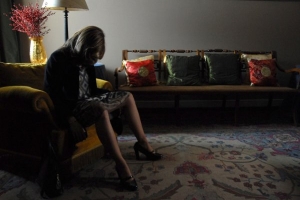 Rigorous but oh-so-tender, centenarian Manoel de Oliveira’s one-hour wonder Eccentricities of a Blonde-haired Girl is a film in one and a half acts. Oliveira translates the work of Eça de Queiroz to the screen, running the 19th century tale of romance through the current economic landscape and harnessing the resultant anachronism to paint an achingly beautiful picture about the inability to transcend class, escape reality and lose oneself in art. Despite its decidedly Brechtian and ceaselessly self reflexive nature, Oliveira’s film is rife with moments of poignancy and touches of humour. Using double, triple and quadruple framing and achieving a mise-en-abyme of art and reality, Oliveira writes a ruminative essay on the impossibility of art and reality to merge, the confusion that exists between them and the classism that exists within and with respect to art. Flooded with references to art and art forms, Eccentricities is such a dense and intricate fabric of the arts that even the past is treated in a detached manner like a piece of art, where each image looks like a painting, each sound feels like a melody and each movement cries out: “cinema!”.
 Of all the recent movies that have attempted to acknowledge dark chapters in national histories and advocated looking forward to the future instead of crying over what is lost, perhaps, none is as sober, ethical and uncompromising as Claudia Llosa’s Golden Bear winner. Llosa inherits her tale from the terrorist atrocities that plagued Peru two decades ago (Inheritance being the prime motif of the film) but, subsequently, discards every possible opportunity for sensationalism or propaganda. Tightly framing the lead character, Fausta (Magaly Solier), within and against claustrophobic structures, doorways, photographs, windows, paintings, mirrors and walls, gradually varying the depth of focus along the movie to detach the protagonist and integrate her with her surroundings and using extremely long shots to dwarf her in vast opens spaces of the tranquil town, Llosa concocts a film of utmost narrative austerity and aesthetic rigor. Punctuating and contrasting these downbeat images of Fausta’s life are slice-of-life sequences from the town depicting various wedding rituals and parties which tenderly highlight Peruvian people’s open-hearted embracing of capitalism and their resolve to come out of the trauma of the past and move on with life.
 If Inglourious Basterds was a coup from within the system, Jim Jarmusch’s The Limits of Control is an out-and-out war against the machine. The essential piece of cinema of resistance, The Limits of Control eschews simple genre classification and flips every ingredient of Hollywood’s conveyor belt products to surprise, appall, irritate and provoke us with each one of its moves. The complete absence of Jarmuschian brand of deadpan humour announces the film’s seriousness of intent. It is as if Jarmusch wants to establish once and for all that Hollywood does not equal American cinema and that the cinema that the former school marginalizes is truly alive and kicking. The Limits of Control is a film that can easily get on your nerves but, eventually, it succeeds in getting under your skin and evolving gradually to reveal how meticulously crafted it is. Using Cinematographer Christopher Doyle, production designer Eugenio Caballero and editor Jay Rabinowitz masterfully, Jarmusch creates a movie so meditative and relaxing that one feels exactly how William Blake (Johnny Depp) would have at the end of Dead Man (1995).
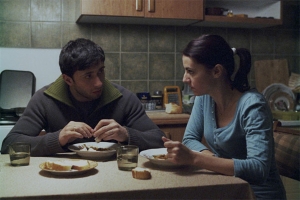 Porumboiu’s follow-up to one of the most hilarious comedies of the decade, 12:08 East of Bucharest (2006), is a companion of sorts to Jarmusch’s film not only in the sense that both of them negate the function of the genre they are supposed to belong to, by completely de-dramatizing their narratives, but also because Porumboiu’s film, too, is a conflict between two types of cinema – the cinema of analytical contemplation represented by the detective-protagonist of the film (Dragos Bucur) and the cinema of thoughtless action represented by his ready-for-ambush boss (Vlad Ivanov). However, more concretely, Police, Adjective is an examination of how our own political and social systems, partly due to the rigidity of our written languages, end up dominating us and how individual conscience and social anomalies are effaced clinically in order to have the bureaucratic clockwork running smoothly. Like Bucharest, Porumboiu, often self-reflexively, sketches the portrait of a bland and pacific city that tries to ape the far west and project itself as more dynamic than it actually is. The film’s disparate themes crystallize deliciously in the final, side-splitting, Tarantino-esque set piece where we witness the police chief urging his subordinates to act by the book, literally.
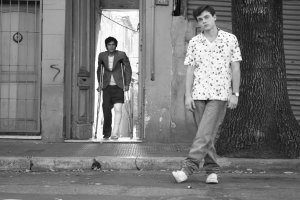 Tetro is a beautiful film. Not just in the way it looks, but in the sheer romance it has for a lost world. The only worthy B&W film of this year out of the four I saw (the other three being Haneke’s
 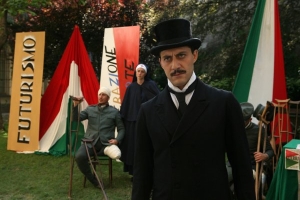 Writer-director Marco Bellocchio’s ballad, based on a nebulous part of fascist leader Benito Mussolini’s life, can teach those so-called historical dramas a thing or two about locating personal ideologies within collective history without being exploitative or pandering to pop demands. Bellocchio’s film is far from a detailed recreation of Mussolini’s political life. It is, in fact, a commentary upon such “detailed recreations” of history based on documents written by winners. Bellocchio’s formidable script and mise en scène keep probing and remarking upon the tendency of fascist systems to suppress histories – personal and national – and exploit popular media, especially the relatively young and emotionally powerful cinema, to blind people of truth and forge a faux reality – a theme underscored in Tarantino’s film too. What more? Bellocchio constructs the film exactly like one of those Soviet agitprop films – not by easy spoofing, but by retaining their spirit and rhythm – using rapid montage, expressionistic performances and operatic sounds. Be it common folk fighting in a cinema hall over a news reel or a bereaved mother breaking down during the screening of The Kid (1921), cinema registers its omnipresence and omnipotence in Bellocchio’s film.
 The perfect antidote to the summer blockbuster, Warwick Thornton’s Samson and Delilah is an extremely assured and undeniably moving piece of cinema that arrives, appositely, as the golden jubilee reboot to Herzog’s thematically kindred movie, Where the Green Ants Dream (1984). Cleverly relegating specific issues such as the Australian government’s intervention and relocation policies for the Aborigines to the background, Thornton frees his films of broad, propagandist political agendas, without ever making the film lack social exploration. With an extraordinary sound design, Thornton keeps the word count in the film to an absolute minimum, letting the stretches of silence shared by his lead characters speak for themselves. The film’s observations about banality of racism in contemporary Australia, exploitation of tribal art and its consequences, the effect of colonialism, especially due to Christian missionaries, on the Aboriginal culture and the ever growing chasm between the tribal and white life styles themselves are fittingly subordinated to the beautiful, unspoken love story that, essentially, forms the heart of the film.
 Let me dare to say this: Jacques Audiard’s A Prophet is either the most profound or the most pretentious movie of the year. For now, I choose the former. Audiard’s decidedly unflinching feature breaks free from the limitations of a generic prison drama and takes on multiple dimensions as the apolitical and irreligious protagonist of the film, Malik (played by Tahar Rahim), finds himself irreversibly entangled in ethnic gang wars within and outside the prison. A trenchant examination of religion as both a tool of oppression and a vehicle for political escalation, A Prophet is an audacious exploration of Muslim identity in the western world post-9/11. Although the plot developments may leave the viewer dizzy, it is easy to acknowledge how Audiard confronts the issues instead of working his way around it or making cheeky and superficial political statements. Strikingly juxtaposing and counterpointing Sufism and Darwinism in Malik’s search for identity, Audiard creates an immensely confident and nonjudgmental film that trusts its audience to work with the rich ambiguity it offers.


 The Seventh Art