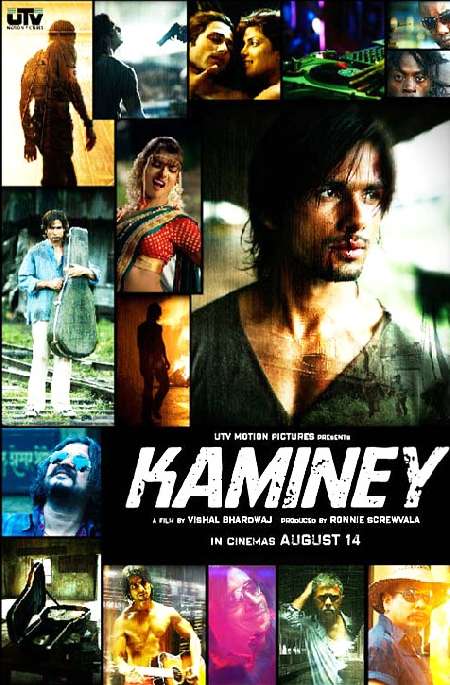
The protagonist of Vishal Bhardwaj’s Kaminey (2009) tells during the beginning of the movie: “We are never screwed by the paths that we take, but by those which we don’t”. And at the end of the film, this is exactly what must be told of Kaminey too. The idea behind Kaminey is inarguably great – so great that each one of us who hears it would be tempted to elaborate on it, make our own version of it and provide a whole new dimension to it. The sad thing is that that is precisely what has happened. With much hype behind it, Kaminey has proved to be yet another idea wasted, but is sure to have its own takers claiming everything, from Shahid’s six pack abs to its pretty neat soundtrack, as a reason to celebrate it as a masterpiece. Cinema is often called a “collaborative art” and Kaminey serves to prove that the real challenge is not to produce art, but to derive it out of collaboration. What would make for a more interesting movie than Kaminey would be a film about its making, for it is surely going to be funny seeing too many people trying to incorporate their own vision into the film, leaving the director helpless.
(Possible spoilers)
Here is the plot for those who would like to know what the film is about. I’m pruning down a lot of details which Bhardwaj seems to have retained for the sake of filling the runtime of the film. Guddu and Charlie (both played by Shahid Kapur) are twins. Guddu is working in an NGO, spreading awareness about HIV/AIDS and is in love with Sweety (Priyanka Chopra). Sweety is pregnant with Guddu’s child and is the sister of Bhope (Amol Gupte), a fundamentalist politician who is now hell bent on getting rid of Guddu to stabilize his position in the party. Charlie, on the other hand, is a gambler and a small time crook. He dreams of having his own horse-race booking company and hopes to grab hold of lady luck by whatever way he can. His villain is Tashi (Tenzing Nima), a high-profile gangster with international connections whose “goods” fall into the hands of Charlie. There are also some two dozen characters who enter the screen now and then, laugh manically, get shot and get forgotten. And yes, their paths cross, things (are made to) happen and they live happily ever after.
Kaminey is written by four people and it shows. Remember the game we used to play where each one of us took turns to add one line to take the story forward? Now remove all the fun from that and voila, you have the script of Kaminey. This proverbial broth absorbs a specific character from each one of its cooks, but doesn’t have one of its own. Nor does it present memorable characters in it. May be Bhardwaj was trying to create a Pulp Fiction (1994) of sorts, but the result is far from it. His characters are quirky for the sake being quirky. May be their names do allude to some movie classics, but you almost hear them crying out: “Hey there, I’m a offbeat and kinky character. Please love me and imitate me”. Neither are they employed as abstractions to make large scale statements about the world as in “arthouse cinema”, nor are they distorted and caricatured to pay homage and refer to film history as in Pulp Fiction and nor are they used to summarize the spirit of the age. They are not even real people living in all three dimensions. Characters come and characters go. Peripheral characters have their own limelight and die without a trace.
Let me try to clarify what I mean by summarizing what “each script” of Kaminey wants to be and what it turns out to be. The first of these was the potential USP of the film. Kaminey is full of Bolly references. Two brothers, who love each other, growing up on either side of the law, a larger than life baddie who vacations in exotic locales while giving orders to pull the trigger elsewhere and even a climax where almost all the characters in the film start firing at each other, while the bad bro turns martyr to save his sibling – we’ve seen them all before. What Kaminey seems to be trying is to pay tribute to and give a reboot to this Masala Noir genre while attempting to retain the sensibilities of today’s generation. But such a film ought not to take itself seriously. Instead it has to go for the laughs, all the way. This is where the second thread of Kaminey intervenes. One might argue that Bhardwaj was trying to give a slick production like Raghavan’s superb Johnny Gaddaar (2007), but characters in such films, I believe, should never be psychoanalyzed. Look at each character in Gaddaar. What do they all want? Simple. Money. Each of them is a mere placeholder, a mere entity that is driven along by the plot, its uncertainties and well, its fate. Kaminey, on the other hand, earnestly elaborates on the characters’ motivations and dreams, trying to make us empathize with them. It even presents extended Freudian sequences for this “purpose”.
[Kaminey Trailer]
Kaminey is then a character-driven film, you say? Let’s take the case of Guddu and Sweety – the two characters that the writers may claims as having depth. Apart from their one night-stand, we are given about three short scenes that are supposed to illustrate their relationship. The first of this is a perfunctory “chemistry scene”. The second one, which turns up just after the fiasco at their marriage ceremony, seems like just another ploy to siphon sympathy. And wait till you hear what the laughable basis of their romance is, in the third scene which takes place in a train. And finally, the most annoying of all the contributions is what makes the already out of control film seem overreaching and pretentious. With a tacked up message that blows up to full scale during the final shootout and cooked up observations that would make Thomas Friedman scratch his head, Kaminey shows signs of a naughty liberal chuckling his way through. Kaminey is not four films packed into one, but one film torn apart into four. Even if it had stuck to one of those paths, Bhardwaj would have had a pretty decent bullet point in his resumé.
Everything seems to come in pairs in Kaminey. There are pairs of brothers everywhere in the film. I would have even loved if the rapper-gangsta from Bombay to Bangkok (2007) showed up in Kaminey to claim that Tashi was his half-brother! But seriously, Kaminey never capitalizes upon this opportunity anywhere in the film. Let me just tell you about a couple of points in the film where I thought it could have taken the “other path” and salvaged itself to an extent. The first is at the intermission point, where Guddu and Charlie are confronted by wrong sets of goons. There was scope both for some awesome comedy and awesome suspense there. Not by the regular identity-confusion gag (and if the film’s vision was strong, that too), but by some subversion of conventions and morals. Instead, the film opts for some slapdash rush towards the climax, which is the second time I felt that the film could somewhat reset itself towards the destination it wanted. When more than a dozen characters are present on your canvas for a single scene, it’s very easy to mash it all up and that is exactly what happens. But this could have proved to be gold if only Bhardwaj had decided to stick to the true purpose of the film.
I may be just playing the troll over here, but surely, none of the scenes hold together. Each version of the film’s script seems to pull down the other, taking the film into a zone of utter indecisiveness. Kaminey, unfortunately, does not even have the surface gloss of Dev D(2009). Using ill-focused, largely handheld shots, Kaminey betrays both its history and quality. One can’t even comment on the technical aspects of the film, for the script leaves them without a direction. So it remains a mystery whether the excessive number of close-ups did good to the film or whether Bhardwaj’s device of revealing the past towards the end was apt, for the film does not seem to know what is good for it at all. All that is amusing in the film is the way Shahid Kapur makes lisping sound funny (lisping is new, stammering is out of date, you know). As for Vishal Bhardwaj, it is only good that he now returns to his personal and honest way of storytelling, for god sake, having a say on the final script. I risked Swine Flu by going to this movie and I say I deserve a medal.
Watching Artavazd Peleshian’s movies, I had this constant feeling of having seen such films elsewhere. A little deliberation reveals that the extraordinary Jean-Luc Godard compilation History of Cinema (1988-98) is, in fact, closer to the works of this Armenian auteur than anyone else’s. Furthermore, it becomes clear that almost all of Godard’s films made in the past couple of decades, especially the many short films, have a notable influence of Peleshian’s style, although they evidently bear Godard’s signature. With a total runtime of hardly three hours, Peleshian’s filmography may not be as prolific as the French director’s, but it shows such degree of consistency of style and unity of content that it almost feels as if Peleshian had decided beforehand what his résumé would read. I guess Peleshian’s films are what could be truly called film poetry. This is because they completely wallow in ambiguity that is so essential to poetry. By ambiguity, I do not mean that they elude meaning or try to deliberately confuse the viewer, but that their meanings are with the audience. That is to say that each viewer would draw out a different meaning or exhibit varied emotional responses that would solely depend on his/her accumulated experiences and thought processes. One might say that this is true of any film. But with Peleshian’s films, all of these responses hold good to some degree. As Peleshian himself says in his interview with Scott MacDonald (found in the book A Critical Cinema: Part 3): “It’s everything”.
I would probably go on talking about Godard’s later works when talking about Peleshian because the similarity here is remarkable. Much like what Godard does with the images from Ivan the Terrible: Part 2 (1958), Angels of Sin (1943) and many of his own films, Peleshian reuses and recycles a number of familiar images and sounds throughout his filmography. And likewise, each of these instances elicits a different meaning every time they occur. Peleshian seems to believe that photography is indeed truth, but alters its frame rate to underscore, enhance and provide meaning. It is as if the director is holding a photograph of stellar importance in his hand, commenting on it, animating and then stopping it, whenever required, to emphasize what he has said, going back to tell us more using the same photograph and, in essence, writing an essay using prefabricated sentences. Only that there is no text or speech as in Godard’s films. In fact, there is not a single word spoken in any of Peleshian’s films, highlighting the deliberately universal nature of his cinema. That is because people, beings to be precise, have always been at the center of Peleshian’s films. Peleshian seems to see humans as a monolithic entity whose ambitions, idiosyncrasies, struggles and emotions, although particularized by history, (to kill a cliché) transcend geographical and ethnological barriers.
But then, this history which Peleshian takes as reference for his examination always seems to be something that is close to Peleshian’s heart, which could perhaps be called truly “Armenian”. A mere look at the country’s history reveals large scale tragedies that have mercilessly plagued it throughout its life. A constant target of imperialism, oppression and, later, nature’s wrath, Armenia has certainly put up with some nasty things. With this knowledge, it is but natural for one to view Peleshian’s films as being also about the resilience of the nation’s residents. This reading seems quite valid at first since Peleshian’s films always seem to be about “movement“ – movement of time, movement of people and movement of life. In almost all of his films, we see various images that denote movement, change and constant transmutation – man made modes of transport, exodus of humans and animals, cycling of seasons, revolutions and of course, birth and death. And Armenia itself has been characterized by such movements and instability as its history tells us – the country’s constant transfer from the hands of one ruler to the other, people made refugees in their own country, forced evacuations and exiles and deformation by natural calamities. It is just too tempting to place these facts alongside and tie Peleshian’s films to a specific nation before generalizing them. But the director seems hesitant to attach any geographical importance to his films:
“The Armenians are simply an opportunity that allows me to talk about the whole world, about human characteristics, human nature. One may with also to see Armenia and the Armenian in that film. But I have never allowed myself to do it then, and would not now.”
Peleshian calls his technique “Distance Montage”, of which, I must admit, I could not make head or tail of, despite the director’s numerous attempts to clarify himself in the interview. But one thing that is clear from his films about his style is that it provides totality to them. That is, what the viewer takes away from the film is the whole and not any fragment or any individual aspect of it. Although certain images and sounds repeat themselves throughout the film, their order and composition are designed to evoke different responses depending on the context. As a matter of fact, without any impact on the individual films, all of Peleshian’s movies could be combined seamlessly into an indexed anthology that produces the same effect as its constituents, for the director’s style is too consistent to make any film seem out of place. Peleshian places the audience always at a distance, giving them an omniscient eye that concerns itself the whole of humanity instead of making them care about individual subjects and their petty objectives and aspirations. Perhaps this is why there are no “characters” in any of Peleshian’s films. It is quite impossible to distinguish between the archival footage and fabricated shots that Peleshian uses since none of these images show any trace of a motive to create a fictional world. The characters, for Peleshian, are already written and exist all around us, merely waiting to be read.
Earth Of People (1966)
Earth of People (Mardkants Yerkire, 1966) is the second student film that Peleshian made while studying at the prestigious VGIK institute and already, it shows the author’s stamp. Early on we are shown images of massive man made structures – bridges, railroads and skyscrapers. As the twisted title starts to make meaning, Peleshian starts showing us human hands, humans at work and the world being constructed by humans. We see people from every profession – doctors, engineers, workers and scientists – carrying on with their routine robotically as the soundtrack suddenly stops giving us conventional score and starts gathering the most bizarre of mechanical sounds. But soon, the optimistic tone of the film gives way to distrust and we realize that we aren’t exactly masters of this world. We see these people are, in fact, trapped within their own creations (which strangely reminds us of 2001: A Space Odyssey (1968)), which gradually takes us back to the title: Whose world is this? No wonder the film opens and closes with the image of a thinker’s statue. Peleshian’s film is symmetrical, as would be his later works, with both the soundtrack and imagery getting reflected along the centre of the film.
Beginning (1967)
Although Peleshian’s style already shows maturity in Earth of People, his official filmography begins with, well, Beginning (Skizbe, 1967). Chronicling the historical events that changed the course of the century following the monumental October Revolution of 1917, Beginning is a powerhouse trip that would definitely rank among the best political films ever made. Running for a mere 10 minute span, Beginning exemplifies Peleshian’s preoccupation with mass movement like no other film. Employing an eclectic mixture of photographs, studio shots and documentary footage, manipulating their speed, repeating them regularly and eventually attaining a musical rhythm like the Soviet pioneers’, Peleshian emphatically registers our recent history that has been marked by an extraordinary number of uprisings and bloodsheds. Peleshian’s soundtrack is remarkable here. Using a combination of highway chase music, gunshots, screams and silence, Beginning shifts gears from a documentary, to an agitprop, to an essay and to an epic in no time. But the true revelation is the ending of Beginning where, after a brief visual and aural pause, Peleshian delivers a moment of epiphany, once again reminiscent of 2001 – an extended close up of a young child staring determinedly into the camera as the soundtrack plays a majestic, Thus Spake Zarathustra like score. Forget the Star Child, what is the human child going to see in the future?
We (1969)
Sheep and mountains have almost become Armenian identities of sorts, thanks to the films of Sergei Paradjanov. We (Menq, 1969), which begins and ends with the image of a gargantuan mountain, is perhaps the most “Armenian” of all Peleshian movies. We are shown images of mountains falling apart before being cut to a large funeral procession. This is followed by visuals of common people carrying on with their everyday work, – some utterly mundane, some shockingly risky – as if proving the adage “Life must go on”. For the first time, religion, which was a major reason for the Armenian Genocide, makes its presence felt in a Peleshian film. It isn’t just personal disappointments that these people seem to putting behind them, but shattering national tragedies, despite (and perhaps because of) which their faith stands affirmed – in religion, in life. The last third of the film acts as a meeting point and the resolution for these two types of calamities as we are presented visuals of reunions of families (and of people who seem to be returning from an exile). More than anything We feels like an ode to the resilience of, in particular, the Armenian people (although Peleshian himself denies this!), who have had to put up with a lot through the centuries and, in general, the spirit of everyday heroes. If at all anything can be made of Peleshian’s attitude here, it must be his unassailable faith on the ability of humanity to survive no matter how difficult it makes it for itself.
Inhabitants (1970)
In contrast to the unusually large number of people in the Beginning and We, Inhabitants (Obitateli, 1970) is almost completely devoid of humans. Peleshian attributes this peculiar absence, quite strangely, to his audience being critical of him for We. Filled with shots of large-scale migrations and stampedes (with, surprisingly, even helicopter shots being present in the film), Inhabitants merely alludes to the presence of the human beings, in the form of a few silhouettes, who seem to be the central cause of panic. Shot in widescreen, Inhabitants, for most part, depicts wildlife, in panic. At first glance, with the anti-mankind tone of the movie, Inhabitants seems to take Peleshian back to the arguably cynical mode of Beginning. But once you begin to see that the humans in the film aren’t exactly humans but far from it, Peleshian’s faith in humanity comes to surface. Surely, the animals are just a normalized form of the people of We, of Beginning and of Earth of People. But the relevant question is whether Inhabitants is connected to the Armenian history directly or not. With the visuals showing us exoduses and captive animals and the soundtrack including gunshots and screams, it is not unfair for one to be reminded once more of the nation’s plight. Whatever the case, the film resonates with quintessentially Peleshian themes – of change, of resilience and of survival.
The Seasons (1975)
The Seasons (Vremana Goda, 1975) is perhaps the most famous of all Peleshian films and just its opening shot would show why – A man, clutching a sheep in his hand, trapped in a raging stream, trying to get to the shore along with the animal. Setting the tone of film and, to an extent, to the director’s whole filmography, The Seasons’ first shot effectively underlines the irony that forms the basis of the relationship between humans and nature. The Seasons, as the title suggests, deals with the change of seasons. In the first section Peleshian presents us images from sunny day in an idyllic pastoral life, where a family of herdsmen lead their sheep through a dark tunnel and then to light. We then see a group of young men dragging huge stacks of hay down a hill slope and then trying to stop it. This scene, once more, illustrates our can’t-live-with-can’t-without relationship with nature, but never once becoming a contrived symbol or a metaphor. It is merely a glimpse of life which reveals a fact rather than expressing it. The same would be true of the sequence that is to follow, where the herdsmen risk their own lives in order to salvage their herd that is caught in the rapids. The film then shifts to an ethno-documentary mode as we witness a marriage ceremony in which a cow forms as much an integral part as the bride and the groom. In a rather prolonged scene that follows, in what looks like an amusing sport, we are shown a few men, each holding a sheep in his hand, sliding down a snowy hill, refusing to let go of the animal – A practice that is as strange as man’s kinship with nature – living with it, living against it, living despite it, living for it and living because of it.
Our Century (1983)
What followed remains Peleshian’s longest film to date, the 50-minute feature Our Century (Mer Dare, 1983). Our Century concerns itself with some cosmonauts (and astronauts) preparing themselves for a space flight. Peleshian constructs the film around this event, quite predictably, exploring his themes through a complex editing system coupled with an equally complex soundtrack. Initially, Peleshian crosscuts between the footage of the activities at a space station, minutes before the launch of a shuttle, and a celebratory procession where the space-heroes are cheered and applauded by the mass. Peleshian frequently presents clips that show the immense stress that the cosmonauts are put under, during the test phase and in space, It is a period of sheer loneliness, physical and mental fatigue and, yet, of excitement and ambitiousness. He then goes on to depict man’s obsession with flight and, in general, his desire to conquer the various elements of nature, where he shows a number of bizarre experiments in aviation, most of which end unsuccessfully. As ever, individual turmoil gives way to and unifies with national tragedies to the point beyond which there is no difference between a nuclear explosion, a rocket launch and the human heartbeat. Our Century arguably presents Peleshian at the top of his game, converting both the form and content of the film into a highly personal mode of expression. In no other Peleshian film has the ecstasy over human achievement mingled with the agony of existence in such an intricate fashion. The point is not the establishment of a simple irony, but of an exploration of what makes humanity go on, against all odds.
Life (1993)
There is some confusion regarding the order of release of the last two Peleshian films. The official Paradjanov site, however, suggests that it is, in fact, Life (Kyanq, 1993) that is the director’s penultimate film thus far. Peleshian uses colour film for the first time, perhaps to enhance the already optimistic tone of the film, and makes his shortest film till date. Running for a mere seven minute time span, Peleshian, for most part of the film, presents us extreme close-ups of a woman delivering a baby. Probably the most moving Peleshian film, Life is also the most overt manifestation of the ever-present Peleshian-ian conversation between human pain and ecstasy in his films. The soundtrack is comparatively simpler here, with only two audible layers – an evocative opera piece and an amplified track of the human heartbeat. Naturally reminiscent of that staggering Stan Brakhage work, Window Water Baby Moving (1962), Life is an equally personal (although far easier to watch), emotionally exhausting and visually stunning piece of film that has the power to dispel any trace of pessimism that anyone may have about humanity. The film ends on a freeze frame showing a mother and her young child looking towards the camera and, possibly, a bright future.
End (1994)
Although Life would have made an astounding end to a solid filmography, it is End (Verj, 1994) that provides a more rounded closure to it. End is a series of shots inside a speeding train, the passengers of which are of diverse age groups, ethnicities and emotional statuses. The train itself feels like a microcosm of the whole world, each of whose inhabitants is moving towards an individual destination but the totality of them going in the same direction. End is perhaps the kind of vision that Damiel (Bruno Ganz) saw in the train in Berlin in Wings of Desire (1987), considering the voyeuristic nature of the camerawork in this film. There are also a few outdoor shots, of mountains (again) and of the sun, that punctuate End. If Life’s ending shot seemed to seal Peleshian’s faith in humanity, the closing shot of End brings back the lifelong dialectic between cynicism and optimism that has so consistently characterized Peleshian’s work. We see the train, after a very long passage through the darkness of the tunnels, suddenly plunging into blinding light. Before it is revealed to us what lies beyond, the end credits roll. Is it a man-made apocalypse foreseen by Earth of People? Is it the Great Armenian Earthquake? Or is it the ultimate redemption for humanity that Life suggests? Looking back at Peleshian’s body of work, it is probably the latter.
Le Sang Des Bêtes (1949) (aka Blood Of The Beasts)
Georges Franju
France
20 Min.
Georges Franju’s Blood of the Beasts (1949) is perhaps the kind of film that you obtain when you mix poetry and snuff. Detailing the everyday work of Parisian slaughterhouses, Blood of the Beasts is a film that manages to rise above its gore-quotient to explore what exactly a ‘society’ is. Franju cuts back and forth between the serene, romantic and sacred city of Paris, where the church carries on its duty, absolving people of their sins and providing solace for the dying, and the slaughterhouses in its suburbs where cattle are beheaded in a mechanical fashion like units on a production line. We are also shown the people who slay these animals and process them for those outside this building. They carry out their routines dispassionately and with no moral dilemmas whatsoever. In fact, never does Blood of the Beasts cry out about it all or take an ideological stance like some propagandist video. It merely presents us facts – purely scientific at times – and gradually reveals to us the questionable basis upon which our so-called ‘civilization’ is built and the moral impasse that it has brought us to. Franju apparently did not want to film the movie in colour since he felt it would be too much to take for the audience. But coming to think of it, had Franju decided to shoot Blood of the Beasts in colour, the movie would have been elevated to a different level altogether. Imagine the mere implication of including the colour red in a film that opens with romance and culminates with bloodshed. But I’m not going to complain, since the black and white too, in a way, provides an odd and tranquil beauty to this gem of a film that strikingly blends conventional documentary and fictional narration.
In some ways, Priyadarshan’s Kanchivaram (A Communist Confession, 2008) reminds of another film that released the same year – the Oscar winning Departures. Not only because these films are two of the best melodramas of recent times, but the fact that both these directors had been making pornographies, real or figurative, for quite some time. A while ago, looking at Priyadarshan’s series of inane films, one could almost joke that Priyadarshan is distracting us while he is laying the groundwork for some sinister master plan. Only that it has come true. In Kanchivaram, he creates a film of high cinematic and dramatic values that I wouldn’t think much about calling it ‘the’ movie Indian cinema has been waiting for. Having witnessed, now, that Priyadarshan’s film can lick Departures any day, it is only saddening to recollect that they sent that educational video about dyslexia for the Oscars. Not because the Oscars are the greatest recognition for movies or that the Academy would have easily nominated Kanchivaram (which is actually unlikely), but the fact that we should be careful about the quality of films that we choose to give a boost to.
Priyadarshan’s script, quite simply, follows the life of Vengadam (Prakash Raj), a silk weaver in Kanchivaram, Tamil Nadu during the pre-independence era. Vengadam is one of the best weavers in that region and has just got married to Annam (Shreya Reddy). The screenplay gradually adds detail to Vengadam’s every day life until Vengadam and Annam have a daughter Thamarai (Shammu). At Thamarai’s naming ceremony, Vengadam, as per customs, avows that he will adorn her in a silk sari during her marriage. And this event becomes the focal point of the story, the object of desire for our protagonist and the fodder for some neat writing by Priyadarshan. The narrative starts two days after the assassination of Mahatma Gandhi and we see Vengadam, now in the police custody, being taken somewhere. The film shuttles between, ironically, the pre-independence era and the newly independent nation as Vengadam recollects his past during a bus journey. This is one of the most worn out devices in cinema but, surprisingly, it works for Kanchivaram because it tells us beforehand of Vengadam’s fate and in essence, removes the unnecessary element of suspense from, what would turn out to be, a character-driven movie.
Evidently, the facet that stands at the podium is Priyadarshan’s script, which perhaps is the kind Indian cinema has been having a go at, unsuccessfully, for years now. Stringing together a chain of massive ironies, honest observations and relevant details, Priyadarshan concocts a script that doesn’t merely derive its characters like many a potboiler, but lets them evolve. That is to say that it doesn’t just take its characters through preordained dramatic checkpoints, but allows them open up at their own pace. Save for the two inevitable turning points that are required to stitch up the three acts, never does Priyadarshan feel the unwarranted need to see the story through to a climax just for the sake of it. Rather, he relies on accumulation of detail to unravel Vengadam’s world. Consider the scene when Vengadam presents the worker’s petitions to his “boss”. Or the scene where he declares the protest. Or even the scene where he and his daughter get caught throwing pebbles at a bystander. One would otherwise have expected a spat of sorts in each one of these petty situations. Instead, Priyadarshan squelches every possible avenue of exaggeration and manipulation.
That is not to say that Kanchivaram is not a melodrama. On the contrary, I believe, it is precisely how a melodrama should be. The word “melodrama” has been used very loosely and often as a derogatory remark. Most of our mainstream movies have been put down because of the same reason, and rightly so. Where these ordinary films tried to exaggerate emotions through copious amounts of words, leaving no margin for discovery or imagination, Kanchivaram lets cinema do that for it. Its exaggeration is not the weak over-emphasis of words, but the subconscious amplification by images. Priyadarshan realizes that subtlety is the essence of art and places immense trust on his audience, yet never lets the movie lurk near ambiguity. His melodrama is not made of music cues or slow motion shots, but of cinematic compositions. Consider the final scene where Thamarai, who had earlier taken over the responsibility of taking care of her father from her mother, breathes her last. Vengadam takes her in his arms to show the sari he has been weaving for her. Earlier in the film, Vengadam had does exactly the same thing when his wife is in her death bed. Instead of having Vengadam break down, and cry out aloud the unfairness of it all, Priyadarshan merely uses the same camera angle – looking at the pair of actors through the weaving machine – to nudge our memory, make us work and only then earn the tragedy of the moment.
But what is most striking about the script, which treads a very risky and usually avoided territory in mainstream cinema, is the way it examines what politics means to common man. Even though the novel idea of communism aids Vengadam to realize that he is being exploited, in summary, it amounts to nothing. Personal, emotionally charged motivations overwhelm conscious political ideologies. Importing an alien political system without any concern for existing social structure has resulted in more harm than good. In fact, reminiscent of what fellow Keralite John Abraham did three decades ago in Agraharathil Kazhuthai (1978), Priyadarshan explores the implications of porting any foreign system to suit a completely different environment. The caste system, which was initially used to classify professions, has mutated into an organized system for exploitation, which is passively accepted by both the oppressors and the oppressed. There is even a subplot in the film, which acts as comic relief and satire at the same time, where a policeman, who is to take charge of the convicted Vengadam, finds the official emblem dislodged from his hat and panics at the thought of losing his job just because of that.
Although attention-craving at places, Priyadarshan’s direction shows the signature of a mature director who knows his craft. He seems to know where exactly to use expressionist lighting and where to focus deeply. Speaking about cinematography, Kanchivaram would not be what it is without the contribution of three fine pieces of work. The first is Sabu Cyril’s production design. Though aided considerably by what looks like post-production processing, Cyril nevertheless does a terrific job in creating a uniform earthy tone to the film which eventually blends into the red of communism that later becomes the central point of the film. All the people in the film – the leads and the junior actors – look straight out of grandpa’s albums, with clearly defined facial features. The second is Thiru’s cinematography, which speaks for itself. This veteran cameraman had already proved his worth in Hey Ram (2000), Kanchivaram is just second witness. And equally noteworthy is M. G. Sreekumar’s soundtrack, which is befitting of the period and shuttles between classic Carnatic, which was at one time everyman’s art, and emphatic choral, going hand in hand with the communist theme of the movie. But needless to say, the greater credit goes to the director for retaining the necessary and weeding out the superfluous.
The performances are all fine (except for Prakash Raj’s diction, which sometimes betrays his roots) and would be the first things to amass praise. But I find it kind of funny that a Malayalam film director casts a Kannada actor and a Telugu actress as the lead in a Tamil film! Talking about languages, it is also interesting that Priyadarshan sets his film in Tamil Nadu and not Kerala, given that communism is central to the plot of the film. And one more thing, I would definitely have loved see more of the actual weaving process, the machines and the graceful movements of the workers who churn out such world-class products, just in order to sink into the world of Kanchivaram. Priyadarshan does show these images early on, but cut away too early to have any effect. Furthermore, with clever use, these gestures could have well increased the vitality of Vengadam’s character manifold. Well, let’s just stick to what is present in the movie, which itself is pretty darn awesome. I may be slightly overrating this movie, but what the heck! We are not going to see such an uncompromising Indian film for a long time to come. No, not from Priyadarshan at least. De Dhana Dhan is slated for a 2009 release.
Verdict:
P.S:Here is a hilarious article by an American about his experience of working as an extra in a Priyadarshan comedy.
Unsere Afrikareise (1966) (aka Our Trip To Africa)
Peter Kubelka
Austria
13 Min.
Rare is the film where the idea of a director is revealed rather than expressed. Of course, the moment the camera chooses a position and an angle, the director has made a moral choice. But not often do wee see these images speaking about themselves. Our Trip to Africa (1966) is such a film where the how and what of its images tell us more about the “maker” than his ideologies. Overloaded with visuals from the “protagonist’s” safari in the African continent, the film could, at first glance, simply be called a badly shot tourist video. But soon, certain images repeat themselves at regular intervals and concoct a theme of sorts to establish that there is more to the film than meets the eye. We see shots of the natives, especially of their bare torsos, and of wild animals being killed for game. The photographer seems to be enjoying this thoroughly. Then, in complete contrast, there are also shots of other white people, presumably the photographer’s family, having a sunbath on their boat and who, too, seem to be happy to bask in the exotic wild that is now under their control. Our Trip to Africa could be easily panned for its decidedly imperialist (and, to an extent, racist) tone, if not for one simple fact – that it is a film within a film. That the function of Our Trip to Africa is not to act as a tourist video, but to show us one. That there’s a world’s difference between the outlook of the man behind the camera – the protagonist of the film – and of “the man behind the man behind the camera” – Peter Kubelka, the director.
Stan Brakhage – the man without a movie camera – has adorned his filmography with some of the most bizarre films ever made, but Mothlight (1963), thankfully, remains one of the more accessible movies – visually and conceptually – among those. The quintessential garage work, Mothlight is an array of images made by gluing together pieces of dead insects and dry leaves on a film strip and projecting the product using a light source. The result is a fascinating viewing experience marked by a mixture of ambiguity and revelation. Like the work of a curious child, which oozes with innocence and imagination, Brakhage’s film (especially when seen with the hum of a projector) is one of the few films that truly capture the “magic of cinema”. Mothlight is a unique film in the sense that a digital copy (or any other recorded source) of it undermines its power because of the very intention of the film. If Andre Bazin traced the need for cinema, and all plastic arts, to the ancient Egyptian craft of mummification, Brakhage carries out precisely the reverse process – employing cinema to revive and preserve the dead for eternity. Mothlight could be seen just as a POV shot of a light bulb on which an army of moths has unleashed itself, only to get killed. But it is also the opposite. The artist’s desire to resurrect the dead and to eternalize the living in order to achieve an immortality of sorts is one of the very many motivations for art. Brakhage’s “actors”, although dead and dismantled, have now achieved life once more, thanks to the singular property of cinema to capture reality, in all its four dimensions.
[In this section, I’ll be posting brief write-ups about some impressive/interesting/frustrating/bizarre/whatever short films. And if possible the video too.]
Agraharathil Kazhuthai(1978) (aka Donkey In The Elite Colony)
John Abraham
Tamil
“I felt a living thing had come to me for love and affection. I hadn’t the heart to drive it out.”
John Abraham’s Donkey in the Elite Colony (1978) begins before its imagery does, with the narrator passionately reciting a fiery poem by Subramanya Bharathi, in praise of fire, during the credits. The first visual of the film follows up the verbal worship of fire in the poem with an extended shot of a sunrise. The tone is set for a leftist kind of film with revolutionary overtones. The seventies was a notorious decade in Indian cinema – both parallel and mainstream – as the permissiveness of American cinema had started showing its influence. And fortunately, it was also the period when cinema was taken most seriously and for the good. Malayalam film director John Abraham’s second film, and his only film made in Tamil, is a controversial film from the era and continues to be rated as one of the most important non-mainstream movies from the country.
Professor of philosophy, Narayanaswamy (M. B. Sreenivasan) returns home one day to find a little donkey at his doorstep. He comes to know upon enquiry that its mother has been killed by a mindless mob and decides to provide refuge to the animal. But staunch opposition from college officials and his students forces him to transport Chinna (that’s what he has named his pet) to his native village, only to trigger a chain of apocalyptic events. The neighbourhood is an agraharam, the settlement of Brahmins (considered one of the higher social classes in ancient India), where the mere notion of a donkey (an icon of the working class) replacing the sacred cow as a domestic animal breeds hostility. Narayanaswamy is single and has a brother who is married but childless. Chinna is taken care of by the mute Uma (Swathi), who is as devoid of the notions of class and caste as Chinna is and whose fate clearly mirrors the donkey’s.
Director John Abraham and scriptwriter Venkat Swaminathan evidently draw inspiration from Bresson’s Au Hasard Balthazar (1966, even overtly referenced early in this film), where too the protagonist’s fate was tied up with the donkey’s. I say fate because none of the central characters (the women and the animals) seem to be able to affect the direction of their lives. Both Chinna and Uma are mute creatures who end up being victims of insecurities and questionable intentions of certain individuals who take refuge under the cover of their social standing. But Abraham is far from being a Jansenist (that Bresson is often claimed to be). He is more interested in doing away with the oppressive forces than in contemplating about the harrowing state of affairs as his opening and closing sequences testify. Towards the end of the film, when the professor finally searches out the whereabouts of Uma, he finds her sitting listless among the ruins of a temple, amidst abandoned idols, subtly raising an intriguing question – Has God forsaken his subjects or is it the other way round?
It is so good to see an Indian film, after a long time, which respects the cinematic form and not just its scenario. Venkat Swaminathan’s script would have been just a hard hitting short story if not for what John Abraham does with it. Although Abraham’s style does become showy at places and the film feels like an uneven student film, the director’s conviction that form underscores and enhances content overwhelms. He draws inspiration from Eisenstein (montage is used regularly in the film), the neo-realists (location shoot and use of non-professionals) and, more extensively, Bresson (lot of detail is conveyed through off screen speech while the camera lingers on the characters’ actions). It is enough to witness just the opening few minutes of the film to see the formalist urge of the film. Following the prolonged shot of the sunrise, using simple cross cutting between the professor and the little donkey, Abraham starts presaging the intrusive and iconoclastic nature of both of them, which will be elaborated upon later in the film.
But most interesting is the central piece of the film, where Abraham achieves a unique effect through repetition and montage. It is a sequence where Narayanaswamy’s father is recounting the villager’s complaints about the donkey. Each scene of complaint begins with a villager shouting out his gripe, after which, Abraham cuts to what actually happened. It is revealed to us that in none of the cases, is the donkey guilty of what the villagers are accusing it for. In contrast to the verbose ranting of the villagers, these flashbacks are completely devoid of words, with only a soundtrack playing throughout each one of them, as if stressing the inherent dubiousness in human words. At the end of each scene, we see Chinna and Uma walking past the father-son pair almost in the same fashion every time. This is followed by a section that shows a working class man taking advantage of Uma’s condition, much like the villagers making use of the donkey’s inability to object. The whole sequence of events repeats three or four times and constantly calls attention to itself, making it a bit of an overkill by today’s standards.
Donkey in the Elite Colony has been called an attack on the Brahmin hegemony in rural Tamil Nadu. But Abraham’s film is much more than a simple tirade against a particular caste or class. It, in fact, talks against any system that tries to imitate itself for a reason it can’t understand and imposes upon itself, laws and practices that are either irrelevant to the present or plainly irrational (In one scene, Narayanaswamy tries drinking coffee without sipping – a practice considered a characteristic of the Brahmin household – in front of his mother, only to fail). Donkey in the Elite Colony presents one such social system which blindly attempts to sustain its oppressive structures like class, caste and family and goes any distance to weed out anomalies that may harm the setup. The class divide is as much perpetuated by the submissiveness of the working class as it is by the domination of the elite. The fact that Narayanaswamy is single and his brother’s family is childless seems to be a big taboo. Status quo is restored only when his brother’s wife bears a child. Even the college where Narayanswamy works insists that he get rid of his pet since it is “demoralizing” for the institution.
The final act of Donkey in the Elite Colony begins on an ambiguous note, which, in a way, feels like a weak link. We are first shown Brahmins who are repenting for their actions, haunted by the implications of their sins, and then the workers rising to revolt. Is Abraham suggesting that a change has to come from within, rather than through an organized movement (This is a plausible explanation, for Narayanaswamy himself is one of the Brahmins)? Or is he of the opinion that a revolution is the only way for progress? The climactic act, at times seeming indecisive, is brought to a final resolution with the help of another Subramanya Bharathi poem – Dance of Death. The penultimate image in the film is that of burning houses, rendering closure to the film’s first sequence (the opening poem is recited in the soundtrack once more) and providing us with a clear solution rather than an introspective question. Abraham’s leftist tendency overwhelms, taking the film with it into an agitprop mode reminiscent of the Soviet cinema of the twenties. The film closes with a shot of the setting sun – a rather unusual metaphor for a propagandist showdown, for the revolution has just begun.
Om Darbadar(1988) (aka Om-Dar-Ba-Dar)
Kamal Swaroop
Hindi
“To Prime Minister. Subject: The Googly. Dear Raju, Please ban googly in cricket and life in general. Thanks, A freedom fighter, Babuji B. Sankar.”
If one is asked to describe briefly what Kamal Swaroop’s Om Darbadar (1988) is, some of the answers could be: carefully constructed non-sense, endless dream of a cinephile, a satire on everything, full stop to Indian parallel cinema, random footage, extremely challenging piece of filmmaking, the great Indian LSD trip, landmark Indian film that aims big. With all the ingredients required to make a cult classic, Om Darbadar is the kind of movie that can easily polarize critics and audiences alike. It is, in fact, surprising that the National Film Development Corporation consented to produce this film. Using image, sound and montage to the maximum extent (and often gratuitously) and dialog that seem like knitted from parts of different sentences, almost always making no meaning (written by Kuku, also the lyricist and the art director of the film), Swaroop’s film is an antithesis to whatever is recognized globally as Indian cinema – a reason good enough to make Om Darbadar a must-see movie.
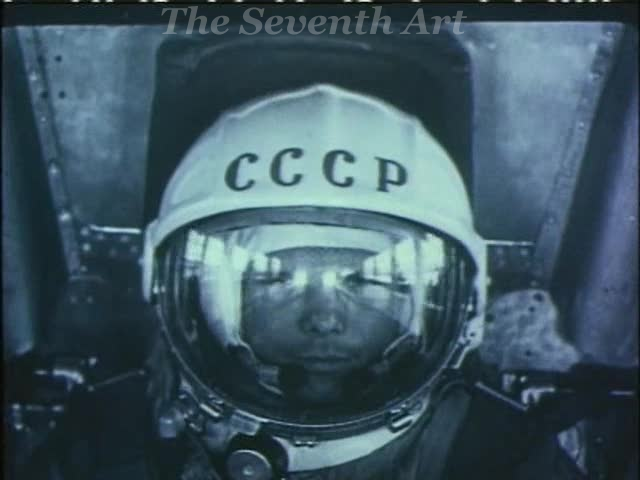
Here’s the plot of the film: Horoscope, dead frog, cloudy sky, the moon, radio program, caste reservation, bicycle, Mount Everest, women’s liberation, communism, sleeveless blouse, Yuri Gagarin, miniature book, Nitrogen fixation, man on moon, terrorist tadpoles, computer, biology class, turtles, Hema Malini, typewriter, sleazy magazines, hibernation, text inside nose, googly, James Bond, severed tongue, fish rain, shoes in a temple, World War, assassin creed, Gandhi, illicit trade, the lake, goggles, hopping currency, helium breath, counterfeit coins, underwater treasure, diamonds inside frogs, fireworks, the zoo, explosives, town at night, dead man, visit of God, the Panchsheel Pact, foreign tourists, Promise toothpaste, holy men, Fish keychain, Ram Rajya, food chain disruption, anti-cooperation movement, birth control, bagpipes, gecko, Jawaharlal Nehru, Aviation centers, Potassium Cyanide. And I guarantee you, this is as lucid as it can get.
Om Darbadar is, hands down, the most confusing movie I have ever seen and not many movies can come close to dethroning it. Some might propose Buñuel’s first film, but one could at least find one pattern in that work – of anti-narration. This one regularly tantalizes us with a somewhat coherent narrative and just when it seems to get steady, snap! Or Last Year at Marienbad (1961), which is, in fact, an incisive study of the human memory. Om Darbadar, on the other hand, overwhelms us with its utter irreverence for integrity of reality, unity of content and consistency of form. Or the very many avant-garde films of Brakhage, Warhol, Anger, Snow or Smith, which, I believe, have always had a strong theoretical basis. No, this film does not have any single, central factor as its theme or motivation. Of course, one can find shreds here and there in the film that do make it seem like dealing with the idea of identity crisis in suburban India, but that’s strictly on a speculative level.
Often we witness directors claiming to show the world what real India is – a statement negated by the films themselves. Leave alone filming, it is to be accepted that even understanding the dynamics of such a largely diverse country is near impossibility. But, if there was ever a film that attempted to capture the workings of real India almost in its entirety, it has to be this one. Yes, it does bite much more than it can chew, but surely, digestion is not its intention. In a country where science, religion, mythology, arts, politics and philosophy seep into common lives trying to overpower each other, there is no single way to separate these threads so as to examine their influence on the way of life. This is a nation where the apparently inexplicable supernatural walks hand in hand with the most modern of scientific theories (In one scene in the film, Gayatri (Gopi Desai) asks Jagdish (Lalit Tiwari) if women can really climb Mount Everest without the help of men, he tells her: “Why not? After all, goddess Parvati did it”), a culture that is exposed to all the isms of western thinking yet revels in having its own interpretations of them (wearing a sleeveless blouse is equated to emancipation of women) and a country whose emotions are largely dictated by cinema, television and pop culture (Om Darbadar can be seen as a jab at just about every genre in Indian cinema).
Conventional (and good) cinema has relied on the fact that human psychology manifests itself in the form of their behaviour and speech and hence, an unhindered documentation of their lives would help us understand them better. But not many filmmakers seem to have embraced the reverse process – an entry into the real via the surreal. Kolker fittingly calls Buñuel “the neo-realist of the unconscious” and each one of his films testifies that. Likewise, the whole of Om Darbadar could well be the ultimate Freudian exercise that could help us (de)construct the actual world that Om lives in – a world that is as much fuelled by a love for pulp novels and thriller movies as it is by an aversion to zoology. But all is not so simple and the film is far from an extended dream sequence. Swaroop could have easily had Om (or his father, who begins the film’s narration) wake up at the end of the film, thereby taking us back to our comfort zones. Instead, he seamlessly blends present reality, past reality and fantastical reality to create an elusive work of cinema that defies literature, science and rationality.
Om Darbadar is an utterly frustrating, endlessly irritating and supremely hilarious film. Is it nonsensical? Yes, that is precisely its function. Is it pretentious? No, that can happen only when a film attempts to be something. Is it a one-of-a-kind movie viewing experience? You bet. Whatever one calls it, you cannot deny one fact – Om Darbadar is an indubitably addictive and thoroughly riveting piece of work that simultaneously repels a viewer by not pandering to his needs and yet, keeps him hooked on to the screen from frame one. Quarter hour into the film, I was completely disarmed and found myself laughing out loud through the rest of the film despite (rather, because of) the meaninglessness of it all. Om Darbadar is perhaps the kind of vision that flashes moments before one’s death. Call it the birth of Indian cinema, call it its death, call it Dadaist, call it anti-art, but be sure to bask in its absurdity while it lasts.
Khesht Va Ayeneh(1965) (aka Brick And Mirror)
Ebrahim Golestan
Persian
“Do you see those panes, those windows? Behind each, there is an evil eye, a wicked tongue, a jealous black heart, each detesting the other and all unified to detest each other.”
Ebrahim Golestan’s Brick and Mirror (1965) begins inside a taxi. The man at the wheel changes the radio station and a voice begins to narrate:
“The night had settled over the forest. The hunter trod through the thicket stealthily. Danger throbbed in the dark. Fear filled the forest. And terror sparked the night. The night was hard. The night seemed long. Nothing was reflected in the eye of the owl but anguish. And fear was life’s only sign. The hunter trod stealthily through the night. Beasts were staring. And the eyes of the thousand-eyed perils were wide. It was dark. And in the dark, there was no one to tell the hunter and the hunted who was the hunter and who was the hunted.”
The camera, meanwhile, gazes safely from behind the windshield, the vast city of Tehran. Night has well fallen and all the street lights are up. It seems like thousands of gigantic eyes staring at the camera, hiding behind the darkness, waiting to pounce on the unsuspecting taxi. After a couple of minutes, we cut to the face of the driver – a thirty-ish gentleman resembling De Niro during his prime. Golestan’s composition is immediately striking. The taxi driver, here and throughout the film, is placed at the margin of the frame, with the dark city pushing him to the boundaries. One gets the feeling that this one might just be the (premeditated) Iranian reply to Scorsese’s Taxi Driver (1976).
Brick and Mirror is unlike anything I have seen from Iran, for it is my introduction to Iranian cinema before the revolution. With the world’s eyes keenly focused on Iran, – politically or otherwise – there prevails a risk of drawing a monolithic portrait of the country. Watching Brick and Mirror, one can see how starkly different the two ages are and how drastic a cultural shift its citizens were subject to after 1979. Golestan’s film, more or less, also testifies the strong relation between France and Iran that prevailed during the Shah’s regime. He, evidently and interestingly, draws inspiration from both Godard and Bresson, apart from incorporating tenets from other famous schools of filmmaking. With complete control over every aspect of the film (writing, directing, editing and producing it by himself), Golestan churns out a film that is clearly Iranian in content, yet could pass of as one of the French New Wave movies.
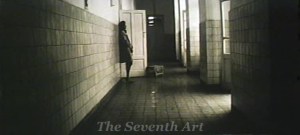
Brick and Mirror takes place over the course of 24 hours in the life of this taxi driver, whom we come to know as Hashemi (Zackaria Hashemi). That fateful night, a woman in a veil (apparently played by the iconic Forugh Farrokhzad) boards his taxi and leaves behind a baby. Unable to locate the woman, Hashemi is forced to provide shelter to the child for the night. He is helped by his love Taji (Taji Ahmadi), a woman who works at the local pub. But the most important of all characters in the film is the city of Tehran itself. The city is also the most powerful of all characters, devouring mentally and physically one character after another. Never has a metropolis been filmed so beautifully yet menacingly. Using the cinemascope judiciously and employing camera movements that are seldom meaningless, Golestan and cinematographer Soleiman Minassian ensnare their characters, like the city itself, surrounding them and locking them to their environment. And how often do we see a tracking shot that is as pregnant with emotion and significance as the final shot of Taji standing at the end of the long, dark corridor of the hospital?
Hashemi and Taji are two well written characters, who complement each other emotionally and ideologically. He is a thorough fatalist, classifying every outcome as good or bad luck. He prefers to live in the dark, literally and figuratively, away from prying eyes of the society. She, on the other hand, is the quintessential existentialist (Again, a possible influence of contemporary French philosophy), believing strongly that we make our own lives and being too prude is no good. But she is also an extreme romantic, always giving Hashemi hope for a new beginning, who seems to shrug off her philosophies (At one point, Golestan even frames Taji in such a way that she appears as one of the photos on the walls of Hashemi’s house). In an explosive scene shot on the streets, both of them plunge into a heated discussion after he delivers the baby to an orphanage against her wishes. The camera tracks in front of them as they walk arguing with each other. And all of a sudden, in a humbling manner, they break into utter silence after a funeral procession cuts through them, reminding the about the futility of their words and the ever tangible presence of death.
Hashemi does bear a striking resemblance to Schrader’s Travis Bickle, in the sense that both of them are marginal characters who are forced to witness a society that is vigorously dragging itself to doom. But the commonality stops at that. While Bickle is an alien frustrated by what he sees in the rear view mirror, Hashemi is the one in that mirror (In one scene, the driver of the taxi that Hashemi boards cribs about his profession and tells the latter that he is lucky not to be a taxi driver). Moreover, Bickle’s decision to do something about it all is exactly contrary to the borderline-agoraphobic Hashemi, who believes it is better to stay low and go through life unnoticed by anyone. True that he comes to know of all the rotten crevices of the city and the breakdown that it is leading to, but, being the determinist that he is, is satisfied with having posters of heroes in his room rather than becoming one. In fact, it is Taji who is closer to Bickle than Hashemi. Only that her search, here, is for inner peace.
Jonathan Rosenbaum describes the film as being Godardian. I doubt if there is any other way to describe it at all. Take a look at the narrative structure of the film, whose episodic nature and style reminds us of My Life to Live (1962) than any other Godard film. Like the French director, Golestan lets his script freewheel all the way. Characters come and characters go. Their lines are seldom relevant to what is happening. But as always, what they speak is less important than why they speak so. The spirit of the 60s, especially of Paris, seems to show clearly in Tehran too. Intellectualism seems to have taken control over pragmatism and emotionality. People sit all day in pubs philosophizing and indulging themselves with tangential conversations. Consider the scene at the bar where Hashemi arrives, carrying the baby. One of the well dressed gentlemen, out of the blue, begins a monologue about the importance of alphabets in the search for truth and the relation of crossword puzzles to all that (Don’t ask me!). One is reminded immediately of the scene at the pub in Made in U.S.A. (1967), where, too, one of the characters goes on talking about the futility of words and sentences!
Furthermore, Golestan never cares about the progressive coherence of these episodes. He generously shifts gears and tones throughout the film. Hopping regularly between vérité, expressionism, documentary and realism, he concocts something very fresh and unique, even by the New Wave standards. Yes, the jump cuts are there too. Additionally, Golestan’s shot composition shows influence of Bresson also. Golestan breaks down action into atomic parts with no history or future, attaining the same effect that the French master achieved. Also Bressonian, and one that would go on to become the forte of directors like Kiarostami, is Golestan’s use of off-screen space through sounds. Often, we see that the camera is fixated on certain characters, even when they are not the ones talking. When Hashemi and Taji are out in the streets, their voices are regularly consumed by the noise of the city. One scene would perhaps sum up the entire attitude of the film. There is a sequence at an orphanage where Hashemi is trying to admit the child he is holding. There is also a middle-class woman in the room who, at one point, breaks down revealing that she has been feigning pregnancy all the time. This is an intensely melodramatic moment in the script and the natural reaction for a director’s camera would be to gradually zoom in to the crying lady’s face. Surprisingly, Golestan shows us the face of the receptionist of the orphanage, who turns teary-eyed for a reason that might not at all be related to the drama of the instant.
Almost the whole film, both formally and script-wise, never conforms to the popular law of cause and effect. Golestan refuses to explain everything and seems to want us to not understand the city, much like Hashemi himself. Who is that crazy female at the hell-hole that Hashemi meets earlier? No answer. What is the guy, whom one might have called a charlatan earlier in the film, doing on the national channel talking about the ethics of living? No answer. Could that female, whom Hashemi sees the second night be the same lady who left the baby in his car the previous day? May be. But surely, all these aren’t merely confusing or distancing devices. Each of these scenes reveals something about the city and the era, in one way or the other. Each of them has indirectly managed to document history – cultural and cinematic. Consequently, now more than ever, it feels that these seemingly stray events are the very elements that can help us perceive better a country that has been unjustly homogenized using, what Brick and Mirror shows us, a faux identity.




 That is not to say that Kanchivaram is not a melodrama. On the contrary, I believe, it is precisely how a melodrama should be. The word “melodrama” has been used very loosely and often as a derogatory remark. Most of our mainstream movies have been put down because of the same reason, and rightly so. Where these ordinary films tried to exaggerate emotions through copious amounts of words, leaving no margin for discovery or imagination, Kanchivaram lets cinema do that for it. Its exaggeration is not the weak over-emphasis of words, but the subconscious amplification by images. Priyadarshan realizes that subtlety is the essence of art and places immense trust on his audience, yet never lets the movie lurk near ambiguity. His melodrama is not made of music cues or slow motion shots, but of cinematic compositions. Consider the final scene where Thamarai, who had earlier taken over the responsibility of taking care of her father from her mother, breathes her last. Vengadam takes her in his arms to show the sari he has been weaving for her. Earlier in the film, Vengadam had does exactly the same thing when his wife is in her death bed. Instead of having Vengadam break down, and cry out aloud the unfairness of it all, Priyadarshan merely uses the same camera angle – looking at the pair of actors through the weaving machine – to nudge our memory, make us work and only then earn the tragedy of the moment.
 Although attention-craving at places, Priyadarshan’s direction shows the signature of a mature director who knows his craft. He seems to know where exactly to use expressionist lighting and where to focus deeply. Speaking about cinematography, Kanchivaram would not be what it is without the contribution of three fine pieces of work. The first is Sabu Cyril’s production design. Though aided considerably by what looks like post-production processing, Cyril nevertheless does a terrific job in creating a uniform earthy tone to the film which eventually blends into the red of communism that later becomes the central point of the film. All the people in the film – the leads and the junior actors – look straight out of grandpa’s albums, with clearly defined facial features. The second is Thiru’s cinematography, which speaks for itself. This veteran cameraman had already proved his worth in
  John Abraham’s Donkey in the Elite Colony (1978) begins before its imagery does, with the narrator passionately reciting a fiery poem by Subramanya Bharathi, in praise of fire, during the credits. The first visual of the film follows up the verbal worship of fire in the poem with an extended shot of a sunrise. The tone is set for a leftist kind of film with revolutionary overtones. The seventies was a notorious decade in Indian cinema – both parallel and mainstream – as the permissiveness of American cinema had started showing its influence. And fortunately, it was also the period when cinema was taken most seriously and for the good. Malayalam film director John Abraham’s second film, and his only film made in Tamil, is a controversial film from the era and continues to be rated as one of the most important non-mainstream movies from the country.
 Director John Abraham and scriptwriter Venkat Swaminathan evidently draw inspiration from Bresson’s Au Hasard Balthazar (1966, even overtly referenced early in this film), where too the protagonist’s fate was tied up with the donkey’s. I say fate because none of the central characters (the women and the animals) seem to be able to affect the direction of their lives. Both Chinna and Uma are mute creatures who end up being victims of insecurities and questionable intentions of certain individuals who take refuge under the cover of their social standing. But Abraham is far from being a Jansenist (that Bresson is often claimed to be). He is more interested in doing away with the oppressive forces than in contemplating about the harrowing state of affairs as his opening and closing sequences testify. Towards the end of the film, when the professor finally searches out the whereabouts of Uma, he finds her sitting listless among the ruins of a temple, amidst abandoned idols, subtly raising an intriguing question – Has God forsaken his subjects or is it the other way round?
 But most interesting is the central piece of the film, where Abraham achieves a unique effect through repetition and montage. It is a sequence where Narayanaswamy’s father is recounting the villager’s complaints about the donkey. Each scene of complaint begins with a villager shouting out his gripe, after which, Abraham cuts to what actually happened. It is revealed to us that in none of the cases, is the donkey guilty of what the villagers are accusing it for. In contrast to the verbose ranting of the villagers, these flashbacks are completely devoid of words, with only a soundtrack playing throughout each one of them, as if stressing the inherent dubiousness in human words. At the end of each scene, we see Chinna and Uma walking past the father-son pair almost in the same fashion every time. This is followed by a section that shows a working class man taking advantage of Uma’s condition, much like the villagers making use of the donkey’s inability to object. The whole sequence of events repeats three or four times and constantly calls attention to itself, making it a bit of an overkill by today’s standards.
 The final act of Donkey in the Elite Colony begins on an ambiguous note, which, in a way, feels like a weak link. We are first shown Brahmins who are repenting for their actions, haunted by the implications of their sins, and then the workers rising to revolt. Is Abraham suggesting that a change has to come from within, rather than through an organized movement (This is a plausible explanation, for Narayanaswamy himself is one of the Brahmins)? Or is he of the opinion that a revolution is the only way for progress? The climactic act, at times seeming indecisive, is brought to a final resolution with the help of another Subramanya Bharathi poem – Dance of Death. The penultimate image in the film is that of burning houses, rendering closure to the film’s first sequence (the opening poem is recited in the soundtrack once more) and providing us with a clear solution rather than an introspective question. Abraham’s leftist tendency overwhelms, taking the film with it into an agitprop mode reminiscent of the Soviet cinema of the twenties. The film closes with a shot of the setting sun – a rather unusual metaphor for a propagandist showdown, for the revolution has just begun.
 If one is asked to describe briefly what Kamal Swaroop’s Om Darbadar (1988) is, some of the answers could be: carefully constructed non-sense, endless dream of a cinephile, a satire on everything, full stop to Indian parallel cinema, random footage, extremely challenging piece of filmmaking, the great Indian LSD trip, landmark Indian film that aims big. With all the ingredients required to make a cult classic, Om Darbadar is the kind of movie that can easily polarize critics and audiences alike. It is, in fact, surprising that the National Film Development Corporation consented to produce this film. Using image, sound and montage to the maximum extent (and often gratuitously) and dialog that seem like knitted from parts of different sentences, almost always making no meaning (written by Kuku, also the lyricist and the art director of the film), Swaroop’s film is an antithesis to whatever is recognized globally as Indian cinema – a reason good enough to make Om Darbadar a must-see movie.


 The Seventh Art