Khesht Va Ayeneh (1965) (aka Brick And Mirror)
Ebrahim Golestan
Persian

“Do you see those panes, those windows? Behind each, there is an evil eye, a wicked tongue, a jealous black heart, each detesting the other and all unified to detest each other.


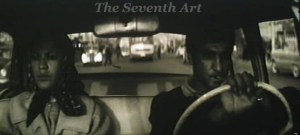
Ebrahim Golestan’s Brick and Mirror (1965) begins inside a taxi. The man at the wheel changes the radio station and a voice begins to narrate:

“The night had settled over the forest. The hunter trod through the thicket stealthily. Danger throbbed in the dark. Fear filled the forest. And terror sparked the night. The night was hard. The night seemed long. Nothing was reflected in the eye of the owl but anguish. And fear was life’s only sign. The hunter trod stealthily through the night. Beasts were staring. And the eyes of the thousand-eyed perils were wide. It was dark. And in the dark, there was no one to tell the hunter and the hunted who was the hunter and who was the hunted.”

The camera, meanwhile, gazes safely from behind the windshield, the vast city of Tehran. Night has well fallen and all the street lights are up. It seems like thousands of gigantic eyes staring at the camera, hiding behind the darkness, waiting to pounce on the unsuspecting taxi. After a couple of minutes, we cut to the face of the driver – a thirty-ish gentleman resembling De Niro during his prime. Golestan’s composition is immediately striking. The taxi driver, here and throughout the film, is placed at the margin of the frame, with the dark city pushing him to the boundaries. One gets the feeling that this one might just be the (premeditated) Iranian reply to Scorsese’s Taxi Driver (1976).
Brick and Mirror

Brick and Mirror is unlike anything I have seen from Iran, for it is my introduction to Iranian cinema before the revolution. With the world’s eyes keenly focused on Iran, – politically or otherwise – there prevails a risk of drawing a monolithic portrait of the country. Watching Brick and Mirror, one can see how starkly different the two ages are and how drastic a cultural shift its citizens were subject to after 1979. Golestan’s film, more or less, also testifies the strong relation between France and Iran that prevailed during the Shah’s regime. He, evidently and interestingly, draws inspiration from both Godard and Bresson, apart from incorporating tenets from other famous schools of filmmaking. With complete control over every aspect of the film (writing, directing, editing and producing it by himself), Golestan churns out a film that is clearly Iranian in content, yet could pass of as one of the French New Wave movies.

Brick and Mirror
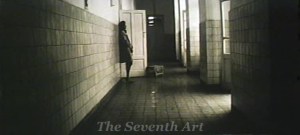
takes place over the course of 24 hours in the life of this taxi driver, whom we come to know as Hashemi (Zackaria Hashemi). That fateful night, a woman in a veil (apparently played by the iconic Forugh Farrokhzad) boards his taxi and leaves behind a baby. Unable to locate the woman, Hashemi is forced to provide shelter to the child for the night. He is helped by his love Taji (Taji Ahmadi), a woman who works at the local pub. But the most important of all characters in the film is the city of Tehran itself.  The city is also the most powerful of all characters, devouring mentally and physically one character after another. Never has a metropolis been filmed so beautifully yet menacingly. Using the cinemascope judiciously and employing camera movements that are seldom meaningless, Golestan and cinematographer Soleiman Minassian ensnare their characters, like the city itself, surrounding them and locking them to their environment. And how often do we see a tracking shot that is as pregnant with emotion and significance as the final shot of Taji standing at the end of the long, dark corridor of the hospital?

Hashemi and Taji are two well written characters, who complement each other emotionally and ideologically. He is a thorough fatalist, classifying every outcome as good or bad luck. He prefers to live in the dark, literally and figuratively, away from prying eyes of the society. She, on the other hand, is the quintessential existentialist (Again, a possible influence of contemporary French philosophy), believing strongly that we make our own lives and being too prude is no good. But she is also an extreme romantic, always giving Hashemi hope for a new beginning, who seems to shrug off her philosophies (At one point, Golestan even frames Taji in such a way that she appears as one of the photos on the walls of Hashemi’s house). In an explosive scene shot on the streets, both of them plunge into a heated discussion after he delivers the baby to an orphanage against her wishes. The camera tracks in front of them as they walk arguing with each other. And all of a sudden, in a humbling manner, they break into utter silence after a funeral procession cuts through them, reminding the about the futility of their words and the ever tangible presence of death.
Brick and Mirror

Hashemi does bear a striking resemblance to Schrader’s Travis Bickle, in the sense that both of them are marginal characters who are forced to witness a society that is vigorously dragging itself to doom. But the commonality stops at that. While Bickle is an alien frustrated by what he sees in the rear view mirror, Hashemi is the one in that mirror (In one scene, the driver of the taxi that Hashemi boards cribs about his profession and tells the latter that he is lucky not to be a taxi driver). Moreover, Bickle’s decision to do something about it all is exactly contrary to the borderline-agoraphobic Hashemi, who believes it is better to stay low and go through life unnoticed by anyone. True that he comes to know of all the rotten crevices of the city and the breakdown that it is leading to, but, being the determinist that he is, is satisfied with having posters of heroes in his room rather than becoming one. In fact, it is Taji who is closer to Bickle than Hashemi. Only that her search, here, is for inner peace.

Jonathan Rosenbaum describes the film as being Godardian. I doubt if there is any other way to describe it at all.  Take a look at the narrative structure of the film, whose episodic nature and style reminds us of My Life to Live (1962) than any other Godard film. Like the French director, Golestan lets his script freewheel all the way. Characters come and characters go. Their lines are seldom relevant to what is happening. But as always, what they speak is less important than why they speak so. The spirit of the 60s, especially of Paris, seems to show clearly in Tehran too. Intellectualism seems to have taken control over pragmatism and emotionality. People sit all day in pubs philosophizing and indulging themselves with tangential conversations. Consider the scene at the bar where Hashemi arrives, carrying the baby. One of the well dressed gentlemen, out of the blue, begins a monologue about the importance of alphabets in the search for truth and the relation of crossword puzzles to all that (Don’t ask me!). One is reminded immediately of the scene at the pub in Made in U.S.A. (1967), where, too, one of the characters goes on talking about the futility of words and sentences!

Brick and Mirror

Furthermore, Golestan never cares about the progressive coherence of these episodes. He generously shifts gears and tones throughout the film. Hopping regularly between vérité, expressionism, documentary and realism, he concocts something very fresh and unique, even by the New Wave standards. Yes, the jump cuts are there too.  Additionally, Golestan’s shot composition shows influence of Bresson also. Golestan breaks down action into atomic parts with no history or future, attaining the same effect that the French master achieved. Also Bressonian, and one that would go on to become the forte of directors like Kiarostami, is Golestan’s use of off-screen space through sounds. Often, we see that the camera is fixated on certain characters, even when they are not the ones talking. When Hashemi and Taji are out in the streets, their voices are regularly consumed by the noise of the city. One scene would perhaps sum up the entire attitude of the film. There is a sequence at an orphanage where Hashemi is trying to admit the child he is holding. There is also a middle-class woman in the room who, at one point, breaks down revealing that she has been feigning pregnancy all the time. This is an intensely melodramatic moment in the script and the natural reaction for a director’s camera would be to gradually zoom in to the crying lady’s face. Surprisingly, Golestan shows us the face of the receptionist of the orphanage, who turns teary-eyed for a reason that might not at all be related to the drama of the instant.

Almost the whole film, both formally and script-wise, never conforms to the popular law of cause and effect. Golestan refuses to explain everything and seems to want us to not understand the city, much like Hashemi himself.  Who is that crazy female at the hell-hole that Hashemi meets earlier? No answer. What is the guy, whom one might have called a charlatan earlier in the film, doing on the national channel talking about the ethics of living? No answer. Could that female, whom Hashemi sees the second night be the same lady who left the baby in his car the previous day? May be. But surely, all these aren’t merely confusing or distancing devices. Each of these scenes reveals something about the city and the era, in one way or the other. Each of them has indirectly managed to document history – cultural and cinematic. Consequently, now more than ever, it feels that these seemingly stray events are the very elements that can help us perceive better a country that has been unjustly homogenized using, what Brick and Mirror shows us, a faux identity.
Il Conformista (1972) (aka The Conformist)
Bernardo Bertolucci
Italian

“That’s why a normal man is a true brother, a true citizen, a true patriot… A true fascist.


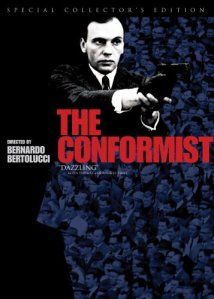
The ConformistBernardo Bertolucci’s The Conformist (1970) is everything that a viewer could ask for – a great story, interesting characters, stylish visuals and a purely cinematic language to convey them all. Using images that possess the judiciousness of a Tati, meaning of an Antonioni and elegance of an Ophuls, Bertolucci, not even 30 at that time, conjures up a film of both high mojo-quotient and long “shelf-life”. Evidently inspiring The Godfather series, The Conformist is the kind of film that persuades you to understand what the difference between direction and visual illustration is. The next time somebody kills you with that irritating “The book was better” act, hit them with this one. Not that The Conformist is better than its book version, but only that it makes such comparisons invalid.

Adapted from Alberto Moravia’s novel, Bertolucci’s script follows a young man, Marcello Clerici (Jean-Louis Trintignant), during the years just before the second big war. He is about to get married to a typical middle class woman, Giulia (Stefania Sandrelli), with “paltry, little ambitions – all bed and kitchen” in order to become a “normal” person in the society. He is also all set to be inducted into the Italian fascist party and has to carry out the assassination of an insurgent in Paris, Quadri (Enzo Tarascio), incidentally his professor during his college days. Employing ace cinematographer Vittorio Storaro’s hypnotic tracking shots and handhelds and seamless, highly-stylized, tense cutting between various timelines, Bertolucci attempts to illustrate the reason for the rise of fascism by delving into the psyche of one man with a troubled past and an uncertain future.

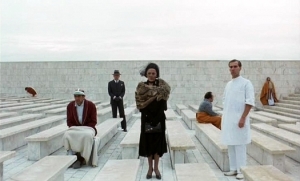
The Conformist is a difficult film, not because its themes are heavy or its form too radical, but because the statement it proposes is a tad indigestible. Once you get over its slight simplification of ideas and reasons, it is a sweeping masterwork that you are looking at. I probably haven’t seen any film that as clearly reveal how we have all confused sexuality with morality, morality with religion, religion with politics and politics with security. The tension is palpable in almost every shot of the film. Consider the central scene of sheer cinematic awesomeness where Quadri and Clerici recollect what actually went wrong. Using staggering interplay of light and shadow, gestures and movements and room space and sound, Bertolucci develops the central motif of the film in pure film language, without ever betraying the diegesis of the film. Bertolucci’s script takes up Plato’s Allegory of the Cave, which suggests that humans are all prisoners inside a dark cave unable to differentiate between real objects and the shadows that they cast on the walls, and adapts it so as to examine the dark history of the country. It is after this point that every element of the film cries out for attention and the ambivalence of the central character brought to light. Especially remarkable is the final shot of the film where, after Italo is swept away by a Rossellinian crowd, Clerici sits on a low platform near the fire, looking towards a homosexual street dweller through prison-like iron bars, still unsure of his political, sexual and moral footing.

The ConformistIn fact, all the major characters in the film tantamount to prisoners of Plato’s cave. None of them actually know what their principles actually mean or what they want from it all. Clerici is confused with both his sexual orientation and political ideology. His wife, Giulia, does not see beyond the two things that Clerici mentions. The professor seems to spend an idyllic life like that of the bourgeoisie –the very people whom he is fighting against. Anna Quadri (Dominique Sanda) is none but a female counterpart of Clerici. Only that the mass she is conforming to happens to be the resistance group. The tragedy about Manganiello (Gastone Moschin) is that the people he despises is the very group he works for (“Cowards. Perverts, Jews. They are all the same. If I had my way, I’d put them all up against the wall. They should all be eliminated at birth”, he says). Even the blind Italo (José Quaglio) joins the group not because of his political leanings, but for “normalcy” and hence safety. It’s almost as if the people who oppose passive acceptance of political philosophies are themselves creating another form of fascism by unanimously scandalizing it – an idea ambiguously explored in Daldry’s The Reader (2008), where it is as much a taboo to humanely understand the people associated en masse with the Holocaust as it is to carry out the inhuman acts of fascism without questioning it.
What is brilliant is the way Bertolucci brings to surface this ambivalence of his characters. He regularly captures Clerici in the frame along with his reflection on mirrors, glass panes and windows. He places him behind wind shields and transparent surfaces and cuts in tandem between the views from both sides. He softly blurs out of focus and then into it when recording Clerici. He breaks both continuity and the 180 rule (also serving as a distancing tool) to have his characters oriented in opposite directions. At one point, Clerici even assumes two quirky firing stances – one symmetrically away from the other. Furthermore, throughout the film, Bertolucci takes Clerici through regions of light and darkness – knowledge and ignorance – thus elevating the already expressionistic tone of the film. It is as if this duality of Clerici’s is as inseparable as his features, perhaps because he never completely believes he is doing the right thing by trying to fit into pre-fabricated structures of the society. As Bertolucci rightly says in an interview:

“Marcello is really a very complex character, searching to conform because of his great, violent anti-conformism. A true conformist is someone who has no wish to change: to wish to conform is really to say that the truth is the contrary.”

As a matter of fact, Clerici is swappable with any character in the film, for he imbibes something from each of them. He behaves like Giulia in order to become one of them. He gradually finds himself moving towards Quadri’s ideologies than the fascists’ (In the layered scene at the ballroom, Bertolucci cuts to a photograph of Laurel and Hardy, indicating the frivolous and merely superficial antagonism between them). Clerici sees himself in Anna. His craving to become an acclaimed fascist comes in the form of Manganiello. One could even say that he meets his own future self in the form of his conformist father (Giuseppe Addobbati) at the asylum, whose political and (alleged) sexual contradictions are not far from Clerici’s own. But he is actually the closest to his friend Italo – insecure and scared because of a difference but unable to see beyond immediate refuge (Bertolucci once superimposes their faces, when Italo is reading a piece of text in praise of Mussolini and Goebbels). Italo even says early on in the film that they are, in a way, similar, after which we notice that he is wearing an unmatched pair of shoes. The idea of physical and ideological blindness recurs throughout in the film to reinforce the Plato allegory.

The ConformistI have always considered Lina Wertmüller’s Seven Beauties (1975) as one of the greatest movies ever made and the best one about the Holocaust that I have seen. Watching The Conformist, one can clearly see where Wertmüller’s movie gets its inspiration from. Both films seem to complement each other thematically. While Seven Beauties examines how man’s fake principles fade into oblivion when it comes down to survival, Bertolucci’s film shows how man can assume false policies in order to survive. However, formally, both the films seem very similar in the sense that both of them exaggerate melodrama to the point of caricaturing it and consequently, derive meaning out of that absurdity. Both use oversaturated colour palettes and chromatic shifts generously to keep reminding us of the phony nature of it all. In fact, Bertolucci keeps prodding us with theatricality. As Clerici recites his father’s past, three women are performing a song in the background (Incidentally called “Who’s happier than me?” – another allusion to the prisoners of the cave). He meets Anna in a ballet class. There is even an edited scene that involves blind people dancing to a piece of music.

Bertolucci is one of the biggest New Wave fans and it shows in the host of movie references that he places in the film. It wouldn’t be a coincidence if you spot allusions to The Little Soldier (1960) or Alphaville (1965) in the film, for the director himself tells us so in an interview. Not counting the humourous nods to neo-realism and Buñuel, Bertolucci is continuously in conversation with his mentor Jean-Luc Godard throughout the film. With anecdotes about the film’s first screening and the influence of Godard on his style, he mentions here how Quadri was modeled with the French director in mind and his assassination, in a way, signified the film’s stylistic and ideological shift from Godard’s. But clearly, the relationship is one of reverence. When Clerici tells Manganiello at point: “What a strange dream I’ve had. I was blind and you took me to a Swiss clinic for an operation. And professor Quadri performed the operation. It was successful. I regained my sight and went off with his wife who had fallen in love with me”, one suspects that this is not just a token of his wavering political and sexual stance, but Bertolucci’s own gratitude towards Godard for his influence.

The ConformistHowever, Bertolucci deviates from Godard by making The Conformist a highly individual-oriented film. While Godard’s is a study of the effect of social and political structures on the individual, Bertolucci’s is the exploration of the effect the psychology of (a generalized) individual has on socio-political norms. His Clerici is a character tailor made for in-depth psychoanalysis and many facets of the film clearly remain subjective. For instance, why does he “see” the same woman thrice, at different places, in the film? Why does no one else stalking Manganiello? Does he even exist? Why does Clerici marry Giulia, even though he hates her typically bourgeois mentality? Bertolucci’s mise en scène suggests that the answers are functions of Clerici’s psyche, which is evidently affected by his childhood trauma and sexual “deviation” (Although every reading of The Conformist insists that it illustrates the role of sexual deviance in the rise of fascism, a case could be made for any kind of difference – sexual as with Clerici, physical as with Italo and even religious, as with the mystic Hanussen). This way, Bertolucci calls for a reassessment of fascism as a force that has grown bottom-up because of individual insecurities, fears, motivations and ignorance rather than a mass hysteria initiated by an arbitrary single man.

(Pics Courtesy: mcnblogs.com, brynmawrfilm.org, dvdactive.com)

Four Faces of King Lear

Four Faces of King Lear

Shakespeare’s plays have become an endless pool of resource for the filmmakers of the world. Their universality of themes and emotions has intrigued a range of directors and has prompted so many adaptations and retellings. One of them, King Lear, distinctly stands out. Romeo and Juliet may have become one for the classrooms and Macbeth may still be classified as a terrifying legend, but King Lear seems to grow with age and feels immensely relevant and profound now more than ever. The themes handled by the epic resonate and typify the post-modern era as if the book was written a few years ago. Of course, it is difficult to make a film that is both true to the literature and retains its cinematic qualities without the influence of theatre. But some of these projects have done this well, to say the least. Here are four of the cinematic versions that were but inevitable to come. 

King Lear – Jonathan Miller (1982), The United Kingdom

A film from the home country to begin with. Miller’s King Lear is my substitute for the impossible-to-find Peter Brook version. Made as a part of a massive project undertaken by the BBC in 1982 to film Shakespeare’s works, this version has been remembered almost solely for the monumental performances of all the actors. And in harmony with the intention of the production, the film remains thoroughly faithful to the classic. It attempts to take into it everything that Shakespeare put forth in his narrative.

I must admit that I was quite skeptical when I started watching the film. Shot in 4:3 and under an objective of just filming Shakespeare’s work, I expected the film to be too theatrical and plainly, an extended soap-opera. But the film is far from that. It almost completely does not use expressionist zooms, shot-reverse shots and even a background score for that matter. Yes, it is excessively lit and has got a soap-like visual quality, but it sure does possess cinematic values of its own. Its cinematography, particularly, uses room space well and with surprisingly long shots, achieves a quiet brilliance of its own. The camera is almost static but it conveys much even with that restriction. Interestingly, it almost always films Lear from a downward angle perhaps mirroring Lear’s own infallible pride.

Hordern’s performance as Lear is evidently great and at times, even imposes on the other actors’. Edmund’s character, played by Michael Kitchen, serves as the comic relief and regularly breaches the fourth wall to glorify his vileness. However, the production design of the film leaves a lot to be desired. Shot almost completely indoors, the film uses a bland colour palette that is neither as expressive as Kurosawa’s version nor as meticulously controlled as Kozinstev’s. But the 185 minutes of inspired performances more than make up for that and eventually deem it a very worthwhile effort.

Korol Lir – Gregori Kozinstev (1971), The USSR

Kozinstev’s least talked about adaptation is ironically a fantastic one. Shot arrestingly in widescreen, the film reminds us of the Tarkovsky classic Andrei Rublev (1966) with its measured pace and absorbing imagery. The extraordinary cinematography uses the widescreen judiciously as it uses track shots to cover the vast stretches of barren and decaying landscape that reflect the very nature of Lear’s mind. Kozinstev’s employment of largely empty rooms and lifeless locales coupled with the recurrent images of wild beasts that highlight the torment that Lear is going through provides the perfect ominous atmosphere for the tragic showdown.

Where the BBC version was elaborate and expressive for the sake of the text, Korol Lir is less verbose and more cinematic. The images take the driver’s seat and the emotions are kept suppressed. This quietness of the images adds to the menacing atmosphere that builds up. Kozinstev utilizes the black and white costumes effectively to convey meaning rather than verbalizing it. Yuri Yarvet shines as the (completely shaven!) foolish king and carries naturally with himself an air of madness.

Kozinstev remains mostly faithful to the text and retains most of the characters and elements as they are. However, his handling of Lear and The Fool are interesting. After the first part of the film, Lear is almost constantly shot downwards. At times, the camera neglects him and shuns him oblivion and others, it completely homogenizes him with the helpless mass. Kozinstev places Lear as an insignificant part in the huge fabric of nature. This stark contrast in his position before and after the partition evokes a sense of sympathy for Lear even though his plight is a result of his own decisions. Additionally, Kozinstev ties Lear’s fate to that of his kingdom itself. As Lear deteriorates, we see images of mass exodus looking as if headed towards doom.

And more fascinating is the character of The Fool. Kozinstev does use The Fool as the pivotal character but where Shakespeare killed off the character towards the end, Kozinstev retains him even after Lear’s death. An interesting proposition – The Fool without The King – considering that The Fool is but a manifestation of Lear’s mental self. The soul without the body, the shadow without the object.

Ran – Akira Kurosawa (1985), Japan

Moving farthest from the country of origin, we arrive at my favorite version of the tragedy. Akira Kurosawa’s Ran is a revelation and a slap for those who considered him defeated after such frustrating years. Kurosawa gives a complete reboot to the book and revamps it perfectly to suit the backdrop. He had already sizzled in the multi-layered feudal drama Kagemusha (1980) and in Ran he retains the backdrop to carve out a shattering masterpiece that is much more cinematic, much more harrowing and much more human than its counterparts.  As much cold at surface as it is with its gut-wrenching violence, Ran at heart it is an elegy, a requiem for the helpless decline of humanity.

Kurosawa makes remarkable changes in the text as he replaces the daughter trio with three sons. He completely eliminates the Gloucester subplot and the theme of lust from the picture. The central focus of Kurosawa remains the idea how man’s past catches up with him no matter what he does. Hidetora (The Lear character) suffers progressively as every one of his action turns back on him one by one. He shelters in a ruined fort that was destroyed by him. He then is protected by Tsurumaru who was blinded during one of his raids. And both his daughters-in-law have been affected by his wars in one way or the other. Hidetora has cast the boomerang, now he has to collect it.

Kurosawa was an excellent painter and it shows. With remarkable use of almost all colours, Kurosawa takes us the filmic medium as his canvas and strikingly brings out the brewing savagery and insanity of all his characters (“Ran” incidentally means Chaos).

Watching Ran even after 20 years of its production, a shiver runs down the body, for the images are of such power. The threatening clouds that preface each scene, the opening hunt, Lady Kaede’s vengeance and its termination and the final image of the blind Tsurumaru dropping the scroll of Buddha – more than an adaptation. Poetry of war.

King Lear – Jean-Luc Godard (1987), France

It actually isn’t fair to call this one a French adaptation. It is Godard’s adaptation, period.

And it isn’t fair to even call it an adaptation of King Lear; it is a film that tells about an adaptation. I might just be giving the article away, but there are some traces of the Shakespearean work to classify it with the other three films. It follows a man who calls himself Shakespeare Junior the fifth just after the Chernobyl incident as he tries to re-create Shakespeare’s (lost) work. And as usual, Godard uses this loose structure to weave his tangled web of ideas and reflections.

What Godard has done here is commendable because he takes Lear from one form of literature to another. All the Lears hitherto have been narrative oriented whereas Godard presents him inside an essay – an essay on art, its preservation and reproduction. He discusses how images are unique and how it is inimitable. Additionally, he places the audience directly in King Lear’s shoes. Lear wanted to believe everything he heard from his daughters and similarly, the audience is “led” to believe that the film has ended much before the actual finish (many times!). And through this mockery, Godard calls for a desertion of belief on the images we see. He emphasizes time and again that “seeing isn’t believing”.

The film regularly tells us that it is 3 journeys into King Lear. Godard grazes the book, which is essentially a tale of struggle of virtue amidst domination, power and betrayal, and extends its possibilities to ponder upon the nature of the cinematic medium. He explores three kinds of domination – domination of commercialism over art, domination of power of image over that of words and the domination of existing forms of cinema over the new ones. And surprisingly, the final tragic image of Lear (Don Learo here) doesn’t show him crying with Cordelia in his arms. Instead, his back is turned as Cordelia remains dead behind him. He continues to be blind.

As such King Lear is all about decadence. Everyone in the story is blind. Lear is blinded by his pride and the fear of hatred, Gloucester by mere belief and later physically, Edmund the sisters by their lust for power and even Kent by his loyalty. The only person unaffected by this “disease” is Cordelia (and perhaps The Fool who is but half a man) whose is the only symbol of virtue and righteousness in the story. And Shakespeare’s work is a tragedy only because of her death that apparently leaves us without a channel of hope.  However, Kent’s eventual awakening after Lear’s death is a possible conduit to sustenance of humanity.

To see how various filmmakers have been obsessed with the representation of power over virtue and vice versa, death and survival of good and vagaries of the human mind is as enlightening as it entertaining. One realizes that even after so many interpretations and analyses, the book remains a constant supplier of thought and remains open to so many adaptations. I, for one, would like to see at least two good Indian adaptations of the book. One, a neorealistic version set in the cities of modern India where struggle for survival is at its peak – something like what would evolve if Wong Kar Wai made it. And the other, a Ran meets Tokyo Story kind of adaptation rooted in the most rural of India’s villages where, also, the feud over familial property remains a fiery issue.

Lettre À Jane
(Letter To Jane: An Investigation About A Still)
1972

Letter to Jane may be seen as a companion piece to the intriguing Tout Va Bien (1972), for the idea of the film sprouted during the making of Tout Va Bien. Godard and fellow Dziga Vertov Group filmmaker Gorin share the sound-space as they step out of the cinematic medium and go on to discuss the role of filmmakers in political activism. Through pictures of Vietnam war, they talk about the importance of questions and questions of importance. They urge the audience to take a journey rather than watch the film and hence decide the role of filmmakers as a whole. Through one particular picture, that of Jane Fonda “empathizing” with the guerrillas, Godard  brings forth issues of media initiated lionization, attitude of the west towards the Vietnam crisis and the Kuleshov effect on photos from the war.

Letter To Jane (1972)

Letter To Jane (1972)

Letter to Jane is the most and perhaps the only disappointing Godard film I’ve seen. Disappointing because Godard not only explores the role of intellectuals in revolution and politics but also tries desperately to classify himself as one. Disappointing because what he did absolutely effortlessly in his early films, he tries to do it as a requirement. Godard dismissed his early films as being bourgeoisie, but even Letter to Jane seems like a discourse for high-brow cocktail sipping crowd, contradicting Godard’s Dziga Vertov principles. Is it only me who feels that Godard is playing God and trying hard to over-analyze what may be a genuine gesture for concern or am I succumbing to the Kuleshov effect too? May be not. Godard himself seems to have become disillusioned after the film, once again, and reworked his strategies and policies.

Having said that, Letter to Jane is one of the most engaging Godard films of this period. With a single gesture from a photograph, Godard extracts so much meaning out of Fonda’s glance (the comparison spectrum runs from Descartes to Welles) that any actor watching the film will feel a shiver running down the spine. They’ll know they are being watched and they’ll know acting isn’t a walk in the park. And true to the film’s claims, it does not give us answers and neither does it tell what the questions are. What is sure is that it asks the audience to extract the questions themselves, for right answers follow only right questions.

British Sounds
(See You At Mao)
1970

Though Godard has made longer and more significant films in the same period, I chose British Sounds because it is here that we see Godard’s masterful use of dynamics and stillness of images that stands quite in contrast to the verbose nature of the previous film. In British Sounds, Godard goes out and out political without any compromise, sugar-coating or skeletal narratives that support his views. What remains intact is Godard’s instinct to experiment and shock, his urge to make his audience think and his sensitivity as a filmmaker towards the events around him. As a result, (not only this film but all his films of the period) what we get isn’t a film with a message, but a message in the form of cinema.

British Sounds (1970)

British Sounds (1970)

It is refreshing to see Godard’s experimentation employed in this transformed style of working that is based on his strong ideologies. He still sticks to the Brechtian theory as he continuously reminds us that this isn’t a propaganda film from the 20s’ USSR, but his own revolutionary filmmaking that is as rooted in cinema as it is in politics. This occurs in the form of verbal mistakes in the narration, complete mismatch of sound and image each of which has multiple instances carrying forward a different thread and the occasional dormancy of camera movement while capturing images dispassionately.

But I will remember the film for just two things. The first is the extended tracking shot of the conveyor in an automobile factory where the workers are seen assembling cars at a rapid pace. Running to almost the same length and as irritatingly noisy, the shot reminds us instantly of the traffic jam scene from Weekend, in a sense providing stark contrast between the bourgeoisie and the working class situations using similar imagery. The second would be the final few images of a fist tearing through the flag of Britain, occurring multiple times. They look as if Godard is asserting “Behold, the Revolution!

Le Vent D’est
(Wind From The East)
1970

Wind from the East is arguably the most difficult-to-watch Godard film ever. About 5 times talkier than the average 90 minute movie, Godard fills the runtime with syllables, syllables and more syllables. Perhaps he was making it clear once and for all that his films are not for passive enjoyment. And boy, does he make himself clear! A thorough test of endurance, even for Godard fans, as he continues to put forth his political theories and experiments with the relation between sound and images. Godard also examines the role of a filmmaker in revolution using revolutionary ways of filmmaking.

Wind From The East (1970)

Wind From The East (1970)

I feel that Godard, being an uncompromising filmmaker, does not want the audience to compromise either. He does not want them to have mixed feelings about the film but rather to share a love-hate relationship with it. He wants us to either chuck the film and move away from the screen or to rethink, reform and develop our political ideologies. In essence, he offers a discussion, an essay – in the form of a film – one which people should get involved in only willingly. It isn’t just the patience of the audience that is taken to the extremes, but almost everything that Godard stood for in this period. He goes totally out against the Hollywood’s way of life and the “filtered” cinema it makes. He condemns the star system and the bourgeoisie nature of blockbusters, by directly having subplots of filmmaking within the film. He takes up the issue of intra-party betrayal and clashes as he did in La Chinoise (1967) and condemns the revisionist nature of so-called communists outright.

In some ways, Wind from the East is the counterpart of Godard’s 2 or 3 Things I Know About Her of the period. He wraps it up with enviably small budget and makes it as visually appealing as his other films. It is essentially this typically Godardian imagery that keeps one sitting through the film and the very Godardian nature of narrative that distances us and makes us think. One particular sequence, where we are shown the method to make explosives is particularly interesting for its ingredients – all branded capitalistic FMCG – the ultimate statement on self-destruction of the west as Godard hints at destroying entities using the entities themselves.

Sympathy For The Devil
(One Plus One)
1968

Godard’s most effective meditation of role of the artist in political and social reformation comes in the form of Sympathy for the Devil. Godard was utterly dissatisfied with Sympathy for the Devil because the producer had included the completed song at the end credits which is exactly opposite to Godard’s purpose. Godard shows the gradual path to revolution and intentionally leaves out the orgasmic moment, precisely like in the erotic stories that visit the narration now and then, urging people to get to it by themselves. And naturally, his director’s cut, One Plus One, will have a better edited version of the film.

Sympathy For The Devil (1968)

Sympathy For The Devil (1968)

Once again, Godard utilizes multiple sound and image threads to weave together a mysterious fabric of ideologies. The prominent thread shows The Rolling Stones creating one of their songs from the scratch in a mundane fashion, so typical of Godard. These images are interleaved with verbose sequences taht are overtly revolutionary in character. Using these scenes Godard targets a range of things that include the fascist, racist and misogynistic nature of occidental art, improper methods of activism and dissemination of revolutionary spirit and political power for the black (boy, would he have loved if Obama had been elected then!). He uses his characteristic word games to the full extent devising words like Cinemarxism and Sovietcong.

And the using the Rolling Stones part of the film, Godard quietly raises issues about artist and the society and the futility of language. He contrasts the talky campaign of the extremists with the subtle yet effective nature of artists but never answers if their paths should cross or if artists should indulge themselves at all. Also intriguing is the film’s cinematography as it snakes along the cramped recording room with protracted pan shots. And the final image, a possible homage to Pudovkin’s arresting film Mat (1924), is vintage Godard as he signs off with his distinctive chromatic shifts.

Week End
(Week-End)
1967

Aah… Week End. A film that would have made John Waters proud. It wasn’t until this film that I got a firm hold on the roller coaster that was Godard. Fully bloomed, Godard plays with the medium like a potter does with his sand – only more carefully careless. Self-proclaimed end to Godard’s most celebrated period is fittingly over-the-top, with the evidently characteristic Godardian magic oozing out of each second of runtime. Closer to conventional narrative than La Chinoise (1967) but overtly more political than his Anna Karina period, Godard leaves no stones unturned to lay open himself and chart out what was to become his mainstay.

Week End (1967)

Week End (1967)

The film follows the road trip of a French couple immediately following a notoriously extended narration of an erotic tale. They come across everything but the kitchen sink (or may be that too…) on their way as Godard employs the unsuspecting leads to paint the screen with his bubbling political ideologies and cultural stand. With intriguingly long tracking shots (including the instant classic traffic jam where Godard pulls off an unimaginable 10 minute odyssey that is as dynamic as it is static) Godard distorts space and time and disorients the viewer from “expecting” anything. So all the viewer can do is to live the moment and reflect on what’s happening on screen. Hmmm… the Brechtian influence has most definitely paid off this time Monsieur Godard.

Progressively mad, Week End ironically takes civilization backwards to the point where we meet cannibalistic guerillas waging war with catapults and stealing picnic baskets (Yes, they are smarter than the average guerilla!). Intense meditation on African colonialism and featherweight moments of self- glorification (to the point of calling himself The Saviour) intersperse to form an oddly entrancing landscape that has to be seen to be believed. An addictive masterwork or decidedly camp, depending on how much you appreciate Godard’s style.

La Chinoise
(The “Chinese,” Or: Something Like The Chinese)
1967

In La Chinoise, Godard explores the issue of intra-party ideological difference as he tries to contrast what Marxism and Maoism stand for. He criticizes, though not hard-hittingly, the revisionist policies of the present-day socialists and questions if they are true to communist principles at all. But the larger discussion in the film remains about the involvement of the student community in revolution – an issue he grazed in Masculine-Feminine (1966) employing the same Jean-Pierre Léaud. Through this issue and use of a classroom-like atmosphere for almost the whole film, Godard calls for sensible political education and calculated extremism – both of which the protagonists of the film fail at.

The Chinese (1967)

The Chinese (1967)

Godard’s use of the red, blue and white colours reaches remarkable heights as he employs them to convey multiple layers of meanings. On a basic level, Godard uses them to portray love, hate and apathy respectively and Contempt (1963) and A Woman is a Woman (1961) remain prime examples of that.  Additionally, he uses them to represent communist, neutral and capitalist principles in this trilogy. He also alludes to the presence of these colours on the French flag, as if suggesting that France herself is being torn apart by these opposing ideologies. Godard turns down the notion of the Left and the Right in Made in U.S.A. (1966) and interestingly, red and blue respectively occupy the right and the left side of the French flag! And in La Chinoise, he does all this so effortlessly.

Godard continues to ruthlessly breach the fourth wall and even refers to Brecht and other influences during the course of the film. In some ways, La Chinoise looks like Godard’s first politically revolutionary film. 2 or 3 things I Know About Her looked like a yearning for change whereas La Chinoise seeks to do the change. Because of this significantly didactic nature of the film, many may decide to put an end to their journey of discovering Godard. But it is indeed after this film that Godard’s films become both politically and cinematically revolutionary.

2 Ou 3 Choses Que Je Sais D’elle
(Two or Three Things I Know About Her
)
1967

What Bitter Tears of Petra Von Kant (1972) is to Fassbinder, 2 or 3 Things I Know About Her is to Godard – minimal, meticulously controlled, thematically central and hard to watch. Harder than that is to follow everything that Godard throws at us, especially when he does it in his characteristically indulgent way. He proves, as he does regularly, that the language of cinema is left largely unexplored and it is, or rather can be made free of the subjectivity and pseudo-objectivity that plagues the oral languages and limits the world one gets and gives access to.

Two or Three Things I Know About Her  (1967)

Two or Three Things I Know About Her (1967)

Another multi-layered approach by Godard compares the central character with the actress who plays her and the city of Paris herself.  It looks as if Godard is bemoaning the changes that are taking place in the society as it assumes a monstrous attitude through incessant consumption and the rat race it nurtures. Scenes of massive reconstruction that dominate the big picture are interspersed with the quotidian struggles that delineate the microcosm as the protagonist takes up casual prostitution to supplement the meager income of the household. Again Godard hints at the prostitution of the city’s ideologies with effective use of red and blue colours, as with the other films of the trilogy.

If I have to sum up the film in a single word it would definitely be “uncompromising” and so will be the word that I would use to describe Godard himself. Till 2 Or Three Things… Godard used a simple story line as a platform on which he would knit his ideas. But here, he sheds even that simple requirement and goes beyond his working limits, which is phenomenally radical by itself. Because of this, the audience is completely left helpless as the characters directly address them and force them to think. This way, Godard stretches the Brechtian theory and makes it the prime mover for the film instead of using it as a tool like he did so far. This is implied in the very title of the film as Godard warns us of the fragmented nature of the film and prepares us to fill in the rest by ourselves.