All Posts


[The following is a translation I did with Andy Rector of the 14-page interview with Jean-Luc Godard that appears in the October issue of Cahiers du Cinéma]

That is what is beautiful about The Image Book. The whole life piles up. You keep everything with you.

I debuted in the second Revue de cinéma when it was with Gallimard and it was with the help of Doniol-Valcroze that I entered Cahiers little by little. Doniol-Valcroze was the son of a friend of my mother’s at the Victor-Duruy high school. I thought he received me because of that. I learnt later that he was demobilized and took refuge in Switzerland. It was my mother who got him to France, to Thonon, on a little speedboat called “the hyphen” and with which we often went vacationing in my grandfather’s property. I discovered that after Doniol-Valcroze’s death. I wasn’t against the Cahiers management at that time. He was the editor-in-chief along with Bazin. He was a “gentle man” in the literal sense of the term. I didn’t know Bazin like Truffaut did at all. I knew Bazin as the head of a communist organization, Work and Culture, just opposite the Beaux-Arts. There was a small library opposite run by a friend of Rivette’s from Rouen. It’s a story that I attached myself to little by little, not from the beginning, but there are all these stories I want to keep to myself. I was prudent like the Delacroix character. I stole some money from one of my uncles to finance Rivette’s first short film, Le Quadrille.

Whom did you feel closest to?

Rivette. Then Truffaut, but before he made Les Mistons. I don’t know if he was already married to Madeleine Morgenstern, whom I liked a lot. He’d become rich by this point. Madeleine Morgenstern’s father was the head of a distribution company called Cocinor in the Nord region and in Paris. But when he wrote “A Certain Tendency of French Cinema”, I hung out with him a lot. I wasn’t so much with Rivette. We could go see films at 2pm and leave at midnight because it was a single-admission cinema. I’d give up after an hour or two. Rivette stayed until the end. Rohmer had a different life. He was a professor and lived in a small hotel opposite the Sorbonne. His name was Schérer and he started signing “Rohmer” so that his mother didn’t know he led a dissolute life in cinema. These were three different friends. It was real camaraderie with Schérer—I still call him Schérer—Rivette and Truffaut. Schérer was one of the few who knew which woman I was in love with, and I was the only one to know that he was in love with the wife of an old head—a communist—of the CNC. Rohmer was ten years older and he was the counterbalance to Bazin and Pierre Kast. In The Image Book, I have a shot of the Liberation of Paris. We see an FFI member from behind, with a gun on his back, speaking to a woman on her knees. To my mind, this man was always Pierre Kast. I hope it’s true.

We get the feeling that you didn’t have political discussions at Cahiers at that time.

Very little. It was the cinema. Even girls were a secret. I remember a moment during the Algeria war. I was at the Place de l’Alma with Rivette. A car sped by with the “nee-naw” of the OAS siren. I saw that as a shot by Douglas Sirk. And Rivette chided me. I couldn’t see things politically at that time. The one who could easily do that was Straub, because he was there from the beginning.


Seven Years in May (Affonso Uchoa)

Brazilian helmer Affonso Uchoa’s forty-minute Seven Years in May contains only four scenes. In the first, a man walks long on the road at night. In the following scene, a group of young men chance upon a box with police uniforms and weapons. They change into these clothes and go out on a raid. They pick up a young man, who we learn is Rafael dos Santos Rocha (playing himself). They rough him up and ask him to reveal where a particular stock of drugs is in his house. Rafael denies that he has any, which prompts the young men to drag the man along with them into the dark. The third and the longest scene of the film is predominantly a monologue. Rafael sits by the fire, recounting the night the police brutalized him in search of drugs. He describes his life thereafter: going on the run, substance abuse, getting cheated, wandering the streets, going to a village to sell drugs, a second double-crossing and finally a return home. It’s clear from the vividness of the description that the trauma is fresh in his mind even though it happened seven years ago. He won’t forget their faces, he says; if he did, what they did to him will be complete. A cut reveals a listener—also a non-white man—who says that every story he hears seems to reflect his own. He declares that, though he believes in an eye for an eye, it’s better “for us and for everyone” to move on.

If one didn’t look at the credits or press notes, it’s hard to guess that Uchoa is mixing fictional and documentary modes here. Rafael, portraying himself, is presumably drawing from his own life for his monologue, which is much more polished and articulate than a spontaneous rendition would be. The second scene, then, is a reconstruction of Rafael’s real-life experiences, which raises the ethical question: why put Rafael through the harrowing situation again? Whether this recreation of violence is itself a form of violence or a therapeutic remedy is possibly only for Rafael to know. What is clear is that Uchoa is building a scaffolding in which power dynamics are presented as a product of role playing. The proposition that a bunch of possibly disenfranchised youth become aggressors by just donning police uniform finds its response in the fourth scene of the film: a white man in police uniform commands a group of about hundred non-white men and women. He utters one of two words—‘alive’ or ‘dead’—to which the men and women must respond by standing up or squatting. Those that react wrongly are ‘out’ of the game. The last man standing turns out to be Rafael, and he refuses to ‘die’ even when the instructor repeatedly commands him to. As a political statement, it’s laughably schematic, but as an instance of curative theatre, it’s at home in the film. Seven Years in May is an odd film that appears to be constantly shifting its axes of operation. Familiarity with the filmmaker’s earlier work would perhaps throw more light.

Farewell to the Night (André Téchiné)

Muriel (Catherine Deneuve) runs a horse ranch in the southwest of France near the Spanish border. When her grandson, Alex (Kacey Mottet-Klein) arrives for a long-pending visit, she discovers that he has converted to Islam and has been radicalized by one of the farmhands, Lila (Oulaya Amamra). We learn this before Muriel does. When Alex meets Lila for the first time, they go out to the lake. She wears a burkini to get into the water, he remains on shore. They embrace, but never kiss. Their interaction and their attitude towards others follow the halal code. He refuses to greet-kiss another man, she refuses to serve men in the old age home she works at. He turns down alcohol and cigarettes, she refuses to uncover her sleeve at work. In collusion with another young radical, the pair plan to fly to Syria to ‘the front’, but are faced with money problems. They decide to steal money from ‘the kuffar’ Muriel, an act Lila justifies as ‘not haram’. Like any liberal-minded film worth its salt, Farewell to the Night ‘explains’ Islamic radicalism to us. The film unfolds over the first five days of spring in 2015. Local elections are underway and, we are told, the National Front is on the ascendant. It’s a soundbite intended to both hint at the other side of the divide and ‘explain’ increasing radicalism.

Lila rails about the rotten society that consigns old people to retirement homes, and she is genuinely compassionate towards the people she serves. On the other hand, the Caucasian Alex, still affectionate towards his grandmother, is sure neither about his sexuality nor about his new mission. Téchiné’s film psychoanalyses the radicals and professes its good faith by throwing in two “good Muslims”, including a Daesh renegade who tries to dissuade Alex in vain. As a portrayal of racial and religious divides in France, Farewell to the Night is a rather unexceptional. But the seventy-five-year-old filmmaker seems to be making a distinction between generational and cultural shifts rather than racial or religious. The world Muriel represents, in harmony with nature and with people of all stripes, is far removed from the polarized present. She is surrounded by children learning riding, and the first thing she does when she realizes she has lost Alex for good is to stop by a highway to watch boys and girls play football. Lila stays with a lonely old man who longs for company, while the foyer is a veritable refuge of those fading away. At one point, Téchiné cuts between the meeting of the stern radicals and a celebration at Muriel’s with wine and dance to indicate two different conceptions of community and culture. His ever-moving camera captures the landscape, vegetation and infrastructure of the region with an aim to please. Deneuve huffs and puffs her way through the ranch, but is all surface. Her purported devastation over her grandson’s fate and her guilt over her ultimate decisions don’t really register. There is, however, a great shot of her taking a swig.

The House (Mali Arun)

In an unnamed part of France, presumably in Occitanie, lies a massive spa retreat: a 22-room renaissance structure from the 17th century once visited by the likes of Voltaire and Casanova. Mali Arun’s film doesn’t give any more detail and simply calls the building ‘La Maison’. The House opens with a fade in from the structure’s original plan to its current decrepit state. Arun’s camera surveys the decaying façade and decrepit interiors of the house, a seeming repository of the debris of European culture: portraits, musical instruments and other objets d’art amassed carelessly in unused rooms and workshops. The attention soon shifts to the residents of this modern “ark”, as the filmmaker calls it: a constantly changing commune of white men, women and children galvanized around the permanent figure of a certain sexagenarian called Jacques. Arun’s voiceover tells us that the spring running through the site was exploited by Nestlé till the seventies, and that when the company left, they filled the water source with concrete to maintain their monopoly. Jacques and co. make plans of renovating the house as per the original plan. They draft monthly goals for their reconstruction project. They call a water diviner to retrace and restore the stream. However, the group, and Jacques in particular, seems to spend most of its time doing everything else.

Arun’s film is interested less in the history of the building or the personalities of the residents, who get to do little more than pose for closeups. It’s more concerned with the building as a space of memory and experience than as a physical presence. Arun’s emphasis is on the way of life of the inhabitants. We see them cutting trees, making music, cooking, discussing and debating, calling relatives on phone, playing with water, moving pianos, rehearing plays, raising bees and, if time permits, working a bit on the house. Despite Jacques’ central status, there’s no hierarchy within the commune, nor is there any binding faith or vice defining them. At best, they exhibit a faint decadence in their epicurean life of wine and music. For the most part, we see them in the all-purpose workshop-turned-piano room, fine-tuning the instruments, practicing pieces and preparing for recitals. There’s a bit of talk about administration, maintenance and financial problems, but nothing that disrupts the character of the place. As the description above suggests, The House is very loosely organized to give a sense of an ambiance. Even though Arun divides the film into seasons of the year in what seems like a last-minute effort, this lack of a structuring element collapses the distance between the filmmaker—who is part of the commune and is pregnant during the making of the film—and her subject. The outcome is a sentimental work, no doubt successful in certain aspects, that asks us to accept it without furnishing a justification as to why we must.

Slits (Carlos Segundo)

Carlos Segundo’s explosive horror-sci-fi hybrid is a high-concept work that draws ideas from quantum mechanics to explore themes of loss, grief and memory. Catarina (Roberta Rangel) is a physicist studying the quantum properties of light. She’s European, but works as a visiting scientist in the city of Natal in Eastern Brazil. In her supplementary research, she makes ‘sound-photos’ to analyse the “displacement of light caused by sound of matter”. For that, she first captures wide shots of ordinary scenes in Natal—digital footage with direct sound. She then ‘dives’ into a particular point on the image—zoom-ins of several thousand orders that abstracts the image—and listens to the ‘noise’ emanating from it. These dives enable her, like the sound engineer of Blow Out, to see with her ears, enter another space-time and listen to stories from another place and period: a kind of synaesthesia that breaks down the barriers between light and sound, visible and invisible, past and present. Shot in crisp, high-definition digital video, Slits is a bracing meditation on the nature of the medium. It finds an expression in Heisenberg’s uncertainty principle of the contradictions inherent in the digital image: the tug of war between details and stability, between richness of palette and noise. Like the zoom of Michael Snow’s Wavelength, Catarina’s dives reveal stories to her, accounts that belie the banality of the image.

The same uncertainly becomes an expression of Catarina’s existence as well. Through the course of the film, we learn that Catarina has had a stable, privileged life with too many options and no crises whatsoever. She is apolitical, doesn’t know the troubled history of the region and doesn’t even participate in the university strike. Her only student, a fisherman, speaks of the need to initiate movements instead of expecting predictable results. Catarina has come to Natal, historically a region of passage, at a moment when natives are trying to leave the place. We also learn that she has become estranged from her husband in France following the loss of their baby daughter. In a sense, Catarina is fleeing Europe, her past and her reality for another dimension. Like the protagonist of The Invention of Morel, she finds refuge in a world of abstract images and sounds. And like Scotty of Vertigo (referenced here) and Laura of Don’t Look Now, she seeks to make sense of her tragedy through a process of reconstruction and interpretation. Her closest cinematic relative is, however, the gamer of Chris Marker’s Level Five, who too loses grip on the present in a quest to reconstruct the past. In the last shot of Marker’s film, the gamer zooms into a video image of herself to a point of obscurity, enacting the same instabilities besieging Catarina: observing reality from too close, she loses sight of it, just like how the extreme telephoto of the painted portrait at her home becomes one with the image of the sea. Catarina’s observations are coloured by her own subject position, and starting off from scientific premises, she ends up with results that can only be unscientific, unobservable and unrepeatable. As she tells her husband who urges her to move on from her mourning, time for some is chronological, for others its chronic.

Unpublished, 2009.

            On the level of quality, Hollywood has declined quite a bit, but its place has been brilliantly taken over by American literature.

That’s why, as a fan of the USA, I’ve decided not to talk about its films anymore, but only about its books.

James Ellroy’s first eight novels still respect many of the conventions of the American detective novel. Ellroy, however, distinguishes himself with the size of his books (about a hundred pages more than the standard crime novel), their excessively gory and sleazy quality, the abundance and rapid succession of their actions. These books don’t respect the good old principle of describing a single criminal affair. There is also the desire to limit himself to the LAPD, the Los Angeles Police Department, and to the personality of his investigators (who are more important than the crimes to be solved). A haunting microcosm that equals those, richer in landscapes, of great writers, Faulkner and his Yoknapatawpha, Giono and his Haute-Provence, Hardy’s Wessex, Mary Webb’s Shropshire, and Caldwell’s Georgia. We hardly leave Los Angeles with Ellroy. The reader is confined to this limited, airless zone that ends up overwhelming him. He’d like to get out of it, but he can never escape.

A small evolution: after Brown’s Requiem (1981) and Clandestine (1982), Ellroy abandons first-person narrative for an objective point of view. A superficial change since this objectivity is expressed in a very personal way. It’s merely a façade, intended to make the odd, the horrible and the repulsive more believable.

It’s still classical narration that predominates from Blood on the Moon (1985) to The Big Nowhere (1988).

But then, from L.A. Confidential onwards, there is a revolution, a rupture which will be even more drastically reaffirmed in White Jazz (1992) and especially in American Tabloid (1995) and The Cold Six Thousand (2001).

How to describe this change, pre-1989 and post-1989? There are several obvious characteristics.


Length of the texts

Ellroy moves from 300 or 400 pages, more or less normal for the thriller genre, to 600 pages or more. Unusual size for a detective novel, which is generally designed to entertain you during a journey (“an airport novel”, it’s called) and shouldn’t be too bulky. This expanse of the books is amplified, as we will see, by the extreme condensation of actions. It makes the reader’s head spin.


Accelerated succession of actions and words used

There are provocative ellipses in Ellroy’s work:

Burglars, confessors–physical stats/MO/priors–I took notes. The Wino Will-o-the-Wisp–shit, still at large. Names, names, names– candidates for a psycho framee. Scribbling notes–distracted–flirty carhops, new money. Nagging me: a frame meant no payoff–no way to match Lucille and the burglar to WHY?

(White Jazz, chapter 8)

One would think it’s the first thriller by James Joyce…

The reader understands a large part of this information, probably not everything. He must make an “effort to participate” to grasp the terms or expressions whose meaning remains obscure. If he cannot, he will have the proof of the superiority of the author (and of the “reality” depicted) over him. Similarly, in The Cold Six Thousand, he will have some serious work to do if he wants to know the kind of character hiding behind each name. And there are more than sixty protagonists! In order to get a hold on things—I think that it’s the first time I’ve had to do that—I had to write down the dramatis personae on a card, like at the start of a play, with the name, profession and purpose of each actor in the drama: another aspect which makes the reader a participant in an interactive work, whereas a crime novel fan is most often a passive being.

If the quality of a book is to be measured against the reader’s pleasure, we can affirm that Ellroy has delivered here a production of very high quality, since I had infinite pleasure in dodging Ellroy’s traps and understanding everything (well, I’m boasting: understanding almost everything).


Intrusion of lapidary terms

I mean by that press cuttings, police reports, telegrams, taped telephone conversations, confidential notes etc.

Like in Dos Passos, who seems to have influenced Ellroy, and Tom Wolfe and the practitioners of the journalistic novel, these documents end up constituting a good part of the book, a quarter or even a third of it. It’s a device somewhat comparable to the succession of letters in our literature of the 18th century, with the difference being that the nature of these “documents” varies enormously.


Starkness

Traditional description of places, faces and bodies so dear to the good old novel and even to the first master of the genre, Dashiell Hammett, is practically eliminated. We rarely know the colour of the hair, the height or the build of the protagonists.

In The Big Nowhere, we could still find some awkward and almost parodic descriptions:

Sodden confetti hung out of windows and littered the sidewalk, and the sun that was looming above the eastern basin had the feel of heat, steam and bad hangovers.

There won’t be any more descriptions.


The brevity of sentences

That night, Lesnick left the apartment to get medicine at County General, thinking Coleman’s Upshaw fixation would break him down on his homosexuality, stymie and stalemate him.

It’s Ellroy’s last big sentence, we find it nine pages before the end of The Big Nowhere.

This example clearly shows that Ellroy has never been at ease with these convoluted, winding, very clever sentences where the reader is somewhat lost. The detective novel, on the other hand, has always been written such that people have a good grasp on the proceedings.

But, all through L.A. Confidential and in the novels thereafter, we will largely find brief, very simple, brutal, elliptic and concise sentences.

In American Tabloid and The Cold Six Thousand, Ellroy proceeds at a frantic rhythm of more than seventy sentences per page. There can be three on a single line. The only exceptions are in the dialogue, or in extracts from the press or copied messages, which seem—wrongly of course—to be not Ellroy’s. This enhances the impression of reality.

We find a good example, among thousands, in L.A. Confidential:

Pops doused his head in the sink, charged with his face scorched black.

A roundhouse to the knees–Papa went down glued to that cleaver. Bud stepped on his hand, cracked the fingers–Papa let go screaming. Bud dragged him to the oven, kicked the pallet loose. Yank the trapdoor, drag the old man downstairs.

Fumes: opium, steam. Bud kicked Papa-san quiet. Through the fumes: dope suckers on mattresses.

(Chapter 66)

This realism is undercut by remarks or comments by real personalities, such as Frank Sinatra or John Kennedy, that are clearly imaginary. We’ll come back to the importance of contradiction and dialectic in Ellroy’s work.


The use of nominal sentences (without verbs)

The notion of a sentence is rather vague since the only objective identification of a sentence is the full stop, which we either put or don’t. In the famous sentence from Ulysses (50 pages), there are no separating periods, but we nevertheless notice a multitude of virtual sentences undone by a tendentious punctuation, which helps to stretch matters.

We find excellent examples of nominal sentences in The Cold Six Thousand:

Bob stood up. Bob aimed his pump. Bob shot low. A beehive blew–darts blew–darts on fire.

The spread cohered. The spread hit. The spread severed legs.1

We see that these nominal sentences arrive at the end of a series of short sentences with verbs. They convey the final acceleration of the action.

It’s obvious that Ellroy could’ve combined several of these actions into a single sentence, but that would’ve destroyed the rhythm and the musicality of the piece, all the more powerful because its poetic impact derives from actions that are antithetical to traditional poetry.

Ellroy had already tried out these nominal sentences before, but only on rare occasions. So, in Suicide Hill (1986), we have: “Dimly, he knew his kick-out date was coming and the bulls were leaving him alone because they were afraid of him. But Vandy …” This line is on page 659 of the Hopkins trilogy.

This “But Vandy” corresponds to an idea of a sentence, suggested, undescribed or scratched out while proofreading. It could mean: “But he thought of Vandy” or something else altogether.

These elliptic flourishes certainly gave the necessary impetus to Ellroy’s subsequent career.


In White Jazz (chapter 29), Ellroy will go even further:

A white screen.

Cut to:

Johnny Duhamel naked.

Cut to:

Dave Klein swinging a sword.

Zooming in–the sword grip: SSGT D.D. Klein USMC Saipan 7/24/43.

Cut to:

We can clearly see the source of inspiration for this scene as for many others: cinematic découpage like in Eisenstein or Scorsese. It’s possible to suppose that Ellroy wrote his book this way because he had a potential film adaptation in mind. I don’t think so. He didn’t really need that, his books selling very well already. And the film adaptation of L.A. Confidential had to employ a classical decoupage that’s vastly from Ellroy’s. But the interest here is in the odd intrusion of specifically cinematic language in literature, just like how we noted the incongruity of poetic language in the description of crime novel massacres.


The importance of numbers

Numbers have a bad reputation in literary culture owing to the old opposition between noble literature and vulgar arithmetic (money + anti-poetic objectivity): to such a degree that, in all novels and in literary or film criticism, as much as possible, numbers are spelt out even if it’s longer (it’s, by the way, more interesting when the author is paid by the word) .

The challenge then for Ellroy is to pack in the most amount of numbers, dates, times, flight numbers, car models, police ID numbers, bullet counts, the sum of money on a body, code and telephone numbers etc.

Buzz Meeks checked in with ninety-four thousand dollars, eighteen pounds of high-grade heroin, a 10-gauge pump, a .38 special, a .45 automatic and a switchblade…

(L.A. Confidential, prologue)

The precision in these numbers is of no interest in itself, but imparts a particular and uncommon rhythm. This documentary aspect enhances the realism of the novel, which, because of its material—several murders and very gory fights—is as unrealistic as possible. And through their repetition, the numbers create a new and unexpected form of poetry.


The importance of acronyms

The creative process here is the same as the one with numbers. The acronyms can be of official administrative organizations (LAPD, CIA etc.) or of commercial firms. In the same vein, we find initials of first names, often followed by those of last names (JFK).


Punctuation

We notice the frequent alternation of words in lower case and those in upper case (newspaper headlines, especially), as well as words in italics.

The forward slash is the most characteristic symbol in Ellroy’s work: “Chairs/shelves/table” (White Jazz, end of chapter 48). It conveys an enumeration based on options and alternatives.


The art of enumeration

This is at the heart of Ellroy’s art.

Ever since book II of the Iliad, we know that literature relies on the extent and quality of enumerations.

Hence, in White Jazz (chapter 27):

11/3/58, 11/3/58, 11/4/58, 11/4/58–Ad Vice.

11/5/58, 11/5/58, 11/6/58–GR 1-4790–John Duhamel, 10477

Just to clarify, this pertains to a list of telephone calls.


Repetition of the subject

Wayne aimed. Wayne popped four shots off. Fido’s teeth shattered. Fido’s neck blew.

Wayne heard yells. Wayne saw three VC.

They charged. They aimed carbines. They got kadre klose. Pete stood up. Chuck stood up. Mesplède waved _come on_.

(The Cold Six Thousand, chapter 62)

The name of the character performing actions is repeated for each of his actions, which creates an incantatory, hallucinatory poetic rhythm.

You will notice here that Ellroy resolves through the absurd—and without annoying the reader one bit—literature’s chief problem, unsolved even today: we don’t ever know who’s speaking or acting, the author being afraid of repeating “A said” or “B said”.


The one-liner

Common in cinema and especially television, this literary device consists of making each character utter a short sentence, to be translated into a single subtitle. For example, at the end of chapter 19 of American Tabloid, there are forty-five lines of dialogue made just of one-liners.


Interrupted sentences

We don’t know how a particular dialogue will end. All we have are the three trailing dots. This allows for the acceleration of the action. Sometimes, the speaker is hit by a bullet.

This could create the impression of realism, as though the speech written by the author was cut short by a reality larger than him.

This effect is sometimes related to the “surprise development”.

For example, characters speak of random, ordinary things. And, in the course of a sentence, the conversation turns into drama, but narrated in the same, trivial tone. At the end of chapter 95 of American Tabloid, we have this exchange:

Kemper said, “Did you really do that?”

“As sure as I’m standing here basking in your light, Boss. As sure as niggers—”

Kemper shot him in the mouth. A full clip took his head off.


Alliterations

“BOOZEBLITZED AND BESOAKED BASTION BOOGIE-WOOGIES!” This extract from American Tabloid (chapter 67) reveals an excess of virtuosity that we can find gratuitous, but which is so difficult to imagine that the reader hardly understands anything. Which adds to the chaotic nature of the work and the world described.


Onomatopoeias

They often express a sonic reality. Hence the ‘bump’ repeated seven times in a row in L.A Confidential (chapter 73). There are also the nine Gs (White Jazz), each occupying a new line, which seem to announce the arrival of the GLUTTON2. Their purpose can be guessed more than understood through a logical analysis.

These various devices—and there are many more—betray an art founded on artifice. But this constant and unpredictable shift from one device to another produces a strong impression of variety, richness and imagination.


Local slang

Vulgar vocabulary, sexual as well as violent, is harnessed to the fullest. This is unusual for an avant-garde work, which often favours a loftier terminology.


Evolution towards the macrocosm

Until L.A. Confidential, we only find simple stories about individuals.

Until White Jazz, we remain focused on Los Angeles and the LAPD.

But little by little, the horizon widens.

For one thing, The Big Nowhere is an indirect story of witch hunts.

Ellroy then leaves Hollywood for Dallas and all the states of America to portray the Kennedy years and the Cuban crisis (American Tabloid).

He then goes around the entire world, all the way to Vietnam to depict the post-Kennedy era, the Dallas investigation and the years between 1963-68 (The Cold Six Thousand).

Those who have followed every step of James Ellroy’s so far, book by book, will be very surprised by this sudden, unmeasured opening up towards the macrocosm. An opening up that comes as a considerable shock to the reader, as though Jane Austen started to travel all over the world. A widening that we could object on these grounds: the notion of a microcosm is closer to the essence of the detective novel. The respect for Aristotelian unities, the endearing modesty of the work that shunned “big subjects” made for its power. Aren’t James Ellroy’s super-detective novels comparable to the flashiness of sumptuous and empty super-westerns? On the contrary, what force, what freshness, what radiance!

Ellroy’s conquest of a new identity, following his first eight novels, clearly proves that Ellroy’s style, as we have admired in the past few years, has nothing innate, immanent or essential about it, in contrast to that of Céline, who has always written the same way. What we see is an evolution, a rather slow progression, a tactic even. Which takes nothing away from the power and originality of the works.

This state of affairs is reaffirmed by Ellroy’s other recent stories such as Tijuana, Mon Amour (1999) or certain short stories—Dial Axminster 6-400, The Tooth of Crime, Bad Boys in Tinseltown, My Life as a Creep—or even My Dark Places (1996). These are more conventional or sober (My Dark Places) works—witnesses perhaps to a flagging of inspiration—sometimes written with the left hand, rehashing previously used ideas. But the literary devices are rarely piled up. There are, to be sure, alliterations in Tijuana and terse sentences in most of the short stories. But these somewhat abridged writings don’t have the same sort of power, the same breath in the sum of their effects. Length has become indispensable in order to assert the force of accumulation.

In the first novels, I was quite aware of the character traits and the deeper themes these thrillers had to offer: artistic creation and woman as savoir, the difficult relationship with the father, guilt and redemption…

All these are present in the recent works too, but we don’t really notice them. The frenzy created by the various devices we have studied doesn’t give the reader the time to analyse character psychology, busy as he is trying to decipher the identity of the protagonist underlying each proper noun, the action underlying each sentence. What remains is only the impression of chaos, generalized corruption and nonsense. A pessimistic vision that is erased, so to speak, by our nascent pleasure before the divine fury of writing.

This bird’s eye view of the characters, and the more human meaning of the work, far from reducing the novel’s value, takes it to new heights: the Ellroy of today has nothing to envy Proust, Camus or Thomas Mann.

Could psychology, certainly present here though invisible, simply be a crude springboard for artistic creation? That’s what happens sometimes in cinema and almost always in music, in opera: the libretto must surely exist, but it’s only a subordinate element. Everything is style. The writing produces a new being in Ellroy’s work, regardless of its contents (les valeurs contenutistes).


1 [Translator’s Note] The excerpt in French contains more nominal sentences than the original, which has only one.

2 [Translator’s Note] This is a literal translation of Moullet’s line. I glanced through White Jazz and did not find such a passage. Perhaps Moullet is misattributing (as he sometimes does in this essay) to White Jazz what might be present in some other novel by Ellroy or someone else.


[From Luc Moullet’s Piges choisies (2009, Capricci). See Table of Contents]

The Goldsmith of Porto Alegre

Cahiers du cinéma no. 608; January 2006.

We thought he was a flash in the pan. Indeed, nothing, or nearly nothing, from Jorge Furtado reached us after Isle of Flowers (1989), which was increasingly becoming his only and indispensable film, screened more and more frequently: a cult short film, in brief, located midway between Night and Fog and Land without Bread, between La Jetée and Zero for Conduct.

Everything changed in 2005. Indeed, the Year of Brazil in France was responsible for many screenings of unknown, revelatory and very enjoyable Brazilian films, including five short and three feature films by Furtado.

There is a certain ostracism towards Furtado. It stems first of all from the isolation of the auteur of Isle of Flowers: he’s the filmmaker from Rio Grande do Sul, and hardly leaves the region. But it has no real negative consequence: Porto Alegre is a microcosm. I’d even say that this particularity helps Furtado. He talks about what he knows, like Thomas Hardy, Giono and Faulkner, who never left their hole so to speak, like Godard or Guiraudie, constantly shooting around Lake Geneva or in Obitania. The second reason for this ostracization is the choice of comedy, displaying external signs of telenovela (small familial conflicts of the average Brazilian, the investigating kid in My Uncle Killed a Guy, 2005) while Furtado manipulates the telenovela form in an amusing way, dynamiting it. Let’s make no mistake, Furtado’s cinema teaches us a lot about Brazil: the fear of the rich of being robbed and the problems produced by an over-the-top security system (Angelo is Missing, 1997), the anxiety of visitors at the entrance of favelas and the critical attitude of Blacks towards Whites (My Uncle Killed a Guy), the polarization around football (Barbosa, 1988), the love of cosmetics and perfumes (Isle of Flowers).

Furtado makes us clearly see that, in this capitalist jungle, everything is based on plan B: how to print fake bank notes using a photocopier (The Man Who Copied, his first feature film, made in 2002), how a girl makes a living faking pregnancies (Two Summers, 2002), how to assume responsibility for a murder committed by your lover, how to prove an act of betrayal, how to escape the clutches of the police (My Uncle Killed a Guy).

One of the central locations of his cinema is an unusual place, along which his camera and characters wander: the corridor, as important in Furtado as in Fuller, Resnais or Jacquot.

Another peculiarity: while most filmmakers avoid numbers (old opposition: civilization of words against the inhumanity of numbers), Furtado looks for them, infests his films with them. A poetry of numbers. He loves lists: having lost the last two digits of his girlfriend’s telephone number, the hero of Two Summers dials the ninety-nine possible combinations one after the other, with the face of the interlocutor shown each time: a sumptuous microcosm, a cross-section view of the whole society. Furtado’s films offer a perspective on adolescence, an age where you should do everything: slaving away to realize all your emotional and professional desires. A milieu from which Furtado hardly comes out of. His point of view is elegiac, almost romantic, based on trivial or slightly scabrous details. We can’t forget the description of an orgasm in Two Summers anytime soon; roughly: “It’s very curious, I remain whole while having the impression of being disintegrated.”

Furtado’s art is based on an emphasis on situations, on changes in attitude, on options of possible behaviours, through an intensive use of video montage techniques, each shot, each special effect within a shot corresponding to a moment in the thought process of the filmmaker or of the characters. Starting from Isle of Flowers—eighteen months of work for thirteen minutes of runtime—we can appreciate the virtuosity of the goldsmith of Porto Alegre, capable of evoking three levels of meaning from three shots or special effects within the span of a second. Furtado constantly plays with the persistence of vision and the acuity of the ear. Only Godard, with The Power of Speech, will go as far.

Isle of Flowers played with an 18th century effect—Persian Letters and Zadig combined—that consisted of pretending to adopt the point of view of a foreigner, while we are very familiar with the reality depicted, and which allowed for a neutral, objective, cheerful and, in any case, an “other” perspective. Furtado pretends to observe completely unusual and secondary subjects—man’s opposable thumb, his highly developed telencephalon—only to secretly evoke essential questions through indirect means: new, shocking and iconoclastic marriage of the comic and the tragic, the latter invading an apparently playful universe rather brutally. The films attain an absurdist, very corrosive humour, close to Queneau, to Perec (whom Furtado will adapt), to Vian and to Oulio, one of whose ardent fans he proves himself to be.

Furtado’s feature films continue this principle of intensive montage by adapting it to fictional narration and justifying it in the narrative itself, by directly relating them to the arsenal of new technologies depicted (photocopiers, computers, automatic photos). We even see a cursor on the image when Furtado and his researcher want to attract our attention to a particular track.

With these recent films, the wizard of Porto Alegre has conquered the highest realms in the cinema of Latin America and maybe even of the American continent.


[From Luc Moullet’s Piges choisies (2009, Capricci). See Table of Contents]

Tit for Tarn

Cahiers du cinéma no. 553; January 2001.

There is a break in Alain Guiraudie’s body of work, a radical change of direction, between his first short films, Les héros sont immortels (1990), Tout droit jusqu’au matin (1994), and his later films, the short La Force des choses (1997) and the medium-length Du soleil pour les gueux (1999).

In the first period, it’s a static art centred around a single location in a town, a large doorway (Héros) or a street (Tout droit), and based on a perpetual volubility that analysed provincial ennui, the limitations of the horizons of life in Blagnac or Rignac and the paltry efforts to (not) get out of the place. The abundance of text, off-putting at first, intrigues and stuns us with its permanence, its rapidity and its complete, frontally-exposed account of existence: Guiraudie’s characters answer each other without a second’s respite, giving tit for tat, tit for Tarn rather, since all of it takes place in the Tarn department of France or its surroundings—Guiraudie always films within a hundred kilometres of Gaillac, where he currently lives after having left his native Rouergue and taken up all kinds of jobs, including that of a location manager. It’s this speed of response—more than the rapidity, the permanence and the acuity of speech—that produces the emotion.

Today, it’s the contrary. Guiraudie has forgotten the city and headed to the countryside: forests (La Force des choses), Causses (Du soleil pour les gueux). These are films where we see hardly see a house, whereas we saw nothing but houses before. And Guiraudie substitutes for the painstaking description of everyday life in the province an imaginary world where characters have unpronounceable names: Djemagalone, Chaouchmaline—sorry, “mister Chaouchmaline”—Poulixanosasdai, Astanojovira, Erixolovodon, where the city-bred heroine sets out to the Causse du Larzac in search of men she doesn’t know but is a fervent groupie of: the ounaye shepherds. The ounaye is an animal we’ll never see, and which we’ll hear only in the last shot of the film. It’s something like the dahu or the unicorn of Larzac. From the world of Eustache, of Guédiguian and even of Flaubert, we go straight into that of Swift, of Butler or of Jarry. The turn towards pure fantasy is all the more provocative given that we are in Larzac, a place charged with socio-political implications. We jump from José Bové to Lewis Carroll.

An evident rupture, indeed, but there are also underground links. Firstly, the films are still set in a single location, outdoors instead of indoors, a forest or a Causse instead of a doorway or a street, and shortly a factory in Ce vieux rêve qui bouge (2000), which is convenient when you don’t have a lot of money, but which is also an aesthetic choice: you can shoot in multiple locations when broke too, it doesn’t take too much money. And it’s a good idea to harness one setting in depth over one hour if needed rather than jump from one setting to another.

Other links: Guiraudie’s volubility carries on even further. And the natural setting particularly embodies the elsewhere, the other side for those marked by provincial ennui1. Nathalie Sanchez, the ounaye fan, tells us that she works at a hairstyling salon where she makes 5,500 francs a month. The characters discuss ounayes, only to get back to the thirty-nine-hour workweek.

This sudden burst of realism into unrealism, naturalism into the artificial, is perhaps what makes for the essential power of Du soleil pour les gueux, which was THE big moment of the Pantin Festival and in which Guiraudie, at thirty-five, finally attains complete mastery of his art: the surge of dream-like, absurd, fantastical, hyper-fictive elements is constantly contradicted, revived and reinforced—a marvellous and enjoyable dialectic—by peaks where the naturalness, spontaneity and cheekiness—in the very speech, in the tone and in the manner—of Isabelle Girardet, who plays Nathalie Sanchez, shows through, alternating the familiar, “come on, hurry up”, “Oh là là”, “So that’s what an ounaye is!” (she’s then rather disappointed), and the straitlaced, “so be it”, or “the issue will be heard shortly”. There are even rhymes: “tenu, inaperçu, prévenu”. She’s brilliantly complemented by the extravagant and incompetent bounty hunter, who introduces himself as a “chase warrior” and who claims that he’s worn out by the jet lag on his return from Siberia.

This perpetual back and forth was already seen in La Force des choses, when the young heiress, who wanders the woods in a bright-red, very nineteenth century evening dress, rebels against her kidnappers: “Are you nuts?!”, and complains about the ordeals she was put through: “Especially with my scoliosis…”, but La Force des choses, a rough draft and prelude to Du Soleil pour les gueux, doesn’t have the power of the latter. Firstly because the female character that Guiraudie’s dialectic is based on and who grounds the viewer faced with a spate of the irrational only appears halfway into the film, while she is present right from the start in Du soleil. And finally and especially because the forest is an infinitely more banal and more familiar setting than the Causse, which is rather ignored by French cinema (with the exception of Pollet’s Sang).

The Causse, a flat and vast place that evokes the puszta so dear to Mikos Jancso, brings an emotion-producing aesthetic value, in conjunction with the sky and the clouds that necessarily complement it, the camera often capturing more sky than earth in the frame. The theatrical discourse—of a rare quality, à la Blier—is magnified, intensified and authenticated by the presence of nature and the evident formal splendour: it’s a theatre of vast spaces, a theatre without limits (the Causse is the place in France where we can see the farthest), a theatre of immensity, an infinite stage. Cinema, like in the latest Godard, is first and foremost a choice of sky and of clouds (cf. also the sea of clouds over the valley in La Force des choses).

There is, among other things, a magnificent shot where the head and the torso of a character in motion appear alone, deep in the frame, over the line of tall grass in the Causse.

But the Causse doesn’t just have an aesthetic value: within the Larzac, even when we move around—and the hero doesn’t stop moving in the film—we get the impression of being at the same spot. In addition to the formal value and the intense recreational value, we have a realist value obtained through a metaphor. Even when we go Elsewhere, we go around ourselves, exactly like we do Here, in the everyday world we flee. The criminal on the run wants to leave the Causse for the city, but he’ll never get the courage to do it. Immensity becomes inseparable from the Speck. It’s reduced to Void.

It’s in this that Guiraudie finds himself in the avant-garde of Aquitanian cinema, which (after Eustache, Breillat, Téchiné, Kané, Nolot…) is increasingly turning out to be the driving force of our cinema. The Garonne, and not the Seine, is the true lifeblood of French cinematic art. The tragic melancholy of Aquitanian petty bourgeoisie is at once erased and reinforced by the landscape. An integral regionalism—as opposed to the more limited, solely script-driven regionalism of a Denis, a Vautier or a Guédiguian—far from the usual agro-metallurgic grumblings.

Faced with this haunting locale, seen continuously for almost an hour, a shot of four seconds of the valley below produces an intense emotion. The Causse is defined as an “elsewhere”, but it has its own “elsewhere”, whose brief glimpse seems to betray its illusory character.

The film must not be reduced to a fixed aesthetic pattern: it’s constantly renewed—and made more discreet—by movements that are as incessant and contradictory as they are paltry and apparently useless.

This is how Guiraudie unwittingly arrives at the principle behind the “Indian chase” (forgotten by the Hollywood Western), which, among the Sioux or the Navajos, consisted of tracking the enemy over many days without approaching him or seeking to capture him: this obsessive and apparently perpetual pursuit always ended with the pursued man voluntarily surrendering without a combat. Du Soleil pour les gueux (what a terrible title for such a beautiful film!) reverses the principle: it’s the pursued man who lets the bounty hunter come close to him, but not too close. He even taunts his pursuer by going back near him and compels him to give up, since the hunter knows well that he’ll never get his hands on his prey. New version of Achilles and the tortoise.

A play of directions—all paths criss-crossing—but also of steps, now slow, now lively or opposed in the same shot: the shepherd walks normally on the tall grass, but behind him, Nathalie Sanchez keeps jumping over each group of plants, losing a lot of time in the process. She is then forced to systematically alter her tempo to keep up with him.

Speaking of systematism, we must make note of the film’s audacious cladding principle (principe de placage), made of long and wide shots (like Ce vieux rêve qui bouge), constructed around the unexpected arrival of inappropriate and unusual music. There are also, in a long shot with two characters, these annoying blades of grass in the foreground (that another filmmaker would have cut out: aesthetic provocation, or ecological concern, or both?). There are especially these long texts, off-screen but nonetheless synchronized with the image, where we hear the characters speak from up close and on the same sound level while walking at a hundred meters from the camera. This cladding principle, so repulsive in television and elsewhere, is fruitful here because its excess (perhaps deriving from a modesty of means) stylizes the film in a way that’s provocative, clearly desired by the filmmaker and ultimately very impressive.

Here’s a work which is like nothing else in French cinema today. We could establish links to Beckett or Pasolini (Ninetto Davoli’s movements in wide shots, the landscapes of Oedipus Rex or of Pigsty). But the difference of place and characters ensures that these are only distant parallels. More relevant seems to be the influence of Godard: the period costume and the familiar tone of Sandra Casellini in the forest of La Force des choses recalls the Emily Bronte of Weekend played by Anne Wiazemsky. And more generally, the constant juxtaposition of the unreal and the spontaneous brings to mind the work of Juliet Berto and that of Laurence Côte in The Power of Speech. But here too, we are dealing with a principle (too) rare in cinema: we’d be better of speaking of homage rather than plagiarism.

The most unquestionable aspect of Guiraudie’s work resides in the way he continuously jumps from one shot to the next, and even within a shot from one register, one point of interest to another: formal splendour, spontaneous acting, total fun, down-to-earth naturalism, avant-garde cladding, ennui, play of costumes, private jokes (the script seen in front of the camera, the oral credits of Héros). Guiraudie avoids redundancy with all this. A superior grace comes out of the whole, a twirling suppleness. What we witness is a very elaborate, almost Mozartian musical structure.


1Homosexuality in a working-class milieu—Ce vieux rêve qui bouge—is a utopia comparable to that of the ounayes.


[From Luc Moullet’s Piges choisies (2009, Capricci). See Table of Contents]

Sunrise with Sea Monsters (Myles Painter)

At the beginning of Glasgow-based Myles Painter’s Sunrise with Sea Monsters, a laptop fails to save files on a LaCie hard disk drive. The dysfunctional drive goes rogue, leaving home, roaming the city streets, visiting museums, discos, cafes and pubs, and traveling around the country from beaches and mountains to jungles and caves. The “eye” of the device—a blue light—blinks all through this odyssey, suggesting a sentient being. Painter ponders on the sleek form of the HDD, reflecting on its “sculptural volume”. As the drive travels the countryside, it indeed assumes a mythical, monument-like quality evocative of the Stonehenge monoliths. But the journey, in fact, is a record of the filmmaker’s various travels with his partner (both of whom we never see). By substituting the HDD for himself in his travelogues, Painter is drawing attention to the function of recording media as physical manifestations of human memory and experience. The drive, in particular, also signals the disjunction that digital media herald in this age-old phenomenon. While photos and films have an indexical relation to the reality they remember, digital media transpose physical reality into another one that can only be understood by species with specific intelligence and capability—a significant risk if the objective is to leave traces for extra-terrestrial or far-future societies.

Though firmly on the side of analogue (the film is shot in 16mm), Painter is curious about digital media and reflects on the spatial (both in terms of size and capacity) and temporal limits of HDDs. The itinerant drive of Painter’s proto-picaresque film gives a lie to the wisdom that we live in the era of dematerialization: the device seems to have a real social existence, with everyone around it giving it resting space but ignoring its presence, just like they would for a stranger. On the film’s soundtrack is a mix of synth music, monologues about the nature of data, the filmmaker’s conversations with his girlfriend and his Skype interviews with scientists, engineers, cinematographers and philosophers. The interviewees touch upon various topics related to the challenge of information archival and storage, and the quest for a limitless, everlasting storage medium. One scientist talks about the intense energy demand that the internet places, threatening our “digital legacy”. Another expert talks about his project of recording the achievements of human civilization on clay tablets stored in Austrian salt mines for intelligent societies in the future. Other researchers discuss data storage in 5D memory crystals and even DNAs. Running through the interviews is the theme of mankind’s obsession with survival and longevity. Sunrise lists a truckload of lofty ideas, but seems to be short of ideas itself. It’s narratively sparse and doesn’t go anywhere in particular. Its humorous, Peter Greenaway-like structuralism soon gives way to monotony, with the images being solely supported by the expert comments on the soundtrack. It would perhaps be more rewarding as a multi-channel installation.

Burning Cane (Phillip Youmans)

The title of Phillip Youmans’ first feature, Burning Cane, is a literal reference to the sugarcane fields set ablaze in the film, but it offers echoes of two other figures: Citizen Kane and the biblical Cain. Like Orson Welles’ ground-breaking film, Burning Cane was made by its author at an impressively young age: seventeen. Like Kane, it presents its story through a range of unusual visual devices: extreme, Wyler-like compositions in deep space, lenses that conversely collapse depth, low-light digital cinematography and canted angles. In one shot, Youmans films a telephone conversation with the speaker in deep space and with the speaker’s son colouring a book in the foreground. In a strongly diagonal shot redolent of Tsai Ming-Liang, a man in the foreground watches a television playing The Jungle Book in the background. A woman obscured in the background passes an object to the man in the foreground, facing away from us, with the distance between them seeming to vanish all of a sudden. These devices, however, don’t exactly come across as gimmicks. Rather, they seem like emanations of a new way of filming the world already familiar to us through cell phone aesthetic. Case in point, the dark shots with a large negative space, which don’t feel like unstable compositions as much as footage taken on the sly with a phone camera. Filming through door gaps and closed curtains, Youmans superimposes a highly contemporary, on-your-face aesthetic on a rather novelistic, classical narrative.

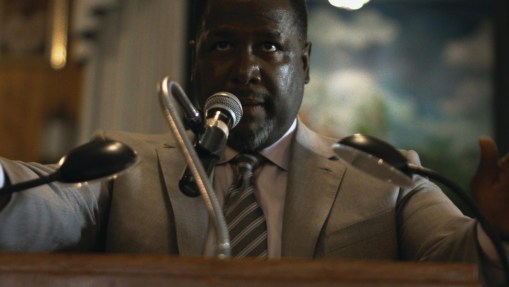
In the first of the film’s three threads, an old woman, Helen (Karen Kaia Livers), speaks about her dog suffering from a skin condition. She talks about various remedies her community members suggest. Set against images of her everyday life, the voiceover, constructed of repeating structures as in poetry, lends Helen a legendary presence. Much like Vitalina Varela in Pedro Costa’s film, she is the lynchpin of this small-town black community whose men are disintegrating into apathy and despair. The town pastor, Tillman (Wendell Pierce in a riveting performance), delivers stirring sermons, but suffers from a lack of faith himself and takes to the bottle. Helen’s son Daniel (Dominique McClellan) is a ne’er-do-well who has lost his job and stays at home with his pre-teen son. Not only does he drink himself to sickness, he also beats up his wife and makes his son drink. Youmans doesn’t really milk the possibilities of this miserabilist scenario; in fact, he elides quite a bit of melodrama and domestic violence. Nevertheless, the script remains rather thin and generic, the characters more abstractions than reflections of real human beings. The cane fields of Louisiana, slicing the frame horizontally and imparting a sense of being closed-in even outdoors, are a welcome change of scenery as are the specific details on the community radio.

Greener Grass (Jocelyn DeBoer, Dawn Luebbe)

Or Just White People Stuff. Adapted from a 2015 short film of the same name, which DeBoer and Luebbe wrote and Paul Briganti directed, the feature-length Greener Grass holds your attention for just as long. What is amusing and funny enough in the short is diluted to over ninety trying minutes, with the two lead actresses also directing this time around. A suburban housewife, Jill (DeBoer), finds her life unravelling after she gifts her new-born to her BFF Lisa (Luebbe). Her elder son becomes a dog, she divorces her husband during a bowling game, her husband leaves, her friend moves into her house, she is rejected from her perfect white community and becomes homeless. The film is a series of absurd sketches about suburban anxiety and conformism. All the characters wear braces over their straight teeth. Jill and Lisa get their husbands mixed up. They become competitive about their children. Jill’s nerdy son doesn’t fit her idea of an ideal child and her stress over him sticking out turns him, as it were, into a well-behaved dog. Jill’s incurable obsession with being nice and winning the approval of her equally neurotic friends ends up alienating her from them. There’s also a serial killer plot shoed in.

The filmmakers underline the superficiality of this life with a candy-coloured palette dominated by artificial-looking primary colours, diffusion filters and a fully daylit cinematography. Like its overused retro aesthetic, Greener Grass trades in ideas about suburban middle-class life already part of the cinematic imaginary. In fact, the film works less as a critique of these values and more as a parody of classical critiques of these values. Make no mistake, this film shares little with David Lynch or Tim Burton and placing it in their tradition would mistake pastiche for vision. The writers cook up one oddity after another, most of which are designed to kindle specific responses. Character reactions are calculatedly mismatched—indifference to big events and overreaction to petty ones. The principle is wholly that of Magritte’s: ordinary elements arranged in implausible configurations. The directors use classical musical cues to elevate banal moments. It recalls Lanthimos, but he employs it for neutral moments whose status as neutral moments is thrown into question by the music. Its use here, on the other hand, is comparable to opera in advertisements. The plot scans as a spoof of women’s pictures à la Sirk or Haynes, but the film is divested of the critical form of those accomplished melodramas. The result is hollow, but not without a handful of successful moments, shots and turns of dialogue.

Ham on Rye (Tyler Taormina)

Where Greener Grass commodifies absurdity for routine pleasures, Tyler Taormina’s Ham on Rye instils the same material with a sense of genuine wonder. The story unfolds, again, in small-town America and follows several groups of teenagers preparing for prom night (?) at a local restaurant-turned-dance floor. The film uses a retro aesthetic similar to Greener Grass: bright yellow Windsor typeface, upbeat music, diffusion filters and backlighting that impart a dreamy, Vilmos Zsigmond-esque glaze. Being a suburban movie, it, too, is focused on the surface of things: boys and girls sprucing themselves up in front of the mirror, McMansions, automobiles, well-kept lawns and yards. But unlike the other film, there’s something lived-in about the details here, the brand names, clothing styles and décor. The first half of the film builds up to the prom night in a mosaic-like fashion, piecing together various groups of teenagers arriving at the venue, Monty’s. There’s a conversation in a schoolyard that’s presented in bits, underscoring that the film isn’t interested in inhabiting this world as much as glimpsing it from a distant perspective. What works so well in the film is that Taormina infuses the banality of this universe with an understated spiritualism. Three primly-dressed girls wander deserted streets and parks like the three graces. One of them reads a postcard from her sister living elsewhere, and they wonder about the mystery of adulthood. As they walk, there’s a tracking shot of the trees, bridging the otherworldly to the ordinariness of this world.

Taormina focuses on the minor rituals of this teen community, rituals that assume a religious flavour. Through the vaguely oriental musical score, he superimposes an international consciousness on this small-town isolation without condescension. The first half culminates in a slow-dance sequence that turns into a veritable spiritual communion. An Ozuvian montage of night-time suburbia signals the film’s shift to its second movement. Night falls and the tone becomes darker, almost funereal. A listless barbecue follows in which disengaged adults engage in silent card games. A group of disaffected, college-age youth knocks about the town in their car. The communion of the first half is replaced by an undefined void at the heart of the community. Like The Last Picture Show, Ham on Rye is a portrait of those who stayed back, of lives in stasis. Taormina’s film is, however, shot through not with a bittersweet nostalgia, but a mournful anxiety about having been left behind. A girl calls out in vain to her two absent friends while another boy cries out in the vicinity. As she sits alone in a park full of toddlers, who no doubt will traverse the same alleys of life, the film whittles itself down to her perspective. Like in Bresson’s L’Argent, Ham on Rye appears to intertwine two time periods, the contemporary cohabiting with the past. I was equally reminded of Hou Hsiao-hsien’s films, especially Goodbye South Goodbye, in its depiction of youth without youth. But Taormina’s approach is the diametric opposite of Hou’s master-shot style: a framing that focuses on hands performing gestures, an odd decoupage that arranges closeups in faint spatial relations (there’s a very funny edit of a plastic pig being tossed away), attention to minor details of the mise en scène and transitions dominated by fades, wipes and superpositions. A strong, promising work.

Real Winner of the Tours Festival, Isn’t Among the Awardees

Arts no. 754; 23 December 1959.

Baldi told me later that I’d described his films exactly like the way he conceived them. He offered to produce a short film for me. It was Capito? (1962).

My first three films were produced at the initiative of filmmakers I had lauded. Do not see any craftiness on my part there.

Three films dominated the fifth international short film festival of Tours: Il Pianto delle zitelle (1958), La Vigilia di mezza estate (1958) and Via dei Cessati Spiriti (1959) are all the works of Gian Vittorio Baldi. A pilgrimage to Abruzzo at an altitude of thousand and eight hundred meters, the celebration of St. John’s Eve in a small village, prostitution in a specialized street in Rome—this diversity clearly shows that Baldi isn’t involved any more in religious propaganda than communist propaganda. He is a documentarian first and foremost, doesn’t exactly belong to any neorealist group and has more affinities with the Rossellini of India than with Zavattini-De Sica.

Critics at Tours sneered before the processions filmed by Baldi, who had a bone to pick with the censors for his film on prostitution. Unfortunately, it seems that very few people understand what a really documentary, objective and impartial cinema is. Baldi films reality and Il Pianto is a pitiless report on mystic madness as well as a hymn to God. […] Baldi shows what he sees: some sequences in his films are shot on the spot, with almost no preparation, as though they were news items. One can’t help but improvise while filming a real procession. But if we French are sensitive to the documentary value of Baldi’s work, the Italian Rouch, we are nevertheless less sensitive to its remarkable formal beauty, perhaps because some typically-Italian details go over our head.


Rediscovered simplicity

Baldi’s crew must’ve done an extraordinary work on colour—Baldi only shoots in colour. Normally so mediocre, Ferraniacolor produces stunning effects thanks to an expert colour matching. Even when there’s improvisation, it almost always gives the impression of an extremely rigorous and concerted composition. It’s Visconti, say some. But Baldi denies all influence. The blacks and the reds of Pianto are as beautiful as those of Minnelli’s Some Came Running; the yellows and the greens of La Vigilia, whose admirable final shot evokes Mizoguchi and Anthony Mann at once, are nearly as beautiful as those of Chabrol’s À double tour.

In the first shot of Via, we think we are dealing with black and white. Some seconds later, we think it’s a sepia or colour print. At the end of a minute, we realize, as we do during the river sequence of La Vigilia, that these are colours of the night, which slowly converge to an admirable pale green when a candle is lit. After the ceremony of the procession, we have the ceremony of the whore, who calmly takes out the tools of her trade one by one. Upon reflection, these gestures of an artisanal intelligence seem unbelievable in a prostitute, but the composition is remarkably balanced by the simplicity of improvisation. No matter, since the gestures, the gait of the girl have a beauty we will find only among the whores of Mizoguchi.

Comparing it to the great mediocrity of other films, I’m perhaps overestimating Baldi’s work. It’s nevertheless a cinema that I’m personally inclined to hate, a cinema based—regardless of Baldi’s intentions—on the notion of perfection foreign to the purest of arts, that of a Griffith, Fuller, Renoir. But perhaps the search for perfection is justified in the documentary, which shouldn’t rely on the vagaries of actors’ performance and should only strive to overcome technical difficulties of colour.


[From Luc Moullet’s Piges choisies (2009, Capricci). See Table of Contents]
[From my column on studio-era Hollywood films for Firstpost]

Ernst Lubitsch was a German immigrant to Hollywood who made some of the most memorable works of its Golden Era. His suave, sexy romantic comedies brought a touch of European elegance to Hollywood and helped found a genre that thrives till date. His sophisticated sense of screen comedy, characterized by subtle, effortless and precise exposition and seamless technique, has influenced comedic filmmakers ever since, not the least of all Billy Wilder, who was a screenwriter on two of his films. Lubitsch worked for almost all the major companies in Hollywood, but his finest achievement was a picture made outside of these studios. To Be or Not to Be (1942) was produced by Romaine, a house set up by Alexander Korda, and distributed by United Artists. Arguably the greatest Hollywood comedy of the sound era, To Be or Not to Be is a daring, intellectually provocative work that stands testament to the power of life-sustaining humour in face of unspeakable horror.

Days before Hitler’s invasion of Poland in 1939, a Jewish troupe in Warsaw tries to put up a play about the Nazis. There’s a disagreement between the actors and the director on whether it should be a comedy or a serious, realistic drama—a split equally applicable to Lubitsch’s film, which bandies the viewer between two approaches to the subject matter. After the Nazis take over, the troupe is forced to shelf the play and continue performing Hamlet. The early stretch of the film centres on a comic romantic triangle involving the troupe’s lead actor, Joseph Tura (Jack Benny), his wife and actress Maria Tura (Carole Lombard, in her last screen role) and an admirer of Maria’s, the war pilot Sobinski (Robert Stack). Warsaw is soon bombed by the Luftwaffe and the film turns into a tense espionage drama. Sobinski flees to England, and becomes part of the Polish division of the Royal Air Force.

The RAF division is infiltrated by Professor Siletsky (Stanley Ridges), a Nazi spy who gathers information about Polish underground resistance fighters. By the time, Sobinski discovers this, the professor is already on his way to the Gestapo office in Warsaw. Sobinski sets out to Poland to stop the professor, but is forced to go underground in Warsaw after the Nazis spot him. He enlists the help of the theatre troupe to mislead the professor, take the documents from him and kill him if need be. This puts the film back on the comedic track, with ingenious scenes of disguise, deceit and subterfuge to follow. Jura first masquerades as the Gestapo commander to get the professor’s files, but he blows his own cover in a fit of jealousy over the professor’s comments about Maria. He then masquerades as the professor to meet the real Gestapo commander Col. Ehrhardt (Sig Ruman), who soon discovers that the real professor is dead. Their mission accomplished, the entire troupe orchestrates an escape plan in which they fly out of Poland in Hitler’s own plane.

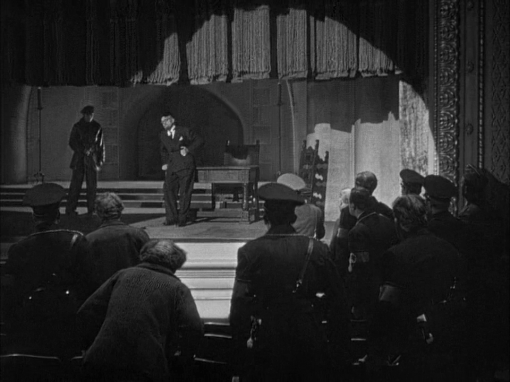
All through Lubitsch’s film is an osmosis between reality and artifice. In the film’s first scene, a street corner in Warsaw (itself recreated on a studio lot) is visited by Hitler behind whom a shop window closes like theatrical curtain. A while later, it’s revealed that this Führer was simply one of the troupe’s actors in disguise. A Gestapo interrogation scene turns out to be a scene from a play, while the bombing of Warsaw is described as a “show” put up by the Nazis “without a censor to stop them”. As the play is interrupted by real world events, the troupe finds itself converting real world into a play, transforming the theatre into a fake Gestapo office, scripting plot lines to fool the real Gestapo, writing new roles on the fly, and rehearsing their great escape. Running away from the spotlight, the professor dies on stage in a dramatic fashion. Lubitsch’s film, in which Americans masquerade as Europeans, is a battle of appearances, where Jewish actors masquerading as Nazis try to outwit a Nazi masquerading as a Jew.

This interplay between theatre and politics has an intellectual coefficient. “The logical result of Fascism is the introduction of aesthetics into political life”, wrote Walter Benjamin, and “all efforts to render politics aesthetic culminate in one thing: war.” The Nazi ideology, with its supremacist racial theories, its cult of beauty, its romanticisation of destruction and its eugenic researches, was at its heart aesthetic. It’s significant that To Be or Not to Be climaxes in a theatre where the Nazi top brass attends a play while the troupe attempts to sabotage it by mounting a little theatre outside the theatre (a scene that’s the direct precursor to Quentin Tarantino’s Inglorious Basterds (2009)). Shakespeare serves as a thematic backdrop to the film, embodying the noblest impulses of mankind in contrast to the fascist project. Hamlet’s eponymous monologue becomes an existential question for the Jewish actors, the answer to which lies in the “Hath not a Jew eyes?” monologue from The Merchant of Venice they use in one of their “skits”.

None of this, however, takes away from how funny the film is. “The Lubitsch touch” is a quality often attributed to the filmmaker. While there’s no set definition to the term, it variously refers to Lubitsch’s economic approach to storytelling (the several narrative ellipses that force the audience to deduce elided plot details), his manner of multiplying the effect of a joke (repetitions within scenes and across the film, with the punchline generally arriving much later than expected and with greater comedic force), his direction of secondary actors that elevates them to show-stealers (Sig Ruman’s caricatural, fawning Ehrhardt with his doubled dialogue and reversals of fortune) and his characteristic construction of a gag (the viewer notices the dead body of the professor at the Gestapo office before Tura does).

Lubitsch employs a whole array of comedic devices here: wordplay (“a laugh is nothing to be sneezed at”, says an actor defending a joke), wit (“what you are I wouldn’t eat” says a Jewish colleague to a ham actor), slapstick (king Hamlet’s crown knocking against a lamp), visual gag (the tracking shot of Sobinski leaving just as Tura starts his monologue), tonal incongruity (the sight of Hamlet ordering salami and cheese sandwich on phone) and situational comedy (the long shot of Tura discovering Sobinski in his bed). In a quintessential Lubitsch gag towards the end, we see an actor dressed as Hitler enter the house where Ehrhardt is forcing himself on Maria. We see Hitler entering before Ehrhardt does, and the pan shot of them discovering each other, petrified, is the comedic equivalent of Hitchcock’s theory on suspense.

Of course, the elephant in the room is the question whether one can make jokes on a subject as serious as Nazism, even if the full horror of the Holocaust wasn’t yet known. It was an objection made during and after the making of the film too: scriptwriter Samuel Raphaelson and music composer Miklós Rózsa quit the project, and certain critics excoriated the film on moral grounds, so much so that Lubitsch had to defend himself in the New York Times. History, however, has been kind to Lubitsch’s film. Like Chaplin’s The Great Dictator two years before it, it believes in comedy as a force of resistance. The very idea that a Jewish troupe rises above its differences to stand against fascism with humour, grace and intelligence, just like considerably Jewish crew of Lubitsch’s film, rests its case as a comedy. In Lubitsch’s own words: “What is the only picture that is still remembered from the last war? It’s not Griffith’s Hearts of the World, or any of the sad ones. It’s Chaplin’s Shoulder Arms.”


[Originally published at Firstpost]

Unstill Life

Arts no. 709; 11 February 1959.

The majority of documentaries seem artificial in comparison to numerous works of fiction. Boredom takes over when no human emotion is able to blend in with a landscape, even if it’s endowed with the greatest beauty. “Nature is a good director”, a text here full of easy literature tells us, which we have a hard time agreeing with: how dull are the many reportages on and under oceans and on the most backward regions of the globe!

But with The Devil’s Blast, it’s necessary for us to acknowledge the basis for this postulate for once. Haroun Tazieff, a passionate volcanologist, gives us a report of his descent into the eight or ten most remarkable craters chosen across five continents. Now, of all manifestations of nature, volcanos and their eruption are the ones that contain the most life. The fall of rain, the movement of snow, wind and oceans, by their routine, confine us to immobility. On the other hand, volcanoes rumble, spit, destroy and transform themselves with the only constant being improvisation, which governs the domain of the artist as well. Their hybrid form of a hollow mountain concealing another world underneath the real world has long fascinated, obsessed a Romantic like Richard Wilson, the painter of course, not the filmmaker. And in Stromboli, and even more so in Journey to Italy, Rossellini could even discover the essential foundations of an entire life through seismic manifestations.

Let’s not try to renounce, on the vain pretext that man hasn’t yet laid his hands on them, our admiration or, better, our emotion before the spectacle of lapilli or of the miniature craters of Pompeii, before these still-moving rock deserts and these enormous lava streams.

Isn’t that minimizing Tazieff’s contribution? I don’t think so, and one could even criticize him for not effacing himself before his subject. Looking for dramatic interest above all, he hasn’t been able to decide between an amateur filmmaker’s reportage and a professional’s essay. To be sure, the lens is damaged at one point by the eruptions and the colours are not of Technicolour surety; but why then these sociological angles, these reconstructions of the crew’s exploits, which makes the documentary lose some of the truth that an artificial clumsiness—that of an Alain Bombard, for example—could’ve shown with more eloquence?


[From Luc Moullet’s Piges choisies (2009, Capricci). See Table of Contents]

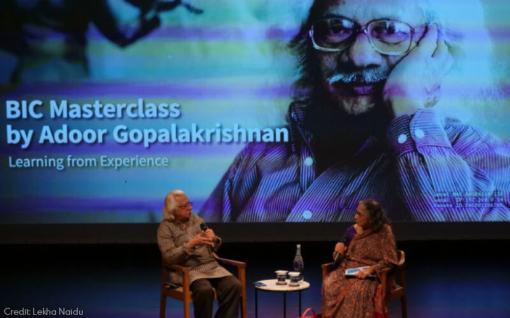
Adoor Gopalakrishnan in conversation with Maithili Rao

Adoor Gopalakrishnan is not much of a speaker. He has written the screenplay of all his films and composed several books on cinema, but the spoken language is something he appears to steer clear of. So it’s perhaps fitting that the two-day masterclass he conducted at the Bangalore International Centre on November 23-24 began with a screening of Kathapurushan, the story of a writer who suffers a speech impediment. It’s also perhaps the reason that the masterclass was conceived simply as a series of moderated Q&A sessions instead of a monologue supported by film extracts. While the moderators, film critic Maithili Rao and writer-filmmaker Basav Biradar, provided useful interpretive frameworks to give shape to the discussion, Adoor’s comments proved rather tangential, veering into generalities in response to specific questions, preferring to dwell on personal authorship over collaboration and remaining focused on the films’ literary aspects when probed on formal choices. But as with all significant artists, we are glad to receive whatever we get.

Adoor describes Kathapurushan (The Man of the Story) as an “incisive look” at himself. Spanning forty years, the film charts the life of Kunjunni (Vishwanathan), the scion of a feudal household who suffers from a stuttering problem. Kunjunni’s personal story—his legend-like birth, his fatherless upbringing, his relationship with the working-class family employed at the house, his blossoming into a young intellectual, his imprisonment and his eventual “cure”—is set against larger events from the history of Kerala. Like many of Adoor’s characters, Kunjunni is a barometer of the upheavals that saw social relations transition from feudalism to communism. His stutter goes just like it came: in reaction to a specific institutional violence. Adoor constantly jumps in time with ellipses that arrive unannounced. These vast temporal leaps are in contrast with the real-time sequences that populate the film. In Kathapurushan, the filmmaker accentuates his characteristic editing style that involves intervals of dead time bookending action or dialogue within a shot.

In the exchange that followed, Adoor touched upon the co-production offer by NHK, Japan, and described how he was urged by the film critic Tadao Sato to take up the offer even though he had no story idea at that point. Speaking about the colours in the film, he recounted how he wanted to shoot the film between rains in peak monsoon in order to capture the various shades of green proper to Kerala. He insisted that he storyboards his sequences beforehand, with the cinematographer responsible primarily for the lighting. This explains the stylized shot division of the film’s most memorable sequence: a raid at Kunjunni’s revolutionary press shown entirely through close-ups of typesets, pamphlets, strewn paper, marching feet and cuffed hands. This manner of synthesizing shots against continuity recalls the work of Sergei Eisenstein, as does the use of actors. Especially in Kathapurushan, the actor’s work is objectified into individual packets of information—gestures signifying discrete ideas like crying, grieving or rejoicing—whose purpose is to support the wider thematic scaffolding.

If Kunjunni represents the first type of Adoor protagonist, the individual who rises above the station his situation consigns him to, the principal characters of Vidheyan (The Servile) are wholly products of their environment. Both Patelar (Mammootty), the malevolent feudal relic who runs roughshod over a village in Dakshina Kannada, and Thommi (M. R. Gopakumar), a migrant settler who becomes his trusted vassal, are products of a social structure that has no legality anymore. Right from the first shot of the film, where Thommi is interpellated by Patelar’s humiliating call, the two are bound in a master-slave dialectic in which each derives social-existential legitimacy from the other. If Vidheyan remains Adoor’s supreme achievement towering over the other films, it’s perhaps because, here, his style finds a subject matter that’s an organic extension of it, inherent to it: the shot divisions, the backlight and the use of off-screen space all become emanations of the central idea.

Talking about the genesis of the script, Adoor said he changed the Patelar character from a serial killer in Paul Zacharia’s original short story to a naïve being out of step with the times. He also revealed that he had offered the short story to his friend and fellow filmmaker K. G. George. The latter, it appears, turned it down as he was more interested in the social politics of migrant Malayali settlers in Mangalore, in place of this abstract meditation on power. Adoor also rejected the moderator’s proposition—after Suranjan Ganguly—that his films were about outsiders, maintaining that they were only about individuals. Discussing his casting of Mammootty as the antagonist, Adoor said that he doesn’t differentiate between novices and professional actors and usually casts actors in small roles before giving them meatier parts in subsequent films. That this was his third production featuring Mammootty made the star comfortable in portraying as repulsive character as Patelar.

If Patelar and Thommi are products of a system, Basheer, the protagonist of Mathilugal (The Walls), rejects all isms and asserts his irreducible individuality. Adapted from Vaikom Muhammad Basheer’s autobiographical novella, Mathilugal, in fact, centres on the dissolution of an institution, namely the police force, into individuals. The story is set a few years before independence in a Travancore prison where Basheer (Mammootty) is held for writing against the state. At the facility, he gets a preferential treatment, with both jailers and fellow-prisoners willing to provide him with his indulgences. Basheer, in turn, is not only brotherly towards them, but affectionate to the plants and small animals on the premises as well. He thinks of a jailbreak, but the romance he develops with a woman prisoner across the high walls of the prison makes him rethink the meaning of freedom. Mathilugal is a tender film for Adoor, gives in as it does to the vagaries of human desire and behaviour instead of putting it under the microscope.

Adoor remembered his collaboration with V. M. Basheer with great fondness and respect. He described how the author was sure the film will turn out well when he learnt that the sole woman character in the story will not be shown, but only heard. Adoor spoke about the authenticity of the period details and the prison set that was built with brick and mortar. He stated that the central challenge of adapting the novel was to turn the ‘I’ of the novella into a flesh and blood character. Answering the moderator’s question about the casting of the Mammootty as Bashir, he said that, in his writings, Basheer had a lofty self-image, which he wanted to bring out through the image of the handsome actor. In the film, Basheer perambulates the prison corridors, amusing himself at first but soon descending into a marked depression—a change in tone that Adoor mapped to the Basheer’s real-life spells of schizophrenia.

The last screening was that of Elippathayam (The Rat Trap), arguably Adoor’s most academic, but also most rigorous film. Another chronicle of the response of the powerful classes to disempowerment, the film follows a landed family living in an ancestral house: the entitled, lazy-to-the-bone patriarch Unni (Karamana Janardanan Nair) and his two sisters, the suffering Rajamma (Sharada) and the self-absorbed Sridevi (Jalaja). Unni’s incurable fear of change eats Rajamma away and prompts Sridevi to flee the house in a gesture of self-preservation, while he remains locked up in the house like a trapped rodent. Elippathayam is a highly abstract work like Vidheyan, and Adoor gives each character in the film a single defining trait. Every shot, sound and detail of the mise en scène has a fixed place in the film’s meticulous structure and serves to illustrate the thesis. Adoor’s characteristic, Platonic attention to objects vested with social significance, such as ancestral furniture, saturates the film with meaning and intellectual heft.

Adoor mentioned that Elippathayam was a film about “sharing”, about our reluctance to respond naturally to change. He detailed the reasons why the film was shot in colour: the Moraji Desai government, having gotten rid of licensing limitations for the import of film stock, enabled the flourishment of colour stock in the country to the detriment of monochrome. The highly coded colour choices of Elippathayam were thus a virtue made of necessity. He asserted that films, whatever else they are, must function at least as social documents, pointing to the authenticity of the way of life depicted in Elippathayam. For all its ills, he added, the feudal system fostered a more intimate relationship between the landed class and the tillers, as well as between the tillers and the land—something that vanished with the disintegration of joint families and ancestral homes.

The four films screened at the masterclass, all of them Bluray projections, offered an excellent cross-section of Adoor’s body of work. Even with Adoor’s limited commentary on them, it was evident that they stake a claim for the filmmaker as one of the true modernists of Indian cinema. The novelistic, classical quality of his script—personal stories set against historic transformation like in John Ford—are given a critical edge by the self-conscious form, the countless doorways that double frame his shots and the carefully curated panoply of ambient and artificial sounds. In all the four sessions, Adoor reflected on the long periods of inactivity between his films. He explained that the hardest part is for him to be convinced that an idea is worthy of a feature-length production; the rest follows. It’s good to get stuck working on an idea and return to it after a while, he went on, instead of compromising the idea. He said that he constantly asks himself why the audience should see his films, that nothing will change if he doesn’t make films. The last thing the seventy-eight-year-old filmmaker wants to do is to repeat himself.


[A shorter version of this report was published in Film Companion]

« Previous PageNext Page »