Books


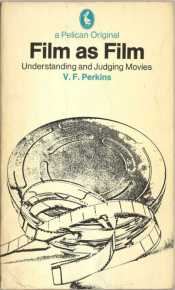
Film As Film: Understanding And Judging Movies
Victor F. Perkins
Penguin, 1972
 

Film as Film

V. F. Perkins’ Film As Film is like that invisible little kid in the last bench who stuns the class one day. The smallest of all the books in the pile on my shelf, Film As Film nevertheless offers insights and information that perhaps the others, put together, can’t.  Divided into nine chapters, the book discusses broadly about the history of film criticism, importance of form in movie making, criteria for assessment of narrative cinema, issues about authorship of a film and the need for judgment of films. Written with an intention to view films independently as films and not as a mishmash of other art forms, Perkins’ book, to a large extent, shows that “cinematizing” a piece of literature is far from “visualizing” it. Using examples from popular Hollywood cinema, especially those of Preminger, Hitchcock and Nick Ray, he elucidates the role of a director and the importance of mise en scène n a film, without ever making it look like a class textbook.

Perhaps the most surprising of all the chapters, “Technology and Technique”, takes up a subject often ignored by historians and theorists. Perkins illustrates how a study of history of cinema entails a study of not only the history of photography, but also that of projection. He examines how the invention of photography brought in realist concerns (with reality being a unique property of the photographic image) into the already popular projection techniques – from the Magic Lantern to the Kinetoscope. He proposes an interesting argument, emphasizing that cinema existed even before the invention of the camera, whose properties were merely absorbed into the existing techniques. Furthermore, Perkins explores how the advancement in film technology gave directors a wider range of choices and hence provided a better measure of the talent of the filmmaker. Consequently, he argues that technology has never been a huge limiting factor as far as the maker’s vision is concerned, although it made sure that clarity need not imply crudity.

There is another impressive section called “Direction and Authorship”, where Perkins speaks about the collaborative nature of cinema and the role of the director amidst various dissenting voices and thought processes. He cites various examples where the creativity of the director is brutally marred by the norms of the production house and also those where the final product shines much more than one would have expected from the talent of its director. Perkins’ point is not to discredit the director or to prove that it doesn’t belong only to him, but that one must concern himself only with the coherence of the finished film and not with the means used to achieve it. He says: “Provided that a film has its own unity, it seems unimportant whether the unity was evolved through cooperation and compromise within the production team or conceived by one man and imposed on his collaborators.”. He insists that a freedom from the studio system does not necessarily warrant quality and conversely, a director working under the obligations of a contract need not sacrifice his personal vision and style, however alien the content is.

But the USP of the book is clearly the first few chapters where Perkins analyzes the development of film criticism and the dichotomy that subsequently developed between those who insisted that films exploit unique cinematic qualities and those who believed in the capturing of reality without the artist’s abstraction. Though, initially, I found myself supporting the early theories of Rotha and Eisenstein, Perkins manages to convince how most of these orthodox theories were, actually, pulling a potential art form into some sort of scientific practice. It’s amusing to see how divergent these two schools were. One championed cinema that moved closer to reality and the other praised films that moved as away from it. One placed artist as the centre of creation whereas the other, the world. Kracauer’s quote perhaps sums up the entire atmosphere: “…the intrusion of Art into film thwarts cinema’s intrinsic properties”. Perkins distances himself from both the theories and even holds the orthodox one with a bit of contempt.

The second part of the book mainly concerns itself with the understanding and judging of films, based on certain criteria that Perkins suggests. And this is where I found myself a bit disappointed by the otherwise masterful book.  Perkins suggests two principal elements when judging narrative cinema – coherence and credibility. The issue of coherence in cinema’s narrative pattern is quite an intuitive one and one wouldn’t at all object to Perkins’ claims. But, additionally, he argues that films must, first and foremost, be true to the world they construct and its actions within them must first be befitting of the reality of that world, strictly obeying causality and rationality. Perkins’ theory limits itself to mainstream narrative cinema and clearly disallows symbols for the sake of symbols, self-reflexivity, Brechtian disengagement and many other modernist principles. Further, it proves weak when trying to judge a bad film. The theory devises a sufficient condition for films to be good but not really a necessary one.

However, Perkins vindicates himself in the excellent last chapter titled “The Limits of Criticism”. He neatly illustrates the drawbacks of the theory and clarifies that it must primarily be used for testifying why a film is good rather than why one is bad (“Within the positive criteria suggested, a critical argument which demonstrates coherence must, other things being equal, take precedence over one which does not.”). This is quite evident from Perkins’ attitude that clearly stands against critics imposing a structure on the filmmakers. One could even say that he considers criticism to be slightly subservient to filmmaking. He seems to be of the opinion that film criticism only enriches itself with movies that push the envelope and can successfully judge only the films that are conventional enough to fall within its established norms. He even mentions at one point that film theory is not the theory of film making but of film criticism. In essence, Film as Film becomes a book that urges one to enjoy a good film for the right reasons, but not one that allows the readers to berate bad films, even for the right reasons. There is nothing more to ask for, especially if you are one who wants to love cinema for what it is and not how it could have been.


Verdict:

The Cinema Of Abbas Kiarostami
Alberto Elena (Translation: Belinda Coombes)
SAQI and Iran Heritage Foundation, 2005
 

Film begins with D. W. Griffith and ends with Abbas Kiarostami

– Jean-Luc Godard


The Cinema of Abbas Kiarostami

Thus reads the cover of Alberto Elena’s book “The Cinema of Abbas Kiarostami”, one of the very few books available in English on the works of the Iranian auteur (the only other renowned book is by Jonathan Rosenbaum which is rebuked by some scholars, according to this book). Before anything, I have to say that the book succeeds right away – by giving an update to the film world about the status of those elusive early Kiarostami films that seem to visit certain festivals now and then. I’m not sure if this is one of the best books on an Asian director, but I can testify that this is one of the most well researched books that I’ve read. To get a measure of what I’m saying, consider this: more than a third of the book is dedicated to foot notes, references and bibliography! Mr. Elena meticulously grounds his arguments and theories on numerous articles, theses, interviews and other books, hence developing an unchallengeable set of inferences and managing never to be speculative – an achievement indeed.

Mr. Elena explores Kiarostami’s films in ways that the western critics have seldom cared for. He carefully avoids (and sometimes criticizes) the terms the west uses to describe Kiarostami’s films – humanist, neo-realist, experimental, artistic and universal, to name a few. He takes a stance against the filtering of these movies using western norms and theories. Not once is a comparison to a western filmmaker made or a movement or technique from Europe recalled to elucidate analyses. Mr. Elena emphasizes Kiarostami’s desire to engage the audience in order to complete his films without ever reminding us of similar works of European filmmakers (Bertolt Brecht is not even mentioned in this context). He regards Kiarostami as a truly “Iranian” filmmaker with genuine social and political concerns. In order to justify his position, Mr. Elena refers to a plethora of native Iranian critics who have very aptly pointed out the influence of various facets of classical Persian art on Kiarostami’s works.

This, precisely, is the biggest strength of the book and a critical value-add as far as literature on Kiarostami is concerned. Mr. Elena resorts to Persian poetry – both classical and modern – and demonstrates regularly how Kiarostami’s work is closer to poetry – especially the overtly visual haikus – than any other form of art. He takes examples from Jalaluddin Rumi, Omar Khayyam and Hafez to illustrate Kiarostami’s preoccupations with the illusory nature of everyday reality and the inevitability and the possibilities of death. With the same conviction, he also establishes the influence of the modernists (the new poetry movement of Iran) – Forugh Farrokhzad and Sohrab Sepehri in poetry, Amir Naderi in film and Sadegh Hedayat in literature – on his own films and poetry. Additionally, Mr. Elena draws parallels between Kiarostami’s use of “human figures” and the Persian miniature painting.

But the most rewarding aspect of Mr. Elena’s linking of Kiarostami’s works to the Persian art is his illumination of the Sufi themes in the director’s works. Always (and quite naturally) overlooked in the discussion of the films, the Sufi influence is what makes Kiarostami films very “Iranian”. The emphasis that Sufism places on journeys – inner and physical – evidently finds its way into many of Kiarostami’s films. Kiarostami’s protagonists are almost always seen traveling in cars but what is more important is the metaphysical journey that they subconsciously embark on. Mr. Elena analyzes the various elements of the “Sufi journey” such as the presence of an omniscient Pir (guide) and closeness of man to nature and to the present that are present in some form in the director’s films. This way, he places in perspective even the most obscure and taken-for-granted components that define these works.

As an added bonus but also an ineluctable facet while charting Kiarostami’s career, The Cinema of Abbas Kiarostami examines the political situations in Iran right from the Shah’s oppressive rule, through the Islamic regime that had its own shortcomings, to the relatively liberal yet largely unsatisfactory Khatami democracy. Mr. Elena describes how Kiarostami’s prosperous years at the Kanun (the Center for Intellectual Development of Children and Young Adults) were actually safer from the supply-demand rules of the movie industry and the excessively stringent and often absurd rules of the censor. And more importantly, he studies how Kiarostami’s films have always been conscious of their society and the politics that governs it. Albeit their cheeky and subversive form, Kiarostami’s films, as Mr. Elena points out, have always reflected the politics of contemporary Iran, be it the economic downturn in the pre-revolutionary period as in The Traveller (1974), the educational and domestic structure of the country as in Homework (1989) or the women’s issue in Ten (2002).

However, like a lot of “definitive” books that are hurt by partiality and pace, The Cinema of Abbas Kiarostami too suffers from abruptness towards the end. Mr. Elena devotes a large chunk of the book for the director’s early short films and medium length features. In fact, a lot of matter-of-fact readings of the films by western critics could have been completely done away with by Mr. Elena, for all these seem to be products of hindsight and over-analysis. The “Koker trilogy” and The Taste of Cherry (1997), too, are discussed in considerable detail and with formidable authority. But from what may be Kiarostami’s most enigmatic and critical film, The Wind Will Carry Us (1999), the book slides downhill. Once the analysis of The Wind Carry Us is hastily completed, Mr. Elena wraps up Kiarostami’s subsequent features – ABC Africa (2001), Ten (2002), Five (2003) and 10 On Ten (2004) – are wrapped up within a few pages in spite of the fertility of the films. Perhaps be Mr. Elena thought that from these films onwards, there are enough printed materials elsewhere for the readers to refer to (The original Spanish version was printed in 2002).

 
Verdict:
 

P.S.: Here is a gargantuan review of the book at Senses of Cinema (which is even bigger than the director’s bio page at their site) that deserves a review of its own!

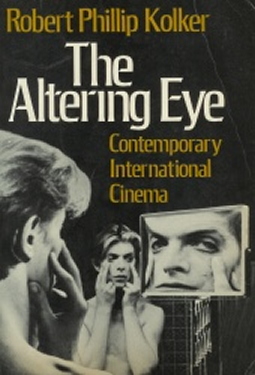
The Altering Eye: Contemporary International Cinema
Robert Kolker
Oxford University Press, 1983
 

the-altering-eyeThe title of Robert Kolker’s The Altering Eye alludes to multiple things – the eye of the filmmaker that sees the society, the eye of cinema that observes its own content and the eye of the audience that facilitates a response to the images it witnesses. And true to its title, Kolker’s book attempts to explore the way these “eyes” have altered their own vision, refined the meaning derived, redefined the process of watching images and essentially understand the emotional and intellectual response they evoke. I read The Altering Eye over a period of 3 to 4 months (interrupted by a few other books) and as I finished reading the last passage, it felt as if I had performed a feat. The book, now, seems so detailed, so vast and so verbose that I begin to wonder if all critical books on cinema would turn out to be like it.

The semblance of vastness of the book partly comes from Mr. Kolker’s style of description and analysis. He starts out discussing schools of thought, covering almost six decades, from a very broad perspective after which he adds detail, bringing in specific works during the period and key figures behind them. Additionally, he talks about the themes of the films, dissecting their screenplays and illustrating their position in film history with respect to contemporary and ancestral works. Furthermore, he often narrows down to specific shots, and sometimes even frames, to excavate details that reinforce his arguments. And suddenly, as if zooming back, he moves on towards the next school of filmmaking to examine its style and substance, the deviations from the existing system and the drawbacks that eventually caused its downfall. As a result, you feel as if Mr. Kolker has covered a huge amount of ground with considerable detail.

Of course, I could crib about the exclusion of major directors from Asia and America, who are grossly ignored in the book. But that objection is instantly nullified since Mr. Kolker makes clear the kind of films and filmmakers he intends to dissect and the ones he doesn’t. His primary aim is to study the response of the filmmakers of Europe and Latin America to the norms and methods of the studio-based Hollywood movies. He primarily deals with filmmakers who understand the “genre” so well that they deconstruct it only to reveal its inherent flaws and later, filmmakers whose subjects are very much a function of history, current affairs and the social structures prevalent. Both these types of filmmakers (not mutually exclusive by any means), Mr. Kolker emphasizes, offer a kind of vehement reaction to Hollywood’s methods of holding the audience in an intellectual inertia and its subconscious conditioning of their morals and emotional responses.

For this, Mr. Kolker divides the book into three large chapters. The first chapter titled “The Validity of the Image” kicks off with a quote from Giuseppe Bertolucci: “The Cinema was born with neo-realism”. Although Mr. Kolker refuses to take up the conventional chronology that is used to trace cinema’s growth (with the clichéd Lumiére brothers versus Georges Melies discussion), he actually presents a good picture of the history of cinema in this chapter. He superficially explores how expressionism paved the way for film noir, which lead to neo-realism in a way, which in turn resulted in the birth of the French new wave, culminating in a hybrid form of cinema in the seventies.  But his main focus in this chapter remains on neo-realism as he studies the very many theories that attempted at first to destroy the bourgeois control of cinema and then create a form that captured the reality “out there”.

The next chapter is called “The Substance of Form” and is probably the biggest one of the three. Here, Mr. Kolker talks about redefinition of cinematic forms by directors who attempted to develop an interactive kind of cinema in reply to the reassuring continuity and passivity of Hollywood. He discusses how the directors destroyed, exaggerated and mixed genres in order to make the audience understand and work out what happened and why it happened that way. He covers a variety of experiments including fracturing of narratives, working within conventions to expose its absurdity, refusal of continuity and omniscient gaze and much more. The French New Wave, in particular, is covered in detail with an overview of every major director of the movement.

The final chapter, “Politics, Psychology and Memory”, rounds off the book with the examination of the influence of history, politics and leftist revolutions on the filmmakers of Western Europe.  Basing his arguments on figures like Bertolucci, Losey, Fassbinder and other Latin American filmmakers, Mr. Kolker talks about the way these films studied fascism and its effects on psychology of the post-war world.  He additionally probes how bourgeois complacency, politics of sexuality, memories and residues of fascism and the left’s struggles relate to each other and gradually make their way into many of these films. Mr. Kolker successfully covers both periods – the rise and fall – of the student revolution and observes the changes in attitudes of the filmmakers towards their subject following its failure.

What is most surprising for me about the book is the way Mr. Kolker examines the films to support his statements. Each analysis seems indisputable and like the only possible interpretation after all. He deconstructs a film (or a movement) into so many layers of meaning that it seems like a flawless movie until Mr. Kolker himself puts it down with drawbacks one would have never imagined. As a result, unsuspecting readers like me, who haven’t seen those films or are relatively new to cinema, might get completely carried away with the text. I do not hint manipulation here. Mr. Kolker does provide in-depth discussions of the films but is also careful enough to let the reader carry on with the discussion using the threads he has provided.

Having said that it is a fantastic book on films and film movements, I must also point out that The Altering Eye is not for the causal reader. You will be going through a paragraph again and again or stuck in a section for a long time. But that is because the content of the book demands it. So if you are looking for a book on cinema that you would want to read with ease, this book may not be the right choice. However, if you want to seriously learn about serious cinema, The Altering Eye is absolutely essential.


Verdict:

P.S: The whole (!) book can be legally read here

Werner Herzog
Beat Presser
JOVIS/ARTE Edition, 2002
 

werner-herzogLast month, the Goethe Institute – Max Mueller Bhavan, Bangalore organized their biggest film event since the Michael Ballhaus/Rainer Werner Fassbinder retrospective in June last year. This one was a photo exhibition titled “Werner Herzog: film has to be physical” followed by a ten film retrospective of Werner Herzog (eventually pruned to nine). Jovis Publication’s book Werner Herzog serves more or less as a collection of these photographs and as an excellent coffee-table book if you are planning to start a cinema themed restaurant. With translations in both German and French placed alongside the English text, the book cleverly positions itself to cater the home crowd, the “cinema people” and the rest of the world.

The book is completely photographed and edited by Beat Presser, who has collaborated with Herzog on multiple films as a still photographer. The book (and the exhibition) predominantly presents photos from three of Herzog’s films in which Presser worked – Invincible (2001), Cobra Verde (1987) and Fitzcarraldo (1982) – though there are quite a few snapshots from some of his other films too. With almost an equal number of monochromatic and colour photos (some spanning two sides too), the collection is a visual treat that not only takes us back to the experience of watching the director’s films but one that enhances the mystery that surrounds Herzog and his work.

Interestingly, the photo-exhibition at the Goethe Institute, Bangalore was the same one that Herzog himself visits in his documentary My Best Fiend (1999) as he chats away with Presser. And the book retains most of these photos in good resolution. Unfortunately, the best few photographs of the exhibition (including one from Stroszek (1977) that clearly stands out among the pictures in the collection) that oozed brilliance with their eye for the dynamic and static components of the photographic image are left out. But not all the photographs grab your attention. There are some seemingly offhand pictures – dull and unimaginative to say the least – that seem like fillers alone. But barring those, the photographs in the book clearly indicate the physical energy that Herzog summons upon his set during the shoot (Herzog himself is captured holding mining and trekking tools many times).

It is common knowledge that Herzog believes that film making is the stuff of brawns and not brains. That an atmosphere, an event or a visual force has to be personally experienced before it can be filmed. With a perspective of cinema (and life) that straddles probable lunacy and profound wisdom, Herzog’s working methods and ideas have often been elusive. What remains clear is his unassailable belief on the physical over the metaphysical and his support for the experiential over the theoretical. This book (and the exhibition at the Embassy) attempts to elaborate upon this principle of Herzog using the photographs. In these pictures that alternate between spontaneous and posed, we see Herzog himself performing the very many physical acts that occur in the three movies that the book covers. Be it the lifting of beer barrels like Zishe of Invincible or the running around during the shoot of Cobra Verde or even the interaction with his actors, one can easily see how this conviction in the physical realm is very important for Herzog when he films something.

The Arte Edition intersperses these photographs with prose and anecdotes written by people who have lived and worked with Herzog. There is Lena Herzog’s short yet fantastic section “Werner” that tells about the minor incident that sprang up (two years after Fitzcarraldo hit the screens) when the couple were shifting houses. Apparently, the guys from the moving company – The Starving Students Movers – upon seeing the couple’s names on the front door asked if they had to move a boat! Then there is playwright Herbert Achternbusch’s bizarre write-up “In the Beginning was the Word” about his reverence for Herzog for the way his life has shaped up. And then there is Peter Berling’s articulate section “Memories of Working with Werner Herzog” that recapitulates his experience during the shoot of Aguirre, the Wrath of God (1972). But all these essays play second fiddle to the paradisiacal images that occur regularly in the book.

This is the only photo-book I’ve read – based on cinema or otherwise. So I can’t exactly say how this one fares in comparison to similar books based on other celebrities. If you really want to know about the director and his methods, this is clearly not the book for you. However, if you want to program a cinema event of sorts based on Herzog’s films or to be the ultimate fanboy of the director or just to decorate your film library, this one might be a very good option. Oh, I haven’t given you the killer yet. This coffee-table book is generally priced at $35. In view of the exhibition and the subsequent retrospective, the Embassy offered the book for $3. Now that’s what I call a steal!

 
Verdict:
 
P.S: Thumbnails of some of the pictures here at Kinski’s site.

Our Films Their Films
Satyajit Ray
Orient Longman, 1976


Surely, God is not a socialist. Why then would he bestow so much talent upon a single person and deprive the rest of the artists of country of any comparable finesse? Be it Japanese architecture, German music, English literature, Chinese paintings or world cinema, Satyajit Ray’s knowledge of the seven arts is everything a connoisseur could ever desire to have. And his book Our Films Their Films clearly shows why a true love for cinema is the only pre-requisite to be a filmmaker.

our-films-their-filmsI have hardly seen Satyajit Ray’s films and was apprehensive about taking up this book. I was afraid that it would require a prior introduction to films he talks about and especially to his own films. But as it turned out, I was completely wrong. Shubhajit here recalls how this book single-handedly induced him into the film culture. Why not? Our Films, Their Films is a rare book that works two ways. I can’t imagine any other book that is as interesting for strangers to cinema as it is for the film buffs.  Ray never does it like an academic scholar churning out one jargon after another nor does he go too low-brow elucidating every shred of observation. Ray’s tone is conversational and at the end of the book, one does feel like he has spent a good few hours with an interesting man.

The book could be plainly called a bunch of essays by Ray assembled in a chronological order. But surely, it can pass off as so many other things too. Each of these articles has the charm of a short story, the depth of a critique, the personal quality of a diary entry and observations of a great essay. With a language that is neither overpowers the content of the text nor undermines its quality (which I think is true of his films too), Ray sets a standard for not only analytical but also for the verbal component of film writing. No wonder he also stands out as one of India’s key literary figures.

Cinematographe has this to say about the book: “The originality of Ray appears in an indirect manner: whilst talking about others, he offers us a subtle self-portrait“. This is so true. The essays in the book gradually and subtly unravel Ray’s perception of cinema and what he believes makes for great filmmaking, all of which reveals itself through the very many critiques of world films he presents. But the fascinating part is that he never takes the role of a filmmaker when he writes these pieces. He could well have elaborated on what lens John Ford used or what editing instruments Kurosawa employed. But the sections where Ray presents his views of international films could only have come from a true-blue cinephile whose very love for cinema is infectious. Look how he presents his opinion on Kumar Shahani’s Maya Darpan (1972), Kaul’s Duvidha (1973), Benegal’s Ankur (1974) and Sathyu’s Garam Hawa (1973), which organically unfolds into a fantastic review of the films.

But what really swept me off my feet are the observations that Ray makes in these early essays, the last of which was written in 1974. These observations – their almost prescient and intensely accurate quality just goes to show how deep Ray’s understanding of cinema was – both as a person behind and in front of the screen. I’ll give you an example. Ray met Kubrick just after he had made Spartacus (1960). He recollects: “On the strength of his Paths of Glory (1957), Kubrick had seemed to me to be one of the white hopes of American Cinema. He had first rate technique, he had style and I had a feeling that he had also something to say.”. Not just that, his opinions of Billy Wilder, Antonioni, Kurosawa and many others prove to be bang on the money.

If one takes a survey of the favorite section in the book among those who have read, it would definitely produce variegated results, for each section has the power to top the previous, no matter what order you read them in. My favorite section in the book Problems of a Bengali Filmmaker (along with Calm Without, Fire Within and An Indian New Wave?) provides an answer to almost every question I have had about the state of filmmaking in India. But again, this is one opinion that may change even before I finish this review. An Indian New Wave? may be just the winner in the long run, I suspect.

Reading the very many experiences of Ray abroad, one is regularly surprised about the range of people he knows in cinema and the dream-like way they meet each other. Reading these is almost like hearing a splendid raconteur recollecting his road trips with wide eyes. But all that is only because he presents himself with such simplicity. And that is partly a reason that this book shines with honesty. I’m sure, there would be hundreds of pages written from the other side of these meetings that would really give an idea of this monumental figure called Satyajit Ray.

 
Verdict:

P.S: Some essays of the book can be found here. Do read it. I think this book is a must read for film-geeks and not-so-film-geeks alike.

Stanley Kubrick Directs:  Expanded Edition
Alexander Walker
Harcourt Brace Jovanovich (HBJ), 1972
 

A brief internet research about the best books written about the life and works of Stanley Kubrick gave me quite a few results with Alexander Walker’s Stanley Kubrick Directs (Expanded Edition) topping the list. Since there wasn’t any book called Kubrick on Kubrick, I had to go for this one! Stanley Kubrick Directs is literally a page-turner, for it contains more images than text. The book is divided into six sections – The Man and Outlook, Style and Content and four chapters dedicated to four of Kubrick’s most famous films.

stanley_kubrick_directsA friend once remarked that there was spirituality in the way Max Ophüls’ camera moved. I was reminded instantly of Kubrick then. But surely, not for the same reason. Kubrick’s tracking shots are anything but spiritual. I should label them “satanic”. These bewitchingly ominous shots, in my opinion, are the essential sequences from each of the films – be it in the French war trenches, in Korova Milkbar or aboard the Discovery space shuttle. And reading that Kubrick was impressed by Ophüls’ films forced a smile on my face. This is not the only reason that I find the opening section of the book – Stanley Kubrick: The Man and Outlook – fascinating. Walker presents us all of Kubrick’s preoccupations as a child and as a teenager and later establishes how the reverberations of these influences find their way to most of Kubrick’s films. As a film buff, it is rewarding to dig deeper into Kubrick’s films after reading these facts.

But Walker follows it up with the most disappointing of all sections in the book. In this section, titled Kubrick: Style and Content, Walker aims to present us the working methods of Kubrick. Unfortunately, this part turns out to be nothing more than a briefing of Kubrick’s early films, till Lolita (1961), interspersed with elaborations of some obvious facets of Kubrick’s films. Walker’s digresses without hesitation and adulterates the section with facets not in line with the chapter’s objective and analyses that at times seem downright speculative.  As a result, this section seems like a poor excuse for a ramp up to Kubrick’s masterpieces that were to follow.

The book then presents us illustrated analysis of Kubrick’s Big 4 that followed – Paths of Glory (1957), Dr. Strangelove (1964), 2001: A Space Odyssey (1968) and A Clockwork Orange (1971). The first two films here take up two thirds of the analysis section and ironically are the least satisfying. Both the analyses of Paths of Glory and Dr. Strangelove are fraught with screenshots (by Halcyon) that are subsequently verbalized. Having presented the early influences of Kubrick, Walker should have let the audience connect the dots and interpret the film their own way. But he starts deconstructing Kubrick’s mise-en-scene frame by frame and strips us completely of the joy of discovering a film. No, I’m not cribbing, but it is a bit discomforting to see such great films presented cut and dried, preventing further exploration the reader may otherwise be tempted to perform. I know this is an analysis, but why at such grassroots level?

Surprisingly, Kubrick’s most profound film is given the least space. A big positive for this section is that it does not go over the top like many an analysis written on the film. Walker sticks generally to the technical and narrative aspects of 2001: A Space Odyssey and discusses “2001 that could have been” citing various choices made by Kubrick with respect to the script. However, it is dissatisfying to see the film grossly ignored in comparison to the earlier two films and sidelined to a smaller status. The film by itself warrants elaborate literature and any analysis should most definitely include the higher aspects it tries to encompass. Walker just grazes through those notions and it never looks like it is for the good of the audience.

But, comes the essay on A Clockwork Orange to salvage the book’s pride. This is the best of the four analyses and serves as a grand climax to an otherwise dissatisfactory book. This is one section that respects the complexity of the film but never once shirks discussion. Walker makes a great move by not just diluting the mise-en-scene by deconstructing it to particulars. He seamlessly integrates multiple ideas the film presents and provides us a solid critical analysis that clearly shines in comparison with the previous three. And it is this section that provides a sense of comfort when one closes the pretty ordinary book.

This book is widely considered the best book on Kubrick till date and that worries me. Kubrick’s canvas is visibly vast and if this is the best of literature available on him, there is a long way to go. Stanley Kubrick Directs does present considerable detail for people who are confused why he is the most critical Hollywood director on a technical level, but the treatment of the content of his film leaves a lot to be desired. May be I expected a bit too much.

 
Verdict:
 

Note: This is a section where I will be blogging on books on films and filmmakers. The entries will be far and few, but this will at least provide me an opportunity to read text – a thing that I used to hate till now.

« Previous Page