Cinema of France


Jeanne Dielman, 23 Quai Du Commerce, 1080 Bruxelles (1975) (aka Jeanne Dielman)
Chantal Akerman
French

“I used less water than last time, so it tastes better”
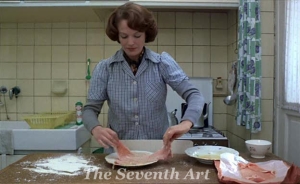
 

Jeanne DielmanChantal Akerman’s most famous film gives away all that is factual about it in its name itself. The rest of it follows what the titular Jeanne Dielman (Delphine Seyrig) does in this 23, Commerce Quay, 1080 Bruxelles house of hers, over a three day period in almost in its entirety. Using completely stationery cameras, Akerman creates a claustrophobic document of life in its most mundane form. Even with a screen time of over three hours, there isn’t much in the movie that could be fit into something called plot. That, precisely, is Akerman’s intention. Details are given with extreme reluctance and in exceedingly small measures (with hardly 10 minutes of spoken dialogue). On the first day, we witness Jeanne ritualistically moving about in her house, switching on and off the room lights, cooking potatoes for her obedient son, arranging tables, doing the dishes and making the bed. She earns by selling herself during the afternoons in her very house. All this is done by the book, if there ever was one.

It is precisely these systematic acts which become our reference for the next day. The next day follows almost the same pattern. Only that Jeanne drops a spoon and the polishing brush. Oh yes, she also goofs up the dinner! On the third day, the bank is closed, she reaches a shop before it opens, the coffee is spoilt and a button snaps off from her son’s blazer. This is all the change that Akerman allows Jeanne. What surfaces is a gradually progressive deviation from our “reference” and perhaps for the worse. Like the geometrically flawless décor and lighting of the film, which exude cheerfulness, contentment and sanity are only apparent. It is almost as if one can mathematically calculate, using these extremely small “mishaps”, when Jeanne will completely succumb to her condition. And this is the kind of gradual disintegration of sanity that many films fail to portray credibly (Revolutionary Road (2008) comes to mind first). What happens obscures how it all happens. Cinema becomes text. Although Jeanne Dielman is much more extreme in its form than the mainstream narrative cinema would require, it clearly shows that why a formal stance doesn’t merely justify the medium chosen but enhances its possibilities.
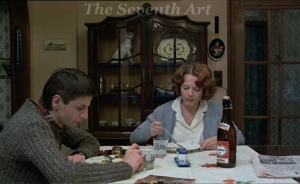
Jeanne DielmanIt wouldn’t be unfair to call Jeanne Dielman an experimental film. Where other films that deal with similar theme of urban alienation tend to bend towards the cerebral side, Jeanne Dielman is more experiential. At any point in the film, once the viewer gathers everything there is to an image, like Tarr’s movies, fatigue sets in. We start experiencing time as it is, undiluted. In other words, we begin taking part in Jeanne’s life by experiencing the savage inertia of time. The only difference is that she is oblivious to it while we, possessing knowledge of the artificial and transitory nature of cinema, are not. Jeanne doesn’t pass through life. She lets life pass through her. Not once does she show signs of emotional fatigue. She is insensitive to her condition much more than her cerebral counterparts. Except for one sequence at a button store, where she shows clear indications of mental derailment, there apparently is no outlet for her emotions at all. Apart from the perfunctory conversations with her son and the occasional visit by the neighbour, who asks Jeanne to take care of her baby (who could well be considered a miniature Jeanne) from time to time, Jeanne is completely cut off (at times literally, in the frame) from the world.

In his extraordinary article on Tarr, Kovács writes about the director’s style:

In Tarr’s world, deconstruction is slow but unstoppable and finds its way everywhere. The question, therefore, is not how to stop or avoid this process, but what we do in the meantime? Tarr asks this question of the audience, but if the audience wants to understand the question, it first has to understand the fatality of time. And in order to grasp that, it has to understand that there is no excuse in surviving the present moment: time is empty—an infinite and undivided dimension, in which everything repeats itself the same way.

Akerman’s own style does not seem far from this. Through repetitions, in gratuitous amounts, Akerman creates a film of high precision and low life quotient. In fact, everything in the film seems to exhaust itself the moment it takes birth.  Akerman repeats every element of the film – time (Jeanne’s daily routine), space (the viewer is immediately acquainted with the couple of rooms that the almost the whole film takes place in), the actors’ movement and gestures (Jeanne act of switching off lights moves from interesting to an in-joke) and even camera angles (as if the actors are passing in front of stationery cameras installed at various locations in the house).

Jeanne DielmanThe only hope for Jeanne to snap out of this vicious loop comes in the form of the final sequence in the film where she stabs to death an unsuspecting client of hers (Actually, it is never made clear if the scene takes place in Jeanne’s present or not. The man could well be her husband, whose death is talked about regularly in the film, thus, also, creating a narrative loop within the film. But considering the realities of the world, it is unlikely). This is where Akerman deviates from Tarr. Tarr seals his characters in their own existence until they fade into oblivion. His characters neither have history or hope. Akerman, on the other hand, gives her characters a past and a future. The circle in Jeanne’s life may just be a stray deadlock that had to be resolved by her action (rather, by ceasing her inaction). There is certainly a gaze at a different future throughout the film. Jeanne is expecting a gift from her aunt, which is revealed to be a dress later.  She deposits money in the bank for future use. Her aunt even urges her to migrate to Canada. Even though, a large part of the movie is concerned with her empty life, it does offer a hope for renewal.

Obviously, Akerman is far from being a romantic. It is true that she does not choose to tread Tarr’s spiral, which seems to go in circles but ends only in decimation, and concocts an open ending, thus leaving margin for hope of escape. But why Akerman’s masterwork feels ultimately like an exercise in despair is that she generalizes Jeanne’s existence. As a matter of fact, we don’t even know if the lady we are watching is Jeanne or if the building is the one mentioned in the title. By not pinning down particulars, Akerman seems to speak for an entire generation and era. Of course, the whole film could be deconstructed to unveil political, social, sexual and cultural outlook of the age, but what makes Jeanne Dielman stand out from its contemporaries is not its keen study of lives in modern times, but its ability to make us experience what every Jeanne Dielman experiences and understand why we each of us, in a way, has become a Jeanne Dielman.
La Jetée (1962) (aka The Pier)
Chris Marker
French

Since humanity had survived, it could not refuse to its own past the means of its own survival.


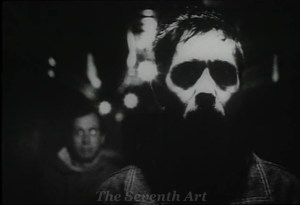
The PierWho would have thought that one could make a sci-fi masterpiece in just 27 minutes? Well, I didn’t. I was wrong. La Jetée (1962) has left behind it, a legacy that many filmmakers have attempted to inherit, time and again, through the years. Its vision of the future of the world and its inhabitants – a sunless earth, cold expressionless faces and almost machine like emotional states – and the possibilities of experiment with cinematic and real time, that it has opened up, have become almost a standard template for sci-fi movies. If only a certain movie monument wasn’t made six years later, La Jetée, hands down, would stand out as the greatest sci-fi film ever made. The surprising fact is that the script of the film wasn’t adapted from some visionary short story, but one written loosely and directly for the screen by Chris Marker, the director, himself. And further, the script is just a minor contributor to the film’s success.  Here is the thing: The word has been destroyed by the ominous nuclear war and humans are forced to stay underground. The “victors” of the war are trying to find a way to contact the past and the future of mankind to prevent the imminent annihilation of the human race. One of the lab rats for this is The Man (Davos Hanich), who retains vivid memories of his childhood and carries with himself, puzzles from the troubled past.
The very nature of the plot, like the slick ones that play with time and its properties, is potent enough to lock its audience into eternal conversations about the science behind it and the implications that it presents. Scientifically, the basic issues of time travel – like the law of conservation of energy and mass-energy equivalent – are revived. At an emotional level, questions about the inner tension of The Man and about his (and ‘his’) perceptions during the “confrontation” come into the picture. Furthermore, the woman’s untroubled indulgence with the man, who not only lacks a past and a future, but lives an interrupted present, raises concern about the woman’s own identity. Is she one of the guinea pigs too? Is she the specimen of another similar experiment? Or is she one of “them”? Marker leaves such questions unanswered, for his concern is not the drama “of the moment”. Actually, Marker doesn’t even rely upon the convolutions of plot and time to make the film seem significant. As a matter of fact, Marker unravels the proceedings of the film in a lucid and patient manner in his soundtrack, where the narrator explains every action that takes place, till the last detail. Marker could have easily diverted his audience’s attention into a process of untangling the plot by having the narrator conceal some of the facts. But by providing complete information about what happens, Marker utilizes that attention to persuade the audience to recognize how it all happens. We process the aural data simultaneously without any effort as we also begin to note the significance of individual images and the relationship between them.

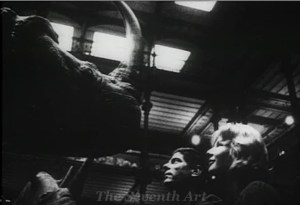
The PierThere is a remarkable scene in La Jetée where The Woman points at a cross-section of the tree trunk to denote her age. The Man jokingly (and self-referentially) points at a region outside the periphery of the trunk suggesting that he is from the future. This scene isn’t just an isolated homage to Vertigo (1958), but one of the many indicators that La Jetée is, in fact, laid on the very themes of Hitchcock’s film. Plainly, both films could well be seen as subjective accounts of treatments of psychological inhibitions – acrophobia and depression. In Vertigo, Scottie is a man who has lost his beloved (and whose face hypnotizes him for some reason) in an accident and is determined to reanimate her back to life, no matter what it takes. The Man, here, is no different from Scottie. The Woman could well be dead too (as he, also, suggests at one point). The Man’s tools for this “ritual” of resurrection are his memories and experiences, because of which he too, like Scottie, is nudged into the vicious cycle (rather, the Vertigo spiral) of resurrection and loss. In another extended sequence in La Jetée, The Man and The Woman visit a museum where stuffed animals are kept as exhibits. The range of animals there – giraffes, elephants and rhinos – make it seem more like a zoo than a hunter’s exhibition. The couple watches them with utmost fascination. Marker photographs the animals and the couple as if they were on the opposite sides of a mirror.  There is great contradiction at work here. Are these live animals trapped in a time frame that is outside their own or are these really dead creatures resurrected back to life by some passionate enthusiast? Either way, they only reinforce that The Man and The Woman are, in fact, one of them.
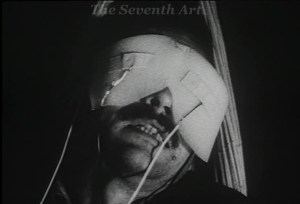
Surely, La Jetée’s glorious triumph is a consequence of three brilliant artistic choices by Marker. The first of them is the use of black and white imagery for his film (Note that Vertigo had already been made in colour four years before this film). For The Man, the past, the present and the future are essentially the three sides of a Penrose triangle – one leading to the other endlessly. Although he can make clear distinctions between the states he is in, he can’t possibly determine his future, his past or even his definite physical location in any given stage. Marker exploits the homogeneity of the monochrome to denote the plasticity and interchangeability of The Man’s memory and experience and the film’s narrative chronology. Incidentally, in his tour to the past, The Man is fascinated by a shop filled with plastics, ceramics and other fibrous materials – another token of the ever malleable world around and within him. Secondly of interest is Marker’s choice of employing voiceover instead of providing conversational dialogues to his protagonists. Surely, Marker is far removed from the concerns of momentary suspense and immediate gratification. Instead of developing an atmosphere for each scene, he creates a tone for the whole film. Alternating his musical score between expressionistic chorus and chilling, low-key drumbeats, Marker hijacks us away from the search for petty dramatic confrontations into the bleak one for a seemingly elusive resolution. Not surprisingly, the whole narration is in the present tense, as if pitching a story to the producer, for neither can Marker place it in the future since that would betray the tenets of realistic storytelling nor can he locate the tale in the past, thus guaranteeing a resolution. Incidentally, the film doesn’t close with “The End”.

The PierBut it is Marker’s use of still images for his narration, almost entirely throughout, that is the masterstroke. He could have used muted motion clips, but that would have added no vitality to the themes of the film. The Man is forced to go back to his past, even after all those traumatizing events of the world.  Predictably, his memory is fragmented, much like the images of the film. He synthesizes his “past” from his subsequent experiences, passionate fantasies and remaining shards of memory. His memory seems to document, eventually, not how the events were, but how he wants to believe they were. Marker uses an array of match cuts to emphasize the dependence of The Man’s memory and vision of past on the present state of his mind and of the world. In a critical scene in the film, The Man and The Woman visit a museum where they observe stone sculptures with missing heads or other parts of their bodies. Just then, an apparently tormented face in the sculptures is juxtaposed with The Man’s own distressed countenance. Are these the just figures of ancient art or are these “products” of the mutilated bodies of the war that The Man witnesses? Most of Marker’s images are spontaneous, with each of them seeming like a freeze-frame ending for intense moments. Each of these images seems like straight out of a dark comic book, with tension and horror oozing out of each pixel. Each one carries with it a past and a future that is as troubling as The Man’s own. Interestingly there is one single shot where motion photography is employed. The Woman, after assuming various poses during sleep, opens her eyes gradually. This is, perhaps, the only time where The Man really feels alive, witnessing movement, hence freedom and hence life. The only moment of escape from his physical existence in a world trapped under the surface of the earth – a world where people don’t live, they exist, a world where they don’t die, they expire.
[Watch the whole film below]

L’année Dernière À Marienbad (1961) (aka Last Year At Marienbad)
Alain Resnais
French

“The grounds of that mansion were rather in the French style, without trees, flowers, or any plants at all. Gravel, stone, marble, rectilinear, formal, devoid of mystery. At first glance, it seemed impossible to get lost in them, along the straight paths, between the immutable statues, granite slabs, where you were, even now, losing yourself forever, in the still night, alone with me.“


last-year-at-marienbadRight from its title, Last Year at Marienbad (1961) spells ambiguity. Neither does the film refer to a place called Marienbad, nor is it sure if the events that the protagonists, X the man (Giorgio Albertazzi) and A the lady (Delphine Sevrig), talk about took place the previous year. Last Year at Marienbad takes place in an ornate French chateau and unfolds as a conversation between X and A – a very repetitive one at that (at least, that is how it looks like!). X insists that he had met A last year when she promised that they would elope if only he waited for a year. But that’s about all the information that the film provides us. We hear X and A carrying on the same conversation, in one tone or the other, for the rest of the film. We see them moving about the chateau, gazing at the mannequin-like guests who seem to be able to speak and shut up according to the whims of X and A. Resnais superimposes every possible permutation of the characters’ forms, – past, present, memories, fantasies and possibilities – appearances – in black, in white – and locations – the chateau, the garden, the room and the bar – to produce a one-of-a-kind work that turns the very tenets of narrative cinema that is builds on.

Perhaps the biggest breakthrough for Last Year at Marienbad is that it obviates the need for reality to make a film. A film, however surreal or convoluted, unravels from the viewpoint of an objective and omniscient narrator, presenting its details as truths and situating its characters in a fixed place and time. Even if it tries to dig into the psyche or the subconsciousness of its protagonists, it first establishes them as real entities in the real world and then dissolves into the other. On the other hand, Last Year at Marienbad is a cinematic materialization of the process of reminiscence. It takes place entirely in the minds of its protagonist. Any attempt from our side to bind the protagonists that we see to a tangible and unchanging reality invariably fails. That’s because what we see aren’t the protagonists, but their perception of themselves. If they wear black, it’s because that’s how they see themselves at that particular time and place. If they irrationally switch to white dresses, it is just in order to piece together fragments of their memory in a more convincing manner. In fact, we never even see the man and woman in the first place. The beautiful actors we see on the screen may just be what the characters want to project themselves as – much like our relationship with our movie stars.

Last Year at Marienbad is a study of how the human memory works. Resnais presents memory as a tool to retrieve the past. The fainter it becomes, the more possibilities it presents. When we are forced to confront it, we try to synthesize the remaining bits and pieces, blending what was with what would have been, into a coherent experience with unmarred chronology and logic. More painful that past is, more comfortable is the version synthesized – A version that is sore enough to recall those dreadful incidents, but safe enough to repudiate their consequences. The authoritative man in Marienbad consistently forces the lady to confront her past. She cooks up a rendering that eschews responsibilities. He intrudes into her edition to thrust his own. Resnais’ eternal breaking of basic editing rules here turns out to be more than a gimmick or a Brechtian technique (which is achieved because of the nature of the film itself). Because what we see on screen is a juxtaposition of two perceptions, they do not share the same cinematic space and, consequently, need not necessarily obey the rules of continuity and eye-line matches.

Resnais accentuates his film with images of mirrors – at times distorted – throughout. He supplements this practice by making Marienbad self-referential at times. The guests at the chateau try to guess out the mechanism behind the card game, which is as logic-defying as the film itself. X delivers monologues that could well be about the film itself (“Conversation flowed in a void, apparently meaningless, or at any rate, not meant to mean anything. A phrase hung in midair, as though frozen, though doubtless taken up again later. No matter. The same conversations were always repeated, by the same colorless voices.”, for one). What Resnais achieves through this combination is a series of mise-en-abymes – both literal and visual – that mirror the very nature of the human percept. Being stuck in this abysmal fractal, both the characters and the audience try to break out of it.  The lady tries to evade this “forced recollection” and hence escape her past. On the other hand, we, the audience, instinctively attempt to piece together the decidedly subjective elements into some form of “truth”.  This is one reason why Marienbad is a very unique film. Where, in the other films, we try to get into the mind of the characters, in Last Year at Marienbad, we try to come out of it. In other words, “conventional” cinema locates its characters in space and time and asks us to derive and construct their world around them. Marienbad presents us their world in totality and just asks us to locate the characters.

last-year-at-marienbadOne thing that is conclusive is that Resnais uses the chateau as a visual manifestation of the human memory. He uses parallel, rigid and clearly defined structures for the interiors of the chateau. The hedgerows in the garden are pruned to perfection and show symmetry and clarity of position and shape. Resnais’ geometry spells determination and factuality and is anything but ambiguous, like the black and white of the film. The man, who persuades the woman to walk with him through the ominous corridors and staircases of the each other’s memories, mentions at one point: “At first glance, it seemed impossible to get lost in them along the straight paths”. Unfortunately, it is only the inanimate that are static. The humans in the chateau, their relation to their surroundings, their actions, their mentality and their appearances keep changing. Like an attempt at the recollection of a distant memory, the mise-en-scene of a sequence regularly changes, filtering out the unnecessary, checking out possibilities, trying to get the perfect match of image, sound and sensation. Perhaps the term “stream of consciousness” suits Marienbad more than any other film.
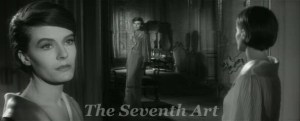
To borrow a quote from the Kubrick page at Senses of Cinema: “Rare is the artist who can suffuse his work with so much ambiguity and still intrigue”.  Resnais bows. Marienbad is a complex film, probably as complex as they get. It plays around with the character’s perceptions of themselves, the audience’s perception of their film stars, their perception of cinema and cinema’s perception of itself. Loads could be written about the film from very many angles and with very many theories. I’m sure there are a thousand “readings” of the film about what exactly happened, but I feel such interpretative exercises would just go against the purpose of the film. Rather than raising the obvious question “why is this film like this?”, Last Year at Marienbad proposes another: “Why were films not like this?”. This is one film that one can safely call meaningless, because Marienbad is not a document bound by the rules of the physical world, but a sensory experience that transcends temporal and spatial barriers. And experiences needn’t always have a meaning.


To Sir, Sans Love

To Sir, Sans Love

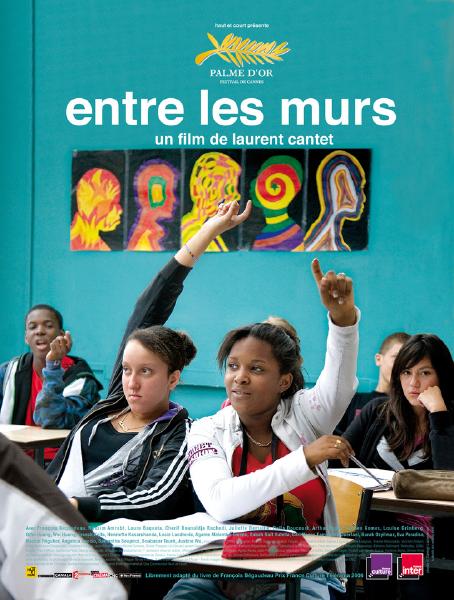
Ever since the ultra-slow moment of lunatic ecstasy took shape in Zero for Conduct (1933), schools in cinema have always been about kids. Everything revolves around them, for good or otherwise. They have been the be all and end all through the decades no matter how complex the scripts got. Even when the films, such as To Sir, With Love (1967), had the teachers as the focal point, the protagonists were always hinged to the acts and moves of the students. Or they turned the table around completely. Some of these films would have this altruistic, uncanny, omniscient and awe-inspiring teachers where the student community is a monolithic entity that served merely as the outlet to emotions. Palm D’Or winner Entre Les Murs (The Class, 2008) (perhaps Half Nelson (2006) too, which I have not seen) breaks all these rules and formulae in a naturalistic and unforced fashion.

The Class is a film where multiculturalism is written right on the face. It does not take the issue as a matter-of-fact as the other films of the year do, but cleverly, builds a premise that enables it to confront it straight on. It does not have a script that tries to be subtle and hence be cheeky enough to implant a message or two. That doesn’t mean The Class does not have a message. It sure does and in loads. It just doesn’t try to hide it. In fact, it attempts to highlight the same. Mr. Cantet avoids the temptation of placing the kids at the edge of the frame and takes them head on (and in focus) as individuals and not as outcasts or marginal. The diversity in Entre Les Murs is not restricted to just nationality or ethnicity, In fact, it goes even beyond the disparities of language, sexual orientation and religious customs, into regions of personal likes and dislikes. To the point where the term ‘diversity loses meaning and it all boils down to individuals, who are like human islands with personalized cultural traits.

The Class presents us two worlds – one each of the students and the teachers – that exist on their own without apparent causality. These are truly independent worlds whose inhabitants have their own problems to attend to, their own private jokes and their own reasons for celebrations. The teachers are assigned a big responsibility of handling multicultural students and that too, in a not-so-reputed school. The teachers have not only to handle this responsibility carefully, but the task of gaining an identity as a teacher in spite of the school. François’ (François Bégaudeau , also the author of the book on which the film is based) personal problems only add to the complication. So do the students, who seem confused about where they belong or who they are. And the class forms the playground for both parties to work within the system and find a place and name of their own.

I believe The Class is a film that has to be watched exactly twice. It is like that stretch of time where you have just quarreled with your friend and you are recollecting what exactly went wrong, only to discover that nothing did. Both the sides and their arguments seem correct upon objective evaluation and the mess seems just like the result of a moment of misplaced subjectivity. This problem arises because the story of The Class is filtered through a highly flawed protagonist. He may psychologically be meaning good, but what his actions at the end of it seem rash and unfitting. So are the acts and intentions of the troublesome Souleymane (Franck Keita). I’m sure that we would have had a symmetrically placed opinion had the tale been told through the eyes of Souleymane. This is precisely the reason I say the movie should be watched twice – in order to understand the two sides instead of passing judgments on them or taking a complacent stand.

The Class works even on a very basic level as it explores the explosive atmosphere between the teacher and the students in the class. This is a very tricky relationship indeed. The teacher tries to cut some slack in order to encourage interaction, ease up his job and ultimately gain reputation among the students. The students being the majority, on the other hand, try to display their wit or skill and get a upper hand in this cat and mouse game. But all this is laid on the foundation of a solid principle. That the adult is always the boss. The kids in Entre Les Murs realize that and try hard to keep themselves in control whenever they can. François too tries not to overstress the principle and to listen to the children as responsible individuals. But a small perceived disturbance, lands to shatter the balance and to provide the dramatic momentum to the film. Funny that this extremely talkative film is the successor of an exceedingly quiet one at Cannes.

The other day, I saw an orphaned girl speaking on TV after she had been admitted to a institution for children. She was speaking in Hindi and was using masculine forms of speech throughout. One could instantly make out the circumstances and environment in which she spent the previous years of her life. The importance of language is a vastly underestimated one and the extinction of languages is as critical as any other issue. The Class is a very talkative film as I said but it is these very words that support its premise. The world seems to have changed so much that the demarcations between the student and the teacher become blurred. They learn French grammar and vocabulary from François. They learn words like “Austrian” and “Argentine” which seems to be much sought after. François learns terms like “honky” and what not from the kids. It doesn’t look like degradation of culture, but rather as the evolution of an alternate culture that has much to teach as the existing one does. A lot of dialectical dialog in the film has gone over my head and understanding that perhaps would help one to see the socio-cultural patterns that are established during the conversations.

There is obviously a pitfall in a situation where a director intends to make broader comments using seemingly minor elements of the film, in this case – the children. One cannot make them too simplistic that it falls laughably flat nor too elaborate such that the elements themselves lose identity (of course, there are exceptions where the intention is not to preserve the elements but to map them completely). Kiarostami’s phenomenal film Homework (1989) is perhaps the bible for directors who want to make film that refuses to compromise on any level. Like Homework, but far less perfect, The Class elicits social, cultural and political structures of the society present outside the school through the interaction and behaviour of the students.

Although there are some forced moments here and there in the film, The Class for a large part is an unpolished film. It does not provide us easy questions or comfortable answers. It carefully avoids all clichés of conventional movies that earnestly move towards a self-congratulatory climax. At the end of The Class, one might be expecting François to pin up the self-portrait of the expelled Souleymane or at least provide a symbolic close to it. No, Mr. Cantel avoids that. Nor does he sweeten anything when the hitherto quiet student insists that she has not learnt anything the whole year. Mr. Cantet is perhaps asking us to see them as they are. Some people just can’t be brought into the clockwork of the system and the system in turn should not pat itself for bringing about the change.

“The System” here may not just denote an educational institution but a larger entity that Mr. Cantet has miniaturized into the four walls of a classroom (Interestingly, “Entre Les Murs” translates to “Between the Walls”). In what may be a metaphor for France itself, Mr. Cantet uses the class to make a commentary on the authoritative mentality of the establishment that tries to impose its values upon its variegated set of inhabitants. Those who don’t conform to the standards set by the system are either marked or expelled. The students feel what the school teaches is irrelevant and outdated, the school feels the what students know is useless and fake. As the whole class – the teacher and the students – vacate the room for winter break, we realize that this ordinary room, which could well have been a hospital, a post office or a shop, was given meaning only because of the presence of the system and its constituents – like our earth that is divided by man-made boundaries with its inhabitants having to adhere to a synthetic feeling called patriotism.

 
Verdict:

Five Dedicated To Ozu (2003) (aka Five)
Abbas Kiarostami
Silent

“…”

Five

Unquestionably, Kiarostami’s films are unlike any film ever seen, leave alone Iranian ones.  But one film that is extreme and decidedly avant-garde even by Kiarostami’s standards – Five: Five long takes dedicated to Yasujiro Ozu (2003) – has turned out to be one of his finest works. In what can be described as a super-slow version of Koyaanisqatsi(1982), Kiarostami presents us five shots of the sea, filmed during various times of the day, at various distances and of varying lengths. Kiarostami quietly integrates the five elements of nature to create a film that is as warm as Ozu’s and as puzzling as his own, in a way, forming a singular connection between them.

The first shot shows us a piece of log lying on the beach as the incoming waves unsuccessfully try to pull it in. There is instant engagement here. I do not know about others, but I have spent hours watching such insignificant dramas of nature – the wind trying to knock off a fruit of a tree, a crow trying to pull out a twig that is stuck and the waves trying to sweep my feet at the beach. There is complete focus on the log and the incoming waves here. These are the only two components of the frame and these alone form the foreground of the image. Interestingly, this is the only segment where the camera actually moves in order to accommodate the object under consideration. Kiarostami shows us a very ordinary piece of event, but our mind conjures up a narrative of sorts – with its own formulation of safe-space and danger zones of the “narrative”.  And things become complicated as the log breaks off and the larger part is swept off into the sea. Though completely unrigged, this “turning point” makes our attention shuttle between the drifting piece in the water and the struggling one on the beach. Is Kiarostami alluding to Floating Weeds?!

In the second one, we are shown the image of the sea as seen from an embankment on the beach. We are drawn into the horizontal waves that decorate the widescreen in the form of broad white lines. Gradually, we have people walking across in front of us pushing the sea into the background. People of all ages flood the screen in many amusing ways, regularly diverting our attention from the sea. There are even critters that wallow into the frame and easily gather focus. There is a feeling of watching a Béla Tarr film – but only in a sense. That is, in Tarr’s films, the dynamics of the foreground, though initially attractive, feel like clockwork after a while. Slowly, we sense the background – the still life – gathering a presence of its own and even imposing itself upon us. There is a feeling of intimidation and ill-omen whereas here, it works the other way round. The patterned backdrop is quite fascinating to start with, but as the humans start coming in the foreground, our attention is naturally devoted to them. We start studying them and even start expecting some new ones (I was hunting Jafar Panahi’s cameo). This segment ends the way it started – the sea alone occupying the stage.

The next shot presents us the sea sandwiched between the sky and land. This is shot from considerable distance and looks like a painting. It is early morning and there are dogs lying on the beach. Almost nil action takes place notwithstanding the stray movements made by the canines. Everything is in the background here as opposed to the previous two shots. Gradually, the contrast of the image starts reducing and after one point we are unable to differentiate between the sky and the sea. The shot fades to white after all the three elements of nature dissolve into one another.

The fourth shot is perhaps the most “interesting” of all. In a direct homage to Ozu’s style, Kiarostami places the camera at knee level and in close proximity to the sea. Soon, the screen is infested by ducks of various sizes, colours and gaits. This is the as close to comedy as the film gets. The ducks move at almost a fixed speed and their footwork seems like a musical rhythm.  Suddenly, all the ducks that have gone past retreat as a bunch as if in a panic. The concentration is completely on the foreground here and the sea becomes no more than a comfortable backdrop.

The final shot lasts about half an hour and is the boldest of them all. It is night time and we can hear the loud croaking of frogs and barking of dogs. And it is only after a while we come to know that we are staring at the still sea. The reflection of the moon appears in a distorted way on the dirty surface of the water. Once more we desire the reflection to settle down to form the perfect circle. The notions of foreground and background are completely eliminated as the pulsating moon appears like a milk drop that falls into abysmal vacuum. And just when everything seems unperturbed, rain comes. The annoying frogs disappear and so does the reflection. Kiarostami has probably shot this in time lapse as the rain stops suddenly to restore the noisy atmosphere. The moon “settles down” and soon disappears behind the clouds. It is interesting to see that all the dynamics of the scene here is off-screen and their presence indicated only by the sounds they produce. We stare at nothing but dark blank space for most of the time but never once lose hold of what is happening in the film’s environment. A little later, we hear the rooster’s call and sure enough, bright sunlight strikes the image to reveal the clear blue water. This part is truly a revelation as one feels a fresh lease of life in the hitherto mundane and contemplative frame.

There is naturally a problem with a film that is as provocative as “Five”. How much of the content we derive out of the film is intentional? Was there a set of objectives for the director while filming the footage? Was every element in the mise-en-scene completely controlled by the filmmaker? Would the film have been different if each shot was prolonged or shortened?  Here lies the classic tale of the emperor and his clothes. With a name as great as Kiarostami’s in the title cards, one directly gets ready to attach significance to the images, however banal they are. At the same time, it is but natural to feel awkward while watching such material. There is that absurd feeling of watching a Stan Brakhage film (I’ve seen over two dozen of his films and I must admit I can’t recognize most of them!) to the point of laughing at yourself. You get the feeling that Kiarostami is probably toying with his audience after all.

But surely, this isn’t anything like what Warhol did. Here is a filmmaker who understands what Ozu stood for and how big a responsibility the title of the film places on him. A filmmaker in the tradition of Ozu himself, Kiarostami does not go for cheap attention using complicated mise-en-scene and steady-cam shots. He doesn’t just see the world but observes it. He studies the relation between the various planes of the image. He experiments with the distance of observation and the range of emotions they evoke. In essence, he analyzes the subjective and objective components of the cinematic image never once losing the most important ingredient of his entire body of work – humanity. And that is why “Five”stands as a fitting tribute to one of cinema’s greatest humanists, by another.

Four Faces of King Lear

Four Faces of King Lear

Shakespeare’s plays have become an endless pool of resource for the filmmakers of the world. Their universality of themes and emotions has intrigued a range of directors and has prompted so many adaptations and retellings. One of them, King Lear, distinctly stands out. Romeo and Juliet may have become one for the classrooms and Macbeth may still be classified as a terrifying legend, but King Lear seems to grow with age and feels immensely relevant and profound now more than ever. The themes handled by the epic resonate and typify the post-modern era as if the book was written a few years ago. Of course, it is difficult to make a film that is both true to the literature and retains its cinematic qualities without the influence of theatre. But some of these projects have done this well, to say the least. Here are four of the cinematic versions that were but inevitable to come. 

King Lear – Jonathan Miller (1982), The United Kingdom

A film from the home country to begin with. Miller’s King Lear is my substitute for the impossible-to-find Peter Brook version. Made as a part of a massive project undertaken by the BBC in 1982 to film Shakespeare’s works, this version has been remembered almost solely for the monumental performances of all the actors. And in harmony with the intention of the production, the film remains thoroughly faithful to the classic. It attempts to take into it everything that Shakespeare put forth in his narrative.

I must admit that I was quite skeptical when I started watching the film. Shot in 4:3 and under an objective of just filming Shakespeare’s work, I expected the film to be too theatrical and plainly, an extended soap-opera. But the film is far from that. It almost completely does not use expressionist zooms, shot-reverse shots and even a background score for that matter. Yes, it is excessively lit and has got a soap-like visual quality, but it sure does possess cinematic values of its own. Its cinematography, particularly, uses room space well and with surprisingly long shots, achieves a quiet brilliance of its own. The camera is almost static but it conveys much even with that restriction. Interestingly, it almost always films Lear from a downward angle perhaps mirroring Lear’s own infallible pride.

Hordern’s performance as Lear is evidently great and at times, even imposes on the other actors’. Edmund’s character, played by Michael Kitchen, serves as the comic relief and regularly breaches the fourth wall to glorify his vileness. However, the production design of the film leaves a lot to be desired. Shot almost completely indoors, the film uses a bland colour palette that is neither as expressive as Kurosawa’s version nor as meticulously controlled as Kozinstev’s. But the 185 minutes of inspired performances more than make up for that and eventually deem it a very worthwhile effort.

Korol Lir – Gregori Kozinstev (1971), The USSR

Kozinstev’s least talked about adaptation is ironically a fantastic one. Shot arrestingly in widescreen, the film reminds us of the Tarkovsky classic Andrei Rublev (1966) with its measured pace and absorbing imagery. The extraordinary cinematography uses the widescreen judiciously as it uses track shots to cover the vast stretches of barren and decaying landscape that reflect the very nature of Lear’s mind. Kozinstev’s employment of largely empty rooms and lifeless locales coupled with the recurrent images of wild beasts that highlight the torment that Lear is going through provides the perfect ominous atmosphere for the tragic showdown.

Where the BBC version was elaborate and expressive for the sake of the text, Korol Lir is less verbose and more cinematic. The images take the driver’s seat and the emotions are kept suppressed. This quietness of the images adds to the menacing atmosphere that builds up. Kozinstev utilizes the black and white costumes effectively to convey meaning rather than verbalizing it. Yuri Yarvet shines as the (completely shaven!) foolish king and carries naturally with himself an air of madness.

Kozinstev remains mostly faithful to the text and retains most of the characters and elements as they are. However, his handling of Lear and The Fool are interesting. After the first part of the film, Lear is almost constantly shot downwards. At times, the camera neglects him and shuns him oblivion and others, it completely homogenizes him with the helpless mass. Kozinstev places Lear as an insignificant part in the huge fabric of nature. This stark contrast in his position before and after the partition evokes a sense of sympathy for Lear even though his plight is a result of his own decisions. Additionally, Kozinstev ties Lear’s fate to that of his kingdom itself. As Lear deteriorates, we see images of mass exodus looking as if headed towards doom.

And more fascinating is the character of The Fool. Kozinstev does use The Fool as the pivotal character but where Shakespeare killed off the character towards the end, Kozinstev retains him even after Lear’s death. An interesting proposition – The Fool without The King – considering that The Fool is but a manifestation of Lear’s mental self. The soul without the body, the shadow without the object.

Ran – Akira Kurosawa (1985), Japan

Moving farthest from the country of origin, we arrive at my favorite version of the tragedy. Akira Kurosawa’s Ran is a revelation and a slap for those who considered him defeated after such frustrating years. Kurosawa gives a complete reboot to the book and revamps it perfectly to suit the backdrop. He had already sizzled in the multi-layered feudal drama Kagemusha (1980) and in Ran he retains the backdrop to carve out a shattering masterpiece that is much more cinematic, much more harrowing and much more human than its counterparts.  As much cold at surface as it is with its gut-wrenching violence, Ran at heart it is an elegy, a requiem for the helpless decline of humanity.

Kurosawa makes remarkable changes in the text as he replaces the daughter trio with three sons. He completely eliminates the Gloucester subplot and the theme of lust from the picture. The central focus of Kurosawa remains the idea how man’s past catches up with him no matter what he does. Hidetora (The Lear character) suffers progressively as every one of his action turns back on him one by one. He shelters in a ruined fort that was destroyed by him. He then is protected by Tsurumaru who was blinded during one of his raids. And both his daughters-in-law have been affected by his wars in one way or the other. Hidetora has cast the boomerang, now he has to collect it.

Kurosawa was an excellent painter and it shows. With remarkable use of almost all colours, Kurosawa takes us the filmic medium as his canvas and strikingly brings out the brewing savagery and insanity of all his characters (“Ran” incidentally means Chaos).

Watching Ran even after 20 years of its production, a shiver runs down the body, for the images are of such power. The threatening clouds that preface each scene, the opening hunt, Lady Kaede’s vengeance and its termination and the final image of the blind Tsurumaru dropping the scroll of Buddha – more than an adaptation. Poetry of war.

King Lear – Jean-Luc Godard (1987), France

It actually isn’t fair to call this one a French adaptation. It is Godard’s adaptation, period.

And it isn’t fair to even call it an adaptation of King Lear; it is a film that tells about an adaptation. I might just be giving the article away, but there are some traces of the Shakespearean work to classify it with the other three films. It follows a man who calls himself Shakespeare Junior the fifth just after the Chernobyl incident as he tries to re-create Shakespeare’s (lost) work. And as usual, Godard uses this loose structure to weave his tangled web of ideas and reflections.

What Godard has done here is commendable because he takes Lear from one form of literature to another. All the Lears hitherto have been narrative oriented whereas Godard presents him inside an essay – an essay on art, its preservation and reproduction. He discusses how images are unique and how it is inimitable. Additionally, he places the audience directly in King Lear’s shoes. Lear wanted to believe everything he heard from his daughters and similarly, the audience is “led” to believe that the film has ended much before the actual finish (many times!). And through this mockery, Godard calls for a desertion of belief on the images we see. He emphasizes time and again that “seeing isn’t believing”.

The film regularly tells us that it is 3 journeys into King Lear. Godard grazes the book, which is essentially a tale of struggle of virtue amidst domination, power and betrayal, and extends its possibilities to ponder upon the nature of the cinematic medium. He explores three kinds of domination – domination of commercialism over art, domination of power of image over that of words and the domination of existing forms of cinema over the new ones. And surprisingly, the final tragic image of Lear (Don Learo here) doesn’t show him crying with Cordelia in his arms. Instead, his back is turned as Cordelia remains dead behind him. He continues to be blind.

As such King Lear is all about decadence. Everyone in the story is blind. Lear is blinded by his pride and the fear of hatred, Gloucester by mere belief and later physically, Edmund the sisters by their lust for power and even Kent by his loyalty. The only person unaffected by this “disease” is Cordelia (and perhaps The Fool who is but half a man) whose is the only symbol of virtue and righteousness in the story. And Shakespeare’s work is a tragedy only because of her death that apparently leaves us without a channel of hope.  However, Kent’s eventual awakening after Lear’s death is a possible conduit to sustenance of humanity.

To see how various filmmakers have been obsessed with the representation of power over virtue and vice versa, death and survival of good and vagaries of the human mind is as enlightening as it entertaining. One realizes that even after so many interpretations and analyses, the book remains a constant supplier of thought and remains open to so many adaptations. I, for one, would like to see at least two good Indian adaptations of the book. One, a neorealistic version set in the cities of modern India where struggle for survival is at its peak – something like what would evolve if Wong Kar Wai made it. And the other, a Ran meets Tokyo Story kind of adaptation rooted in the most rural of India’s villages where, also, the feud over familial property remains a fiery issue.

Histoire(s) Du Cinéma
(History Of Cinema)
1988-98


History of Cinema (1988-98)

History of Cinema (1988-98)

The candidate for this concluding part of the Godard marathon couldn’t be anything other than Godard’s magnum opus History of Cinema (1988-98) – a one-of-a-kind film that isn’t like anything seen before, even by Godard’s standards. In what I like to call “Stan Brakhage meets Sergei Eisenstein” kind of cinema, Godard completely does away with the need for a film camera as he employs loads and loads of footage from the most obscure corners of film history to express his ever-baffling, ever-revolutionary ideas and eventually reconstruct history – of art and of time itself. His editing prowess coupled with his oceanic knowledge of art and history result in a barrage of images, sounds and texts that anyone calling himself a Godard scholar, leave alone film scholar, would hesitate to come forward. Nevertheless, History of Cinema remains an immensely enriching experience for those who are game and those who earnestly try to get a whiff of what Godard is getting at.

Though the film as such is considered an eight part series that Godard gradually completed within a span of 10 years, the sharing of thematic and formal content among the film is so strong that any demarcation between the segments seems valid only for documenting purposes. Each film is as much tied to the others as it is singular – an idea that carries over to the commentary on cinema that Godard delivers – Cinema as an art that is as much connected to the preceding arts as it is unique. He regularly intersperses critical works of painting, sculpture, music and photography with entities of pure cinema as though suggesting that not only does cinema bear a definite relationship with them, but also that history repeats itself in one form or the other. As a result, the tracing of history of cinema necessitates a journey back not just to the year of the Lumiéres but much before.

History of Cinema (1988-98)

If we had to single out Godard’s most favorite quote it has to be the misattributed Bazin one: “The cinema, substitutes for our gaze a world that corresponds to our desires”. And this is where the series kicks off. Cinema as a substitute for our dreams – the dream factory. Godard explores the meaning of “dream” as interpreted by the two functioning extremes of cinema then. He presents the occident interpretation as one that had converted cinema into a portal offering an alternate reality, a second life, to the audience whose “dreams” were the fodder for the larger-than-life images that the films projected -one that continues till date. He crosscuts this with the adversarial position taken up by the Russian giants whose visions/dreams of the society after the 1917 revolution were the primary driving force that prompted the directors to make films that could make audience act and think, not get addicted to. Godard contrasts these notions and movements and laments the death of the latter while reconstructing fragments from pivotal moments of history and cinema.

In the centenary film Lumiére & Co. (1995), the filmmakers were asked a question: “Is cinema mortal?” If Godard had been asked the same thing he would have most probably said that cinema is already dead – killed almost as soon as it was born. In History of Cinema, Godard puts forth the idea, or rather the bitter truth, that cinema had infinitely more potential to influence history than any of its predecessors, but was ruthlessly narrowed down to a medium that tells “stories”. That, in an attempt to reproduce reality to utmost perfection, filmmakers have put on it a fake fabric of synthetic morals and eventually pulled over it a world of spectacle so as to mask the blunder. He argues that cinema could have prevented unfortunate tragedies and averted genocides rather than merely crying over damages dealt and observing helplessly the misery of its subjects.

History of Cinema (1988-98)

And in resonance with this ideology, instead of bemoaning what is lost and what could have been, Godard anticipates the death of cinema (He apparently asked Henri Langlois to burn the archives). Death, so that it can rise again from the ashes. “Art is like fire. Born from what it burns.” says Godard and that is precisely what he desires – Cinema to go down with all its exploitations and restrictions and rise in its purest form. Back to infancy, so that it can learn everything out of free will, without rules and without vanity.

Having said that, Godard also calls for a preservation of cinema and hence a preservation of history, for cinema has recorded both beauty and atrocity with equal emotional bias, if not with justice. True that cinema has always been a runner-up to history, but at least it has mirrored history to some extent. But unlike traditional methods that document history as a direct function of time, Godard attempts to reconstruct history as seen in retrospect. He utilizes existing film fragments to fabricate various histories of film – the one that was and the ones that weren’t but could have been. He examines how cinema could have been made independent of historical accounts and even made to influence them. In essence, he projects history backwards to uncover the history of projection. Godard examines such dualities in a number of places in the film – Infancy of art and art of infancy, newness of history and history of news and reality of reflection and reflection of reality – employing a variety of footage ranging from newsreels to pornography.

Godard elucidates this servile relation that cinema bears to history using images of dictators and authoritarians. He highlights how the visual medium itself is being manipulated by a few people in power and how in turn, modern cinema manipulates the audience. Godard reproaches this moral policing and expresses his disapproval of the hypnosis that the TV-driven audience is subjected to. He appeals for a cinema that provokes but doesn’t direct, a cinema that gives you options but doesn’t select one, a cinema that makes you think and doesn’t think for you and a cinema that is only complete with its audience. As he quotes in one of the segments, “Cinema does not cry. Cinema does not comfort us. It is with us. It is us”.

History of Cinema (1988-98)

There is an intriguing recurrence of the image of human hands in the film. Godard urges artists to think with their hands – their real tools that have the potency to both create and destroy, to beautify and to horrify, to document and to change. He argues that these are the instruments capable of changing and redefining history and it is the weakness of the mind that hinders the possibility. This motif is punctuated by quintessential Hitchcockian and Bressonian images of hands and their gestures that carry with them an air of graceful individuality. And amidst this theory, Godard expresses his deep admiration for Hitchcock and Rossellini (especially Rome, Open City (1948)).

It is naturally impossible to grab every reference and idea that Godard throws at us. Hence, History of Cinema becomes a film that one should watch multiple times with considerable spacing. Without doubt, uncovering each layer of its text, sound and image to see how Godard has constructed the history of cinema, just in order to rebuke it, is a progressive task that becomes possible only with much exposure to all the six arts that precede cinema. I, for one, am going to visit the film every year trying to gain something more out of every time and get a glimpse into the esoteric world that is Godard’s.

=========================FIN=============================

That brings me to the end of the series. This has been one heck of a ride for me – exploring a world that almost no one talks about. I must thank everyone who has been visiting the blog, especially Nitesh, Ed and Shubhajit who have presented some very interesting and illustrative facets of Godard’s ever-baffling works. And Godard himself, for I’ve never become so tired after watching a film. To get a measure of that, I spend around 3 hours watching an 80 minute film! His films extract so much out of you that following 1% of Godard is much more enlightening than absorbing 100% of the others. I do hope that I get my hands on more of his films some time in the future.

Of course, I have missed out on more than a dozen worthy Godard films and shorts including Here and Elsewhere (1976), the bizarre Keep Your Right Up (1987), the radical King Lear (1987), and the more recent Our Music (2004). I hope I can cover them in the Flashback series or elsewhere.

Till then, au revoir and a happy new year,
Le Petit Soldat

Éloge De L’amour
(In Praise Of Love)
2001

In In Praise of Love, Godard focuses on a single topic for discussion – that of preservation of history. He debates the validity of preserving history using media and the replacement of memory by technology. Additionally, he raises questions about Hollywood’s methods of representing history and argues that the industry manipulates history in order to make the audience sympathize or react but never to indict the guilty. There are also some hard-hitting statements made about the history of the United States that are readily controversial. And these questions in turn bring up the conflicts between image and reality, documentation and re-creation of history and proprietorship and openness of history.

In Praise Of Love (2001)

In Praise Of Love (2001)

The film is marked by extraordinary cinematography with the first half of the film taking up a neo-realistic character. Godard achieves complete distancing and passivity of vision that the Italian pioneers could never achieve. The second half of the film literally changes tone with its excessively saturated Wong Kar Wai-ish colour palette and expressionistic style. In some ways, In Praise of Love is Godard’s version of Wings of Desire (1987). He films the past in colour and the present in monochrome as if suggesting that the variegated experiences and stories of the past have now lost their colours and been demarcated by black and white regions – like what a child sees. This absence of an adult’s vision that plagued the very nature of revolution seems to have made history a matter of pop culture.

This creation of extraordinary out of the ordinary, refusal of cinema to act as a social mirror and one-dimensionality of perception about history, Godard suggests, is decidedly a result of the years of training of the audience’s minds by the films of the west. There is a fantastic sequence where we see a theatre that is screening both Bresson’s Pickpocket (1959) and the Wachowski siblings’ The Matrix (1999). Though both the films deal with the notions of fate, free will and existential imprisonment, the popular choice seems be the spiced up version.

For Ever Mozart
1996

For Ever Mozart is one of Godard’s most complex films. This is true of all his films that have a seemingly coherent narrative, but For Ever Mozart surpasses all its companions into a realm that only Godard has the access to. But by no means is it a self-indulgent film. While the whole world of filmmaking is crowding the narrow lane defined by the “rules of success”, Godard wallows alone in the vast unexplored stretches, taking his gigantic leaps and pondering on the barrenness of the field. Until someone gives him company and learns his language, I can just guess.

For Ever Mozart (1996)

For Ever Mozart (1996)

For Ever Mozart, on the outset shows us two threads the first of which follows a group of self-proclaimed theatre artists out in Yugoslavia to put up a play amidst the frustrating war situation around. The second thread, the more accessible one, involves a director with an urge to use filmmaking as an art (wanna guess who?!) against the wishes of his producer and audience. He believes the director to be the father and the actor to be the mother of any play and sure enough, after much labour by both the director and his actress, they deliver the film of their dreams. But what does the audience want? Terminator-4. This creates a tautology of sorts within the film between the two threads. One depicts the struggle of art to survive within the harsh realities of the world whereas the other portrays the battle of art with its own subverted form – Cinema among wars and war among cinemas.

There is a magical scene at the end of the film, perhaps Godard’s best. We see an anachronistic image of Mozart performing amidst an audience that is clad in jeans, chewing gum. The mute Mozart invites a layman to assist him in his concert. The director ascends to the hall with difficulty via a stairway (to heaven?) after which he retires. Is Godard suggesting that a time will come where art will be a commodity of the public and not just for the public? To steal from the film itself, “It’s almost nothing or… something I don’t know“.

JLG/JLG – Autoportrait De Décembre
(JLG By JLG)
1995

Godard’s influence of Van Gogh shows in his next film JLG by JLG: An Auto-portrait in December. Made largely inside his room, JLG/JLG looks like a home movie like some of his films of the late 80’s. The film seems to take place during the editing of Godard’s interesting reworking of the Greek legend – Oh Woe is Me (1993). Godard makes it clear that the film is only a self-portrait, not an autobiography – not an objective account of his psychological motivations, but an introspection that is subjective and only skin-deep.

JLG By JLG (1995)

JLG By JLG (1995)

The most interesting aspect of the film is that we get a glimpse into Godard’s daily life, which by itself is quite extraordinary. We see what he reads –  a huge private library which stores some of Godard’s most famous quotes that have enthralled audience through the decades. We see what he speaks – as we have seen before through his various quirky characters. We see what he watches – the films that find their way into almost all of his movies in the form of references and posters. And we see what he thinks – like the relationship he conjures up between stereo speaker system and the Star of David. His financial difficulties clearly show up as we even see an official raid into his shabby household. These claustrophobic images are intercut with paradisaical images of the winter that seem to bear a strong relationship with Godard’s own mental landscape during that period.

Although all this gives the feel of an honest documentary observing a day in the life of a filmmaker, it is, like most of Godard’s filmography, an essay that presents as many ideas as its predecessors and provides a commentary on larger issues hidden beneath the veneer of the quotidian events that we see. Godard begins with his favorite theme of individualism versus the community (crystal and smoke, according to him), moves on to the regular issues of truth, image and fate and finally takes up an elegiac tone that shows a clear yearning for the past carrying over from his previous films. And who wouldn’t be disarmed by a film whose closing quote reads “A man, nothing but a man, no better than any other, But no other better than him.

« Previous PageNext Page »