Cinema of Iran


The Cinema Of Abbas Kiarostami
Alberto Elena (Translation: Belinda Coombes)
SAQI and Iran Heritage Foundation, 2005
 

Film begins with D. W. Griffith and ends with Abbas Kiarostami

– Jean-Luc Godard


The Cinema of Abbas Kiarostami

Thus reads the cover of Alberto Elena’s book “The Cinema of Abbas Kiarostami”, one of the very few books available in English on the works of the Iranian auteur (the only other renowned book is by Jonathan Rosenbaum which is rebuked by some scholars, according to this book). Before anything, I have to say that the book succeeds right away – by giving an update to the film world about the status of those elusive early Kiarostami films that seem to visit certain festivals now and then. I’m not sure if this is one of the best books on an Asian director, but I can testify that this is one of the most well researched books that I’ve read. To get a measure of what I’m saying, consider this: more than a third of the book is dedicated to foot notes, references and bibliography! Mr. Elena meticulously grounds his arguments and theories on numerous articles, theses, interviews and other books, hence developing an unchallengeable set of inferences and managing never to be speculative – an achievement indeed.

Mr. Elena explores Kiarostami’s films in ways that the western critics have seldom cared for. He carefully avoids (and sometimes criticizes) the terms the west uses to describe Kiarostami’s films – humanist, neo-realist, experimental, artistic and universal, to name a few. He takes a stance against the filtering of these movies using western norms and theories. Not once is a comparison to a western filmmaker made or a movement or technique from Europe recalled to elucidate analyses. Mr. Elena emphasizes Kiarostami’s desire to engage the audience in order to complete his films without ever reminding us of similar works of European filmmakers (Bertolt Brecht is not even mentioned in this context). He regards Kiarostami as a truly “Iranian” filmmaker with genuine social and political concerns. In order to justify his position, Mr. Elena refers to a plethora of native Iranian critics who have very aptly pointed out the influence of various facets of classical Persian art on Kiarostami’s works.

This, precisely, is the biggest strength of the book and a critical value-add as far as literature on Kiarostami is concerned. Mr. Elena resorts to Persian poetry – both classical and modern – and demonstrates regularly how Kiarostami’s work is closer to poetry – especially the overtly visual haikus – than any other form of art. He takes examples from Jalaluddin Rumi, Omar Khayyam and Hafez to illustrate Kiarostami’s preoccupations with the illusory nature of everyday reality and the inevitability and the possibilities of death. With the same conviction, he also establishes the influence of the modernists (the new poetry movement of Iran) – Forugh Farrokhzad and Sohrab Sepehri in poetry, Amir Naderi in film and Sadegh Hedayat in literature – on his own films and poetry. Additionally, Mr. Elena draws parallels between Kiarostami’s use of “human figures” and the Persian miniature painting.

But the most rewarding aspect of Mr. Elena’s linking of Kiarostami’s works to the Persian art is his illumination of the Sufi themes in the director’s works. Always (and quite naturally) overlooked in the discussion of the films, the Sufi influence is what makes Kiarostami films very “Iranian”. The emphasis that Sufism places on journeys – inner and physical – evidently finds its way into many of Kiarostami’s films. Kiarostami’s protagonists are almost always seen traveling in cars but what is more important is the metaphysical journey that they subconsciously embark on. Mr. Elena analyzes the various elements of the “Sufi journey” such as the presence of an omniscient Pir (guide) and closeness of man to nature and to the present that are present in some form in the director’s films. This way, he places in perspective even the most obscure and taken-for-granted components that define these works.

As an added bonus but also an ineluctable facet while charting Kiarostami’s career, The Cinema of Abbas Kiarostami examines the political situations in Iran right from the Shah’s oppressive rule, through the Islamic regime that had its own shortcomings, to the relatively liberal yet largely unsatisfactory Khatami democracy. Mr. Elena describes how Kiarostami’s prosperous years at the Kanun (the Center for Intellectual Development of Children and Young Adults) were actually safer from the supply-demand rules of the movie industry and the excessively stringent and often absurd rules of the censor. And more importantly, he studies how Kiarostami’s films have always been conscious of their society and the politics that governs it. Albeit their cheeky and subversive form, Kiarostami’s films, as Mr. Elena points out, have always reflected the politics of contemporary Iran, be it the economic downturn in the pre-revolutionary period as in The Traveller (1974), the educational and domestic structure of the country as in Homework (1989) or the women’s issue in Ten (2002).

However, like a lot of “definitive” books that are hurt by partiality and pace, The Cinema of Abbas Kiarostami too suffers from abruptness towards the end. Mr. Elena devotes a large chunk of the book for the director’s early short films and medium length features. In fact, a lot of matter-of-fact readings of the films by western critics could have been completely done away with by Mr. Elena, for all these seem to be products of hindsight and over-analysis. The “Koker trilogy” and The Taste of Cherry (1997), too, are discussed in considerable detail and with formidable authority. But from what may be Kiarostami’s most enigmatic and critical film, The Wind Will Carry Us (1999), the book slides downhill. Once the analysis of The Wind Carry Us is hastily completed, Mr. Elena wraps up Kiarostami’s subsequent features – ABC Africa (2001), Ten (2002), Five (2003) and 10 On Ten (2004) – are wrapped up within a few pages in spite of the fertility of the films. Perhaps be Mr. Elena thought that from these films onwards, there are enough printed materials elsewhere for the readers to refer to (The original Spanish version was printed in 2002).

 
Verdict:
 

P.S.: Here is a gargantuan review of the book at Senses of Cinema (which is even bigger than the director’s bio page at their site) that deserves a review of its own!

Mashgh-e Shab (1989) (aka Homework)
Abbas Kiarostami
Persian

Punishment means getting beaten up.”


Homework

There are a few directors whose films I can never say no to. More Jarmusch? Yes please. More Herzog? You bet. More Kubrick? Is there even a question? Abbas Kiarostami clearly belongs to this pantheon. Trust Kiarostami to come up with something completely new and radically profound. In what may be his greatest work to date, Homework (1989), he pulls off something that world directors have been struggling to even script. But more than the content, what baffles us about all his films, more so in Homework…

Homework is, quite predictably, a plotless film. It involves the director interviewing some first graders about why they don’t complete their homework on time. If you are tempted to ask what ever can be interesting about it, please think again. Using what are decidedly banal questions, Kiarostami emphatically derives and establishes social, cultural, political, emotional and even moral patterns prevalent in the contemporary Iranian society in a fashion no spectacular cinema can provide. Without ever being overtly controversial, he successfully exposes the national mentality through the words of children that indicate the society’s complacency towards violence and the influence of the extremely competition-oriented behavior of the west.

“What do you like more – cartoons or homework?” is the question that he asks the children, who invariably reply that they prefer the latter. They are obviously lying and proved so when they contradict themselves in the succeeding questions. But why should they lie? It can be seen that they are aware of the presence of the camera and realize that someone watching them would directly mean prosecution for their petty crimes. Kiarostami then asks them the meaning of punishment. The children are quick to answer unanimously that punishment means getting beaten up with a waist band. He then goes on to ask them what encouragement means which too produces some interesting trends. Also seen in parallel is the tendency of the children to desire top grades and look at anything below that as poor. And encouragement for them seems to be a causal commodity that follows only these top grades.

The emotional responses of the children are simple and their priorities, straight-forward. They try to save their skin but also try not to implicate anyone in the process. They want to be fearless, patriotic and go war against Iraq but, in accordance with the morals they have been taught, do not like fights at home. The passivity of the adults towards domestic violence is alarmingly evident and the children seem to be happy enough to continue the tradition. The freedom of choice and of preference for indifference over involvement seems to have been overridden by the authoritarian and one-dimensional nature of the educational system, which in turn reflects the political-ideology and history of the country.Kiarostami integrates such macroscopic facets into a disarmingly and deceivingly simple format that one wonders if censorial prohibition is a hindrance to handle controversial subjects at all.

Earlier in the film we are shown the school’s prayer song that contains anti-Saddam lines interspersed with lines in praise of God. We also come to know that this theological element runs deep into the education system and into the figures of speech. The choice of Faith is removed and the morals made black and white. So is the cinema that the kids watch – based on war between Iran and Iraq with altruistic Iranian soldiers and Iraqi baddies. I must say that sadly, the same patterns would be revealed if such a film was made in other countries too. There is, however, a healthy pattern that is visible too. Almost all the parents seem to be illiterate and the kids seem to be helped by their sisters. Clearly, the awareness about the importance of education, especially girls’, seems to have spread largely in comparison to the previous generation.

Interestingly, there are two segments where adults speak about this homework issue to Kiarostami. I initially disliked this idea as it seemed like a tacked up summary of the film so far. But a closer inspection revealed that these guys were as camera-conscious as the kids themselves. Only that these guys were crafty enough to hide their lies and seem like being utterly objective about it all.It is extremely difficult to pin them down with their statements but it is observable that they were both trying to exonerate themselves of the blame (a laRashomon), and to criticize the state of the educational system. So eventually, no one speaks the truth in the film except the film itself. And in some ways,Kiarostami scores over Kurosawa’s Rashomon (1950) which at least provided a humanitarian glimmer at the end.

Like his extremely acclaimed Close Up (1990) that was to follow, Homework’s biggest success is its meditation of the nature of the medium and the tag of reality that goes with it. It is known that Kiarostami never hesitates from letting his audience know that there is a camera in operation during the film. Kiarostamiquotes:

A filmmaker has to be conscious about his responsibility. I always wish to remind the audience that they are watching a film. You see, it is very dangerous to make the audience more emotionally engaged than they need to be. In the darkness of the cinema, people are so innocent. It makes them feel that everything is closer and stronger. That is why we should not make them even more emotional: People need to think when they watch films, not to be robbed of their reason … I make half movies. The rest is up to the audience to create for themselves.

Furthermore, in Homework, even his characters are conscious of the film tools.Kiarostami crosscuts the interviews with shots of the cinematographer behind his camera – the omniscient eye – to remind us that we are watching a film and the characters that they are being watched in a film. In essence, he removes the transparency of the camera from his cinema and makes it an opaque and often intrusive object for us and the characters. Kiarostami’s technique is perhaps the smoothest form of Brechtian alienation employed in modern cinema. He trivializes the film image by exposing the tricks of the trade, yet this knowledge of the truth is ironically what makes it so complex. Like the classic case of the Schrödinger cat, reality seems to be altered by the presence of the film camera, proving that reality in cinema can indeed be achieved only through artifice and by undoing the consciousness induced by the camera.

An additional layer of complexity is added by the presence of Kiarostami, the director (over Kiarostami, the interviewer). Two possible answers evolve when one thinks how Kiarostami might have carried out the film. One – he might have told the parents about his project about homework and the parents’ involvement in it (as he does in the first scene to an admirer, possibly one of the two adults in the film). In this case, the parents would have been quick to ‘condition’ their children in order to save their faces and prepare the kids with all the statements required to conceal truth. This would be an indirect and psychologically complex way of directing children by actually directing their parents. Or Two – he might have hinted to the children that the information they provide will be delivered to their parents and teachers. This would also shape up the stimuli of the children who would try to evade the waist belts. In either case, Kiarostami’s point turns out true – that children are being made victims of a violent game of power, ego and greed of the adults.

Homework is an epic film. Not in its spectacle, but in its scope and implications. It is too profound, too complex and too vast for words. Both its form and content are uniquely and completely cinematic to the point of redefining its boundaries. This is a film that shows why the perspective of a director is more important than his ambitions. A must-see.

Bad Ma Ra Khahad Bord (1999) (aka The Wind Will Carry Us)
Abbas Kiarostami
Persian

“Well, since I’m good, can you get me a bowl to fetch milk?”
 

What would cinema be without Abbas Kiarostami? Watching his films is a process of unlearning cinematic conventions and relearning the humanity within. He has time and again proved that the audience can be emotionally stimulated and for the right reason, without ever engaging them in the film. The Wind Will Carry Us (1999) is a testament why he never sacrifices Kiarostami the humanist for Kiarostami the filmmaker. The moral questions – of choices, of priorities and of conscience – which the film presents seem pertinent now, in these tough times, more than ever. I can guarantee that one ready to confront them would have understood him(her)self better at the end of it all. All it takes is a little patience and a willingness to introspect after the film has ended.

the-wind-will-carry-usMore than the apparent issue of communication and the lack of it, The Wind Will Carry Us seeks to question the definition of communication. Sure, the protagonist Behzad (played to perfection by Behzad Dorani) does have a cellular phone and the speedy vehicle to move around, but what was the use of it all? He is shortsighted in more ways than one and seems to forget details that he had voluntarily gathered moments ago (Ironically, the villages consider him to be a telecommunications engineer!). The villagers, on the other hand, are scientifically handicapped but that seems to be utterly insignificant. They commute very easily, they have multiple paths to the same destination for easy or quick access and they seem to be able to even move vertically though the village using ladders and the serpentine alleys. They seem to know who lives where and at what distance a resource is to be found. This partly is reflected in their priorities in life and their attitudes towards it – gratefulness for the present and a reverence for the future.

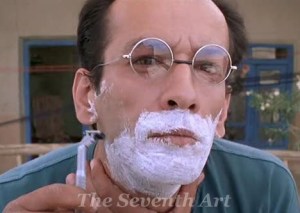
The Wind Will Carry Us can very well serve as a commentary on how the developed nations and the Third World look at each other, but that would only be of minor significance compared to the seething humanity within and around the film. More than anything, The Wind Will Carry Us is a meditative self-portrait, or rather an attempt to look at oneself objectively. Kiarostami observes his own intrusion in the lives of unsuspecting locals and in general, the exploitative and manipulative relationship that exists between the filmmaker and his subjects. He drops enough hints suggesting this in the film.  At one point in the film, Behzad is seen shaving facing the camera as the latter assumes the role of a mirror, which is not much different from what Kiarostami uses it as. Unlike in other Kiarostami “car trips”, the filmmaker protagonist is often filmed head on while driving the car, thereby obtaining a literal and figurative reflection of the camera on his spectacles – an indication that the person in front of the camera is not very unlike the one behind it.

Behzad, his alter ego, is the symbol of encroachment. He arrives ominously in his giant vehicle, tearing through the serene landscape of the secluded village, with a motive that is no more selfish than ours. His work involves the demise of an elderly woman of the village who is presently on her deathbed. Behzad spends time hoping against nature for the process to happen fast but things are not to be so. His attempt to strike up conversations with the village folk, more often than not, turns them off and renders them uncommunicative.  In a remarkable scene, Behzad, in a fit of frustration, overturns a turtle on to its shell and leaves the place. The turtle, after a minor struggle, corrects itself and carries on with its journey. A while later, after he realizes that there is nothing now to fret over, he comes to understand how inconsequential his attempts are to dictate nature are, much like his car which is dwarfed by the colossal landscape.

In the court sequence of his marvelous film Where The Green Ants Dream (1984), Werner Herzog cuts away from the centre of attraction after the tribal chief starts unraveling a package that supposed to contain a sacred emblem as a sign of respect for the divine and the unknown. In The Wind Will Carry Us, Kiarostami keeps a host of characters off-screen and denotes their presence employing just subdued voices and Behzad’s response to them. Nor does he show us the interior of the houses in the village. The camera is fixed on Behzad throughout the film but prefers to stay at the doorstep even if he doesn’t. And this is where the contrast between Behzad the actor and Kiarostami the director– the past and the present of Abbas Kiarostami, his mistakes and their correction – is established. It is a reverence that Kiarostami seems to have gotten the hard way. A reverence that acknowledges the right of things to exist as they are.

The final scene is perhaps the most heartwarming and ethical Kiarostami has ever filmed. Behzad, convinced that his stay of two weeks has taken its toll on both him and the villagers, decides to do away with the final physical traces of the village on him, After washing the dust off the windshield of his car, he throws into a stream the last remnant he possesses – a thigh bone that he picked up earlier – in an attempt to restore the spiritual balance of the land that he may have disturbed. Like Herzog who has consistently been against the intrusion of man in the clockwork of nature, Kiarostami calls for a “calculated indifference” towards the way various cultures work and a regard for its methods against one’s own judgment. However, it should not be assumed that Kiarostami is lashing out against the domineering and subsequently destructive nature of man. Behzad is anything but despicable. He merely acts by impulse and his notions of right and wrong, which may well differ from the villagers’. By creating a multi-dimensional protagonist whose morals and desires are very much our own, Kiarostami’s gesture comes out both as a token of heartfelt atonement and a subtle appeal for recognition and preservation of diversity.

Five Dedicated To Ozu (2003) (aka Five)
Abbas Kiarostami
Silent

“…”

Five

Unquestionably, Kiarostami’s films are unlike any film ever seen, leave alone Iranian ones.  But one film that is extreme and decidedly avant-garde even by Kiarostami’s standards – Five: Five long takes dedicated to Yasujiro Ozu (2003) – has turned out to be one of his finest works. In what can be described as a super-slow version of Koyaanisqatsi(1982), Kiarostami presents us five shots of the sea, filmed during various times of the day, at various distances and of varying lengths. Kiarostami quietly integrates the five elements of nature to create a film that is as warm as Ozu’s and as puzzling as his own, in a way, forming a singular connection between them.

The first shot shows us a piece of log lying on the beach as the incoming waves unsuccessfully try to pull it in. There is instant engagement here. I do not know about others, but I have spent hours watching such insignificant dramas of nature – the wind trying to knock off a fruit of a tree, a crow trying to pull out a twig that is stuck and the waves trying to sweep my feet at the beach. There is complete focus on the log and the incoming waves here. These are the only two components of the frame and these alone form the foreground of the image. Interestingly, this is the only segment where the camera actually moves in order to accommodate the object under consideration. Kiarostami shows us a very ordinary piece of event, but our mind conjures up a narrative of sorts – with its own formulation of safe-space and danger zones of the “narrative”.  And things become complicated as the log breaks off and the larger part is swept off into the sea. Though completely unrigged, this “turning point” makes our attention shuttle between the drifting piece in the water and the struggling one on the beach. Is Kiarostami alluding to Floating Weeds?!

In the second one, we are shown the image of the sea as seen from an embankment on the beach. We are drawn into the horizontal waves that decorate the widescreen in the form of broad white lines. Gradually, we have people walking across in front of us pushing the sea into the background. People of all ages flood the screen in many amusing ways, regularly diverting our attention from the sea. There are even critters that wallow into the frame and easily gather focus. There is a feeling of watching a Béla Tarr film – but only in a sense. That is, in Tarr’s films, the dynamics of the foreground, though initially attractive, feel like clockwork after a while. Slowly, we sense the background – the still life – gathering a presence of its own and even imposing itself upon us. There is a feeling of intimidation and ill-omen whereas here, it works the other way round. The patterned backdrop is quite fascinating to start with, but as the humans start coming in the foreground, our attention is naturally devoted to them. We start studying them and even start expecting some new ones (I was hunting Jafar Panahi’s cameo). This segment ends the way it started – the sea alone occupying the stage.

The next shot presents us the sea sandwiched between the sky and land. This is shot from considerable distance and looks like a painting. It is early morning and there are dogs lying on the beach. Almost nil action takes place notwithstanding the stray movements made by the canines. Everything is in the background here as opposed to the previous two shots. Gradually, the contrast of the image starts reducing and after one point we are unable to differentiate between the sky and the sea. The shot fades to white after all the three elements of nature dissolve into one another.

The fourth shot is perhaps the most “interesting” of all. In a direct homage to Ozu’s style, Kiarostami places the camera at knee level and in close proximity to the sea. Soon, the screen is infested by ducks of various sizes, colours and gaits. This is the as close to comedy as the film gets. The ducks move at almost a fixed speed and their footwork seems like a musical rhythm.  Suddenly, all the ducks that have gone past retreat as a bunch as if in a panic. The concentration is completely on the foreground here and the sea becomes no more than a comfortable backdrop.

The final shot lasts about half an hour and is the boldest of them all. It is night time and we can hear the loud croaking of frogs and barking of dogs. And it is only after a while we come to know that we are staring at the still sea. The reflection of the moon appears in a distorted way on the dirty surface of the water. Once more we desire the reflection to settle down to form the perfect circle. The notions of foreground and background are completely eliminated as the pulsating moon appears like a milk drop that falls into abysmal vacuum. And just when everything seems unperturbed, rain comes. The annoying frogs disappear and so does the reflection. Kiarostami has probably shot this in time lapse as the rain stops suddenly to restore the noisy atmosphere. The moon “settles down” and soon disappears behind the clouds. It is interesting to see that all the dynamics of the scene here is off-screen and their presence indicated only by the sounds they produce. We stare at nothing but dark blank space for most of the time but never once lose hold of what is happening in the film’s environment. A little later, we hear the rooster’s call and sure enough, bright sunlight strikes the image to reveal the clear blue water. This part is truly a revelation as one feels a fresh lease of life in the hitherto mundane and contemplative frame.

There is naturally a problem with a film that is as provocative as “Five”. How much of the content we derive out of the film is intentional? Was there a set of objectives for the director while filming the footage? Was every element in the mise-en-scene completely controlled by the filmmaker? Would the film have been different if each shot was prolonged or shortened?  Here lies the classic tale of the emperor and his clothes. With a name as great as Kiarostami’s in the title cards, one directly gets ready to attach significance to the images, however banal they are. At the same time, it is but natural to feel awkward while watching such material. There is that absurd feeling of watching a Stan Brakhage film (I’ve seen over two dozen of his films and I must admit I can’t recognize most of them!) to the point of laughing at yourself. You get the feeling that Kiarostami is probably toying with his audience after all.

But surely, this isn’t anything like what Warhol did. Here is a filmmaker who understands what Ozu stood for and how big a responsibility the title of the film places on him. A filmmaker in the tradition of Ozu himself, Kiarostami does not go for cheap attention using complicated mise-en-scene and steady-cam shots. He doesn’t just see the world but observes it. He studies the relation between the various planes of the image. He experiments with the distance of observation and the range of emotions they evoke. In essence, he analyzes the subjective and objective components of the cinematic image never once losing the most important ingredient of his entire body of work – humanity. And that is why “Five”stands as a fitting tribute to one of cinema’s greatest humanists, by another.

Ayneh (1997) (aka The Mirror)
Jafar Panahi
Persian

“I’m not acting anymore.”


Ayneh

Iranian cinema has been getting a lot of attention in this first decade of the new century and rightly so. The contribution of stalwarts like Abbas Kiarostami is being progressively applauded with Kiarostami himself being called as the unofficial leader of the whole movement. And if we jot down the names of the most vital of his Iranian contemporaries, we would almost instantly arrive at one name that has been surprising the audience with the sheer power of the films he has been creating with shocking consistency – Jafar Panahi. The charming The White Balloon (1995) put him on the world cinema map firmly and films like The Circle (2000) just added to his glory. But a quiet little film that he made in between these two films, Ayneh (1997), is one that has intrigued me for years and has made me return to it multiple times.

One should be careful while furnishing the story of Ayneh for the very plot is subject to one’s own interpretations. You’ll know what I mean when you see the film’s tradition defying form that can by itself start a perpetually healthy conversation about cinema. You have a little girl Mina ready to go home after the school. Her mother has not come to pick her up. So she decides to go home on her own. There are a lot of struggles in her venture and a hope for triumph seems vague. And suddenly at one point in the film, Mina throws down her scarf and announces that she is not going to act any more. This is where we are revealed that what we have witnessed is a film shooting. Mina quits and walks home as the crew continues to film her from their vehicle as the shooting for the day seems to stand aborted. Or does it?

The film’s title translates to the word Mirror – an instrument that one can look at in two ways– one that reproduces reality as it is without any ornamentation or one that resembles reality only because it completely inverts it point by point. One is a statement about absolute truth and the other about absolute falsehood. And like this paradoxical idea that the mirror presents, Panahi’s film uses the cinematic screen as a mirror that simultaneously presents both striking similarity between the two formally different sections of the film and stark difference between the fiction of the first part and the intriguing “reality” of the second. Mina struggles to find the way to her home and her tongue-tied nature nearly shuts off the possibilities. On the other hand, we see a bolder Mina going out into the wilderness of Tehran and sorting it out herself. But what remains same is her untainted childishness that shows that children are after all, children. Inherently, this duality makes one think how fiction tries to track reality closely and how reality itself is so fictionalized.

There is a clearly defined point in the film where Mina breaches the fourth wall and quits shooting. She goes off from the “sets” and walks home on her own. The film makers continue to film her nevertheless without her knowledge. Now, it is comfortable to assume that what ever has happened till now is the fictional part and what ever is going on is nothing but reality. But are we witnessing reality as it is? How do we know that this dissidence of Mina isn’t staged too? How do we know that what the director is filming in the obviously “candid camera” style isn’t a highly skilled manipulation of the filmic medium? And are we sure that there is no artifice here even though the style is clearly self referential. I am reminded of another skillful film from Iran. In Abbas Kiarostami’s Close-Up (1990), we have a wannabe director who infiltrates the home of an unsuspecting family impersonating as Mohsen Makhmalbaf. He is caught alright and tried in the court in front of the camera. Note that this is as complex as films get. Kiarostami reconstructed the film with the same family and the crook and staged what happened earlier almost exactly. The trial scene is the real trial though. Here, the protagonist tries to gain sympathy by elaborating his love for cinema. This may be real, but how do we know that this person is not acting because of the presence of the camera? This meditation on the classic Schrödinger cat is perhaps the insuperable study of the nature of cinema but Panahi too manages to put forth some very thought-provoking questions on the ontology of the most popular art.

We as the audience play the most vital part in its execution and his property of Ayneh which places the audience as the completing half of the film is its biggest success. With its all-encompassing sound design that includes even stray sounds such as car horns and other banal conversations, the first half pushes one to accept it readily as a near-genuine representation of reality. But once that illusion is shattered, we are pushed on to a new version of “reality”. We mock ourselves for believing in the first half and comfortably settle once more into the new atmosphere coolly assuring ourselves that this is indeed reality. All this is engrossing and fun. However, the more demanding viewer will be once bitten, twice shy. (S)he will hold the film at an arm’s length. (S)he will be skeptical about what is happening on screen and will try to observe the film rather than get involved. In short, a complete detachment from the medium is achieved – an idea that giants like Godard have been trying for decades.

I like Panahi’s more “conventional” ventures like Crimson Gold (2003) and Circle (2000) which are pretty staggering in their own ways, but what sweeps me off my feet is his films like Ayneh and Offside (2006). In Offside, like Ayneh, Panahi seamlessly blends reality and fiction as we know it. We begin to question about the boundary between them. Is the football match a synthetic premise to construct the film’s ideas or is the drama outside the stadium really happening like the match itself? What other arts have been doing for decades – reflecting on the medium themselves rather than the content they carry – cinema has started picking up. At the end of it all, the content of Ayneh – the girl, her house, the social details –seems secondary even though a lot is open to discussion. And isn’t that a huge success for a such a minimal film such as this? And aren’t we all glad that filmmakers such as Kiarostami and Panahi exist?

Ten (2002) (aka 10)
Abbas Kiarostami
Persian

“You are wholesalers. We are retailers”

Ten

There are not more than a handful of directors who have the special ability to look beyond the boundaries and hop over the conventions of the medium. Abbas Kiarostami, with his radically fresh perspective and consistent streak of “different” films, undoubtedly is in the cream of that list. The loose and naturalistic style, that would have made Tarkovsky proud, still remains potent to intrigue the audience, even decades after its inception. Ten (2002) serves as an embodiment of that statement.

The whole film takes place inside a car whose driver is a married woman. She travels around the city the whole day and in the process meets women from various age groups and social strata. This group includes her insolent and impatient son, her sister, a jilted bride, an old woman on her way to a prayer and a prostitute. She listens to all their complaints and tries to console them, even though an act of formality. It is also revealed that the driver herself is on the brink of a break-up. The whole action takes place in a single day and inside the same car.

As ironical as it sounds, Kiarostami tries to provide a broad social commentary employing his alarmingly limited set of resources. The position of women in the Iranian society has been elaborated upon by contemporaries from the country such as Jafar Panahi and Tahmineh Milani. Kiarostami, taking a slightly different path (as usual!), does not stress explicitly upon the issue, but lets his characters and conversations drive the point. The range of characters that the driver meets helps the audience to delve into the social conditions, one step at a time.

What, ultimately, the viewers take away from Ten is its daring execution and its fearlessness at that. Whole of the film is shot using 2 cameras placed inside the car. The film is so claustrophobic and even borderline nauseating that one can almost smell the fumes from the car engine. The viewer, mentally, tries to break away from the spatial restriction imposed and the resulting suffocation and get out of the car, into the fresh. This, as in most Abbas Kiarostami films, is precisely what the director wants. The immense social and political restriction placed upon the women of the nation is directly mirrored in their physical placement in the car. As a result, both the viewers and the characters yearn for visual and social emancipation respectively.

As with all of the director’s films, Ten too has its fair share of admirers and haters. Its avant-garde style and non-judgmental observation of reality may be the revelation for many, but it still is a difficult watch. One can be easily cramped by the hour and a half of sitting on the music player of the car, unable to even turn his/her head towards a different view. But considering that such unexampled films do not come very often, nobody complains.

(Spoilers ahead)

Iranian cinema was first put on the map when the films of Abbas Kiarostami caught the attention of the west. The avant-garde style and the peculiar yet totally fresh concept of “plotlessness” impressed the critics, invariably, throughout the world. After Kiarostami had made way for Iranian filmmakers to venture into the international scenario, it was up to the new generation to develop a stronghold and reserve a unique place for the cinema of their country without mimicking their forerunner. Quite a few of them have made it big, all in their own styles.
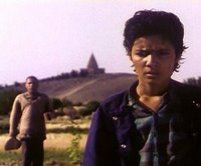
Jafar Panahi’s eye for the social issues and status of women in Iran, Bahman Ghobadi’s penchant for the portrayal of the fate of the Kurds and Mohsen Makhmalbaf’s authority on depiction of proletarian life still remain unchallenged. Majid Majidi, taking an altogether different path, too has made his mark on celluloid. His films remain detached from the society and hence radically different from his contemporaries. These films, nevertheless, make an equally deep impact on the viewers, but in a very different sense. The following passages attempt to examine few of the themes and motifs employed in four of his major works – The Father (1996), Children of Heaven (1997), Colour of Paradise (1999) and Baran (2001).

The most evident facet in Majid Majidi’s works is the firm bonding of the central character with his family, especially with his father. Though Mohammad’s relation with his father does not seem to be all rosy, Colour of Paradise is essentially about their eventual bonding. Memar acts as a surrogate father for the orphaned Lateef in Baran and supports him as a real father does. Needless to say, Pedar is all about the father-son relationship. Furthermore, his works also track the sacrifices his characters make for their beloved ones. Mehrollah goes to the city for earning money for his sisters and mother, Ali is determined to win his sister the shoes he promised even if it means wounding his feet and Lateef literally loses his identity to get money for Baran. The exception of Mohammad shows his inability to mend his family’s situation and tackle his own suffering, eventually relying on God to do the needful. However, his love for his family is unvanquished and unadulterated.

Running becomes an integral motif in Majidi’s films. The characters are frequently seen running for life and sometimes running away running away from it. These images are invariably captured by a pan shot, taking the audience along with the character and thereby placing them in the character’s shoes. Additionally, running also becomes the major part in the plot of Children of Heaven with Ali needing to come third in a marathon to win a pair of sneakers.

The protagonists in Majidi’s films are often seen connecting to the outside world and the nature in their moments of solitude and depression. Be it Lateef (Baran) feeding the pigeons, Mohammad (Colour of Paradise) caressing the birds of the nest or Ali (Children of Heaven) being “consoled” by the fishes of the pond (incidentally, the gold fish is a sign of good omen in Iran), the agonists are in a dire need to be heard and soothed. Again, the exception of Mehrollah (The Father), who has no emotional outlet into nature or to his friend, substantiates the closed and inaccessible nature of his mind.

Yet another motif in the four films is the image of a flowing stream of water. The stream, in various manifestations ranging from sleek to tumultuous, represents the flow of life and carries along with it the disappointments and lost opportunities of the characters’ lives. The central characters are shown making contacts with the stream flowing at various rates that reflect the emotional turbulence of the characters themselves.

Another noticeable aspect about the movies of Majidi is their poetic endings that carry with them a sense of resurrection – destruction of the old and beloved and the arrival of a new one. Mehrollah accepts a new father, Lateef notices the departure of one Baran (rain) and the onset of another, Mohammad is free from his paternal alienation and is able to feel God at the end of his fingers and Ali spoils his shoes as he gets a new pair. This kind of visual poetry overflows in Baran.

Of course, this list is non-exhaustive and Majidi’s films carry many more themes and symbols than specified here. For example, the images of Roti (Bread) and tea appear almost consistently. Though no explicit meaning can be assigned to this leitmotif, it does give a sense of realism and struggle for daily survival. Also, the close up of hands doing various activities that define the key idea of the film – hands trying to connect to loved ones, hands unsuccessful at the same and hands attempting to restore lost happiness – provide the right tone for the emphasis of the central ideas sans verbalization.

In a country whose political and artistic barriers are just opening up to the world, Majidi has carved a niche for himself and his films without offending the nation’s sentiments and ideologies or getting into controversies. More than anything, these recurring elements of visual composition and mellifluous poetry affirm Majidi’s position as a true cinematic auteur and have made him the most respected Iranian after Kiarostami and Makhmalbaf.

Pedar (1996) (aka The Father)
Majid Majidi
Persian

“Mehrolah, your mom has married a police officer”


For a large part of the world Majid Majidi’s filmography begins with the disarmingly charming Children of Heaven (1997). But the Iranian auteur had already struck gold a year before the first Oscar nomination from Iran. The themes, style and idiosyncrasies that were to mesmerize the world in the years following Children of Heaven clearly show their roots in Pedar (1996) (aka Father).

The film kicks off with the image of Mehrollah (Hassan Sadeghi), a boy in his teens working in the city in the south of Iran, purchasing clothes and ornaments, possibly for his family. The sweat on his face and his crumpled currency clearly indicate the boy’s struggle for a living. At his Spartan room besides the shop, Mehrollah packs his stuff that includes a photograph of himself with a man, probably his father, and leaves the city the next day.

Mehrollah makes a long trip by bus and arrives at his village. He halts to freshen up at a stream nearby and in the process loses the photograph. He notices his friend Latif (Hossein Abedini, who will go on to become the protagonist of Majidi’s spectacular Baran (2001)), and plays a childish prank on him. Immediately following that, Latif informs Mehrollah that after he had gone to the city following his father’s death, his mother had married a policeman. Mehrollah is infuriated and hits Latif, indicating his straddling between the playfulness of childhood and the fits of adolescent anger.

He reaches the policeman’s house where his mother and sisters are staying and notices the policemen with them. He throws the gifts he had bought for them at the gates and leaves the place in frustration. Determined that the policeman had married his mother only by offering money for the treatment of his sister, he decides to teach the man a lesson.

The next day he returns to the house and throws his wad of money at the policeman’s face and asks him to leave his mother alone. The policeman, much too experienced with these kinds of reactions, is passive and asks Mehrollah to either get into the house or flee the place. In another futile attempt at retrieving his sisters, Mehrollah refurbishes the place where he is staying in and brings his sisters without the knowledge of his mother. After the policeman and his mother track him down, he is rebuked severely. Following a minor protest outside the policeman’s house that rainy night, Mehrollah falls sick, only to be helped by the policeman. The policeman brings Mehrollah to his house for care and leaves the house for a few days in the pretext of a mission, leaving Mehrollah and his mother to bond. It is now that we find that the policeman was a divorcee and had married Mehrollah’s mother out of true love for her and her kids.

After the few days of bout, Mehrollah decides to hit back big time. He pinches the policeman’s pistol and leaves the village by night along with Latif, after wooing the latter with the hopes of making tons of money. The policeman, now out of his patience limits, sets off on his bike in order to arrest the juvenile delinquents who have now reached the beach at the city (a la Truffaut’s The 400 Blows (1959)). The two friends play in the sandy waters at the beach, a scene reminiscent of Elem Klimov’s war epic Come and See (1985), suggesting that they are, after all, children.

The policeman manages to track them down, but not without a marathon of a run. He grabs hold of Mehrollah and cuffs him to his own wrists suggesting his realization that he has to bring his kid up the hard way. He also sends the weeping Latif off to the village on a bus. The rest of the film follows the policeman’s struggle to bring back Mehrollah back home both physically and emotionally. The pair travels through the scorched desert on foot following the breakdown of the bike and get lost. As they set off on an excruciating quest for water and civilization, Mehrollah realizes how the policeman has taken responsibility of his safety and survival. He learns that the policeman has married his mother for reasons beyond what he had thought.

The policeman collapses, unable to keep with the heat, but not before freeing Mehrollah asking him to carry on. Mehrollah, determined to save his companion, runs in search of water and finds a stream at a distance. He performs a mammoth task by dragging the unconscious policeman to the stream and collapses besides him on the water. In the final moment, as poetic and moving as all of Majidi’s later film endings, a photograph of the policeman with his “new family” floats towards Mehrollah. Mehrollah, who lost the photograph of his father in a stream early on, finds this photograph coming to him through a similar stream. Mehrollah has found a new father.

Majidi’s films, unlike his contemporaries’ Jafar Panahi and Bahman Ghobadi, do not intend to highlight the social ills prevalent in society of Iran and the discrimination of humans based on gender and ethnicity. Rather, they focus on the best parts of the country’s culture and flourish on them. They are deeply rooted on the family values and traditions of Iran, yet are universal in their themes.

Pedar is shot in the rural localities of Iran, a place that may look like a whole new world to the outsiders. However, the alienation stops there and one will be emotionally overwhelmed as the movie proceeds. The global themes of fatherhood, adolescence and emotional bonding through distress will remind every viewer how the world is so large yet so small.

Bicycleran (1987) (aka The Cyclist)
Persian
Mohsen Makhmalbaf

“His name is Nasim (Breeze), but he resembles a typhoon. He rides bicycle blindfolded. This man has stopped a train in India with his eyes. In Pakistan, he’s lifted two bulls on a finger and this time he is gonna ride and live on a bicycle for 7 days round the clock.”


The cyclistThe objectives, outlooks and needs of different levels of a community, naturally, do not concur. One man’s grief is another man’s pleasure. Mohsen Makhmalbaf’s Bicycleran (1987) captures this difference in the context of an event as viewed from people from different sections of the society. Though a bit more dramatic than most films then from Iran, Bicycleran has enough raw power and truth value to be classified under the neo-realistic genre.
Nasim is a Afghani labourer whose wife is sick and is in need of immediate treatment. Times are hard and labourers cannot expect more than 50 Tomans per day for their work. But Nasim’s requirements are higher and he tries everything he can including a feigned suicide attempt to blackmail people into giving money. Finally, through a bookie, Nasim agrees to put up a show where he would be riding a bicycle for 7 continuous days. The show begins amidst a lot of objections and . with time pedestrians and vendors begin to gather around him. Nasim witnesses his own exploitation by various people from different strata of society – vendors making it their sales hub, middlemen betting and common people getting relief from his plight. In spite of a lot of physical, emotional and social obstacles Nasim manages to finish the 7 days. At the time of glory, Nasim is asked to dismount from the bicycle by the reporters. He is indifferent to all the commotion (possibly because of the physical and mental fatigue) and continues to ride in the circular path.

The film can be viewed as an allegory of the struggles of the working class, a society that exploits them and an upper class that views them as objects of amusements. The recurrent themes of roundness that occur through the images of wheels, cycles and structures signify the vicious circle of fate and inevitability that the working class treads in. The film won the best film at the Hawaii Film Festival in 1987.

Gabbeh (1996)
Persian
Mohsen Makhmalbaf

“Life is colour”
 

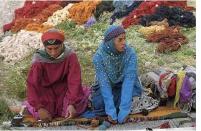
GabbehA co-production of the French and the Iranian film industry, Gabbeh (1996) is perhaps the best and most typical starting point for the westerners who would like to get an insight into the cinema of the east. Released in 1996 Gabbeh has managed to enchant the westerners and the Asians alike for not only its artistic merits but also for its subtle exposure of the culture of Iran. The film is centered around a nomadic tribe, which is tightly bound by blood relations. The tribe has its own rituals and beliefs which it passes on for posterity. One such practice is the weaving of carpets for a person depicting the journey of their life. The tribe carries and updates the carpets wherever they go.

The film begins with an old couple who are at the river side washing one such carpet. They envisage a young lady representative of the carpet and converse with her. The young lady has a story to tell- one that of forbidden love. She takes us through her life’s ordeals, her moments of joy, dissatisfaction and sorrow. Representing various emotions, colours play a very important role in the film. These colours blend with the carpet to tell stories of the people it has been with. So do the various landscapes that the tribe wanders through. The animals too, in the film are representative of the oneness of the clan and the alienation of the beloved of the young lady.

Running over just a hour and a quarter, the film is succinct and opts to show what it wants rather than talk. The film opened ways for subsequent Iranian films to reach out to the world and display their artistic and film making abilities. For its poetic direction and striking use of imagery, the film won the Best Artistic Contribution Award in the Tokyo International Film Festival.

« Previous Page