Podzemlje (1995) (Underground)
Emir Kusturica
Serbian/German/French/English/Russian


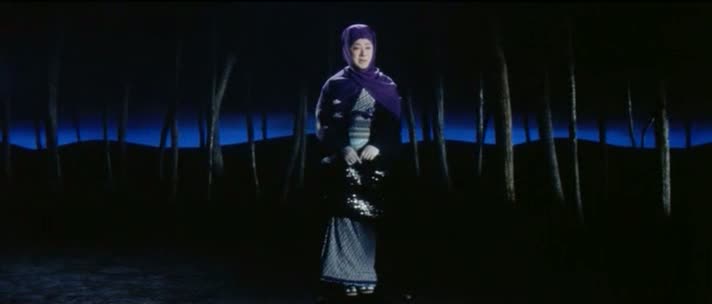
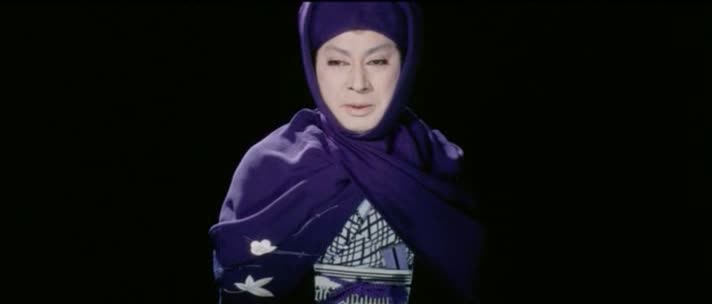
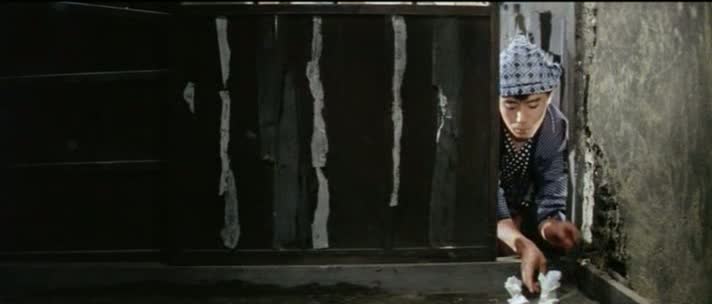
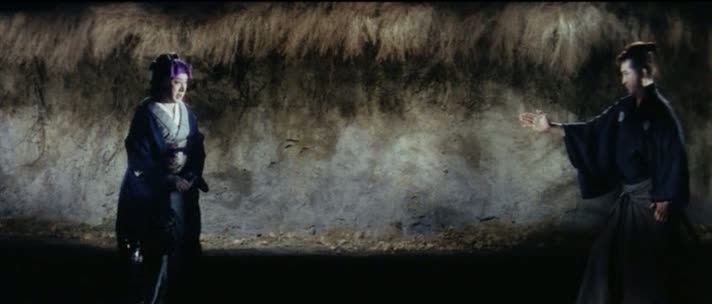
UndergroundEmir Kusturica’s Underground (1995) has been torn apart in certain sections as pro-Milosevic propaganda that brushes aside Serbia’s atrocities in the Balkan Wars. I think that’s not only being too harsh on a relatively benign satire but also that it ascribes way too much intention and focus to a film that’s riddled with ideological inconsistencies, like most films. True that it presents Yugoslavia under Tito as a Platonic cave whose residents mistake the shadows on the wall – sometimes literally, as when the inmates of an underground cell watch faked footage from WW2, which they think is still on – for truth and who are kept united under a phantom enemy while being blind to internal fault lines. But construing Kusturica’s generally sentimental lament about the breakup of a nation as brothers start killing brothers and friends turn on each other as a case for Serbia comes across as a pre-determined approach to the film which writes down the answers before the questions. What’s most inviting about Underground is how it keeps poking at the nexus between politics and cinema. Marko (Miki Manojlović), whose rise to power mirrors Tito’s, appears to us like a filmmaker figure, directing his historical actors in an underground set illuminated by high-key lighting and marked by a bizarre communal mise en scène. (And what of Tito himself, who could be the seen as the helmer of a chaotic crew made to act out a Communist metanarrative?) The deep hierarchy of performances that pervades the film aptly throws light on the loss of “reality” and the alienation from history that seems to have characterized Yugoslavia’s tumultuous half-century since the end of the Second World War.


[Excerpts from Paul Virilio’s War and Cinema: The Logistics of Perception (1984/89)]

From the original watch-tower through the anchored balloon to the reconnaissance aircraft and remote sensing satellites, one and the same function has been indefinitely repeated, the eye’s function being the function of a weapon.

The industrial production of repeating guns and automatic weapons was thus followed by the innovation of repeating images.


A war of pictures and sounds is replacing the war of objects (projectiles and missiles)

War can never break free from the magical spectacle because its very purpose is to produce that spectacle: to fell the enemy is not so much to capture as to ‘captivate’ him, to instill the fear of death before he actually dies.

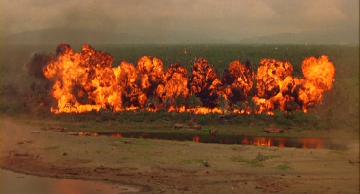
Apocalypse Now

…the history of battle is primarily the history of radically changing fields of perception.

“I still remember the effect I produced I produced on a small group of Galla tribesman massed around a man in black clothes,” reported Mussolini’s son during the Abyssinian war of 1935-36. “I dropped an aerial torpedo right in the centre, and the group opened up just like a flowering rose.”

Dr. Strangelove

Rudolph Arnheim once remarked that, after 1914, many film-actors became props and the props took the leading role. Similarly, women became the objective tragedy in the wars from which they were excluded.

The star system and the sex symbol were the result of that unforeseen perceptual logistics which developed intensively in every field during the First World War.

Drums Along The Mohawk

World War One was the reason for Hollywood”.

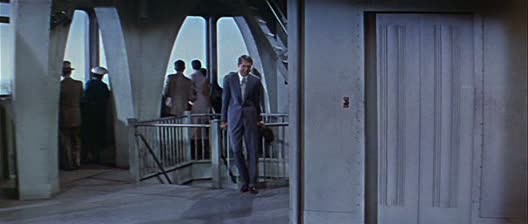
Cinemas, too, were training camps which bonded people together in the face of death agony, teaching them to fear the death of what they did not know – or rather, as Hitchcock put it, of what did not exist.

Dr. Strangelove

…the Allies’ victory in the Second World War was at least partly due to their grasp of the real nature of Nazi Lebensraum, and to their decision to attach the core of Hitler’s power by undermining his charismatic infallibility. They did this by making themselves the leading innovators of film technology.

Eyesight and direct vision have gradually given way to optical or opto-electronic processes, to the most sophisticated forms of ‘telescopic sight’.

Only serial photography was capable of changing troop positions or the impact of long range artillery, and hence the capacity of new weapons for serial destruction.

Dr. Strangelove

As Andre Malraux wrote: “Caesar could have conversed with Napoleon, but Napoleon has nothing to say to President Johnson

Positional warfare, then, had had its day. The extreme mobility of mechanized armies impaired a new temporal unity that only cinema could apprehend.

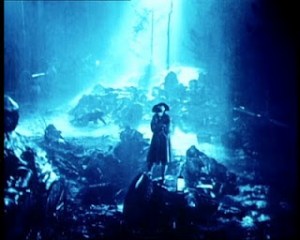
Napoleon

Just as weapons and armour developed in unison throughout history, so invisibility and visibility now began to evolve together, eventually producing invisible weapons that make things visible.

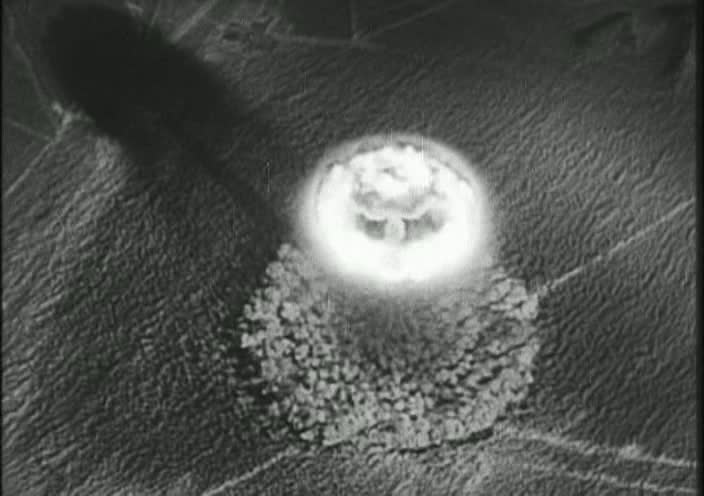
The projectile’s image and the image’s projectile form a single composite. In its tasks of detection  and acquisition, pursuit and destruction, the projectile is an image of ‘signature’ on a screen, and the television picture is an ultrasonic projectile propagated at the speed of light.

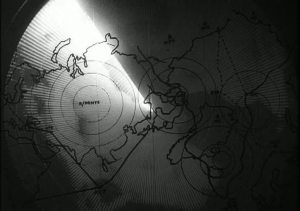
Dr. Strangelove

La Petite Vendeuse De Soleil  (1999) (The Little Girl Who Sold The Sun)
Djibril Diop Mambéty
Wolof/French


The Little Girl Who Sold The SunThe second part of an unfinished trilogy titled Tales of Ordinary People, Senegalese maverick Djibril Diop Mambety’s posthumously released The Little Girl Who Sold The Sun (1999) centers on a physically challenged girl who makes her living selling Le Soleil in the streets of Dakar. We witness her bravely fighting the everyday tyranny of cops and other street urchins, who try to elbow her out of business, and helping out her blind grandmother. The overwhelming optimism of the film, admittedly, is an attempt to balance the cynicism and anger of the directors’ previous feature, Hyenas (1992), which presented an Africa that had buckled to the pressures of global economic powers. Bathed in sunlight and shot almost entirely in open spaces, The Little Girl seems to be characterized by a pair of contradictory forces at its heart. On one hand, the film, on its face value, comes across as one of those million well-meaning, liberal, independent movies which dodge real issues in favour of readymade humanist themes and identity politics. On the other, it is clear that Mambety is attaching an allegorical weight to this simple tale, put into place by a fantastical political event – all of Africa leaving the Franc zone and taking up a sovereign currency – which reveals that Mambety’s fervent commitment to the “African cause” hasn’t lapsed into some kind of “everyman for himself” philosophy. Mambety’s recognition of the girl – as herself – and her condition prevents The Little Girl from becoming frigidly schematic or crumbing under its symbolic weight. When the girl’s friend carries her on his back, after her crutches have been stolen by the boy gang, you simultaneously sense an individual’s resilience to her immediate surroundings as well as a soaring political utopianism.

Agneepath

For film lovers who consider Bollywood cinema to be a blind spot in their cinephilia and wish to change that, there’s a curious entry from Karan Johar’s Dharma Productions that rolled out last week: a purported remake of their own 1990 production Agneepath. The curiosity, I think, arises from the tug-of-war between Dharma’s current reputation as makers of an “international” brand of Bollywood cinema targeted specifically at expatriates and nascent Indophiles and the highly indigenous, culturally and historically rooted nature of the movie they have chosen to remake. The result is exciting, to say almost nothing, and should serve as a good takeoff point for the adventurous.

A crucial detail about the original Agneepath, starring Amitabh Bachchan and directed by Mukul Anand: It’s insane. Made during the limbo between Amitabh Bachchan’s infamous career in politics and his equally unsuccessful foray into film production, the film is located at the fag end of that vague set of films that academicians have milked to death—the so-called Angry Young Man pictures, all featuring a generally tormented Bachchan trudging through the narrative. The film works on archetypal material redolent of classic Westerns, and fleshes it out into three hours with scenes both startling and superfluous (for a measure, imagine the Ranown cycle developed as a TV series): The righteous schoolmaster of Mandwa, an island village to the west of Mumbai, Dinanath Chauhan is cudgeled to death in front of his son Vijay by his villagers after having been misled by the scheming Kancha, who plans to appropriate the village for growing opium. Forced to bury his father by himself and move to Mumbai for a living, Vijay plans to reclaim his village and avenge his father. Anand cares little about redaction, tonal consistency or pacing and primarily works around self-styled iconic images which in turn have no scruples about their literariness and in-your-face symbolism. (The continuity between father Chauhan and son is illustrated by what the film takes to be as its central image: blood dripping from battered father’s face onto his son’s. I kid you not.)

Agneepath

Considering multiplex-bred audiences today have a little less patience for three hours of such excesses, it is not surprising that Karan Malhotra’s Agneepath (2012) is less a remake of Mukul Anand’s film and more a respin of it for a new generation of film goers from a new nation, half of whose populace is younger than Anand’s film. Nowhere is this more apparent than the scene in which we are introduced to the adult Vijay, 15 years after his father was lynched by the mindless mob of Mandwa. We see Hrithik Roshan, with his perfectly-chiseled body and Greek God features, sprinting forward like a stallion, climbing on to the top of the Dahi Handi pyramid, and seizing the jackpot at the top. Vijay is now 27, about a decade younger than his predecessor (who is, exactly, 36 years, 9 months, 8 days and 16 hours old when we see him for the first time) and as just as old as most of his audience. Anand’s 1990 film is an Amitabh Bachchan vehicle in more ways than one. It is the Bachchan persona struggling against an emaciating physique, the Angry Young Man trapped in a body that couldn’t be called so—an empty container in which his voice ricochets endlessly. Roshan’s unkempt yet obviously resplendent countenance is the direct opposite of Bachchan’s drooping, mascara-wearing face. “He looks normal, but he’s the one most disturbed,”Inspector Gaitonde (Om Puri) correctly characterizes. The glacial surface of Roshan’s face reveals nothing, not even the simmering wrath that is supposedly driving him, and isn’t helped by his barely visible blue pupils that vanish when he cries.

Agneepath

Malhotra’s film, perhaps as homage of which there is no shortage within and outside of the film, including its publicity, retains much of the original’s shamelessly literal approach to images and impressive use of long lenses, shallow fields and racking focus for dramatic impact. (In an adeptly realized and shot encounter early on between Vijay’s father and Kancha, Vijay and mother are frighteningly visible and out of focus, as seen from Kancha’s POV.) Equally discerning is the fine-tuned attention to landscapes that sets up a visceral contrast between the metallic-blue, horizontal wastelands of Mandwa and the radiant saffron-tinged, vertical settlements of Mumbai. Malhotra’s film finds itself constantly in dialogue with the older Agneepath, resolving a few of the latter’s contradictions (and adding a few), deftly pruning out its circuitous narrative threads and making prominent some of the latent themes and equivalences. If Anand’s film unabashedly works towards a near-surreal, graceful finale recalling The Searchers (“Let’s go home, mother”), the reboot keeps underscoring the parallel between Vijay and Kancha, much like what Ford’s film does with Ethan and Scar. For one, both Sanjay Dutt, who plays Kancha, and Hrithik Roshan have imposing statures and that stand in contrast with other portly figures in the film. Vijay uses the same means as Kancha to reclaim his hometown, including an ignoble murder of a man in front of his son. The seemingly ageless, Kurtz-like Kancha might be something of an essence that Vijay is reducing himself to: an asexual, amoral nihilist with no other function than to induct people like Vijay. This sustained emphasis, illustrated through blocking and editing, is why the deliciously classical scene of confrontation between the two is also the best one in the film.

Agneepath

But labeling Malhotra’s film as an ironic, movie-bratish throwback to the past, conscious of its own workings, is perhaps too lenient. The older film was made when the country was on the brink of opening up its markets and this was the time when satellite television and discos were becoming commonplace. While left-leaning filmmakers like Girish Kasaravalli were probing into the flipside of this proclaimed boon, Agneepath was making an argument for the right-wingers in the mainstream. Mukul Anand’s Vijay Dinanath Chauhan is a raving reactionary railing against all foreign intrusion and taking it upon himself to protect the sanctity of institutions like family, religion and community. Bachchan’s racist patriarch, who can not see women as anything other than his mother or bearers of children, is a far bolder, far more politically-incorrect and far more rounded character than Roshan’s generally unmarked, comparatively genteel, secular hero. What enrages the new Vijay is not alcohol and prostitution, which are but indulgences according to current moral standards of Bollywood, but more scandalizing taboos of today such as human trafficking and child molestation. The villain, too, is not some suave, tuxedo-wearing, sunglass-sporting non-resident, but a Hindu madman who, like Pulp Fiction‘s Jules Winnfield, misquotes the Gita to suit his own needs. Even the welcome elimination of the stereotyped South Indian character, portrayed by Mithun Chakraborty in the original, seems first a necessity of the times and only then an indicator of refined taste. The thematic stress in the new film is solely on revenge, instead of the salvage of Mandwa and its residents. Vijay’s agenda, as it were, is reduced to the purely familial, unlike his predecessor, for whom the familial becomes inextricably political. Between the two Agneepath films, we witness an India that has taken an abrupt about turn. Bachchan’s Vijay Chauhan is now an outcast in his own country.

Agneepath

[First published at the Mubi Notebook]

An Affair To Remember

An Affair To Remember

An Affair To Remember

An Affair To Remember

An Affair To Remember

An Affair To Remember

An Affair To Remember

An Affair To Remember

An Affair To Remember

An Affair To Remember

An Affair To Remember

An Affair To Remember

An Affair To Remember

An Affair To Remember

An Affair To Remember

Mati Manas (1985) (The Mind Of Clay)
Mani Kaul
Hindi/Marathi/Tamil


Mati ManasCommissioned by NFDC and the handicrafts division of Ministry of Textiles, Mani Kaul’s Mati Manas centers on potters and terra cotta artisans located in and around Rajasthan and unfolds as a fictionalized version of Kaul’s journey into the region as an outsider and a documentary filmmaker. We have documentary passages that elaborately detail the art and business of terra cotta making and the way of life that revolves around it interspersed with sections where we see the in-movie documentary crew shuttling between museums showcasing earthenware from the Indus Valley civilization, excavation sites and various potter villages while narrating to us the various myths, legends and folk tales of the region that reveal how mud/earth has become, for these artisans, an element inextricable from imagination and practice and has gone on to develop maternal associations with its capacity to nurture, shelter and produce. Suffused with Cezanne-like still life and images of potters at work, especially the weary, skillful hands that lovingly, spontaneously shape raw earth into little, wondrous artifacts, Mati Manas comes across as a tribute to the dignity and grace of human labour. Perhaps more importantly, Kaul’s return-to-zero film unveils a society where people’s relationship to art is still habitual and tactile, a pre-reflective, non-reductive, phenomenological way of experiencing art that stands in opposition to modern, appropriative, optical approaches – a split that is reflected in the chasm between how ancient pottery is exhibited in museums and sketched in textbooks as icons of heritage and triumph of archaeology and how it might have been perceived by people of its time.


 [Capsule added to The Films of Mani Kaul]

Serious Games (2009-10)
Harun Farocki
English


Serious GamesHarun Farocki’s four-part project Serious Games (2009-10) takes a look at the use of photorealistic computer-generated imagery in processes surrounding the wars in Afghanistan and Iraq. We see soldiers being trained before missions by demonstrative games that map out enemy terrain and climate in amazing detail – right down till the physical properties of the vegetation found in these geographies. We also see similar interactive programs that help PTSD-afflicted ex-servicemen revisit devastating moments and, in doing so, overcome their condition. There is an amalgamation of reality, fiction and simulation throughout the film. What appear to be documentary segments are revealed to be performances by amateur actor-salesmen demonstrating to soldiers the uses of their video games. In one segment, a mock Iraqi village is set up in Twentynine Palms, California with the help of local Iranian and Pakistani folk that seems directly modeled on a videogame. While not all of these games with reality and fiction pay off, it is intriguing to note how armies’ relationship to war has changed over the years. War appears to have ceased being a hard, irrational, unpredictable material reality and become a science that could be modeled, predicted and controlled. Farocki refers to this modern type of war as an asymmetric war, in which one side has a heavy advantage over the other and focuses on the biased representation and perceptual manipulation such simulations propagate. His fuzzy polemic, however, is not only compromised but also questionable because the kind of representation he is criticizing is, unlike the mass media, made specifically for the consumption of the army and is, itself, based on the army’s existing view of things. So not only does the commentary come across as self-evident, but also toothless because the position that the film locates itself in does not allow for insightful criticism in the first place.

Indigène d’Eurasie (2010) (Eastern Drift)
Sharunas Bartas
French/Lithuanian/Russian


Eastern DriftThe trajectory of Lithuanian helmer Sharunas Bartas’ filmography, in a sense, runs anti-parallel to that of Béla Tarr, with whom the former shares a number of artistic, political and philosophical inclinations, and has moved from extreme stylization to rough-hewn naturalism, from near-total narrative abstraction to flirtation with generic structures, from semi-autobiographical meditations set against the backdrop of Soviet collapse to highly materialist tales of marginal lives in the Eurozone. (In fact, one could say that the exact tipping point occurs at Freedom (2000).) Eastern Drift finds the filmmaker moving one step closer to conventional aesthetic as well as dramatic construction and follows Gena (Bartas himself), who is on the run after he knocks off his Russian boss after an altercation over a hefty sum of money. Even though the film has the appearance of a Euro-thriller, with the protagonist hopping from one major city of the continent to another, each of which regularly gets its token establishment shot (and all of which look very similar for the untrained eye), it actually moves against the grain of the sub-genre. Unlike the traditional European action picture, in Eastern Drift movement – the prime action over which the narrative is founded – itself is problematized. A large part of the proceedings is made up of Gena trying to sneak in and out of buildings as well as countries and finding himself thwarted at almost every move. An antithesis to the utopianism of Eurozone and its myth of intra-continental mobility, Eastern Drift crystallizes and futhers Bartas’ preoccupation with suffocating national borders, although the scenario over which he builds his argument remains moot.


[Capsule added to The Films of Sharunas Bartas]

It was the best of years, it was the worst of years. Best because a dizzying number of big and important projects surfaced this year and worst because I haven’t even been able to see even a fraction of that number, even though my film viewing hit an all-time high this December, That last bit was possible thanks to the city’s major international film festival, the first full-fledged fest that I’ve ever attended – a key event as far as my cinephilia is concerned. Although, I must admit, none of the new titles I saw at the fest blew me away, I was surprised by a handful of films that I think deserve wider exposure. (I’m thinking specifically of Jean-Jacques Jauffret’s debut film Heat Wave, a tragic, graceful hyperlionk movie in which piecing together the disorienting geography of Marseilles becomes as important as piecing together the four intersecting narratives.) Instead of continuing apologetically to emphasize my viewing gaps and to rationalize the countless number of entries on my to-see list, I present you another list, The Top 10 Films I Didn’t See This Year: (1) House of Tolerance (Bertrand Bonello, an indisputable masterpiece, probably) (2) Seeking the Monkey King (Ken Jacobs) (3) Margaret (Kenneth Lonergan) (4) This is Not a Film (Jafar Panahi/Mojtaba Mirtahmasb) (5) Century of Birthing (Lav Diaz) (6) Life Without Principle (Johnnie To) (7) The Loneliest Planet (Julia Loktev) (8) Hugo (Martin Scorsese) (9) Once Upon a Time in Anatolia (Nuri Bilge Ceylan) (10) La Havre (Aki Kaurismaki). Now that that’s out of my system, here are my favorites from the ones I did get to see.

1. The Turin Horse (Béla Tarr/Ágnes Hranitzky, Hungary)


The Turin HorseFor a number of films this year, the end of the world became some sort of a theme park ride taken with ease, but none of them ventured as far as Béla Tarr’s mesmerizing, awe-inspiring farewell to cinema. With The Turin Horse, Tarr’s filmmaking traverses the whole gamut, moving away from the wordy realist pictures of his early phase to this extreme abstraction suggesting, in Godard’s phrasing, a farewell to language itself. Centering on a man, his daughter and their horse as they eke out a skeletal existence in some damned plain somewhere in Europe, The Turin Horse is the last chapter of a testament never written, an anti-Genesis narrative that finds God forsaking the world and leaving it to beings on earth to sort it all out by themselves. Tarr’s film is a remarkable cinematic achievement, primal in its physicality and elemental in its force. Nothing this year was so laden with doom and so brimming with hope at once as the ultimate image of the film, where father and daughter – now awakened, perhaps – sit in the darkness with nothing to confront but each other.

2. A Separation (Asghar Farhadi, Iran)


A SeparationAsghar Farhadi’s super-modest yet supremely ambitious chronicle of class conflict in Tehran is a massive deconstruction project that strikes right at the heart of systems that define us. Accumulating detail upon detail and soaking the film in the ambiguity that characterizes the real world, A Separation reveals the utter failure of binary logic – which not only forms the foundation of institutions such as justice but also permeates and petrifies our imagination – in dealing with human dilemmas. Farhadi’s centrism is not a form of bourgeois neutrality that plagues many a war movies, it is a recognition that truth lies somewhere in the recesses between the contours of language, law and logic. Working with unquantifiable parameters such as irrationality and doubt, Farhadi’s film is something of an aporia in the discourses that surround cinema and reality and an urgent call for revaluation of approaches towards critical problems in general. Rigorously shot, edited and directed, A Separation is a genuinely empathetic yet highly intelligent slice of reality in all its messy complexity and breathtaking grace.

3. The Tree Of Life (Terrence Malick, USA)


The Tree of LifeJuxtaposing the cosmic, the macroscopic and the infinite with the particular, the everyday and the finite, Terrence Malick’s fifth film The Tree of Life seeks to ask big questions. It is here that the director’s longstanding philosophical concerns find perfect articulation and efficacy in the specific form of the film. Seamlessly shifting between perspectives both all-knowing and limited, The Tree of Life posits the existence of a single shared consciousness across time and place, only a small part of which is each human being. It is also Malick’s most phenomenological film and mostly unfolds as a series of sensory impressions that both invites and resists interpretation. An awe-instilling tug-of-war between finitude and permanence, omniscience and ignorance, narrativization and immediate experience and rationalization and incomprehension, Malick’s unabashed celebration of the birth of consciousness – in general and in specific forms – locates the particular in the universal and vice versa. What lingers in the mind more than the grand ideas, though, are extremely minor details, which is pretty much what the medium must aspire to achieve.

4. The Story Of Film: An Odyssey (Mark Cousins, UK)


The Story of FilmA scandalous history, a disproportionate sense of importance and a frustrating accent. Critic-Filmmaker Mark Cousins’ project to present the story of cinema as a 15-part TV series appears doomed right from the conceptualization stage: can you even attempt to tell a story of film without omitting whole schools of filmmaking or national cinemas? Omit it certainly does, and unapologetically so, but when Cousins chronologically hops from one country to another, halting at particular films, scenes or even shots, providing commentary that is as insightful as they come and situating them in the larger scheme of things, you wouldn’t hesitate to lower your guard. Not only does Cousins’ 900-minute tribute to filmdom introduce us to names in world cinema rarely discussed about, but also presents newer approaches to canonical entries. Admirably inclusive (Matthew Barney and Baz Luhrmann find adjacent seats, so do Youssef Chahine and Steven Spielberg) and never condescending, The Story of Film exhibits towards the history of the form a sensitivity comparable to the finest of film criticism.

5. We Need To Talk About Kevin (Lynne Ramsay, UK)

We Need to Talk About KevinWhat is stressed in Lynne Ramsay’s rattling third feature We Need to Talk About Kevin is not only the continuity between mother and son, but also the essential discontinuity. Where does the mother end and where does the son begin? Every inch of space between actors resonates with this dreadful ambiguity. The film is as much about Eva’s birth from the stifling womb of motherhood as it is Kevin’s apparent inability to be severed from her umbilical cord. Every visual in Ramsay’s chronicle of blood and birth works on three levels – literal, symbolic and associative – the last of which links the images of the film in subtle, subconscious and thoroughly unsettling ways. For the outcast Eva, the past bleeds into the present and every object, sound and gesture becomes a living, breathing reminder of whatever has been put behind. Ramsay’s intuitive, sensual approach to colour, composition and sound locates her directly in the tradition of the Surrealists and deems this unnerving, shattering, personal genre work as one of the most exciting pieces of cinema this year.

6. Life In A Day (Various, Various)


Life in a DayAn heir to the ideas of Dziga Vertov and Aleksandr Medvedkin, Kevin Macdonald’s Life in a Day is a moving, bewildering, charming, frustrating and dizzying snapshot of Planet Earth in all its glory, stupidity and complexity on a single day in 2011. An endless interplay of presence and absence, familiar and exotic, lack and excess, similarity and difference, the homogenous and the un-normalizable and the empowered and the marginalized, Life in a Day is a virtually inexhaustible film that is a strong testament to how many of us lived together on this particular planet on this particular day of this particular year. (That it represents only a cross section of the world population is a complaint that is subsumed by the film’s observations.) Each shot, loaded with so much cultural content, acts as a synecdoche, suggesting a dense social, political and historical network underneath. Most importantly, it taps right into the dread of death that accompanies cinematography: the heightened awareness of the finitude of existence and experience and the direct confrontation with the passing of time.

7. Kill List (Ben Wheatley, UK)


Kill ListOn the surface, Ben Wheatley’s Kill List comes across like a sick B-movie with a mischievous sense of plotting, but on closer examination, it reveals itself as a serious work with clear-cut philosophical and political inclination. That its philosophy is inseparable from its mind-bending narrative structure makes it a very challenging beast. Kill List is the kind of kick in the gut that video games must strive to emulate if they aspire to become art. Indeed, Wheatley’s chameleon of a film borrows much from video games – from its division of a mission into stages announced by intertitles to the third-person-shooter aesthetic that it segues into – making us complicit with the protagonist and his moral attitude, later pulling the rug from our feet and leaving us afloat. Early in the film, Iraq war veteran and protagonist Jay mumbles that it was better if he was fighting the Nazis – at least, he would know who the enemy was. He learns the hard way that this ‘othering’ of the enemy into a mass of unidentifiable groups is a psychological strategy to protect and redeem himself, that it’s judgment that defeats us.

8. Sleeping Beauty (Julia Leigh, Australia)


Sleeping BeautyYour vagina will be a temple” one elderly procurer assures Lucy, a twenty something university student who takes up odd jobs to pay her fees. Not only is the vagina a temple in Julia Leigh’s markedly assured debut feature, but the human body itself is a space that is to be furnished, maintained and rented out for public use. Leigh’s vehemently anti-realist examination of continuous privatization of the public and publicization of the private works against any kind of psychological or sociological realism, instead unfolding as an academic study of the human body as a site of control. Setting up a dialectic between pristine, clinical public spaces and messy, emotional private ones, Sleeping Beauty attempts to explore not our relationship to the spaces that we inhabit, but also to the space that we ourselves are. Consistently baffling and irreducible, Leigh’s film displays an eccentric yet surefooted approach to design, composition and framing, revealing the presence of a personality beneath. Sleeping Beauty is, for me, the most impressive debut film of the year.

9. The Kid With A Bike (Jean-Pierre Dardenne/Luc Dardenne, Belgium/France)


The Kid with a BikeThe Dardenne brothers have turned out to be the preeminent documentarians of our world and their latest wonder The Kid with a Bike sits alongside their best works as an unadorned, incisive portrait of our time. Admittedly inspired by fairly tales, Dardennes’ film might appear like an archetypal illustration of innocence lured by the devil, but its parameters are all drawn from here and now. Structured as a series of transactions – persons, objects, moral grounds – where human interaction is inextricably bound to the movement of physical objects, the film presents our world as one defined by exchanges of all kind, but never reduces this observation to some cynical reading of life as a business. Also characteristic of Dardennes’ universe is the intense physicality that pervades each shot. Be it the boy scurrying about on foot or on bike or the countless number of doors that are opened and closed, the Dardennes, once more, show us that cinema must concern itself with superficies and it is on the surface of things that one can find depth.

10. The Monk (Dominik Moll, France/Spain)


The MonkDominik Moll’s adaptation of Matthew Lewis’ eponymous novel concerning a self-righteous priest tempted by the devil could be described as an intervention of late nineteenth century tools – psychoanalysis and cinema – into a late eighteenth century text. Located on this side of the birth of psychoanalysis, Moll’s film comes across as essentially Freudian in the way it portrays the titular monk as a human being flawed by design and the church, society and family as institutions responsible for suppressing those basic impulses. Incest, rape and murder abound as hell breaks loose, but the film’s sympathy is clearly with the devil. The Monk uses an array of early silent cinema techniques including a schema that combines an impressionistic illustration of the protagonist’s sensory experience and expressionistic mise en scène to signal his irreversible descent into decadence. Alternating between metallic blues of the night and sun bathed brown, Moll’s film teeters on the obscure boundary between Good and Evil. Exquisitely composed and expertly realized, The Monk supplies that irresistible dose of classicism missing in the other films on this list.

Project Nim (2011)
James Marsh
English

 
Project Nim

Project Nim (2011), directed by James Marsh of Man on Wire (2008) fame, gives to us the life of Nim Chimpsky, the chimpanzee at Columbia University that was being trained to communicate in sign language, as narrated by Dr. Herbert Terrace (the head of the project) and his team of trainers. We see the animal being taken away from his mother by force, brought up along with human children at one of Terrace’s friends’ home, transferred back to the university, sold to a drug-testing facility and, finally, to a private ranch. We witness the devastating tragedy of Nim’s life, as he is deracinated, trained for years to become human-like only to be expected, subsequently, to behave like chimpanzee. Throughout, there is an ambivalence based on the nature versus nurture question that we experience: Is Nim’s rapid learning curve an indication of the dominance of social relations in shaping communication or is his random acts of violence a clinching proof for the presence of an innate animal essence? The interviewees describe their relationship to Nim in very human terms and one wonders if some of it is not the projection of their own anthropomorphic understanding of the animal’s behaviour. Consequently, Nim becomes something of a MacGuffin that everybody is talking about, but no one knows what it exactly is. The film’s sympathies clearly lie with the animal, to such an extent that it refuses to see the complexity of the situation. Abstracting scientific research as animal cruelty, the film fails to take into account the more pressing issues that are being addressed by such projects. To add to this gross simplification, Marsh’s questionable fictional restaging of facts and regular use of unrelated footage in order to prevent the film from becoming a talking-heads documentary betrays a lack of faith on the material and an unwarranted fear that a straightforward presentation would be ‘uncinematic’.