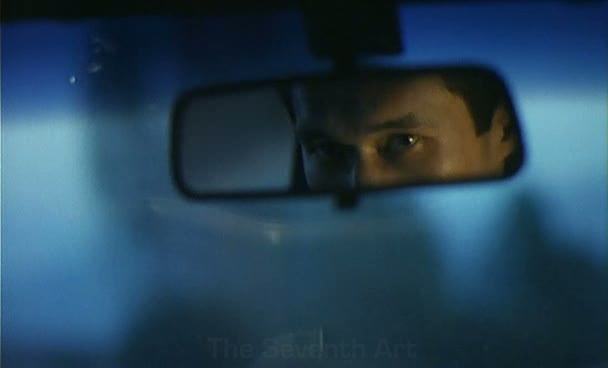
Film Socialism

Persistence Of Vision 
(Image Courtesy: Cannes Festival Site)

A spectre is haunting Europe – the spectre of its own past. So seems to suggest Jean Luc-Godard’s golden jubilee work Film Socialism (2010), the one film of recent times that has produced the least insightful body of criticism so far (with some of them being downright vengeful; one wonders if the film would fared better with the critics if Godard’s name wasn’t attached to it). The latter observation should come as no surprise for neither does the film provide the comfort of a clear,  overarching authorial voice as in History of Cinema (1988-98) nor does it overtly embrace – as some recent works of the director have – the free associative essay form. What we have, rather, is a documentary with conscious fictional texts embedded within or a self-conscious documentary of a shoddy fictional production. Film Socialism’s ontological confusion might be a throwback to Godard’s films of the late eighties, but the picture that is closest to this one, to my mind, is Last Year at Marienbad (1961, more on this later).

The film is divided into three segments (or “movements”) the first and longest of which, titled “Things such as”, is set on a cruise ship (which has been noted to possibly denote a floating Europe – both financially and historically), whose passengers seem to represent a microcosm of Europe present and Europe past (including intellectuals who carry out dialectical conversations). Amidst the fragments of dialogues, scenes and visuals runs a plot involving an ex-Nazi turned Jew who might have appropriated a huge sum of money from the Bank of Spain. The brooding environment of the ship’s deck at twilight, the seeming absence of contact between various groups of people on the vessel, the contemplative images of the sea (water being equated to money right from the first line) that punctuate the segment and the general sense of hopelessness that pervades it – all serve to create a post-apocalyptic atmosphere redolent of Tsai Min-liang’s cinema. Likewise, the filmmaking here seems both like a desperate act to salvage and synthesize from what remains of a glorious civilization and a typical Godardian attempt and appeal to return to zero. The first facet is reflected in the fractured nature of this section, wherein shards of banal, familiar images, texts, words and sounds are sewed together (a treatise on Husserl gets to sit alongside Lolcat videos) using equally eclectic assortment of digital media (ranging from cheap cell phone camera footage to crisp high-definition, from unfiltered, noisy microphone recordings to studio-mastered sound), while the latter manifests as an intermittent but perennial discourse on the value of things and the possibility of reversion to barter system where, probably, the concept of surplus labour vanishes. (Godard’s use of nearly-unintelligible Navajo subtitles, in this sense, might be an offer to barter the film’s half-articulated ideas for our participation).

The second section, called “Quo Vadis Europa”, involves a middle class French family whose ‘head’ is disillusioned by the state of affairs of the nation. The children of the family take to anarchistic politics following which they adopt rigorous policies in the usage of language and show an increased involvement in the arts. Whether this is a straightforward parody of the Leftist agitation of the 60s (whose poster boy Godard undeniably has become, when it comes to cinema) or a serious consideration of an atavistic return of student radicalism (and the consequent sloganeering) is somewhat unclear, but these sequences marry the apparent emotionality and solemnity of the director’s post-eighties work with his flamboyant rigor of the years before in a manner that seems like new territory even for Godard. (It is mainly the absurd scenario – reminiscent of the filmmaker’s works featuring Jean-Pierre Léaud – of this segment that prompts the former reading. Both Melville and Herzog compared student anarchists to children and dwarfs respectively during the seventies. However, Godard’s insistence here that the spirit and ideas of the age persist through language seems more sober and hopeful and less nostalgic and playful).

The third part of the film – “Humanities”, an epilogue of sorts resembling the scintillating “Hell” segment of Our Music (2004) – takes us further back in time, into ages which are now considered ancient. I say ‘considered’ because the film appears to refer to our perception of those time periods than the periods themselves. This is an era where we see images of relics of Aegyptus, prisoners of Palestine and ruins of Naples alongside Eisenstein’s version of the Odessa massacre and Rossellini’s documentation of an archeological excavation. There is no logical reason for us to consider the first set of images as belonging to a remote past and the other to a more recent time (the same way it is illogical to consider one set as fictional and the other as real). Mythology and history interpenetrate irreversibly. (Elsewhere, Godard points out how Eisenstein’s restaging of the October Revolution now passes off as the actual event). In every case, cinema distorts, realigns or plainly obscures our perception of history, as does the written language to an arguably lesser extent. “It’s not the literal past that rules us, but the images of the past” said George Steiner. Like film technology, these images have persisted in our vision through the ages, distilling and redefining the past along the way. The visual language of photography, with its deceptive simplicity and misleading verisimilitude seems to have ‘become’ what it sought to represent. (“Roman Jakobson shows during the winter of 1942/43 that is it impossible to separate sound from meaning” quotes the film). Cinema is not just the defining phenomenon of the 20th century, it is the 20th century. Like the inhabitants of the cruise ship, we all seem to be aboard this boundless, floating fleet of images having almost no anchor to reality, in this quagmire of symbols where to say is to be, in this inverted world where our own footmen – our languages, our currencies – have become our rulers.

[Film Socialism (2010) Trailer]

Language is, of course, the central object of investigation in Film Socialism (as it is in almost all of Godard’s pictures; he calls Film Socialism his “Farewell to Language”). Money is treated as a language for communication at the outset and an examination of the possibility of returning to zero of economics is also extended to the possibility of return to zero of communication (Someone utters the maxim: “silence is golden”). (The Navajo text for the film is perhaps the first attempt at this, with its unambiguous, rudimentary words being uncontroversial and untainted in comparison to the meaning-laden sentences a proper set of subtitle would have provided. Like the Navajo subtitles, Film Socialism is composed of discrete, clear, nearly incongruous images which sacrifice meaning for concreteness). Speaking of concreteness and directness, Godard seems to have found a new respect for objects and surfaces in this film. The first movement of the picture, at least, is a cinema of superficies. Be they of the wet floors of the ship or of a slot machine at work, the images of this segment seem to acknowledge objects for what they are rather than as symbols or props. One could suspend the movie at any random point and admire the beauty of the objects seen, without any consideration of the context. Each image, each cut and each sound seem to have found their proper place, like these objects. Given that this section is a reflection on the value of (manmade) things, this apparent piety towards commonplace articles – made more palpable by the ‘immediacy’ of digital video and the use of static shots – is perhaps Godard’s (and cinema’s) way of appraising the objects he films.

Furthermore such use of images as objects invokes the issue of copyright and intellectual property, which the French has been long against. (The film’s opening credits cites all the film clips, sounds and texts used in the film and there’s the FBI copyright warning, surprisingly, at the end with the text “when the law is wrong, justice comes before the law”, as if asking if images of objects could be subjected to laws of private possession at all. Godard’s plundering, of course, ranges from John Ford to YouTube). During the seventies, Godard was not just concerned with making political films, but, as James Monaco points out, making films politically. Godard and company recognized that the whole enterprise of cinema – production, authorship, marketing, distribution and exhibition – inherently espouses an ideology and to subvert the ideology called for a subversion of all these systems. This also meant an effacement of individual authorship and ownership (for a person who had been at the forefront of auteur criticism). The movement, of course, fell apart and Godard went back to an even more personal mode of filmmaking. However, even with their esoteric eccentricities and idiosyncrasies, his films continued to possess the same critical charge and formal rigor. In that sense, Film Socialism might not (just) be a film about socialism but one that is made socialistically in the way it lets its audience take responsibility for and ownership of its text.

I’m, of course, only speculating. Part of the problem in properly responding to the film arises from the confusion regarding whether we should take what we see at face value or as symbols, metaphors and allegories, whether these things exist for the sake of an interpretation and not as themselves. Each shot simultaneously prompts interpretation and invites us to explore its surface. Susan Sontag, against all temptation to interpret it using literary prisms, praised Last Year at Marienbad for “the pure, untranslatable, sensuous immediacy of some of its images, and its rigorous if narrow solutions to certain problems of cinematic form”. The same could be said about Film Socialism, which, for me, replicates the experience of watching the Resnais film. More than the fluidity of form or the repudiation of grammar, it is the lingering feeling that it might all just fall into place if we only stayed with the film – if we could just enter the film – for long enough that makes Film Socialism resemble Marienbad. “Conversation flowed in a void, apparently meaningless, or at any rate, not meant to mean anything. A phrase hung in midair, as though frozen, though doubtless taken up again later. No matter. The same conversations were always repeated, by the same colorless voices” could well be a paragraph from a description of Godard’s film. Like the floating phrases of Marienbad that are periodically picked up, the Film Socialism is a work that would, no doubt, be visited regularly by those fascinated by it, as I am, even if that fascination isn’t all for the right reasons. If the rumours are anything to go by, Godard might just have retired at the peak of his prowess.


Rating:

[Raavan (2010) Trailer]

Copie Conforme (2010) (Certified Copy)
Abbas Kiarostami
French/Italian/English


Certified CopyA possible manifesto for postmodernism, Abbas Kiarostami’s Certified Copy (2010) reminds one of a million other pictures – from the director’s own early films, through Godard, Rossellini, and Hitchcock, to Scorsese, Hou and Jarmusch – in both its major and minor strokes. This actually goes well with the film’s central argument of there being no originals in art as well as life. It asserts, as does Jarmusch’s latest, that meaning and authenticity exist in one’s gaze of objects rather than the objects themselves (Like the director’s previous film, this one reverses the artist-audience relationship and suggests that the viewer is the original author of works of art), that the question of authenticity is obviated if a (relative) truth could be arrived at through artifice, that no art can be inherently original given that it is feeds on and reshapes reality and that all aspects of human existence – appearance, language, behaviour, relationships and gestures – are reproductions of existing templates. Building upon the latter argument, the film examines the importance and inevitability of role-playing in our lives through the lead characters/actors (Juliette Binoche and William Shimmel), who bear an original-copy relationship themselves. Through them, the film proposes that there is no absolute ‘self’ and that it is only within context and within a relationship that each ‘role’ we play obtains a meaning. It is not that these two characters are faking it during one half of the film, but just that – like Sartre’s waiter – these inauthentic people segue from one level of role-playing to another (On one level, Certified Copy is a film where actors play characters playing characters playing characters). Akin to Shutter Island (2010), Certified Copy is divided into two realities, with the verity of each half being valid only in relation to that of the other. However, there’s much more to Kiarostami’s film than such straightforward illustration of philosophical ideas. (Like Scorsese’s movie, this one wears its themes on its sleeve, thereby undermining them.) Throughout, it probes where the essence and authenticity of a film rests: in its grand, ethereal ideas or in its banal, concrete physicality. Does the spirit of Certified Copy lie in its precise, recursive structure and its intricate mise en scène or is it in the minute, magical gestures of Binoche’s visage and the gentle eroticism of her loose-fitting gown?

Endhiran (2010) (Robot)
Shankar Shanmugam
Tamil


EndhiranShankar’s Endhiran (2010) is the sort of material that would have proven gold in the hands of a director like Bertolucci or Hitchcock. It has been over a decade and a half since ‘Superstar’ Rajinikanth started playing himself in his movies, maintaining a Brechtian relationship with his audience wherein the actor would slip in and out of the context of the films on whim. And Endhiran only seems like a logical consequence of that choice. Watching the film, it would be useful to remember that the Tamil film and television industry fetishizes the Rajini image to such an extent that all spin-offs from it – spoofs, impersonations, derivatives and pastiches – are celebrated endlessly. New age actors imitate and try to emulate him all the time, with some of them even proclaiming that they’re the next ‘Superstar’. It has, more or less, come to a point where the Rajini image has assumed an immortal life of its own while the man responsible for it has been deemed a faint echo. Given this postmodern, post-Rajinikanth situation the industry is in, much of the premise of Endhiran – a grouchy, ageing, eventually-envious scientist builds a nearly-invulnerable android modeled on his younger self, which goes berserk and multiplies itself to the point where the original (copy) loses its value – feels faintly autobiographical. An affront in every which way to the generally revered tenets of Hollywood storytelling (and science) predicated on plausibility, causality and relevance – as if the writer-director has taken all those Chuck Norris-based Rajinikanth jokes to heart –  Endhiran might just be the harbinger of something that was always within the reach of this industry: Tamil camp!


(Image Courtesy: SouthDreamz)

Exit Through The Gift Shop (2010)
Banksy
English


Exit through the Gift ShopNoted British street artist Banksy’s Exit through the Gift Shop (2010) is a confounding beast in that it purports to be a documentary by Banksy on a man called Thierry Guetta who attempts to make a documentary on Banksy (along with other street artists). The first section of the film brings us the essence of street art, its intention to democratize art by bringing it out of arthouses and into the streets. (One of Banksy’s “guerilla installation” works depicts a lady wearing a gas mask). Gradually, the film’s focus shifts to Guetta himself. He is presented as an inarticulate, passionate camera buff fetishizing the recorded image (presaging his unrestrained fetishizing of pop culture later on), as a romantic who believes that recording every moment of one’s life increases the value of one’s gaze and, in a sense, as a Banksy-like artist working on the streets of life. Along the way, it takes a lot of potshots at the reception of avant-garde art centered on the grand debut of Guetta. The interesting thing here is that it doesn’t judge Guetta’s works till the very end, thereby toying with our perception of these works as well (some of them indeed seem praiseworthy and were probably made by Banksy himself). But then, Exit does have an agenda of its own. It evidently stands against celebrity culture and the commodification of street art. It seems to propose that street art has to be a physical endeavour more than a conceptual one and that the physical presence of the artist during creation is of utmost importance. Ironical it is that Banksy himself has held a number of exhibitions and is a revered name in art circles. This is perhaps the whole point of the film. Exit could be read – if not as a self-serving promotional campaign – as Banksy’s attempt to come to terms with his failed anonymity, as an effort to resolve the contradictions associated with his name (through the figure of Guetta) and as a form of self-criticism which recognizes that he has become a brand despite himself.

Anand Patwardhan

Anand Patwardhan 
(1950-)

Anand Patwardhan has been making political documentaries for nearly three decades pursuing diverse and controversial issues that are at the crux of social and political life in India. Many of his films were at one time or another banned by state television channels in India and became the subject of litigation by Patwardhan who successfully challenged the censorship rulings in court. Patwardhan received a B.A. in English Literature from Bombay University in 1970, won a scholarship to get another B.A. in Sociology from Brandeis University in 1972 and earned a Master’s degree in Communications from McGill University in 1982. Patwardhan has been an activist ever since he was a student — having participated in the anti-Vietnam War movement; being a volunteer in Caesar Chavez’s United Farm Worker’s Union; working in Kishore Bharati, a rural development and education project in central India; and participating in the Bihar anti-corruption movement in 1974-75 and in the civil liberties and democratic rights movement during and after the 1975-77 Emergency. Since then he has been active in movements for housing rights of the urban poor, for communal harmony and participated in movements against unjust, unsustainable development, miltarism and nuclear nationalism. [Image Courtesy: Icarus Films, Bio Courtesy: Official Site]

The most acclaimed Indian documentary filmmaker, Anand Patwardhan has been called the Michael Moore of India, although the latter started his career much later than Patwardhan did. The comparison is not entirely unwarranted though. For one, Patwardhan’s political inclination is very similar to that of the Canadian-American. He even admires Moore’s works to a large extent. But of more interest is the commonality between their styles. Like in the films of Moore, the image and the sound counterpoint each other at the most critical junctures. But, unlike in Moore where it’s almost exclusively played out for laughs, this friction is also used to provide highly affecting social ironies or even serve as penetrating summations. Same is true of the dialectical imagery – arrived at though Eisensteinian cutting or, more frequently, within the same shot – in his films. This might sound too crude and simplistic, but Patwardhan’s curious, clear-sighted camera and editing never once call attention to themselves or invite us to marvel their artistry. It is almost as if the sound and the image have independent existence since each of them has its own emotional weight and rumination quotient. At times, the image and sound are linked together by folk (generally recorded directly) or pop songs (official versions), which serve as catharsis for the pent up resentment and tension. Moreover, these folk songs also help illustrate how a community uses its art forms to make a record of its problems and struggles and to develop a sense of clanship among its members to help them go on.

Another singular aspect of Patwardhan’s cinema is his attention to dialects, language and speech patterns. Although there must have been considerable amount of luck in making many of these observations, the amazing consistency with which these nuggets steal the speeches they appear in makes this an ostensible trademark of the director.  A chief nuclear scientist believes, albeit with a modicum of humour, that the numerous berserk cows did not spoil the nuclear test because they are sacred. A well-off, educated urban businessman, who has, along with his wife, resorted to religious methods for having a child, tells us (among other atrocities) that Hinduism is extremely liberal and broad minded in comparison to Islam and that “women cannot be divorced very easily”. An atheist (or secular) speaker of the Left uses the term “Lakshman Rekha” to denote the poverty line. This scrupulous attention to representation extends also to the visual language. Mass media, especially mainstream cinema and popular television (shows and news – rather interchangeable really), make regular appearances in Patwardhan’s films and are used to highlight their regressive influence. Although the working methods that he has developed over time bear an unmistakable authorial stamp (save for two rather ordinary short films), Patwardhan claims that he does not believe in deliberate stylization and that there is no conscious aesthetic in his films. In fact, the only cinematic influence that he mentions in interviews is that of Imperfect Cinema (Patwardhan’s films are certainly works of Third Cinema and his essay on The Battle of Chile (1977) is an illuminating read). So it should of little doubt that his politics is what informs his aesthetics.

In a way, Anand Patwardhan could be called the child of Karl Marx and Karamchand Gandhi. If there is one vein that runs throughout Patwardhan’s filmography, it is the attempt to suitably wed class consciousness with nonviolent methods of problem solving. In that respect, all his films could be seen as efforts to demonstrate that this marriage is not just chimerical utopianism, but a practical possibility. He has been criticized for taking sides, for not presenting facts with objectivity and, plainly, for not giving the ‘other’ side a fair hearing. Surely, there can be few qualities more repulsive than non-committedness, neutrality and pseudo-objectivity in a political documentary for you can’t be neutral on a moving train. But then that doesn’t mean films such as Patwardhan’s are propagandistic or, worse, merely personal preferences, worldviews and opinions. His filmmaking is defined by curiosity and compassion rather than didacticism and judgment. Patwardhan’s allegiance is not to any geography, religion, ideology, language or class, but only to humanitarianism (for the lack of a better term), although, ironically, that stance dictates much of his politics. Through the films, it becomes evident that it is not an hatred towards the ruling class, but a genuine concern for the underprivileged that characterizes his cinema.  Witness to this attitude is the fact his central interest remains – and this has given birth to the best sections he’s ever done – in the struggles of the oppressed than the acts of the powerful. All his films, in one way or the other, are celebrations of (or pleas for) nonviolent forms of resistance. (He places Mohandas Gandhi, Martin Luther King, B. R. Ambedkar and Salvador Allende on the same pedestal.) It is as if, for him, the struggle itself is more important than the end result. These films testify to the filmmaker’s belief that a struggle for human rights need not necessarily entail dehumanization of oneself, that, to borrow Gandhi’s oft-used quote, “an eye for an eye makes the whole world blind”.

 
(NOTE: As usual, there are gaping holes here which will be filled once I see those missing films)

Zameer Ke Bandi (Prisoners Of Conscience, 1978)


Prisoners of ConscienceShot on grainy 16mm stock that embodies the spirit and theory of Imperfect Cinema that Patwardhan so cherishes, Prisoners of Conscience (1978) captures a particular facet of the tumultuous years following the declaration of emergency by Prime Minister Indira Gandhi in June, 1975: political imprisonment. Through first hand accounts, the director presents details of the appalling brutality of prison procedures and the classism that permeates them. Patwardhan’s major lament is not against Indira’s policies per se, but the very act of holding political prisoners without trial (That the film clearly points out that the situation did not improve much even after Janata Dal came to power testifies to its “nonpartisan” quality). What was unique about the widespread resistance to this political ploy of Indira Gandhi was that it was highly democratic in nature, with participation by both the secular Left and the Hindu-based RSS (a marriage quite unimaginable now), both workers and students, both citizens and immigrants and both radical Maoists and nonviolent Gandhians. Using the various interviews of people from each of these groups, Patwardhan attempts to examine and evaluate his own political leaning by trying to uncover socialist strains in Gandhian philosophy and the possibility of having a nonviolent base for Marxist thought. In additional to his ideology, it is also Patwardhan’s directorial style that seems to have (more or less) found its bearings in Prisoners as is evident in the therapeutic use of folk songs, the ironic cross cutting between Republic Day celebrations and prison proceedings and the general hesitation to be overly acerbic or coldly academic.

Hamara Shahar (Bombay, Our City, 1985)

Bombay, Our CityBombay, Our City (1985) is a devastating account of the slum clearance operations of the Bombay Municipal Corporation in 1984, in which encroachments by rural immigrants were systematically removed to make way for skyscrapers and to prettify the city. Patwardhan interviews residents of the slums, industrialists in the city, officials at the municipality office and middle class citizens of the city, all of whose words provide a unique insight into the issue. Occasionally, the film falls prey to an unrefined Marxist impulse wherein the director includes images of bourgeois tea parties and yacht races for no reason other than to provide contrast. But then, this sudden shift of gears also seems justified when we witness a group of upper-class folks – the city’s police commissioner included – discussing how to fight this “evil” of encroachments through martial training of youths. What is really extraordinary about the segments involving the slum residents is how remarkably aware these people are of their surroundings and of the numerous forces that bind them. A terrific song compiled by the local theatre group, which forms the spiritual backbone of the film, details the government’s injustices with great humour and pathos. Equally piercing are the testaments of the evicted (One of them says “Instead of removing poverty, they’re removing the poor”, alluding to Indira (and Rajiv) Gandhi’s populist slogan for eradicating poverty). Finally, Bombay, Our City also presents Patwardhan finding his own place as a filmmaker and an activist. One of the slum dwellers accuses Patwardhan of exploiting their misery for artistic gains while the Right accuses him of romanticizing the working class. The director, however, remains the humble inquisitor.

Una Mitran Di Yaad Pyaari (In Memory Of Friends, 1990)

In Memory of FriendsIn Memory of Friends (1990) finds Patwardhan in Punjab covering communal clashes between Sikh and Hindu fundamentalists during the Khalistan Movement and the subsequent endeavours of secular parties with Marxist associations in reinstating peace in the state. The subject of In Memory is both philosophically and politically complex (primarily due to different parties holding power at the state and central levels), for the demand for a separate state based on religion is, as Patwardhan remarks, both purely democratic and against democracy. At the focal point of the film is the figure of Bhagat Singh, freedom fighter and revolutionary whose image has been appropriated and manipulated by each political group to suit to its own ideological agenda. The Sikh separatists claim Bhagat Singh was a religious man whereas the right wing extols his nationalism. Even those who remain neutral about him seem to consider him as some sort of an antithesis to the nonviolent Gandhi. This starling rupture between the past and the present – the reality and its image – informs the central structuring device of In Memory. Interleaved with footage of interviews with the secularists, the separatists and the relatives of Bhagat Singh are passages in which Bhagat Singh’s posthumously published jail writings are recited by a narrator (Naseeruddin Shah) which clearly indicate that he was not only a staunch socialist and an atheist who believed that widespread class consciousness was the only way out of communal wars, but also that he deeply admired non-violence. Like all the secular teachings of Sikhism, Bhagat Singh’s beliefs, too, seem to have vanished into the past.

Ram Ke Naam (In The Name Of God, 1992)

In The Name Of GodIn the Name of God (1992) chronicles the immediate and historical events leading up to the demolition of the Babri Mosque in Ayodhya, Uttar Pradesh on 6 December 1992, when thousands of Hindu fundamentalists barged into the mosque premises and started bringing down the structure. Characteristically witty with a very keen eye for tragicomic ironies (The camera casually photographs an eatery named “Shriram Fast Food” as we hear public speakers, mounted on hired trucks, advertising the divinity of Lord Ram), Patwardhan examines the classism that exists within these communal forces (in the form of castes) and charts both the strategies of the then-oppositional Hindu groups, one of whose leaders had undertaken a nationwide propagandist tour, and the efforts of the secular Left in mitigating the communal agitation that seemed to have gripped the country like a plague. Unlike most rationalists, he chooses to view religion not as an entity fascist in its very conception, but as one which is molded by the ideology that propagates it. This is reinforced by the numerous segments featuring with Pujari Laldas, the official priest at the temple inside the mosque premise and a Hindu liberation theologian, the honesty and conviction of whose words suffuse the film with an earnestness and compassion so crucial to sociological filmmaking. But perhaps more than anything, In the Name of God is an elegy for the city of Ayodhya – a city caught unawares by external polarizing forces, its identity erased and reconstituted and its people made to live in perpetual fear.

Pitra, Putra Aur Dharmayuddha (Father, Son And Holy War, 1994)

Father, Son And Holy WarA twin to In the Name of God, Father, Son and Holy War (1994) is less topical and more contemplative a film than its predecessor in that it attempts to study primeval and deep-rooted social issues with the bloody aftermath of the Babri Mosque demolition as only the backdrop. The central thesis of the film contends that religion and mythology – whatever be their flavour – construct and propagate a skewed sense of masculinity and bravery that is predicated on violence and hatred, which deems non-violence as an impotent principle and which is only exacerbated by most of modern consumerist advertising and certain sections of the mass media. Furthermore, Patwardhan suggests, it is the same texts and practices that define femininity as whatever masculinity isn’t, with passive acceptance, chastity and servility being its prime virtues. The film argues, presenting archaeological evidence, that this was not always the case and that, at the danger of sounding too simplistic, this worship of violence and destruction – in place of fertility and proliferation – started when man learned to domesticate and own animals and settle down. Equally sweeping are its other assertions that attempt to cover of number of social phenomena (including the popularity of WWF and on-screen violence, in general), which runs the risk of decontextualizing the key argument of the film. True, that all these facets are only deeply intertwined, but the film is so ambitious and loosely structured that it almost ends up proving otherwise. These observations would find greater strength and coherence in the director’s decidedly superior work, War and Peace.

A Narmada Diary (1995)

A Narmada DiaryA very pertinent film about the social conditions in the third world – especially after the advent of globalization – A Narmada Diary (1995) sits well alongside works such as West of the Tracks (2003) and Up the Yangtze (2007) in the sense that it chooses to document on film – for us and for posterity – what would otherwise be relegated to the footnotes of most mass media. Co-directed with activist Simantini Dhuru, the film tracks the struggle of an indigenous population (Narmada Bachao Andolan/Save Narmada Movement) living on the banks of river Narmada against the Sardar Sarovar Dam project, which would result in their displacement and massive land submergence. There is a sense of watching history in the making as the group congregates for planning, organizes non-violent protests, confronts key officials responsible for the construction of the dam and exhibits a singular integrity of purpose, further evidencing Patwardhan’s heartfelt admiration for Patricio Guzmán’s masterpiece. Although the Save Narmada Movement is generally known to be led by Medha Patkar, Patwardhan and Dhuru avoid the pitfall of making a hero out of her and building a film around an exceptional individual’s actions. Instead, true to the spirit of this struggle, the directors present her as a key player in a movement organized and executed by the local populace en masse. Additionally, A Narmada Diary is also a personal struggle for Patwardhan as a filmmaker. Like the rebellion, his work stands as the direct antithesis to the pro-dam government propaganda films that make their appearance throughout the picture.

Jang Aur Aman (War And Peace, 2001)

War and PeaceWar and Peace (2001) could well have been titled War and Peace: Or How I Learned to Forget Gandhi and Worship the Bomb, for the major theme that runs through the film is the disjunction that exists between the past and the present and a nation’s collective (and selective) cultural amnesia with respect to its own past. Shot in four countries – India, Pakistan, Japan and the USA – and over a period of four years following the 5 nuclear tests done by India in 1998, Patwardhan’s film was slammed by Pakistan for being anti-Pakistani and by India for being anti-Indian, while the film’s barrel was always pointed elsewhere. Tracing out the country’s appalling shift from Gandhianism to Nuclear Nationalism and Pakistan’s follow-up to India’s nuclear tests, Patwardhan examines the role of the two countries as both perpetrators and victims of a major mishap that is now imminent, taking the Hiroshima-Nagasaki incident as a potent example to illustrate why nuclear armament is not merely a potentially hazardous move, but a wholly unethical one. War and Peace is a film that should exist, even if amounts to only the ticking of a radiometer amidst atomic explosions, for it calls for a realization that there can be neither a victor nor a finish point in this internecine race. It is, without doubt, Anand Patwardhan’s masterpiece. [Read full review]

[To The Children Of Swat, From The Children Of Mandala (2009)]

The Heart Of The World (2000)
Guy Maddin
Canada
6 Min.


One of the most exhilarating works of the last decade, Guy Maddin’s six minutes of undiluted phantasmagoria, The Heart of the World (2000), is a postmodern film about modernism. Like The Limits of Control (2009) – a postmodern film about postmodernism – Maddin’s picture parodies modernist ideas of grand narratives and universal philosophical and political truths, obtainable through science, that could help change humanity for the better. But while Jarmusch’s latest took up arms against capitalist modernization and cultural homogenization, Maddin’s film is merely nostalgic and mocking in attitude. Constructed using pseudo-degraded film stock, expressionist, distorted images, atypically ambiguous Eisensteinian montage and a pulsating track by Georgi Sviridov (which was also employed by Peleshian in Beginning (1967)), the film’s “grand narrative” opens with the image of an omniscient cinematic eye peeping into the diegesis and follows Anna the scientist (the mother figure in the film – wielding a telescope that points downwards – is possibly modeled after the titular queen in Aelita (1924)) as she tries to save the “heart of the world” – the truth – from a breakdown due to, well, individualism and capitalism. Even at the minimum, The Heart of the World, teasingly and cheerfully, presents a scintillating time capsule of an age that exhibited a utopian optimism towards psychoanalysis (the film is a Freudian’s playground), feminism, technology and cinema (the last two of which Vertov uses almost interchangeably when he says that Kino-Eye can transform man “from a bumbling citizen through the poetry of the machine to the perfect electric man”), be it through Kino-Pravda, Kino-Train or Kino-Eye.

L’homme Sans Nom (2009) (Man With No Name)
Wang Bing
Silent


Man With No NameA refreshing and welcome relocation for Wang Bing from the decrepit industrial landscapes of post-Mao China, Man With No Name (2009) finds the director pointing his ever curious, never condescending, hand-held digital camera towards the eponymous, anonymous man living in a deserted wasteland in an unnamed part of the country. A Dersu Uzala incarnate, he lives in an underground shanty – an earthen igloo – in this harsh and otherworldly geography that seems to be entirely cut off from civilization, save for some broken plastic containers that the man uses. From an anthropological perspective, Wang Bing’s account is the idea of man being reduced to his most rudimentary elements. This unnamed man is largely seen taking care of his basic needs – food, clothing and shelter. But, additionally, he also appears to have developed an aesthetic need and we see him compacting heaps of earth and mending the mud walls of his neighbourhood during his “free time”. However, such a reading runs the risk of undermining the political question that the work raises. The moment a film relates one person to another, it goes political. And films such as Man With No Name become political by, ironically, being exceptions to that rule – politicization due to resistance to it. The man in Bing’s film is also a political concept, a new man who refuses to leave the (literal and figurative) womb of the earth, a man who, like Lisandro Alonso’s woodcutter, has seemingly succeeded in freeing himself from all ideology and leading a genuinely self-sustained life.

Tueur À Gages (1998) (Killer)
Darezhan Omirbaev
Russian


KillerA bleak and incisive social portrait of Kazakhstan following the fall of Soviet Union, Darezhan Omirbaev’s Killer (1998), on the outside, seems like a sudden detour from the director’s earlier works. Unlike the director’s previous three eloquent films, which respectively depicted a boy’s life in Kazakhstan during his childhood, adolescent and preadolescent periods, the sociopolitical description of the country here is neither allegorized nor limited by personal experience. What surfaces is a string of vignettes – highly redolent of the best of Italian neorealism – whose nearly mathematical structure betrays a need on the part of the director to speak out, to be overtly political. In the film, a scientist speaks about the importance of demonstration over verification (Omirbaev himself is a mathematician turned film theorist turned filmmaker). Likewise, Omirbaev takes it upon himself to demonstrate the various forces at work on an individual and to illustrate how the often depoliticized idea known as fate is nothing but a set of sociopolitical equations grounded in causality. He uses recurrent imagery and situations to highlight this idea of being unable to escape these forces. Interestingly, the acting, editing and direction are all highly Bressonian, with the excesses of the melodramatic script being continuously siphoned off by the austerity of (the sporadically heavy-handed) realization and relegation of all sensational action to off screen space and ellipses. Although Killer is anti-Bressonian in the sense that it dispels the illusion of randomness of grace, the penultimate encounter and the inevitable ending of the film is as affecting and as spiritually charged as the finest of Bresson.

(Nearly) random excerpts from Robert Bresson’s Notes On Cinematography (1977):


  • Cinematography, the art, with images, of representing nothing.
  • Make visible what, without you, might never have been seen.
  • Shooting. No part of the unexpected which is not secretly expected by you.
  • Many people are needed in order to make a film, but only one who makes, unmakes, remakes his images and sounds, returning at every second to the initial impression or sensation which brought these to birth and is incomprehensible to the other people.
  • Economy: Racine (to his son Louis): I know your handwriting well enough, without your having to sign your name.
  • Respect man’s nature without wishing it more palpable than it is.
  • Actor. The to-and-fro of the character in front of his nature forces the public to look for talent on his face, instead of the enigma peculiar to each living creature.
  • To defeat the false powers of photography.
  • Two persons, looking each other in the eye, see not their eyes but their looks. (The reason why we get the color of a person’s eyes wrong?)
  • From the beings and things of nature, washed clean of all art and especially of the art of drama, you will make an art.
  • X demonstrates a great stupidity when he says that to touch the masses there is no need of art.
  • Not to shoot a film in order to illustrate a thesis, or to display men and women confined to their external aspect, but to discover the matter they are made of. To attain that “heart of the heart” which does not let itself be caught either by poetry, or by philosophy or by drama.
  • Empty the pond to get the fish.
  • Don’t run after poetry. It penetrates unaided through the joins (ellipses).
  • Your film’s beauty will not be in the images (postcardism), but in the ineffable that they will emanate.
  • Production of emotion determined by a resistance to emotion.
  • The CINEMA did not start from zero. Everything to be called into question.

Sharon Lockhart

Sharon Lockhart 
(1964-)

Sharon Lockhart was born in 1964 in Norwood, Massachusetts. The American artist and filmmaker studied at the Art Center College of Design in Pasadena, and at the San Francisco Art Institute. She lives and works in Los Angeles. Her work has been shown in numerous exhibitions and screenings in America, Europe and in Japan and has won many awards. Lockhart is the recipient of fellowships from the Guggenheim Foundation, the Rockefeller Foundation and the Asian Cultural Council. Her films NO and TEATRO AMAZONAS both screened at the Berlinale, Forum of New Cinema. In February 2006, her work, PINE FLAT, was shown at the Berlinale within the context of Forum expanded, the new platform for video art and installations, hosted by Forum and KW Institute for Contemporary Art. [Bio Courtesy: Split Film Festival, Image Courtesy: Walker Art Center]


Photographer and experimental filmmaker Sharon Lockhart’s cinema is one that straddles multiple realms. It has been noted that her film works attempt to explore the boundary between photography and cinema. For one, most of her films are composed with a static camera and with self-conscious framing that photographs actions head on. The compositions serve to remind us that the camera’s vision is highly restricted and there’s a world that lies beyond its four edges. This is also reinforced by the numerous activities that take place off-screen in the films. Since the prime distinguishing factor between cinematography and photography is time, these works are highly conscious of their temporal dimension. While Lockhart introduces the element of time in her photography by perturbing the order in which the photographs were taken, she chooses to preserve the linearity of time in her films. Instead, she invokes the sense of passing of time by retaining the photographed image for a long time – by using overly prolonged shots of largely unchanging actions. It is perhaps best to look at her films in relation to her photographs and vice versa. Another prominent aspect of her cinematographic work is the relationship between people and the spaces they inhabit. These surroundings may counterpoint (an opera house in the Amazon, a basketball court in Japan) or define (a labyrinthine industrial corridor, dusty Polish courtyards) the way of life of the people within them, but, in all cases, the kinship between the two remains of central interest.

Another dialectic that permeates Lockhart’s filmography is that between art and ethnography/anthropology – between straightforward documentation and authorial stylization. Lockhart seems to be conscious of the fact that such a tug-of-war always runs the risk of entering the territory of exploitation and unwarranted anesthetization (“I was well aware of the problems of filming in another culture and had begun to think about the way ethnographic film works within an art context.”). She overcomes this deadlock, as do other documentary filmmakers, by choreographing routines (there are dance trainers and movement advisors who work in Lockhart’s films), by making the subjects active participants in the filmmaking process and by not imposing preformed psychoanalytic notions on them. She cites Jean Rouch as a major inspiration (“I became even more fascinated with ethnographic film, especially Jean Rouch. He took ethnographic film to a whole new level. His ideas of collaboration and being a catalyst are especially interesting to me, like the way he lets his subjects choose fictional characters or roles, through which something very real comes out”). Consequently, the actions in her films are both spontaneous (the anthropological) and rigged (the aesthetic) wherein the participants both perform and behave. They are carrying out their daily tasks and, at the same time, executing the choreography they have practiced.

Goshogaoka (1998)

GoshogaokaLockhart’s debut project, Goshogaoka (1998), shot in 16mm in a basketball stadium in Japan, opens with the image of a theatre curtain, thereby setting up the motif of theatricality that pervades the rest of the film. The stillness of the image is interrupted as we witness almost two dozen high school girls in sports outfit running in and out of the frame – apparently in a circle – making the shot indicative of the cinematic system itself – the projector and the screen (In one segment, the “actors” run towards the camera, projecting themselves on us, as if mirroring the light particles that bombard the screen within the film). In fact, Goshogaoka, in its entirety, could pass of as a metaphor for filmmaking where seemingly random acts are shaped and stylized into a coherent whole (“everyday routines recontextualized and reinterpreted as dance”), where order is arrived at through disorder and where the banal moulds itself into the beautiful. The impeccably ritualized nature of the activities in the early part of the film – as one would associate with the Japanese-ness of the participants – gives way to more improvised individual tasks where the girls “perform” consciously in front of the camera, floundering at times, as if on the audience’s demand. The illusion of the work being a straightforward documentation of routines is also broken by Lockhart’s self-referential framing and utilization of off-screen space wherein we are made to acknowledge that all that we see is as much posed as it is improvised. This concept of the cinema space, by its very purpose, being a zone of contemplation would be explored further in Lockhart’s next film.

Teatro Amazonas (1999)

Teatro AmazonasTeatro Amazonas (1999) is set in the eponymous opera house in Manaus, Brazil, which one might remember from Herzog’s Fitzcarraldo (1982), and consists of a single half-hour shot filmed in 35mm of a native audience listening to a piece of avant-garde music (scored by Becky Allen). As the film progresses, the voices of the audience completely overpower the vocals of the music in the same way our concentration is distracted by the length of the shot. The camera is on the stage and observes the audience head on, essentially making the film screen a portal of sorts through which cultural exchange – between two worlds, one might say – takes place. One is reminded of Kiarostami’s Shirin (2008) in the way the screen additionally acts as a mirror where one audience – watching Lockhart’s experimental work – resembles the other – listening to Allen’s experimental work. Being set in South America, the reversal of the subject-audience relationship here elicits other intriguing responses from us as well. Lockhart’s camera places us on the stage, with the Native American audience staring at us, and hence manages to reverse the colonial gaze (if one makes the fairly questionable assumption that the audience is predominantly European/North American). The “colony-wise” credits at the end only compound this revisionism. In that sense, each passing minute ratchets up the tension instead of accustoming us to the new space. Although Lockhart’s films don’t possess such overt political objectives, this particular film works on such an extreme Brechtian level that such a response doesn’t seem invalid.

NŌ (2003)

NoA companion piece to Goshogaoka in a number of ways, (2003) is a highly formalist work that attempts to study the properties of the film frame with the agricultural process of mulching as the backdrop (the ethnographic aspect of the film is very subdued). The film documents two Japanese farmers (Masa and Yoko Ito) amassing heaps of hay and later spreading them out on a field. We see that farther the farmers are from the camera, the longer they take to traverse the breadth of the frame. As the amount of hay gathered decreases with decreasing distance of the workers from the frame, we realize that the geographical and representational areas of a region are in inverse proportion to each other and that the field of vision of a camera is conical rather than cubical. Although is an examination of the relation between the XY plane and the Z-axis, it also functions as a painting unfolding in time. The screen is bisected by the horizon which separates the black soil from the reddish sky. As the farmers spread the hay over the soil, they end up coloring the lower half of the frame, literally assembling it. Coupled with ambient sounds of bird chirps, is like an impressionist painting on film in which both rapidly and gradually varying hues of light are registered (A little more plot and it could pass off as Jean Renoir). In that respect, the semi-static-semi-dynamic composition of the film largely resembles those of James Benning, where, too, quick changes in landscape are pitted against microscopic ones.

Pine Flat (2006)

Pine FlatLockhart’s longest feature to date, Pine Flat (2006) is shot in the eponymous rural area in California where she apparently lived for four years. Consisting of twelve silent ten minute sketches – most of them presented through skewed compositions – all of which deal with kids and teenagers residing the locality, Pine Flat preoccupies itself with the study of cinematic time. The first six sketches deal with children who are alone and the next six with groups of teenagers and kids hanging out together. Lockhart reveals that she wanted to investigate the subjective experience of time in both these types of situations. In both cases, the kids seem to be somehow beating boredom by indulging themselves and each other (The viewer’s experience of these stretches of time also plays a part in the film’s exploration). Lockhart’s idea of disrupting chronology in her photo works translates to prolongation of the film image in this work. Consequently, the segments are reduced to their functional minimum and come across as little more than photographic – a girl reading a book, a boy playing the harmonica, a kid waiting for the school bus, a boy sleeping on the ground and so on. This return to cinematic zero (if one can approximate cinema as photography in time) is also mirrored in the implied return to zero of nature. The kids playing and carrying out their petty activities happily in the lush woods is the image of serenity itself. Alternately, this sort of persistence on mundane gestures defamiliarizes them, elevating the quotidian into the realm of art (similar to Walhol’s works) and eventually urging us to see them with fresh eyes.

Lunch Break (2008)

Lunch BreakIn Lunch Break (2008), Sharon Lockhart seems to have taken to heart the Douglas Adams quip that time is an illusion and lunchtime doubly so. Shot in Bath Iron Works, Maine during the titular break period on a typical day, the film consists of a single tracking shot through the central corridor of the factory slowed down digitally to 75 minutes (It is probably the only film I’ve seen that takes longer to see than to shoot!). The dolly moves along the Z-axis of the frame – reminiscent of Kubrick’s tracking shots in the WW1 trenches – as rusty lockers and other furniture trudge past us. The film almost entirely consists of vertical planes, straining and training our eyes to such an extent that we start recognizing the minutest of lateral movements that the camera undergoes. Beyond a point, our eyes start playing tricks on us. If we concentrate at the centre of the image, the edges seem to melt away and the camera seems to move pretty fast and if we choose to pay attention to the edges, the camera seems slower than ever (an illusion that might be very useful in genre filmmaking). At times, when there are only machines in our view, we are not sure if we are witnessing a tracking shot within a real space or a zoom into a photograph (The one Lockhart film that most resembles Wavelength (1967) is this). It is only when the humans enter the frame that we have reference for the camera’s motion. Likewise, it is only during the lunch break that the human elements, for once, triumph over their mechanical counterparts, which continue to drone even during this cherished recess time.

Exit (2008)

ExitOver a 110 years after the Lumiére brothers photographed workers coming out of a factory, Sharon Lockhart embarks on a similar project, attempting to chronicle workers exiting a factory – Bath Iron Works again – over a time span of five days. Unlike in the earlier film, we don’t get to see the worker’s faces. Only a few of them even seem to notice the presence of a camera. Over the week, we see a number of workers walking into the frame, moving away from the camera and vanishing at a point near the centre. There is no strict pattern – in attendance, in attire or in mood – that is evident as we move from Monday to Friday. No insight into the psychology of the workers is given either. Instead we are left to speculate about the contents of the lunch boxes (which had made their debut in Lunch Break) and back packs (which many seem to be carrying), about the kind of work these workers are doing (not all seem to be involved in physical labor) and about the time of the day and season of the year (given the changes in the intensity of natural light). It’s kind of like guessing the contents of those mysterious trains in RR (2007). A man stops to chat with another. We barely hear their voices and are left wondering about the poetry of their lives. One striking thing that is evident is that the majority of the workers are wearing denim. This might give us an insight into the taste and economic standing of these people, but it is also suggestive of mass production of commodities, discrediting of human skill and homogenization of culture.

Podwórka (2009)

PodworkaPodwórka (2009) is shot in Lodz, Poland and consists of six sketches depicting the kids of the neighbourhood playing with each other in the courtyards of the city. A miniature version of sorts of Pine Flat, this film, too, presents a string of vignettes from the lives of children of a particular city. But, unlike Lockhart’s earlier film which shot the kids from at eye level and from a close distance, the kids here are photographed with a detached perspective and in long shots as if integrating them with their environment. This, in effect, presents them as human elements maneuvering through industrial landscapes which are – a la Lunch Break – marked by rusted pipes and seemingly defunct structures. Like Pine Flat, Podwórka attempts to study a locality by viewing it from different angles and through different people and to synthesize a version of the region that stays true to the filmmaker’s experience of it (although I don’t understand the geo-specificity of Poland for this project) – as if trying to hold on to the fleeting memories of childhood, which is influenced only too deeply by one’s environment. If it was the green trees in Pine Flat, it is Lodz’s mellowed courtyards that seem to be engulfing the children in Podwórka. The soiled, dilapidated walls of the neighbourhood seem to be of no bother to the kids, who are gleefully engaged in playing with mud, bicycles, footballs and the surrounding buildings. In that sense, one could say that the film is, as is Weerasethakul’s debut feature, a paean to dead times of the afternoon and to the power of human imagination.


(You can watch two of Lockhart’s films here)