Mashgh-e Shab (1989) (aka Homework)
Abbas Kiarostami
Persian

Punishment means getting beaten up.”


Homework

There are a few directors whose films I can never say no to. More Jarmusch? Yes please. More Herzog? You bet. More Kubrick? Is there even a question? Abbas Kiarostami clearly belongs to this pantheon. Trust Kiarostami to come up with something completely new and radically profound. In what may be his greatest work to date, Homework (1989), he pulls off something that world directors have been struggling to even script. But more than the content, what baffles us about all his films, more so in Homework…

Homework is, quite predictably, a plotless film. It involves the director interviewing some first graders about why they don’t complete their homework on time. If you are tempted to ask what ever can be interesting about it, please think again. Using what are decidedly banal questions, Kiarostami emphatically derives and establishes social, cultural, political, emotional and even moral patterns prevalent in the contemporary Iranian society in a fashion no spectacular cinema can provide. Without ever being overtly controversial, he successfully exposes the national mentality through the words of children that indicate the society’s complacency towards violence and the influence of the extremely competition-oriented behavior of the west.

“What do you like more – cartoons or homework?” is the question that he asks the children, who invariably reply that they prefer the latter. They are obviously lying and proved so when they contradict themselves in the succeeding questions. But why should they lie? It can be seen that they are aware of the presence of the camera and realize that someone watching them would directly mean prosecution for their petty crimes. Kiarostami then asks them the meaning of punishment. The children are quick to answer unanimously that punishment means getting beaten up with a waist band. He then goes on to ask them what encouragement means which too produces some interesting trends. Also seen in parallel is the tendency of the children to desire top grades and look at anything below that as poor. And encouragement for them seems to be a causal commodity that follows only these top grades.

The emotional responses of the children are simple and their priorities, straight-forward. They try to save their skin but also try not to implicate anyone in the process. They want to be fearless, patriotic and go war against Iraq but, in accordance with the morals they have been taught, do not like fights at home. The passivity of the adults towards domestic violence is alarmingly evident and the children seem to be happy enough to continue the tradition. The freedom of choice and of preference for indifference over involvement seems to have been overridden by the authoritarian and one-dimensional nature of the educational system, which in turn reflects the political-ideology and history of the country.Kiarostami integrates such macroscopic facets into a disarmingly and deceivingly simple format that one wonders if censorial prohibition is a hindrance to handle controversial subjects at all.

Earlier in the film we are shown the school’s prayer song that contains anti-Saddam lines interspersed with lines in praise of God. We also come to know that this theological element runs deep into the education system and into the figures of speech. The choice of Faith is removed and the morals made black and white. So is the cinema that the kids watch – based on war between Iran and Iraq with altruistic Iranian soldiers and Iraqi baddies. I must say that sadly, the same patterns would be revealed if such a film was made in other countries too. There is, however, a healthy pattern that is visible too. Almost all the parents seem to be illiterate and the kids seem to be helped by their sisters. Clearly, the awareness about the importance of education, especially girls’, seems to have spread largely in comparison to the previous generation.

Interestingly, there are two segments where adults speak about this homework issue to Kiarostami. I initially disliked this idea as it seemed like a tacked up summary of the film so far. But a closer inspection revealed that these guys were as camera-conscious as the kids themselves. Only that these guys were crafty enough to hide their lies and seem like being utterly objective about it all.It is extremely difficult to pin them down with their statements but it is observable that they were both trying to exonerate themselves of the blame (a laRashomon), and to criticize the state of the educational system. So eventually, no one speaks the truth in the film except the film itself. And in some ways,Kiarostami scores over Kurosawa’s Rashomon (1950) which at least provided a humanitarian glimmer at the end.

Like his extremely acclaimed Close Up (1990) that was to follow, Homework’s biggest success is its meditation of the nature of the medium and the tag of reality that goes with it. It is known that Kiarostami never hesitates from letting his audience know that there is a camera in operation during the film. Kiarostamiquotes:

A filmmaker has to be conscious about his responsibility. I always wish to remind the audience that they are watching a film. You see, it is very dangerous to make the audience more emotionally engaged than they need to be. In the darkness of the cinema, people are so innocent. It makes them feel that everything is closer and stronger. That is why we should not make them even more emotional: People need to think when they watch films, not to be robbed of their reason … I make half movies. The rest is up to the audience to create for themselves.

Furthermore, in Homework, even his characters are conscious of the film tools.Kiarostami crosscuts the interviews with shots of the cinematographer behind his camera – the omniscient eye – to remind us that we are watching a film and the characters that they are being watched in a film. In essence, he removes the transparency of the camera from his cinema and makes it an opaque and often intrusive object for us and the characters. Kiarostami’s technique is perhaps the smoothest form of Brechtian alienation employed in modern cinema. He trivializes the film image by exposing the tricks of the trade, yet this knowledge of the truth is ironically what makes it so complex. Like the classic case of the Schrödinger cat, reality seems to be altered by the presence of the film camera, proving that reality in cinema can indeed be achieved only through artifice and by undoing the consciousness induced by the camera.

An additional layer of complexity is added by the presence of Kiarostami, the director (over Kiarostami, the interviewer). Two possible answers evolve when one thinks how Kiarostami might have carried out the film. One – he might have told the parents about his project about homework and the parents’ involvement in it (as he does in the first scene to an admirer, possibly one of the two adults in the film). In this case, the parents would have been quick to ‘condition’ their children in order to save their faces and prepare the kids with all the statements required to conceal truth. This would be an indirect and psychologically complex way of directing children by actually directing their parents. Or Two – he might have hinted to the children that the information they provide will be delivered to their parents and teachers. This would also shape up the stimuli of the children who would try to evade the waist belts. In either case, Kiarostami’s point turns out true – that children are being made victims of a violent game of power, ego and greed of the adults.

Homework is an epic film. Not in its spectacle, but in its scope and implications. It is too profound, too complex and too vast for words. Both its form and content are uniquely and completely cinematic to the point of redefining its boundaries. This is a film that shows why the perspective of a director is more important than his ambitions. A must-see.
Bad Ma Ra Khahad Bord (1999) (aka The Wind Will Carry Us)
Abbas Kiarostami
Persian

“Well, since I’m good, can you get me a bowl to fetch milk?”
 

What would cinema be without Abbas Kiarostami? Watching his films is a process of unlearning cinematic conventions and relearning the humanity within. He has time and again proved that the audience can be emotionally stimulated and for the right reason, without ever engaging them in the film. The Wind Will Carry Us (1999) is a testament why he never sacrifices Kiarostami the humanist for Kiarostami the filmmaker. The moral questions – of choices, of priorities and of conscience – which the film presents seem pertinent now, in these tough times, more than ever. I can guarantee that one ready to confront them would have understood him(her)self better at the end of it all. All it takes is a little patience and a willingness to introspect after the film has ended.

the-wind-will-carry-usMore than the apparent issue of communication and the lack of it, The Wind Will Carry Us seeks to question the definition of communication. Sure, the protagonist Behzad (played to perfection by Behzad Dorani) does have a cellular phone and the speedy vehicle to move around, but what was the use of it all? He is shortsighted in more ways than one and seems to forget details that he had voluntarily gathered moments ago (Ironically, the villages consider him to be a telecommunications engineer!). The villagers, on the other hand, are scientifically handicapped but that seems to be utterly insignificant. They commute very easily, they have multiple paths to the same destination for easy or quick access and they seem to be able to even move vertically though the village using ladders and the serpentine alleys. They seem to know who lives where and at what distance a resource is to be found. This partly is reflected in their priorities in life and their attitudes towards it – gratefulness for the present and a reverence for the future.
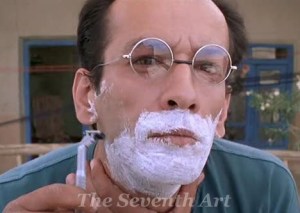
The Wind Will Carry Us can very well serve as a commentary on how the developed nations and the Third World look at each other, but that would only be of minor significance compared to the seething humanity within and around the film. More than anything, The Wind Will Carry Us is a meditative self-portrait, or rather an attempt to look at oneself objectively. Kiarostami observes his own intrusion in the lives of unsuspecting locals and in general, the exploitative and manipulative relationship that exists between the filmmaker and his subjects. He drops enough hints suggesting this in the film.  At one point in the film, Behzad is seen shaving facing the camera as the latter assumes the role of a mirror, which is not much different from what Kiarostami uses it as. Unlike in other Kiarostami “car trips”, the filmmaker protagonist is often filmed head on while driving the car, thereby obtaining a literal and figurative reflection of the camera on his spectacles – an indication that the person in front of the camera is not very unlike the one behind it.

Behzad, his alter ego, is the symbol of encroachment. He arrives ominously in his giant vehicle, tearing through the serene landscape of the secluded village, with a motive that is no more selfish than ours. His work involves the demise of an elderly woman of the village who is presently on her deathbed. Behzad spends time hoping against nature for the process to happen fast but things are not to be so. His attempt to strike up conversations with the village folk, more often than not, turns them off and renders them uncommunicative.  In a remarkable scene, Behzad, in a fit of frustration, overturns a turtle on to its shell and leaves the place. The turtle, after a minor struggle, corrects itself and carries on with its journey. A while later, after he realizes that there is nothing now to fret over, he comes to understand how inconsequential his attempts are to dictate nature are, much like his car which is dwarfed by the colossal landscape.

In the court sequence of his marvelous film Where The Green Ants Dream (1984), Werner Herzog cuts away from the centre of attraction after the tribal chief starts unraveling a package that supposed to contain a sacred emblem as a sign of respect for the divine and the unknown. In The Wind Will Carry Us, Kiarostami keeps a host of characters off-screen and denotes their presence employing just subdued voices and Behzad’s response to them. Nor does he show us the interior of the houses in the village. The camera is fixed on Behzad throughout the film but prefers to stay at the doorstep even if he doesn’t. And this is where the contrast between Behzad the actor and Kiarostami the director– the past and the present of Abbas Kiarostami, his mistakes and their correction – is established. It is a reverence that Kiarostami seems to have gotten the hard way. A reverence that acknowledges the right of things to exist as they are.

The final scene is perhaps the most heartwarming and ethical Kiarostami has ever filmed. Behzad, convinced that his stay of two weeks has taken its toll on both him and the villagers, decides to do away with the final physical traces of the village on him, After washing the dust off the windshield of his car, he throws into a stream the last remnant he possesses – a thigh bone that he picked up earlier – in an attempt to restore the spiritual balance of the land that he may have disturbed. Like Herzog who has consistently been against the intrusion of man in the clockwork of nature, Kiarostami calls for a “calculated indifference” towards the way various cultures work and a regard for its methods against one’s own judgment. However, it should not be assumed that Kiarostami is lashing out against the domineering and subsequently destructive nature of man. Behzad is anything but despicable. He merely acts by impulse and his notions of right and wrong, which may well differ from the villagers’. By creating a multi-dimensional protagonist whose morals and desires are very much our own, Kiarostami’s gesture comes out both as a token of heartfelt atonement and a subtle appeal for recognition and preservation of diversity.

The Altering Eye: Contemporary International Cinema
Robert Kolker
Oxford University Press, 1983
 

the-altering-eyeThe title of Robert Kolker’s The Altering Eye alludes to multiple things – the eye of the filmmaker that sees the society, the eye of cinema that observes its own content and the eye of the audience that facilitates a response to the images it witnesses. And true to its title, Kolker’s book attempts to explore the way these “eyes” have altered their own vision, refined the meaning derived, redefined the process of watching images and essentially understand the emotional and intellectual response they evoke. I read The Altering Eye over a period of 3 to 4 months (interrupted by a few other books) and as I finished reading the last passage, it felt as if I had performed a feat. The book, now, seems so detailed, so vast and so verbose that I begin to wonder if all critical books on cinema would turn out to be like it.

The semblance of vastness of the book partly comes from Mr. Kolker’s style of description and analysis. He starts out discussing schools of thought, covering almost six decades, from a very broad perspective after which he adds detail, bringing in specific works during the period and key figures behind them. Additionally, he talks about the themes of the films, dissecting their screenplays and illustrating their position in film history with respect to contemporary and ancestral works. Furthermore, he often narrows down to specific shots, and sometimes even frames, to excavate details that reinforce his arguments. And suddenly, as if zooming back, he moves on towards the next school of filmmaking to examine its style and substance, the deviations from the existing system and the drawbacks that eventually caused its downfall. As a result, you feel as if Mr. Kolker has covered a huge amount of ground with considerable detail.

Of course, I could crib about the exclusion of major directors from Asia and America, who are grossly ignored in the book. But that objection is instantly nullified since Mr. Kolker makes clear the kind of films and filmmakers he intends to dissect and the ones he doesn’t. His primary aim is to study the response of the filmmakers of Europe and Latin America to the norms and methods of the studio-based Hollywood movies. He primarily deals with filmmakers who understand the “genre” so well that they deconstruct it only to reveal its inherent flaws and later, filmmakers whose subjects are very much a function of history, current affairs and the social structures prevalent. Both these types of filmmakers (not mutually exclusive by any means), Mr. Kolker emphasizes, offer a kind of vehement reaction to Hollywood’s methods of holding the audience in an intellectual inertia and its subconscious conditioning of their morals and emotional responses.

For this, Mr. Kolker divides the book into three large chapters. The first chapter titled “The Validity of the Image” kicks off with a quote from Giuseppe Bertolucci: “The Cinema was born with neo-realism”. Although Mr. Kolker refuses to take up the conventional chronology that is used to trace cinema’s growth (with the clichéd Lumiére brothers versus Georges Melies discussion), he actually presents a good picture of the history of cinema in this chapter. He superficially explores how expressionism paved the way for film noir, which lead to neo-realism in a way, which in turn resulted in the birth of the French new wave, culminating in a hybrid form of cinema in the seventies.  But his main focus in this chapter remains on neo-realism as he studies the very many theories that attempted at first to destroy the bourgeois control of cinema and then create a form that captured the reality “out there”.

The next chapter is called “The Substance of Form” and is probably the biggest one of the three. Here, Mr. Kolker talks about redefinition of cinematic forms by directors who attempted to develop an interactive kind of cinema in reply to the reassuring continuity and passivity of Hollywood. He discusses how the directors destroyed, exaggerated and mixed genres in order to make the audience understand and work out what happened and why it happened that way. He covers a variety of experiments including fracturing of narratives, working within conventions to expose its absurdity, refusal of continuity and omniscient gaze and much more. The French New Wave, in particular, is covered in detail with an overview of every major director of the movement.

The final chapter, “Politics, Psychology and Memory”, rounds off the book with the examination of the influence of history, politics and leftist revolutions on the filmmakers of Western Europe.  Basing his arguments on figures like Bertolucci, Losey, Fassbinder and other Latin American filmmakers, Mr. Kolker talks about the way these films studied fascism and its effects on psychology of the post-war world.  He additionally probes how bourgeois complacency, politics of sexuality, memories and residues of fascism and the left’s struggles relate to each other and gradually make their way into many of these films. Mr. Kolker successfully covers both periods – the rise and fall – of the student revolution and observes the changes in attitudes of the filmmakers towards their subject following its failure.

What is most surprising for me about the book is the way Mr. Kolker examines the films to support his statements. Each analysis seems indisputable and like the only possible interpretation after all. He deconstructs a film (or a movement) into so many layers of meaning that it seems like a flawless movie until Mr. Kolker himself puts it down with drawbacks one would have never imagined. As a result, unsuspecting readers like me, who haven’t seen those films or are relatively new to cinema, might get completely carried away with the text. I do not hint manipulation here. Mr. Kolker does provide in-depth discussions of the films but is also careful enough to let the reader carry on with the discussion using the threads he has provided.

Having said that it is a fantastic book on films and film movements, I must also point out that The Altering Eye is not for the causal reader. You will be going through a paragraph again and again or stuck in a section for a long time. But that is because the content of the book demands it. So if you are looking for a book on cinema that you would want to read with ease, this book may not be the right choice. However, if you want to seriously learn about serious cinema, The Altering Eye is absolutely essential.


Verdict:

P.S: The whole (!) book can be legally read here

To Sir, Sans Love

To Sir, Sans Love

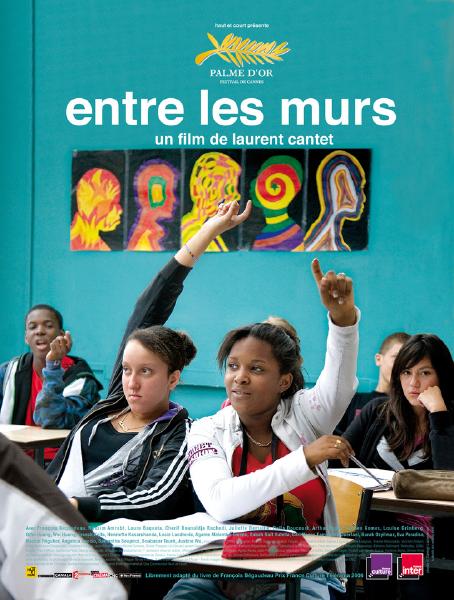
Ever since the ultra-slow moment of lunatic ecstasy took shape in Zero for Conduct (1933), schools in cinema have always been about kids. Everything revolves around them, for good or otherwise. They have been the be all and end all through the decades no matter how complex the scripts got. Even when the films, such as To Sir, With Love (1967), had the teachers as the focal point, the protagonists were always hinged to the acts and moves of the students. Or they turned the table around completely. Some of these films would have this altruistic, uncanny, omniscient and awe-inspiring teachers where the student community is a monolithic entity that served merely as the outlet to emotions. Palm D’Or winner Entre Les Murs (The Class, 2008) (perhaps Half Nelson (2006) too, which I have not seen) breaks all these rules and formulae in a naturalistic and unforced fashion.

The Class is a film where multiculturalism is written right on the face. It does not take the issue as a matter-of-fact as the other films of the year do, but cleverly, builds a premise that enables it to confront it straight on. It does not have a script that tries to be subtle and hence be cheeky enough to implant a message or two. That doesn’t mean The Class does not have a message. It sure does and in loads. It just doesn’t try to hide it. In fact, it attempts to highlight the same. Mr. Cantet avoids the temptation of placing the kids at the edge of the frame and takes them head on (and in focus) as individuals and not as outcasts or marginal. The diversity in Entre Les Murs is not restricted to just nationality or ethnicity, In fact, it goes even beyond the disparities of language, sexual orientation and religious customs, into regions of personal likes and dislikes. To the point where the term ‘diversity loses meaning and it all boils down to individuals, who are like human islands with personalized cultural traits.

The Class presents us two worlds – one each of the students and the teachers – that exist on their own without apparent causality. These are truly independent worlds whose inhabitants have their own problems to attend to, their own private jokes and their own reasons for celebrations. The teachers are assigned a big responsibility of handling multicultural students and that too, in a not-so-reputed school. The teachers have not only to handle this responsibility carefully, but the task of gaining an identity as a teacher in spite of the school. François’ (François Bégaudeau , also the author of the book on which the film is based) personal problems only add to the complication. So do the students, who seem confused about where they belong or who they are. And the class forms the playground for both parties to work within the system and find a place and name of their own.

I believe The Class is a film that has to be watched exactly twice. It is like that stretch of time where you have just quarreled with your friend and you are recollecting what exactly went wrong, only to discover that nothing did. Both the sides and their arguments seem correct upon objective evaluation and the mess seems just like the result of a moment of misplaced subjectivity. This problem arises because the story of The Class is filtered through a highly flawed protagonist. He may psychologically be meaning good, but what his actions at the end of it seem rash and unfitting. So are the acts and intentions of the troublesome Souleymane (Franck Keita). I’m sure that we would have had a symmetrically placed opinion had the tale been told through the eyes of Souleymane. This is precisely the reason I say the movie should be watched twice – in order to understand the two sides instead of passing judgments on them or taking a complacent stand.

The Class works even on a very basic level as it explores the explosive atmosphere between the teacher and the students in the class. This is a very tricky relationship indeed. The teacher tries to cut some slack in order to encourage interaction, ease up his job and ultimately gain reputation among the students. The students being the majority, on the other hand, try to display their wit or skill and get a upper hand in this cat and mouse game. But all this is laid on the foundation of a solid principle. That the adult is always the boss. The kids in Entre Les Murs realize that and try hard to keep themselves in control whenever they can. François too tries not to overstress the principle and to listen to the children as responsible individuals. But a small perceived disturbance, lands to shatter the balance and to provide the dramatic momentum to the film. Funny that this extremely talkative film is the successor of an exceedingly quiet one at Cannes.

The other day, I saw an orphaned girl speaking on TV after she had been admitted to a institution for children. She was speaking in Hindi and was using masculine forms of speech throughout. One could instantly make out the circumstances and environment in which she spent the previous years of her life. The importance of language is a vastly underestimated one and the extinction of languages is as critical as any other issue. The Class is a very talkative film as I said but it is these very words that support its premise. The world seems to have changed so much that the demarcations between the student and the teacher become blurred. They learn French grammar and vocabulary from François. They learn words like “Austrian” and “Argentine” which seems to be much sought after. François learns terms like “honky” and what not from the kids. It doesn’t look like degradation of culture, but rather as the evolution of an alternate culture that has much to teach as the existing one does. A lot of dialectical dialog in the film has gone over my head and understanding that perhaps would help one to see the socio-cultural patterns that are established during the conversations.

There is obviously a pitfall in a situation where a director intends to make broader comments using seemingly minor elements of the film, in this case – the children. One cannot make them too simplistic that it falls laughably flat nor too elaborate such that the elements themselves lose identity (of course, there are exceptions where the intention is not to preserve the elements but to map them completely). Kiarostami’s phenomenal film Homework (1989) is perhaps the bible for directors who want to make film that refuses to compromise on any level. Like Homework, but far less perfect, The Class elicits social, cultural and political structures of the society present outside the school through the interaction and behaviour of the students.

Although there are some forced moments here and there in the film, The Class for a large part is an unpolished film. It does not provide us easy questions or comfortable answers. It carefully avoids all clichés of conventional movies that earnestly move towards a self-congratulatory climax. At the end of The Class, one might be expecting François to pin up the self-portrait of the expelled Souleymane or at least provide a symbolic close to it. No, Mr. Cantel avoids that. Nor does he sweeten anything when the hitherto quiet student insists that she has not learnt anything the whole year. Mr. Cantet is perhaps asking us to see them as they are. Some people just can’t be brought into the clockwork of the system and the system in turn should not pat itself for bringing about the change.

“The System” here may not just denote an educational institution but a larger entity that Mr. Cantet has miniaturized into the four walls of a classroom (Interestingly, “Entre Les Murs” translates to “Between the Walls”). In what may be a metaphor for France itself, Mr. Cantet uses the class to make a commentary on the authoritative mentality of the establishment that tries to impose its values upon its variegated set of inhabitants. Those who don’t conform to the standards set by the system are either marked or expelled. The students feel what the school teaches is irrelevant and outdated, the school feels the what students know is useless and fake. As the whole class – the teacher and the students – vacate the room for winter break, we realize that this ordinary room, which could well have been a hospital, a post office or a shop, was given meaning only because of the presence of the system and its constituents – like our earth that is divided by man-made boundaries with its inhabitants having to adhere to a synthetic feeling called patriotism.

 
Verdict:

A History For Violence

A History For Violence

I hear that the term “Baader-Meinhof phenomenon” refers to something that you keep coming across at an alarming frequency after your first encounter with it. This might sound contrived but unfortunately, that is exactly how I felt when watching Germany’s official entry to the Oscars, Der Baader-Meinhof Komplex (2008). If you’ve watched the first couple of scenes, you’ve probably seen the whole film. Deservedly the least successful of the five nominees, The Baader-Meinhof Complex is an exercise in futility that seems to have wasted great raw material for historical, political and cinematic analysis. And looking back to see that this one overtook Gomorra (2008) is only shocking. Don’t worry, I am not going to give you plot details here. This link gives you all the necessary (and more than that) details about the script of the film!

The Baader-Meinhof Complex is an out and out political film as opposed to personal films with political subtexts. Its course has already been defined by the passage of time. Now, the only creative latitude that the director has in these kind of films is in providing dimensions, motives and moral conflicts to his characters in order to understand them. The director inherits the responsibility to explore the subject, analyze it and provide insights into the events from an arbitrary perspective. Take the case of a film that shares some of the content with this one – Steven Spielberg’s Munich (2005). Having got heavily panned for his handling of history in Schindler’s List (1993), Spielberg returns in style correcting all the errors that might have been committed in the latter film. He quite successfully delves into the psyche of a troubled man on whom a national mentality is forced, managing never to be speculative. All the “data” associated with the film – the Munich Olympic massacre, the initiation of the Wrath of God by Mossad and the statistics that would invariably arise with it – take a back seat with minuscule runtime.

Coming back to The Baader-Meinhof Complex. See what plot details Mr. Uli Edel chooses. Activities carried out by the gang, courtroom transcripts, initiation of major figures into the group, counter-terrorist measures of the police team and the members’ trip across the Middle East – stuff that any text book about the period can provide. The only scope of innovation, now, can come in the indoor sequences that actually merge these disparate events. There, too, Mr. Edel does an interpolating job by gathering the consequences of the preceding events and providing the obligatory kick off to the forthcoming ones. Now, a case may be made for the film to be considered as plain “time-pass” or tea-time entertainment, but its own runtime betrays it. One hundred and forty minutes can not be considered a time-pass, especially if the content can be wrapped up in ten.

I’m absolutely OK with on-screen violence if it is used for a purpose – as a motif or as a tool to illustrate additional meaning or at least to imply the futility of it all. In The Baader-Meinhof Complex, the violence is an experiment with the ways a bullet can go through a person. There are probably over a dozen extensively “choreographed” sequences of heavy gunfire and massacre in the film that serve no purpose than to pass (historical) time and to provide some cheap thrills. You can actually predict the routine as in our own mainstream films. SMGs and AKs hog the limelight once the perfunctory events that lead to it are established. It’s almost mathematical in the way the pattern evolves and destinations reveal themselves. You quickly realize how the RAF is, in fact, a shoddy wrapper to the laughable WW2 films from Hollywood, minus the one-dimensional portrayal of the two armies. Yes, credit has to be given to Mr. Edel for at least depicting both sides of the revolution with equal affinity, if not with a reason.

The Baader-Meinhof Complex is a film with fine cinematography, fine editing, fine casting and fine performances but one without a direction. Rather, it is a film with a direction that is already decided by history. As a result, Mr. Edel comes across more as the author of a sensational and often sleazy detailer of events than as a film director with skill or ambition. The Baader-Meinhof Complex is a film without a soul, if you please. If at all Mr. Edel is attempting to say something of his own, it must be that the revolutionaries were as directionless and authoritative as the very system they were opposing. That it was more because of the hip-factor associated with it than the vision of real revolutionaries that anti-establishmentarianism became as widespread as it did. But, except for the last scene that actually salvages the film to a minor extent, these sporadic observations fail to come within the grasp of the film and die off within minutes of birth.

Consider one of the better scenes in the film where the car that Baader steals gets stolen from him immediately after he challenges one of his comrades to flick a purse. There was scope for great analysis following this. In Herzog’s spectacular Cobra Verde (1987), the Kinski character overthrows an existing regime with the help of the slaves of the country only to become its chancellor and indulge in slave trade. A while later, when an associate asks him who the arrested people in the cellar are, he says “Our future murderers”. Here too, a similar situation evolves. It is inevitable that revolution begets revolution. Successful revolutionaries will one day be overthrown by similar kinds. Snatchers will be snatched from. Anarchists will eventually become the system. But the film never capitalizes upon the ephemeral idea. Or the intriguing moment when an officer asks Horst Herold (Bruno Ganz) what perpetuates the evolution of terrorist groups. He replies “A myth”. It sets us ruminating. What myth is he referring to? The Raskolnikovian myth bordering foolishness?  The Guevara-esque romanticism?  Sadly, the film remains completely oblivious to it.

Verdict: 

Rise Of The Landing Sun

Rise Of The Landing Sun

When one thinks of people like Steve Irwin (“The Croc Hunter“) and Timothy Treadwell (immortalized in Grizzly Man (2005)), it is invariably about the way they died. Some say they saw it coming all the time while some coldly label them romantic fools. But coming to think of it, they perhaps are the happiest kind of people – dying doing what they wanted all their life.  And the same goes for the little octopus in Okuribito (2008) that struggles to survive on land and dies serenely when discharged into its habitat. Hijacking the Oscar from strongly tipped films Waltz with Bashir (2008, Golden Globe winner) and The Class (2008, Palm D’Or winner), Departures has attempted to turn the eyes of the world from the age old issue of wars into something perhaps equally alarming.

Kicking off from the buzzing city of Tokyo, the film tells us of Daigo Kobayashi (a very physical, Ben Stiller-ish Masahiro Motoki), a cellist who finds himself out of job, his wife Mika (Ryoko Hirosue) who seems to be tolerant to all his bluffs and goof-ups and their life following their decision to move to the countryside. By twist of fate, Daigo lands up as a mortician and what follows is a series of impressive and often funny encounters that he has in his profession. After the first gruesome “project”, he takes bath vigorously to get rid of the stench having done the same to the deceased! However, he still desires to play the cello at defining moments that either shake him up or have him exhilarated, perhaps the only times he truly feels alive.

Although Departures is not entirely a character-driven film, the people in the film exist not because they are entities that shape the plot but because they signify something that is not forced upon them. Director Takita neither shapes his characters to conform to the mechanics of a plot nor does he let them take over the unraveling of the film. He merely chooses or avoids them. He reveals them to highlight disparities, change in attitudes and at times the national mentality. All of them (most importantly) have a past that runs parallel the country’s itself. They all are aware of their destination – both collective and individual. I do hope Mr. Takita makes a film that is set 25 years hence. That would clearly justify the ominous atmosphere that the characters carry with them.

Death doesn’t mean the end, but leaving the present, heading for the next stage. Truly a gateway” says the old man at the funeral house. “Journeys” they are called. Takita punctuates episodes in the film with shots of landscape in motion – trams, cars, rivers and birds – illustrating the significance of commutations, movements and relocations in our lifetime and beyond. These journeys are initiated by the morticians with a grace and precision comparable to a wedding or religious ceremony. I guess humans have a paradoxical tendency towards death – possessing inherent self-destructive properties to move towards it yet a grotesque desire to reanimate the dead and to infuse life into the non-living. Daigo embellishes the corpses, endowing them with elegance never seen during their living days, which almost consoles one with the fact that they have had such a beautiful death despite their ugly lives. In essence, a death that unites everyone – the expired and the living. Takita presents a number of such references to the living, the dead and the living dead throughout Departures.

Like Scorsese’s comic book wonder Bringing Out The Dead (1999), Okuribito is a film of great ironies – ironies that come packaged with the biggest taboo of them all called Death. A destitute gets all the respect and care he never had when he lived. A misanthrope would be called a gentle giant the minute he stops breathing. Okuribito explores all these weirdly funny facets of life (and its absence) through the prism contemporary Japanese culture and the paradigm shift that it is currently experiencing. Take the hilarious scene where Daigo “discovers” that the dead girl is actually a transvestite. When asked what kind of make-up – men’s or women’s – would the parents like their child to have, they ask Daigo to use the female make-up – which they perhaps would never have allowed their son to use. One excavates a host of such observations and Herzogian contradictions which will only be ruined by verbalization.

I was tempted to compare the film with Ozu’s masterwork Tokyo Story (1953) until I realized how unfair and often foolish this comparison would be. There is nothing Ozuvian about the form that Takita employs (the first few shots of the film would confirm that). The film is as removed from Tokyo Story, albeit the striking similarity of content, as modern Japan is from the culture the west associates it with. Unlike Ozu’s films that suggest a larger youth population, Okuribito provides us with sketches of Yamagata that are filled largely with old people and a few “Macdonalized” young ones. Yet, both seem so true to the contemporary state of affairs in the country. This just goes to show how the country itself has transformed through the years and that a comparison of films can be made only from a historical perspective and not a cinematic one.

Japan is standing on the brink of a historical moment now. With a large fraction of its citizens moving out of the income graph and a minuscule youth population struggling to stabilize the pyramid, the country’s economy seems to be in for a major crisis – a crisis that every country has to go through some day. Okuribito’s almost allegorical take on this transmutation of the country’s demography and culture is probably what makes it uniquely Japanese (and perhaps the only reason it is fir for comparison with the “Japanese” Ozu). The film’s excessively melodramatic flavour may turn off purists but why I feel that it succeeds despite (and sometimes because of) its flaws is that Departures plays out as an elegy. A requiem for the death, or rather the departure, of its senior population and the social, cultural and economic norms that are soon to go down with it.

 
Verdict:

Lebenszeichen (1968) (aka Signs Of Life)
Werner Herzog
German

“Dammit! This place is full of roaches. They’re not harmful. They are the most repulsive things on earth. They don’t even bite.”

Signs Of Life

German master Werner Herzog has made more than 50 feature films and he is as intriguing as ever. His films, though he has requested people not to read too much into them, have made us raise so many questions about the world we live in. His first feature film Signs Of Life(1967) holds as many questions for us as does his recent Oscar nominated documentary Encounters At The End Of The World. Herzog’s natural affinity for documentary filmmaking shows as he presents the film in a cinema vérité style employing low-lying camera angles and without a soundtrack for most part of the film.

Signs of Life, at first glance, seems like an extension of his short film, The Unprecedented Defence of the Fortress Deutschkreuz (1967), which also followed a group of soldiers trying to take down a bunch of non-extant enemies. Here, Herzog presents us a soldier, Stroszek, who has been injured in war and has been relocated to a quieter place in Greece’s countryside for recuperation. He is put in charge of the defense of an isolated fortress housing 50 tons of ammunition along his Greek wife Nora and two other soldiers Becker andMeinhard. He spends the nights guarding the fort against nothing and the day time lazing around.

This radically new environment has variegated effects on the psychology of the three people who are used to bloodshed and constant unrest in the battle fields.Meinhard seems to rip apart every critter that comes his way and conjures up contraptions and techniques to eradicate the lesser creatures. Stroszek is petrified as he desperately looks for signs of life. He tries to invite a passing gypsy into the fort but is stopped by the probable-misanthrope Meinhard. He looks at Meinhard’s “victims” with childlike curiosity and even goes on to mentally animate the wooden owl that the gypsy presents him. And between these two people is the well-read Becker who tries to adapt himself to the milieu and stay flexible unlike the other two.

In the short film, the soldiers mention that it is an obligation for the enemy to attack and a defensive stance is equated to cowardice and desertion. They say that a state of passivity is just an illusion of peace and a delusory cover for barbarism that is to be unleashed. The soldiers in Signs of Life find themselves in a similar state of mind. They are supposed to guard an arsenal that they cannot use. The town that surrounds them is either made of toddlers or old men. The animals in vicinity are passive insects and lazy pets. Even the landscape is pacific yet carries a sense of foreboding with it. The walls of the fortress they defend are decorated with artifacts resembling human body parts (which may have been real human parts, considering what Becker tells us about the ancient Greeks). It seems like almost an insult to the soldiers that they have to defend the fort against dead partisans and a peasant crowd. And Herzog’s B&W cinematography adds to the barrenness of it all.

Why Signs of Life is all the more surprising is that the themes that would haunt the director and his works in the decades to come not only show their roots in this film but establish themselves with as much conviction as their descendants.Herzog translates his cynical view of Mother Nature and the inherent savagery that it conceals with its beauty using the landscape of the environment and of his characters’ mind that manifests itself through the bizarre acts they perform. We regularly see flora and fauna obstructing our view of the characters as if devouring them. There are bugs flying around he household irritating the soldiers.

It seems like Herzog is suggesting that humans and perhaps even the whole of nature is self-destructive to the core and would perish if not controlled by a higher order. Like the “cannibalistic” chicken in Even Dwarves Started Small(1970), Stroszek seems to be celebrating self-mutilation as he tries to hold explosives in his hand while they go off. This rage for self-destruction escalates to the point where he threatens to blow up the whole town with the stack of explosives under his control. This pervasive need to constantly expose oneself to danger may perhaps be the reason he opens fire at random in the first place. Now, once Stroszek is rendered a threat for the greater part of the human community, it is up to higher establishments of the society – Law and Science – to bring him down and save the town. Is Herzog suggesting that slavery is the only way of survival? Are we all subconsciously Darwinian in the way we tend to trivialize the lives of lesser beings? I don’t know, but Herzog sure does know the knack of both entertaining us and making us think.

Werner Herzog
Beat Presser
JOVIS/ARTE Edition, 2002
 

werner-herzogLast month, the Goethe Institute – Max Mueller Bhavan, Bangalore organized their biggest film event since the Michael Ballhaus/Rainer Werner Fassbinder retrospective in June last year. This one was a photo exhibition titled “Werner Herzog: film has to be physical” followed by a ten film retrospective of Werner Herzog (eventually pruned to nine). Jovis Publication’s book Werner Herzog serves more or less as a collection of these photographs and as an excellent coffee-table book if you are planning to start a cinema themed restaurant. With translations in both German and French placed alongside the English text, the book cleverly positions itself to cater the home crowd, the “cinema people” and the rest of the world.

The book is completely photographed and edited by Beat Presser, who has collaborated with Herzog on multiple films as a still photographer. The book (and the exhibition) predominantly presents photos from three of Herzog’s films in which Presser worked – Invincible (2001), Cobra Verde (1987) and Fitzcarraldo (1982) – though there are quite a few snapshots from some of his other films too. With almost an equal number of monochromatic and colour photos (some spanning two sides too), the collection is a visual treat that not only takes us back to the experience of watching the director’s films but one that enhances the mystery that surrounds Herzog and his work.

Interestingly, the photo-exhibition at the Goethe Institute, Bangalore was the same one that Herzog himself visits in his documentary My Best Fiend (1999) as he chats away with Presser. And the book retains most of these photos in good resolution. Unfortunately, the best few photographs of the exhibition (including one from Stroszek (1977) that clearly stands out among the pictures in the collection) that oozed brilliance with their eye for the dynamic and static components of the photographic image are left out. But not all the photographs grab your attention. There are some seemingly offhand pictures – dull and unimaginative to say the least – that seem like fillers alone. But barring those, the photographs in the book clearly indicate the physical energy that Herzog summons upon his set during the shoot (Herzog himself is captured holding mining and trekking tools many times).

It is common knowledge that Herzog believes that film making is the stuff of brawns and not brains. That an atmosphere, an event or a visual force has to be personally experienced before it can be filmed. With a perspective of cinema (and life) that straddles probable lunacy and profound wisdom, Herzog’s working methods and ideas have often been elusive. What remains clear is his unassailable belief on the physical over the metaphysical and his support for the experiential over the theoretical. This book (and the exhibition at the Embassy) attempts to elaborate upon this principle of Herzog using the photographs. In these pictures that alternate between spontaneous and posed, we see Herzog himself performing the very many physical acts that occur in the three movies that the book covers. Be it the lifting of beer barrels like Zishe of Invincible or the running around during the shoot of Cobra Verde or even the interaction with his actors, one can easily see how this conviction in the physical realm is very important for Herzog when he films something.

The Arte Edition intersperses these photographs with prose and anecdotes written by people who have lived and worked with Herzog. There is Lena Herzog’s short yet fantastic section “Werner” that tells about the minor incident that sprang up (two years after Fitzcarraldo hit the screens) when the couple were shifting houses. Apparently, the guys from the moving company – The Starving Students Movers – upon seeing the couple’s names on the front door asked if they had to move a boat! Then there is playwright Herbert Achternbusch’s bizarre write-up “In the Beginning was the Word” about his reverence for Herzog for the way his life has shaped up. And then there is Peter Berling’s articulate section “Memories of Working with Werner Herzog” that recapitulates his experience during the shoot of Aguirre, the Wrath of God (1972). But all these essays play second fiddle to the paradisiacal images that occur regularly in the book.

This is the only photo-book I’ve read – based on cinema or otherwise. So I can’t exactly say how this one fares in comparison to similar books based on other celebrities. If you really want to know about the director and his methods, this is clearly not the book for you. However, if you want to program a cinema event of sorts based on Herzog’s films or to be the ultimate fanboy of the director or just to decorate your film library, this one might be a very good option. Oh, I haven’t given you the killer yet. This coffee-table book is generally priced at $35. In view of the exhibition and the subsequent retrospective, the Embassy offered the book for $3. Now that’s what I call a steal!

 
Verdict:
 
P.S: Thumbnails of some of the pictures here at Kinski’s site.

Fitzcarraldo (1982)
Werner Herzog
German

“It’s only the dreamers who ever move mountains”


FitzcarraldoIf the judgment criteria for a film included the way it was made and the circumstances under which it was pulled off, Fitzcarraldo (1982) perhaps would rate as the best movie ever made. The Reason? Take a look at the outstanding documentary on the making of Fitzcarraldo – Les Blank’s Burden of Dreams (1982) – and see if you can believe it. Watching the making of Fitzcarraldo is like watching Picasso paint in Clouzot’s The Mystery of Picasso (1956) as we practically witness the work of art take shape through an array of improvisations and brainwaves and burst out into its moment of glory. One begins to wonder if the final product alone is sufficient while assessing an artist or if the tools and means of its creation should be considered too.

I may sound like appreciating the making of the film more than the film itself. But that in no way takes the credit away from Fitzcarraldo as a standalone piece. Some consider it as Herzog’s best film. Clearly, it is up there with the likes of Stroszek (1977), Aguirre, The Wrath of God (1972) and a few others. Fitzcarraldo follows the titular character’s larger-than-life quest to harvest rubber from a practically isolated plantation in order to make money to build an opera house. The central activity involves the towing of a gigantic ship from one Amazonian tributary onto another with the help of the supposedly savage natives. The story and the one behind it are legends by themselves and I would like to just add whatever we see on-screen is indubitably autobiographical – not in the physical sense, but the emotions underneath.

Fitzcarraldo is clear evidence that Herzog has this natural inclination to stage operas. Even though he would argue against bringing ideas of opera into cinema and vice-versa, Fitzcarraldo comes out as a grandly staged opera with its own exhilarating crescendos and chilling decrescendos. Herzog direction percolates into as far as his locales that seem to have taken a demonic life of their own. The ever-shocking Kinski in tandem with that element of Herzogian mystery are sure to haunt you long after the film has ended.

Our Films Their Films
Satyajit Ray
Orient Longman, 1976


Surely, God is not a socialist. Why then would he bestow so much talent upon a single person and deprive the rest of the artists of country of any comparable finesse? Be it Japanese architecture, German music, English literature, Chinese paintings or world cinema, Satyajit Ray’s knowledge of the seven arts is everything a connoisseur could ever desire to have. And his book Our Films Their Films clearly shows why a true love for cinema is the only pre-requisite to be a filmmaker.

our-films-their-filmsI have hardly seen Satyajit Ray’s films and was apprehensive about taking up this book. I was afraid that it would require a prior introduction to films he talks about and especially to his own films. But as it turned out, I was completely wrong. Shubhajit here recalls how this book single-handedly induced him into the film culture. Why not? Our Films, Their Films is a rare book that works two ways. I can’t imagine any other book that is as interesting for strangers to cinema as it is for the film buffs.  Ray never does it like an academic scholar churning out one jargon after another nor does he go too low-brow elucidating every shred of observation. Ray’s tone is conversational and at the end of the book, one does feel like he has spent a good few hours with an interesting man.

The book could be plainly called a bunch of essays by Ray assembled in a chronological order. But surely, it can pass off as so many other things too. Each of these articles has the charm of a short story, the depth of a critique, the personal quality of a diary entry and observations of a great essay. With a language that is neither overpowers the content of the text nor undermines its quality (which I think is true of his films too), Ray sets a standard for not only analytical but also for the verbal component of film writing. No wonder he also stands out as one of India’s key literary figures.

Cinematographe has this to say about the book: “The originality of Ray appears in an indirect manner: whilst talking about others, he offers us a subtle self-portrait“. This is so true. The essays in the book gradually and subtly unravel Ray’s perception of cinema and what he believes makes for great filmmaking, all of which reveals itself through the very many critiques of world films he presents. But the fascinating part is that he never takes the role of a filmmaker when he writes these pieces. He could well have elaborated on what lens John Ford used or what editing instruments Kurosawa employed. But the sections where Ray presents his views of international films could only have come from a true-blue cinephile whose very love for cinema is infectious. Look how he presents his opinion on Kumar Shahani’s Maya Darpan (1972), Kaul’s Duvidha (1973), Benegal’s Ankur (1974) and Sathyu’s Garam Hawa (1973), which organically unfolds into a fantastic review of the films.

But what really swept me off my feet are the observations that Ray makes in these early essays, the last of which was written in 1974. These observations – their almost prescient and intensely accurate quality just goes to show how deep Ray’s understanding of cinema was – both as a person behind and in front of the screen. I’ll give you an example. Ray met Kubrick just after he had made Spartacus (1960). He recollects: “On the strength of his Paths of Glory (1957), Kubrick had seemed to me to be one of the white hopes of American Cinema. He had first rate technique, he had style and I had a feeling that he had also something to say.”. Not just that, his opinions of Billy Wilder, Antonioni, Kurosawa and many others prove to be bang on the money.

If one takes a survey of the favorite section in the book among those who have read, it would definitely produce variegated results, for each section has the power to top the previous, no matter what order you read them in. My favorite section in the book Problems of a Bengali Filmmaker (along with Calm Without, Fire Within and An Indian New Wave?) provides an answer to almost every question I have had about the state of filmmaking in India. But again, this is one opinion that may change even before I finish this review. An Indian New Wave? may be just the winner in the long run, I suspect.

Reading the very many experiences of Ray abroad, one is regularly surprised about the range of people he knows in cinema and the dream-like way they meet each other. Reading these is almost like hearing a splendid raconteur recollecting his road trips with wide eyes. But all that is only because he presents himself with such simplicity. And that is partly a reason that this book shines with honesty. I’m sure, there would be hundreds of pages written from the other side of these meetings that would really give an idea of this monumental figure called Satyajit Ray.

 
Verdict:

P.S: Some essays of the book can be found here. Do read it. I think this book is a must read for film-geeks and not-so-film-geeks alike.