
In a face-off marking the film’s intermission, the local IIT coaching business head Lallan (Aditya Shrivastava) comes to warn a renegade star professor Anand Kumar (Hrithik Roshan) of dire consequences if he continues running his free coaching centre for the poor. Pockets of sunlight trickling through the makeshift roof creates dramatic zones of shadow and light on the character’s faces. As Lallan cranks up his challenge using colourful metaphors of a horse derby, music swells and a wind from nowhere sweeps across the room, making the asbestos walls rumble. Lest we miss the cues, Anand asks Lallan to brace for a storm.
Multiplying signifiers is part of all melodramatic expression, but Vikas Bahl, the director of Super 30, uses it exclusively as a crutch to prop up an uninspired material bordering on formula. The strings are pulled even before the first shot, violins and choruses preparing us for a soundscape that will be set to 11 through the remainder of the film. The film opens in London in 2017 at a gathering to felicitate a successful student of Anand’s. After a brief rollcall of Indian-headed corporations, he pays tribute to his professor, who, even before the flashback, is presented as a genius educator to be lionized. The second scene is a gathering too, this time in Patna twenty years ago, and sets up a lazy opposition between education and politics that characterizes the film: a slimy education minister (Pankaj Tripathi) makes false promises to Anand, who has just won a top medal.
He goes to show the medal to his romantic interest Ritu (Mrunal Thakur). In the first scene of a gratuitous romantic track, shoehorned as in all biopics of men to show that these men have Feelings, Ritu sits wearing the medal looking sideways at Anand, who crouches on the floor, talking about PhD while playing pittu. The scene, like all others in the film, plays out exactly as you imagine; a romantic interlude between a math geek and a plain Jane: she expects him to declare his love while he, in a parody of 60s Hindi cinema bholas, holds forth on phi, the golden ratio. A first meeting with the girl’s father, Anand’s appointment with the minister seeking financial help, all the exchanges with Lallan, the minister’s rude dismissals of Lallan, a scene at the police station seeking protection, Anand’s pep talk as he shuttles between students standing around him in the room, they all proceed with the predictability of the Fibonacci series. The villains recognize themselves as villains, the amir log address themselves as amir log. A story’s dramatic value is already diminished when its antagonists themselves are convinced of the hero’s moral superiority.
This bloodless quality of the script might have been made up for with a dynamic style, but Super 30 is so formally inert and conservative that the sole visceral impact that Anand’s victories provide comes from its booming soundtrack. Outside of a few ominous close-ups of a cycle chain (whose delicious ambiguity is soon dispelled by the turn of events) and three meal scenes, none of which the film seems to be really invested in, there’s hardly an organizational principle at sight. The visual culture of IIT coaching institutes, with its fatigue-inducing self-promotional ads and banners, is dispensed in a single second-unit montage. The better part of the film is given a burnished DI look to evoke some vague sense of the rustic while once florescent-lit scene at a hospital, with stroboscopic effects on cue, sticks out like Hrithik’s grey eyes in the hinterlands of Bihar.
What does hold the attention and ground the film is, however, the figure of Hrithik Roshan himself. Successively outfitted in old sneakers, half-sweaters (= innocent man, per Bollywood), pilled T-shirts, checked shirts, oversized kurtas, his top button always open making his neck crane out even further in the frame, a pen in the shirt pocket, a large-dial wristwatch on the right hand and sometimes a red towel on the shoulder to signify his modest means, Hrithik is always interesting to watch here, despite the raw deal the script offers him. Like Gary Cooper, he effaces himself in the early part of the film, blending into the crowd and sticking to the edge of the frame. He squats twice in the film to indicate overwhelming joy – one when he gets an admit at Cambridge and again when his students clear IIT – he pulls up his belt that wraps around a too-tucked-in shirt when he meets the girl’s father (borrowing from his man-child repertoire from Koi Mil Gaya), he uses his middle finger to point at objects and stands in the classroom against the table leaning on his right elbow or with his right foot on a chair, looking like a pretty hieroglyphic. And, of course, he swallows his saliva to show that he is overcome with emotion. His Adam’s apple is a compositional element of its own.
Does Super 30 take on feudal forces as it repeatedly claims in its punchline? I believe not. The film inscribes itself into a Hollywood tradition of individual triumph in which the nominal social problem (the exclusion of the poor from the social ladder) becomes a wallpaper to the protagonist’s journey of self-realization (the success of Anand’s academy). Think Dances with Wolves, Schindler’s List, Amistad. Like the heroes of these films, Hrithik’s Anand is a paternal figure who not only must do his professional duty as a teacher, but also prepare his children to face life’s challenges. In an extended set piece – perhaps the film’s most inspired moment, pulling off with a straight face what is otherwise unintentionally funny – he orders his students to put up a play entirely in English in order to help them find self-respect and overcome their complexes of not being able to speak in English. The play, set at the town square on Holi day with coaching institute posters all around, starts out as a funny skit around Sholay, but soon becomes a resistance song against the hegemony of English. While Anand’s prowess as a life coach are amply demonstrated, the cognitive challenges in teaching and learning advanced mathematical concepts, themselves, are side stepped. Turning abstract physical problems into real world questions or pretty animations doesn’t, despite what the film thinks, make them any more pertinent, leave alone solvable.
The event the entire film prepares us for – the IIT entrance exam – is placed right after a shootout worthy of Anu Club, in which the students employ various scientific concepts to ward off gun-toting henchmen sent by the minister. The exam itself is not depicted and the day of the exam results becomes an excuse for the camera to linger long on Hrithik’s expression of relief and vindication. The film’s end credits present a list of international laurels for Anand’s programme, not what it did to its participants or what IIT means to its aspirants today. It reads no differently than the promotional banners of other coaching institutes.
Part of the problem stems from the film’s wholesale purchase of the bourgeois myth of Education as a ticket out of poverty. Not only will education help you get a job, but you can build slide projectors with rubber bands and fend off a criminal outfit with solenoids and lenses. Pervading the film is the idea that were the children allowed a shot at the IIT, all the systemic problems facing them for generations would vanish. No matter the lack of institutional support once you get into top-tier colleges as an underprivileged student or the continuation of inequalities in performance through accrued academic capital. The notion of education as panacea and an ultimate goal to be pursued reverberates throughout Super 30, with its thundering Sanskrit chorus about education, its unironic reverence of the IITs and its belief that education lies somewhere beyond the corrupting realms of business and politics. These are talking points that you will invariably find echoed in middle-class living rooms and corporate offices.
“A king’s son will no longer become the king. Only he who deserves it will become the king,” a line that’s uttered a handful of times in the film. This seeming rebuttal to zamindari era is actually a cover for the belief in pure meritocracy the film embodies. Super 30’s dodging of the question of reservation is not simply a curiosity, but essential to its functioning. It has to pit rich kids who have all the means at their disposal to prepare for the exam and poor but gifted kids who have to fight for everything. In a sequence depicting competition between the two camps, the former group turns out to be winners by a couple of marks, and the film plays it out as a defeat for Anand. It would not sit well within the moral fabric of the film for an underprivileged student with lower marks passing the exam over a rich student with higher marks. In an early scene at a university library, Anand Kumar is thrown out for not giving out his full name. What first appears to be a rebellious gesture to withhold caste name is extended to every character in the film, who are all to be read only as tropes such as evil politician, corrupt businessman, doting father, helpful reporter etc. I hope this objection to the film for trying to remap caste-class inequalities solely along class lines doesn’t seem like an unfair or irrelevant criticism. What I intend to point out is that, in doing so, the film falls in line with the same outlook it rebukes. Super 30, however, is not special offender. This narrative of the triumph of merit over mediocrity, talent over entitlement is part of the enduring myth that culture industries such as Hollywood and Bollywood – without a hint of irony – tell us, if not themselves.


 At a time when Daesh funds itself by trafficking cultural artifacts and Europe announces asylum for threatened art works, Sokurov’s marvelous, piercing film offers nothing less than a revisionist historiography of art itself. For Francofonia, History is not the content of art but its very skin. Museums flatten time, and justifiably present their contents as the highest achievements of a culture, obfuscating, in effect, their history as objects involved in power brokerage, class conflict and market manipulation. Sokurov’s film flips this perspective inside out, identifying art as being frequently the currency of diplomatic power possessing the capacity to purchase peace and as being instruments in service of totalitarian collaboration. Napoleon,
 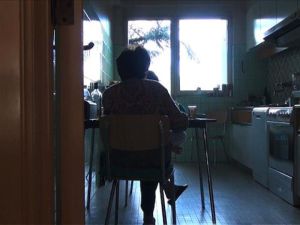 The jeu de mots in the title says it all. Not only is this deeply death-marked, Ozuvian film an unordinary home movie, but it is also a film about not having a home. Composed of footage shot in the filmmaker’s mother’s Brussels apartment and recorded video-conference sessions between the two, No Home Movie contrasts Akerman’s professional nomadism with the perennial confinedness of her mother Natalia. Between Chantal’s constant off-screen presence and Natalia’s self-imposed captivity (within the apartment as well as the computer screen), between Here and Elsewhere, lies the film’s true space – a part-real, part-virtual space of filial anxiety and affection. Akerman’s matrilineal counterpart to Porumboiu’s
  Taxi opens with a shot of downtown Tehran photographed from the dashboard of a car. Announcing Panahi’s first cinematic outdoor excursion since his house arrest in 2011, this shot sets up the dialectics that would define the film: home/world, individual/social and freedom/captivity. Through the course of Taxi, the spied-upon filmmaker drives around the city in the guise of a cabbie, chauffeuring clients-actors from various strata of the society, and realizing a pre-scripted scenario with them whose urgent, didactic purpose can’t be more obvious. The Iranian state has forged a private prison for Panahi from the public spaces of Tehran, allowing him a mobility and false freedom that’s regulated by its watchful eyes. Panahi turns this power dynamic upside down, transforming the private space of the vehicle into a public space for debate, discussion, instruction and critique. Watching the film, I was constantly reminded of that saying beloved of Wittgenstein: “It takes all kinds to make a world”. Panahi’s very presence in the film – his image, his voice – becomes an audacious act of political defiance, a gesture of tremendous existential courage that stares at the possibility of death floating in the air. Taxi makes cinema still matter.
 A beautiful marine cousin to Guzman’s previous film, Nostalgia for the Light (2010), The Pearl Button turns its attention from the arid stretches of the Atacama to the waterfront and ice field of Southern Patagonia. Threading metaphor over metaphor, the director fashions a typically associative, richly suggestive essay film that turns the nature documentary form on its head. Guzman’s film plumbs the depths of the ocean, trying to uncover traces of suppressed, unseen history embodied by countless “missing people” – a project that derives its impetus from the filmmaker’s bittersweet childhood experience of the sea. Despite Chile’s economic indifference to its 4000-kilometer-long coastline, he notes, the sea has been indispensable those in power, serving first as the entry point of the European invaders, who wiped out the Patagonian natives, and then as the dumping ground of political prisoners during the Pinochet regime. Guzman teases out the different values that the sea holds for him, the autochthons and the Chilean state, in effect politicizing and historicizing that which conventional wisdom takes to be apolitical and ahistorical: geography and the perception of it. The result is a film of immense poetry and horror – a horror that only poetry can convey.
 The most impressive debut film of the year, Alexandra Gerbaulet’s ambitious, intoxicating Shift excavates the evolution of her hometown, Salzgitter, along with that of her family with archaeological care and scientific detachment. In Gerbaulet’s heady narration, anchored by a powerful, quasi-declamatory, rhythmic voiceover, Salzgitter’s transformation from a Nazi mining stronghold and concentration camp, through a waning industrial hub and to a nuclear waste dump parallels the gradual disintegration of the Gerbaulet family under the weight of unemployment, sickness and sexual repression. The filmmaker closely intercuts photographs and diary entries of her mother with impersonal material from popular and scientific culture, weaving in and out of both registers with ease. Gerbaulet’s film is literally an unearthing project, as the director scoops out the various historical, political and geographical layers of this war-weathered city whose tranquil current-day model housing sits atop a makeshift Jewish graveyard consisting of camp workers buried using industrial debris. “Man gets used to everything, even the scar”, declares the narrator bluntly. Shift unscrambles such a habituated view of things, observing the tragicomic tautologies in which history revisits the city. The more you dig, it would seem, the more of the same you get.
 One of my favorite films of the year is a commercial for a major power corporation made by a 106-year-old artist.
  Thomas McCarthy’s dramatization of Boston Globe’s exposé of child abuse in the Church is a robust, smart procedural that is less about picking apart the Catholic establishment than about elucidating the epistemological processes of the Information Age. Set at the transitional period between print and online news media, the film underscores the soon-to-be-outmoded physical nature of journalistic investigation. There are no antagonists of the traditional kind in Spotlight. The only obstacles to the knowledge required to carry out the exposé are the numerous procedures and institutional protocols that have for objective the protection or publication of information. It is telling that the entire film is about a pack of newswriters seeking information that’s already out in the open. What’s more, the film recognizes that the Spotlight team’s attempts to mount an institutional critique is itself inscribed within kindred ideological biases, operational strategies and structural iniquities of Boston Globe as an institution and that the metaphysical crisis that their story can potentially wreak amidst readers is but similar to the disillusionment the newsmen experience vis-à-vis their Protestant weltanschauung. With relatively uncommon formal and ethical restraint, McCarthy crafts an arresting film about how a society’s narratives are made, predicated they are as much on the dissemination of information as on their marginalization.
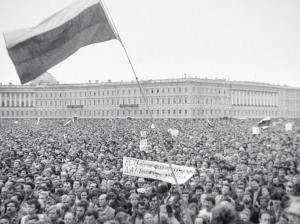 ergei Loznitsa’s formidable follow-up to Maidan (2014) furthers the earlier film’s exploration of the aesthetics and mechanics of revolution, capturing a people coming together to make sense of a political limbo. Without context or a framing perspective, the film drops us straight into the streets of St. Petersburg just after the attempted reactionary coup d’état in Moscow in 1991. Confusion and mundanity – not heroics and determination – reign as we observe the formative process of a people’s movement and the imagined/imaginary social glue that causes individuals to cohere into a group. State apparatuses compete with each other for imposing a narrative onto the events, while the very toponymy of the city becomes an ideological battleground. Working off priceless archival footage, much of which is incredibly reminiscent of the filmmaker’s own cinematographic style, Loznitsa provides an invaluable glimpse into the unfurling of history, chronicling how numerous banal, unsure gestures and actions snowball into Historical Events. If Eisenstein’s better-than-the-original recreation of the October Revolution was the abstraction of materialist history into ideas, Loznitsa’s film, taking place at the same Palace Square 63 years later, rescues history from the reductions of ideology and brings it right back into the realm of the material.
 A remarkable American counterpart to J. P. Sniadecki’s The Iron Ministry (2014), In Transit unfolds predominantly as a series of interviews with a mixed bag of travellers on board The Empire Builder, a long-distance passenger train running over 3500 kilometers and spanning almost the entire width of the United States. The accounts of passengers seeking out professional and financial breakthroughs evoke the pioneer myth hinged on a “Go West” imperative while the stories of those aboard in search of their ‘calling’ demonstrate the essentially spiritual, even religious nature of their pilgrimage-like journey. The diversity and range of the interviewees and their interactions help the film depict the train as a miniature America, à la Stagecoach, and carve out a quasi-utopian space in which members across class, race and gender divides get an opportunity to converse with each other without personal baggage. Nonetheless, In Transit is less a cultural vision of a possible America than an existential meditation on what makes people embark on these journeys. One elderly war veteran remarks that he’ll never be able to see these plains again. To cite John Berger, “the desire to have seen has a deep ontological basis.”
 One of a piece with Gianvito’s Vapor Trail (Clark) (2010), Wake continues its precedent’s important investigation into the ecological consequences of the presence of America’s largest military bases in the Philippines during most of the 20th century. Like Profit Motive and the Whispering Wind (2007), Wake is guided by the spirit of Howard Zinn’s approach to history and sketches an economically-founded account of US-Philippines political and cultural relations – a history that seems to be have been lamentably wiped off from the Filipino national consciousness. Gianvito juxtaposes images from the Philippine-American war with current day images from the contaminated Subic naval base area, suggesting, in effect, the poisonous persistence of an agonizing, unacknowledged history. Wake is imperfect cinema – unwieldy and resourceful – and employs fly-on-the-wall records, talking heads, on-screen text, photographs and news clips to mount a potent critique of a historiography defined political amnesia and economic opportunism. More importantly, it is a necessary reminder that imperialism is not always about presence, action and exercise of power but sometimes also about the refusal of these very elements, that history is not only a matter of events but also processes and phenomena and that geography is always political.
 Chan’s diaristic digital work is divided into chapters named after family members and unfurls as a process of piecing together of familial history. Through various confrontational interviews with her mother and father, the filmmaker attempts to understand their failed marriage, her strained relation with her step-father and the violence that has structured them both. Chan’s decision to put her entire life-story on film is a brave gesture, but the film closes upon itself, satisfied to be a melodrama valorizing personal experience over broader frameworks. (Consider, in contrast, the rigorous domestic formalism of Liu Jiayin or the socio-political tapestry of Jia Zhangke’s early work.) Chan misses the forest for the lone tree. Winner of the Adolfas Mekas award of the fest.
 Beep assembles anti-communist propaganda material from the 60s and the 70s commissioned by the South Korean state that was based on the mythologizing of a young boy, Lee Seung-bok, slain by North Korean soldiers. With the unseen, absent boy-hero at its focus, Kim’s film depicts the dialectical manner in which a nation defines itself in relationship to an imagined Other. Kim makes minimal aesthetic intervention into the source material – our relation to it automatically ironic by dint of our very distance from the period it was made in – restricting himself to adding periodic beep sounds to the footage, producing something like a cautionary transmission from another world.
 Black Sun opens with a composition in deep space presenting a metonym for a country in the process of development: high-rise buildings in the background as a pair of actors in period costumes rehearse a scene in the foreground. In a series of Jia Zhangke-like vignettes of Saigon set in middle-class youth hangouts scored to pop songs and television sounds, interspersed with images of a metamorphosing city, we see the distance that separates art from reality and the middle-class from the changes around it. The film culminates in a complex, home-made long take following the protagonist across her house and out into the terrace, where she dances, presumably to the eponymous song.
 The most challenging and elusive film of the competition I saw is also the most hypnotic. Cloud Shadow gives us a narrative of sorts in first person about a group of people who go into the woods and dissolve in its elements. The film is obliquely a story of the fascination with cinema, of the trans-individualist communal experience it promises, of the desire to dissolve the limits of one’s body into the images and sounds it offers. With an imagery consisting of sumptuous tints, and nuanced colour gradation and superimpositions, the film enraptures as much as it evades easy intellectual grasp. The one film of the festival that felt most like a half-remembered dream.
 Ferri’s teasing, playful Dog, Dear appropriates the filmed record of a Soviet zoological experiment in the 1940s in which scientists impart motor functions to different parts of a dead dog. In the incantatory soundtrack, a woman – presumably the animal’s owner – repeatedly conveys messages to it, with each of them prefaced by the titular term of endearment. Ferri’s film would serve sufficiently as a blunt political allegory about the dysfunction of communism, but I think it’s probably fashioning itself as a metaphysical question: the dog might well be kicking but is he alive? His physical resurrection will not be accompanied by a restoration of consciousness. He will not respond to his master’s voice.
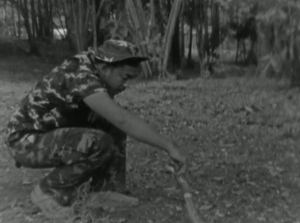 Put together from footage apparently shot over twenty years at a Thai army officer’s residence, Tesprateep’s film shows us four conscripts working in the general’s garden. We witness their camaraderie, their obvious boredom, the empty bravado in entrapping small animals and intimidating each other. The misuse of power by the officer in employing these youth to mow his lawn reflects a broader militaristic hierarchy, as is attested by the youths’ casual violence towards the animals and their brutal torturing of a prisoner. Endless, Nameless recalls Claire Denis in its emphasis on military performativity and Werner Herzog in its juxtaposition of idyllic nature and seething violence, all the while retaining an
 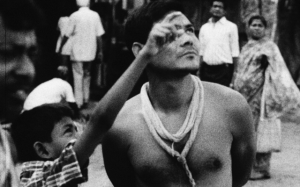 In Fictitious Force, Widmann incidentally poses himself the age-old challenge of ethnological cinema; how to film the Other without imposing your own worldview on him? The filmmaker smartly takes the Chris Marker route, avoiding explanatory voiceover for the rather physical Hindu ritual he photographs and instead holding it at a slightly mystifying – but never exoticizing – distance. Widmann’s film is about this distance, the chasm between experience and knowledge that prevents the observer from experiencing what the observed is experiencing, however understanding he might be. Fictitious Force’s considered reflexivity carefully circumvents the all-too-common trap of conflating the subjectivities of the photographer and the photographed.
 Fashioned out of footage that the artist shot during his visit to the titular natural reserve in Ontario, Fish Point comes across as an impressionist cine-sketch of the locale. The film opens with Daichi Saito-esque silhouettes of trees against harsh pulsating light – near-monochrome shots that are then superimposed over a slow, green-saturated pan shot of a section of a forest. This segment gives way to a passage with purely geometric compositions consisting of alternating browns and greens and strong horizontals and verticals. Forms change abruptly and tints become more diffuse and earthly. We are finally shown the sea and the horizon, with a rough map of the area overlaid on the imagery.
 A music video for a song that reportedly riffs on a holy chant and the traditional cry of the local ragman, Ye’s film starts out with shots of old women and men lip-syncing to the titular melody before turning increasingly darker. The rag picker of the poem progresses from accepting material refuse to buying off diseases, emotional traumas and even intolerable human characters. Ye builds the video using shots both documentary and voluntarily-performed that portray everyday life in Taiwan as being poised between tradition and modernity. The junkman of the film then becomes a witness to all that the society rejects and, hence, to all that it stands for.
 Set in a suburban Mumbai slum, Bhargava’s film takes a look into one of the reportedly many carrom clubs in the area where young boys come to play, smoke and generally indulge in displays of precocious masculinity. Where Imraan, the 11-year-old manager of the club, seems reticent before the camera, his peers and clients are much more willing to perform adulthood in front of the filming crew. While some of them are acutely aware of the intrusive presence of the camera, urging their friends not to project a bad image of the country, the film itself seems indifferent about the ethics of filming these youngsters, asking them condescending questions with a problematic, non-committal non-judgmentalism.
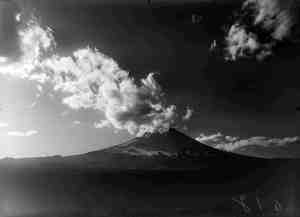 Völter’s visually pleasing and relaxing silent film is a compilation of scientific documents of cloud movement over the Mount Fuji recorded from a static observatory by Japanese physicist Masanao Abe in the 1920s and 1930s. Abe’s problem was also one of cinema’s primary challenges: to study the invisible through the visible; in this case, to examine air currents through cloud patterns. The air currents take numerous different directions and these variegated views of the mountain situate the film in the tradition of Mt. Fuji paintings. The end product is a James Benning-like juxtaposition of fugitive and stable forms, a duet between rapidly changing and unchanging natural entities.
 The most narrative film of the competition, Memorials situates itself in the tradition of 21st century Slow Cinema with its elliptical exposition, stylized longueurs, (a bit too) naturalistic sound and its overall emphasis on Bazinian realism. A young man revisits his father’s house long after his passing and starts discovering him through the objects of his everyday use, while a dead fish becomes the instrument of meditation and grieving. Though rather conventional in its workings, Memorials offers the details in its interstices fairly subtly and touches upon the usual themes of inter-generational inheritance and posthumous rapprochement, while also gesturing towards a necessary break from the past.
 Punprutsachat’s work is a straightforward document of the protracted rescue of a water buffalo from a man-made well on a sultry summer afternoon by dozens of village folk. Shot with a handheld digital camera and employing mostly on-location sound, the film presents to us the efforts of the villagers in chipping away at the edifice, restraining the animal from agitating and finally allowing it to go back to its herd. Natee Cheewit attempts to encapsulate the idea of eternal struggle between man and animal and, more broadly, between nature and civilization. The remnants of the demolished pit and the dog wandering about it are reminders of this sometimes symbiotic, sometimes destructive interaction.
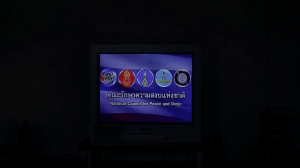 Night Watch is reportedly set in the days following the military coup in Thailand in May, 2014 – a period of state repression dissimulated by triumphalist propaganda about reigning happiness. Chulphuthiphong’s debut film showcases one quiet night during this period. Jacques Tati-esque cross-sectional shots of isolated apartments and office spaces show the citizenry complacently cloistered in their domestic and professional spaces, much like the sundry critters that crawl about in the night. Someone surfs through television channels. Most of them are censored, the rest telecast inane entertainment. Night Watch underscores the mundanity and the ordinariness of the whole situation, which is the source of the film’s horror.
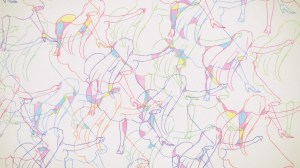 A rapid editing rhythm approximating the audiovisual assault of the information age, a visual idiom weaving together anime, pencil-drawing and Pink Film aesthetic and a soundscape consisting of reversed audio and noise of clicking mice and shattering glass defines Ouchi’s high-strung portrayal of modern adolescent anxieties. In a progressively sombre, cyclic series of events, a teenager navigates the real and virtual worlds that are haunted by sex and death around her. Ouchi’s pulsating, mutating forms and her preoccupation with the hyper-sexualization of visual culture are reminiscent of
  One of the high points of the festival, Scrapbook consists of videograms shot in 1967 in a care centre in Ohio for autistic children with commentary by one of the patients, Donna, recorded (and curiously re-performed by a voiceover artist at Donna’s request) in 2014. Donna’s words – indeed, her very use of the pronoun ‘I’ – not only attest to the vast improvement in her personal mental condition, but also throw light on the psychological mechanisms that engender a self-identity. For Donna and the other children-patients filming each other, the act of filming and watching substitutes for their thwarted mirror-stage of psychological development, helping them experience their own individuality, reclaim their bodies. Bracing stuff.
 Canadian animator Leslie Supnet’s hand-drawn animation piece is an extension of her previous work
 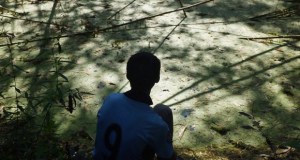 According to the program notes, the project brings together a real-life DJ who has lost her job after the coup d’etat in 2014 and an actual illegal immigrant boy from Myanmar at a secluded pond in the woods to allow them to do what they can’t in real life. We see the DJ perform for the camera, talking with imaginary strangers, giving and playing unheard songs, while the boy is content in tossing stones into the moss-covered pond. Like a structural film, The Asylum, alternates between the DJ’s ‘calls’ and the boy’s quiet alienation, taking occasional albeit unmotivated excursions into impressionist image-making, to weave a vignette about ordinary people made fugitives overnight.
 A Kiarostami-like narrative minimalism characterizes Radjamuda’s naturalistic sketch in digital monochrome of a lazy holiday afternoon. A young boy perched near the window of his house engages in a series of self-absorbed activities, while actions quotidian and dramatic, including a hinted domestic conflict, wordlessly unfold around him off-screen. A series of shallow-focus shots rally around a wide-angle master shot of the backyard to establish clear spatial relations. Literally and metaphorically set at the boundary between the inside and the outside of the house – home and the world – Radjamuda’s film is a pocket-sized paean to childhood’s privilege of insouciance and to the transformative power of imagination.
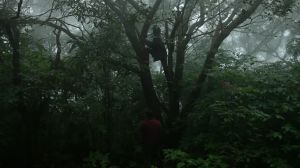 The shadow of Apichatpong Weerasethakul’s work is strongest in Kapadia’s three-part work about the cycles of life, death and reincarnation and the interaction between mankind and nature, between the real and the surreal. Set in various regions of India and in multiple languages and shot predominantly between dusk and dawn, the film has a beguiling though mannered visual quality to it, with its appeal predicated on primal, elemental evocations of the supernatural. While Kapadia’s superimposition of line drawings on shot footage to depict man’s longing for and transformation into nature demands attention, the film itself seems derivative and a bit too enamoured of its influences.
 A potential companion piece to Porumboiu’s
  At least as formally innovative as Rithy Panh’s
  Wind Castle opens with a complex composition made of an unfinished (or destroyed) building behind a burnt crater, with the moon in full bloom. We are somewhere in the Indian hinterlands, a brick manufacturing site tucked inside large swathes of commercial plantations. Basu’s camera charts the territory in precise, X-axis tracking shots that form a counterpoint to the verticality of the trees. Noise from occasional on-location radios and trucks fill the soundtrack. A surveyor studies the area and trees are marked. ‘Development’ is perhaps around the corner. But the rain gods arrive first. Basu’s quasi-rural-symphony paints an atmospheric picture of quiet lives closer to and at the mercy of nature.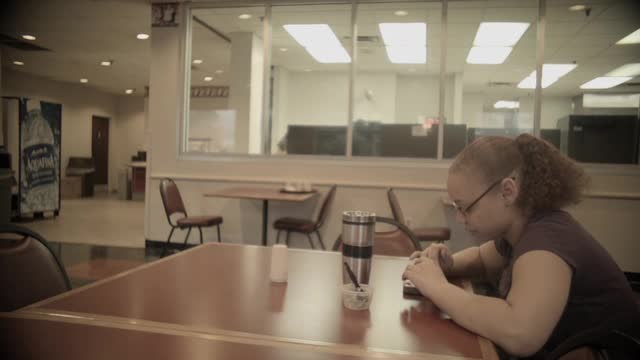


 The Seventh Art