Jeanne Dielman, 23 Quai Du Commerce, 1080 Bruxelles (1975) (aka Jeanne Dielman)
Chantal Akerman
French
“I used less water than last time, so it tastes better”
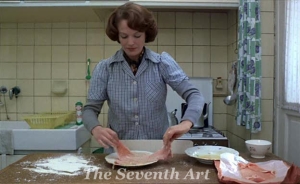 Chantal Akerman’s most famous film gives away all that is factual about it in its name itself. The rest of it follows what the titular Jeanne Dielman (Delphine Seyrig) does in this 23, Commerce Quay, 1080 Bruxelles house of hers, over a three day period in almost in its entirety. Using completely stationery cameras, Akerman creates a claustrophobic document of life in its most mundane form. Even with a screen time of over three hours, there isn’t much in the movie that could be fit into something called plot. That, precisely, is Akerman’s intention. Details are given with extreme reluctance and in exceedingly small measures (with hardly 10 minutes of spoken dialogue). On the first day, we witness Jeanne ritualistically moving about in her house, switching on and off the room lights, cooking potatoes for her obedient son, arranging tables, doing the dishes and making the bed. She earns by selling herself during the afternoons in her very house. All this is done by the book, if there ever was one.
It is precisely these systematic acts which become our reference for the next day. The next day follows almost the same pattern. Only that Jeanne drops a spoon and the polishing brush. Oh yes, she also goofs up the dinner! On the third day, the bank is closed, she reaches a shop before it opens, the coffee is spoilt and a button snaps off from her son’s blazer. This is all the change that Akerman allows Jeanne. What surfaces is a gradually progressive deviation from our “reference” and perhaps for the worse. Like the geometrically flawless décor and lighting of the film, which exude cheerfulness, contentment and sanity are only apparent. It is almost as if one can mathematically calculate, using these extremely small “mishaps”, when Jeanne will completely succumb to her condition. And this is the kind of gradual disintegration of sanity that many films fail to portray credibly (Revolutionary Road (2008) comes to mind first). What happens obscures how it all happens. Cinema becomes text. Although Jeanne Dielman is much more extreme in its form than the mainstream narrative cinema would require, it clearly shows that why a formal stance doesn’t merely justify the medium chosen but enhances its possibilities.
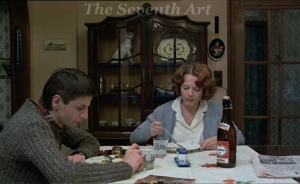 It wouldn’t be unfair to call Jeanne Dielman an experimental film. Where other films that deal with similar theme of urban alienation tend to bend towards the cerebral side, Jeanne Dielman is more experiential. At any point in the film, once the viewer gathers everything there is to an image, like Tarr’s movies, fatigue sets in. We start experiencing time as it is, undiluted. In other words, we begin taking part in Jeanne’s life by experiencing the savage inertia of time. The only difference is that she is oblivious to it while we, possessing knowledge of the artificial and transitory nature of cinema, are not. Jeanne doesn’t pass through life. She lets life pass through her. Not once does she show signs of emotional fatigue. She is insensitive to her condition much more than her cerebral counterparts. Except for one sequence at a button store, where she shows clear indications of mental derailment, there apparently is no outlet for her emotions at all. Apart from the perfunctory conversations with her son and the occasional visit by the neighbour, who asks Jeanne to take care of her baby (who could well be considered a miniature Jeanne) from time to time, Jeanne is completely cut off (at times literally, in the frame) from the world.
In his extraordinary article on Tarr, Kovács writes about the director’s style:
In Tarr’s world, deconstruction is slow but unstoppable and finds its way everywhere. The question, therefore, is not how to stop or avoid this process, but what we do in the meantime? Tarr asks this question of the audience, but if the audience wants to understand the question, it first has to understand the fatality of time. And in order to grasp that, it has to understand that there is no excuse in surviving the present moment: time is empty—an infinite and undivided dimension, in which everything repeats itself the same way.
Akerman’s own style does not seem far from this. Through repetitions, in gratuitous amounts, Akerman creates a film of high precision and low life quotient. In fact, everything in the film seems to exhaust itself the moment it takes birth. Akerman repeats every element of the film – time (Jeanne’s daily routine), space (the viewer is immediately acquainted with the couple of rooms that the almost the whole film takes place in), the actors’ movement and gestures (Jeanne act of switching off lights moves from interesting to an in-joke) and even camera angles (as if the actors are passing in front of stationery cameras installed at various locations in the house).
 The only hope for Jeanne to snap out of this vicious loop comes in the form of the final sequence in the film where she stabs to death an unsuspecting client of hers (Actually, it is never made clear if the scene takes place in Jeanne’s present or not. The man could well be her husband, whose death is talked about regularly in the film, thus, also, creating a narrative loop within the film. But considering the realities of the world, it is unlikely). This is where Akerman deviates from Tarr. Tarr seals his characters in their own existence until they fade into oblivion. His characters neither have history or hope. Akerman, on the other hand, gives her characters a past and a future. The circle in Jeanne’s life may just be a stray deadlock that had to be resolved by her action (rather, by ceasing her inaction). There is certainly a gaze at a different future throughout the film. Jeanne is expecting a gift from her aunt, which is revealed to be a dress later. She deposits money in the bank for future use. Her aunt even urges her to migrate to Canada. Even though, a large part of the movie is concerned with her empty life, it does offer a hope for renewal.
Obviously, Akerman is far from being a romantic. It is true that she does not choose to tread Tarr’s spiral, which seems to go in circles but ends only in decimation, and concocts an open ending, thus leaving margin for hope of escape. But why Akerman’s masterwork feels ultimately like an exercise in despair is that she generalizes Jeanne’s existence. As a matter of fact, we don’t even know if the lady we are watching is Jeanne or if the building is the one mentioned in the title. By not pinning down particulars, Akerman seems to speak for an entire generation and era. Of course, the whole film could be deconstructed to unveil political, social, sexual and cultural outlook of the age, but what makes Jeanne Dielman stand out from its contemporaries is not its keen study of lives in modern times, but its ability to make us experience what every Jeanne Dielman experiences and understand why we each of us, in a way, has become a Jeanne Dielman.


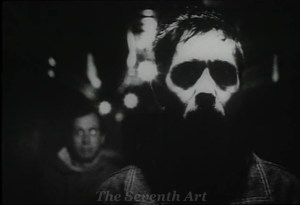 Who would have thought that one could make a sci-fi masterpiece in just 27 minutes? Well, I didn’t. I was wrong. La Jetée (1962) has left behind it, a legacy that many filmmakers have attempted to inherit, time and again, through the years. Its vision of the future of the world and its inhabitants – a sunless earth, cold expressionless faces and almost machine like emotional states – and the possibilities of experiment with cinematic and real time, that it has opened up, have become almost a standard template for sci-fi movies. If only a certain movie monument wasn’t made six years later, La Jetée, hands down, would stand out as the greatest sci-fi film ever made. The surprising fact is that the script of the film wasn’t adapted from some visionary short story, but one written loosely and directly for the screen by Chris Marker, the director, himself. And further, the script is just a minor contributor to the film’s success. Here is the thing: The word has been destroyed by the ominous nuclear war and humans are forced to stay underground. The “victors” of the war are trying to find a way to contact the past and the future of mankind to prevent the imminent annihilation of the human race. One of the lab rats for this is The Man (Davos Hanich), who retains vivid memories of his childhood and carries with himself, puzzles from the troubled past.
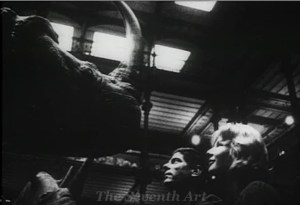 There is a remarkable scene in La Jetée where The Woman points at a cross-section of the tree trunk to denote her age. The Man jokingly (and self-referentially) points at a region outside the periphery of the trunk suggesting that he is from the future. This scene isn’t just an isolated homage to Vertigo (1958), but one of the many indicators that La Jetée is, in fact, laid on the very themes of Hitchcock’s film. Plainly, both films could well be seen as subjective accounts of treatments of psychological inhibitions – acrophobia and depression. In Vertigo, Scottie is a man who has lost his beloved (and whose face hypnotizes him for some reason) in an accident and is determined to reanimate her back to life, no matter what it takes. The Man, here, is no different from Scottie. The Woman could well be dead too (as he, also, suggests at one point). The Man’s tools for this “ritual” of resurrection are his memories and experiences, because of which he too, like Scottie, is nudged into the vicious cycle (rather, the Vertigo spiral) of resurrection and loss. In another extended sequence in La Jetée, The Man and The Woman visit a museum where stuffed animals are kept as exhibits. The range of animals there – giraffes, elephants and rhinos – make it seem more like a zoo than a hunter’s exhibition. The couple watches them with utmost fascination. Marker photographs the animals and the couple as if they were on the opposite sides of a mirror. There is great contradiction at work here. Are these live animals trapped in a time frame that is outside their own or are these really dead creatures resurrected back to life by some passionate enthusiast? Either way, they only reinforce that The Man and The Woman are, in fact, one of them.
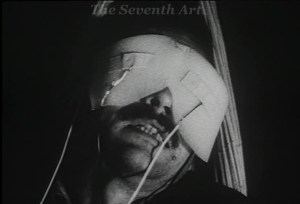 But it is Marker’s use of still images for his narration, almost entirely throughout, that is the masterstroke. He could have used muted motion clips, but that would have added no vitality to the themes of the film. The Man is forced to go back to his past, even after all those traumatizing events of the world. Predictably, his memory is fragmented, much like the images of the film. He synthesizes his “past” from his subsequent experiences, passionate fantasies and remaining shards of memory. His memory seems to document, eventually, not how the events were, but how he wants to believe they were. Marker uses an array of match cuts to emphasize the dependence of The Man’s memory and vision of past on the present state of his mind and of the world. In a critical scene in the film, The Man and The Woman visit a museum where they observe stone sculptures with missing heads or other parts of their bodies. Just then, an apparently tormented face in the sculptures is juxtaposed with The Man’s own distressed countenance. Are these the just figures of ancient art or are these “products” of the mutilated bodies of the war that The Man witnesses? Most of Marker’s images are spontaneous, with each of them seeming like a freeze-frame ending for intense moments. Each of these images seems like straight out of a dark comic book, with tension and horror oozing out of each pixel. Each one carries with it a past and a future that is as troubling as The Man’s own. Interestingly there is one single shot where motion photography is employed. The Woman, after assuming various poses during sleep, opens her eyes gradually. This is, perhaps, the only time where The Man really feels alive, witnessing movement, hence freedom and hence life. The only moment of escape from his physical existence in a world trapped under the surface of the earth – a world where people don’t live, they exist, a world where they don’t die, they expire.
 Ingmar Bergman’s Persona (1966) isn’t like anything I’ve seen of his other works – perhaps the first time I’ll replace the word ‘meticulous’ with ‘avant-garde’ when describing his films. The film follows two women – Elisabet Vogler (the luminous Liv Ullman), an actress who has deliberately pushed herself into a shell of silence and Sister Alma (Bibi Andersson), her young nurse – on an isolated island where each others’ desires, fears, agonies and memories unfold. Although fraught with elements apt for traditional character analyses, including the famous character switch trick that scriptwriters love, Persona manages to avoid the trap that the Bergman has partly set for himself through his previous films. Suitably imbibing elements of the modernist mode of cinema championed by the New Wave, Bergman creates a confounding work that is as rich in its implications and as cinematic in its execution as his previous films.
 Furthermore, they act as the audiences of the respective cinemas as well. Elisabet watches Alma dispassionately, never reacting even to the most dramatic gestures and words of the latter. She seems completely devoid of external emotions. She alienates both herself from Alma and Alma from her. Alma, however, complements Elisabet with her excessive sentimentality and expressiveness. Contrary to Elisabet, she tries to involve herself with Elisabet and even expects her to react to her misery. Alma’s need for an emotional response is indeed adversarial to Elisabet’s intellectual reply. This complementarity is more than just literary. Bergman often cuts from one character to the other in a pattern that establishes them as mirror images, obeying eye-line matches. The characters wear opposite coloured clothes. Bergman frames his shots in such a way that one of the characters superimposes over the other as if obtaining a hybrid. In a notable scene, Alma threatens Elisabet with a bowl of boiling water, upon which the latter reacts with the only words she ever speaks in the film. Alma, like many who disapprove of the modernists’ self-indulgence, even tries to expose Elisabet’s “pretentiousness” (“You’re acting healthy. You do it so well everyone believes you. Everyone except me, because I know how rotten you are.” she says).
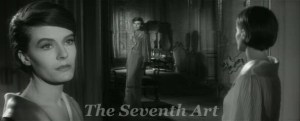 Right from its title, Last Year at Marienbad (1961) spells ambiguity. Neither does the film refer to a place called Marienbad, nor is it sure if the events that the protagonists, X the man (Giorgio Albertazzi) and A the lady (Delphine Sevrig), talk about took place the previous year. Last Year at Marienbad takes place in an ornate French chateau and unfolds as a conversation between X and A – a very repetitive one at that (at least, that is how it looks like!). X insists that he had met A last year when she promised that they would elope if only he waited for a year. But that’s about all the information that the film provides us. We hear X and A carrying on the same conversation, in one tone or the other, for the rest of the film. We see them moving about the chateau, gazing at the mannequin-like guests who seem to be able to speak and shut up according to the whims of X and A. Resnais superimposes every possible permutation of the characters’ forms, – past, present, memories, fantasies and possibilities – appearances – in black, in white – and locations – the chateau, the garden, the room and the bar – to produce a one-of-a-kind work that turns the very tenets of narrative cinema that is builds on.
 One thing that is conclusive is that Resnais uses the chateau as a visual manifestation of the human memory. He uses parallel, rigid and clearly defined structures for the interiors of the chateau. The hedgerows in the garden are pruned to perfection and show symmetry and clarity of position and shape. Resnais’ geometry spells determination and factuality and is anything but ambiguous, like the black and white of the film. The man, who persuades the woman to walk with him through the ominous corridors and staircases of the each other’s memories, mentions at one point: “At first glance, it seemed impossible to get lost in them along the straight paths”. Unfortunately, it is only the inanimate that are static. The humans in the chateau, their relation to their surroundings, their actions, their mentality and their appearances keep changing. Like an attempt at the recollection of a distant memory, the mise-en-scene of a sequence regularly changes, filtering out the unnecessary, checking out possibilities, trying to get the perfect match of image, sound and sensation. Perhaps the term “stream of consciousness” suits Marienbad more than any other film.
 If there is a synonym for “iconoclasm” in cinema, it might well be Luis Buñuel. It’s almost as if it is a need for him to go against conventions and established practices, – social, cultural and cinematic – pick out their weak points and hit them so hard that their absurdities are exposed. I’m far from being qualified to make general statements (including the above) about Buñuel, but the few films I’ve watched of him provide a more than clear picture about his role as a cinema pioneer and a social critic. In the legendary debut work Un Chien Andalou (1929), Buñuel and Sali present us a plethora of images – ones that would be termed “Lynchian” nowadays – that refuse temporal and spatial continuity on which popular cinema thrived on at that time. Apart from a filmmaker’s impulse to break stereotypes, what Un Chien Andalou showed us was the way we looked at movies and the elements of cinema that we had taken for granted. The conventional viewer, who tries to assemble the images into some form of theme or narrative, would invariably fail.
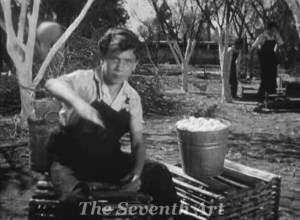 The children in the classic Neo-realist films were sympathetic and often pawns of fate or power plays. Buñuel’s Pedro is also a product of his environment and the prejudices against him. But that does not mean all of Buñuel’s kids are sympathy-magnets. Most of them are, in fact, instigators of social disturbances that the “neo-realist kids” are subjected to. Buñuel breaks away from that “objective gaze” of the Italian pioneers and takes us on a tour into the subconscious world of his protagonists. Moreover, Buñuel questions the moral integrity of its protagonists, or rather does away with that concern completely (Buñuel apparently wanted to put an orchestra as the backdrop to some major scenes which would have broken another tenet of the Italians). But all this subversiveness isn’t just a product of a desperate need to break rules. What Buñuel does here is, like he did in his first two movies, that he exposes the inherent flaws of a cinema movement. In other words, Los Olvidados is a critique of a way of filmmaking written in the form of a film. Buñuel takes up neo-realism in order to explode it from within and boy, does he succeed! In one of the greatest shots in film history, Pedro, in his reformatory, throws an egg at the soberly observing camera. – An in-your-face advice given by the director asking the neo-realists to cease the nonparticipation and do something about it all. Buñuel has driven the final nail into the coffin of Neo-realism.
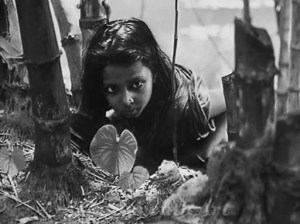 Based on a book by Bibhutibhushan Bandopadhyay, Pather Panchali is a series of loosely knit episodes in a poor Brahmin family in rural Bengal. Harihar (Kanu Banerjee) is a priest who also dabbles in play writing. His wife, Sarbojaya (Karuna Banerjee) manages the household and her two children Durga (Uma Das Gupta) and Apu (Subir Banerjee). There is also their old “aunt” Indir (Chunibala Devi) who loves eating the fruits given to her by Durga. Then there are their neighbours, the well-off Mukherjees, who share a love-hate relationship with their family. Mrs. Mukherjee helps out when Durga falls sick almost as her surrogate mother (as Ray hints early in his mise en scène) and Sarbojaya does the cooking in Mrs. Mukherjee’s daughter’s wedding. It’s a warm and isolated little world of theirs.
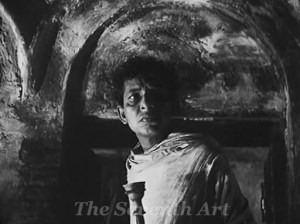 The neo-realists strongly emphasized that the neo-realist filmmaker be just a passive observer of reality without imposing his interpretations on it. That whatever the situation of their characters, – glory or misery – the filmmaker must maintain objectivity, always subordinating reason to action. Although many of the staunch neo-realists themselves couldn’t achieve this complete objectivity, they did attempt to do so in theory. However, in Pather Panchali, Ray never claims to be a mere observer. It is true that he does not comment on the characters’ actions and situation or throw hints to the audience so as to tell them what to feel. But that does not mean Ray does not take a stance (or a neutral stance for that matter). Ray is biased for sure, but not towards his characters but towards life itself. He takes immense joy in infusing life on to the screen and providing a channel of hope to his protagonists. Quite in contention with the neo-realist theory, Ray does not hesitate using Pt. Ravi Shankar’s soundtrack generously (but not without much caution) or in concocting sequences with a tinge of humour.
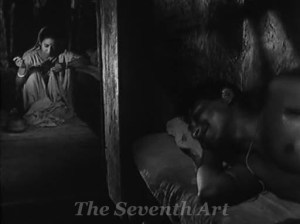 Like La Strada (another victim of the neo-realist baptism), that was as much away from its purely neo-realist contemporaries as it was close to them, Ray marries the neo-realist objectivity that avoids hyperbole and his own subjective view of life producing what may be, like Fellini’s film, called “neo-realism with a heart”. But again, Ray absorbs and deviates. Where, like many a film of later years, La Strada compares a road trip to life, Pather Panchali compares life to a road trip. Ray treats life as an inevitable journey which should go on no matter how shattering its events are. He punctuates his film with images of little roads through the woods and of characters arriving or departing from the village. In other words, Satyajit Ray presents life as a train journey where passengers may come and passengers may go, but the train itself never stops. Ray wasn’t kidding when he put that train in Pather Panchali – a train that Durga never manages to get on and one that Apu would, in Aparajito (1957), my favorite film of the trilogy.
 Mrs. Mukherjee confiscates the family’s grove as a penalty for the failure of repayment of loan. Later, the people of the village persuade Harihar to stay and tell him that this place is their ancestral land. It is as if the people of the village have assumed the land to be theirs despite of the fact that it was already there much before them. Ray touches upon the conflict between man and nature that has been dear to so many filmmakers before and after him. And this is where Pather Panchali gets deeper than meets the eye. Exactly like Herzog would do in
  Sansho the Bailiff cuts back to the last millennium to tell the tale of Zushio and Anju, children of a deposed governor whose only mistake was compassion towards his subjects. With the governor forced into exile, the children and their mother have to make their way into the neighbouring country, along with their faithful maid. But it is fate that decides their course and they find themselves separated into and by islands in no time. Mother is traded as a courtesan and the children sold as slaves to a rich man named Sansho. Years pass by as the kids assume a new identity. Zushio seems be moving closer to Sansho’s principles than his fathers’, mirroring Sansho’s son who refuses to take up his father’s job and becomes a monk. The only hope for his redemption lies in his sister’s faith in better times and in his own memory of the past.
 Mizoguchi, technically handicapped in comparison to Kubrick, gloriously achieves the same effect and, more importantly, in a decidedly “Japanese” fashion. As clarified in the opening quote (“This tale is set during the late Heian period an era when mankind had not yet awakened as human beings. It has been retold by the people for centuries and it is treasured today as one of the world’s great folk tales, full of grief.”), Mizoguchi, too, proclaims that the story is of the past – over and done with, its outcome fixed. Again, within the film he furnishes detail using direct flashbacks or visual fragments from the past. Contrary to Kubrick’s motionlessness, Mizoguchi’s camera tracks, pans and rises in a spectacular fashion (the shot in the manor after the slaves over is strangely reminiscent of
  The only hope that Mizoguchi presents in the film is by situating the tale in the past – by providing an apparent relief that all the pain and suffering is over and humanity has been discovered (“…an era when mankind had not yet awakened as human beings.”). But reading the opening quote once more, one can feel a strong vein of sarcasm running through. Is Mizoguchi decidedly making it a period drama? Or is there something more “present” to the tale? To clarify my doubts, I looked up the internet about the situation in post-war Japan. Not very surprisingly, I discovered that there indeed were atrocities committed by the occupying forces in the country during the post-war period and also a foundation known as
 Pick up the ordinary film that chronicles the rise of fascism prior to the second world war and you know what to expect – a nation penalized for the first war, a corporal in resentment, his becoming a key figure, formation of ideology, those mesmerizing speeches, rise to power and finally, the ruthless extermination of humans. Well, you know the routine. Rare is the case that such a film is historically inaccurate or morally flawed, but what is troubling is that a single person is made the focal point of such monumental passages of history – as if satisfying our need for a villain as we do for a hero. Not that I am in defense of any such individual, but how on earth can a single person independently cause the galvanization of a whole nation? However convincing his words and however significant his moves are, it is finally the mass and the intentions that run through it that make it possible. From what can be seen as an adversarial position, Béla Tarr’s Werckmeister Harmonies (2000) chillingly exposes the other side of the loudspeaker – a film that is to the ordinary documentary what Goodfellas (1990) is to The Godfather (1972).
 In the film, The Prince apparently quotes that people who are afraid do not understand. Tarr too seems to be concerned with the notion of fear, ignorance and violence being stimulants of fascism and presents them as the three sides of a triangle with each one perpetuating the others. Being the Wong Kar Wai of monochrome, Tarr employs black and white colours extensively and in an expressionistic fashion to juggle with the ideas of ignorance and knowledge, fear and courage and war and peace. János’ shuttling between his desire to learn and the inertia imposed upon him by the townsfolk culminates in his witnessing of the inevitable streak of violence. In what may be one of the most effective and chilling depiction of violence in cinema, we see the rabid folks enter a hospital and put down its inhabitants. There is complete detachment by the camera which continues to track away as ever to leave a lump in your throat. It’s a sequence that is so stunningly choreographed that it almost deserves to be called beautiful despite its nature.
 The Seventh Art