Los Olvidados (1950) (aka The Young And The Damned)
Luis Buñuel
Spanish
“Watch out, here’s the mangy dog. Look, he’s coming. That’s it. I’m falling into the black hole. I’m alone. Alone! As always, boy, as always… “
 If there is a synonym for “iconoclasm” in cinema, it might well be Luis Buñuel. It’s almost as if it is a need for him to go against conventions and established practices, – social, cultural and cinematic – pick out their weak points and hit them so hard that their absurdities are exposed. I’m far from being qualified to make general statements (including the above) about Buñuel, but the few films I’ve watched of him provide a more than clear picture about his role as a cinema pioneer and a social critic. In the legendary debut work Un Chien Andalou (1929), Buñuel and Sali present us a plethora of images – ones that would be termed “Lynchian” nowadays – that refuse temporal and spatial continuity on which popular cinema thrived on at that time. Apart from a filmmaker’s impulse to break stereotypes, what Un Chien Andalou showed us was the way we looked at movies and the elements of cinema that we had taken for granted. The conventional viewer, who tries to assemble the images into some form of theme or narrative, would invariably fail.
Buñuel’s follow up to the first authoritative surrealist film, L’Âge D’or (1930) also shattered conventions, but of a different kind. Apart from employing an experimental structure of the script, Luis Buñuel lashes out at the ultra-prudish morals of the hypocritical aristocracy and our own obsession with sex. Fraught with perplexing and often teasing images, L’Âge D’or confirmed Buñuel’s position as an auteur and more importantly, as a genuine firebrand. His definitive comeback film, which he made in Mexico after years of puzzling silence, Los Olvidados (1950) is no less unorthodox. After turning Hollywood and Expressionist form of filmmaking inside out in his first two features, it looks like Buñuel had deliberately waited for the next big film movement to establish itself. With Neo-realism rising to power after the war, backed by many critics and theorists, it was but a opportune moment for enter the scenario and create chaos.
Los Olvidados opens with the following lines:
“Almost every capital, like New York, Paris, London, hides behind its wealth, poverty-stricken homes where poorly-fed children, deprived of health or school, are doomed to criminality. Society tries to provide a cure. Success for its efforts remains very limited. The future is not bound to the present: The day will come when children rights are respected. Mexico, large modern city, is no exception to the rule. This film shows the real life. It’s not optimistic. The solution to this problem is left to the forces of progress.”
Following this declaration of depiction of reality, Buñuel cuts to the streets where we see a bunch of noisy kids playing. The setting is apt for another neorealist feature – kids on the streets, the scorching heat and images of massive reconstruction. Los Olvidados follows the life of Pedro, a street urchin and the other children of the locality he spends his time with – Jaibo, the eldest of the lot who ultimately shapes Pedro’s life, Ojitos aka Small Eyes, a lost kid from the country side and Julian, the only “responsible” person in the gang. The film’s content proceeds from being raw, to cruel, to immoral, to misanthropic and culminates in traumatizing despair.
The older people in Los Olvidados are either sick, perverted, physically challenged or drunk. And the young are no good. But their worlds are not, by any stretch of imagination, mutually exclusive. The youth abstain from responsibility and abuse their agility and power. They could easily be labeled Les Enfants Terrible and Mexico, no country for old men. However, there are no angels in Buñuel’s land. The hypocritical seniors, on the other hand, judge them in plurality. They carry on with their old traditions and spend time cheating each other and cursing the younger ones (The blind Don Carmelo, the first victim of the brats’ “ultraviolence”, supplements his street music with his witch-doctor act). The only neutral elements of the film – the police and the judiciary, possibly representing the bourgeoisie – spend time philosophizing about poverty and the urgent need to eradicate it. This isn’t just a generation gap. What we have here is two competing and almost internecine worlds that refuse to conform.
Buñuel applies magnanimous amounts of violence – both simulated and otherwise – to the already unnerving realism of Mexico streets that is sure to make stomachs churn, especially now that CG has made us numb to everyday violence. But Buñuel’s violence is all the more unsettling, than say A Clockwork Orange (1971), because imminence of its possibility. Kubrick’s mystical and often anti-realistic setting prevents the barbarism of the Droogs to seep into the present and the film itself is, at its best, prophetic. Buñuel, on the other hand, exploits the neo-realist premise to situate the events in the tangible present and, as the opening statement of the film says, universalize the hypothesis. The fact that the victims are the violence are the physically challenged, the “morally” good and children makes it exceptionally scandalous to bourgeois sensibilities. Coexisting with the neorealist wave was film-noir craze where (also) the grey heroes never hesitated to pull the trigger unwarrantably. But even there, the victims themselves were like the protagonists – always carrying with them a fair reason to get killed – thus causing no harm to the existing moral framework.
But Buñuel’s world isn’t an appeasing aquarium which can be gazed at from a safe distance. He gets close to the characters, much more than the neo-realists, even giving us glimpses of their dreams but always eschewing psychoanalysis. Nor does he have one-to-one relation between images and their meaning. The chickens that appear throughout the movie may be a symbol that stands for some deeper meaning or a token for entry into the surreal from the real or plainly, a chicken. Like the eye-slitter of Un Chien Andalou or the cow in the bedroom gag of L’Âge D’or, Buñuel shocks us with one inexplicable image after the other, eventually pushing us to a “zone of no reasoning”, after which one just has to accept the reality that he gives us without questions. “This film shows the real life” says the title monologue. “Reality” here is tricky. It is Buñuel’s reality. He is happy to indulge himself into reality that is not just skin deep. And this is where Buñuel departs from and slays Neorealism.
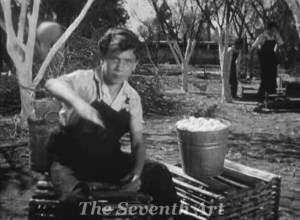 The children in the classic Neo-realist films were sympathetic and often pawns of fate or power plays. Buñuel’s Pedro is also a product of his environment and the prejudices against him. But that does not mean all of Buñuel’s kids are sympathy-magnets. Most of them are, in fact, instigators of social disturbances that the “neo-realist kids” are subjected to. Buñuel breaks away from that “objective gaze” of the Italian pioneers and takes us on a tour into the subconscious world of his protagonists. Moreover, Buñuel questions the moral integrity of its protagonists, or rather does away with that concern completely (Buñuel apparently wanted to put an orchestra as the backdrop to some major scenes which would have broken another tenet of the Italians). But all this subversiveness isn’t just a product of a desperate need to break rules. What Buñuel does here is, like he did in his first two movies, that he exposes the inherent flaws of a cinema movement. In other words, Los Olvidados is a critique of a way of filmmaking written in the form of a film. Buñuel takes up neo-realism in order to explode it from within and boy, does he succeed! In one of the greatest shots in film history, Pedro, in his reformatory, throws an egg at the soberly observing camera. – An in-your-face advice given by the director asking the neo-realists to cease the nonparticipation and do something about it all. Buñuel has driven the final nail into the coffin of Neo-realism.
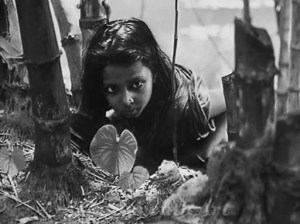 Based on a book by Bibhutibhushan Bandopadhyay, Pather Panchali is a series of loosely knit episodes in a poor Brahmin family in rural Bengal. Harihar (Kanu Banerjee) is a priest who also dabbles in play writing. His wife, Sarbojaya (Karuna Banerjee) manages the household and her two children Durga (Uma Das Gupta) and Apu (Subir Banerjee). There is also their old “aunt” Indir (Chunibala Devi) who loves eating the fruits given to her by Durga. Then there are their neighbours, the well-off Mukherjees, who share a love-hate relationship with their family. Mrs. Mukherjee helps out when Durga falls sick almost as her surrogate mother (as Ray hints early in his mise en scène) and Sarbojaya does the cooking in Mrs. Mukherjee’s daughter’s wedding. It’s a warm and isolated little world of theirs.
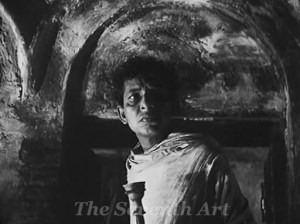 The neo-realists strongly emphasized that the neo-realist filmmaker be just a passive observer of reality without imposing his interpretations on it. That whatever the situation of their characters, – glory or misery – the filmmaker must maintain objectivity, always subordinating reason to action. Although many of the staunch neo-realists themselves couldn’t achieve this complete objectivity, they did attempt to do so in theory. However, in Pather Panchali, Ray never claims to be a mere observer. It is true that he does not comment on the characters’ actions and situation or throw hints to the audience so as to tell them what to feel. But that does not mean Ray does not take a stance (or a neutral stance for that matter). Ray is biased for sure, but not towards his characters but towards life itself. He takes immense joy in infusing life on to the screen and providing a channel of hope to his protagonists. Quite in contention with the neo-realist theory, Ray does not hesitate using Pt. Ravi Shankar’s soundtrack generously (but not without much caution) or in concocting sequences with a tinge of humour.
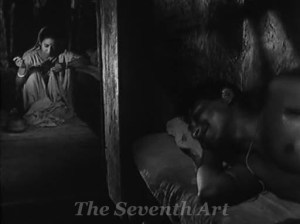 Like La Strada (another victim of the neo-realist baptism), that was as much away from its purely neo-realist contemporaries as it was close to them, Ray marries the neo-realist objectivity that avoids hyperbole and his own subjective view of life producing what may be, like Fellini’s film, called “neo-realism with a heart”. But again, Ray absorbs and deviates. Where, like many a film of later years, La Strada compares a road trip to life, Pather Panchali compares life to a road trip. Ray treats life as an inevitable journey which should go on no matter how shattering its events are. He punctuates his film with images of little roads through the woods and of characters arriving or departing from the village. In other words, Satyajit Ray presents life as a train journey where passengers may come and passengers may go, but the train itself never stops. Ray wasn’t kidding when he put that train in Pather Panchali – a train that Durga never manages to get on and one that Apu would, in Aparajito (1957), my favorite film of the trilogy.
 Mrs. Mukherjee confiscates the family’s grove as a penalty for the failure of repayment of loan. Later, the people of the village persuade Harihar to stay and tell him that this place is their ancestral land. It is as if the people of the village have assumed the land to be theirs despite of the fact that it was already there much before them. Ray touches upon the conflict between man and nature that has been dear to so many filmmakers before and after him. And this is where Pather Panchali gets deeper than meets the eye. Exactly like Herzog would do in
  Sansho the Bailiff cuts back to the last millennium to tell the tale of Zushio and Anju, children of a deposed governor whose only mistake was compassion towards his subjects. With the governor forced into exile, the children and their mother have to make their way into the neighbouring country, along with their faithful maid. But it is fate that decides their course and they find themselves separated into and by islands in no time. Mother is traded as a courtesan and the children sold as slaves to a rich man named Sansho. Years pass by as the kids assume a new identity. Zushio seems be moving closer to Sansho’s principles than his fathers’, mirroring Sansho’s son who refuses to take up his father’s job and becomes a monk. The only hope for his redemption lies in his sister’s faith in better times and in his own memory of the past.
 Mizoguchi, technically handicapped in comparison to Kubrick, gloriously achieves the same effect and, more importantly, in a decidedly “Japanese” fashion. As clarified in the opening quote (“This tale is set during the late Heian period an era when mankind had not yet awakened as human beings. It has been retold by the people for centuries and it is treasured today as one of the world’s great folk tales, full of grief.”), Mizoguchi, too, proclaims that the story is of the past – over and done with, its outcome fixed. Again, within the film he furnishes detail using direct flashbacks or visual fragments from the past. Contrary to Kubrick’s motionlessness, Mizoguchi’s camera tracks, pans and rises in a spectacular fashion (the shot in the manor after the slaves over is strangely reminiscent of
  The only hope that Mizoguchi presents in the film is by situating the tale in the past – by providing an apparent relief that all the pain and suffering is over and humanity has been discovered (“…an era when mankind had not yet awakened as human beings.”). But reading the opening quote once more, one can feel a strong vein of sarcasm running through. Is Mizoguchi decidedly making it a period drama? Or is there something more “present” to the tale? To clarify my doubts, I looked up the internet about the situation in post-war Japan. Not very surprisingly, I discovered that there indeed were atrocities committed by the occupying forces in the country during the post-war period and also a foundation known as


 Pick up the ordinary film that chronicles the rise of fascism prior to the second world war and you know what to expect – a nation penalized for the first war, a corporal in resentment, his becoming a key figure, formation of ideology, those mesmerizing speeches, rise to power and finally, the ruthless extermination of humans. Well, you know the routine. Rare is the case that such a film is historically inaccurate or morally flawed, but what is troubling is that a single person is made the focal point of such monumental passages of history – as if satisfying our need for a villain as we do for a hero. Not that I am in defense of any such individual, but how on earth can a single person independently cause the galvanization of a whole nation? However convincing his words and however significant his moves are, it is finally the mass and the intentions that run through it that make it possible. From what can be seen as an adversarial position, Béla Tarr’s Werckmeister Harmonies (2000) chillingly exposes the other side of the loudspeaker – a film that is to the ordinary documentary what Goodfellas (1990) is to The Godfather (1972).
 In the film, The Prince apparently quotes that people who are afraid do not understand. Tarr too seems to be concerned with the notion of fear, ignorance and violence being stimulants of fascism and presents them as the three sides of a triangle with each one perpetuating the others. Being the Wong Kar Wai of monochrome, Tarr employs black and white colours extensively and in an expressionistic fashion to juggle with the ideas of ignorance and knowledge, fear and courage and war and peace. János’ shuttling between his desire to learn and the inertia imposed upon him by the townsfolk culminates in his witnessing of the inevitable streak of violence. In what may be one of the most effective and chilling depiction of violence in cinema, we see the rabid folks enter a hospital and put down its inhabitants. There is complete detachment by the camera which continues to track away as ever to leave a lump in your throat. It’s a sequence that is so stunningly choreographed that it almost deserves to be called beautiful despite its nature.
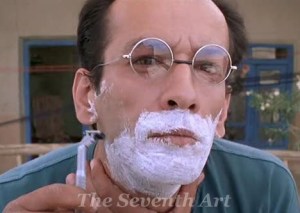 More than the apparent issue of communication and the lack of it, The Wind Will Carry Us seeks to question the definition of communication. Sure, the protagonist Behzad (played to perfection by Behzad Dorani) does have a cellular phone and the speedy vehicle to move around, but what was the use of it all? He is shortsighted in more ways than one and seems to forget details that he had voluntarily gathered moments ago (Ironically, the villages consider him to be a telecommunications engineer!). The villagers, on the other hand, are scientifically handicapped but that seems to be utterly insignificant. They commute very easily, they have multiple paths to the same destination for easy or quick access and they seem to be able to even move vertically though the village using ladders and the serpentine alleys. They seem to know who lives where and at what distance a resource is to be found. This partly is reflected in their priorities in life and their attitudes towards it – gratefulness for the present and a reverence for the future.



 The Seventh Art